ACID AND BASE
Venkata Kumar Sahu
Pharmaceutical Analysis
OBJECTIVE:
• 1. To Understand the Definitions of Acid and
Base
• 2. To learn theories of acid and base
Common Lab acids
Common Lab Bases
Every day example of Neutralization
Indigestion remedies are bases that
neutralise excess stomach acid
Toothpaste is a base that neutralises
acid in the mouth
Lewis Theory
A Lewis acid is an electrophilic species that accepts a pair of electrons
from ions or molecules.
A Lewis base is a nucleophilic species that donates a pair of electrons to
ions and molecules.
Lewis acid and base can react with one another by transferring electrons to
form a covalent bond resulting in a simple or complex molecular structure.
The product formed by a Lewis acid-base reaction is known as adduct
Mechanism
Lewis Acid and Base
Examples of Lewis Acid and Base
Lewis acid can be
• Any cation that can accept
electron pair: H+, Mg2+, Fe3+,
NH4
+, and H3O+
• Any molecule with an incomplete
octet of electrons: BF3 and AlCl3
• Any molecule where the central
atom can have more than 8
electrons in its valence shell:
SiCl4 and SiF4
• Any molecule that can have
multiple bonds between two
atoms of different
electronegativity: CO2 and SO2
•
Lewis base can be
• Any simple anion that can give
up a lone pair of electrons: O2-,
Cl–, F–, and H–
• Any anionic species containing
a lone pair of electrons: OH–,
CN–, CH3
–, and SO4
2-
• Any molecule with an extra
pair or pairs of electrons: H2O,
NH3, and C(CH3)Cl
• Any electron-rich pi system:
benzene (C6H6), ethylene
(C2H4), and ethyne (C2H2)
•
APPLICATION
Applications of Lewis
Acid
• Friedel-Crafts alkylation
reaction
(method of generating alkylbenzenes by using alkyl
halides as reactants)
Applications of Lewis
Base
• Formation of ligands
• Modification of metallic
catalyst
• Form bonds with Lewis
acids to produce
chelating agents
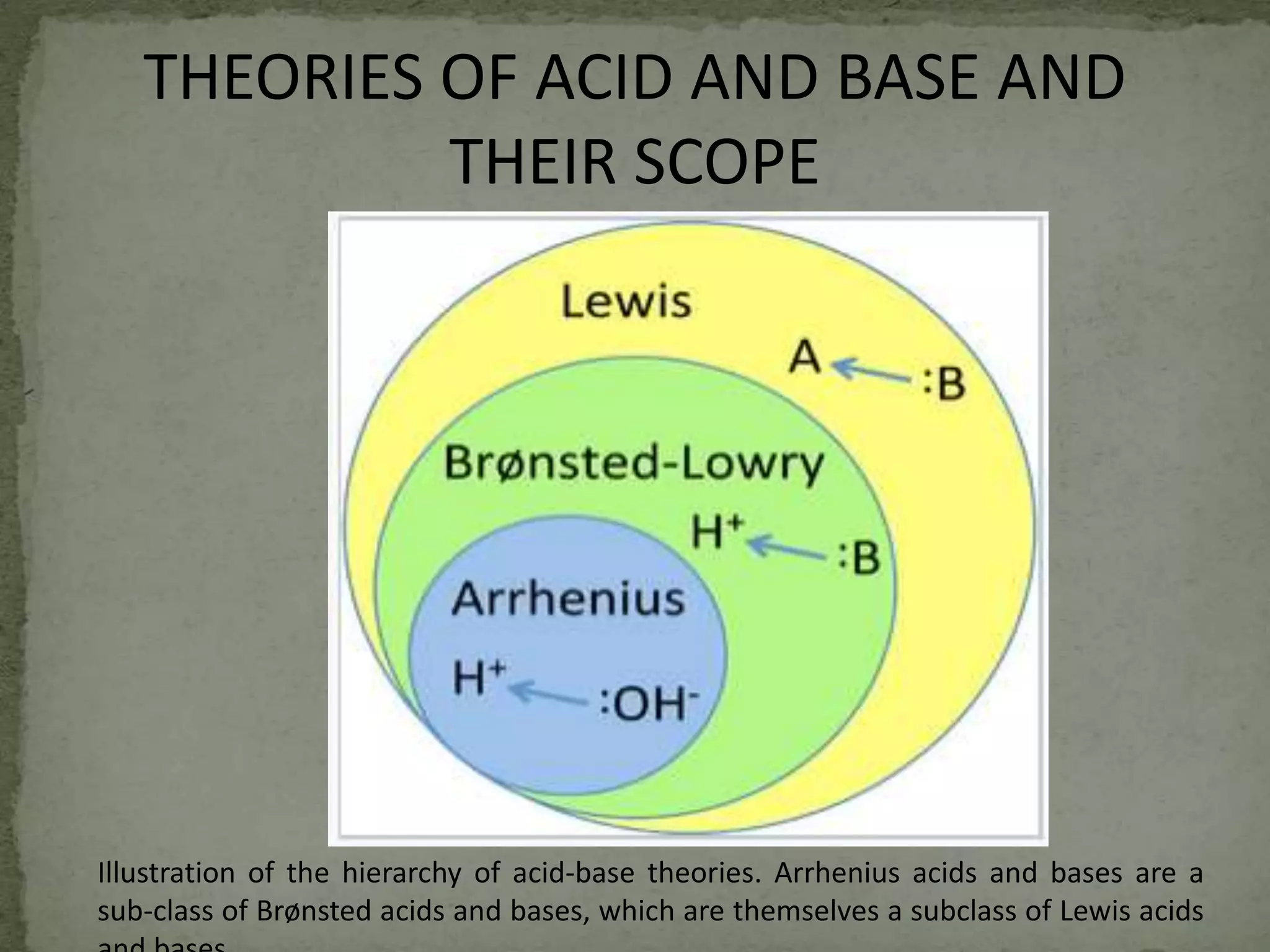
THEORIES OF ACID AND BASE AND
THEIR SCOPE
Illustration of the hierarchy of acid-base theories. Arrhenius acids and bases are a
sub-class of Brønsted acids and bases, which are themselves a subclass of Lewis acids
USANOVICH THEORY
Usanovich (1934) modified the Lewis concept of acid and base by removing
the restriction of either donation or acceptance of the electron pair in a more
generalized fashion.
Acid : It is a chemical species that reacts with a base thereby giving up
cations or accepting anions or electrons.
Base : It is a chemical species that reacts with an acid thereby giving up
anions or electrons or combines with cations
Usanovich’s concept in a much broader sense includes all the oxidizing agents
as acids and the reducing agents as bases, e.g.,
LUX-FLOOD CONCEPT
The concept of acid-base reactions with respect to the oxide ion was first
introduced by Lux (1929) and supported by Flood (1947). According to the
Lux-Flood concept—‘an acid is the oxide-ion acceptor while a base is the
oxide donor’.
Merit:
This approach emphasizes the acid and basic-anhydride aspects. Acidic oxides
are acid anhydride and in the aqueous medium generate protonic acids,
while, basic oxides are basic anhydride and generate hydroxyl ions in the
aqueous medium.
Demerit:
The usefulness of this concept is limited to species that contain oxide ion.
The concept is applicable only in the molten state of an oxide.

acid base theory for Bpharm 1st year students

  • 1.
    ACID AND BASE VenkataKumar Sahu Pharmaceutical Analysis
  • 2.
    OBJECTIVE: • 1. ToUnderstand the Definitions of Acid and Base • 2. To learn theories of acid and base
  • 3.
  • 8.
  • 22.
    Every day exampleof Neutralization Indigestion remedies are bases that neutralise excess stomach acid Toothpaste is a base that neutralises acid in the mouth
  • 24.
    Lewis Theory A Lewisacid is an electrophilic species that accepts a pair of electrons from ions or molecules. A Lewis base is a nucleophilic species that donates a pair of electrons to ions and molecules. Lewis acid and base can react with one another by transferring electrons to form a covalent bond resulting in a simple or complex molecular structure. The product formed by a Lewis acid-base reaction is known as adduct
  • 25.
  • 26.
  • 27.
    Examples of LewisAcid and Base Lewis acid can be • Any cation that can accept electron pair: H+, Mg2+, Fe3+, NH4 +, and H3O+ • Any molecule with an incomplete octet of electrons: BF3 and AlCl3 • Any molecule where the central atom can have more than 8 electrons in its valence shell: SiCl4 and SiF4 • Any molecule that can have multiple bonds between two atoms of different electronegativity: CO2 and SO2 • Lewis base can be • Any simple anion that can give up a lone pair of electrons: O2-, Cl–, F–, and H– • Any anionic species containing a lone pair of electrons: OH–, CN–, CH3 –, and SO4 2- • Any molecule with an extra pair or pairs of electrons: H2O, NH3, and C(CH3)Cl • Any electron-rich pi system: benzene (C6H6), ethylene (C2H4), and ethyne (C2H2) •
  • 31.
    APPLICATION Applications of Lewis Acid •Friedel-Crafts alkylation reaction (method of generating alkylbenzenes by using alkyl halides as reactants) Applications of Lewis Base • Formation of ligands • Modification of metallic catalyst • Form bonds with Lewis acids to produce chelating agents
  • 32.
    THEORIES OF ACIDAND BASE AND THEIR SCOPE Illustration of the hierarchy of acid-base theories. Arrhenius acids and bases are a sub-class of Brønsted acids and bases, which are themselves a subclass of Lewis acids
  • 33.
    USANOVICH THEORY Usanovich (1934)modified the Lewis concept of acid and base by removing the restriction of either donation or acceptance of the electron pair in a more generalized fashion. Acid : It is a chemical species that reacts with a base thereby giving up cations or accepting anions or electrons. Base : It is a chemical species that reacts with an acid thereby giving up anions or electrons or combines with cations Usanovich’s concept in a much broader sense includes all the oxidizing agents as acids and the reducing agents as bases, e.g.,
  • 34.
    LUX-FLOOD CONCEPT The conceptof acid-base reactions with respect to the oxide ion was first introduced by Lux (1929) and supported by Flood (1947). According to the Lux-Flood concept—‘an acid is the oxide-ion acceptor while a base is the oxide donor’. Merit: This approach emphasizes the acid and basic-anhydride aspects. Acidic oxides are acid anhydride and in the aqueous medium generate protonic acids, while, basic oxides are basic anhydride and generate hydroxyl ions in the aqueous medium. Demerit: The usefulness of this concept is limited to species that contain oxide ion. The concept is applicable only in the molten state of an oxide.