Congestive Heart Failure M Chadi Alraies Thursday, January 3, 2008
Essentials of Diagnosis LV failure:  Exertional dyspnea, cough,  fatigue,  orthopnea,  PND,  cardiac enlargement,  rales,  gallop rhythm,  pulmonary venous congestion.  RV failure:  Elevated venous pressure, hepatomegaly,  dependent edema;
Types Systolic heart failure Diastolic heart failure High output heart failure Thyrotoxicosis,  Severe anemia,  Arteriovenous shunting (including dialysis fistulas),  Paget's disease of bone,  Thiamine deficiency (wet beriberi).
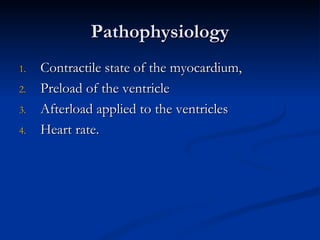
Pathophysiology Contractile state of the myocardium,  Preload of the ventricle  Afterload applied to the ventricles Heart rate.
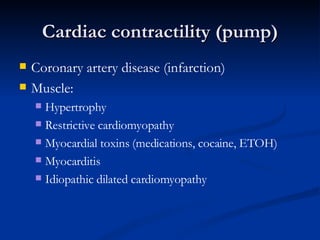
Cardiac contractility (pump)‏ Coronary artery disease (infarction)‏ Muscle: Hypertrophy Restrictive cardiomyopathy Myocardial toxins (medications, cocaine, ETOH)‏ Myocarditis Idiopathic dilated cardiomyopathy
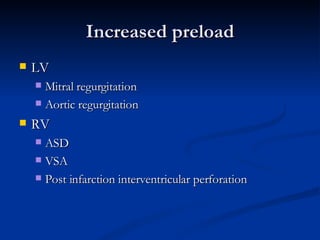
Increased preload LV Mitral regurgitation Aortic regurgitation RV ASD VSA Post infarction interventricular perforation
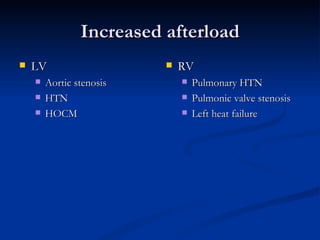
Increased afterload LV Aortic stenosis HTN HOCM RV Pulmonary HTN Pulmonic valve stenosis Left heat failure
Conduction system Bradycardia Tachycardia
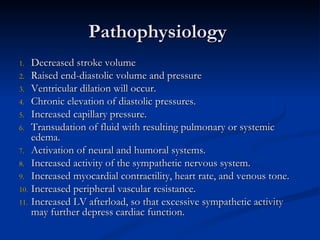
Pathophysiology  Decreased stroke volume Raised end-diastolic volume and pressure  Ventricular dilation will occur.  Chronic elevation of diastolic pressures. Increased capillary pressure. Transudation of fluid with resulting pulmonary or systemic edema.  Activation of neural and humoral systems.  Increased activity of the sympathetic nervous system. Increased myocardial contractility, heart rate, and venous tone. Increased peripheral vascular resistance. Increased LV afterload, so that excessive sympathetic activity may further depress cardiac function.
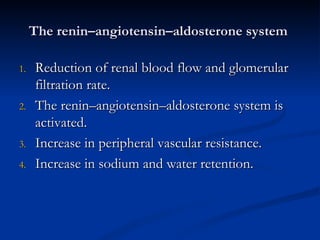
The renin–angiotensin–aldosterone system  Reduction of renal blood flow and glomerular filtration rate. The renin–angiotensin–aldosterone system is activated. Increase in peripheral vascular resistance. Increase in sodium and water retention.
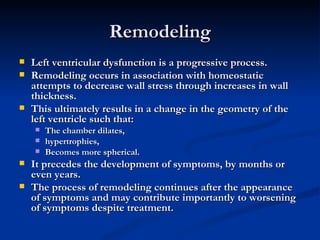
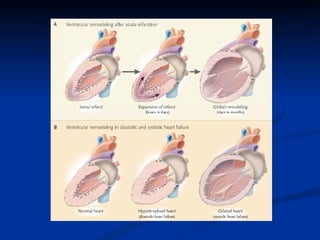
Remodeling Left ventricular dysfunction is a progressive process.  Remodeling occurs in association with homeostatic attempts to decrease wall stress through increases in wall thickness.  This ultimately results in a change in the geometry of the left ventricle such that:  The chamber dilates,  hypertrophies, Becomes more spherical. It precedes the development of symptoms, by months or even years.  The process of remodeling continues after the appearance of symptoms and may contribute importantly to worsening of symptoms despite treatment.
 
Causes Ischemic cardiomyopathy HTN DCM: ETOH Myocarditis (HIV)‏ Idiopathic Cardiotoxins Infiltrative cardiomyopathy (sarcoidosis, Amyloidosis, hemochromatosis)‏ Valvular hear disease.
Stages of HF
 
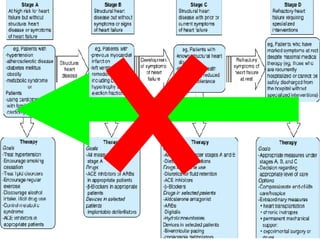
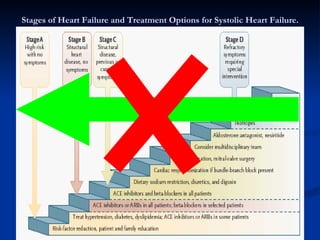
Stages of Heart Failure and Treatment Options for Systolic Heart Failure.
Symptoms LV failure:  Exertional dyspnea, Cough,  Fatigue,  Orthopnea PND Nocturia RV failure:  RUQ pain Loss of appetite Nausea Dependent edema
Exacerbations  Patient noncompliance Excessive salt and fluid intake Arrhythmias Excessive activity Pulmonary emboli Intercurrent infection Progression of the underlying disease.
New York Heart Association classification  I II III IV Has major limitations: Patient reports are highly subjective Symptoms vary from day to day.  Insufficiently sensitive to be useful in predicting outcomes or assessing the results of treatment.
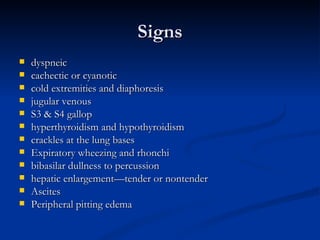
Signs dyspneic  cachectic or cyanotic  cold extremities and diaphoresis jugular venous  S3 & S4 gallop hyperthyroidism and hypothyroidism  crackles at the lung bases  Expiratory wheezing and rhonchi  bibasilar dullness to percussion  hepatic enlargement—tender or nontender  Ascites  Peripheral pitting edema
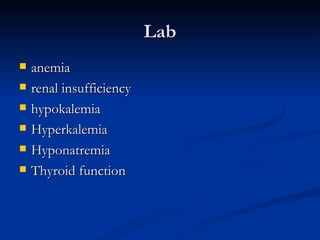
Lab anemia  renal insufficiency  hypokalemia  Hyperkalemia Hyponatremia Thyroid function
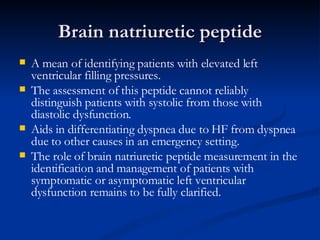
Brain natriuretic peptide A mean of identifying patients with elevated left ventricular filling pressures. The assessment of this peptide cannot reliably distinguish patients with systolic from those with diastolic dysfunction. Aids in differentiating dyspnea due to HF from dyspnea due to other causes in an emergency setting.  The role of brain natriuretic peptide measurement in the identification and management of patients with symptomatic or asymptomatic left ventricular dysfunction remains to be fully clarified.
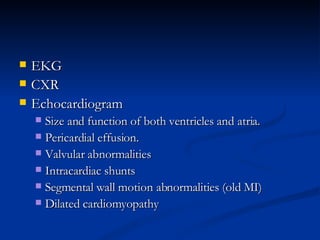
EKG CXR Echocardiogram Size and function of both ventricles and atria.  Pericardial effusion. Valvular abnormalities Intracardiac shunts Segmental wall motion abnormalities (old MI)‏ Dilated cardiomyopathy
CARDIAC CATHETERIZATION The combination of: Angina Noninvasive evidence of significant myocardial ischemia. Symptomatic heart failure.
Treatment
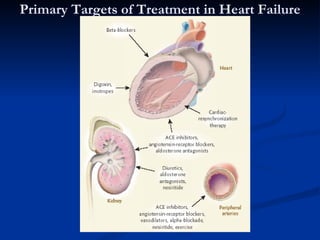
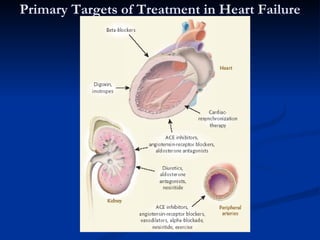
Primary Targets of Treatment in Heart Failure
Pharmacologic Treatment CORRECTION OF REVERSIBLE CAUSES: Valvular lesions Myocardial ischemia Uncontrolled hypertension Arrhythmias  Alcohol- or drug-induced myocardial depression Stop Calcium channel blockers, antiarrhythmic drugs, and NSAID’s
Diuretic therapy
Thiazides  Hydrochlorothiazide, metolazone, chlorthalidone.  Block sodium reabsorption in the cortical diluting segment at the terminal portion of the loop of Henle and in the proximal portion of the distal convoluted tubule  Thiazides are ineffective when the GFR falls below 30–40 mL/min.
Loop diuretics Furosemide, bumetanide and torsemide. Rapid onset and a relatively short duration of action  Two or more doses are preferable to a single larger dose.  Inhibit chloride reabsorption in the ascending limb of the loop of Henle, which results in natriuresis, kaliuresis, and metabolic alkalosis.
Potassium sparing diurestics Spironolactone, triamterene, and amiloride  Spironolactone is a specific inhibitor of aldosterone.
INHIBITORS OF THE  RENIN–ANGIOTENSIN–ALDOSTERONE  SYSTEM
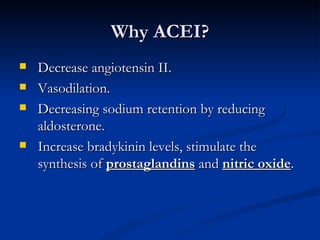
Why ACEI? Decrease angiotensin II. Vasodilation. Decreasing sodium retention by reducing aldosterone.  Increase bradykinin levels, stimulate the synthesis of  prostaglandins  and  nitric oxide .
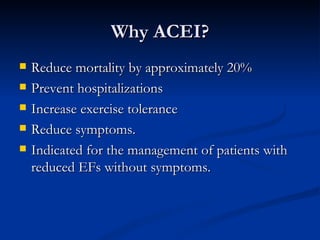
Why ACEI? Reduce mortality by approximately 20% Prevent hospitalizations Increase exercise tolerance Reduce symptoms. Indicated for the management of patients with reduced EFs without symptoms.
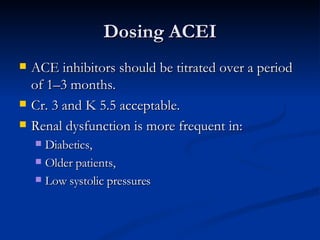
Dosing ACEI ACE inhibitors should be titrated over a period of 1–3 months. Cr. 3 and K 5.5 acceptable. Renal dysfunction is more frequent in: Diabetics,  Older patients,  Low systolic pressures
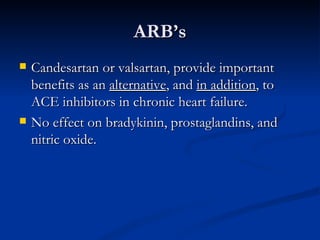
ARB’s Candesartan or valsartan, provide important benefits as an  alternative , and  in addition , to ACE inhibitors in chronic heart failure. No effect on bradykinin, prostaglandins, and nitric oxide.
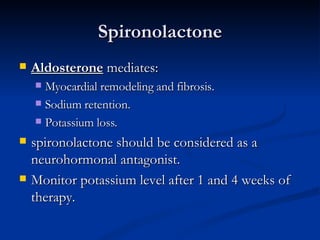
Spironolactone Aldosterone  mediates: Myocardial remodeling and fibrosis. Sodium retention. Potassium loss. spironolactone should be considered as a neurohormonal antagonist. Monitor potassium level after 1 and 4 weeks of therapy.
BB
BB chronic elevations of catecholamines and sympathetic nervous system activity cause progressive myocardial damage, leading to worsening LV function and dilation. stable  patients (defined as having no recent deterioration or evidence of volume overload) with  mild, moderate, and even severe  heart failure should be treated with a -blocker unless there is a noncardiac contraindication.
BB Ensure that they were free of fluid retention at the time of initiation. Initiation must be done gradually.
BB Start low and go slow
How to monitor BB? Patients should be instructed to monitor their weights at home. report any increase or change in symptoms immediately.  If heart failure worsens, this can usually be managed by increasing diuretic doses and delaying further increases. Carvedilol, because of its -blocking activity, may cause dizziness or hypotension. This can usually be managed by reducing the doses of other vasodilators and by slowing the pace of dose increases.
DIGITALIS GLYCOSIDES The only orally active positive inotropic agents.  Lack the benefits of the neurohormonal antagonists. Efficacy in reducing the symptoms of heart failure has been established. Digoxin should be used for patients who remain symptomatic when taking diuretics and ACE inhibitors as well as for patients with heart failure who are in atrial fibrillation and require rate control.
Vasodilators
Nitrates and Hydralazine Use this combination in addition to other effective therapies in African Americans with severe heart failure.  A-HeFT trial.
IV Nitrates Used primarily for acute or severely decompensated chronic heart failure, especially when accompanied by hypertension or myocardial ischemia.
Nesiritide Recombinant form of human brain natriuretic peptide, is a potent vasodilator that reduces ventricular filling pressures and improves cardiac output.
POSITIVE INOTROPIC AGENTS Dobutamine and milrinone. The role is limited to: Patients with symptoms and signs of low CO. No response to intravenous diuretics.  Maintain patients who are awaiting cardiac transplantation. No benefit in terms of survival, decreasing length of admission, or preventing readmission—and significantly increased rates of sustained hypotension and atrial fibrillation.
CALCIUM CHANNEL BLOCKERS agents should be avoided unless they are being utilized to treat associated angina or hypertension, and for these indications amlodipine is the drug of choice.
IMPLANTABLE CARDIOVERTER DEFIBRILLATORS Patients with… Chronic heart failure and  Ischemic or nonischemic cardiomyopathy with an EF 35%. SCD-HeFT trial.
BIVENTRICULAR PACING (RESYNCHRONIZATION)‏ Patient criteria: NYHA class III or IV heart failure,  EF of 35%, and  QRS duration 120 milliseconds.
CARDIAC TRANSPLANTATION 1-year survival rates exceeding 80–90%
Primary Targets of Treatment in Heart Failure
References CMDT 2007 ACC/AHA Guidelines for the Evaluation and Management of Chronic Heart Failure in the Adult: Executive Summary THANK YOU

Congestive Heart Failure

  • 1.
    Congestive Heart FailureM Chadi Alraies Thursday, January 3, 2008
  • 2.
    Essentials of DiagnosisLV failure: Exertional dyspnea, cough, fatigue, orthopnea, PND, cardiac enlargement, rales, gallop rhythm, pulmonary venous congestion. RV failure: Elevated venous pressure, hepatomegaly, dependent edema;
  • 3.
    Types Systolic heartfailure Diastolic heart failure High output heart failure Thyrotoxicosis, Severe anemia, Arteriovenous shunting (including dialysis fistulas), Paget's disease of bone, Thiamine deficiency (wet beriberi).
  • 4.
    Pathophysiology Contractile stateof the myocardium, Preload of the ventricle Afterload applied to the ventricles Heart rate.
  • 5.
    Cardiac contractility (pump)‏Coronary artery disease (infarction)‏ Muscle: Hypertrophy Restrictive cardiomyopathy Myocardial toxins (medications, cocaine, ETOH)‏ Myocarditis Idiopathic dilated cardiomyopathy
  • 6.
    Increased preload LVMitral regurgitation Aortic regurgitation RV ASD VSA Post infarction interventricular perforation
  • 7.
    Increased afterload LVAortic stenosis HTN HOCM RV Pulmonary HTN Pulmonic valve stenosis Left heat failure
  • 8.
  • 9.
    Pathophysiology Decreasedstroke volume Raised end-diastolic volume and pressure Ventricular dilation will occur. Chronic elevation of diastolic pressures. Increased capillary pressure. Transudation of fluid with resulting pulmonary or systemic edema. Activation of neural and humoral systems. Increased activity of the sympathetic nervous system. Increased myocardial contractility, heart rate, and venous tone. Increased peripheral vascular resistance. Increased LV afterload, so that excessive sympathetic activity may further depress cardiac function.
  • 10.
    The renin–angiotensin–aldosterone system Reduction of renal blood flow and glomerular filtration rate. The renin–angiotensin–aldosterone system is activated. Increase in peripheral vascular resistance. Increase in sodium and water retention.
  • 11.
    Remodeling Left ventriculardysfunction is a progressive process. Remodeling occurs in association with homeostatic attempts to decrease wall stress through increases in wall thickness. This ultimately results in a change in the geometry of the left ventricle such that: The chamber dilates, hypertrophies, Becomes more spherical. It precedes the development of symptoms, by months or even years. The process of remodeling continues after the appearance of symptoms and may contribute importantly to worsening of symptoms despite treatment.
  • 12.
  • 13.
    Causes Ischemic cardiomyopathyHTN DCM: ETOH Myocarditis (HIV)‏ Idiopathic Cardiotoxins Infiltrative cardiomyopathy (sarcoidosis, Amyloidosis, hemochromatosis)‏ Valvular hear disease.
  • 14.
  • 15.
  • 16.
    Stages of HeartFailure and Treatment Options for Systolic Heart Failure.
  • 17.
    Symptoms LV failure: Exertional dyspnea, Cough, Fatigue, Orthopnea PND Nocturia RV failure: RUQ pain Loss of appetite Nausea Dependent edema
  • 18.
    Exacerbations Patientnoncompliance Excessive salt and fluid intake Arrhythmias Excessive activity Pulmonary emboli Intercurrent infection Progression of the underlying disease.
  • 19.
    New York HeartAssociation classification I II III IV Has major limitations: Patient reports are highly subjective Symptoms vary from day to day. Insufficiently sensitive to be useful in predicting outcomes or assessing the results of treatment.
  • 20.
    Signs dyspneic cachectic or cyanotic cold extremities and diaphoresis jugular venous S3 & S4 gallop hyperthyroidism and hypothyroidism crackles at the lung bases Expiratory wheezing and rhonchi bibasilar dullness to percussion hepatic enlargement—tender or nontender Ascites Peripheral pitting edema
  • 21.
    Lab anemia renal insufficiency hypokalemia Hyperkalemia Hyponatremia Thyroid function
  • 22.
    Brain natriuretic peptideA mean of identifying patients with elevated left ventricular filling pressures. The assessment of this peptide cannot reliably distinguish patients with systolic from those with diastolic dysfunction. Aids in differentiating dyspnea due to HF from dyspnea due to other causes in an emergency setting. The role of brain natriuretic peptide measurement in the identification and management of patients with symptomatic or asymptomatic left ventricular dysfunction remains to be fully clarified.
  • 23.
    EKG CXR EchocardiogramSize and function of both ventricles and atria. Pericardial effusion. Valvular abnormalities Intracardiac shunts Segmental wall motion abnormalities (old MI)‏ Dilated cardiomyopathy
  • 24.
    CARDIAC CATHETERIZATION Thecombination of: Angina Noninvasive evidence of significant myocardial ischemia. Symptomatic heart failure.
  • 25.
  • 26.
    Primary Targets ofTreatment in Heart Failure
  • 27.
    Pharmacologic Treatment CORRECTIONOF REVERSIBLE CAUSES: Valvular lesions Myocardial ischemia Uncontrolled hypertension Arrhythmias Alcohol- or drug-induced myocardial depression Stop Calcium channel blockers, antiarrhythmic drugs, and NSAID’s
  • 28.
  • 29.
    Thiazides Hydrochlorothiazide,metolazone, chlorthalidone. Block sodium reabsorption in the cortical diluting segment at the terminal portion of the loop of Henle and in the proximal portion of the distal convoluted tubule Thiazides are ineffective when the GFR falls below 30–40 mL/min.
  • 30.
    Loop diuretics Furosemide,bumetanide and torsemide. Rapid onset and a relatively short duration of action Two or more doses are preferable to a single larger dose. Inhibit chloride reabsorption in the ascending limb of the loop of Henle, which results in natriuresis, kaliuresis, and metabolic alkalosis.
  • 31.
    Potassium sparing diuresticsSpironolactone, triamterene, and amiloride Spironolactone is a specific inhibitor of aldosterone.
  • 32.
    INHIBITORS OF THE RENIN–ANGIOTENSIN–ALDOSTERONE SYSTEM
  • 33.
    Why ACEI? Decreaseangiotensin II. Vasodilation. Decreasing sodium retention by reducing aldosterone. Increase bradykinin levels, stimulate the synthesis of prostaglandins and nitric oxide .
  • 34.
    Why ACEI? Reducemortality by approximately 20% Prevent hospitalizations Increase exercise tolerance Reduce symptoms. Indicated for the management of patients with reduced EFs without symptoms.
  • 35.
    Dosing ACEI ACEinhibitors should be titrated over a period of 1–3 months. Cr. 3 and K 5.5 acceptable. Renal dysfunction is more frequent in: Diabetics, Older patients, Low systolic pressures
  • 36.
    ARB’s Candesartan orvalsartan, provide important benefits as an alternative , and in addition , to ACE inhibitors in chronic heart failure. No effect on bradykinin, prostaglandins, and nitric oxide.
  • 37.
    Spironolactone Aldosterone mediates: Myocardial remodeling and fibrosis. Sodium retention. Potassium loss. spironolactone should be considered as a neurohormonal antagonist. Monitor potassium level after 1 and 4 weeks of therapy.
  • 38.
  • 39.
    BB chronic elevationsof catecholamines and sympathetic nervous system activity cause progressive myocardial damage, leading to worsening LV function and dilation. stable patients (defined as having no recent deterioration or evidence of volume overload) with mild, moderate, and even severe heart failure should be treated with a -blocker unless there is a noncardiac contraindication.
  • 40.
    BB Ensure thatthey were free of fluid retention at the time of initiation. Initiation must be done gradually.
  • 41.
    BB Start lowand go slow
  • 42.
    How to monitorBB? Patients should be instructed to monitor their weights at home. report any increase or change in symptoms immediately. If heart failure worsens, this can usually be managed by increasing diuretic doses and delaying further increases. Carvedilol, because of its -blocking activity, may cause dizziness or hypotension. This can usually be managed by reducing the doses of other vasodilators and by slowing the pace of dose increases.
  • 43.
    DIGITALIS GLYCOSIDES Theonly orally active positive inotropic agents. Lack the benefits of the neurohormonal antagonists. Efficacy in reducing the symptoms of heart failure has been established. Digoxin should be used for patients who remain symptomatic when taking diuretics and ACE inhibitors as well as for patients with heart failure who are in atrial fibrillation and require rate control.
  • 44.
  • 45.
    Nitrates and HydralazineUse this combination in addition to other effective therapies in African Americans with severe heart failure. A-HeFT trial.
  • 46.
    IV Nitrates Usedprimarily for acute or severely decompensated chronic heart failure, especially when accompanied by hypertension or myocardial ischemia.
  • 47.
    Nesiritide Recombinant formof human brain natriuretic peptide, is a potent vasodilator that reduces ventricular filling pressures and improves cardiac output.
  • 48.
    POSITIVE INOTROPIC AGENTSDobutamine and milrinone. The role is limited to: Patients with symptoms and signs of low CO. No response to intravenous diuretics. Maintain patients who are awaiting cardiac transplantation. No benefit in terms of survival, decreasing length of admission, or preventing readmission—and significantly increased rates of sustained hypotension and atrial fibrillation.
  • 49.
    CALCIUM CHANNEL BLOCKERSagents should be avoided unless they are being utilized to treat associated angina or hypertension, and for these indications amlodipine is the drug of choice.
  • 50.
    IMPLANTABLE CARDIOVERTER DEFIBRILLATORSPatients with… Chronic heart failure and Ischemic or nonischemic cardiomyopathy with an EF 35%. SCD-HeFT trial.
  • 51.
    BIVENTRICULAR PACING (RESYNCHRONIZATION)‏Patient criteria: NYHA class III or IV heart failure, EF of 35%, and QRS duration 120 milliseconds.
  • 52.
    CARDIAC TRANSPLANTATION 1-yearsurvival rates exceeding 80–90%
  • 53.
    Primary Targets ofTreatment in Heart Failure
  • 54.
    References CMDT 2007ACC/AHA Guidelines for the Evaluation and Management of Chronic Heart Failure in the Adult: Executive Summary THANK YOU