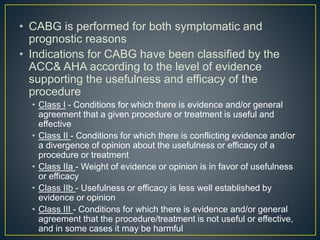
• CABG is performed for both symptomatic and
prognostic reasons
• Indications for CABG have been classified by the
ACC& AHA according to the level of evidence
supporting the usefulness and efficacy of the
procedure
• Class I - Conditions for which there is evidence and/or general
agreement that a given procedure or treatment is useful and
effective
• Class II - Conditions for which there is conflicting evidence and/or
a divergence of opinion about the usefulness or efficacy of a
procedure or treatment
• Class IIa - Weight of evidence or opinion is in favor of usefulness
or efficacy
• Class IIb - Usefulness or efficacy is less well established by
evidence or opinion
• Class III - Conditions for which there is evidence and/or general
agreement that the procedure/treatment is not useful or effective,
and in some cases it may be harmful
Indication
Asymptoma
tic or Mild
Angina
Stable
Angina
Unstable
Angina/
NSTEMI
Poor LV
Functio
n
Left main
stenosis >50%
Class I Class I Class I Class I
Stenosis of
proximal LAD
and proximal
circumflex
>70%
Class I Class I Class I Class I
3-vessel
disease
Class I Class I
Class I,
with
proximal
LAD
stenosis
2-vessel
Class I if there is
large area of
viable
myocardium in
high-risk area
Class IIb
Indication
Asymptoma
tic or Mild
Angina
Stable
Angina
Unstable
Angina/
NSTEMI
Poor LV
Functio
n
With >70%
proximal LAD
stenosis
Class IIa
Class I with
either ejection
fraction < 50%
or demonstrable
ischemia on
noninvasive
testing
Class IIa Class I
Involving
proximal LAD
Class IIb
1-vessel
disease
Class I if there is
large area of
viable
myocardium in
high-risk area
Class IIa, if there
is viable
moderate area
Class IIb
Indication
Asymptoma
tic or Mild
Angina
Stable
Angina
Unstable
Angina/
NSTEMI
Poor LV
Functio
n
With >70%
proximal LAD
stenosis
Class IIa Class IIa Class IIa
Involving
proximal LAD
Class IIb
• Disabling angina (Class I)
• Ongoing ischemia in the setting of a non-
ST segment elevation myocardial infarction
that is unresponsive to medical therapy
(Class I)
• Poor left ventricular function but with
viable, nonfunctioning myocardium above
the anatomical defect that can be
revascularized
• CABG may be performed as an
emergency procedure in the context of a
STEMI in cases where it has not been
possible to perform PCI or where this
procedure has failed and there is
persistent pain and ischemia threatening a
significant area of myocardium despite
medical therapy
Other indications for CABG in the setting
of STEMI are:
• ventricular septal defect related to myocardial
infarction
• papillary muscle rupture
• free wall rupture
• ventricular pseudoaneurysm
• life-threatening ventricular arrhythmias, and
• cardiogenic shock
• [Guideline] Hillis LD, Smith PK, Anderson JL, Bittl JA, Bridges CR,
Byrne JG, et al. 2011 ACCF/AHA Guideline for Coronary Artery
Bypass Graft Surgery: A Report of the American College of
Cardiology Foundation/American Heart Association Task Force on
Practice Guidelines. Circulation. 2011 Nov 7.[Medline]
• Eagle KA, Guyton RA, Davidoff R, Edwards FH, Ewy GA, Gardner
TJ. ACC/AHA 2004 guideline update for coronary artery bypass graft
surgery: summary article: a report of the American College of
Cardiology/American Heart Association Task Force on Practice
Guidelines (Committee to Update the 1999 Guidelines for Coronary
Artery Bypass Graft Surgery). Circulation. 2004 Aug 31. 110(9):1168-
76. [Medline]
• http://emedicine.medscape.com/article/1893992-overview#a3

Cabg indications

  • 2.
    • CABG isperformed for both symptomatic and prognostic reasons • Indications for CABG have been classified by the ACC& AHA according to the level of evidence supporting the usefulness and efficacy of the procedure • Class I - Conditions for which there is evidence and/or general agreement that a given procedure or treatment is useful and effective • Class II - Conditions for which there is conflicting evidence and/or a divergence of opinion about the usefulness or efficacy of a procedure or treatment • Class IIa - Weight of evidence or opinion is in favor of usefulness or efficacy • Class IIb - Usefulness or efficacy is less well established by evidence or opinion • Class III - Conditions for which there is evidence and/or general agreement that the procedure/treatment is not useful or effective, and in some cases it may be harmful
  • 3.
    Indication Asymptoma tic or Mild Angina Stable Angina Unstable Angina/ NSTEMI PoorLV Functio n Left main stenosis >50% Class I Class I Class I Class I Stenosis of proximal LAD and proximal circumflex >70% Class I Class I Class I Class I 3-vessel disease Class I Class I Class I, with proximal LAD stenosis 2-vessel Class I if there is large area of viable myocardium in high-risk area Class IIb
  • 4.
    Indication Asymptoma tic or Mild Angina Stable Angina Unstable Angina/ NSTEMI PoorLV Functio n With >70% proximal LAD stenosis Class IIa Class I with either ejection fraction < 50% or demonstrable ischemia on noninvasive testing Class IIa Class I Involving proximal LAD Class IIb 1-vessel disease Class I if there is large area of viable myocardium in high-risk area Class IIa, if there is viable moderate area Class IIb
  • 5.
    Indication Asymptoma tic or Mild Angina Stable Angina Unstable Angina/ NSTEMI PoorLV Functio n With >70% proximal LAD stenosis Class IIa Class IIa Class IIa Involving proximal LAD Class IIb
  • 6.
    • Disabling angina(Class I) • Ongoing ischemia in the setting of a non- ST segment elevation myocardial infarction that is unresponsive to medical therapy (Class I) • Poor left ventricular function but with viable, nonfunctioning myocardium above the anatomical defect that can be revascularized
  • 7.
    • CABG maybe performed as an emergency procedure in the context of a STEMI in cases where it has not been possible to perform PCI or where this procedure has failed and there is persistent pain and ischemia threatening a significant area of myocardium despite medical therapy
  • 8.
    Other indications forCABG in the setting of STEMI are: • ventricular septal defect related to myocardial infarction • papillary muscle rupture • free wall rupture • ventricular pseudoaneurysm • life-threatening ventricular arrhythmias, and • cardiogenic shock
  • 9.
    • [Guideline] HillisLD, Smith PK, Anderson JL, Bittl JA, Bridges CR, Byrne JG, et al. 2011 ACCF/AHA Guideline for Coronary Artery Bypass Graft Surgery: A Report of the American College of Cardiology Foundation/American Heart Association Task Force on Practice Guidelines. Circulation. 2011 Nov 7.[Medline] • Eagle KA, Guyton RA, Davidoff R, Edwards FH, Ewy GA, Gardner TJ. ACC/AHA 2004 guideline update for coronary artery bypass graft surgery: summary article: a report of the American College of Cardiology/American Heart Association Task Force on Practice Guidelines (Committee to Update the 1999 Guidelines for Coronary Artery Bypass Graft Surgery). Circulation. 2004 Aug 31. 110(9):1168- 76. [Medline] • http://emedicine.medscape.com/article/1893992-overview#a3