HEART FAILURE
By: Saili Gaude
Asst. Prof.
Medical Surgical Nursing
DEFINITION
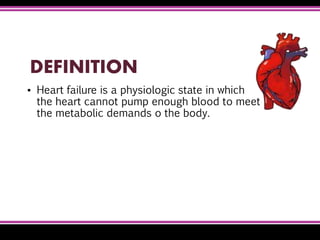
▪ Heart failure is a physiologic state in which
the heart cannot pump enough blood to meet
the metabolic demands o the body.
Clinical Syndrome
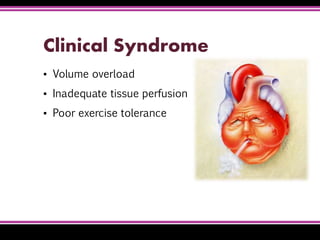
▪ Volume overload
▪ Inadequate tissue perfusion
▪ Poor exercise tolerance
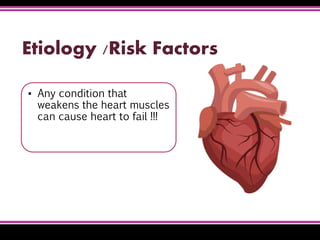
Etiology /Risk Factors
▪ Any condition that
weakens the heart muscles
can cause heart to fail !!!
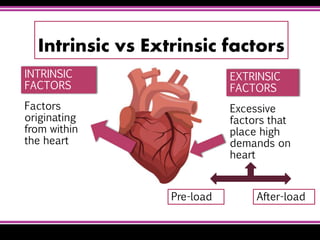
Intrinsic vs Extrinsic factors
EXTRINSIC
FACTORS
INTRINSIC
FACTORS
Factors
originating
from within
the heart
Excessive
factors that
place high
demands on
heart
Pre-load After-load
Intrinsic Factors
▪ Coronary artery disease
▪ Cardiomyopathy
▪ Dysrhythmias
▪ Valvular disease
▪ Constrictive pericarditis
▪ Cardiac tamponade
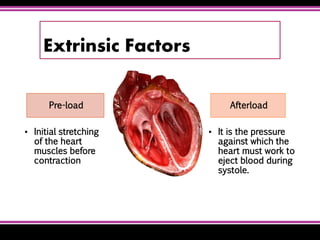
Extrinsic Factors
Pre-load
▪ Initial stretching
of the heart
muscles before
contraction
Afterload
▪ It is the pressure
against which the
heart must work to
eject blood during
systole.
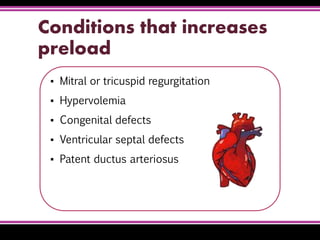
Conditions that increases
preload
▪ Mitral or tricuspid regurgitation
▪ Hypervolemia
▪ Congenital defects
▪ Ventricular septal defects
▪ Patent ductus arteriosus
Conditions that
increases after load
▪ Hypertension
▪ Aortic or pulmonary stenosis
▪ High peripheral vascular resistance
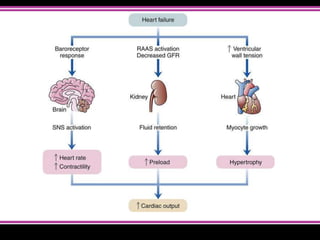
Pathophysiology-
compensated HF
▪ Ventricular dilatation
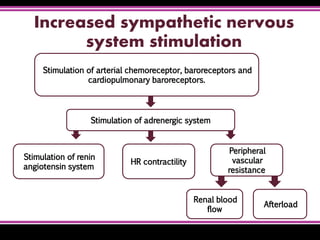
▪ Increased sympathetic nervous system
stimulation
▪ Stimulation of renin angiotensin system
Ventricular dilation
▪ Lengthening of muscle fibres that increases
the volume in the heart chambers.
▪ Frank starlings mechanism : Increased filling
volume dilate the ventricle Increases the
contractility
Increased sympathetic nervous
system stimulation
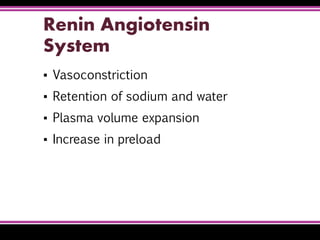
Renin Angiotensin
System
▪ Vasoconstriction
▪ Retention of sodium and water
▪ Plasma volume expansion
▪ Increase in preload
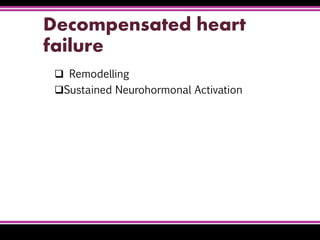
Decompensated heart
failure
 Remodelling
Sustained Neurohormonal Activation
Remodelling
▪ Remodeling is thought to result from
hypertrophy of the myocardial cells and
sustained activation of neurohormonal
compensatory systems.
▪ To reduce wall stress during ventricular
dilation the myocardial cells hypertrophy
(Laplace Law).
▪ Prolonged dilation causes permanent changes
leading to further deterioration of the heart
failure.
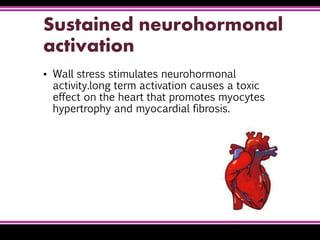
Sustained neurohormonal
activation
▪ Wall stress stimulates neurohormonal
activity.long term activation causes a toxic
effect on the heart that promotes myocytes
hypertrophy and myocardial fibrosis.
Types of
heart
failure
LVF vs RVF
Backward vs Forward
heart failure
High output vs low
output failure
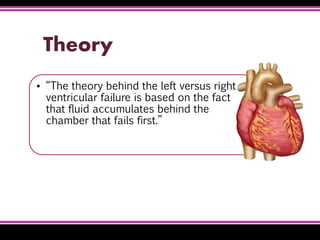
Theory
▪ “The theory behind the left versus right
ventricular failure is based on the fact
that fluid accumulates behind the
chamber that fails first.”
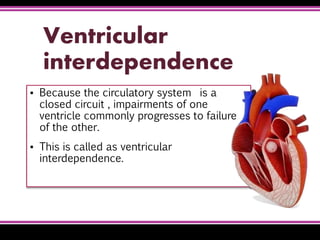
Ventricular
interdependence
▪ Because the circulatory system is a
closed circuit , impairments of one
ventricle commonly progresses to failure
of the other.
▪ This is called as ventricular
interdependence.
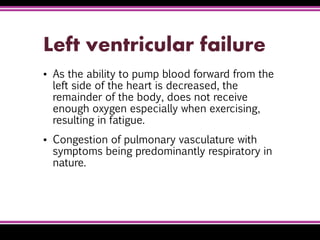
Left ventricular failure
▪ As the ability to pump blood forward from the
left side of the heart is decreased, the
remainder of the body, does not receive
enough oxygen especially when exercising,
resulting in fatigue.
▪ Congestion of pulmonary vasculature with
symptoms being predominantly respiratory in
nature.
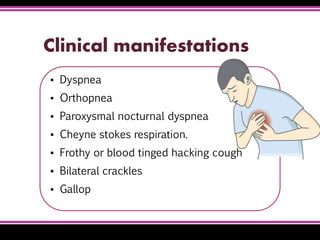
Clinical manifestations
▪ Dyspnea
▪ Orthopnea
▪ Paroxysmal nocturnal dyspnea
▪ Cheyne stokes respiration.
▪ Frothy or blood tinged hacking cough
▪ Bilateral crackles
▪ Gallop
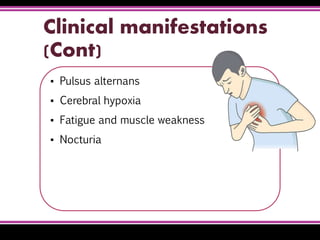
▪ Pulsus alternans
▪ Cerebral hypoxia
▪ Fatigue and muscle weakness
▪ Nocturia
Clinical manifestations
(Cont)
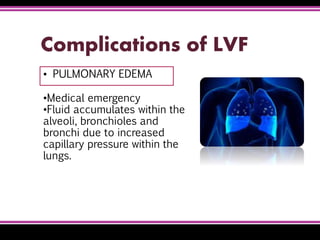
Complications of LVF
▪ PULMONARY EDEMA
•Medical emergency
•Fluid accumulates within the
alveoli, bronchioles and
bronchi due to increased
capillary pressure within the
lungs.
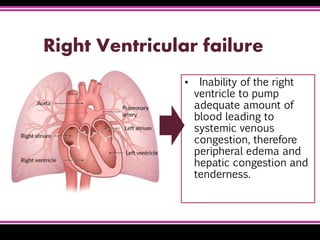
Right Ventricular failure
▪ Inability of the right
ventricle to pump
adequate amount of
blood leading to
systemic venous
congestion, therefore
peripheral edema and
hepatic congestion and
tenderness.
Clinical manifestations
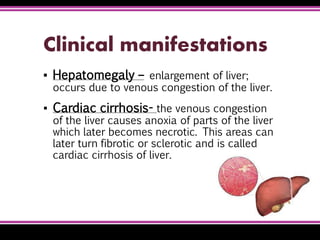
▪ Hepatomegaly – enlargement of liver;
occurs due to venous congestion of the liver.
▪ Cardiac cirrhosis- the venous congestion
of the liver causes anoxia of parts of the liver
which later becomes necrotic. This areas can
later turn fibrotic or sclerotic and is called
cardiac cirrhosis of liver.
Clinical manifestations
(Cont)
▪ Cardiac cachexia : increased workload of
heart and extreme work of breathing increases
metabolic demand while abdominal venous
congestion causes anorexia, nausea and
bloating.
▪ The combination of both leads to marked
wasting of tissue mass called as cardiac
cachexia.
Clinical manifestations
(Cont)
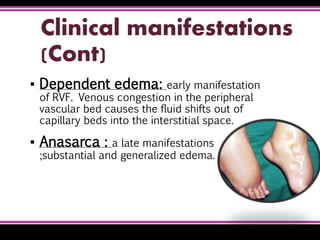
▪ Dependent edema: early manifestation
of RVF. Venous congestion in the peripheral
vascular bed causes the fluid shifts out of
capillary beds into the interstitial space.
▪ Anasarca : a late manifestations
;substantial and generalized edema.
2. Backward failure
vs
Forward failure
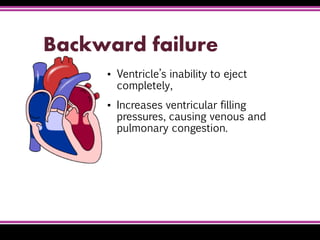
Backward failure
▪ Ventricle’s inability to eject
completely,
▪ Increases ventricular filling
pressures, causing venous and
pulmonary congestion.
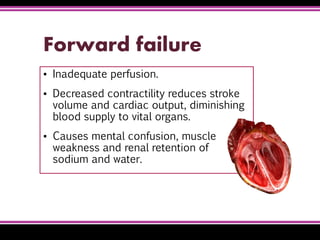
Forward failure
▪ Inadequate perfusion.
▪ Decreased contractility reduces stroke
volume and cardiac output, diminishing
blood supply to vital organs.
▪ Causes mental confusion, muscle
weakness and renal retention of
sodium and water.
3. High Output failure
vs
Low Output failure
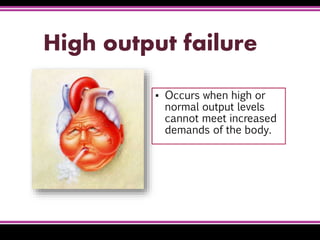
High output failure
▪ Occurs when high or
normal output levels
cannot meet increased
demands of the body.
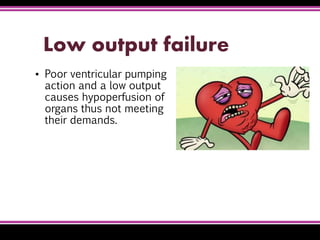
Low output failure
▪ Poor ventricular pumping
action and a low output
causes hypoperfusion of
organs thus not meeting
their demands.
4. Decompensated
failure
vs
Chronic Heart failure
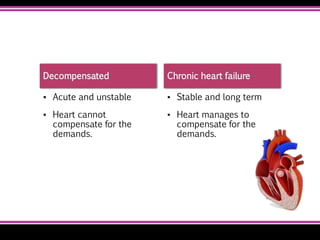
Decompensated
▪ Acute and unstable
▪ Heart cannot
compensate for the
demands.
Chronic heart failure
▪ Stable and long term
▪ Heart manages to
compensate for the
demands.
Diagnosis
1. The Framingham criteria
2. BNP
3. ECG
4. Chest Xray
5. Echocardiogram
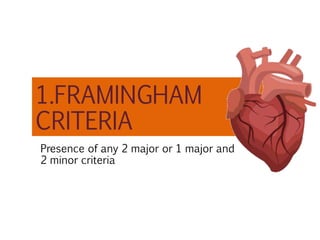
1.FRAMINGHAM
CRITERIA
Presence of any 2 major or 1 major and
2 minor criteria
Major criteria
▪ S3 heart sound present (‘gallop’ sound)
▪ Acute pulmonary oedema (left side of heart is unable to
clear fluid from lungs)
▪ Weight loss of more than 4.5kg in 5 days when treated
(patients lose their retained fluids)
▪ Paroxysmal nocturnal dyspnoea
▪ Abdominojugular reflux (JVP waveform rises when
pressure applied over liver area)
▪ Neck vein distended (i.e. JVP elevated at rest)
▪ Increased cardiac shadow on X-ray (cardiomegaly: heart
occupies more than ≈50% of chest diameter)
▪ Crackles heard in lungs
Minor
▪ Hepatomegaly
▪ Effusion, pleural
▪ Ankle oedema bilaterally
▪ exeRtional dyspnoea
▪ Tachycardia
▪ Vital capacity decreased by a third of
maximum value
▪ Nocturnal cough
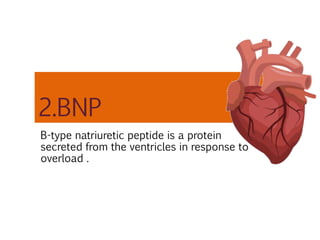
2.BNP
B-type natriuretic peptide is a protein
secreted from the ventricles in response to
overload .
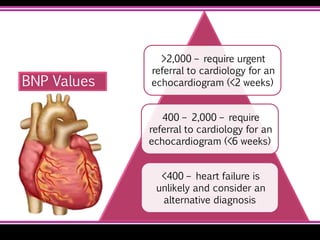
>2,000 – require urgent
referral to cardiology for an
echocardiogram (<2 weeks)
400 – 2,000 – require
referral to cardiology for an
echocardiogram (<6 weeks)
<400 – heart failure is
unlikely and consider an
alternative diagnosis
BNP Values
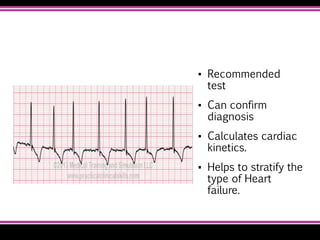
3.ECG
Measures the electrical activity of the heart
as it contracts.
ECG
▪ Performed on all suspected cases of heart
failure.
▪ May indicate the underlying cause of heart
failure.
▪ A normal ECG makes heart failure unlikely
(89% sensitivity).
4.Chest Xray
Uses a small amount of radiation to create
pictures of the structures in and around
the chest.
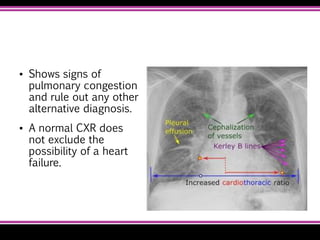
▪ Shows signs of
pulmonary congestion
and rule out any other
alternative diagnosis.
▪ A normal CXR does
not exclude the
possibility of a heart
failure.
5.Echocardiogram
A probe sends out and records sound waves
of the heart to produce moving image of the
heart on a computer.
▪ Recommended
test
▪ Can confirm
diagnosis
▪ Calculates cardiac
kinetics.
▪ Helps to stratify the
type of Heart
failure.
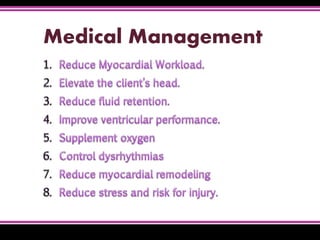
Medical Management
Reduce myocardial
workload
▪ Diuretics
▪ Vasodilators – nitroglycerine
▪ Morphine
▪ Beta adrenergic antagonist
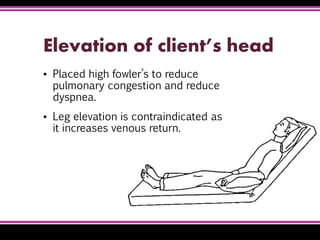
Elevation of client’s head
▪ Placed high fowler’s to reduce
pulmonary congestion and reduce
dyspnea.
▪ Leg elevation is contraindicated as
it increases venous return.
Reduce fluid retention
▪ Sodium restricted diet- 2-4g sodium
recommended.
▪ In case of severe heart failure, fluid is
restricted to 1000 ml/day.
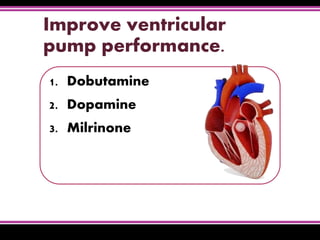
Improve ventricular
pump performance.
1. Dobutamine
2. Dopamine
3. Milrinone
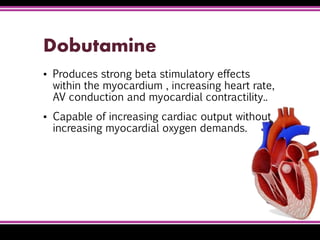
Dobutamine
▪ Produces strong beta stimulatory effects
within the myocardium , increasing heart rate,
AV conduction and myocardial contractility..
▪ Capable of increasing cardiac output without
increasing myocardial oxygen demands.
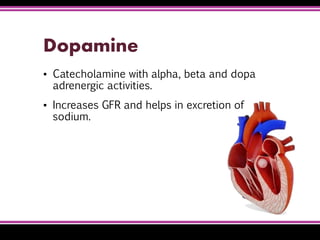
Dopamine
▪ Catecholamine with alpha, beta and dopa
adrenergic activities.
▪ Increases GFR and helps in excretion of
sodium.
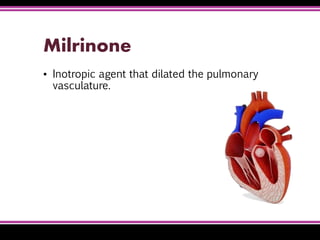
Milrinone
▪ Inotropic agent that dilated the pulmonary
vasculature.
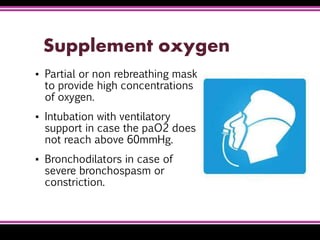
Supplement oxygen
▪ Partial or non rebreathing mask
to provide high concentrations
of oxygen.
▪ Intubation with ventilatory
support in case the paO2 does
not reach above 60mmHg.
▪ Bronchodilators in case of
severe bronchospasm or
constriction.
Control dysrhythmias
▪ Atrial fibrillation is commonest.
▪ Can lead to embolic stroke thus controlled by
anticoagulant therapy.
▪ Arrhythmia controlled by amiodrone.
Reduce myocardial
remodelling
▪ ACE inhibitors:
▪ Reduces remodelling changes in the heart.
▪ Reduces afterload , increases renal blood flow
and enhances diuresis.
Reduce stress and risk of
injury
▪ Rest
▪ Reduce anxiety
▪ Tranquilizers, and barbiturates.
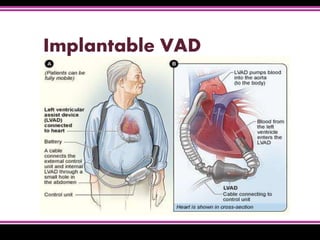
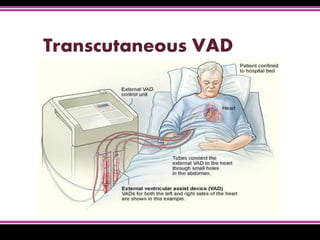
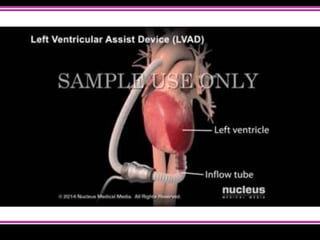
Ventricular assist devices
▪ Mechanical pump that’s used to support heart
function and blood flow in a weakened heart.
▪ Types: transcutaneous vs implantable
Implantable VAD
Transcutaneous VAD
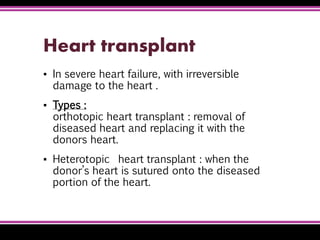
Heart transplant
▪ In severe heart failure, with irreversible
damage to the heart .
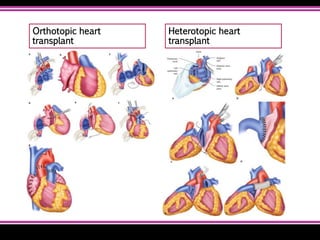
▪ Types :
orthotopic heart transplant : removal of
diseased heart and replacing it with the
donors heart.
▪ Heterotopic heart transplant : when the
donor’s heart is sutured onto the diseased
portion of the heart.
Orthotopic heart
transplant
Heterotopic heart
transplant
Cardiomyoplasty
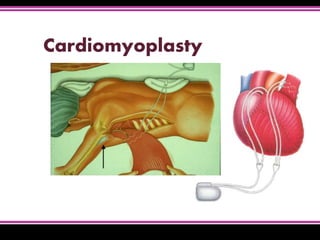
▪ Involves wrapping the latissimus dorsi muscle
around the heart and electro stimulating it in
synchrony with the ventricular systole.
▪ Patients with low cardiac output, but not a
candidate of heart transplant.
Cardiomyoplasty
Digoxin therapy for
chronic heart failure
▪ A positive ionotrope
▪ Slows and strengthens the heart beat .
▪ Improved cardiac output enhances kidney
perfusion , which may create a mild diuresis of
sodium and water.
▪ Toxicity- plasma levels more than 2mcg/L
Nursing diagnosis
▪ Decreased cardiac output related to heart
failure.
▪ Excess fluid volume related to reduced
glomerular filtration rate.
▪ Impaired gas exchange related to fluid in
alveoli.
▪ Ineffective tissue perfusion related to
decreased cardiac output.
▪ Risk for activity intolerance related to
decreased cardiac output.
▪ Risk for impaired skin integrity related to
decreased tissue perfusion and activities.
▪ Risk for anxiety related to decreased cardiac
output.

Heart failure

  • 1.
    HEART FAILURE By: SailiGaude Asst. Prof. Medical Surgical Nursing
  • 2.
    DEFINITION ▪ Heart failureis a physiologic state in which the heart cannot pump enough blood to meet the metabolic demands o the body.
  • 3.
    Clinical Syndrome ▪ Volumeoverload ▪ Inadequate tissue perfusion ▪ Poor exercise tolerance
  • 4.
    Etiology /Risk Factors ▪Any condition that weakens the heart muscles can cause heart to fail !!!
  • 5.
    Intrinsic vs Extrinsicfactors EXTRINSIC FACTORS INTRINSIC FACTORS Factors originating from within the heart Excessive factors that place high demands on heart Pre-load After-load
  • 6.
    Intrinsic Factors ▪ Coronaryartery disease ▪ Cardiomyopathy ▪ Dysrhythmias ▪ Valvular disease ▪ Constrictive pericarditis ▪ Cardiac tamponade
  • 7.
    Extrinsic Factors Pre-load ▪ Initialstretching of the heart muscles before contraction Afterload ▪ It is the pressure against which the heart must work to eject blood during systole.
  • 8.
    Conditions that increases preload ▪Mitral or tricuspid regurgitation ▪ Hypervolemia ▪ Congenital defects ▪ Ventricular septal defects ▪ Patent ductus arteriosus
  • 9.
    Conditions that increases afterload ▪ Hypertension ▪ Aortic or pulmonary stenosis ▪ High peripheral vascular resistance
  • 10.
    Pathophysiology- compensated HF ▪ Ventriculardilatation ▪ Increased sympathetic nervous system stimulation ▪ Stimulation of renin angiotensin system
  • 11.
    Ventricular dilation ▪ Lengtheningof muscle fibres that increases the volume in the heart chambers. ▪ Frank starlings mechanism : Increased filling volume dilate the ventricle Increases the contractility
  • 12.
  • 13.
    Renin Angiotensin System ▪ Vasoconstriction ▪Retention of sodium and water ▪ Plasma volume expansion ▪ Increase in preload
  • 15.
  • 16.
    Remodelling ▪ Remodeling isthought to result from hypertrophy of the myocardial cells and sustained activation of neurohormonal compensatory systems. ▪ To reduce wall stress during ventricular dilation the myocardial cells hypertrophy (Laplace Law). ▪ Prolonged dilation causes permanent changes leading to further deterioration of the heart failure.
  • 17.
    Sustained neurohormonal activation ▪ Wallstress stimulates neurohormonal activity.long term activation causes a toxic effect on the heart that promotes myocytes hypertrophy and myocardial fibrosis.
  • 18.
  • 19.
    LVF vs RVF Backwardvs Forward heart failure High output vs low output failure
  • 21.
    Theory ▪ “The theorybehind the left versus right ventricular failure is based on the fact that fluid accumulates behind the chamber that fails first.”
  • 22.
    Ventricular interdependence ▪ Because thecirculatory system is a closed circuit , impairments of one ventricle commonly progresses to failure of the other. ▪ This is called as ventricular interdependence.
  • 23.
    Left ventricular failure ▪As the ability to pump blood forward from the left side of the heart is decreased, the remainder of the body, does not receive enough oxygen especially when exercising, resulting in fatigue. ▪ Congestion of pulmonary vasculature with symptoms being predominantly respiratory in nature.
  • 24.
    Clinical manifestations ▪ Dyspnea ▪Orthopnea ▪ Paroxysmal nocturnal dyspnea ▪ Cheyne stokes respiration. ▪ Frothy or blood tinged hacking cough ▪ Bilateral crackles ▪ Gallop
  • 25.
    ▪ Pulsus alternans ▪Cerebral hypoxia ▪ Fatigue and muscle weakness ▪ Nocturia Clinical manifestations (Cont)
  • 26.
    Complications of LVF ▪PULMONARY EDEMA •Medical emergency •Fluid accumulates within the alveoli, bronchioles and bronchi due to increased capillary pressure within the lungs.
  • 27.
    Right Ventricular failure ▪Inability of the right ventricle to pump adequate amount of blood leading to systemic venous congestion, therefore peripheral edema and hepatic congestion and tenderness.
  • 28.
    Clinical manifestations ▪ Hepatomegaly– enlargement of liver; occurs due to venous congestion of the liver. ▪ Cardiac cirrhosis- the venous congestion of the liver causes anoxia of parts of the liver which later becomes necrotic. This areas can later turn fibrotic or sclerotic and is called cardiac cirrhosis of liver.
  • 29.
    Clinical manifestations (Cont) ▪ Cardiaccachexia : increased workload of heart and extreme work of breathing increases metabolic demand while abdominal venous congestion causes anorexia, nausea and bloating. ▪ The combination of both leads to marked wasting of tissue mass called as cardiac cachexia.
  • 30.
    Clinical manifestations (Cont) ▪ Dependentedema: early manifestation of RVF. Venous congestion in the peripheral vascular bed causes the fluid shifts out of capillary beds into the interstitial space. ▪ Anasarca : a late manifestations ;substantial and generalized edema.
  • 31.
  • 32.
    Backward failure ▪ Ventricle’sinability to eject completely, ▪ Increases ventricular filling pressures, causing venous and pulmonary congestion.
  • 33.
    Forward failure ▪ Inadequateperfusion. ▪ Decreased contractility reduces stroke volume and cardiac output, diminishing blood supply to vital organs. ▪ Causes mental confusion, muscle weakness and renal retention of sodium and water.
  • 34.
    3. High Outputfailure vs Low Output failure
  • 35.
    High output failure ▪Occurs when high or normal output levels cannot meet increased demands of the body.
  • 36.
    Low output failure ▪Poor ventricular pumping action and a low output causes hypoperfusion of organs thus not meeting their demands.
  • 37.
  • 38.
    Decompensated ▪ Acute andunstable ▪ Heart cannot compensate for the demands. Chronic heart failure ▪ Stable and long term ▪ Heart manages to compensate for the demands.
  • 39.
    Diagnosis 1. The Framinghamcriteria 2. BNP 3. ECG 4. Chest Xray 5. Echocardiogram
  • 40.
    1.FRAMINGHAM CRITERIA Presence of any2 major or 1 major and 2 minor criteria
  • 41.
    Major criteria ▪ S3heart sound present (‘gallop’ sound) ▪ Acute pulmonary oedema (left side of heart is unable to clear fluid from lungs) ▪ Weight loss of more than 4.5kg in 5 days when treated (patients lose their retained fluids) ▪ Paroxysmal nocturnal dyspnoea ▪ Abdominojugular reflux (JVP waveform rises when pressure applied over liver area) ▪ Neck vein distended (i.e. JVP elevated at rest) ▪ Increased cardiac shadow on X-ray (cardiomegaly: heart occupies more than ≈50% of chest diameter) ▪ Crackles heard in lungs
  • 42.
    Minor ▪ Hepatomegaly ▪ Effusion,pleural ▪ Ankle oedema bilaterally ▪ exeRtional dyspnoea ▪ Tachycardia ▪ Vital capacity decreased by a third of maximum value ▪ Nocturnal cough
  • 43.
    2.BNP B-type natriuretic peptideis a protein secreted from the ventricles in response to overload .
  • 44.
    >2,000 – requireurgent referral to cardiology for an echocardiogram (<2 weeks) 400 – 2,000 – require referral to cardiology for an echocardiogram (<6 weeks) <400 – heart failure is unlikely and consider an alternative diagnosis BNP Values
  • 45.
    3.ECG Measures the electricalactivity of the heart as it contracts.
  • 46.
    ECG ▪ Performed onall suspected cases of heart failure. ▪ May indicate the underlying cause of heart failure. ▪ A normal ECG makes heart failure unlikely (89% sensitivity).
  • 47.
    4.Chest Xray Uses asmall amount of radiation to create pictures of the structures in and around the chest.
  • 48.
    ▪ Shows signsof pulmonary congestion and rule out any other alternative diagnosis. ▪ A normal CXR does not exclude the possibility of a heart failure.
  • 49.
    5.Echocardiogram A probe sendsout and records sound waves of the heart to produce moving image of the heart on a computer.
  • 50.
    ▪ Recommended test ▪ Canconfirm diagnosis ▪ Calculates cardiac kinetics. ▪ Helps to stratify the type of Heart failure.
  • 51.
  • 52.
    Reduce myocardial workload ▪ Diuretics ▪Vasodilators – nitroglycerine ▪ Morphine ▪ Beta adrenergic antagonist
  • 53.
    Elevation of client’shead ▪ Placed high fowler’s to reduce pulmonary congestion and reduce dyspnea. ▪ Leg elevation is contraindicated as it increases venous return.
  • 54.
    Reduce fluid retention ▪Sodium restricted diet- 2-4g sodium recommended. ▪ In case of severe heart failure, fluid is restricted to 1000 ml/day.
  • 55.
    Improve ventricular pump performance. 1.Dobutamine 2. Dopamine 3. Milrinone
  • 56.
    Dobutamine ▪ Produces strongbeta stimulatory effects within the myocardium , increasing heart rate, AV conduction and myocardial contractility.. ▪ Capable of increasing cardiac output without increasing myocardial oxygen demands.
  • 57.
    Dopamine ▪ Catecholamine withalpha, beta and dopa adrenergic activities. ▪ Increases GFR and helps in excretion of sodium.
  • 58.
    Milrinone ▪ Inotropic agentthat dilated the pulmonary vasculature.
  • 59.
    Supplement oxygen ▪ Partialor non rebreathing mask to provide high concentrations of oxygen. ▪ Intubation with ventilatory support in case the paO2 does not reach above 60mmHg. ▪ Bronchodilators in case of severe bronchospasm or constriction.
  • 60.
    Control dysrhythmias ▪ Atrialfibrillation is commonest. ▪ Can lead to embolic stroke thus controlled by anticoagulant therapy. ▪ Arrhythmia controlled by amiodrone.
  • 61.
    Reduce myocardial remodelling ▪ ACEinhibitors: ▪ Reduces remodelling changes in the heart. ▪ Reduces afterload , increases renal blood flow and enhances diuresis.
  • 62.
    Reduce stress andrisk of injury ▪ Rest ▪ Reduce anxiety ▪ Tranquilizers, and barbiturates.
  • 64.
    Ventricular assist devices ▪Mechanical pump that’s used to support heart function and blood flow in a weakened heart. ▪ Types: transcutaneous vs implantable
  • 65.
  • 66.
  • 68.
    Heart transplant ▪ Insevere heart failure, with irreversible damage to the heart . ▪ Types : orthotopic heart transplant : removal of diseased heart and replacing it with the donors heart. ▪ Heterotopic heart transplant : when the donor’s heart is sutured onto the diseased portion of the heart.
  • 69.
  • 70.
    Cardiomyoplasty ▪ Involves wrappingthe latissimus dorsi muscle around the heart and electro stimulating it in synchrony with the ventricular systole. ▪ Patients with low cardiac output, but not a candidate of heart transplant.
  • 71.
  • 72.
    Digoxin therapy for chronicheart failure ▪ A positive ionotrope ▪ Slows and strengthens the heart beat . ▪ Improved cardiac output enhances kidney perfusion , which may create a mild diuresis of sodium and water. ▪ Toxicity- plasma levels more than 2mcg/L
  • 73.
    Nursing diagnosis ▪ Decreasedcardiac output related to heart failure. ▪ Excess fluid volume related to reduced glomerular filtration rate. ▪ Impaired gas exchange related to fluid in alveoli. ▪ Ineffective tissue perfusion related to decreased cardiac output.
  • 74.
    ▪ Risk foractivity intolerance related to decreased cardiac output. ▪ Risk for impaired skin integrity related to decreased tissue perfusion and activities. ▪ Risk for anxiety related to decreased cardiac output.