CONGESTIVE
HEART
FAILURE
ASLAM,SHUMAYLA
• Heart failure (HF) also known as CHF
• clinical syndrome in which an abnormality of cardiac
structure or function is responsible for the inability
of the heart to eject or fill with blood at a rate
commensurate with the requirements of the
metabolizing tissues.
• It is frequent end point of many of the conditions.
Classification
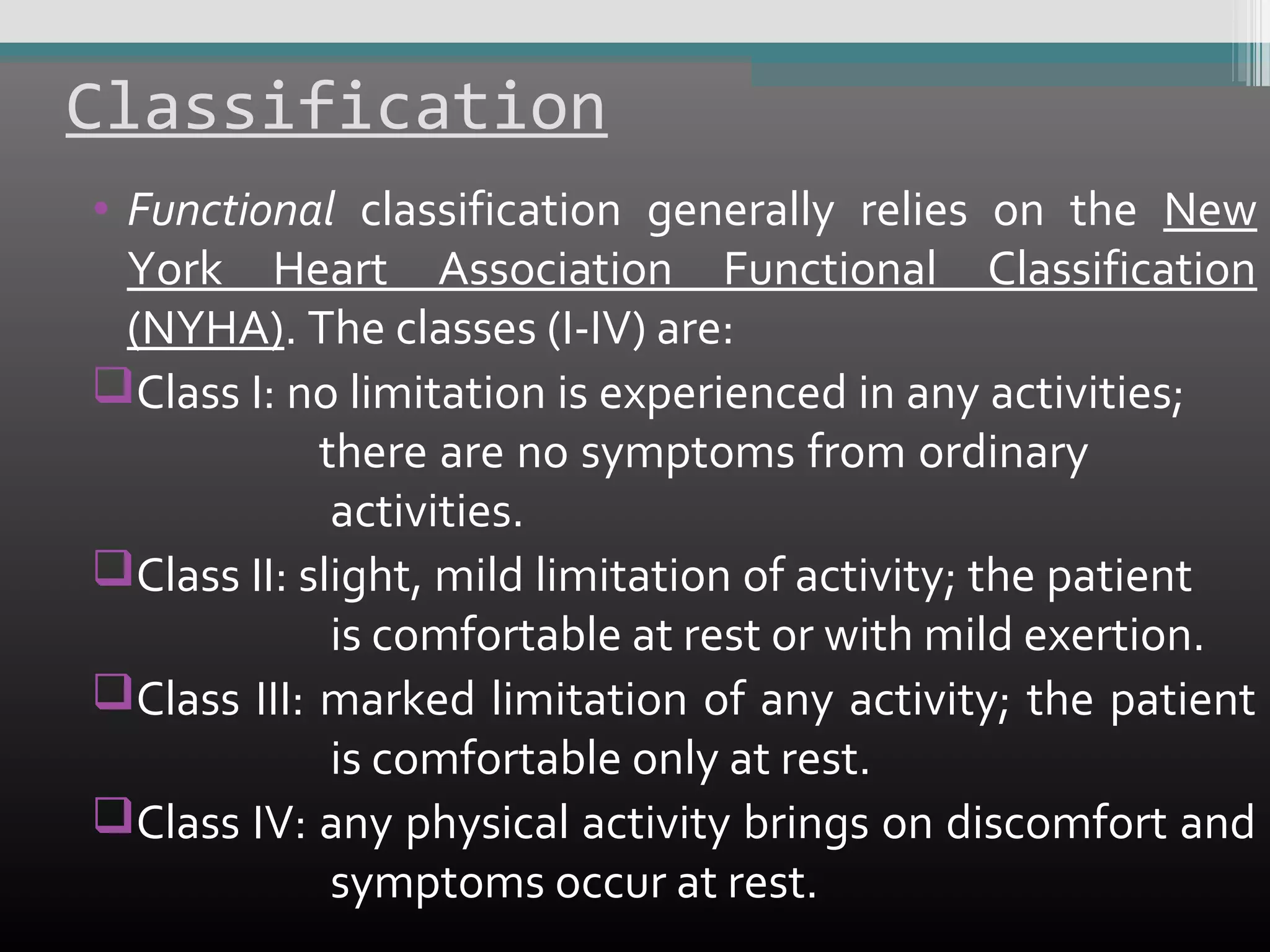
• Functional classification generally relies on the New
York Heart Association Functional Classification
(NYHA). The classes (I-IV) are:
Class I: no limitation is experienced in any activities;
there are no symptoms from ordinary
activities.
Class II: slight, mild limitation of activity; the patient
is comfortable at rest or with mild exertion.
Class III: marked limitation of any activity; the patient
is comfortable only at rest.
Class IV: any physical activity brings on discomfort and
symptoms occur at rest.
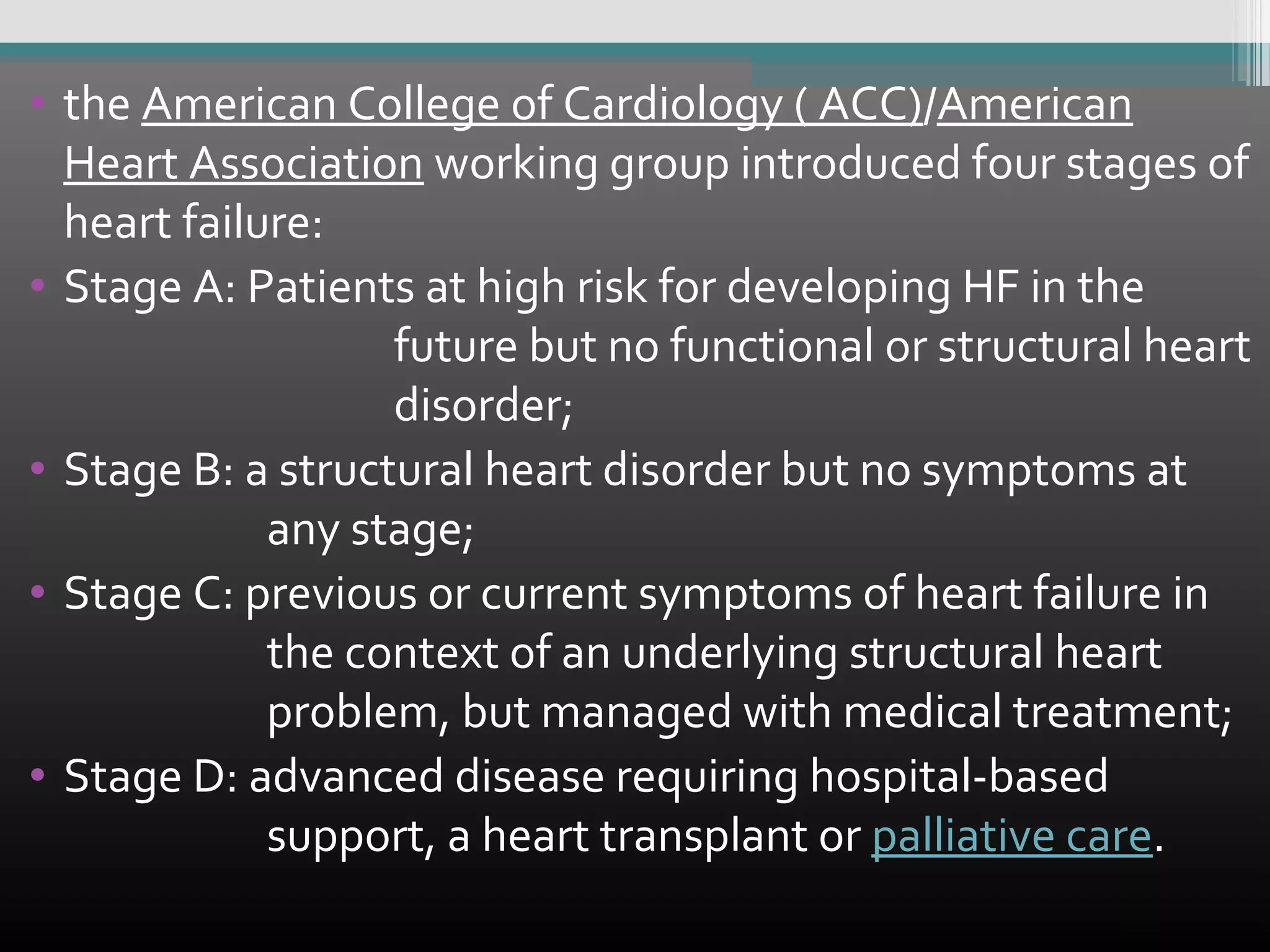
• the American College of Cardiology ( ACC)/American
Heart Association working group introduced four stages of
heart failure:
• Stage A: Patients at high risk for developing HF in the
future but no functional or structural heart
disorder;
• Stage B: a structural heart disorder but no symptoms at
any stage;
• Stage C: previous or current symptoms of heart failure in
the context of an underlying structural heart
problem, but managed with medical treatment;
• Stage D: advanced disease requiring hospital-based
support, a heart transplant or palliative care.
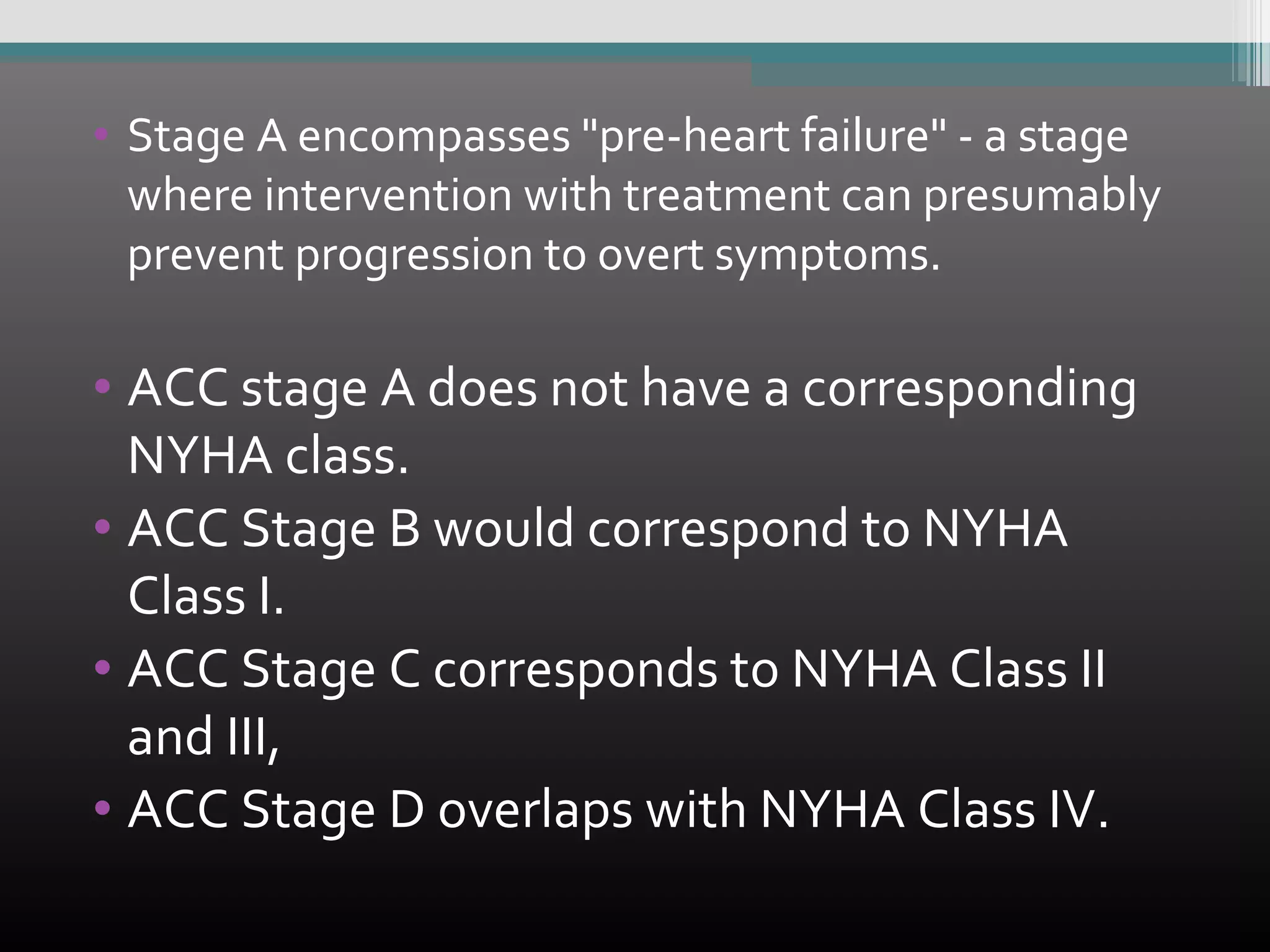
• Stage A encompasses "pre-heart failure" - a stage
where intervention with treatment can presumably
prevent progression to overt symptoms.

• ACC stage A does not have a corresponding
NYHA class.
• ACC Stage B would correspond to NYHA
Class I.
• ACC Stage C corresponds to NYHA Class II
and III,
• ACC Stage D overlaps with NYHA Class IV.
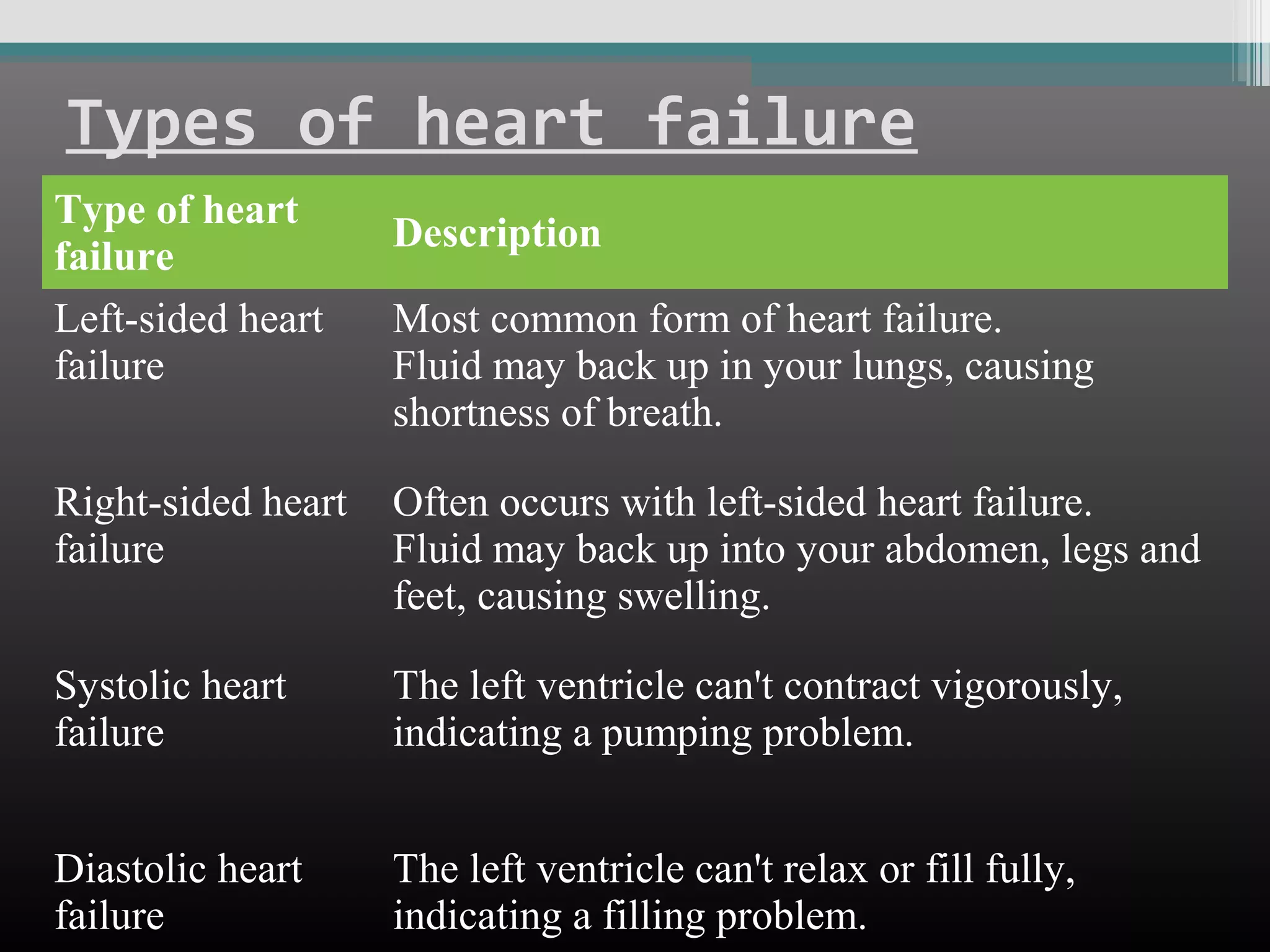
Types of heart failure
Type of heart
failure
Left-sided heart
failure

Description
Most common form of heart failure.
Fluid may back up in your lungs, causing
shortness of breath.

Right-sided heart
failure

Often occurs with left-sided heart failure.
Fluid may back up into your abdomen, legs and
feet, causing swelling.

Systolic heart
failure

The left ventricle can't contract vigorously,
indicating a pumping problem.

Diastolic heart
failure

The left ventricle can't relax or fill fully,
indicating a filling problem.
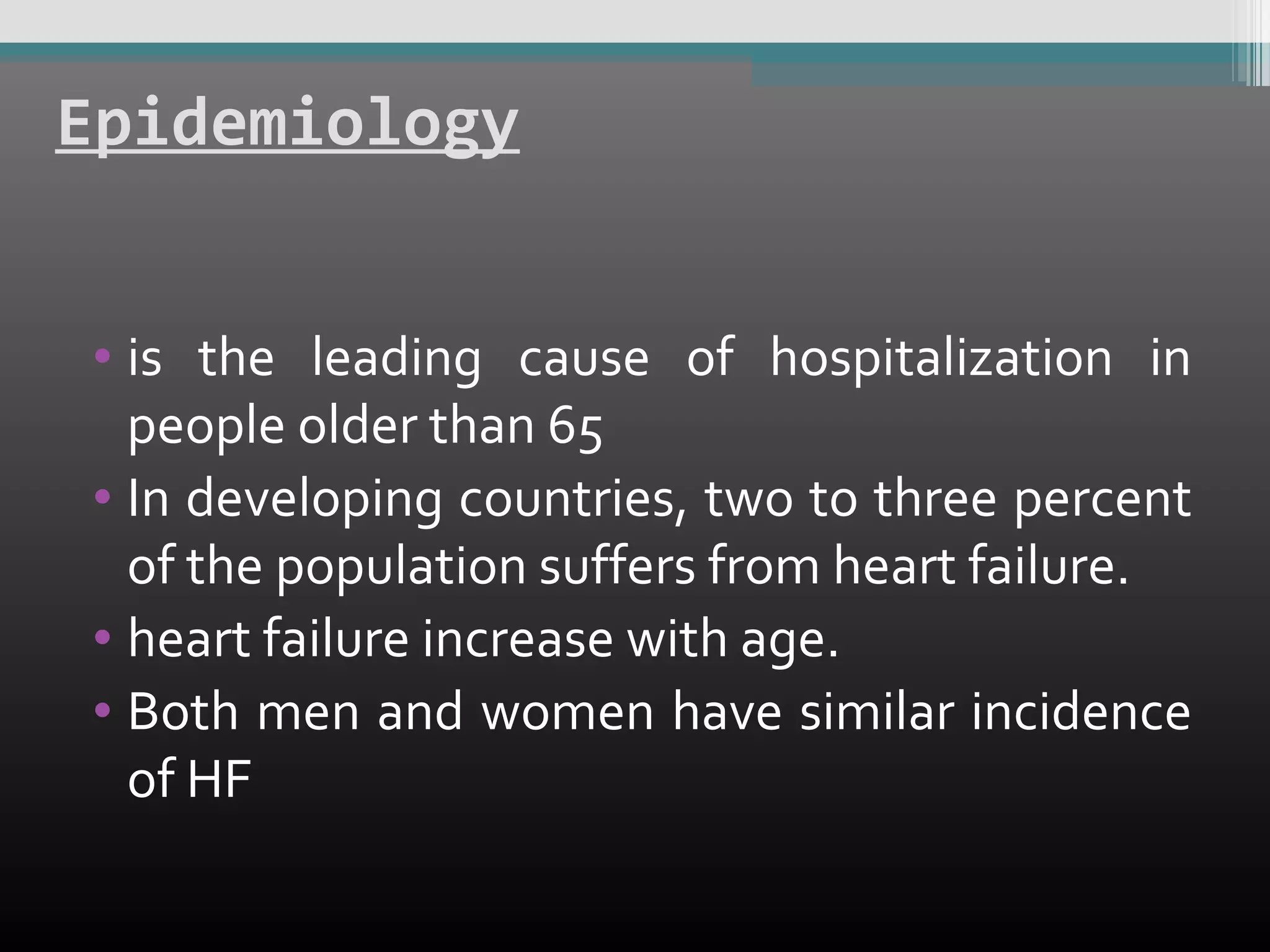
Epidemiology
• is the leading cause of hospitalization in
people older than 65
• In developing countries, two to three percent
of the population suffers from heart failure.
• heart failure increase with age.
• Both men and women have similar incidence
of HF
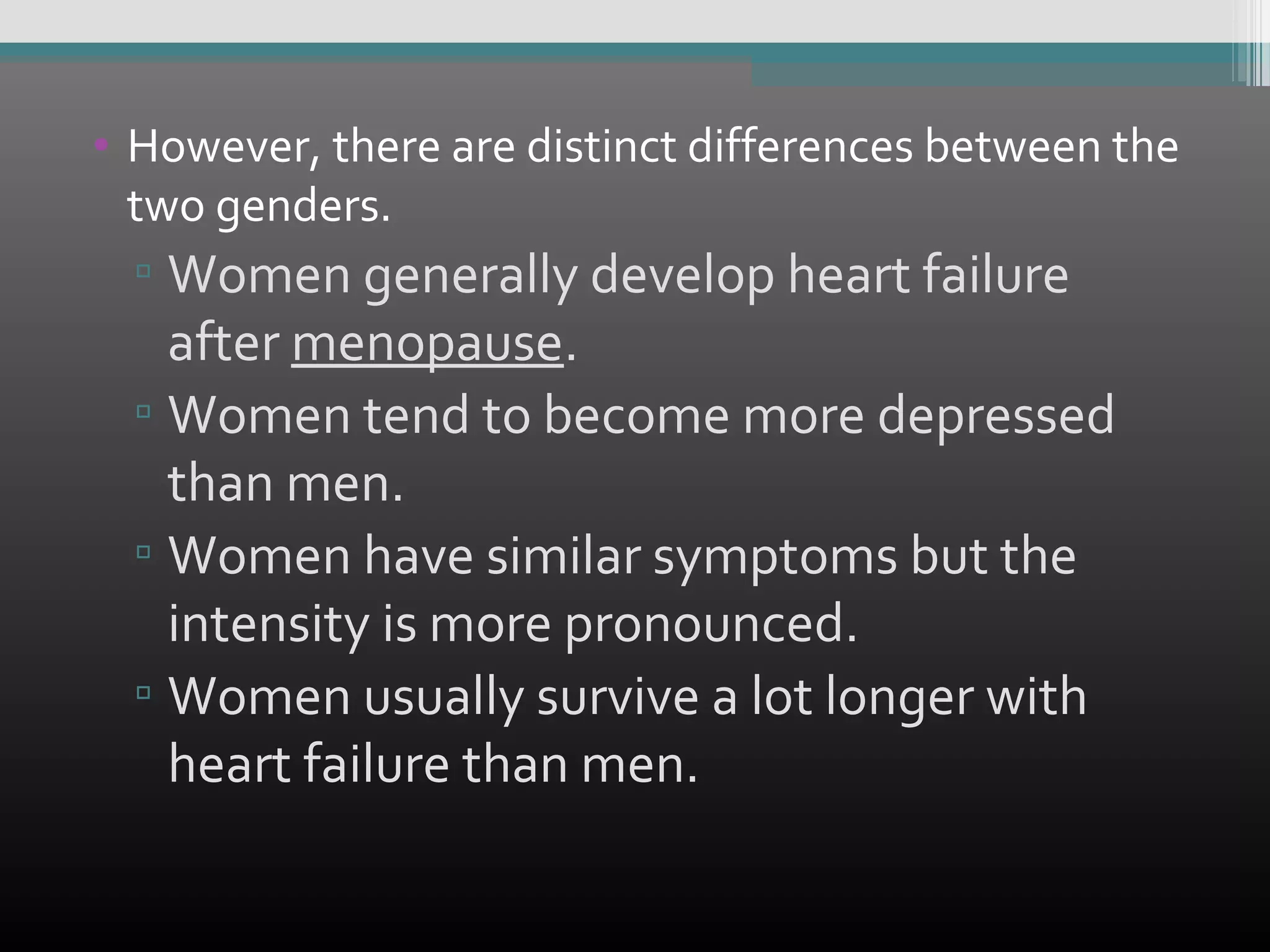
• However, there are distinct differences between the
two genders.

▫ Women generally develop heart failure
after menopause.
▫ Women tend to become more depressed
than men.
▫ Women have similar symptoms but the
intensity is more pronounced.
▫ Women usually survive a lot longer with
heart failure than men.
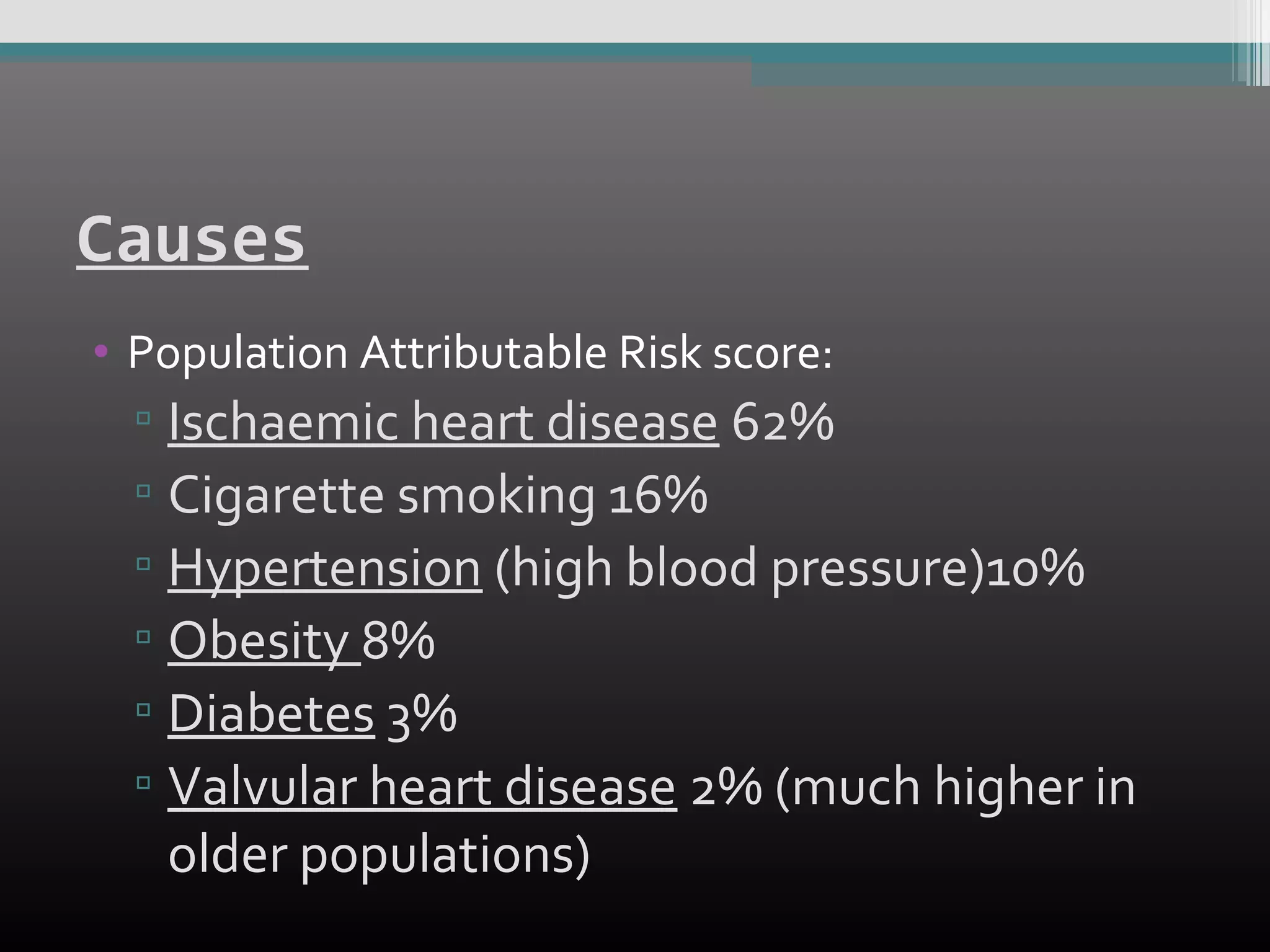
Causes
• Population Attributable Risk score:

▫ Ischaemic heart disease 62%
▫ Cigarette smoking 16%
▫ Hypertension (high blood pressure)10%
▫ Obesity 8%
▫ Diabetes 3%
▫ Valvular heart disease 2% (much higher in
older populations)
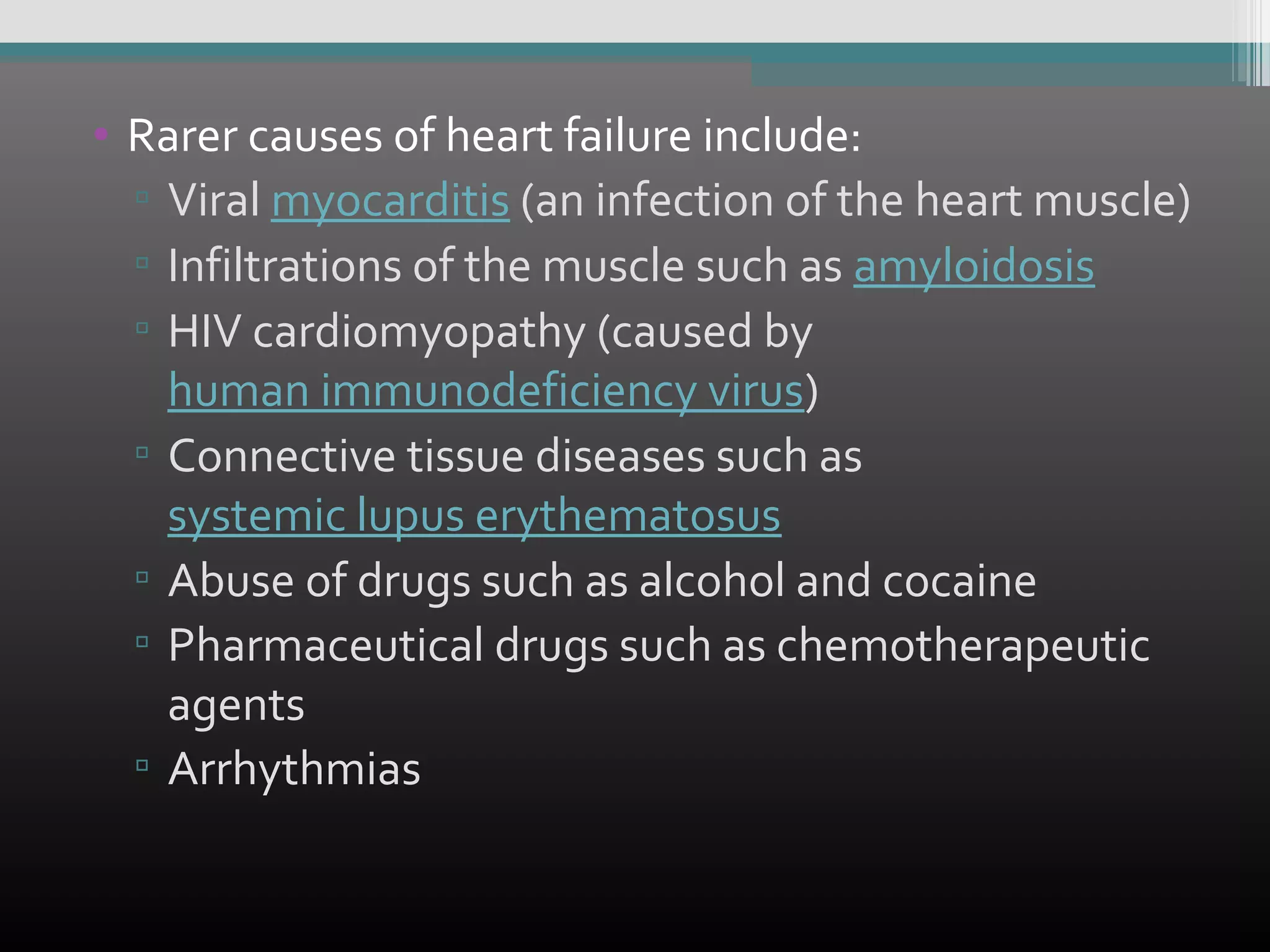
• Rarer causes of heart failure include:
▫ Viral myocarditis (an infection of the heart muscle)
▫ Infiltrations of the muscle such as amyloidosis
▫ HIV cardiomyopathy (caused by
human immunodeficiency virus)
▫ Connective tissue diseases such as
systemic lupus erythematosus
▫ Abuse of drugs such as alcohol and cocaine
▫ Pharmaceutical drugs such as chemotherapeutic
agents
▫ Arrhythmias
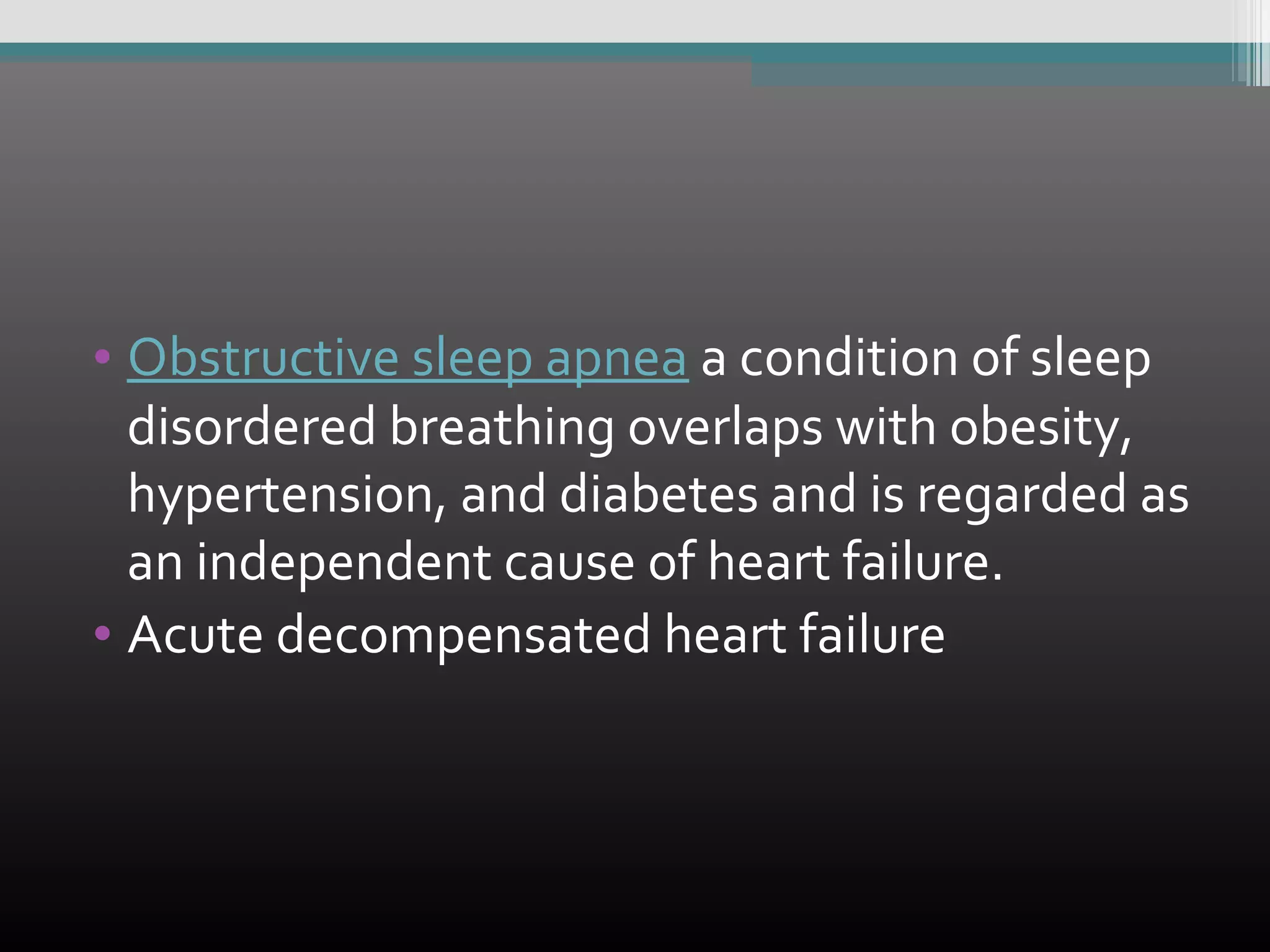
• Obstructive sleep apnea a condition of sleep
disordered breathing overlaps with obesity,
hypertension, and diabetes and is regarded as
an independent cause of heart failure.
• Acute decompensated heart failure
PATHOPHYSIOLOGY
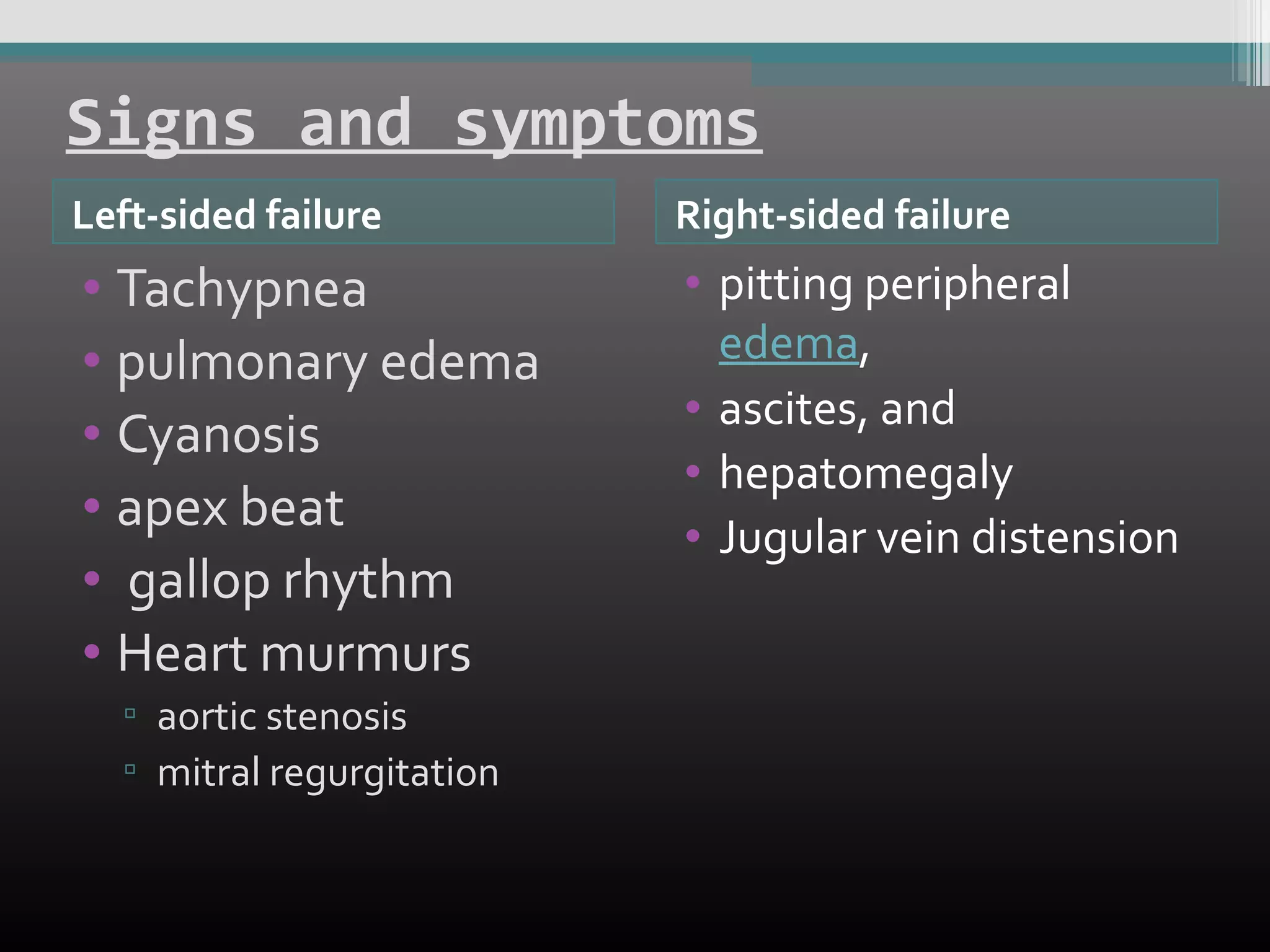
Signs and symptoms
Left-sided failure

Right-sided failure

• Tachypnea
• pulmonary edema
• Cyanosis
• apex beat
• gallop rhythm
• Heart murmurs

• pitting peripheral
edema,
• ascites, and
• hepatomegaly
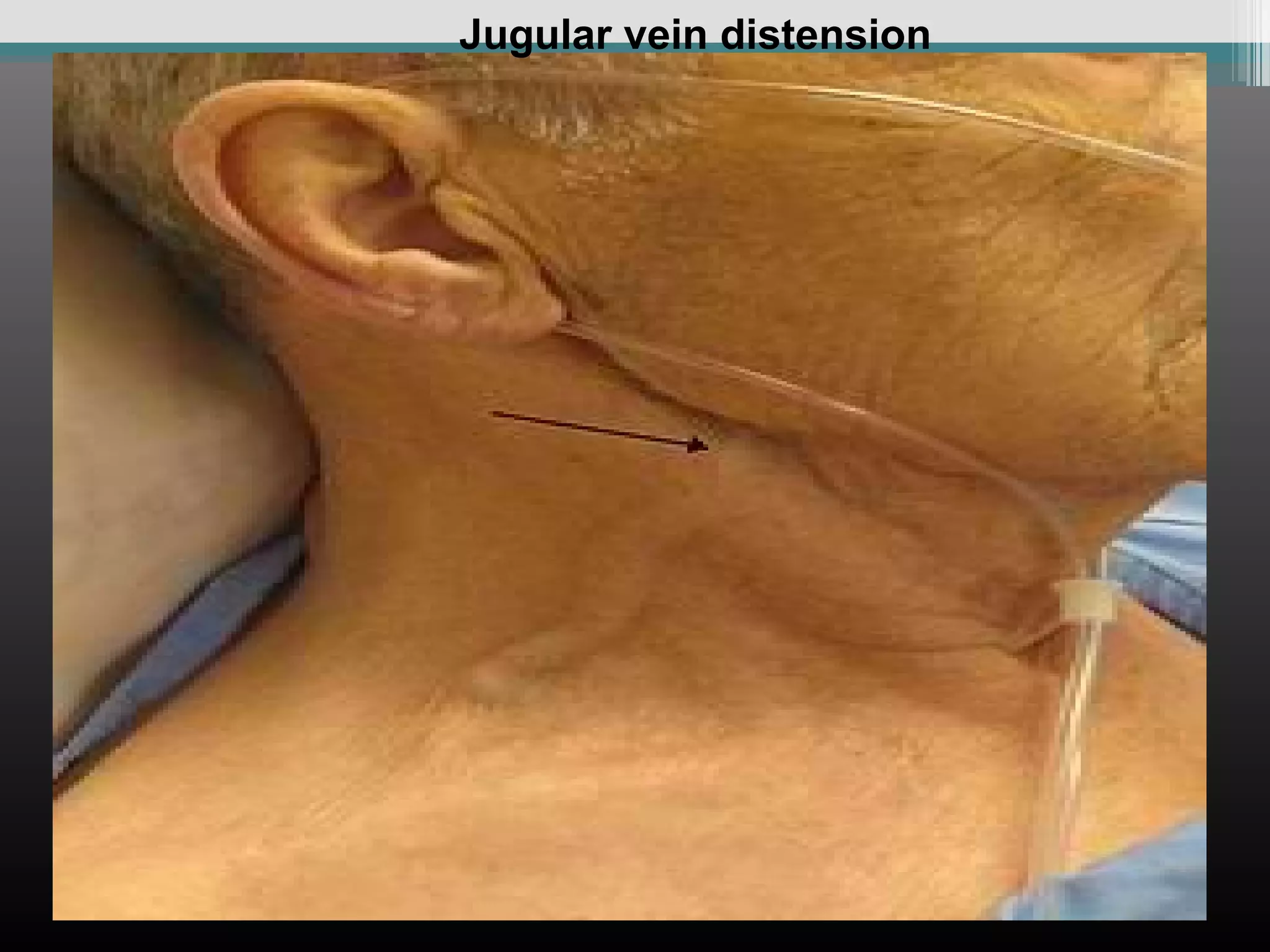
• Jugular vein distension

▫ aortic stenosis
▫ mitral regurgitation
Jugular vein distension
• Backward failure of the left ventricle causes
• congestion of the pulmonary vasculature,
• subdivided into
 failure of the left atrium,
 the left ventricle or
 both within the left circuit.

•
•
•
•
•

Dyspnea
Orthopnea
paroxysmal nocturnal dyspnea
Easy fatigueability and exercise intolerance
"Cardiac asthma" or wheezing may occur.
•
•
•
•
•
•
•

Backward failure of the right ventricle leads to
congestion of systemic capillaries.
peripheral edema or anasarca
Nocturia
Ascites
Hepatomegaly
coagulopathy
Diagnosis
•
•
•
•
•

Imaging
Chest X-rays
Electrophysiology
Blood tests
Angiography
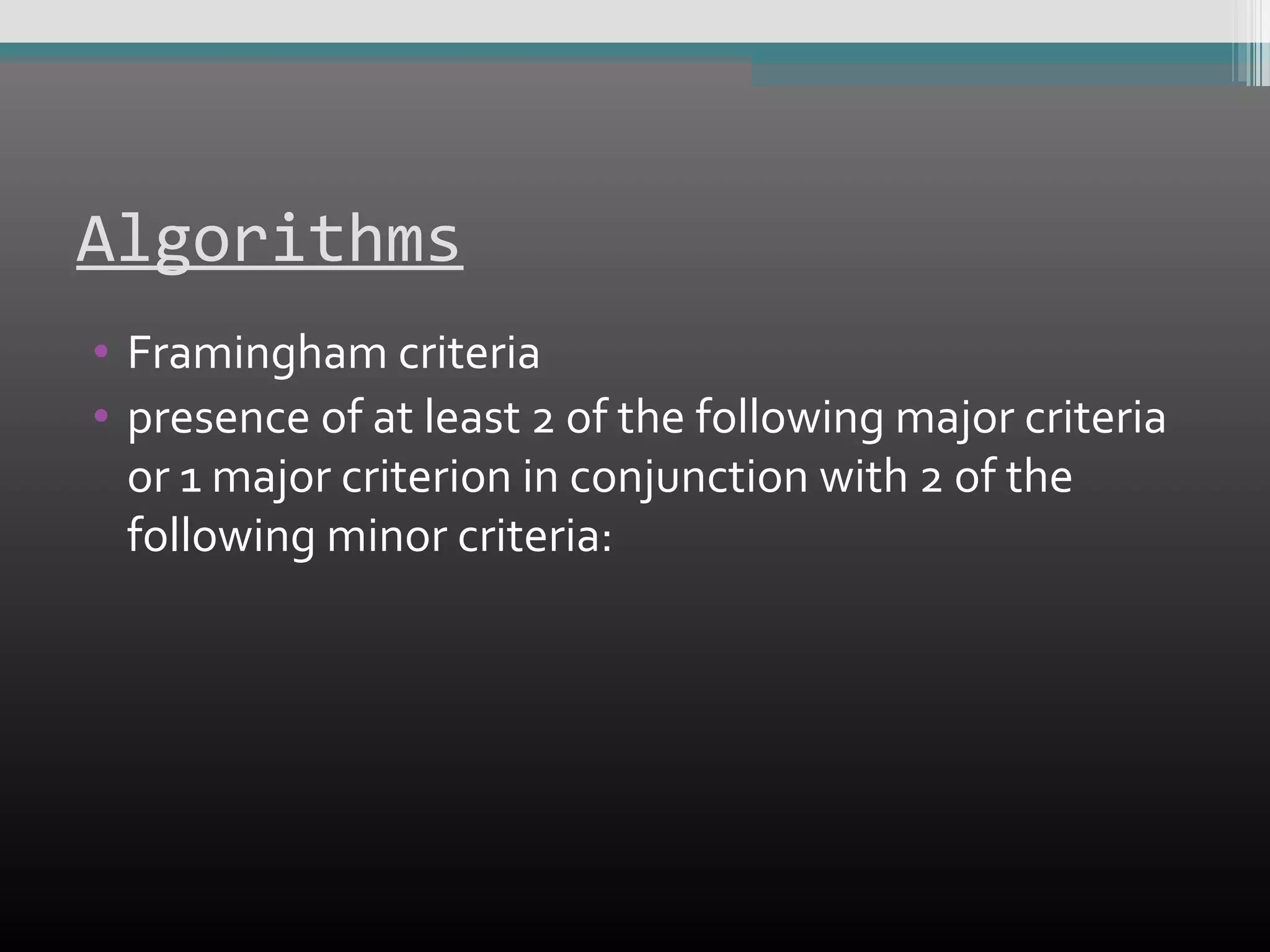
Algorithms
• Framingham criteria
• presence of at least 2 of the following major criteria
or 1 major criterion in conjunction with 2 of the
following minor criteria:
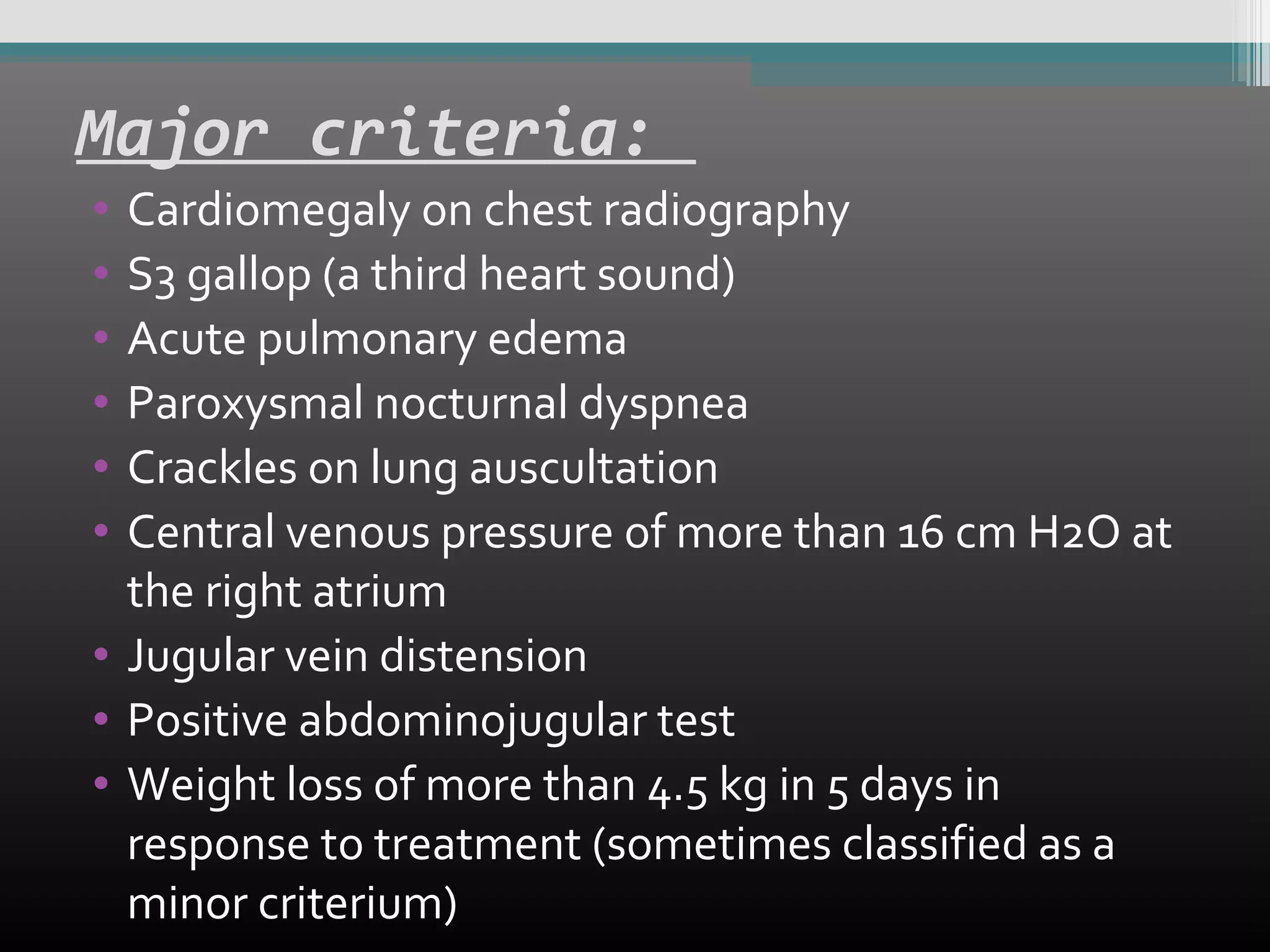
Major criteria:
•
•
•
•
•
•

Cardiomegaly on chest radiography
S3 gallop (a third heart sound)
Acute pulmonary edema
Paroxysmal nocturnal dyspnea
Crackles on lung auscultation
Central venous pressure of more than 16 cm H2O at
the right atrium
• Jugular vein distension
• Positive abdominojugular test
• Weight loss of more than 4.5 kg in 5 days in
response to treatment (sometimes classified as a
minor criterium)
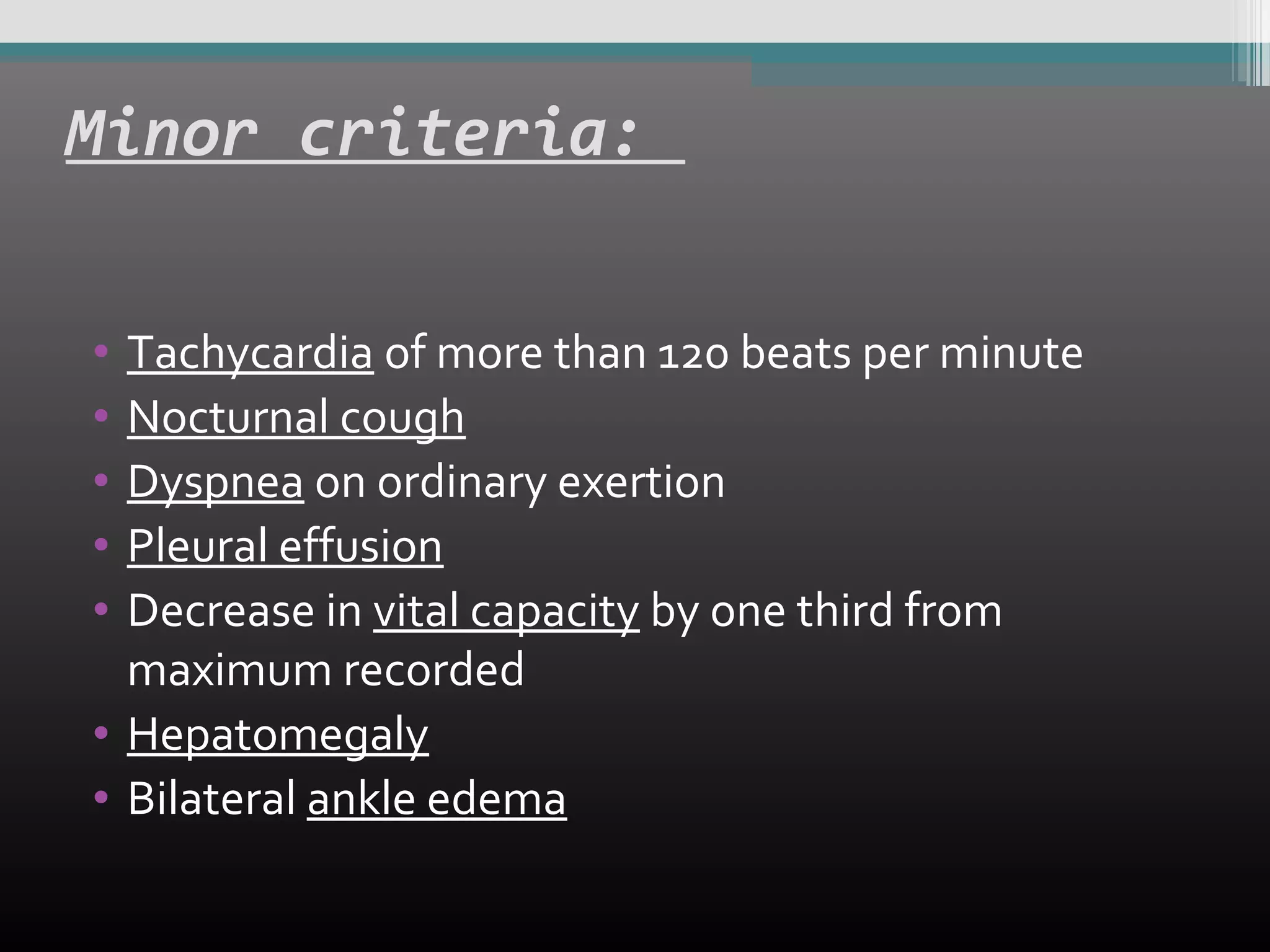
Minor criteria:
•
•
•
•
•

Tachycardia of more than 120 beats per minute
Nocturnal cough
Dyspnea on ordinary exertion
Pleural effusion
Decrease in vital capacity by one third from
maximum recorded
• Hepatomegaly
• Bilateral ankle edema
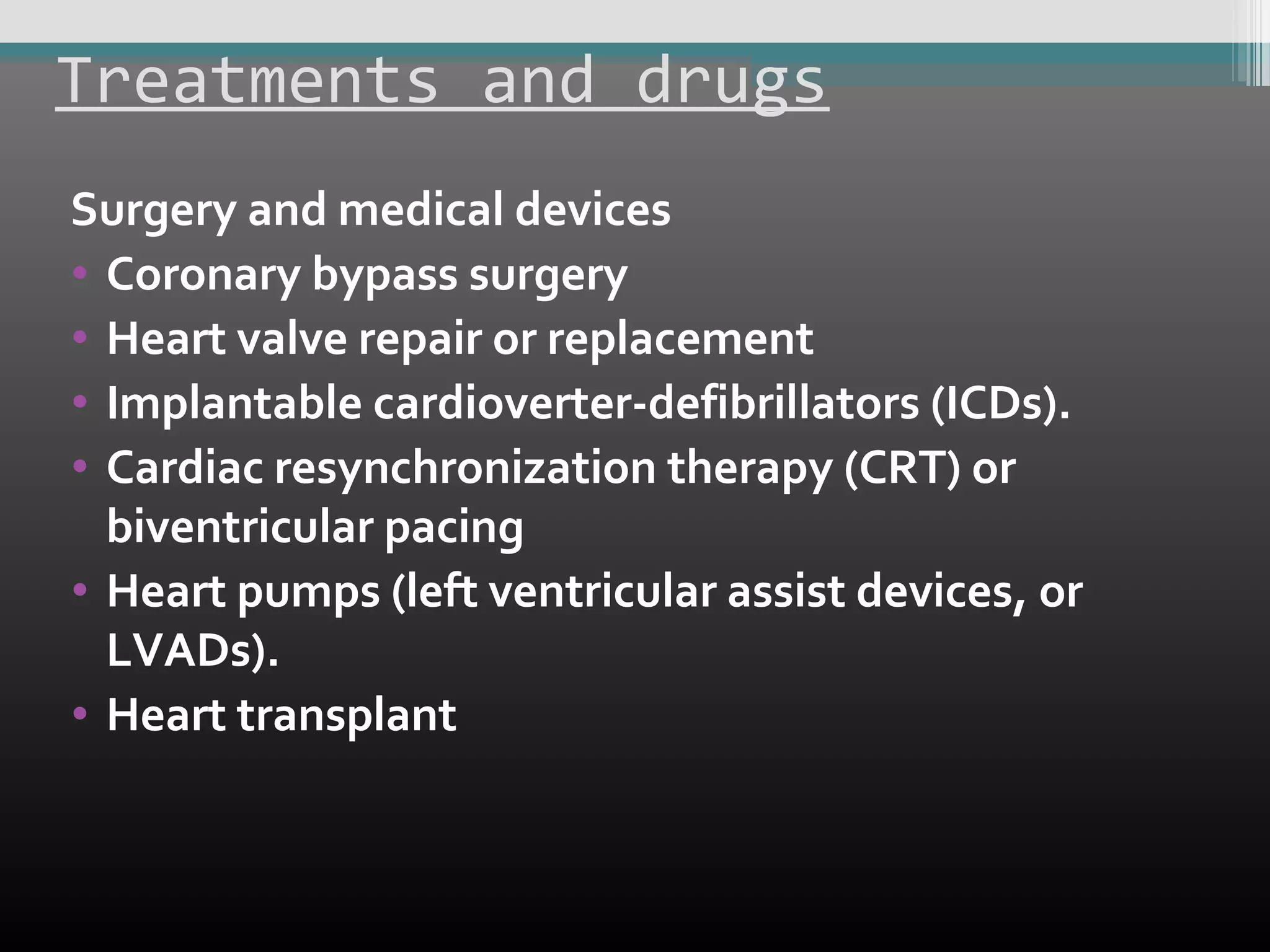
Treatments and drugs
Surgery and medical devices
• Coronary bypass surgery
• Heart valve repair or replacement
• Implantable cardioverter-defibrillators (ICDs).
• Cardiac resynchronization therapy (CRT) or
biventricular pacing
• Heart pumps (left ventricular assist devices, or
LVADs).
• Heart transplant
Prevention
• Lifestyle changes you can make to help prevent
heart failure include:
• Not smoking
• Controlling certain conditions, such as high blood
pressure, high cholesterol and diabetes
• Staying physically active
• Eating healthy foods
• Maintaining a healthy weight
• Reducing and managing stress
congestive heart failure

congestive heart failure

  • 1.
  • 2.
    • Heart failure(HF) also known as CHF • clinical syndrome in which an abnormality of cardiac structure or function is responsible for the inability of the heart to eject or fill with blood at a rate commensurate with the requirements of the metabolizing tissues. • It is frequent end point of many of the conditions.
  • 3.
    Classification • Functional classificationgenerally relies on the New York Heart Association Functional Classification (NYHA). The classes (I-IV) are: Class I: no limitation is experienced in any activities; there are no symptoms from ordinary activities. Class II: slight, mild limitation of activity; the patient is comfortable at rest or with mild exertion. Class III: marked limitation of any activity; the patient is comfortable only at rest. Class IV: any physical activity brings on discomfort and symptoms occur at rest.
  • 4.
    • the AmericanCollege of Cardiology ( ACC)/American Heart Association working group introduced four stages of heart failure: • Stage A: Patients at high risk for developing HF in the future but no functional or structural heart disorder; • Stage B: a structural heart disorder but no symptoms at any stage; • Stage C: previous or current symptoms of heart failure in the context of an underlying structural heart problem, but managed with medical treatment; • Stage D: advanced disease requiring hospital-based support, a heart transplant or palliative care.
  • 5.
    • Stage Aencompasses "pre-heart failure" - a stage where intervention with treatment can presumably prevent progression to overt symptoms. • ACC stage A does not have a corresponding NYHA class. • ACC Stage B would correspond to NYHA Class I. • ACC Stage C corresponds to NYHA Class II and III, • ACC Stage D overlaps with NYHA Class IV.
  • 6.
    Types of heartfailure Type of heart failure Left-sided heart failure Description Most common form of heart failure. Fluid may back up in your lungs, causing shortness of breath. Right-sided heart failure Often occurs with left-sided heart failure. Fluid may back up into your abdomen, legs and feet, causing swelling. Systolic heart failure The left ventricle can't contract vigorously, indicating a pumping problem. Diastolic heart failure The left ventricle can't relax or fill fully, indicating a filling problem.
  • 7.
    Epidemiology • is theleading cause of hospitalization in people older than 65 • In developing countries, two to three percent of the population suffers from heart failure. • heart failure increase with age. • Both men and women have similar incidence of HF
  • 8.
    • However, thereare distinct differences between the two genders. ▫ Women generally develop heart failure after menopause. ▫ Women tend to become more depressed than men. ▫ Women have similar symptoms but the intensity is more pronounced. ▫ Women usually survive a lot longer with heart failure than men.
  • 9.
    Causes • Population AttributableRisk score: ▫ Ischaemic heart disease 62% ▫ Cigarette smoking 16% ▫ Hypertension (high blood pressure)10% ▫ Obesity 8% ▫ Diabetes 3% ▫ Valvular heart disease 2% (much higher in older populations)
  • 10.
    • Rarer causesof heart failure include: ▫ Viral myocarditis (an infection of the heart muscle) ▫ Infiltrations of the muscle such as amyloidosis ▫ HIV cardiomyopathy (caused by human immunodeficiency virus) ▫ Connective tissue diseases such as systemic lupus erythematosus ▫ Abuse of drugs such as alcohol and cocaine ▫ Pharmaceutical drugs such as chemotherapeutic agents ▫ Arrhythmias
  • 11.
    • Obstructive sleepapnea a condition of sleep disordered breathing overlaps with obesity, hypertension, and diabetes and is regarded as an independent cause of heart failure. • Acute decompensated heart failure
  • 12.
  • 13.
    Signs and symptoms Left-sidedfailure Right-sided failure • Tachypnea • pulmonary edema • Cyanosis • apex beat • gallop rhythm • Heart murmurs • pitting peripheral edema, • ascites, and • hepatomegaly • Jugular vein distension ▫ aortic stenosis ▫ mitral regurgitation
  • 14.
  • 15.
    • Backward failureof the left ventricle causes • congestion of the pulmonary vasculature, • subdivided into  failure of the left atrium,  the left ventricle or  both within the left circuit. • • • • • Dyspnea Orthopnea paroxysmal nocturnal dyspnea Easy fatigueability and exercise intolerance "Cardiac asthma" or wheezing may occur.
  • 16.
    • • • • • • • Backward failure ofthe right ventricle leads to congestion of systemic capillaries. peripheral edema or anasarca Nocturia Ascites Hepatomegaly coagulopathy
  • 17.
  • 18.
    Algorithms • Framingham criteria •presence of at least 2 of the following major criteria or 1 major criterion in conjunction with 2 of the following minor criteria:
  • 19.
    Major criteria: • • • • • • Cardiomegaly onchest radiography S3 gallop (a third heart sound) Acute pulmonary edema Paroxysmal nocturnal dyspnea Crackles on lung auscultation Central venous pressure of more than 16 cm H2O at the right atrium • Jugular vein distension • Positive abdominojugular test • Weight loss of more than 4.5 kg in 5 days in response to treatment (sometimes classified as a minor criterium)
  • 20.
    Minor criteria: • • • • • Tachycardia ofmore than 120 beats per minute Nocturnal cough Dyspnea on ordinary exertion Pleural effusion Decrease in vital capacity by one third from maximum recorded • Hepatomegaly • Bilateral ankle edema
  • 21.
    Treatments and drugs Surgeryand medical devices • Coronary bypass surgery • Heart valve repair or replacement • Implantable cardioverter-defibrillators (ICDs). • Cardiac resynchronization therapy (CRT) or biventricular pacing • Heart pumps (left ventricular assist devices, or LVADs). • Heart transplant
  • 22.
    Prevention • Lifestyle changesyou can make to help prevent heart failure include: • Not smoking • Controlling certain conditions, such as high blood pressure, high cholesterol and diabetes • Staying physically active • Eating healthy foods • Maintaining a healthy weight • Reducing and managing stress