CONGENITAL MYASTHENIC SYNDROMES

Dr Prashant Makhija
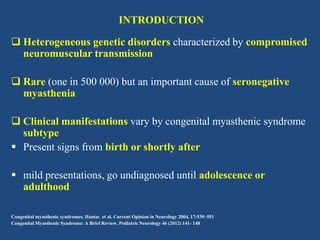
INTRODUCTION
 Heterogeneous genetic disorders characterized by compromised
neuromuscular transmission

 Rare (one in 500 000) but an important cause of seronegative
myasthenia
 Clinical manifestations vary by congenital myasthenic syndrome
subtype
 Present signs from birth or shortly after
 mild presentations, go undiagnosed until adolescence or
adulthood
Congenital myasthenic syndromes. Hantaı et al. Current Opinion in Neurology 2004, 17:539–551
Congenital Myasthenic Syndrome: A Brief Review. Pediatric Neurology 46 (2012) 141- 148
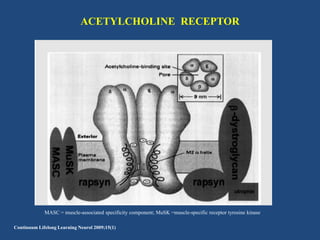
ACETYLCHOLINE RECEPTOR

MASC = muscle-associated specificity component; MuSK =muscle-specific receptor tyrosine kinase
Continuum Lifelong Learning Neurol 2009;15(1)
CLASSIFICATION
 Depending on the location of the primary defect within the
neuromuscular junction

 Presynaptic
 Synaptic
 Postsynaptic

P.J. Lorenzoni et al. / Pediatric Neurology 46 (2012) 141- 148
PRESYNAPTIC DEFECTS
 rarest, affecting an estimated 7-8% of patients
 4 subtypes
 Episodic apnea
 paucity of synaptic vesicles
 “Lambert-Eaton-like”
 other presynaptic defects
SYNAPTIC DEFECTS
 account for approximately 14-15% of patients
 Endplate acetylcholinesterase deficiency
 Abnormal laminin β2 chain

P.J. Lorenzoni et al. / Pediatric Neurology 46 (2012) 141- 148
POSTSYNAPTIC DEFECTS
 75-80% of patients
 Acetylcholine receptor deficiency without kinetic abnormality
 Primary kinetic abnormality of the acetylcholine receptor
 Slow-channel syndrome
 Fast-channel syndrome





Defects of acetylcholine receptor complex
Rapsyn deficiency
Dok-7 deficiency
MuSK deficiency






Voltage-gated sodium channel
Agrin deficiency
With tubular aggregates
Other defects

P.J. Lorenzoni et al. / Pediatric Neurology 46 (2012) 141- 148
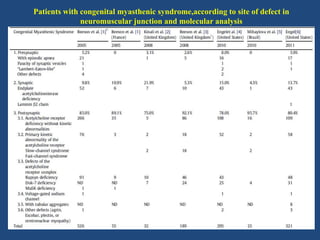
Patients with congenital myasthenic syndrome,according to site of defect in
neuromuscular junction and molecular analysis
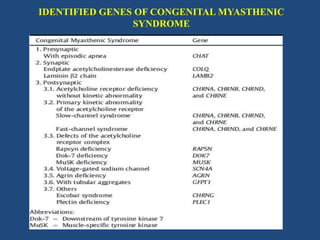
IDENTIFIED GENES OF CONGENITAL MYASTHENIC
SYNDROME
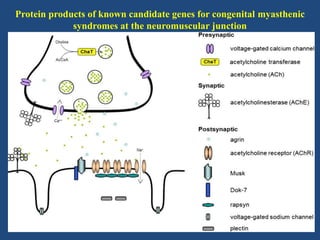
Protein products of known candidate genes for congenital myasthenic
syndromes at the neuromuscular junction
CLINICAL FEATURES

 Generic features
 Fatigable weakness involving ocular, bulbar, and limb muscles
since infancy or early childhood
 Similarly affected relative
 Decremental EMG response at 2- to 3-Hz stimulation, or abnormal
jitter and blocking on single fiber EMG
 Negative tests for anti-AChR antibodies, MuSK, and P/Q type
calcium channels

A.G. Engel / Neuromuscular Disorders 22 (2012) 99–111
 Exceptions
 In some CMS the onset is delayed
 There may be no similarly affected relatives
 EMG abnormalities may not be present in all muscles, or are
present only intermittently

A.G. Engel / Neuromuscular Disorders 22 (2012) 99–111
CLINICAL CLUES – SPECIFIC CMS
 Endplate acetylcholinesterase deficiency
 Delayed pupillary light reflex in some cases
 Repetitive CMAPs
 Refractoriness to cholinesterase inhibitors; negative
edrophonium test
 Absence of cholinesterase reactivity from EPs in muscle
specimens

A.G. Engel / Neuromuscular Disorders 22 (2012) 99–111
 Slow-channel myasthenic syndrome
 Cranial muscles only mildly affected; slowly progressive
course
 Selectively severe involvement of neck and wrist and finger
extensor muscles in most cases
 Dominant inheritance in nearly all cases
 Repetitive CMAPs
 Worsened by long-term pyridostigmine therapy; little or no
response to edrophonium

A.G. Engel / Neuromuscular Disorders 22 (2012) 99–111
 Endplate choline acetyltransferase deficiency
 Recurrent apneic episodes, spontaneous or with fever,
vomiting, or excitement
 No or variable myasthenic symptoms between acute episodes
 Rapsyn deficiency
 Ophthalmoparesis in 25%; strabismus relatively common
 Multiple congenital joint contractures or dysmorphic features
in 30%
 Increased weakness and respiratory insufficiency precipitated by
intercurrent infections

A.G. Engel / Neuromuscular Disorders 22 (2012) 99–111
 Dok-7 myasthenia
 Predominantly limb-girdle and axial distribution of weakness,
mild facial weakness, and ptosis are common, and normal ocular
ductions in most patients
 Significant bulbar muscles involvement in some patients
 Can present with stridor and vocal cord paralysis in neonates and
infants
 GFPT1 (GFAT) myasthenia
 Tubular aggregates in muscle in most patients
 Predominantly limb-girdle and axial distribution of weakness
 Responds to pyridostigmine
A.G. Engel / Neuromuscular Disorders 22 (2012) 99–111
 Laminin-b2 myasthenia
 Nephrotic syndrome, ocular abnormalities (Pierson syndrome)
 Refractoriness to cholinesterase inhibitors
 Plectin deficiency myasthenia
 Epidermolysis bullosa simplex
 Myasthenic syndrome associated with centronuclear myopathy
 Muscle histology

A.G. Engel / Neuromuscular Disorders 22 (2012) 99–111
DIFFERENTIAL DIAGNOSIS
 Vs Neonatal transient Myasthenia
 +ve h/o MG in mother (affects 10-20% of newborns whose mothers
have autoimmune MG)
 Transient symptoms (usually last < 2wks but may occur upto 12
wks)
 Vs Infantile Botulism
 Suggestive history ( 4mths of age, infants fed with honey)
 Rapidity of symptom progression
 Prominent involvement of ocular & bulbar musculature (pupillary
invovement seen in ~ 50% )

Bradley’s Neurology in Clinical Practice. 6th edition
 Vs Juvenile MG (<18 yrs)
 Almost never occurs <1 year of age ( CMS- birth)
 Association with other autoimmune disorders (diabetes, thyroid dx
and JRA, Thymoma rare)
 Seropositivity for AChR Ab (~20% of JMG & ~ 50% those with
prepubertal onset are seronegative )
 +ve response to immunomodulatory therapy
 Spontaneous remission
 Skeletal deformities(scoliosis, lordosis)- favours CMS

Bradley’s Neurology in Clinical Practice. 6th edition
 Vs SMA (neonatal & infantile onset)
 neonatal form – diffuse weakness of limb & trunk muscles, facial
sparing or mild involvement , arthrogryposis
 Infantile form- weakness in first 6 mths of life, proximal> distal,
lower> distal
 Relative preservation of diaphragmatic muscle as compared to
abdominal & chest musculature
 Needle EMG- denervation
 Genetic testing- SMN (survival motor neuron gene)

Bradley’s Neurology in Clinical Practice. 6th edition
 Vs Congenital myopathies
 Autosomal recessive or X-linked pattern of inheritance
 Diffuse weakness & hypotonia , weakness may be severe but is
typically static or slowly progressive
 Midly elevated CK
 EMG- myopaathic
 Histopathology- type I predominance

Bradley’s Neurology in Clinical Practice. 6th edition
 Vs Congenital Muscular dystrophies
 diffuse weakness and hypotonia
 significant elevations in serum CK
 subcortical white matter abnormalities may be seen on
brain MRI , cognition is usually normal
 Epilepsy may occur
 Supportive EMG, Histopatholgy, genetic analysis is confirmatory

Bradley’s Neurology in Clinical Practice. 6th edition
 Vs Congenital Myotonic dystophy
 type 1 myotonic dystrophy (~25% of infants born to mothers with
myotonic dystrophy)
 hypotonia and weakness of the face and limbs in infancy
 global developmental delay- intellectual impairment and motor
disability
 Later develop myotonia and other characteristic symptoms
 Electrphysiology & Genetic analysis

Bradley’s Neurology in Clinical Practice. 6th edition
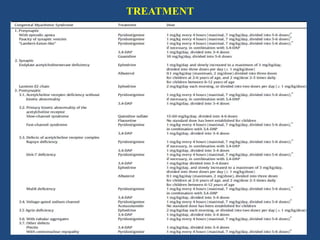
TREATMENT
 Presynaptic
 Pyridostigmine- 1 mg/kg every 4 hours (maximal, 7 mg/kg/day,
divided into 5-6 doses
 3,4-DAP- 1 mg/kg/day, divided into 3-4 doses
 Synaptic
 Ephedrine-1 mg/kg/day and slowly increased to a maximum of 3
mg/kg/day, divided into three doses per day
 Albuterol- 0.1 mg/kg/day (maximum, 2 mg/dose) divided into
three doses for children at 2-6 years of age, and 2 mg/dose 2-3
times daily for children between 6-12 years of age

P.J. Lorenzoni et al. / Pediatric Neurology 46 (2012) 141- 148
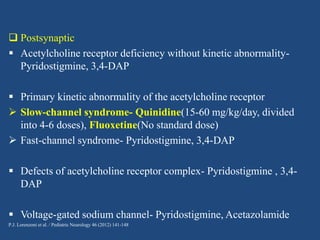
 Postsynaptic
 Acetylcholine receptor deficiency without kinetic abnormalityPyridostigmine, 3,4-DAP
 Primary kinetic abnormality of the acetylcholine receptor
 Slow-channel syndrome- Quinidine(15-60 mg/kg/day, divided
into 4-6 doses), Fluoxetine(No standard dose)
 Fast-channel syndrome- Pyridostigmine, 3,4-DAP
 Defects of acetylcholine receptor complex- Pyridostigmine , 3,4DAP
 Voltage-gated sodium channel- Pyridostigmine, Acetazolamide
P.J. Lorenzoni et al. / Pediatric Neurology 46 (2012) 141-148
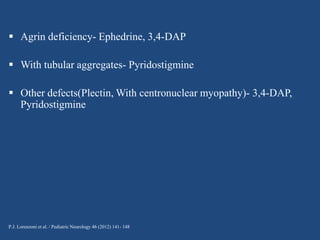
 Agrin deficiency- Ephedrine, 3,4-DAP
 With tubular aggregates- Pyridostigmine
 Other defects(Plectin, With centronuclear myopathy)- 3,4-DAP,
Pyridostigmine

P.J. Lorenzoni et al. / Pediatric Neurology 46 (2012) 141- 148
TREATMENT
CONCLUSION
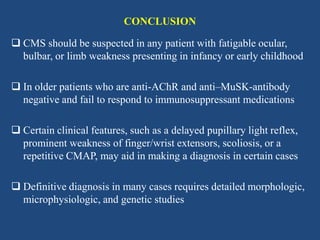
 CMS should be suspected in any patient with fatigable ocular,
bulbar, or limb weakness presenting in infancy or early childhood

 In older patients who are anti-AChR and anti–MuSK-antibody
negative and fail to respond to immunosuppressant medications
 Certain clinical features, such as a delayed pupillary light reflex,
prominent weakness of finger/wrist extensors, scoliosis, or a
repetitive CMAP, may aid in making a diagnosis in certain cases
 Definitive diagnosis in many cases requires detailed morphologic,
microphysiologic, and genetic studies
THANK YOU

Congenital myasthenic syndrome

  • 1.
  • 2.
    INTRODUCTION  Heterogeneous geneticdisorders characterized by compromised neuromuscular transmission  Rare (one in 500 000) but an important cause of seronegative myasthenia  Clinical manifestations vary by congenital myasthenic syndrome subtype  Present signs from birth or shortly after  mild presentations, go undiagnosed until adolescence or adulthood Congenital myasthenic syndromes. Hantaı et al. Current Opinion in Neurology 2004, 17:539–551 Congenital Myasthenic Syndrome: A Brief Review. Pediatric Neurology 46 (2012) 141- 148
  • 3.
    ACETYLCHOLINE RECEPTOR MASC =muscle-associated specificity component; MuSK =muscle-specific receptor tyrosine kinase Continuum Lifelong Learning Neurol 2009;15(1)
  • 4.
    CLASSIFICATION  Depending onthe location of the primary defect within the neuromuscular junction  Presynaptic  Synaptic  Postsynaptic P.J. Lorenzoni et al. / Pediatric Neurology 46 (2012) 141- 148
  • 5.
    PRESYNAPTIC DEFECTS  rarest,affecting an estimated 7-8% of patients  4 subtypes  Episodic apnea  paucity of synaptic vesicles  “Lambert-Eaton-like”  other presynaptic defects SYNAPTIC DEFECTS  account for approximately 14-15% of patients  Endplate acetylcholinesterase deficiency  Abnormal laminin β2 chain P.J. Lorenzoni et al. / Pediatric Neurology 46 (2012) 141- 148
  • 6.
    POSTSYNAPTIC DEFECTS  75-80%of patients  Acetylcholine receptor deficiency without kinetic abnormality  Primary kinetic abnormality of the acetylcholine receptor  Slow-channel syndrome  Fast-channel syndrome     Defects of acetylcholine receptor complex Rapsyn deficiency Dok-7 deficiency MuSK deficiency     Voltage-gated sodium channel Agrin deficiency With tubular aggregates Other defects P.J. Lorenzoni et al. / Pediatric Neurology 46 (2012) 141- 148
  • 7.
    Patients with congenitalmyasthenic syndrome,according to site of defect in neuromuscular junction and molecular analysis
  • 8.
    IDENTIFIED GENES OFCONGENITAL MYASTHENIC SYNDROME
  • 9.
    Protein products ofknown candidate genes for congenital myasthenic syndromes at the neuromuscular junction
  • 10.
    CLINICAL FEATURES  Genericfeatures  Fatigable weakness involving ocular, bulbar, and limb muscles since infancy or early childhood  Similarly affected relative  Decremental EMG response at 2- to 3-Hz stimulation, or abnormal jitter and blocking on single fiber EMG  Negative tests for anti-AChR antibodies, MuSK, and P/Q type calcium channels A.G. Engel / Neuromuscular Disorders 22 (2012) 99–111
  • 11.
     Exceptions  Insome CMS the onset is delayed  There may be no similarly affected relatives  EMG abnormalities may not be present in all muscles, or are present only intermittently A.G. Engel / Neuromuscular Disorders 22 (2012) 99–111
  • 12.
    CLINICAL CLUES –SPECIFIC CMS  Endplate acetylcholinesterase deficiency  Delayed pupillary light reflex in some cases  Repetitive CMAPs  Refractoriness to cholinesterase inhibitors; negative edrophonium test  Absence of cholinesterase reactivity from EPs in muscle specimens A.G. Engel / Neuromuscular Disorders 22 (2012) 99–111
  • 13.
     Slow-channel myasthenicsyndrome  Cranial muscles only mildly affected; slowly progressive course  Selectively severe involvement of neck and wrist and finger extensor muscles in most cases  Dominant inheritance in nearly all cases  Repetitive CMAPs  Worsened by long-term pyridostigmine therapy; little or no response to edrophonium A.G. Engel / Neuromuscular Disorders 22 (2012) 99–111
  • 14.
     Endplate cholineacetyltransferase deficiency  Recurrent apneic episodes, spontaneous or with fever, vomiting, or excitement  No or variable myasthenic symptoms between acute episodes  Rapsyn deficiency  Ophthalmoparesis in 25%; strabismus relatively common  Multiple congenital joint contractures or dysmorphic features in 30%  Increased weakness and respiratory insufficiency precipitated by intercurrent infections A.G. Engel / Neuromuscular Disorders 22 (2012) 99–111
  • 15.
     Dok-7 myasthenia Predominantly limb-girdle and axial distribution of weakness, mild facial weakness, and ptosis are common, and normal ocular ductions in most patients  Significant bulbar muscles involvement in some patients  Can present with stridor and vocal cord paralysis in neonates and infants  GFPT1 (GFAT) myasthenia  Tubular aggregates in muscle in most patients  Predominantly limb-girdle and axial distribution of weakness  Responds to pyridostigmine A.G. Engel / Neuromuscular Disorders 22 (2012) 99–111
  • 16.
     Laminin-b2 myasthenia Nephrotic syndrome, ocular abnormalities (Pierson syndrome)  Refractoriness to cholinesterase inhibitors  Plectin deficiency myasthenia  Epidermolysis bullosa simplex  Myasthenic syndrome associated with centronuclear myopathy  Muscle histology A.G. Engel / Neuromuscular Disorders 22 (2012) 99–111
  • 17.
    DIFFERENTIAL DIAGNOSIS  VsNeonatal transient Myasthenia  +ve h/o MG in mother (affects 10-20% of newborns whose mothers have autoimmune MG)  Transient symptoms (usually last < 2wks but may occur upto 12 wks)  Vs Infantile Botulism  Suggestive history ( 4mths of age, infants fed with honey)  Rapidity of symptom progression  Prominent involvement of ocular & bulbar musculature (pupillary invovement seen in ~ 50% ) Bradley’s Neurology in Clinical Practice. 6th edition
  • 18.
     Vs JuvenileMG (<18 yrs)  Almost never occurs <1 year of age ( CMS- birth)  Association with other autoimmune disorders (diabetes, thyroid dx and JRA, Thymoma rare)  Seropositivity for AChR Ab (~20% of JMG & ~ 50% those with prepubertal onset are seronegative )  +ve response to immunomodulatory therapy  Spontaneous remission  Skeletal deformities(scoliosis, lordosis)- favours CMS Bradley’s Neurology in Clinical Practice. 6th edition
  • 19.
     Vs SMA(neonatal & infantile onset)  neonatal form – diffuse weakness of limb & trunk muscles, facial sparing or mild involvement , arthrogryposis  Infantile form- weakness in first 6 mths of life, proximal> distal, lower> distal  Relative preservation of diaphragmatic muscle as compared to abdominal & chest musculature  Needle EMG- denervation  Genetic testing- SMN (survival motor neuron gene) Bradley’s Neurology in Clinical Practice. 6th edition
  • 20.
     Vs Congenitalmyopathies  Autosomal recessive or X-linked pattern of inheritance  Diffuse weakness & hypotonia , weakness may be severe but is typically static or slowly progressive  Midly elevated CK  EMG- myopaathic  Histopathology- type I predominance Bradley’s Neurology in Clinical Practice. 6th edition
  • 21.
     Vs CongenitalMuscular dystrophies  diffuse weakness and hypotonia  significant elevations in serum CK  subcortical white matter abnormalities may be seen on brain MRI , cognition is usually normal  Epilepsy may occur  Supportive EMG, Histopatholgy, genetic analysis is confirmatory Bradley’s Neurology in Clinical Practice. 6th edition
  • 22.
     Vs CongenitalMyotonic dystophy  type 1 myotonic dystrophy (~25% of infants born to mothers with myotonic dystrophy)  hypotonia and weakness of the face and limbs in infancy  global developmental delay- intellectual impairment and motor disability  Later develop myotonia and other characteristic symptoms  Electrphysiology & Genetic analysis Bradley’s Neurology in Clinical Practice. 6th edition
  • 23.
    TREATMENT  Presynaptic  Pyridostigmine-1 mg/kg every 4 hours (maximal, 7 mg/kg/day, divided into 5-6 doses  3,4-DAP- 1 mg/kg/day, divided into 3-4 doses  Synaptic  Ephedrine-1 mg/kg/day and slowly increased to a maximum of 3 mg/kg/day, divided into three doses per day  Albuterol- 0.1 mg/kg/day (maximum, 2 mg/dose) divided into three doses for children at 2-6 years of age, and 2 mg/dose 2-3 times daily for children between 6-12 years of age P.J. Lorenzoni et al. / Pediatric Neurology 46 (2012) 141- 148
  • 24.
     Postsynaptic  Acetylcholinereceptor deficiency without kinetic abnormalityPyridostigmine, 3,4-DAP  Primary kinetic abnormality of the acetylcholine receptor  Slow-channel syndrome- Quinidine(15-60 mg/kg/day, divided into 4-6 doses), Fluoxetine(No standard dose)  Fast-channel syndrome- Pyridostigmine, 3,4-DAP  Defects of acetylcholine receptor complex- Pyridostigmine , 3,4DAP  Voltage-gated sodium channel- Pyridostigmine, Acetazolamide P.J. Lorenzoni et al. / Pediatric Neurology 46 (2012) 141-148
  • 25.
     Agrin deficiency-Ephedrine, 3,4-DAP  With tubular aggregates- Pyridostigmine  Other defects(Plectin, With centronuclear myopathy)- 3,4-DAP, Pyridostigmine P.J. Lorenzoni et al. / Pediatric Neurology 46 (2012) 141- 148
  • 26.
  • 27.
    CONCLUSION  CMS shouldbe suspected in any patient with fatigable ocular, bulbar, or limb weakness presenting in infancy or early childhood  In older patients who are anti-AChR and anti–MuSK-antibody negative and fail to respond to immunosuppressant medications  Certain clinical features, such as a delayed pupillary light reflex, prominent weakness of finger/wrist extensors, scoliosis, or a repetitive CMAP, may aid in making a diagnosis in certain cases  Definitive diagnosis in many cases requires detailed morphologic, microphysiologic, and genetic studies
  • 28.