Psychogenic
nonepileptic
seizure (PNES)
Maryann Ryan, RN-C, MSN,
APN-C
PNES
PNES are not associated with
physiological central nervous
system dysfunction but are instead
psychogenically determined.
(Uptodate, 2013)
PNES
Psychiatric conditions
associated with PNES include
ď‚› Depression
ď‚› Anxiety
ď‚› Somatoform disorder
ď‚› Posttraumatic stress disorder
ď‚› Dissociative disorder
ď‚› Personality disorders, especially borderline
personality disorder, but also narcissistic,
histrionic, and antisocial personalities
PNES
Psychiatric conditions
associated with PNES include
A history of sexual or physical abuse is
reported in one-third to one-half of
patients
Individuals with a hx of sex abuse may be
more like to have clinical events that are
more severe and more likely to resemble
epileptic seizures
They are more likely to exhibit self-harming
behaviors and other medically
unexplained symptoms
(Slekirk, 2008)(Duncan, 2008)
PNES
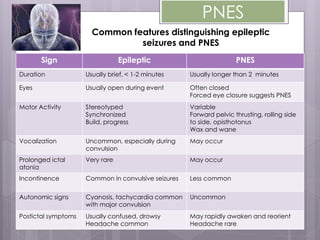
Common features distinguishing epileptic
seizures and PNES
Sign Epileptic PNES
Duration Usually brief, < 1-2 minutes Usually longer than 2 minutes
Eyes Usually open during event Often closed
Forced eye closure suggests PNES
Motor Activity Stereotyped
Synchronized
Build, progress
Variable
Forward pelvic thrusting, rolling side
to side, opisthotonus
Wax and wane
Vocalization Uncommon, especially during
convulsion
May occur
Prolonged ictal
atonia
Very rare May occur
Incontinence Common in convulsive seizures Less common
Autonomic signs Cyanosis, tachycardia common
with major convulsion
Uncommon
Postictal symptoms Usually confused, drowsy
Headache common
May rapidly awaken and reorient
Headache rare
PNES
Presenting the Diagnosis
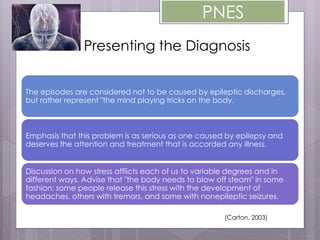
The episodes are considered not to be caused by epileptic discharges,
but rather represent "the mind playing tricks on the body.
Emphasis that this problem is as serious as one caused by epilepsy and
deserves the attention and treatment that is accorded any illness.
Discussion on how stress afflicts each of us to variable degrees and in
different ways. Advise that "the body needs to blow off steam" in some
fashion; some people release this stress with the development of
headaches, others with tremors, and some with nonepileptic seizures.
(Carton, 2003)
PNES
Presenting the Diagnosis
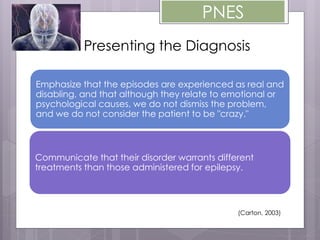
Emphasize that the episodes are experienced as real and
disabling, and that although they relate to emotional or
psychological causes, we do not dismiss the problem,
and we do not consider the patient to be "crazy."
Communicate that their disorder warrants different
treatments than those administered for epilepsy.
(Carton, 2003)
PNES
Many patients become angry in response to receiving the
diagnosis. Some may acknowledge these feelings, while others
may not. An angry reaction may forebode a poor prognosis. In
my experience, it is useful to anticipate these feelings at the time
of revealing the diagnosis.
We and others have also found that patients may exhibit
exacerbations of their episodes after the diagnosis is revealed
and we often warn the patients not to be surprised if this were to
occur.
(Carton, 2003)(Thompson, 2009)
PNES
References
Carton, S., Thompson, P.J., Duncan, J.S. Non-epileptic seizures: patients’ understanding and reaction to the
diagnosis and impact on outcome. Seizure, 12(5).
Duncan, R., Oto, M. (2008). Predictors of antecedent factors in psychogenic nonepileptic attacks:
multivariate analysis. Neurology, 71(31).
Selkirk, M., Duncan, R., Oto, M., Pelosi, A., (2008) Clinical differences between patients with nonepileptic
seizures who report antecedent sexual abuse and those who do not. Epilepsia, 49(8):1446.
Thompson, R., Isaac, C.L., Rowse, G., Tooth, D.L., Reuber, M.(2009). What is it like to receive a diagnosis of
noneplieptic seizures? Epilepsy Behavior, 14(3).
Ettinger, A.B. (2013) Psychogenic nonepileptic seizures. Retrieved 8/18/13
http://www.uptodate.com/contents/psychogenic-nonepileptic-
seizures?detectedLanguage=en&source=search_result&search=pseudoseizures&selectedTitle=1%7E23
&provider=noProvider.

Psychogenic nonepileptic seizure (PNES)

  • 1.
  • 2.
    PNES PNES are notassociated with physiological central nervous system dysfunction but are instead psychogenically determined. (Uptodate, 2013)
  • 3.
    PNES Psychiatric conditions associated withPNES include ď‚› Depression ď‚› Anxiety ď‚› Somatoform disorder ď‚› Posttraumatic stress disorder ď‚› Dissociative disorder ď‚› Personality disorders, especially borderline personality disorder, but also narcissistic, histrionic, and antisocial personalities
  • 4.
    PNES Psychiatric conditions associated withPNES include A history of sexual or physical abuse is reported in one-third to one-half of patients Individuals with a hx of sex abuse may be more like to have clinical events that are more severe and more likely to resemble epileptic seizures They are more likely to exhibit self-harming behaviors and other medically unexplained symptoms (Slekirk, 2008)(Duncan, 2008)
  • 5.
    PNES Common features distinguishingepileptic seizures and PNES Sign Epileptic PNES Duration Usually brief, < 1-2 minutes Usually longer than 2 minutes Eyes Usually open during event Often closed Forced eye closure suggests PNES Motor Activity Stereotyped Synchronized Build, progress Variable Forward pelvic thrusting, rolling side to side, opisthotonus Wax and wane Vocalization Uncommon, especially during convulsion May occur Prolonged ictal atonia Very rare May occur Incontinence Common in convulsive seizures Less common Autonomic signs Cyanosis, tachycardia common with major convulsion Uncommon Postictal symptoms Usually confused, drowsy Headache common May rapidly awaken and reorient Headache rare
  • 6.
    PNES Presenting the Diagnosis Theepisodes are considered not to be caused by epileptic discharges, but rather represent "the mind playing tricks on the body. Emphasis that this problem is as serious as one caused by epilepsy and deserves the attention and treatment that is accorded any illness. Discussion on how stress afflicts each of us to variable degrees and in different ways. Advise that "the body needs to blow off steam" in some fashion; some people release this stress with the development of headaches, others with tremors, and some with nonepileptic seizures. (Carton, 2003)
  • 7.
    PNES Presenting the Diagnosis Emphasizethat the episodes are experienced as real and disabling, and that although they relate to emotional or psychological causes, we do not dismiss the problem, and we do not consider the patient to be "crazy." Communicate that their disorder warrants different treatments than those administered for epilepsy. (Carton, 2003)
  • 8.
    PNES Many patients becomeangry in response to receiving the diagnosis. Some may acknowledge these feelings, while others may not. An angry reaction may forebode a poor prognosis. In my experience, it is useful to anticipate these feelings at the time of revealing the diagnosis. We and others have also found that patients may exhibit exacerbations of their episodes after the diagnosis is revealed and we often warn the patients not to be surprised if this were to occur. (Carton, 2003)(Thompson, 2009)
  • 9.
    PNES References Carton, S., Thompson,P.J., Duncan, J.S. Non-epileptic seizures: patients’ understanding and reaction to the diagnosis and impact on outcome. Seizure, 12(5). Duncan, R., Oto, M. (2008). Predictors of antecedent factors in psychogenic nonepileptic attacks: multivariate analysis. Neurology, 71(31). Selkirk, M., Duncan, R., Oto, M., Pelosi, A., (2008) Clinical differences between patients with nonepileptic seizures who report antecedent sexual abuse and those who do not. Epilepsia, 49(8):1446. Thompson, R., Isaac, C.L., Rowse, G., Tooth, D.L., Reuber, M.(2009). What is it like to receive a diagnosis of noneplieptic seizures? Epilepsy Behavior, 14(3). Ettinger, A.B. (2013) Psychogenic nonepileptic seizures. Retrieved 8/18/13 http://www.uptodate.com/contents/psychogenic-nonepileptic- seizures?detectedLanguage=en&source=search_result&search=pseudoseizures&selectedTitle=1%7E23 &provider=noProvider.