BY
BHAVYA SHARMA
The term neuromuscular
disease defines disorders of
the motor unit and excludes
influences on muscular
function from the brain, such
as spasticity.
 The motor unit has 4 components:
 Motor neuron in the brainstem or anterior horn of
the spinal cord;
 Axon(with other axons forming the peripheral
nerve);
 Neuromuscular junction disorder; and
 Myopathies (all muscle fibers innervated by a
single motor neuron).
 The motor unit is influenced by suprasegmental or
upper motor neuron.
Muscular Dystrophies
Congenital and Metabolic Myopathies
Anterior Horn Cell Disorders
Neuromuscular Junction Diseases
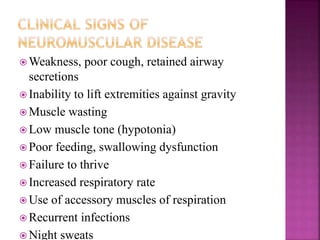
 Weakness, poor cough, retained airway
secretions
 Inability to lift extremities against gravity
 Muscle wasting
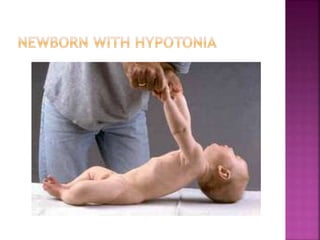
 Low muscle tone (hypotonia)
 Poor feeding, swallowing dysfunction
 Failure to thrive
 Increased respiratory rate
 Use of accessory muscles of respiration
 Recurrent infections
 Night sweats
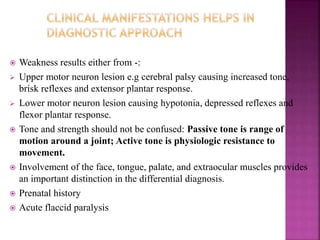
 Weakness results either from -:
 Upper motor neuron lesion e.g cerebral palsy causing increased tone,
brisk reflexes and extensor plantar response.
 Lower motor neuron lesion causing hypotonia, depressed reflexes and
flexor plantar response.
 Tone and strength should not be confused: Passive tone is range of
motion around a joint; Active tone is physiologic resistance to
movement.
 Involvement of the face, tongue, palate, and extraocular muscles provides
an important distinction in the differential diagnosis.
 Prenatal history
 Acute flaccid paralysis
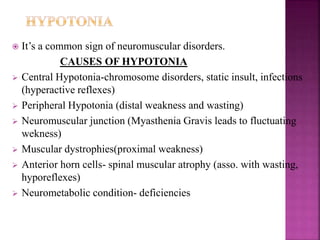
 It’s a common sign of neuromuscular disorders.
CAUSES OF HYPOTONIA
 Central Hypotonia-chromosome disorders, static insult, infections
(hyperactive reflexes)
 Peripheral Hypotonia (distal weakness and wasting)
 Neuromuscular junction (Myasthenia Gravis leads to fluctuating
wekness)
 Muscular dystrophies(proximal weakness)
 Anterior horn cells- spinal muscular atrophy (asso. with wasting,
hyporeflexes)
 Neurometabolic condition- deficiencies
 Serum Enzymes- creatine kinase
 MM for skeletal muscle
 MB for cardiac muscle
 BB for brain
 Mainly elevated in Duchenne muscular dystrophy.
 Molecular Genetic Markers
 Nerve Conduction Velocity
 Electromyography- insertion of needle into belly of muscle
→ recording electric potentials in various states of
contraction.
 Imaging of Muscle
 Muscle Biopsy- most important (vastus lateralis is sampled)
 ECG
Classification-
 Infectious - poliomyelitis
 Motor neuron disease - amyotrophic lateral
sclerosis
 Spinal muscular atrophy (SMA)
 Autosomal Recessive disease
 Type 1(Werdnig-hoffmann disease) present with profound hypotonia
and areflexia, respiratory weakness, poor swallowing and tongue
fasciculation. Children never learn to sit and Aspiration pneumonia
cause of death.
 Type 2(Dubowitz disease) onset at 6-18 months and usually able to sit
unaided but may develop kyphoscoliosis, tremors.
 Type 3(Kugelberg-Welander disease) onset >18 months and usually
able to walk
 Treatment is supportive and respiratory care, management of feeding
and swallowing and provide adequate nutrition.
 Guillain-Barrẽ syndrome is the most common.
 Clinical patterns to a demyelating process include-
 Presence of global areflexia
 Moderate to severe muscle weakness with bulk
 Motor symptoms
 Hypertrophy of nerves
Guillain- Barrẽ Syndrome
 Common cause of AFP
 Immune mediated, rapidly progressive, predominantly
motor, symmetric polyradiculoneuropathy
 Condition can occur at any age within six weeks prior
to symptom
 Clinically the respiratory illness and weakness(2-
4weeks after onset) along with tachycardia, arrhythmia,
bladder dysfunction, labile blood pressure and
impaired thermoregulation.
 Diagnosis
TREATMENT
 IVIG at 2g/kg over 2-5 days or plasma exchanges if
child presents within 2-4weeks.
 Donot respond give second course
 General supportive care
 Cardiorespiratory care and nutritional management.
MYASTHENIA GRAVIS
 Autoimmune and autosomal recessive trait disorder
characterized by rapid fatigability of striated muscle.
 Three clinical varieties-
 Juvenile in late infancy and childhood showing extraocular
muscle weakness.
 Congenital
 Transient neonatal-symptoms arises after birth till 3rd day.
 Occasionally associated with hypothyroidism, systemic
lupus erythematosus.
 Acetylcholine receptor antibodies may be positive.
 Electromyography show increases jitter or blocking.
 Diagnostic test done by Edrophonium chloride(0.1-
0.2mg/kg IV) and effects of weakness as distance b/w
upper and lower lid is seen in 10sec.
TREATMENT
 Mild myasthenia gravis require no treatment.
 Cholinesterase inhibiting drugs such as
 Neostigmine methylsulfate (0.4mg/kg) I/M every 4-6hr
or oral neostigmine bromide.
 Pyridostigmine (1-7mg/kg/day) in 4 divided doses
 Prednisone(0.5mg/kg/day)
 Thymectomy, Plasmapheresis, IVIG is effective in high
circulating levels of anti-A ch receptor antibodies.
 A group of genetically
determined, progressive primary
myopathy characterized by
degeneration and death of
muscle fibres, occurring at some
stage of the disorder.
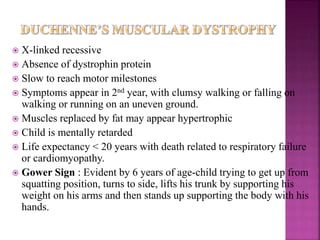
 –Duchenne muscular dystrophy
 –Becker muscular dystrophy
 –Myotonic muscular dystrophy
 –Congenital muscular dystrophy
- Glycogenoses
- Mitochondrial
 –Distal muscular dystrophy
–Others- Polymyositis
Dermatomyositis
inclusion body myositis
 X-linked recessive
 Absence of dystrophin protein
 Slow to reach motor milestones
 Symptoms appear in 2nd year, with clumsy walking or falling on
walking or running on an uneven ground.
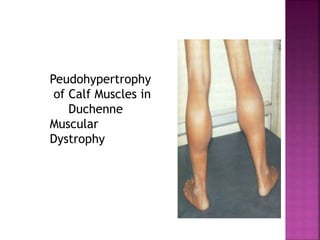
 Muscles replaced by fat may appear hypertrophic
 Child is mentally retarded
 Life expectancy < 20 years with death related to respiratory failure
or cardiomyopathy.
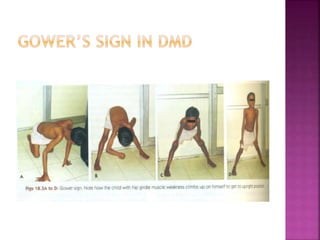
 Gower Sign : Evident by 6 years of age-child trying to get up from
squatting position, turns to side, lifts his trunk by supporting his
weight on his arms and then stands up supporting the body with his
hands.
Peudohypertrophy
of Calf Muscles in
Duchenne
Muscular
Dystrophy
 Serum CPK elevated upto 15,000-20,000 U/L (normal
2000U/L)
 EMG rarely necessary but useful in doubtful cases.
 Histopathology of muscle show diffuse changes of
degeneration & regeneration.
 Advanced genetic studies can find gene deletion.
 Physiotherapy, exercises including walking & cycling
useful; tenotomy may be required for contractures.
 Prednisone (0.75mg/kg/day) for 10days of each month to
avoid chronic complications.
Nemaline myopathy
Myotubular/Centronuclear myopathy
Central core disease
Multiminicore disease
Congenital fiber-type disproportion
myopathy
 Genetics Autosomal recessive and dominant forms
 First discovered in 1956 by Dr. Reyes
 1/50,000 births
 6 different mutations identified
 Onset Infancy and early childhood
 Clinical presentation Face, neck and proximal muscle
weakness
 Absent deep tendon reflexes (DTR), normal creatinine
kinase
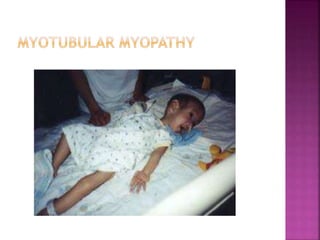
 A form of centronuclear myopathy
 Genetics X-linked recessive
 Autosomal recessive and dominant
 Onset Birth for X-linked recessive
 Infancy and childhood for autosomal recessive
 Adult for autosomal dominant
 X-linked is most common form and most severe
 Clinical Hypotonia, respiratory pump failure,
scaphocephaly
Neuromuscular disorders in children (2)

Neuromuscular disorders in children (2)

  • 1.
  • 2.
    The term neuromuscular diseasedefines disorders of the motor unit and excludes influences on muscular function from the brain, such as spasticity.
  • 3.
     The motorunit has 4 components:  Motor neuron in the brainstem or anterior horn of the spinal cord;  Axon(with other axons forming the peripheral nerve);  Neuromuscular junction disorder; and  Myopathies (all muscle fibers innervated by a single motor neuron).  The motor unit is influenced by suprasegmental or upper motor neuron.
  • 4.
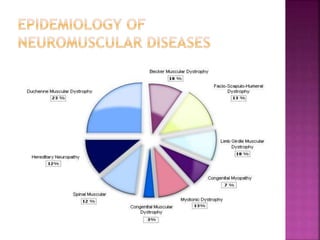
    Muscular Dystrophies Congenital andMetabolic Myopathies Anterior Horn Cell Disorders Neuromuscular Junction Diseases
  • 6.
     Weakness, poorcough, retained airway secretions  Inability to lift extremities against gravity  Muscle wasting  Low muscle tone (hypotonia)  Poor feeding, swallowing dysfunction  Failure to thrive  Increased respiratory rate  Use of accessory muscles of respiration  Recurrent infections  Night sweats
  • 7.
     Weakness resultseither from -:  Upper motor neuron lesion e.g cerebral palsy causing increased tone, brisk reflexes and extensor plantar response.  Lower motor neuron lesion causing hypotonia, depressed reflexes and flexor plantar response.  Tone and strength should not be confused: Passive tone is range of motion around a joint; Active tone is physiologic resistance to movement.  Involvement of the face, tongue, palate, and extraocular muscles provides an important distinction in the differential diagnosis.  Prenatal history  Acute flaccid paralysis
  • 8.
     It’s acommon sign of neuromuscular disorders. CAUSES OF HYPOTONIA  Central Hypotonia-chromosome disorders, static insult, infections (hyperactive reflexes)  Peripheral Hypotonia (distal weakness and wasting)  Neuromuscular junction (Myasthenia Gravis leads to fluctuating wekness)  Muscular dystrophies(proximal weakness)  Anterior horn cells- spinal muscular atrophy (asso. with wasting, hyporeflexes)  Neurometabolic condition- deficiencies
  • 10.
     Serum Enzymes-creatine kinase  MM for skeletal muscle  MB for cardiac muscle  BB for brain  Mainly elevated in Duchenne muscular dystrophy.  Molecular Genetic Markers  Nerve Conduction Velocity  Electromyography- insertion of needle into belly of muscle → recording electric potentials in various states of contraction.  Imaging of Muscle  Muscle Biopsy- most important (vastus lateralis is sampled)  ECG
  • 11.
    Classification-  Infectious -poliomyelitis  Motor neuron disease - amyotrophic lateral sclerosis  Spinal muscular atrophy (SMA)
  • 12.
     Autosomal Recessivedisease  Type 1(Werdnig-hoffmann disease) present with profound hypotonia and areflexia, respiratory weakness, poor swallowing and tongue fasciculation. Children never learn to sit and Aspiration pneumonia cause of death.  Type 2(Dubowitz disease) onset at 6-18 months and usually able to sit unaided but may develop kyphoscoliosis, tremors.  Type 3(Kugelberg-Welander disease) onset >18 months and usually able to walk  Treatment is supportive and respiratory care, management of feeding and swallowing and provide adequate nutrition.
  • 13.
     Guillain-Barrẽ syndromeis the most common.  Clinical patterns to a demyelating process include-  Presence of global areflexia  Moderate to severe muscle weakness with bulk  Motor symptoms  Hypertrophy of nerves Guillain- Barrẽ Syndrome  Common cause of AFP  Immune mediated, rapidly progressive, predominantly motor, symmetric polyradiculoneuropathy  Condition can occur at any age within six weeks prior to symptom
  • 14.
     Clinically therespiratory illness and weakness(2- 4weeks after onset) along with tachycardia, arrhythmia, bladder dysfunction, labile blood pressure and impaired thermoregulation.  Diagnosis TREATMENT  IVIG at 2g/kg over 2-5 days or plasma exchanges if child presents within 2-4weeks.  Donot respond give second course  General supportive care  Cardiorespiratory care and nutritional management.
  • 15.
    MYASTHENIA GRAVIS  Autoimmuneand autosomal recessive trait disorder characterized by rapid fatigability of striated muscle.  Three clinical varieties-  Juvenile in late infancy and childhood showing extraocular muscle weakness.  Congenital  Transient neonatal-symptoms arises after birth till 3rd day.  Occasionally associated with hypothyroidism, systemic lupus erythematosus.  Acetylcholine receptor antibodies may be positive.  Electromyography show increases jitter or blocking.
  • 16.
     Diagnostic testdone by Edrophonium chloride(0.1- 0.2mg/kg IV) and effects of weakness as distance b/w upper and lower lid is seen in 10sec. TREATMENT  Mild myasthenia gravis require no treatment.  Cholinesterase inhibiting drugs such as  Neostigmine methylsulfate (0.4mg/kg) I/M every 4-6hr or oral neostigmine bromide.  Pyridostigmine (1-7mg/kg/day) in 4 divided doses  Prednisone(0.5mg/kg/day)  Thymectomy, Plasmapheresis, IVIG is effective in high circulating levels of anti-A ch receptor antibodies.
  • 17.
     A groupof genetically determined, progressive primary myopathy characterized by degeneration and death of muscle fibres, occurring at some stage of the disorder.
  • 18.
     –Duchenne musculardystrophy  –Becker muscular dystrophy  –Myotonic muscular dystrophy  –Congenital muscular dystrophy - Glycogenoses - Mitochondrial  –Distal muscular dystrophy –Others- Polymyositis Dermatomyositis inclusion body myositis
  • 19.
     X-linked recessive Absence of dystrophin protein  Slow to reach motor milestones  Symptoms appear in 2nd year, with clumsy walking or falling on walking or running on an uneven ground.  Muscles replaced by fat may appear hypertrophic  Child is mentally retarded  Life expectancy < 20 years with death related to respiratory failure or cardiomyopathy.  Gower Sign : Evident by 6 years of age-child trying to get up from squatting position, turns to side, lifts his trunk by supporting his weight on his arms and then stands up supporting the body with his hands.
  • 20.
    Peudohypertrophy of Calf Musclesin Duchenne Muscular Dystrophy
  • 22.
     Serum CPKelevated upto 15,000-20,000 U/L (normal 2000U/L)  EMG rarely necessary but useful in doubtful cases.  Histopathology of muscle show diffuse changes of degeneration & regeneration.  Advanced genetic studies can find gene deletion.  Physiotherapy, exercises including walking & cycling useful; tenotomy may be required for contractures.  Prednisone (0.75mg/kg/day) for 10days of each month to avoid chronic complications.
  • 23.
    Nemaline myopathy Myotubular/Centronuclear myopathy Centralcore disease Multiminicore disease Congenital fiber-type disproportion myopathy
  • 24.
     Genetics Autosomalrecessive and dominant forms  First discovered in 1956 by Dr. Reyes  1/50,000 births  6 different mutations identified  Onset Infancy and early childhood  Clinical presentation Face, neck and proximal muscle weakness  Absent deep tendon reflexes (DTR), normal creatinine kinase
  • 25.
     A formof centronuclear myopathy  Genetics X-linked recessive  Autosomal recessive and dominant  Onset Birth for X-linked recessive  Infancy and childhood for autosomal recessive  Adult for autosomal dominant  X-linked is most common form and most severe  Clinical Hypotonia, respiratory pump failure, scaphocephaly