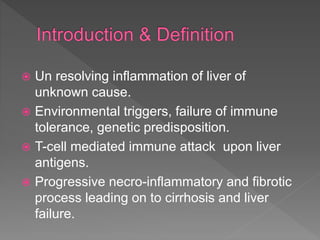
 Un resolving inflammation of liver of
unknown cause.
 Environmental triggers, failure of immune
tolerance, genetic predisposition.
 T-cell mediated immune attack upon liver
antigens.
 Progressive necro-inflammatory and fibrotic
process leading on to cirrhosis and liver
failure.
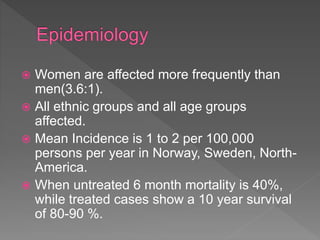
 Women are affected more frequently than
men(3.6:1).
 All ethnic groups and all age groups
affected.
 Mean Incidence is 1 to 2 per 100,000
persons per year in Norway, Sweden, North-
America.
 When untreated 6 month mortality is 40%,
while treated cases show a 10 year survival
of 80-90 %.
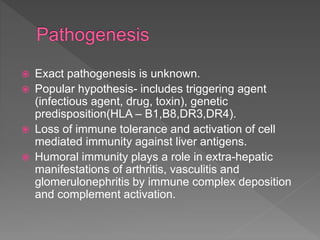
 Exact pathogenesis is unknown.
 Popular hypothesis- includes triggering agent
(infectious agent, drug, toxin), genetic
predisposition(HLA – B1,B8,DR3,DR4).
 Loss of immune tolerance and activation of cell
mediated immunity against liver antigens.
 Humoral immunity plays a role in extra-hepatic
manifestations of arthritis, vasculitis and
glomerulonephritis by immune complex deposition
and complement activation.
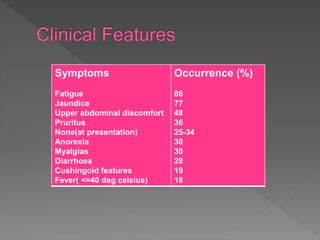
Symptoms
Fatigue
Jaundice
Upper abdominal discomfort
Pruritus
None(at presentation)
Anorexia
Myalgias
Diarrhoea
Cushingoid features
Fever( <=40 deg celsius)
Occurrence (%)
86
77
48
36
25-34
30
30
28
19
18
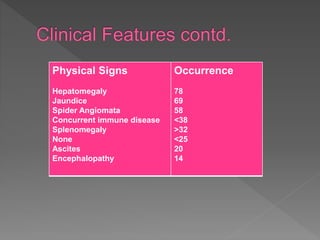
Physical Signs
Hepatomegaly
Jaundice
Spider Angiomata
Concurrent immune disease
Splenomegaly
None
Ascites
Encephalopathy
Occurrence
78
69
58
<38
>32
<25
20
14
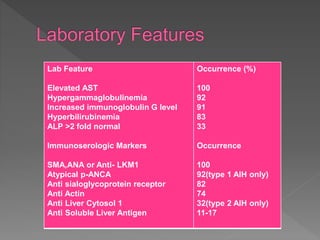
Lab Feature
Elevated AST
Hypergammaglobulinemia
Increased immunoglobulin G level
Hyperbilirubinemia
ALP >2 fold normal
Immunoserologic Markers
SMA,ANA or Anti- LKM1
Atypical p-ANCA
Anti sialoglycoprotein receptor
Anti Actin
Anti Liver Cytosol 1
Anti Soluble Liver Antigen
Occurrence (%)
100
92
91
83
33
Occurrence
100
92(type 1 AIH only)
82
74
32(type 2 AIH only)
11-17
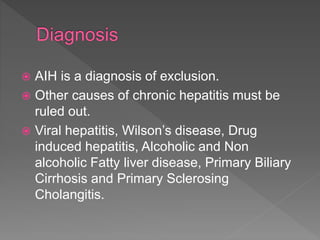
 AIH is a diagnosis of exclusion.
 Other causes of chronic hepatitis must be
ruled out.
 Viral hepatitis, Wilson’s disease, Drug
induced hepatitis, Alcoholic and Non
alcoholic Fatty liver disease, Primary Biliary
Cirrhosis and Primary Sclerosing
Cholangitis.
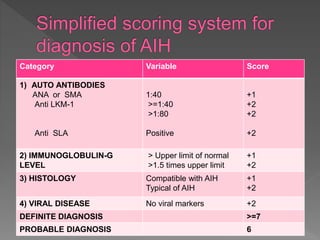
Category Variable Score
1) AUTO ANTIBODIES
ANA or SMA
Anti LKM-1
Anti SLA
1:40
>=1:40
>1:80
Positive
+1
+2
+2
+2
2) IMMUNOGLOBULIN-G
LEVEL
> Upper limit of normal
>1.5 times upper limit
+1
+2
3) HISTOLOGY Compatible with AIH
Typical of AIH
+1
+2
4) VIRAL DISEASE No viral markers +2
DEFINITE DIAGNOSIS >=7
PROBABLE DIAGNOSIS 6
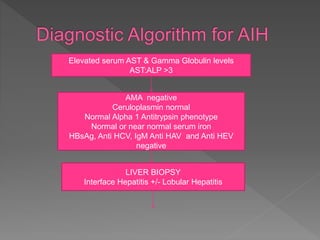
Elevated serum AST & Gamma Globulin levels
AST:ALP >3
AMA negative
Ceruloplasmin normal
Normal Alpha 1 Antitrypsin phenotype
Normal or near normal serum iron
HBsAg, Anti HCV, IgM Anti HAV and Anti HEV
negative
LIVER BIOPSY
Interface Hepatitis +/- Lobular Hepatitis
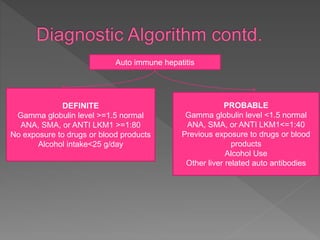
Auto immune hepatitis
DEFINITE
Gamma globulin level >=1.5 normal
ANA, SMA, or ANTI LKM1 >=1:80
No exposure to drugs or blood products
Alcohol intake<25 g/day
PROBABLE
Gamma globulin level <1.5 normal
ANA, SMA, or ANTI LKM1<=1:40
Previous exposure to drugs or blood
products
Alcohol Use
Other liver related auto antibodies
 Two types of AIH (Type 1 and Type 2).
 Based on serological markers.
 A proposed third type (type 3) has been
abandoned and considered a more severe
form of type 1 AIH.
 Anti-SLA is found in both type 1 AIH and in
type 2 AIH and indicator of severe disease
and poor outcome.
 Characterized by the presence of ANA, SMA or
both, and constitutes 80% of AIH cases.
 70 % of patients are female, with a peak
incidence between ages 16 and 30 years.
 Associations with other autoimmune diseases
are common (15%-34%); these include
autoimmune thyroid disease, synovitis, celiac
disease and ulcerative colitis.
 Characterized by the presence of anti-LKM1
and/or anti-LC1 and/or anti-LKM-3.
 Most patients with type 2 AIH are children,
and serum immunoglobulin levels are usually
elevated except for IgA, which may be
reduced.
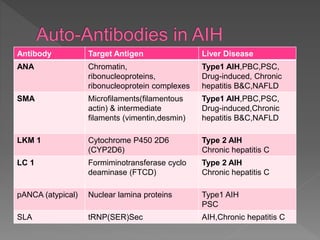
Antibody Target Antigen Liver Disease
ANA Chromatin,
ribonucleoproteins,
ribonucleoprotein complexes
Type1 AIH,PBC,PSC,
Drug-induced, Chronic
hepatitis B&C,NAFLD
SMA Microfilaments(filamentous
actin) & intermediate
filaments (vimentin,desmin)
Type1 AIH,PBC,PSC,
Drug-induced,Chronic
hepatitis B&C,NAFLD
LKM 1 Cytochrome P450 2D6
(CYP2D6)
Type 2 AIH
Chronic hepatitis C
LC 1 Formiminotransferase cyclo
deaminase (FTCD)
Type 2 AIH
Chronic hepatitis C
pANCA (atypical) Nuclear lamina proteins Type1 AIH
PSC
SLA tRNP(SER)Sec AIH,Chronic hepatitis C
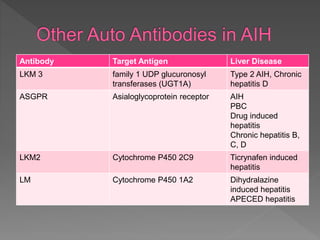
Antibody Target Antigen Liver Disease
LKM 3 family 1 UDP glucuronosyl
transferases (UGT1A)
Type 2 AIH, Chronic
hepatitis D
ASGPR Asialoglycoprotein receptor AIH
PBC
Drug induced
hepatitis
Chronic hepatitis B,
C, D
LKM2 Cytochrome P450 2C9 Ticrynafen induced
hepatitis
LM Cytochrome P450 1A2 Dihydralazine
induced hepatitis
APECED hepatitis
 Recommended at presentation to establish the
diagnosis and to guide the treatment decision.
 Interface hepatitis is the histological hallmark and
plasma cell infiltration is typical.
 Neither histological finding is specific for AIH, and
the absence of plasma cells in the infiltrate does not
preclude the diagnosis.
 Eosinophils, lobular inflammation, bridging
necrosis, and multiacinar necrosis may be present.
 Portal lesions generally spare bile ducts.
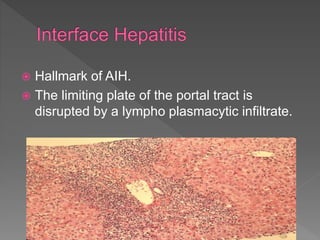
 Hallmark of AIH.
 The limiting plate of the portal tract is
disrupted by a lympho plasmacytic infiltrate.
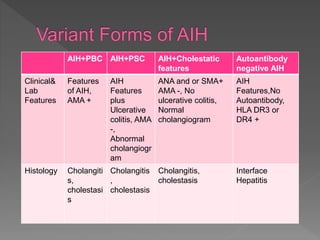
AIH+PBC AIH+PSC AIH+Cholestatic
features
Autoantibody
negative AIH
Clinical&
Lab
Features
Features
of AIH,
AMA +
AIH
Features
plus
Ulcerative
colitis, AMA
-,
Abnormal
cholangiogr
am
ANA and or SMA+
AMA -, No
ulcerative colitis,
Normal
cholangiogram
AIH
Features,No
Autoantibody,
HLA DR3 or
DR4 +
Histology Cholangiti
s,
cholestasi
s
Cholangitis
,
cholestasis
Cholangitis,
cholestasis
Interface
Hepatitis
 13% of chronic hepatitis of unknown cause
satisfy criteria for AIH but lack the
characteristic autoantibodies.
 Commonly called CRYPTOGENIC
CHRONIC HEPATITIS.
 Clinical, biochemical and histological
features are characteristic of AIH.
 They have the similar HLA types and
respond to steroids like AIH.
 Autoimmune thyroiditis, Graves’ disease,
synovitis and ulcerative colitis are the most
common immune-mediated disorders
associated with AIH in North American
adults.
 Type I diabetes mellitus, vitiligo, and
autoimmune thyroiditis are the most common
concurrent disorders in European anti-
LKM1+ AIH patients.
 In children with AIH, autoimmune sclerosing
cholangitis can be present, with or without IBD.
 Cholangiographic studies should be considered
to exclude PSC in adults if there has been no
response to corticosteroid therapy after 3
months.
 All children with AIH and all adults with both AIH
and IBD should undergo cholangiographic
studies to exclude PSC.
 Incapacitating symptoms and relentless
clinical progression.
 Serum AST or ALT levels are >=10 fold the
upper limit of normal.
 If AST or ALT levels are >=5 fold the upper
limit of normal with gamma globulin >=2 fold
the upper limit of normal.
 Bridging or Multi-lobular Necrosis on
histology
 Mild or no symptoms.
 Serum AST is 3-9.9 fold ULN.
 Serum AST is >=5 fold ULN BUT gamma
globulin is <2 fold ULN.
 Interface Hepatitis on histology
 Asymptomatic with minimal laboratory
changes.
 Serum AST <3 fold the ULN.
 Burned out or Inactive Cirrhosis – patients
do not benefit from therapy and have
increased drug induced side effects (Hypo-
albuminemia, hyper-bilirubinemia and porto-
systemic shunting affect protein binding and
increase free prednisone)
 Portal hepatitis and Decompensated Cirrhosis
with variceal bleeding.
 Severe pre treatment CYTOPENIA or known
deficiency of thiopurine methyltransferase
deficiency.
 Brittle diabetes, vertebral compression,
psychosis, osteoporosis and uncontrolled
hypertension where steroids can be harmful.
 Previous intolerances to azathioprine or
prednisone.
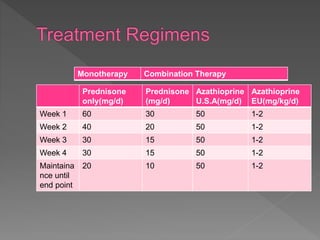
 Mainstay of management of AIH is
Glucocorticoid therapy.
 Although some advocate the use of
prednisolone, prednisone is just as effective
and favoured by most authorities.
 Two treatment regimens are used and are
equally effective but it is the combination
therapy which is preferred.
 It is usually preferred as over a span of 18
months it reduces the serious life threatening
side effects of steroids from 66% down to under
20 %.
 Begin with 30 mg/d of prednisone along with 50
mg/d(1-2mg/kg in europe) of azathioprine.
 With azathioprine maintained at 50mg/d the
prednisone dose is tapered over a month to a
maintainance level of 10mg/d.
 Preferred in patients in whom azathioprine
cant be given.
 Severe pre treatment cytopenia, known
thiopurine methyl transferase deficiency,
pregnancy, active malignancy and if
treatment is to be given for a short course <6
months.
Monotherapy Combination Therapy
Prednisone
only(mg/d)
Prednisone
(mg/d)
Azathioprine
U.S.A(mg/d)
Azathioprine
EU(mg/kg/d)
Week 1 60 30 50 1-2
Week 2 40 20 50 1-2
Week 3 30 15 50 1-2
Week 4 30 15 50 1-2
Maintaina
nce until
end point
20 10 50 1-2
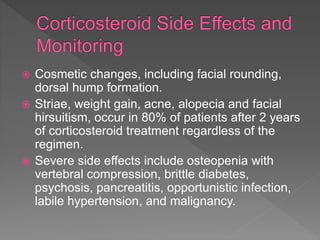
 Cosmetic changes, including facial rounding,
dorsal hump formation.
 Striae, weight gain, acne, alopecia and facial
hirsuitism, occur in 80% of patients after 2 years
of corticosteroid treatment regardless of the
regimen.
 Severe side effects include osteopenia with
vertebral compression, brittle diabetes,
psychosis, pancreatitis, opportunistic infection,
labile hypertension, and malignancy.
 regular weight baring exercise program, vitamin
D and calcium supplementation and
administration of bisphosphonates wherever
needed.
 Patients on long-term corticosteroid treatment
should be monitored for bone disease by
baseline and annual bone mineral densitometry
of the lumbar spine and hip.
 Pre treatment vaccination against HAV and
HBV should be performed if there has been no
previous vaccination .
 include nausea, emesis, rash, opportunistic
infection, villous atrophy, malabsorption, bone
marrow suppression and malignancy.
 The principal side effect of azathioprine is
cytopenia and the most common cause of
cytopenia in these patients is hypersplenism
associated with cirrhosis.
 Patients undergoing azathioprine therapy
should have blood leukocyte and platelet counts
assessed at 6-month intervals.
 Patients with near-zero erythrocyte concentrations of its
activity are at risk for myelo-suppression during
azathioprine treatment.
 The rarity of severe azathioprine-induced myelo-
suppression, the low dose of azathioprine used in
conventional treatment (50 mg-150 mg daily), and the
inability to reliably predict risk by phenotypic and genotypic
assessments have not supported routine screening for
thiopurine methy-ltransferase activity in AIH.
 Pre treatment cytopenia, cytopenia developing during
therapy, or the administration of higher than conventional
doses of azathioprine (>150 mg daily) justifies
determination of enzyme activity.
 Autoimmune hepatitis can improve during
pregnancy and this improvement may allow
reductions in immunosuppressive therapy
during pregnancy.
 Pre-conceptional counselling is advised and
termination of immunosuppressive therapy
should be attempted where possible.
 Patients must be counselled regarding the uncertain risk of
azathioprine(CAT D) in pregnancy, and azathioprine
should be discontinued, if possible, in patients during
pregnancy.
 Postpartum exacerbation of AIH must be anticipated by
resuming standard therapy 2 weeks prior to anticipated
delivery and by closely monitoring serum AST or ALT
levels at 3-week intervals for at least 3 months after
delivery.
 Contraception should be advised in women with advanced
liver disease and features of portal hypertension because
they are at risk for variceal hemorrhage during pregnancy.
 Remission
 Treatment failure
 Incomplete response
 Relapse
 Drug toxicity
 Disappearance of symptoms, normal serum
aminotransferases, bilirubin and gamma globulin levels,
normal hepatic tissue or inactive cirrhosis is the ideal
treatment endpoint and the goal of initial therapy.
 Liver biopsy assessment prior to termination of treatment
is the only method by which to ensure full resolution of the
disease and an optimal endpoint of therapy.
 Interface hepatitis is found in 55% of patients with normal
serum AST and gamma-globulin levels and these
individuals typically relapse after cessation of treatment,
therefore, a liver biopsy is recommended before
termination of therapy.
 Termination of therapy should be considered after
at least 2-year treatment, when liver function tests
and immunoglobulin levels have been repeatedly
normal.
 Termination of therapy after induction of remission
requires a gradual, well-monitored dose reduction
over a 6-week period of close surveillance.
 Laboratory tests are performed at 3-week intervals
during drug withdrawal and for 3 months after
termination of therapy. Thereafter, they are
repeated at 3 months and then every 6 months for
1 year and then annually life-long.
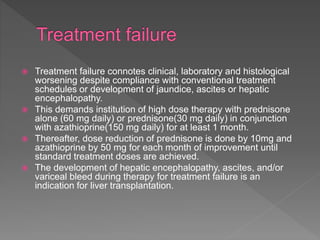
 Treatment failure connotes clinical, laboratory and histological
worsening despite compliance with conventional treatment
schedules or development of jaundice, ascites or hepatic
encephalopathy.
 This demands institution of high dose therapy with prednisone
alone (60 mg daily) or prednisone(30 mg daily) in conjunction
with azathioprine(150 mg daily) for at least 1 month.
 Thereafter, dose reduction of prednisone is done by 10mg and
azathioprine by 50 mg for each month of improvement until
standard treatment doses are achieved.
 The development of hepatic encephalopathy, ascites, and/or
variceal bleed during therapy for treatment failure is an
indication for liver transplantation.
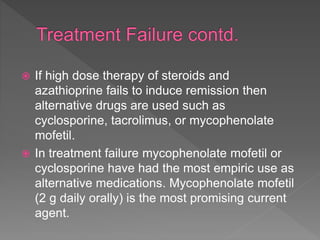
 If high dose therapy of steroids and
azathioprine fails to induce remission then
alternative drugs are used such as
cyclosporine, tacrolimus, or mycophenolate
mofetil.
 In treatment failure mycophenolate mofetil or
cyclosporine have had the most empiric use as
alternative medications. Mycophenolate mofetil
(2 g daily orally) is the most promising current
agent.
 Clinical, laboratory and histological
improvement which is insufficient to satisfy
criteria for a treatment endpoint after continuous
therapy for at least 36 months.
 Reduction in doses of prednisone by 2.5
mg/month until lowest level possible (10 mg
daily) to prevent worsening of serum AST or
ALT abnormalities.
 Indefinite azathioprine therapy (2 mg/kg daily)
as an alternative treatment if corticosteroid
intolerance.
 Relapse connotes recrudescence of disease activity after
induction of remission and termination of therapy.
 It is characterized by an increase in the serum AST level to
more than three-fold the ULN and/ or increase in the
serum gamma globulin level to more than 2g/dL.
 The first relapse after drug withdrawal should be retreated
with a combination of prednisone plus azathioprine at the
same treatment regimen as with the initial course of
therapy and then tapered to mono therapy with either
azathioprine (2 mg/kg daily) as a long-term maintenance
therapy or with indefinite low dose prednisone (10 mg
daily) in patients intolerant of azathioprine.
 Drug toxicity justifies premature
discontinuation or alteration of conventional
therapy.
 therapy with the tolerated agent (prednisone
or azathioprine) can be maintained in
adjusted dose to prevent worsening in the
clinical and laboratory features.
 occurs in 4% of patients with type 1 AIH, and the
10-year probability of developing this neoplasm is
2.9%.
 Risk factors include male sex, portal hypertension
manifested by ascites, oesophageal varices, or
thrombocytopenia, immunosuppressive treatment
for at least 3 years, and cirrhosis of at least 10
years duration.
 A focused surveillance strategy based on hepatic
ultrasonography at 6-month intervals is
recommended for these individuals
 AIH and acute liver failure
 Decompensated cirrhosis with a MELD score
>=15
 Hepatocellular carcinoma meeting criteria for
transplantation.
 40% of all patients develop cirrhosis.
 54% develop oesophageal varices in 2 years.
 Poor prognosis if ascites or hepatic encephalopathy
present.
 13-20% can have spontaneous resolution.
 Of patients who survive the early and active stage
of disease, approximately 41% of them develop
inactive cirrhosis.
 Of patients who have severe initial disease and
survive the first two years, typically survive long
term.
 Suspect AIH as a cause of acute or chronic hepatitis when
other causes such as viral, hereditary, metabolic,
cholestatic, and drug-induced diseases, have been
excluded.
 Two types based on the presence of ANA and SMA (type1
AIH) or anti-LKM1 and anti-LC1 (type 2 AIH).
 Immunosuppressive treatment should be instituted in
patients with serum AST or ALT levels greater than 10-fold
ULN, at least five-fold ULN in conjunction with a serum
gamma-globulin level at least 2-fold ULN, and/or
histological features of bridging necrosis or multi-lobular
necrosis.
 Immunosuppressive treatment should not be
instituted in patients with minimal or no disease
activity or inactive cirrhosis, but these patients
must continue to be followed closely, i.e., 3-6
months.
 Apart from alcoholic hepatitis (DF>32), it is the
only hepatitis for which STEROIDS should be
given.
 AIH must always be suspected because early
treatment can reduce the mortality and
progression to cirrhosis significantly.
Autoimmune hepatitis better understanding (2)

Autoimmune hepatitis better understanding (2)

  • 2.
     Un resolvinginflammation of liver of unknown cause.  Environmental triggers, failure of immune tolerance, genetic predisposition.  T-cell mediated immune attack upon liver antigens.  Progressive necro-inflammatory and fibrotic process leading on to cirrhosis and liver failure.
  • 3.
     Women areaffected more frequently than men(3.6:1).  All ethnic groups and all age groups affected.  Mean Incidence is 1 to 2 per 100,000 persons per year in Norway, Sweden, North- America.  When untreated 6 month mortality is 40%, while treated cases show a 10 year survival of 80-90 %.
  • 4.
     Exact pathogenesisis unknown.  Popular hypothesis- includes triggering agent (infectious agent, drug, toxin), genetic predisposition(HLA – B1,B8,DR3,DR4).  Loss of immune tolerance and activation of cell mediated immunity against liver antigens.  Humoral immunity plays a role in extra-hepatic manifestations of arthritis, vasculitis and glomerulonephritis by immune complex deposition and complement activation.
  • 5.
    Symptoms Fatigue Jaundice Upper abdominal discomfort Pruritus None(atpresentation) Anorexia Myalgias Diarrhoea Cushingoid features Fever( <=40 deg celsius) Occurrence (%) 86 77 48 36 25-34 30 30 28 19 18
  • 6.
    Physical Signs Hepatomegaly Jaundice Spider Angiomata Concurrentimmune disease Splenomegaly None Ascites Encephalopathy Occurrence 78 69 58 <38 >32 <25 20 14
  • 7.
    Lab Feature Elevated AST Hypergammaglobulinemia Increasedimmunoglobulin G level Hyperbilirubinemia ALP >2 fold normal Immunoserologic Markers SMA,ANA or Anti- LKM1 Atypical p-ANCA Anti sialoglycoprotein receptor Anti Actin Anti Liver Cytosol 1 Anti Soluble Liver Antigen Occurrence (%) 100 92 91 83 33 Occurrence 100 92(type 1 AIH only) 82 74 32(type 2 AIH only) 11-17
  • 8.
     AIH isa diagnosis of exclusion.  Other causes of chronic hepatitis must be ruled out.  Viral hepatitis, Wilson’s disease, Drug induced hepatitis, Alcoholic and Non alcoholic Fatty liver disease, Primary Biliary Cirrhosis and Primary Sclerosing Cholangitis.
  • 9.
    Category Variable Score 1)AUTO ANTIBODIES ANA or SMA Anti LKM-1 Anti SLA 1:40 >=1:40 >1:80 Positive +1 +2 +2 +2 2) IMMUNOGLOBULIN-G LEVEL > Upper limit of normal >1.5 times upper limit +1 +2 3) HISTOLOGY Compatible with AIH Typical of AIH +1 +2 4) VIRAL DISEASE No viral markers +2 DEFINITE DIAGNOSIS >=7 PROBABLE DIAGNOSIS 6
  • 10.
    Elevated serum AST& Gamma Globulin levels AST:ALP >3 AMA negative Ceruloplasmin normal Normal Alpha 1 Antitrypsin phenotype Normal or near normal serum iron HBsAg, Anti HCV, IgM Anti HAV and Anti HEV negative LIVER BIOPSY Interface Hepatitis +/- Lobular Hepatitis
  • 11.
    Auto immune hepatitis DEFINITE Gammaglobulin level >=1.5 normal ANA, SMA, or ANTI LKM1 >=1:80 No exposure to drugs or blood products Alcohol intake<25 g/day PROBABLE Gamma globulin level <1.5 normal ANA, SMA, or ANTI LKM1<=1:40 Previous exposure to drugs or blood products Alcohol Use Other liver related auto antibodies
  • 12.
     Two typesof AIH (Type 1 and Type 2).  Based on serological markers.  A proposed third type (type 3) has been abandoned and considered a more severe form of type 1 AIH.  Anti-SLA is found in both type 1 AIH and in type 2 AIH and indicator of severe disease and poor outcome.
  • 13.
     Characterized bythe presence of ANA, SMA or both, and constitutes 80% of AIH cases.  70 % of patients are female, with a peak incidence between ages 16 and 30 years.  Associations with other autoimmune diseases are common (15%-34%); these include autoimmune thyroid disease, synovitis, celiac disease and ulcerative colitis.
  • 14.
     Characterized bythe presence of anti-LKM1 and/or anti-LC1 and/or anti-LKM-3.  Most patients with type 2 AIH are children, and serum immunoglobulin levels are usually elevated except for IgA, which may be reduced.
  • 15.
    Antibody Target AntigenLiver Disease ANA Chromatin, ribonucleoproteins, ribonucleoprotein complexes Type1 AIH,PBC,PSC, Drug-induced, Chronic hepatitis B&C,NAFLD SMA Microfilaments(filamentous actin) & intermediate filaments (vimentin,desmin) Type1 AIH,PBC,PSC, Drug-induced,Chronic hepatitis B&C,NAFLD LKM 1 Cytochrome P450 2D6 (CYP2D6) Type 2 AIH Chronic hepatitis C LC 1 Formiminotransferase cyclo deaminase (FTCD) Type 2 AIH Chronic hepatitis C pANCA (atypical) Nuclear lamina proteins Type1 AIH PSC SLA tRNP(SER)Sec AIH,Chronic hepatitis C
  • 16.
    Antibody Target AntigenLiver Disease LKM 3 family 1 UDP glucuronosyl transferases (UGT1A) Type 2 AIH, Chronic hepatitis D ASGPR Asialoglycoprotein receptor AIH PBC Drug induced hepatitis Chronic hepatitis B, C, D LKM2 Cytochrome P450 2C9 Ticrynafen induced hepatitis LM Cytochrome P450 1A2 Dihydralazine induced hepatitis APECED hepatitis
  • 17.
     Recommended atpresentation to establish the diagnosis and to guide the treatment decision.  Interface hepatitis is the histological hallmark and plasma cell infiltration is typical.  Neither histological finding is specific for AIH, and the absence of plasma cells in the infiltrate does not preclude the diagnosis.  Eosinophils, lobular inflammation, bridging necrosis, and multiacinar necrosis may be present.  Portal lesions generally spare bile ducts.
  • 18.
     Hallmark ofAIH.  The limiting plate of the portal tract is disrupted by a lympho plasmacytic infiltrate.
  • 19.
    AIH+PBC AIH+PSC AIH+Cholestatic features Autoantibody negativeAIH Clinical& Lab Features Features of AIH, AMA + AIH Features plus Ulcerative colitis, AMA -, Abnormal cholangiogr am ANA and or SMA+ AMA -, No ulcerative colitis, Normal cholangiogram AIH Features,No Autoantibody, HLA DR3 or DR4 + Histology Cholangiti s, cholestasi s Cholangitis , cholestasis Cholangitis, cholestasis Interface Hepatitis
  • 20.
     13% ofchronic hepatitis of unknown cause satisfy criteria for AIH but lack the characteristic autoantibodies.  Commonly called CRYPTOGENIC CHRONIC HEPATITIS.  Clinical, biochemical and histological features are characteristic of AIH.  They have the similar HLA types and respond to steroids like AIH.
  • 21.
     Autoimmune thyroiditis,Graves’ disease, synovitis and ulcerative colitis are the most common immune-mediated disorders associated with AIH in North American adults.  Type I diabetes mellitus, vitiligo, and autoimmune thyroiditis are the most common concurrent disorders in European anti- LKM1+ AIH patients.
  • 22.
     In childrenwith AIH, autoimmune sclerosing cholangitis can be present, with or without IBD.  Cholangiographic studies should be considered to exclude PSC in adults if there has been no response to corticosteroid therapy after 3 months.  All children with AIH and all adults with both AIH and IBD should undergo cholangiographic studies to exclude PSC.
  • 23.
     Incapacitating symptomsand relentless clinical progression.  Serum AST or ALT levels are >=10 fold the upper limit of normal.  If AST or ALT levels are >=5 fold the upper limit of normal with gamma globulin >=2 fold the upper limit of normal.  Bridging or Multi-lobular Necrosis on histology
  • 24.
     Mild orno symptoms.  Serum AST is 3-9.9 fold ULN.  Serum AST is >=5 fold ULN BUT gamma globulin is <2 fold ULN.  Interface Hepatitis on histology
  • 25.
     Asymptomatic withminimal laboratory changes.  Serum AST <3 fold the ULN.  Burned out or Inactive Cirrhosis – patients do not benefit from therapy and have increased drug induced side effects (Hypo- albuminemia, hyper-bilirubinemia and porto- systemic shunting affect protein binding and increase free prednisone)
  • 26.
     Portal hepatitisand Decompensated Cirrhosis with variceal bleeding.  Severe pre treatment CYTOPENIA or known deficiency of thiopurine methyltransferase deficiency.  Brittle diabetes, vertebral compression, psychosis, osteoporosis and uncontrolled hypertension where steroids can be harmful.  Previous intolerances to azathioprine or prednisone.
  • 27.
     Mainstay ofmanagement of AIH is Glucocorticoid therapy.  Although some advocate the use of prednisolone, prednisone is just as effective and favoured by most authorities.  Two treatment regimens are used and are equally effective but it is the combination therapy which is preferred.
  • 28.
     It isusually preferred as over a span of 18 months it reduces the serious life threatening side effects of steroids from 66% down to under 20 %.  Begin with 30 mg/d of prednisone along with 50 mg/d(1-2mg/kg in europe) of azathioprine.  With azathioprine maintained at 50mg/d the prednisone dose is tapered over a month to a maintainance level of 10mg/d.
  • 29.
     Preferred inpatients in whom azathioprine cant be given.  Severe pre treatment cytopenia, known thiopurine methyl transferase deficiency, pregnancy, active malignancy and if treatment is to be given for a short course <6 months.
  • 30.
    Monotherapy Combination Therapy Prednisone only(mg/d) Prednisone (mg/d) Azathioprine U.S.A(mg/d) Azathioprine EU(mg/kg/d) Week1 60 30 50 1-2 Week 2 40 20 50 1-2 Week 3 30 15 50 1-2 Week 4 30 15 50 1-2 Maintaina nce until end point 20 10 50 1-2
  • 31.
     Cosmetic changes,including facial rounding, dorsal hump formation.  Striae, weight gain, acne, alopecia and facial hirsuitism, occur in 80% of patients after 2 years of corticosteroid treatment regardless of the regimen.  Severe side effects include osteopenia with vertebral compression, brittle diabetes, psychosis, pancreatitis, opportunistic infection, labile hypertension, and malignancy.
  • 32.
     regular weightbaring exercise program, vitamin D and calcium supplementation and administration of bisphosphonates wherever needed.  Patients on long-term corticosteroid treatment should be monitored for bone disease by baseline and annual bone mineral densitometry of the lumbar spine and hip.  Pre treatment vaccination against HAV and HBV should be performed if there has been no previous vaccination .
  • 33.
     include nausea,emesis, rash, opportunistic infection, villous atrophy, malabsorption, bone marrow suppression and malignancy.  The principal side effect of azathioprine is cytopenia and the most common cause of cytopenia in these patients is hypersplenism associated with cirrhosis.  Patients undergoing azathioprine therapy should have blood leukocyte and platelet counts assessed at 6-month intervals.
  • 34.
     Patients withnear-zero erythrocyte concentrations of its activity are at risk for myelo-suppression during azathioprine treatment.  The rarity of severe azathioprine-induced myelo- suppression, the low dose of azathioprine used in conventional treatment (50 mg-150 mg daily), and the inability to reliably predict risk by phenotypic and genotypic assessments have not supported routine screening for thiopurine methy-ltransferase activity in AIH.  Pre treatment cytopenia, cytopenia developing during therapy, or the administration of higher than conventional doses of azathioprine (>150 mg daily) justifies determination of enzyme activity.
  • 35.
     Autoimmune hepatitiscan improve during pregnancy and this improvement may allow reductions in immunosuppressive therapy during pregnancy.  Pre-conceptional counselling is advised and termination of immunosuppressive therapy should be attempted where possible.
  • 36.
     Patients mustbe counselled regarding the uncertain risk of azathioprine(CAT D) in pregnancy, and azathioprine should be discontinued, if possible, in patients during pregnancy.  Postpartum exacerbation of AIH must be anticipated by resuming standard therapy 2 weeks prior to anticipated delivery and by closely monitoring serum AST or ALT levels at 3-week intervals for at least 3 months after delivery.  Contraception should be advised in women with advanced liver disease and features of portal hypertension because they are at risk for variceal hemorrhage during pregnancy.
  • 37.
     Remission  Treatmentfailure  Incomplete response  Relapse  Drug toxicity
  • 38.
     Disappearance ofsymptoms, normal serum aminotransferases, bilirubin and gamma globulin levels, normal hepatic tissue or inactive cirrhosis is the ideal treatment endpoint and the goal of initial therapy.  Liver biopsy assessment prior to termination of treatment is the only method by which to ensure full resolution of the disease and an optimal endpoint of therapy.  Interface hepatitis is found in 55% of patients with normal serum AST and gamma-globulin levels and these individuals typically relapse after cessation of treatment, therefore, a liver biopsy is recommended before termination of therapy.
  • 39.
     Termination oftherapy should be considered after at least 2-year treatment, when liver function tests and immunoglobulin levels have been repeatedly normal.  Termination of therapy after induction of remission requires a gradual, well-monitored dose reduction over a 6-week period of close surveillance.  Laboratory tests are performed at 3-week intervals during drug withdrawal and for 3 months after termination of therapy. Thereafter, they are repeated at 3 months and then every 6 months for 1 year and then annually life-long.
  • 40.
     Treatment failureconnotes clinical, laboratory and histological worsening despite compliance with conventional treatment schedules or development of jaundice, ascites or hepatic encephalopathy.  This demands institution of high dose therapy with prednisone alone (60 mg daily) or prednisone(30 mg daily) in conjunction with azathioprine(150 mg daily) for at least 1 month.  Thereafter, dose reduction of prednisone is done by 10mg and azathioprine by 50 mg for each month of improvement until standard treatment doses are achieved.  The development of hepatic encephalopathy, ascites, and/or variceal bleed during therapy for treatment failure is an indication for liver transplantation.
  • 41.
     If highdose therapy of steroids and azathioprine fails to induce remission then alternative drugs are used such as cyclosporine, tacrolimus, or mycophenolate mofetil.  In treatment failure mycophenolate mofetil or cyclosporine have had the most empiric use as alternative medications. Mycophenolate mofetil (2 g daily orally) is the most promising current agent.
  • 42.
     Clinical, laboratoryand histological improvement which is insufficient to satisfy criteria for a treatment endpoint after continuous therapy for at least 36 months.  Reduction in doses of prednisone by 2.5 mg/month until lowest level possible (10 mg daily) to prevent worsening of serum AST or ALT abnormalities.  Indefinite azathioprine therapy (2 mg/kg daily) as an alternative treatment if corticosteroid intolerance.
  • 43.
     Relapse connotesrecrudescence of disease activity after induction of remission and termination of therapy.  It is characterized by an increase in the serum AST level to more than three-fold the ULN and/ or increase in the serum gamma globulin level to more than 2g/dL.  The first relapse after drug withdrawal should be retreated with a combination of prednisone plus azathioprine at the same treatment regimen as with the initial course of therapy and then tapered to mono therapy with either azathioprine (2 mg/kg daily) as a long-term maintenance therapy or with indefinite low dose prednisone (10 mg daily) in patients intolerant of azathioprine.
  • 44.
     Drug toxicityjustifies premature discontinuation or alteration of conventional therapy.  therapy with the tolerated agent (prednisone or azathioprine) can be maintained in adjusted dose to prevent worsening in the clinical and laboratory features.
  • 45.
     occurs in4% of patients with type 1 AIH, and the 10-year probability of developing this neoplasm is 2.9%.  Risk factors include male sex, portal hypertension manifested by ascites, oesophageal varices, or thrombocytopenia, immunosuppressive treatment for at least 3 years, and cirrhosis of at least 10 years duration.  A focused surveillance strategy based on hepatic ultrasonography at 6-month intervals is recommended for these individuals
  • 46.
     AIH andacute liver failure  Decompensated cirrhosis with a MELD score >=15  Hepatocellular carcinoma meeting criteria for transplantation.
  • 47.
     40% ofall patients develop cirrhosis.  54% develop oesophageal varices in 2 years.  Poor prognosis if ascites or hepatic encephalopathy present.  13-20% can have spontaneous resolution.  Of patients who survive the early and active stage of disease, approximately 41% of them develop inactive cirrhosis.  Of patients who have severe initial disease and survive the first two years, typically survive long term.
  • 48.
     Suspect AIHas a cause of acute or chronic hepatitis when other causes such as viral, hereditary, metabolic, cholestatic, and drug-induced diseases, have been excluded.  Two types based on the presence of ANA and SMA (type1 AIH) or anti-LKM1 and anti-LC1 (type 2 AIH).  Immunosuppressive treatment should be instituted in patients with serum AST or ALT levels greater than 10-fold ULN, at least five-fold ULN in conjunction with a serum gamma-globulin level at least 2-fold ULN, and/or histological features of bridging necrosis or multi-lobular necrosis.
  • 49.
     Immunosuppressive treatmentshould not be instituted in patients with minimal or no disease activity or inactive cirrhosis, but these patients must continue to be followed closely, i.e., 3-6 months.  Apart from alcoholic hepatitis (DF>32), it is the only hepatitis for which STEROIDS should be given.  AIH must always be suspected because early treatment can reduce the mortality and progression to cirrhosis significantly.