











Definition of Conflict
What is conflict??
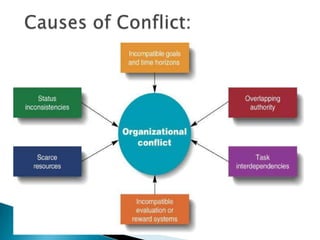
Causes of Conflict
Types of Conflict
Different views on conflict
What is Conflict Management?
Ways of managing Conflict
Tips for handling organizational conflicts
Conclusion




Conflict is an inevitable & unavoidable part of
our everyday Professional & Personal lives.
Conflict is when two or more values,
perspectives & opinions are contradictory in
nature & haven’t been aligned or agreed.


A disagreement between people that may be
the result of different:
◦
◦
◦
◦
◦
◦
◦
◦

Ideas
Perspectives
Priorities
Preferences
Beliefs
Values
Goals
Organization structures


Conflict is a problem when:
◦
◦
◦
◦
◦



It hampers productivity & increases tension
Lowers morale
Causes more & continued conflicts
Causes inappropriate behavior
Increases absenteeism

Conflict is constructive when:
◦ Opens up issues of importance resulting in issue
clarification
◦ Helps build cohesiveness as people learn more about
each other
◦ Causes reassessment by allowing for examination of
procedures or actions
◦ Increases individual involvement





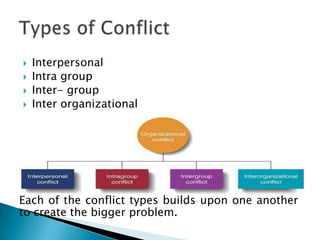
Interpersonal
Intra group
Inter- group
Inter organizational

Each of the conflict types builds upon one another
to create the bigger problem.






Traditional view of conflict:
◦ The belief that all conflict is harmful & must be
avoided
Human Relations View of Conflict:
◦ The belief that conflict is a natural & inevitable
outcome in any group
Interactionist View of conflict:
The belief that conflict is not only a positive
force in a group but that is absolutely necessary
for a group to perform effectively.
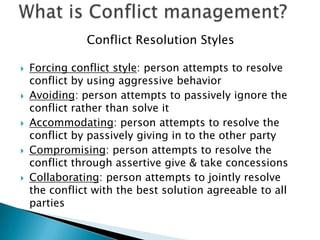
Conflict Resolution Styles










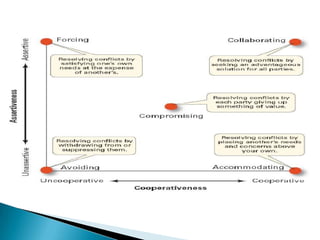
Forcing conflict style: person attempts to resolve
conflict by using aggressive behavior
Avoiding: person attempts to passively ignore the
conflict rather than solve it
Accommodating: person attempts to resolve the
conflict by passively giving in to the other party
Compromising: person attempts to resolve the
conflict through assertive give & take concessions
Collaborating: person attempts to jointly resolve
the conflict with the best solution agreeable to all
parties


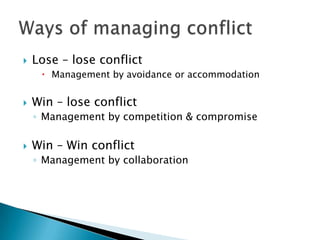
Lose – lose conflict
 Management by avoidance or accommodation



Win – lose conflict
◦ Management by competition & compromise



Win – Win conflict
◦ Management by collaboration
1. Diagnose
• Clarify critical issues
• Identify stakeholders
• Assess sources of conflict

2. Plan
• Recognize your styles
• Minimize blocks
• Plan your strategy

4. Implement
• Carry out the plan
• Evaluate outcomes
• Follow up

3. Prepare
• Problem solve
• Practice














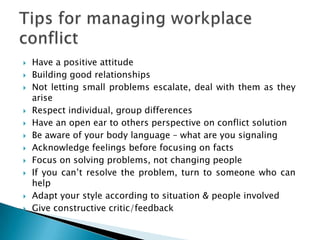
Have a positive attitude
Building good relationships
Not letting small problems escalate, deal with them as they
arise
Respect individual, group differences
Have an open ear to others perspective on conflict solution
Be aware of your body language – what are you signaling
Acknowledge feelings before focusing on facts
Focus on solving problems, not changing people
If you can’t resolve the problem, turn to someone who can
help
Adapt your style according to situation & people involved
Give constructive critic/feedback






Conflict Between people is a Fact of Life.
Conflicts occur at all levels of interaction.
Thus, conflict is a critical event in the course of a
relationship.
Whether a relationship is healthy or unhealthy
depends not so much on the number of conflicts
between participants but on how the conflicts are
resolved.
Conflict mgt.

Conflict mgt.

  • 2.
             Definition of Conflict Whatis conflict?? Causes of Conflict Types of Conflict Different views on conflict What is Conflict Management? Ways of managing Conflict Tips for handling organizational conflicts Conclusion
  • 3.
      Conflict is aninevitable & unavoidable part of our everyday Professional & Personal lives. Conflict is when two or more values, perspectives & opinions are contradictory in nature & haven’t been aligned or agreed.
  • 4.
     A disagreement betweenpeople that may be the result of different: ◦ ◦ ◦ ◦ ◦ ◦ ◦ ◦ Ideas Perspectives Priorities Preferences Beliefs Values Goals Organization structures
  • 6.
     Conflict is aproblem when: ◦ ◦ ◦ ◦ ◦  It hampers productivity & increases tension Lowers morale Causes more & continued conflicts Causes inappropriate behavior Increases absenteeism Conflict is constructive when: ◦ Opens up issues of importance resulting in issue clarification ◦ Helps build cohesiveness as people learn more about each other ◦ Causes reassessment by allowing for examination of procedures or actions ◦ Increases individual involvement
  • 7.
        Interpersonal Intra group Inter- group Interorganizational Each of the conflict types builds upon one another to create the bigger problem.
  • 8.
       Traditional view ofconflict: ◦ The belief that all conflict is harmful & must be avoided Human Relations View of Conflict: ◦ The belief that conflict is a natural & inevitable outcome in any group Interactionist View of conflict: The belief that conflict is not only a positive force in a group but that is absolutely necessary for a group to perform effectively.
  • 9.
    Conflict Resolution Styles      Forcingconflict style: person attempts to resolve conflict by using aggressive behavior Avoiding: person attempts to passively ignore the conflict rather than solve it Accommodating: person attempts to resolve the conflict by passively giving in to the other party Compromising: person attempts to resolve the conflict through assertive give & take concessions Collaborating: person attempts to jointly resolve the conflict with the best solution agreeable to all parties
  • 10.
     Lose – loseconflict  Management by avoidance or accommodation  Win – lose conflict ◦ Management by competition & compromise  Win – Win conflict ◦ Management by collaboration
  • 12.
    1. Diagnose • Clarifycritical issues • Identify stakeholders • Assess sources of conflict 2. Plan • Recognize your styles • Minimize blocks • Plan your strategy 4. Implement • Carry out the plan • Evaluate outcomes • Follow up 3. Prepare • Problem solve • Practice
  • 13.
               Have a positiveattitude Building good relationships Not letting small problems escalate, deal with them as they arise Respect individual, group differences Have an open ear to others perspective on conflict solution Be aware of your body language – what are you signaling Acknowledge feelings before focusing on facts Focus on solving problems, not changing people If you can’t resolve the problem, turn to someone who can help Adapt your style according to situation & people involved Give constructive critic/feedback
  • 14.
        Conflict Between peopleis a Fact of Life. Conflicts occur at all levels of interaction. Thus, conflict is a critical event in the course of a relationship. Whether a relationship is healthy or unhealthy depends not so much on the number of conflicts between participants but on how the conflicts are resolved.