Negotiation Skills and
Techniques
 Determining goals is the first step in the
negotiation process
 Negotiators should specify goals and
objectives clearly
 The goals set have direct and indirect
effects on the negotiator’s strategy
Prepared By Md. Mahamudul
Hasan Babu
 Judges effective by both slides
 Track record success
 Skilled negotiators spend more time (than
average negotiators) preparing the
negotiation, by gathering more
information and setting their objectives,
priorities and limits
Prepared By Md. Mahamudul
Hasan Babu
 It is important to present as many
reasons as possible to support each of
your proposals
 The key to persuading someone is to
present your argument logically
 Win-Win negotiating involves both
parties stating their ideal outcomes
and then splitting the difference
Prepared By Md. Mahamudul
Hasan Babu
With clients, when you’re
advising/selling?
When you’re buying, e.g. to outsource
services?
Will you have more negotiation
opportunities in future?
What makes these negotiations
difficult?
Prepared By Md. Mahamudul
Hasan Babu
Prepare and plan with great care,
including identifying ‘negotiable
issues’
Identify and use your ‘Leaver’
‘Trade concessions/Benefit’ – don't
give them away
Prepared By Md. Mahamudul
Hasan Babu
a) With clients
b) With outsourced suppliers
What issues do you have?
What issues may they have?
Are there enough issues to negotiate with?
 Any others you can introduce, that may be
negotiable?
 If no, plan to persuade/convinced ; if yes, plan to
negotiate.
Prepared By Md. Mahamudul
Hasan Babu
1. Persuade / convinced 1st and only negotiate
later…if you have to
2. Logic is not persuasive/Initiative!
3. Beware argument dilution/alternation
4. Effective persuasion leads to ‘I’d like to deal
with you if…’
5. Average persuaders give things away to achieve
this
Prepared By Md. Mahamudul
Hasan Babu
6. Identify and use your leavers
7. You may need to instigate/initiating
the negotiating
8. Trade concessions, don’t give them
away
9. Remember Win-Win is not 50:50
10. Never, ever forget that ‘no deal’ is
better than a bad deal
Prepared By Md. Mahamudul
Hasan Babu
“Negotiations in which both parties come away
winners and both parties are committed to
upholding their ends of the agreement”
(The Win-Win Negotiator)
Negotiation
Both parties
Winners
Committed
Upholding their ends of the agreement
Prepared By Md. Mahamudul
Hasan Babu
 Fundamental principle in negotiations — need
satisfaction
 Look for creative ways to satisfy your and your
counterpart’s needs
 Establish a friendly climate of mutual interests and
trust
 Negotiation is the beginning of a process, not the
end —
Look for a long-term mutually beneficial
relationship
 Don’t be afraid to give up something to get
something
 Be open to creative ways to satisfy critical needs —
look beyond current situation for win - win
 Everyone is better off than before the negotiation
Prepared By Md. Mahamudul
Hasan Babu
 Congratulations — you have been selected for
negotiations!
 Now it’s time to prepare for success
 First step — review this presentation and your notes to
refresh yourself on the fundamentals of effective
negotiations
 Strategize with your negotiation teammates to develop a
strategy
 Develop a plan incorporating your negotiation
knowledge and the needs of your customer
 Practice, refine, practice, refine, practice
Prepared By Md. Mahamudul
Hasan Babu
 Assess outcome values and the costs
of termination for the other party
 Manage the other party’s impressions
 Modify the other party’s
perceptions/Understanding
 Manipulate the actual costs of delay or
termination
Prepared By Md. Mahamudul
Hasan Babu
 Screen your behavior:
◦Say and do as little as possible
 Direct action to alter impressions
◦Present facts that enhance one’s
position
Prepared By Md. Mahamudul
Hasan Babu
 Make outcomes appear less attractive
 Make the cost of obtaining goals
appear higher
 Make demands and positions appear
more or less attractive to the other
party – whichever suits your needs
Prepared By Md. Mahamudul
Hasan Babu
 Plan disruptive action
◦ Raise the costs of delay to the other party
 Form an alliance with outsiders
◦ Involve (or threaten to involve) other parties
who can influence the outcome in your favor
 Schedule manipulations
◦ One party is usually more vulnerable to
delaying than the other
Prepared By Md. Mahamudul
Hasan Babu
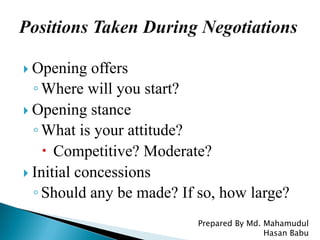
 Opening offers
◦Where will you start?
 Opening stance
◦What is your attitude?
 Competitive? Moderate?
 Initial concessions
◦Should any be made? If so, how large?
Prepared By Md. Mahamudul
Hasan Babu
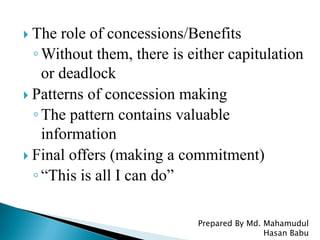
 The role of concessions/Benefits
◦Without them, there is either capitulation
or deadlock
 Patterns of concession making
◦The pattern contains valuable
information
 Final offers (making a commitment)
◦“This is all I can do”
Prepared By Md. Mahamudul
Hasan Babu
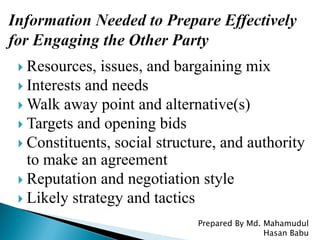
 Resources, issues, and bargaining mix
 Interests and needs
 Walk away point and alternative(s)
 Targets and opening bids
 Constituents, social structure, and authority
to make an agreement
 Reputation and negotiation style
 Likely strategy and tactics
Prepared By Md. Mahamudul
Hasan Babu
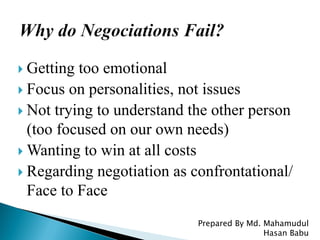
 Getting too emotional
 Focus on personalities, not issues
 Not trying to understand the other person
(too focused on our own needs)
 Wanting to win at all costs
 Regarding negotiation as confrontational/
Face to Face
Prepared By Md. Mahamudul
Hasan Babu
 Professional
 Confident, Relaxed, at ease
 Open, honest, sincere & credible
 Respectful of other peoples vales
 Show empathy, and understanding
 Committed to a WIN:WIN result
 Continually enhancing their skills
Prepared By Md. Mahamudul
Hasan Babu
Prepared By Md. Mahamudul
Hasan Babu
 You are fully briefed on the subject matter of the
negotiation
 You are clear about your objectives and what you are
trying to achieve:
The LIM Model:
Like to Achieve (most favoured option, ideal
settlement)
Intend to Achieve (expected result, realistic settlement)
Must Achieve (fall back position, bottom line)
 You have worked out your tactics and how best to put
your case.
 You have tried to figure out what the other parties
objectives will be
 You have gathered background information
(personalities involved, power balance, attitudes etc.)
Prepared By Md. Mahamudul
Hasan Babu
 This is the single most important stage of
negotiation. Both parties will be trying
to find out and understand the other’s
position and requirements.
 Successful negotiators ask twice the
number of questions and spend over
twice the amount of time acquiring and
clarifying information than do average
negotiators.
Prepared By Md. Mahamudul
Hasan Babu
 As soon as a number or term is
mentioned by one party, you have
begun to move out of information
exchange and into bargaining....
 Exchange of terms
 Never give a
concession/benefits....trade it
reluctantly/unwillingly
Prepared By Md. Mahamudul
Hasan Babu
Reject constructively
Note the moving base line
Be firm on broad issues: be flexible
on specifics.
Look for the agreement signals
Prepared By Md. Mahamudul
Hasan Babu
 Your judgement : Is this best and final offer?
If yes:
◦ List the agreement in detail
◦ List the points of explanation, clarification
and interpretation
◦ Record agreed summary with all at the table
◦ Re-start negotiations if any dispute over
agreement
Prepared By Md. Mahamudul
Hasan Babu
 Tends to see negotiators as friends
 Sees agreement as the goals prepared to
make concessions to cultivate the
relationship
 Is willing to trust the other side
 Is willing to modify position at an early
stage
 Discloses “bottom line” early in discussions
 Avoids contests of will on particular points
 Concedes to pressure Prepared By Md. Mahamudul
Hasan Babu
 Sees negotiators as opponents or adversaries
 Sees victory as the goal
 Demands concessions to establish a
relationship
 Tends to mistrust the other side
 Is reluctant to alter position in any way
 Misleads as to “bottom line”
 Expects to win contests of wills
 Applies pressure
Prepared By Md. Mahamudul
Hasan Babu
Negotiators need to:
 Set a clear target and resistance points
 Understand and work to improve their
BATNA(Best alternative to a negotiated
agreement)
 Start with good opening offer
 Make appropriate concessions
 Manage the commitment process
Prepared By Md. Mahamudul
Hasan Babu
 Negotiation Skills — Learned or natural
ability?
 Definition of negotiation
 Negotiation Strategies
 Personality Types / Communication Styles
 Win - Win Negotiating Principles
 Prepare and Practice
 Continuing education on negotiating skills
Prepared By Md. Mahamudul
Hasan Babu
Negotiations Tactics & Techniques

Negotiations Tactics & Techniques

  • 1.
  • 2.
     Determining goalsis the first step in the negotiation process  Negotiators should specify goals and objectives clearly  The goals set have direct and indirect effects on the negotiator’s strategy Prepared By Md. Mahamudul Hasan Babu
  • 3.
     Judges effectiveby both slides  Track record success  Skilled negotiators spend more time (than average negotiators) preparing the negotiation, by gathering more information and setting their objectives, priorities and limits Prepared By Md. Mahamudul Hasan Babu
  • 4.
     It isimportant to present as many reasons as possible to support each of your proposals  The key to persuading someone is to present your argument logically  Win-Win negotiating involves both parties stating their ideal outcomes and then splitting the difference Prepared By Md. Mahamudul Hasan Babu
  • 5.
    With clients, whenyou’re advising/selling? When you’re buying, e.g. to outsource services? Will you have more negotiation opportunities in future? What makes these negotiations difficult? Prepared By Md. Mahamudul Hasan Babu
  • 6.
    Prepare and planwith great care, including identifying ‘negotiable issues’ Identify and use your ‘Leaver’ ‘Trade concessions/Benefit’ – don't give them away Prepared By Md. Mahamudul Hasan Babu
  • 7.
    a) With clients b)With outsourced suppliers What issues do you have? What issues may they have? Are there enough issues to negotiate with?  Any others you can introduce, that may be negotiable?  If no, plan to persuade/convinced ; if yes, plan to negotiate. Prepared By Md. Mahamudul Hasan Babu
  • 8.
    1. Persuade /convinced 1st and only negotiate later…if you have to 2. Logic is not persuasive/Initiative! 3. Beware argument dilution/alternation 4. Effective persuasion leads to ‘I’d like to deal with you if…’ 5. Average persuaders give things away to achieve this Prepared By Md. Mahamudul Hasan Babu
  • 9.
    6. Identify anduse your leavers 7. You may need to instigate/initiating the negotiating 8. Trade concessions, don’t give them away 9. Remember Win-Win is not 50:50 10. Never, ever forget that ‘no deal’ is better than a bad deal Prepared By Md. Mahamudul Hasan Babu
  • 10.
    “Negotiations in whichboth parties come away winners and both parties are committed to upholding their ends of the agreement” (The Win-Win Negotiator) Negotiation Both parties Winners Committed Upholding their ends of the agreement Prepared By Md. Mahamudul Hasan Babu
  • 11.
     Fundamental principlein negotiations — need satisfaction  Look for creative ways to satisfy your and your counterpart’s needs  Establish a friendly climate of mutual interests and trust  Negotiation is the beginning of a process, not the end — Look for a long-term mutually beneficial relationship  Don’t be afraid to give up something to get something  Be open to creative ways to satisfy critical needs — look beyond current situation for win - win  Everyone is better off than before the negotiation Prepared By Md. Mahamudul Hasan Babu
  • 12.
     Congratulations —you have been selected for negotiations!  Now it’s time to prepare for success  First step — review this presentation and your notes to refresh yourself on the fundamentals of effective negotiations  Strategize with your negotiation teammates to develop a strategy  Develop a plan incorporating your negotiation knowledge and the needs of your customer  Practice, refine, practice, refine, practice Prepared By Md. Mahamudul Hasan Babu
  • 13.
     Assess outcomevalues and the costs of termination for the other party  Manage the other party’s impressions  Modify the other party’s perceptions/Understanding  Manipulate the actual costs of delay or termination Prepared By Md. Mahamudul Hasan Babu
  • 14.
     Screen yourbehavior: ◦Say and do as little as possible  Direct action to alter impressions ◦Present facts that enhance one’s position Prepared By Md. Mahamudul Hasan Babu
  • 15.
     Make outcomesappear less attractive  Make the cost of obtaining goals appear higher  Make demands and positions appear more or less attractive to the other party – whichever suits your needs Prepared By Md. Mahamudul Hasan Babu
  • 16.
     Plan disruptiveaction ◦ Raise the costs of delay to the other party  Form an alliance with outsiders ◦ Involve (or threaten to involve) other parties who can influence the outcome in your favor  Schedule manipulations ◦ One party is usually more vulnerable to delaying than the other Prepared By Md. Mahamudul Hasan Babu
  • 17.
     Opening offers ◦Wherewill you start?  Opening stance ◦What is your attitude?  Competitive? Moderate?  Initial concessions ◦Should any be made? If so, how large? Prepared By Md. Mahamudul Hasan Babu
  • 18.
     The roleof concessions/Benefits ◦Without them, there is either capitulation or deadlock  Patterns of concession making ◦The pattern contains valuable information  Final offers (making a commitment) ◦“This is all I can do” Prepared By Md. Mahamudul Hasan Babu
  • 19.
     Resources, issues,and bargaining mix  Interests and needs  Walk away point and alternative(s)  Targets and opening bids  Constituents, social structure, and authority to make an agreement  Reputation and negotiation style  Likely strategy and tactics Prepared By Md. Mahamudul Hasan Babu
  • 20.
     Getting tooemotional  Focus on personalities, not issues  Not trying to understand the other person (too focused on our own needs)  Wanting to win at all costs  Regarding negotiation as confrontational/ Face to Face Prepared By Md. Mahamudul Hasan Babu
  • 21.
     Professional  Confident,Relaxed, at ease  Open, honest, sincere & credible  Respectful of other peoples vales  Show empathy, and understanding  Committed to a WIN:WIN result  Continually enhancing their skills Prepared By Md. Mahamudul Hasan Babu
  • 22.
    Prepared By Md.Mahamudul Hasan Babu
  • 23.
     You arefully briefed on the subject matter of the negotiation  You are clear about your objectives and what you are trying to achieve: The LIM Model: Like to Achieve (most favoured option, ideal settlement) Intend to Achieve (expected result, realistic settlement) Must Achieve (fall back position, bottom line)  You have worked out your tactics and how best to put your case.  You have tried to figure out what the other parties objectives will be  You have gathered background information (personalities involved, power balance, attitudes etc.) Prepared By Md. Mahamudul Hasan Babu
  • 24.
     This isthe single most important stage of negotiation. Both parties will be trying to find out and understand the other’s position and requirements.  Successful negotiators ask twice the number of questions and spend over twice the amount of time acquiring and clarifying information than do average negotiators. Prepared By Md. Mahamudul Hasan Babu
  • 25.
     As soonas a number or term is mentioned by one party, you have begun to move out of information exchange and into bargaining....  Exchange of terms  Never give a concession/benefits....trade it reluctantly/unwillingly Prepared By Md. Mahamudul Hasan Babu
  • 26.
    Reject constructively Note themoving base line Be firm on broad issues: be flexible on specifics. Look for the agreement signals Prepared By Md. Mahamudul Hasan Babu
  • 27.
     Your judgement: Is this best and final offer? If yes: ◦ List the agreement in detail ◦ List the points of explanation, clarification and interpretation ◦ Record agreed summary with all at the table ◦ Re-start negotiations if any dispute over agreement Prepared By Md. Mahamudul Hasan Babu
  • 28.
     Tends tosee negotiators as friends  Sees agreement as the goals prepared to make concessions to cultivate the relationship  Is willing to trust the other side  Is willing to modify position at an early stage  Discloses “bottom line” early in discussions  Avoids contests of will on particular points  Concedes to pressure Prepared By Md. Mahamudul Hasan Babu
  • 29.
     Sees negotiatorsas opponents or adversaries  Sees victory as the goal  Demands concessions to establish a relationship  Tends to mistrust the other side  Is reluctant to alter position in any way  Misleads as to “bottom line”  Expects to win contests of wills  Applies pressure Prepared By Md. Mahamudul Hasan Babu
  • 30.
    Negotiators need to: Set a clear target and resistance points  Understand and work to improve their BATNA(Best alternative to a negotiated agreement)  Start with good opening offer  Make appropriate concessions  Manage the commitment process Prepared By Md. Mahamudul Hasan Babu
  • 31.
     Negotiation Skills— Learned or natural ability?  Definition of negotiation  Negotiation Strategies  Personality Types / Communication Styles  Win - Win Negotiating Principles  Prepare and Practice  Continuing education on negotiating skills Prepared By Md. Mahamudul Hasan Babu