CONFLICT MANAGEMENT IN THE WORKPLACE

                                    By

                Obasemola Stephen

              HR Learning Session


         International Institute of Tropical Agriculture – Institut international d’agriculture tropicale – www.iita.org
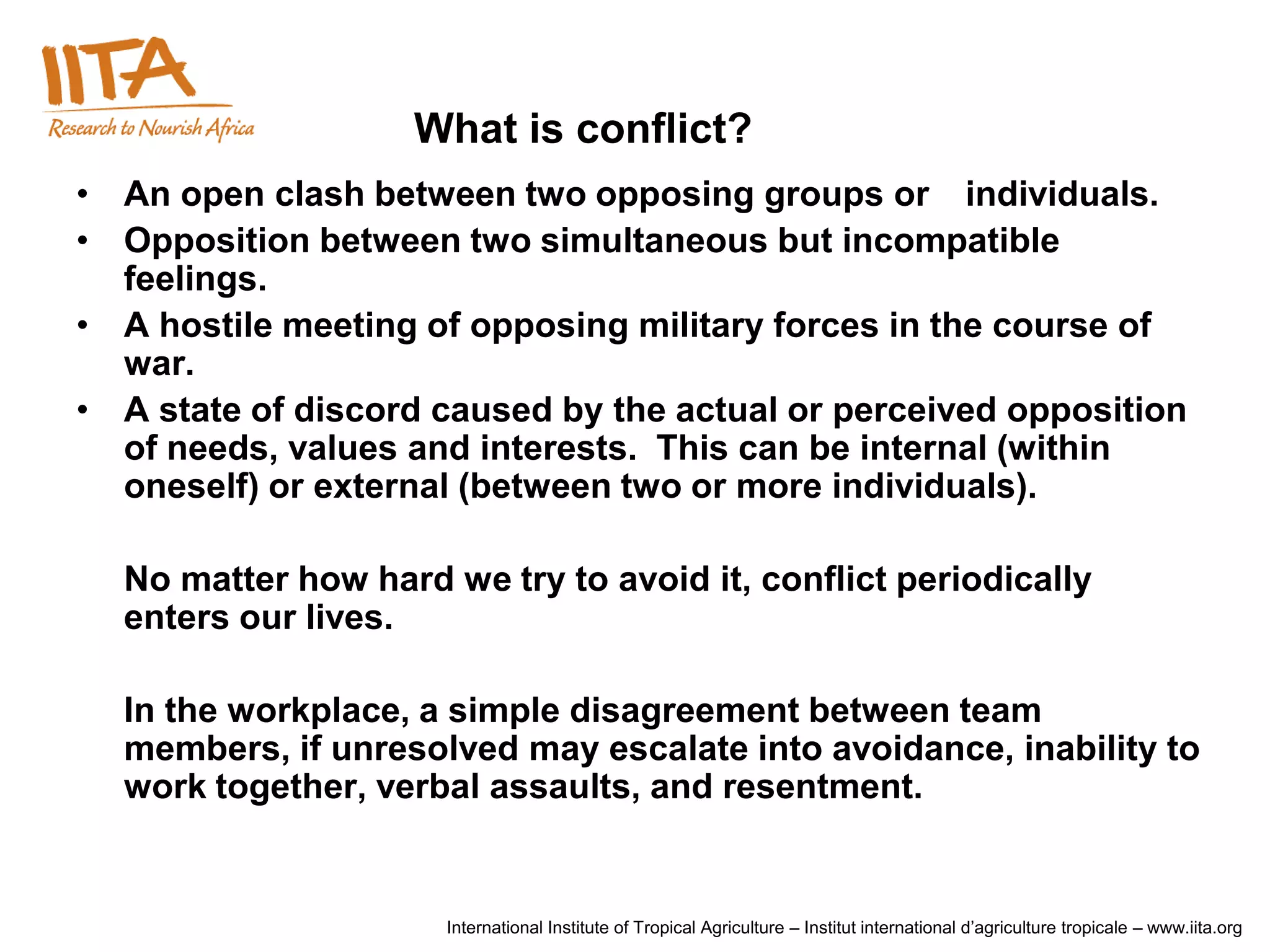
What is conflict?
• An open clash between two opposing groups or individuals.
• Opposition between two simultaneous but incompatible
  feelings.
• A hostile meeting of opposing military forces in the course of
  war.
• A state of discord caused by the actual or perceived opposition
  of needs, values and interests. This can be internal (within
  oneself) or external (between two or more individuals).

  No matter how hard we try to avoid it, conflict periodically
  enters our lives.

  In the workplace, a simple disagreement between team
  members, if unresolved may escalate into avoidance, inability to
  work together, verbal assaults, and resentment.


                      International Institute of Tropical Agriculture – Institut international d’agriculture tropicale – www.iita.org
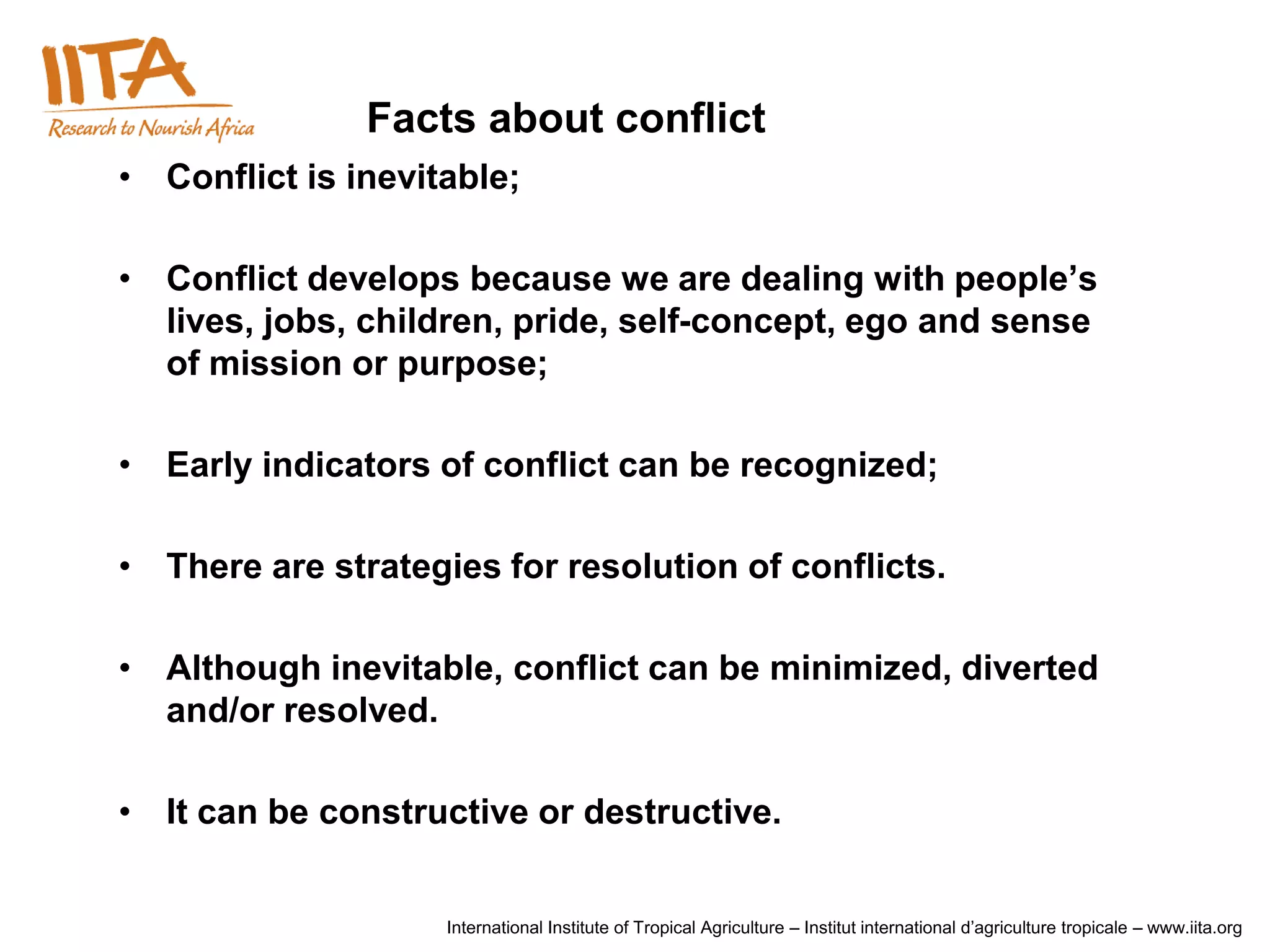
Facts about conflict
• Conflict is inevitable;

• Conflict develops because we are dealing with people’s
  lives, jobs, children, pride, self-concept, ego and sense
  of mission or purpose;

• Early indicators of conflict can be recognized;

• There are strategies for resolution of conflicts.

• Although inevitable, conflict can be minimized, diverted
  and/or resolved.

• It can be constructive or destructive.


                    International Institute of Tropical Agriculture – Institut international d’agriculture tropicale – www.iita.org
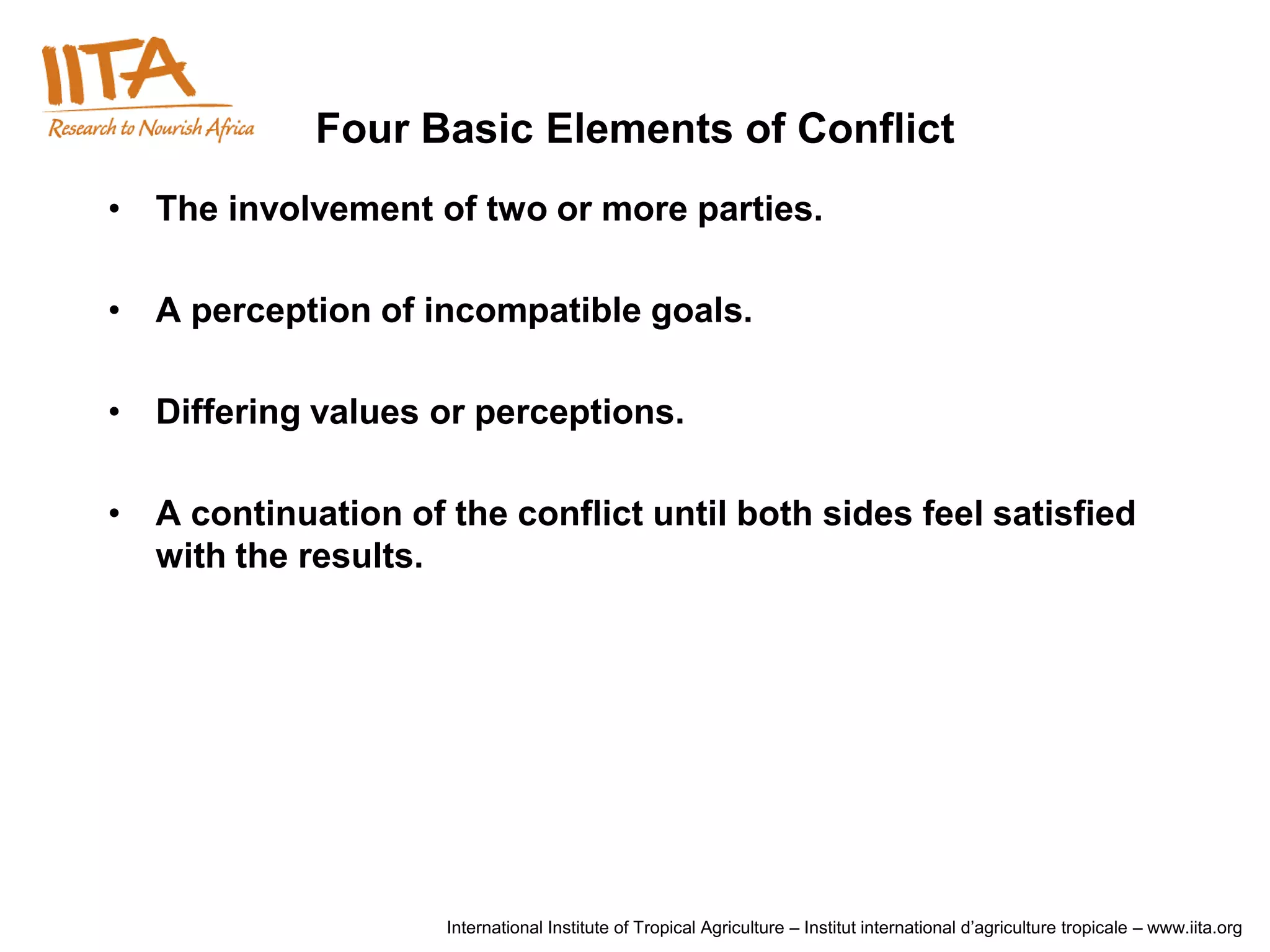
Four Basic Elements of Conflict
• The involvement of two or more parties.

• A perception of incompatible goals.

• Differing values or perceptions.

• A continuation of the conflict until both sides feel satisfied
  with the results.


                     International Institute of Tropical Agriculture – Institut international d’agriculture tropicale – www.iita.org
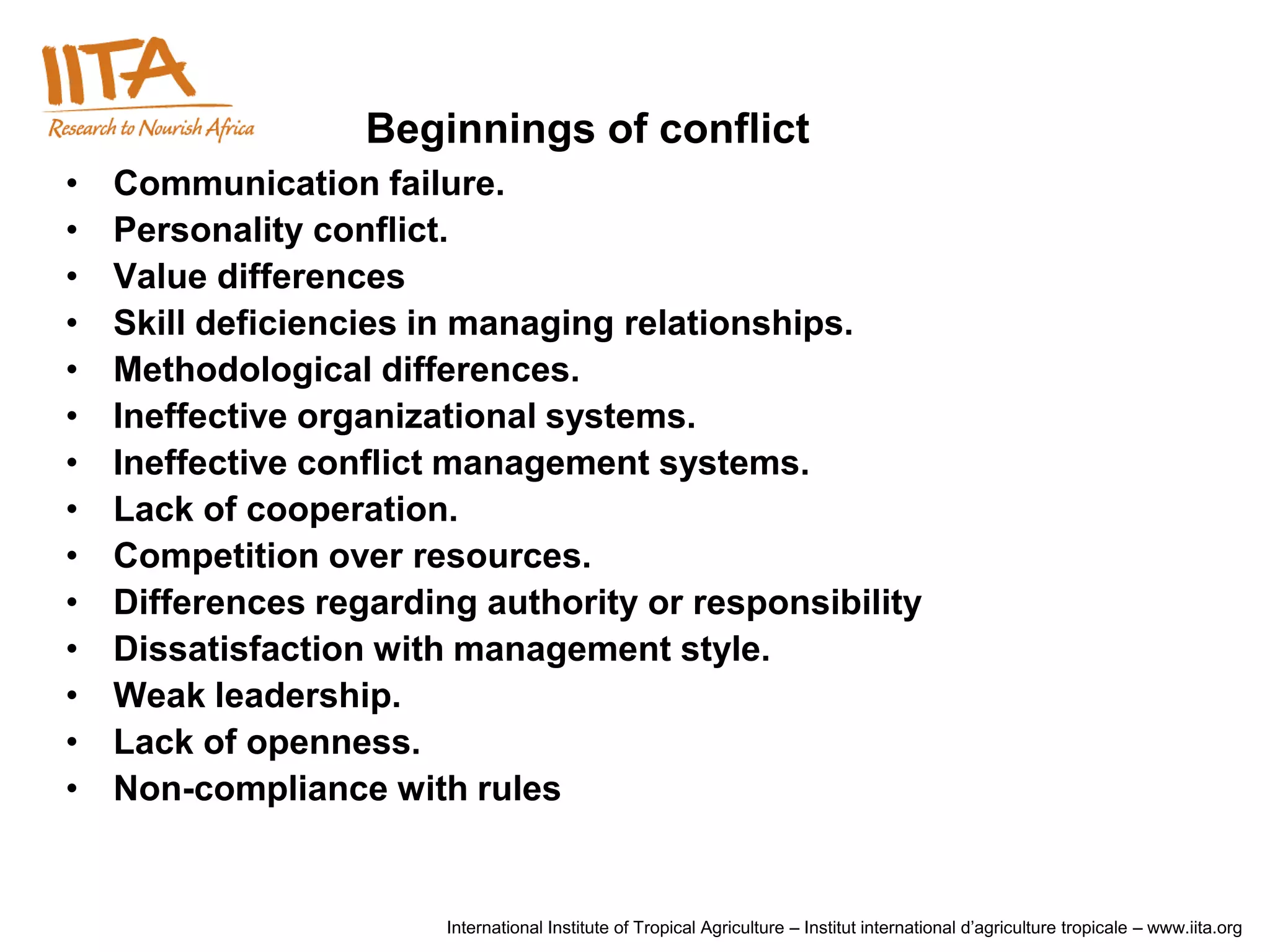
Beginnings of conflict
•   Communication failure.
•   Personality conflict.
•   Value differences
•   Skill deficiencies in managing relationships.
•   Methodological differences.
•   Ineffective organizational systems.
•   Ineffective conflict management systems.
•   Lack of cooperation.
•   Competition over resources.
•   Differences regarding authority or responsibility
•   Dissatisfaction with management style.
•   Weak leadership.
•   Lack of openness.
•   Non-compliance with rules


                        International Institute of Tropical Agriculture – Institut international d’agriculture tropicale – www.iita.org
Conflict Indicators
•   Body language.
•   Disagreements, regardless of issue.
•   Withholding bad news.
•   Surprises.
•   Strong public statements.
•   Airing disagreements through media.
•   Desire for power.
•   Increasing lack of respect.
•   Open disagreement.
•   Lack of candor (openness) on sensitive issues.
•   Lack of clear goals.
•   Lack of interest in the common tasks.


                      International Institute of Tropical Agriculture – Institut international d’agriculture tropicale – www.iita.org
Conflict is destructive when it:
• Takes attention away from other important activities.

• Undermines morale or self-concept.

• Polarizes people and groups, reducing cooperation.

• Increases or sharpens difference.

• Leads to irresponsible and harmful behavior, such as
  fighting, name calling etc.


                    International Institute of Tropical Agriculture – Institut international d’agriculture tropicale – www.iita.org
Conflict is constructive when it:
• Results in clarification of important problems and issues.
• Results in solution to problems.
• Involves people in resolving issues important to them.
• Causes authentic communication.
• Helps release emotion, anxiety, and stress.
• Builds cooperation among people through learning more
  about each other.
• Helps individuals develop understanding skills.


                      International Institute of Tropical Agriculture – Institut international d’agriculture tropicale – www.iita.org
Cognitive Vs Afflictive

Cognitive Conflict: Disagreements that focus on
  substantive, issue-related differences of
  opinion. They tend to improve team
  effectiveness. They are usually borne out of
  different ideas, opinions and perspectives
  offered by members of the group.

Affective Conflict: Disagreements over
   personalized, individually oriented matters.
   Such lowers team effectiveness by provoking
   hostility, distrust, cynicism and aparthy among
   team members. They are usually focused on
   personalized anger or resentment, usually
   directed at specific individuals rather than
   specific ideas.


International Institute of Tropical Agriculture – Institut international d’agriculture tropicale – www.iita.org
Resolving Conflict
    Conflict Resolution: This is a range of processes aimed at
    alleviating or eliminating source of conflict.

Identifying the causes of conflict is essential to conflict resolution.

Possible causes of Conflict include:

•   Needs or wants are not being met.
•   Values are being tested.
•   Perceptions are being questioned.
•   Assumptions are being made.
•   Knowledge is minimal.
•   Expectations are too high/too low.
•   Personality, race, or gender differences are present.


                        International Institute of Tropical Agriculture – Institut international d’agriculture tropicale – www.iita.org
Common ways of Dealing with Conflicts
•   Deny the conflict; wait until it goes away.

•   Change the subject.

•   React emotionally; become aggressive, abusive, hysterical,
    or frightening.

•   Find someone to blame.

•   Make excuses.

•   Delegate the situation to someone else


                     International Institute of Tropical Agriculture – Institut international d’agriculture tropicale – www.iita.org
Common ways of dealing with conflict (contd.)
• Avoid the conflict.

• Accommodating: This will rarely lead to the resolution of
  conflict. Although it can help solve the immediate problem, the
  basic issue remains.

• Force your opinion on the other party.

• Compromise: Is often seen as the best way to deal with conflict.
  Although it can often leave both sides feeling like they have
  lost.


                        International Institute of Tropical Agriculture – Institut international d’agriculture tropicale – www.iita.org
Conflict Management Techniques
SHARK – Competing – is assertive and uncooperative. An
  individual pursues his or her own concerns at the other
  person’s expense. This is power oriented mode in which one
  uses whatever power seems appropriate to win ones own
  position.

When to use competition:
• When you know you are right.
• When you need a quick decision.
• When you meet a steamroller type of person and you need to
  stand up for your own right.


                    International Institute of Tropical Agriculture – Institut international d’agriculture tropicale – www.iita.org
Conflict Management Techniques Cont’d
• TEDDY BEAR – Accommodating – is unassertive and
  uncooperative. This is the opposite of competing. When
  accommodating, an individual neglects his/her own concerns
  to satisfy the concerns of the other person. There is an
  element of self-sacrifice in this mode.

When to use accommodating:
• When the issue is not so important to you but it is to other
  person.
• When you discover that you are wrong.
• When continued competition would be detrimental - :”you
  know you can’t win.”
• When preserving harmony without disruption is the most
  important – “It’s not the right time”.


                      International Institute of Tropical Agriculture – Institut international d’agriculture tropicale – www.iita.org
Conflict Management Techniques Cont’d
• TURTLE – Avoiding – is unassertive and cooperative. When a
  person does not pursue her/his own concerns or those of the
  other person. He/she does not address the conflict, but rather
  sidesteps, postpones or simply withdraw.

When to use avoiding:
• When the stakes are not that high and you don’t have anything
  to lose – “when the issue is trivial”.
• When you do not have time to deal with it.
• When the context isn’t suitable – “it is not the right time or
  place.”
• When more important issues are pressing.
• When you see no chance of getting your concerns met.
• When you would have to deal with an angry, hot headed person.
• When you are totally unprepared, taken by surprise, and you
  need time to think and collect information.
• When you are too emotionally involved and the others around
  you can solve the conflict more successfully.
                     International Institute of Tropical Agriculture – Institut international d’agriculture tropicale – www.iita.org
Conflict Management Techniques Cont’d
• OWL – Collaborating – is both assertive and cooperative. This is
  the opposite of avoiding. Collaboration involves an attempt to
  work with other person to find some solution which fully satisfies
  the concerns of both persons. It includes identifying the
  underlying concerns of the two individuals and finding an
  alternative which meets both sets of concerns.

When to use collaboration:
• When other’s lives are involved.
• When you don’t want to have full responsibility.
• When there is a high level of trust.
• When you want to gain commitment from others.
• When you need to work through hard feelings, animosity etc.

The best decisions are made by collaboration.
                       International Institute of Tropical Agriculture – Institut international d’agriculture tropicale – www.iita.org
Conflict Management Techniques Cont’d
• FOX – Compromising – is intermediate in both assertiveness and
  cooperativeness. The objective of compromise is to find some
  expedient, mutually acceptable solution which partially satisfies
  both parties. It falls in the middle group between competing and
  accommodating. Compromise gives up more than competing,
  but is less than accommodating.

When to use compromise:
• When the goals are moderately important and not worth the use
  of more assertive modes.
• When people of equal status are equally committed.
• To reach temporary settlement on complex issues.
• To reach expedient solutions on important issues.
• As a back-up mode when competition or collaboration do not
  work.

                      International Institute of Tropical Agriculture – Institut international d’agriculture tropicale – www.iita.org
Conflict Resolution Skills
Conflict Resolution is a set of skills that anyone can learn.
Two important skills: Active Listening and Conflict de-escalation
skills.

Active listening: Active listening enables you to demonstrate that
  you understand what another person is saying and how he or
  she is feeling about it.
  It means restating, in your own words, what the other person
  has said.
  It is a way of checking whether your understanding is correct. It
  also demonstrates that you are listening and that you are
  interested and concerned. These help to resolve a situation
  when there are conflicting points.

Two components:
• naming the feeling that the other person is conveying
• stating the reason for the feeling.

                      International Institute of Tropical Agriculture – Institut international d’agriculture tropicale – www.iita.org
Examples:
• “Sounds like you’re upset about what happened at work”

• “You’re annoyed by the lateness, aren’t you?

• “You sound really confused about how to solve this problem”

• “It makes you angry when you find errors on Vicky’s paperwork”

• “Sounds like you’re really worried about Samuel”

• “I get the feeling you’re awfully busy right now.”

Active listening is not the same as agreement. It is a way of
demonstrating that you intend to hear and understand another’s
point of view.

                       International Institute of Tropical Agriculture – Institut international d’agriculture tropicale – www.iita.org
Benefits:
• It feels good when another person makes an effort to understand
  what you are thinking and feeling. It creates good feelings about
  the other person and makes you feel better about yourself.

• Restating what you’ve heard, and checking for understanding
  promotes better communication and produces fewer
  misunderstandings.

• Responding with active listening has a calming effect in an
  emotional situation.


                      International Institute of Tropical Agriculture – Institut international d’agriculture tropicale – www.iita.org
Conflict De-Escalation
These actions aimed at preventing a conflict to escalate. Take the
following steps:

• Stick with “I” statements; avoid “you” statements.
• Avoid name-calling and put downs (“A reasonable person
  could see that ………”
• Soften your tone.
• Take a time out (“Let’s take a break and cool down”).
• Acknowledge the other person’s point of view (agreement is
  not necessary).
• Avoid defensive or hostile body language (rolling eyes,
  crossing arms in front of body, tapping foot, hissing).
• Be specific and factual; avoid generalities.


                      International Institute of Tropical Agriculture – Institut international d’agriculture tropicale – www.iita.org
Conflict Prevention Skills
• Bring issues out in the open before they become problems.

• Be aware of triggers and respond to them when you notice
  them. Have a process of resolving conflicts. Bring it up at a
  meeting and get agreement on what people should do in cases
  of differing viewpoints.


                      International Institute of Tropical Agriculture – Institut international d’agriculture tropicale – www.iita.org
•     HOW TO MEDIATE AND RESOLVE CONFLICT
1.    Meet with the antagonists together.
2.    Ask each participant to describe specific actions they’d like to see
      the other party take that would resolve the differences.
3.    Sometimes, as in the second example, you as the supervisor, must
      own some of the responsibilities for helping the employee resolve
      their conflict. Always ask “What about the work situation is causing
      these staff members to fail?”
4.    If the situation needs further exploration, ask each participant to
      additionally identify what the other employee can do more of, less
      of, stop and start.
5.    All participants discuss and commit to making the changes
      necessary to resolve the conflict.
6.    Let the antagonists know that you will not choose sides, that it is
      impossible for a person external to the to know the truth of the
      matter. You expect the individuals to resolve the conflicts
      proactively as adults.
7.    Finally, assure both parties that you have every faith in their ability
      to resolve their differences and get on with their successful
      contributions within your unit. Set a time to review progress.


International Institute of Tropical Agriculture – Institut international d’agriculture tropicale – www.iita.org
THANK YOU

HAVE A CONFLICT-FREE INTERACTION


         International Institute of Tropical Agriculture – Institut international d’agriculture tropicale – www.iita.org

Conflict management in the workplace

  • 1.
    CONFLICT MANAGEMENT INTHE WORKPLACE By Obasemola Stephen HR Learning Session International Institute of Tropical Agriculture – Institut international d’agriculture tropicale – www.iita.org
  • 2.
    What is conflict? •An open clash between two opposing groups or individuals. • Opposition between two simultaneous but incompatible feelings. • A hostile meeting of opposing military forces in the course of war. • A state of discord caused by the actual or perceived opposition of needs, values and interests. This can be internal (within oneself) or external (between two or more individuals). No matter how hard we try to avoid it, conflict periodically enters our lives. In the workplace, a simple disagreement between team members, if unresolved may escalate into avoidance, inability to work together, verbal assaults, and resentment. International Institute of Tropical Agriculture – Institut international d’agriculture tropicale – www.iita.org
  • 3.
    Facts about conflict •Conflict is inevitable; • Conflict develops because we are dealing with people’s lives, jobs, children, pride, self-concept, ego and sense of mission or purpose; • Early indicators of conflict can be recognized; • There are strategies for resolution of conflicts. • Although inevitable, conflict can be minimized, diverted and/or resolved. • It can be constructive or destructive. International Institute of Tropical Agriculture – Institut international d’agriculture tropicale – www.iita.org
  • 4.
    Four Basic Elementsof Conflict • The involvement of two or more parties. • A perception of incompatible goals. • Differing values or perceptions. • A continuation of the conflict until both sides feel satisfied with the results. International Institute of Tropical Agriculture – Institut international d’agriculture tropicale – www.iita.org
  • 5.
    Beginnings of conflict • Communication failure. • Personality conflict. • Value differences • Skill deficiencies in managing relationships. • Methodological differences. • Ineffective organizational systems. • Ineffective conflict management systems. • Lack of cooperation. • Competition over resources. • Differences regarding authority or responsibility • Dissatisfaction with management style. • Weak leadership. • Lack of openness. • Non-compliance with rules International Institute of Tropical Agriculture – Institut international d’agriculture tropicale – www.iita.org
  • 6.
    Conflict Indicators • Body language. • Disagreements, regardless of issue. • Withholding bad news. • Surprises. • Strong public statements. • Airing disagreements through media. • Desire for power. • Increasing lack of respect. • Open disagreement. • Lack of candor (openness) on sensitive issues. • Lack of clear goals. • Lack of interest in the common tasks. International Institute of Tropical Agriculture – Institut international d’agriculture tropicale – www.iita.org
  • 7.
    Conflict is destructivewhen it: • Takes attention away from other important activities. • Undermines morale or self-concept. • Polarizes people and groups, reducing cooperation. • Increases or sharpens difference. • Leads to irresponsible and harmful behavior, such as fighting, name calling etc. International Institute of Tropical Agriculture – Institut international d’agriculture tropicale – www.iita.org
  • 8.
    Conflict is constructivewhen it: • Results in clarification of important problems and issues. • Results in solution to problems. • Involves people in resolving issues important to them. • Causes authentic communication. • Helps release emotion, anxiety, and stress. • Builds cooperation among people through learning more about each other. • Helps individuals develop understanding skills. International Institute of Tropical Agriculture – Institut international d’agriculture tropicale – www.iita.org
  • 9.
    Cognitive Vs Afflictive CognitiveConflict: Disagreements that focus on substantive, issue-related differences of opinion. They tend to improve team effectiveness. They are usually borne out of different ideas, opinions and perspectives offered by members of the group. Affective Conflict: Disagreements over personalized, individually oriented matters. Such lowers team effectiveness by provoking hostility, distrust, cynicism and aparthy among team members. They are usually focused on personalized anger or resentment, usually directed at specific individuals rather than specific ideas. International Institute of Tropical Agriculture – Institut international d’agriculture tropicale – www.iita.org
  • 10.
    Resolving Conflict Conflict Resolution: This is a range of processes aimed at alleviating or eliminating source of conflict. Identifying the causes of conflict is essential to conflict resolution. Possible causes of Conflict include: • Needs or wants are not being met. • Values are being tested. • Perceptions are being questioned. • Assumptions are being made. • Knowledge is minimal. • Expectations are too high/too low. • Personality, race, or gender differences are present. International Institute of Tropical Agriculture – Institut international d’agriculture tropicale – www.iita.org
  • 11.
    Common ways ofDealing with Conflicts • Deny the conflict; wait until it goes away. • Change the subject. • React emotionally; become aggressive, abusive, hysterical, or frightening. • Find someone to blame. • Make excuses. • Delegate the situation to someone else International Institute of Tropical Agriculture – Institut international d’agriculture tropicale – www.iita.org
  • 12.
    Common ways ofdealing with conflict (contd.) • Avoid the conflict. • Accommodating: This will rarely lead to the resolution of conflict. Although it can help solve the immediate problem, the basic issue remains. • Force your opinion on the other party. • Compromise: Is often seen as the best way to deal with conflict. Although it can often leave both sides feeling like they have lost. International Institute of Tropical Agriculture – Institut international d’agriculture tropicale – www.iita.org
  • 13.
    Conflict Management Techniques SHARK– Competing – is assertive and uncooperative. An individual pursues his or her own concerns at the other person’s expense. This is power oriented mode in which one uses whatever power seems appropriate to win ones own position. When to use competition: • When you know you are right. • When you need a quick decision. • When you meet a steamroller type of person and you need to stand up for your own right. International Institute of Tropical Agriculture – Institut international d’agriculture tropicale – www.iita.org
  • 14.
    Conflict Management TechniquesCont’d • TEDDY BEAR – Accommodating – is unassertive and uncooperative. This is the opposite of competing. When accommodating, an individual neglects his/her own concerns to satisfy the concerns of the other person. There is an element of self-sacrifice in this mode. When to use accommodating: • When the issue is not so important to you but it is to other person. • When you discover that you are wrong. • When continued competition would be detrimental - :”you know you can’t win.” • When preserving harmony without disruption is the most important – “It’s not the right time”. International Institute of Tropical Agriculture – Institut international d’agriculture tropicale – www.iita.org
  • 15.
    Conflict Management TechniquesCont’d • TURTLE – Avoiding – is unassertive and cooperative. When a person does not pursue her/his own concerns or those of the other person. He/she does not address the conflict, but rather sidesteps, postpones or simply withdraw. When to use avoiding: • When the stakes are not that high and you don’t have anything to lose – “when the issue is trivial”. • When you do not have time to deal with it. • When the context isn’t suitable – “it is not the right time or place.” • When more important issues are pressing. • When you see no chance of getting your concerns met. • When you would have to deal with an angry, hot headed person. • When you are totally unprepared, taken by surprise, and you need time to think and collect information. • When you are too emotionally involved and the others around you can solve the conflict more successfully. International Institute of Tropical Agriculture – Institut international d’agriculture tropicale – www.iita.org
  • 16.
    Conflict Management TechniquesCont’d • OWL – Collaborating – is both assertive and cooperative. This is the opposite of avoiding. Collaboration involves an attempt to work with other person to find some solution which fully satisfies the concerns of both persons. It includes identifying the underlying concerns of the two individuals and finding an alternative which meets both sets of concerns. When to use collaboration: • When other’s lives are involved. • When you don’t want to have full responsibility. • When there is a high level of trust. • When you want to gain commitment from others. • When you need to work through hard feelings, animosity etc. The best decisions are made by collaboration. International Institute of Tropical Agriculture – Institut international d’agriculture tropicale – www.iita.org
  • 17.
    Conflict Management TechniquesCont’d • FOX – Compromising – is intermediate in both assertiveness and cooperativeness. The objective of compromise is to find some expedient, mutually acceptable solution which partially satisfies both parties. It falls in the middle group between competing and accommodating. Compromise gives up more than competing, but is less than accommodating. When to use compromise: • When the goals are moderately important and not worth the use of more assertive modes. • When people of equal status are equally committed. • To reach temporary settlement on complex issues. • To reach expedient solutions on important issues. • As a back-up mode when competition or collaboration do not work. International Institute of Tropical Agriculture – Institut international d’agriculture tropicale – www.iita.org
  • 18.
    Conflict Resolution Skills ConflictResolution is a set of skills that anyone can learn. Two important skills: Active Listening and Conflict de-escalation skills. Active listening: Active listening enables you to demonstrate that you understand what another person is saying and how he or she is feeling about it. It means restating, in your own words, what the other person has said. It is a way of checking whether your understanding is correct. It also demonstrates that you are listening and that you are interested and concerned. These help to resolve a situation when there are conflicting points. Two components: • naming the feeling that the other person is conveying • stating the reason for the feeling. International Institute of Tropical Agriculture – Institut international d’agriculture tropicale – www.iita.org
  • 19.
    Examples: • “Sounds likeyou’re upset about what happened at work” • “You’re annoyed by the lateness, aren’t you? • “You sound really confused about how to solve this problem” • “It makes you angry when you find errors on Vicky’s paperwork” • “Sounds like you’re really worried about Samuel” • “I get the feeling you’re awfully busy right now.” Active listening is not the same as agreement. It is a way of demonstrating that you intend to hear and understand another’s point of view. International Institute of Tropical Agriculture – Institut international d’agriculture tropicale – www.iita.org
  • 20.
    Benefits: • It feelsgood when another person makes an effort to understand what you are thinking and feeling. It creates good feelings about the other person and makes you feel better about yourself. • Restating what you’ve heard, and checking for understanding promotes better communication and produces fewer misunderstandings. • Responding with active listening has a calming effect in an emotional situation. International Institute of Tropical Agriculture – Institut international d’agriculture tropicale – www.iita.org
  • 21.
    Conflict De-Escalation These actionsaimed at preventing a conflict to escalate. Take the following steps: • Stick with “I” statements; avoid “you” statements. • Avoid name-calling and put downs (“A reasonable person could see that ………” • Soften your tone. • Take a time out (“Let’s take a break and cool down”). • Acknowledge the other person’s point of view (agreement is not necessary). • Avoid defensive or hostile body language (rolling eyes, crossing arms in front of body, tapping foot, hissing). • Be specific and factual; avoid generalities. International Institute of Tropical Agriculture – Institut international d’agriculture tropicale – www.iita.org
  • 22.
    Conflict Prevention Skills •Bring issues out in the open before they become problems. • Be aware of triggers and respond to them when you notice them. Have a process of resolving conflicts. Bring it up at a meeting and get agreement on what people should do in cases of differing viewpoints. International Institute of Tropical Agriculture – Institut international d’agriculture tropicale – www.iita.org
  • 23.
    HOW TO MEDIATE AND RESOLVE CONFLICT 1. Meet with the antagonists together. 2. Ask each participant to describe specific actions they’d like to see the other party take that would resolve the differences. 3. Sometimes, as in the second example, you as the supervisor, must own some of the responsibilities for helping the employee resolve their conflict. Always ask “What about the work situation is causing these staff members to fail?” 4. If the situation needs further exploration, ask each participant to additionally identify what the other employee can do more of, less of, stop and start. 5. All participants discuss and commit to making the changes necessary to resolve the conflict. 6. Let the antagonists know that you will not choose sides, that it is impossible for a person external to the to know the truth of the matter. You expect the individuals to resolve the conflicts proactively as adults. 7. Finally, assure both parties that you have every faith in their ability to resolve their differences and get on with their successful contributions within your unit. Set a time to review progress. International Institute of Tropical Agriculture – Institut international d’agriculture tropicale – www.iita.org
  • 24.
    THANK YOU HAVE ACONFLICT-FREE INTERACTION International Institute of Tropical Agriculture – Institut international d’agriculture tropicale – www.iita.org