The Handshake Game Win as many points as you can. You win a point when the joined hands touch  your  hip. You must keep track of points.
Managing Conflict Mickaël Houri Julien Bouhlel Ferl Ngningone Udi Li-Hod
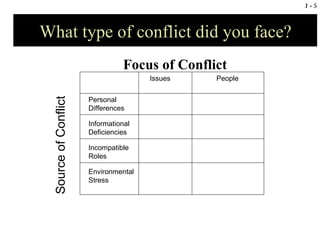
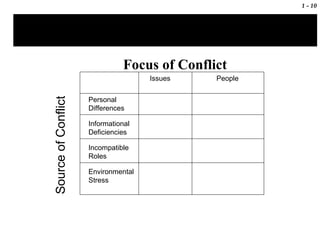
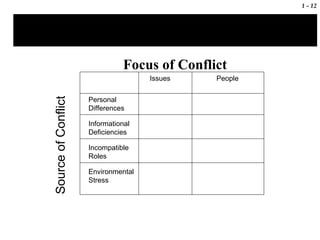
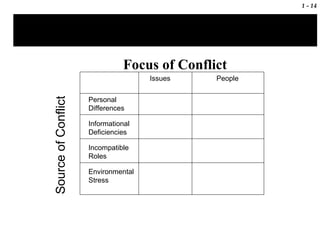
Sources of Conflict Personal differences Conflict stemming from incompatible personal values and needs Information deficiencies A message is not received, misinterpreted, interpreted differently based on contradictory data sources Role incompatibility Interdependent tasks, incompatible roles Environmentally induced stress Lots of change in the environment, scarce resources, etc.
Focus of Conflict People based conflict refers to the “in your face” kind of confrontations in which affect level is high  Issue-focused conflict refers to a rational negotiation between two parties that focuses on the distribution of resources
What type of conflict did you face? Focus of Conflict Source of Conflict Personal Differences Informational Deficiencies Incompatible Roles Environmental Stress Issues People
Is conflict always a bad thing? “ Each afternoon, in a tiny workroom on the 12 th  floor of the Mayo Clinic, the battle against cancer begins with an argument. The walls of the room are plastered with X-rays, CT scans, and data. A group of cancer specialists, surgeons, residents, and nurses debates how to diagnose, and ultimately treat, the day’s patients. On one particular day, Dr. Lynn Hartmann, a medical oncologist, suggests a surgical procedure for a 65-year-old man with a possible kidney tumor. However, when she asks teammates for their opinions, they challenge her in a direct point-counterpoint debate” - Roberts (1999)
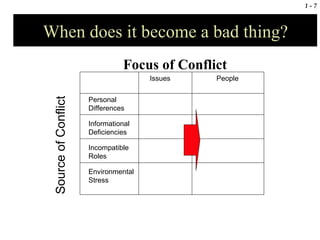
When does it become a bad thing? Focus of Conflict Source of Conflict Personal Differences Informational Deficiencies Incompatible Roles Environmental Stress Issues People
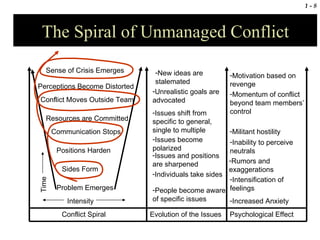
The Spiral of Unmanaged Conflict Conflict Spiral Time Psychological Effect Evolution of the Issues Problem Emerges Intensity Sides Form Positions Harden Communication Stops Resources are Committed Conflict Moves Outside Team Perceptions Become Distorted Sense of Crisis Emerges New ideas are  stalemated Unrealistic goals are  advocated People become aware of specific issues Individuals take sides Issues and positions are sharpened Issues become  polarized Issues shift from  specific to general, single to multiple Motivation based on revenge  Momentum of conflict beyond team members’ control  Militant hostility Inability to perceive neutrals  Rumors and  exaggerations Increased Anxiety Intensification of  feelings
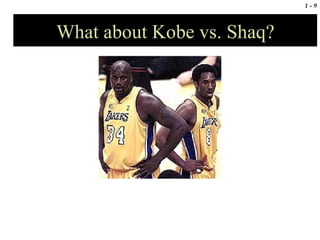
What about Kobe vs. Shaq?
Focus of Conflict Source of Conflict Personal Differences Informational Deficiencies Incompatible Roles Environmental Stress Issues People
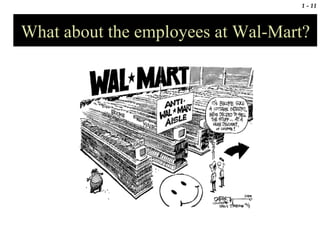
What about the employees at Wal-Mart?
Focus of Conflict Source of Conflict Personal Differences Informational Deficiencies Incompatible Roles Environmental Stress Issues People
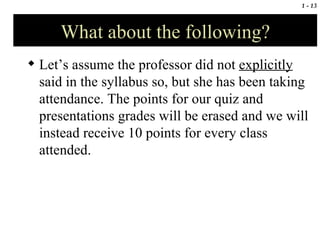
What about the following? Let’s assume the professor did not  explicitly  said in the syllabus so, but she has been taking attendance. The points for our quiz and presentations grades will be erased and we will instead receive 10 points for every class attended.
Focus of Conflict Source of Conflict Personal Differences Informational Deficiencies Incompatible Roles Environmental Stress Issues People
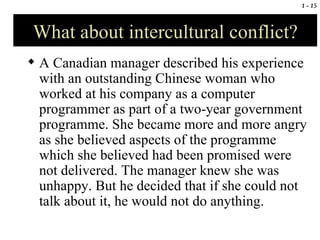
What about intercultural conflict? A Canadian manager described his experience with an outstanding Chinese woman who worked at his company as a computer programmer as part of a two-year government programme. She became more and more angry as she believed aspects of the programme which she believed had been promised were not delivered. The manager knew she was unhappy. But he decided that if she could not talk about it, he would not do anything.
What about intercultural conflict? Being from a hierarchical society, the Chinese woman could not make claims against the boss without making him lose face. But coming from an egalitarian society, the Canadian manager relied upon her to tell him what the problems were. When people from hierarchical cultures do make claims in which they recognise their lack of status, they are more likely to appeal to sympathy. This reminds the person of higher status of his responsibility to take care of the needs of the lower status person.
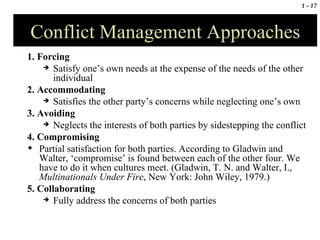
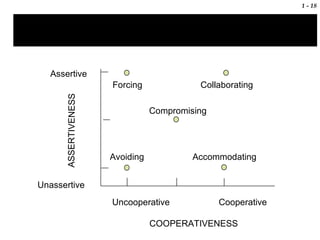
Conflict Management Approaches 1. Forcing Satisfy one’s own needs at the expense of the needs of the other individual 2. Accommodating Satisfies the other party’s concerns while neglecting one’s own 3. Avoiding Neglects the interests of both parties by sidestepping the conflict 4. Compromising Partial satisfaction for both parties.  According to Gladwin and Walter, ‘compromise’ is found between each of the other four. We have to do it when cultures meet. (Gladwin, T. N. and Walter, I.,  Multinationals Under Fire , New York: John Wiley, 1979.) 5. Collaborating Fully address the concerns of both parties
Uncooperative Cooperative COOPERATIVENESS Assertive Unassertive ASSERTIVENESS Forcing Collaborating Compromising Avoiding Accommodating
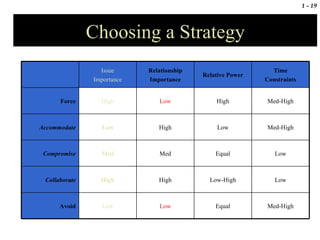
Choosing a Strategy Med-High Equal Low Low Avoid Low Low-High High High Collaborate Low Equal Med Med Compromise Med-High Low High Low Accommodate Med-High High Low High Force Time Constraints Relative Power Relationship Importance Issue Importance
What is the best conflict resolution strategy for the Handshake Game, for Kobe vs. Shaq, etc., etc.? What conflict resolution strategy was  actually  used in the Kobe and Shaq battle? What should they have done? What about the employees at Wal-Mart?
The Five-Step method of collaboration Show empathy and respect for their points and feelings Reframe their argument as an attempt to deal with the problem Share information to understand each other’s position  and build trust Don’t discuss issues sequentially Make multiple proposals simultaneously (can add contingency contracts)
Bibliography Schneider and Barsoux, 2003 Di Stefano, J. J., Canada-China Computer Crisis Case,London, Canada: University of Western Ontario, 1994 Thomas, K., ‘Conflict and conflict management’, in M. Dunnette (ed.)  Handbook of Industrial and Organizational Psychology , Chicago: Rand McNally, 1976, pp. 889-935 Gladwin, T. N. and Walter, I.,  Multinationals Under Fire , New York: John Wiley, 1979   Goldberg, S. B., F. E. A. sander, and N. H. Rogers, Dispute resolution: Negotiation, Mediation, and Other Processes, 3rd ed. (Gaithersburg, Md., Aspen, 1999)
INTRODUCED BY MICKAËL HOURI JULIEN BOUHLEL FERL NGNINGONE UDI LI-HOD THANK YOU FOR YOUR ATTENTION…

Managing Conflict

  • 1.
    The Handshake GameWin as many points as you can. You win a point when the joined hands touch your hip. You must keep track of points.
  • 2.
    Managing Conflict MickaëlHouri Julien Bouhlel Ferl Ngningone Udi Li-Hod
  • 3.
    Sources of ConflictPersonal differences Conflict stemming from incompatible personal values and needs Information deficiencies A message is not received, misinterpreted, interpreted differently based on contradictory data sources Role incompatibility Interdependent tasks, incompatible roles Environmentally induced stress Lots of change in the environment, scarce resources, etc.
  • 4.
    Focus of ConflictPeople based conflict refers to the “in your face” kind of confrontations in which affect level is high Issue-focused conflict refers to a rational negotiation between two parties that focuses on the distribution of resources
  • 5.
    What type ofconflict did you face? Focus of Conflict Source of Conflict Personal Differences Informational Deficiencies Incompatible Roles Environmental Stress Issues People
  • 6.
    Is conflict alwaysa bad thing? “ Each afternoon, in a tiny workroom on the 12 th floor of the Mayo Clinic, the battle against cancer begins with an argument. The walls of the room are plastered with X-rays, CT scans, and data. A group of cancer specialists, surgeons, residents, and nurses debates how to diagnose, and ultimately treat, the day’s patients. On one particular day, Dr. Lynn Hartmann, a medical oncologist, suggests a surgical procedure for a 65-year-old man with a possible kidney tumor. However, when she asks teammates for their opinions, they challenge her in a direct point-counterpoint debate” - Roberts (1999)
  • 7.
    When does itbecome a bad thing? Focus of Conflict Source of Conflict Personal Differences Informational Deficiencies Incompatible Roles Environmental Stress Issues People
  • 8.
    The Spiral ofUnmanaged Conflict Conflict Spiral Time Psychological Effect Evolution of the Issues Problem Emerges Intensity Sides Form Positions Harden Communication Stops Resources are Committed Conflict Moves Outside Team Perceptions Become Distorted Sense of Crisis Emerges New ideas are stalemated Unrealistic goals are advocated People become aware of specific issues Individuals take sides Issues and positions are sharpened Issues become polarized Issues shift from specific to general, single to multiple Motivation based on revenge Momentum of conflict beyond team members’ control Militant hostility Inability to perceive neutrals Rumors and exaggerations Increased Anxiety Intensification of feelings
  • 9.
    What about Kobevs. Shaq?
  • 10.
    Focus of ConflictSource of Conflict Personal Differences Informational Deficiencies Incompatible Roles Environmental Stress Issues People
  • 11.
    What about theemployees at Wal-Mart?
  • 12.
    Focus of ConflictSource of Conflict Personal Differences Informational Deficiencies Incompatible Roles Environmental Stress Issues People
  • 13.
    What about thefollowing? Let’s assume the professor did not explicitly said in the syllabus so, but she has been taking attendance. The points for our quiz and presentations grades will be erased and we will instead receive 10 points for every class attended.
  • 14.
    Focus of ConflictSource of Conflict Personal Differences Informational Deficiencies Incompatible Roles Environmental Stress Issues People
  • 15.
    What about interculturalconflict? A Canadian manager described his experience with an outstanding Chinese woman who worked at his company as a computer programmer as part of a two-year government programme. She became more and more angry as she believed aspects of the programme which she believed had been promised were not delivered. The manager knew she was unhappy. But he decided that if she could not talk about it, he would not do anything.
  • 16.
    What about interculturalconflict? Being from a hierarchical society, the Chinese woman could not make claims against the boss without making him lose face. But coming from an egalitarian society, the Canadian manager relied upon her to tell him what the problems were. When people from hierarchical cultures do make claims in which they recognise their lack of status, they are more likely to appeal to sympathy. This reminds the person of higher status of his responsibility to take care of the needs of the lower status person.
  • 17.
    Conflict Management Approaches1. Forcing Satisfy one’s own needs at the expense of the needs of the other individual 2. Accommodating Satisfies the other party’s concerns while neglecting one’s own 3. Avoiding Neglects the interests of both parties by sidestepping the conflict 4. Compromising Partial satisfaction for both parties. According to Gladwin and Walter, ‘compromise’ is found between each of the other four. We have to do it when cultures meet. (Gladwin, T. N. and Walter, I., Multinationals Under Fire , New York: John Wiley, 1979.) 5. Collaborating Fully address the concerns of both parties
  • 18.
    Uncooperative Cooperative COOPERATIVENESSAssertive Unassertive ASSERTIVENESS Forcing Collaborating Compromising Avoiding Accommodating
  • 19.
    Choosing a StrategyMed-High Equal Low Low Avoid Low Low-High High High Collaborate Low Equal Med Med Compromise Med-High Low High Low Accommodate Med-High High Low High Force Time Constraints Relative Power Relationship Importance Issue Importance
  • 20.
    What is thebest conflict resolution strategy for the Handshake Game, for Kobe vs. Shaq, etc., etc.? What conflict resolution strategy was actually used in the Kobe and Shaq battle? What should they have done? What about the employees at Wal-Mart?
  • 21.
    The Five-Step methodof collaboration Show empathy and respect for their points and feelings Reframe their argument as an attempt to deal with the problem Share information to understand each other’s position and build trust Don’t discuss issues sequentially Make multiple proposals simultaneously (can add contingency contracts)
  • 22.
    Bibliography Schneider andBarsoux, 2003 Di Stefano, J. J., Canada-China Computer Crisis Case,London, Canada: University of Western Ontario, 1994 Thomas, K., ‘Conflict and conflict management’, in M. Dunnette (ed.) Handbook of Industrial and Organizational Psychology , Chicago: Rand McNally, 1976, pp. 889-935 Gladwin, T. N. and Walter, I., Multinationals Under Fire , New York: John Wiley, 1979 Goldberg, S. B., F. E. A. sander, and N. H. Rogers, Dispute resolution: Negotiation, Mediation, and Other Processes, 3rd ed. (Gaithersburg, Md., Aspen, 1999)
  • 23.
    INTRODUCED BY MICKAËLHOURI JULIEN BOUHLEL FERL NGNINGONE UDI LI-HOD THANK YOU FOR YOUR ATTENTION…