Introduction
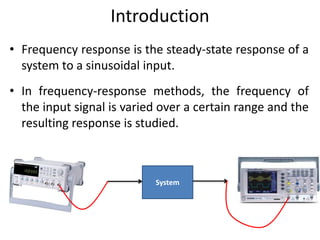
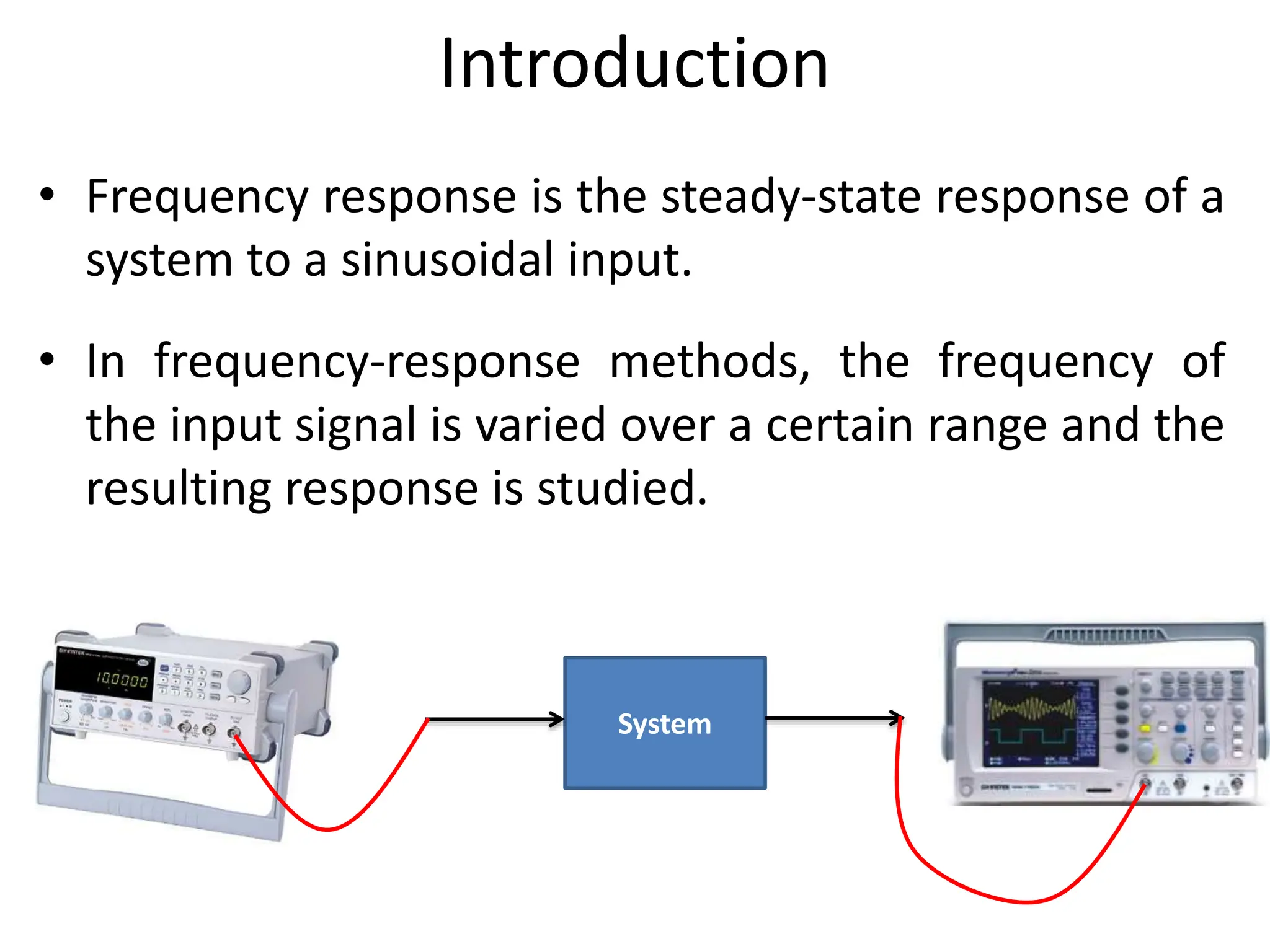
• Frequency response is the steady-state response of a
system to a sinusoidal input.
• In frequency-response methods, the frequency of
the input signal is varied over a certain range and the
resulting response is studied.
System
The Concept of Frequency Response
• In the steady state, sinusoidal inputs to a linear
system generate sinusoidal responses of the
same frequency.
• Even though these responses are of the same
frequency as the input, they differ in amplitude
and phase angle from the input.
• These differences are functions of frequency.
The Concept of Frequency Response
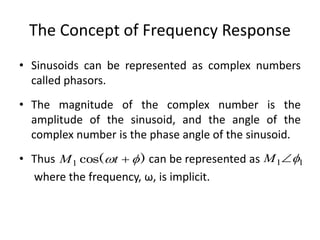
• Sinusoids can be represented as complex numbers
called phasors.
• The magnitude of the complex number is the
amplitude of the sinusoid, and the angle of the
complex number is the phase angle of the sinusoid.
• Thus can be represented as
where the frequency, ω, is implicit.
)
cos( 
 
t
M1 1
1 

M
The Concept of Frequency Response
• A system causes both the amplitude and phase angle
of the input to be changed.
• Therefore, the system itself can be represented by a
complex number.
• Thus, the product of the input phasor and the system
function yields the phasor representation of the
output.
The Concept of Frequency Response
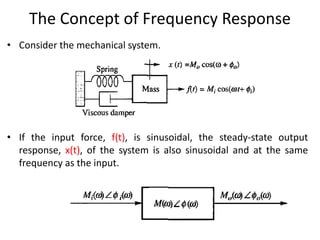
• Consider the mechanical system.
• If the input force, f(t), is sinusoidal, the steady-state output
response, x(t), of the system is also sinusoidal and at the same
frequency as the input.
The Concept of Frequency Response
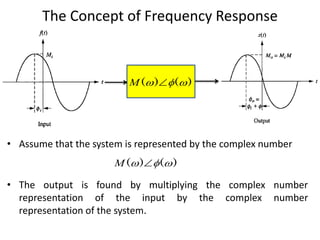
• Assume that the system is represented by the complex number
• The output is found by multiplying the complex number
representation of the input by the complex number
representation of the system.
)
(
)
( 

 
M
)
(
)
( 

 
M
The Concept of Frequency Response
• Thus, the steady-state output sinusoid is
• Mo(ω) is the magnitude response and Φ(ω) is the phase response.
The combination of the magnitude and phase frequency
responses is called the frequency response.
)
(
)
( 

 
M
)]
(
)
(
[
)
(
)
(
)
(
)
( 







 i
i
o
o M
M
M 



Frequency Domain Plots
• Bode Plot
• Nyquist Plot
• Nichol’s Chart
Bode Plot
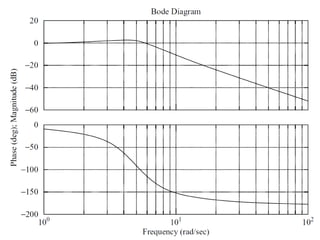
• A Bode diagram consists of two graphs:
– One is a plot of the logarithm of the magnitude of
a sinusoidal transfer function.
– The other is a plot of the phase angle.
– Both are plotted against the frequency on a
logarithmic scale.
Basic Factors of a Transfer Function
• The basic factors that very frequently occur in
an arbitrary transfer function are
1. Gain K
2. Integral and Derivative Factors (jω)±1
3. First Order Factors (jωT+1)±1
4. Quadratic Factors
)
)(
(
)
(
)
(
2
5
1
1
3
20
2





s
s
s
s
s
s
G
Basic Factors of a Transfer Function
1. Gain K
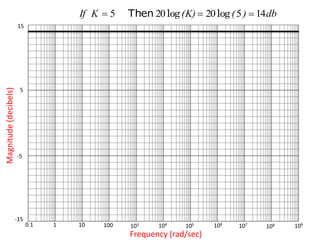
• The log-magnitude curve for a constant gain K is a horizontal
straight line at the magnitude of 20 log(K) decibels.
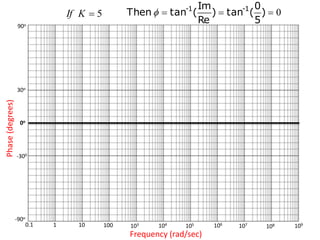
• The phase angle of the gain K is zero.
• The effect of varying the gain K in the transfer function is that
it raises or lowers the log-magnitude curve of the transfer
function by the corresponding constant amount, but it has no
effect on the phase curve.
-15
-5
5
15
Magnitude
(decibels)
Frequency (rad/sec)
0.1 1 10 100
5

K
If db
)
(
(K) 14
5
20
20 
 log
log
Then
103 104 105 106
107
108 109
-90o
-300
30o
90o
Phase
(degrees)
Frequency (rad/sec)
0.1 1 10 100
5

K
If 0


 )
5
0
(
tan
)
Re
Im
(
tan
Then 1
-
1
-

103 104 105 106
107
108 109
0o
Basic Factors of a Transfer Function
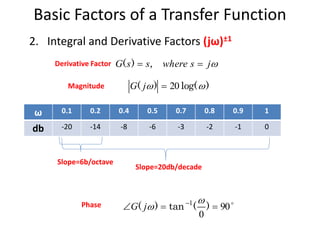
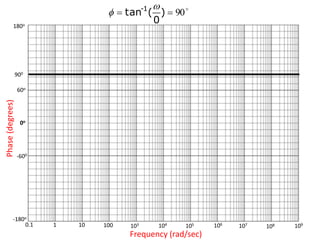
2. Integral and Derivative Factors (jω)±1

j
s
where
s
s
G 
 ,
)
(
)
log(
)
( 
 20

j
G

90
0
1


 
)
(
tan
)
(


j
G
Derivative Factor
Magnitude
Phase
ω 0.1 0.2 0.4 0.5 0.7 0.8 0.9 1
db -20 -14 -8 -6 -3 -2 -1 0
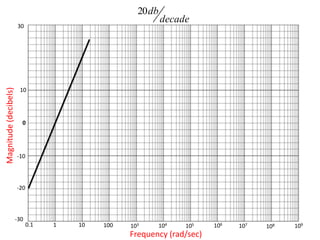
Slope=20db/decade
Slope=6b/octave
-30
-10
10
30
Magnitude
(decibels)
Frequency (rad/sec)
0.1 1 10 100
decade
db
20
103 104 105 106
107
108 109
0
-20
-180o
-600
60o
180o
Phase
(degrees)
Frequency (rad/sec)
0.1 1 10 100

90

 )
0
(
tan 1
- 

103 104 105 106
107
108 109
0o
900
Basic Factors of a Transfer Function
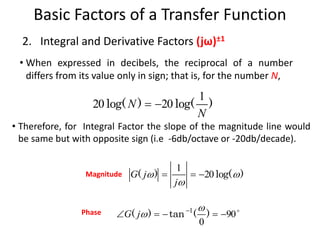
2. Integral and Derivative Factors (jω)±1
• When expressed in decibels, the reciprocal of a number
differs from its value only in sign; that is, for the number N,
)
log(
)
log(
N
N
1
20
20 

)
log(
)
( 

 20
1



j
j
G
Magnitude
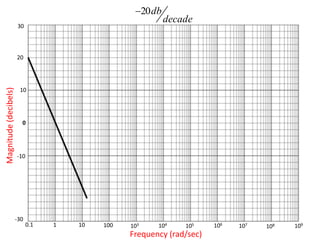
• Therefore, for Integral Factor the slope of the magnitude line would
be same but with opposite sign (i.e -6db/octave or -20db/decade).
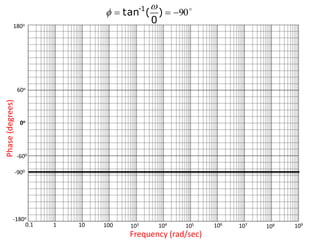

90
0
1




 
)
(
tan
)
(


j
G
Phase
-30
-10
10
30
Magnitude
(decibels)
Frequency (rad/sec)
0.1 1 10 100
decade
db
20

103 104 105 106
107
108 109
0
20
-180o
-600
60o
180o
Phase
(degrees)
Frequency (rad/sec)
0.1 1 10 100

90


 )
0
(
tan 1
- 

103 104 105 106
107
108 109
0o
-900
Basic Factors of a Transfer Function
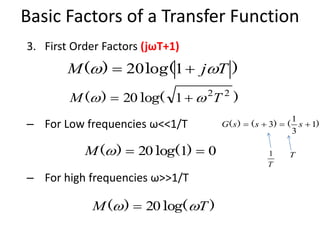
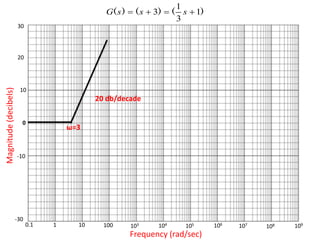
3. First Order Factors (jωT+1)
– For Low frequencies ω<<1/T
– For high frequencies ω>>1/T
)
log(
)
( T
j
M 
 
 1
20
)
log(
)
( 2
2
1
20 T
M 
 

0
1
20 
 )
log(
)
(
M
)
log(
)
( T
M 
 20

)
(
)
(
)
( 1
3
1
3 


 s
s
s
G
T
T
1
Basic Factors of a Transfer Function
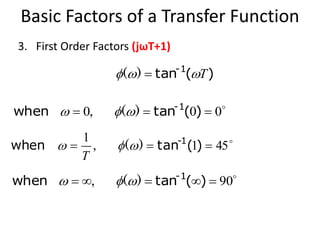
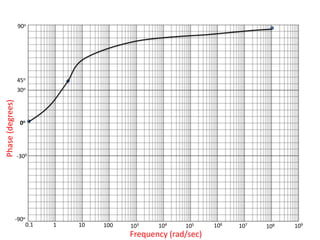
3. First Order Factors (jωT+1)
)
(
tan-1
T


 
)
(

0
0
0 

 )
(
tan
when -1
)
(
, 



45
1
1


 )
(
tan
when 1
-
)
(
, 


T

90




 )
(
tan
when -1
)
(
, 


-30
-10
10
30
Magnitude
(decibels)
Frequency (rad/sec)
0.1 1 10 100 103 104 105 106
107
108 109
0
20
)
(
)
(
)
( 1
3
1
3 


 s
s
s
G
ω=3
20 db/decade
-90o
-300
30o
90o
Phase
(degrees)
Frequency (rad/sec)
0.1 1 10 100 103 104 105 106
107
108 109
0o
45o
Basic Factors of a Transfer Function
3. First Order Factors (jωT+1)-1
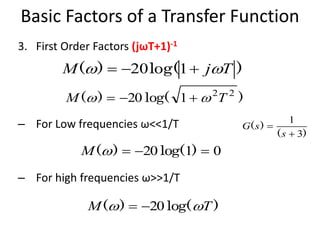
– For Low frequencies ω<<1/T
– For high frequencies ω>>1/T
)
log(
)
( T
j
M 
 

 1
20
)
log(
)
( 2
2
1
20 T
M 
 


0
1
20 

 )
log(
)
(
M
)
log(
)
( T
M 
 20


)
(
)
(
3
1


s
s
G
Basic Factors of a Transfer Function
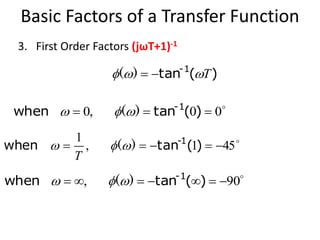
3. First Order Factors (jωT+1)-1
)
(
tan-1
T


 

)
(

0
0
0 

 )
(
tan
when -1
)
(
, 



45
1
1




 )
(
tan
when 1
-
)
(
, 


T

90






 )
(
tan
when -1
)
(
, 


-30
-10
10
30
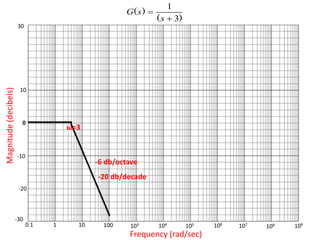
Magnitude
(decibels)
Frequency (rad/sec)
0.1 1 10 100 103 104 105 106
107
108 109
0
-20
)
(
)
(
3
1


s
s
G
ω=3
-6 db/octave
-20 db/decade
-90o
-300
30o
90o
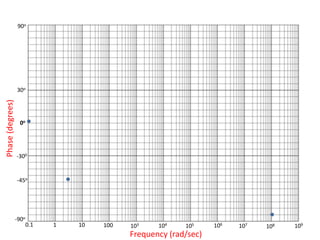
Phase
(degrees)
Frequency (rad/sec)
0.1 1 10 100 103 104 105 106
107
108 109
0o
-45o
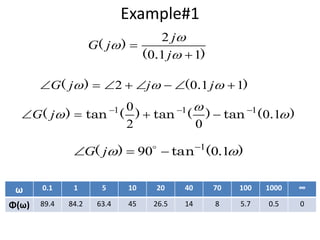
Example#1
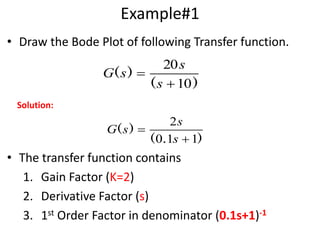
• Draw the Bode Plot of following Transfer function.
)
(
)
(
10
20


s
s
s
G
Solution:
)
.
(
)
(
1
1
0
2


s
s
s
G
• The transfer function contains
1. Gain Factor (K=2)
2. Derivative Factor (s)
3. 1st Order Factor in denominator (0.1s+1)-1
Example#1
)
.
(
)
(
1
1
0
2


s
s
s
G
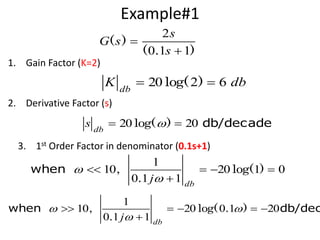
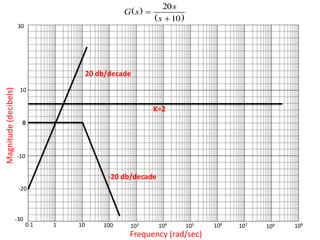
1. Gain Factor (K=2)
db
K db
6
2
20 
 )
log(
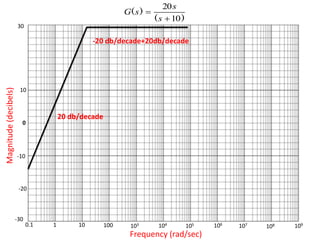
2. Derivative Factor (s)
db/decade
20
20 
 )
log(
db
s
3. 1st Order Factor in denominator (0.1s+1)
0
1
20
1
1
0
1
10 



 )
log(
.
,
db
j

when
db/dec
when 20
1
0
20
1
1
0
1
10 




 )
.
log(
.
, 


db
j
-30
-10
10
30
Magnitude
(decibels)
Frequency (rad/sec)
0.1 1 10 100 103 104 105 106
107
108 109
0
-20
)
(
)
(
10
20


s
s
s
G
K=2
20 db/decade
-20 db/decade
-30
-10
10
30
Magnitude
(decibels)
Frequency (rad/sec)
0.1 1 10 100 103 104 105 106
107
108 109
0
-20
)
(
)
(
10
20


s
s
s
G
20 db/decade
-20 db/decade+20db/decade
Example#1
)
.
(
)
(
1
1
0
2





j
j
j
G
)
.
(
)
( 1
1
0
2 






 

 j
j
j
G
)
.
(
tan
)
(
tan
)
(
tan
)
( 

 1
0
0
2
0 1
1
1 





 j
G
)
.
(
tan
)
( 
 1
0
90 1



 
j
G
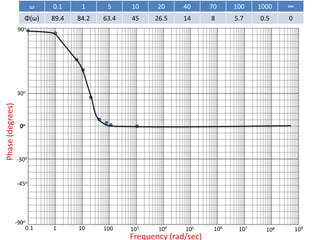
ω 0.1 1 5 10 20 40 70 100 1000 ∞
Φ(ω) 89.4 84.2 63.4 45 26.5 14 8 5.7 0.5 0
-90o
-300
30o
90o
Phase
(degrees)
Frequency (rad/sec)
0.1 1 10 100 103 104 105 106
107
108 109
0o
-45o
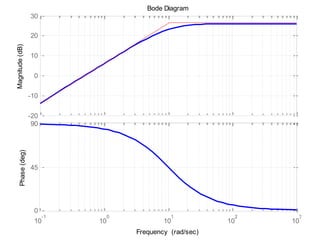
ω 0.1 1 5 10 20 40 70 100 1000 ∞
Φ(ω) 89.4 84.2 63.4 45 26.5 14 8 5.7 0.5 0
-20
-10
0
10
20
30
Magnitude
(dB)
10
-1
10
0
10
1
10
2
10
3
0
45
90
Phase
(deg)
Bode Diagram
Frequency (rad/sec)
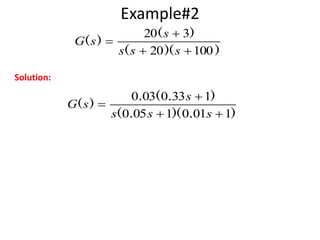
Example#2
)
)(
(
)
(
)
(
100
20
3
20




s
s
s
s
s
G
Solution:
)
.
)(
.
(
)
.
(
.
)
(
1
01
0
1
05
0
1
33
0
03
0




s
s
s
s
s
G
Understanding and Implementation the Bode Plot

Understanding and Implementation the Bode Plot

  • 1.
    Introduction • Frequency responseis the steady-state response of a system to a sinusoidal input. • In frequency-response methods, the frequency of the input signal is varied over a certain range and the resulting response is studied. System
  • 2.
    The Concept ofFrequency Response • In the steady state, sinusoidal inputs to a linear system generate sinusoidal responses of the same frequency. • Even though these responses are of the same frequency as the input, they differ in amplitude and phase angle from the input. • These differences are functions of frequency.
  • 3.
    The Concept ofFrequency Response • Sinusoids can be represented as complex numbers called phasors. • The magnitude of the complex number is the amplitude of the sinusoid, and the angle of the complex number is the phase angle of the sinusoid. • Thus can be represented as where the frequency, ω, is implicit. ) cos(    t M1 1 1   M
  • 4.
    The Concept ofFrequency Response • A system causes both the amplitude and phase angle of the input to be changed. • Therefore, the system itself can be represented by a complex number. • Thus, the product of the input phasor and the system function yields the phasor representation of the output.
  • 5.
    The Concept ofFrequency Response • Consider the mechanical system. • If the input force, f(t), is sinusoidal, the steady-state output response, x(t), of the system is also sinusoidal and at the same frequency as the input.
  • 6.
    The Concept ofFrequency Response • Assume that the system is represented by the complex number • The output is found by multiplying the complex number representation of the input by the complex number representation of the system. ) ( ) (     M ) ( ) (     M
  • 7.
    The Concept ofFrequency Response • Thus, the steady-state output sinusoid is • Mo(ω) is the magnitude response and Φ(ω) is the phase response. The combination of the magnitude and phase frequency responses is called the frequency response. ) ( ) (     M )] ( ) ( [ ) ( ) ( ) ( ) (          i i o o M M M    
  • 8.
    Frequency Domain Plots •Bode Plot • Nyquist Plot • Nichol’s Chart
  • 9.
    Bode Plot • ABode diagram consists of two graphs: – One is a plot of the logarithm of the magnitude of a sinusoidal transfer function. – The other is a plot of the phase angle. – Both are plotted against the frequency on a logarithmic scale.
  • 11.
    Basic Factors ofa Transfer Function • The basic factors that very frequently occur in an arbitrary transfer function are 1. Gain K 2. Integral and Derivative Factors (jω)±1 3. First Order Factors (jωT+1)±1 4. Quadratic Factors ) )( ( ) ( ) ( 2 5 1 1 3 20 2      s s s s s s G
  • 12.
    Basic Factors ofa Transfer Function 1. Gain K • The log-magnitude curve for a constant gain K is a horizontal straight line at the magnitude of 20 log(K) decibels. • The phase angle of the gain K is zero. • The effect of varying the gain K in the transfer function is that it raises or lowers the log-magnitude curve of the transfer function by the corresponding constant amount, but it has no effect on the phase curve.
  • 13.
    -15 -5 5 15 Magnitude (decibels) Frequency (rad/sec) 0.1 110 100 5  K If db ) ( (K) 14 5 20 20   log log Then 103 104 105 106 107 108 109
  • 14.
    -90o -300 30o 90o Phase (degrees) Frequency (rad/sec) 0.1 110 100 5  K If 0    ) 5 0 ( tan ) Re Im ( tan Then 1 - 1 -  103 104 105 106 107 108 109 0o
  • 15.
    Basic Factors ofa Transfer Function 2. Integral and Derivative Factors (jω)±1  j s where s s G   , ) ( ) log( ) (   20  j G  90 0 1     ) ( tan ) (   j G Derivative Factor Magnitude Phase ω 0.1 0.2 0.4 0.5 0.7 0.8 0.9 1 db -20 -14 -8 -6 -3 -2 -1 0 Slope=20db/decade Slope=6b/octave
  • 16.
    -30 -10 10 30 Magnitude (decibels) Frequency (rad/sec) 0.1 110 100 decade db 20 103 104 105 106 107 108 109 0 -20
  • 17.
    -180o -600 60o 180o Phase (degrees) Frequency (rad/sec) 0.1 110 100  90   ) 0 ( tan 1 -   103 104 105 106 107 108 109 0o 900
  • 18.
    Basic Factors ofa Transfer Function 2. Integral and Derivative Factors (jω)±1 • When expressed in decibels, the reciprocal of a number differs from its value only in sign; that is, for the number N, ) log( ) log( N N 1 20 20   ) log( ) (    20 1    j j G Magnitude • Therefore, for Integral Factor the slope of the magnitude line would be same but with opposite sign (i.e -6db/octave or -20db/decade).  90 0 1       ) ( tan ) (   j G Phase
  • 19.
    -30 -10 10 30 Magnitude (decibels) Frequency (rad/sec) 0.1 110 100 decade db 20  103 104 105 106 107 108 109 0 20
  • 20.
    -180o -600 60o 180o Phase (degrees) Frequency (rad/sec) 0.1 110 100  90    ) 0 ( tan 1 -   103 104 105 106 107 108 109 0o -900
  • 21.
    Basic Factors ofa Transfer Function 3. First Order Factors (jωT+1) – For Low frequencies ω<<1/T – For high frequencies ω>>1/T ) log( ) ( T j M     1 20 ) log( ) ( 2 2 1 20 T M     0 1 20   ) log( ) ( M ) log( ) ( T M   20  ) ( ) ( ) ( 1 3 1 3     s s s G T T 1
  • 22.
    Basic Factors ofa Transfer Function 3. First Order Factors (jωT+1) ) ( tan-1 T     ) (  0 0 0    ) ( tan when -1 ) ( ,     45 1 1    ) ( tan when 1 - ) ( ,    T  90      ) ( tan when -1 ) ( ,   
  • 23.
    -30 -10 10 30 Magnitude (decibels) Frequency (rad/sec) 0.1 110 100 103 104 105 106 107 108 109 0 20 ) ( ) ( ) ( 1 3 1 3     s s s G ω=3 20 db/decade
  • 24.
    -90o -300 30o 90o Phase (degrees) Frequency (rad/sec) 0.1 110 100 103 104 105 106 107 108 109 0o 45o
  • 25.
    Basic Factors ofa Transfer Function 3. First Order Factors (jωT+1)-1 – For Low frequencies ω<<1/T – For high frequencies ω>>1/T ) log( ) ( T j M      1 20 ) log( ) ( 2 2 1 20 T M      0 1 20    ) log( ) ( M ) log( ) ( T M   20   ) ( ) ( 3 1   s s G
  • 26.
    Basic Factors ofa Transfer Function 3. First Order Factors (jωT+1)-1 ) ( tan-1 T      ) (  0 0 0    ) ( tan when -1 ) ( ,     45 1 1      ) ( tan when 1 - ) ( ,    T  90        ) ( tan when -1 ) ( ,   
  • 27.
    -30 -10 10 30 Magnitude (decibels) Frequency (rad/sec) 0.1 110 100 103 104 105 106 107 108 109 0 -20 ) ( ) ( 3 1   s s G ω=3 -6 db/octave -20 db/decade
  • 28.
    -90o -300 30o 90o Phase (degrees) Frequency (rad/sec) 0.1 110 100 103 104 105 106 107 108 109 0o -45o
  • 29.
    Example#1 • Draw theBode Plot of following Transfer function. ) ( ) ( 10 20   s s s G Solution: ) . ( ) ( 1 1 0 2   s s s G • The transfer function contains 1. Gain Factor (K=2) 2. Derivative Factor (s) 3. 1st Order Factor in denominator (0.1s+1)-1
  • 30.
    Example#1 ) . ( ) ( 1 1 0 2   s s s G 1. Gain Factor(K=2) db K db 6 2 20   ) log( 2. Derivative Factor (s) db/decade 20 20   ) log( db s 3. 1st Order Factor in denominator (0.1s+1) 0 1 20 1 1 0 1 10      ) log( . , db j  when db/dec when 20 1 0 20 1 1 0 1 10       ) . log( . ,    db j
  • 31.
    -30 -10 10 30 Magnitude (decibels) Frequency (rad/sec) 0.1 110 100 103 104 105 106 107 108 109 0 -20 ) ( ) ( 10 20   s s s G K=2 20 db/decade -20 db/decade
  • 32.
    -30 -10 10 30 Magnitude (decibels) Frequency (rad/sec) 0.1 110 100 103 104 105 106 107 108 109 0 -20 ) ( ) ( 10 20   s s s G 20 db/decade -20 db/decade+20db/decade
  • 33.
    Example#1 ) . ( ) ( 1 1 0 2      j j j G ) . ( ) ( 1 1 0 2           j j j G ) . ( tan ) ( tan ) ( tan ) (    1 0 0 2 0 1 1 1        j G ) . ( tan ) (   1 0 90 1      j G ω 0.1 1 5 10 20 40 70 100 1000 ∞ Φ(ω) 89.4 84.2 63.4 45 26.5 14 8 5.7 0.5 0
  • 34.
    -90o -300 30o 90o Phase (degrees) Frequency (rad/sec) 0.1 110 100 103 104 105 106 107 108 109 0o -45o ω 0.1 1 5 10 20 40 70 100 1000 ∞ Φ(ω) 89.4 84.2 63.4 45 26.5 14 8 5.7 0.5 0
  • 35.
  • 36.