

Disaster Management and
Seismic Retrofitting
Dr K M Soni
Chief Engineer, CPWD, Mumbai
Major Disasters Worldwide
4th July 2017 Disaster management 2
Sl.
No.
Name of Event Year Country and
Region
Fatalities in the
known history
1 Earthquake 1556 China, Shaanxi 830000
2 Earthquake 1731 China 100000
3 Cyclone 1737 India, Calcutta 300000
4 Yellow River flood 1887 China 9,00,000-20,00,000
5 Messina Earthquake 1908 Italy 123000
6 Earthquake 1920 China, Gansu 235000
7 Great Kanto Earthquake 1923 Japan 142000
8 Great Chinese Famine
1958-1961 China
1958-1961 China 150,00,000-
430,00,000
9 Bhola Cyclone 1970 West Bengal,
India & B/desh
5,00,000
10 Tangshan Earthquake 1976 China 2,42,419
HAITI’S E/Q, 12.1.2010; DEATHS-3,16,000; MAGNITUDE:7
34th July 2017 Disaster management
TANGSHAN, CHINA, 27.7.1976; DEATHS-242,769; MAG. 7.5
44th July 2017 Disaster management
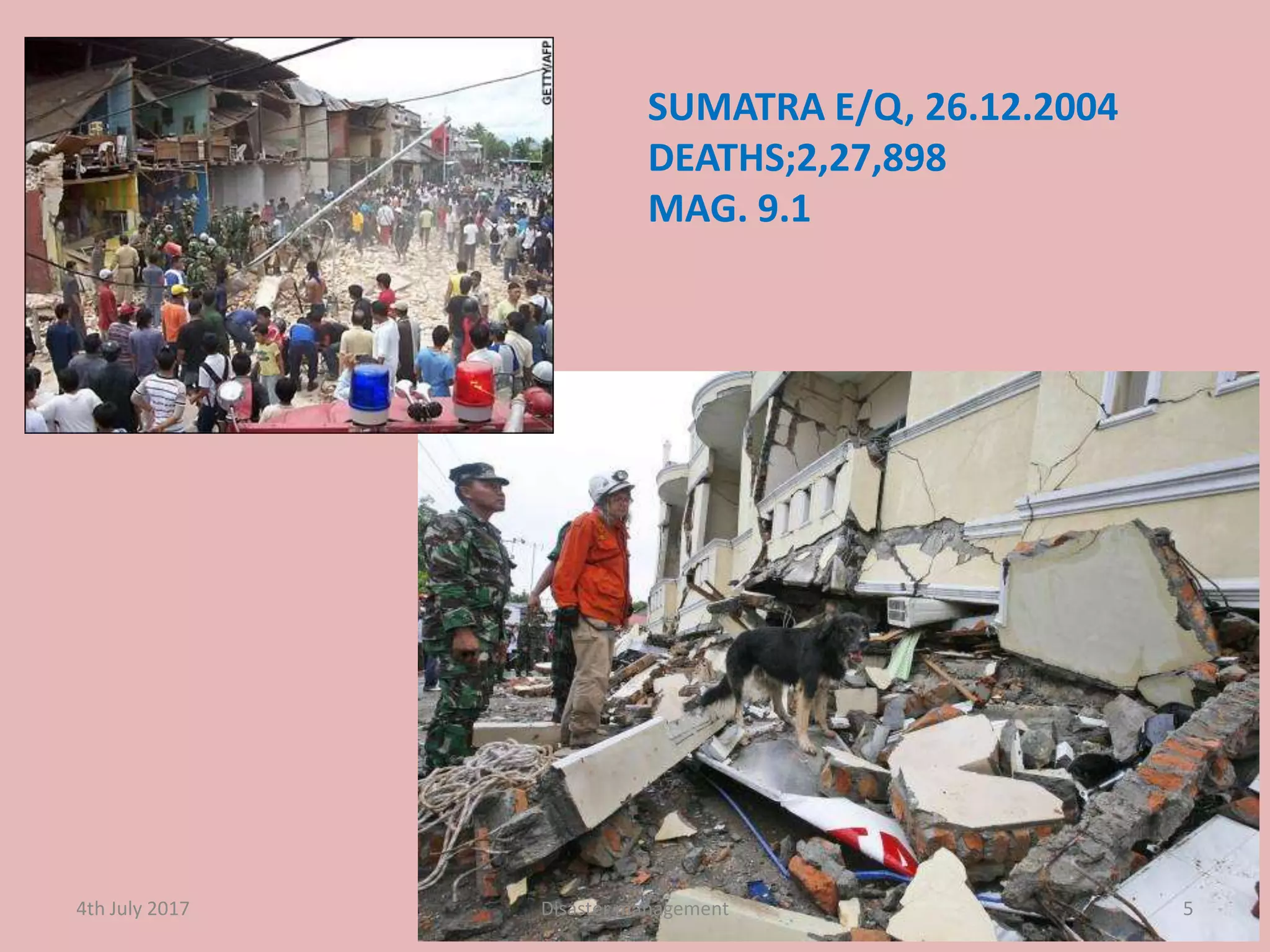
SUMATRA E/Q, 26.12.2004
DEATHS;2,27,898
MAG. 9.1
54th July 2017 Disaster management
Haiyuan, china
e/q 16.12.1920
Deaths; 2,00,000
Mag. 7.8
64th July 2017 Disaster management
Kanto, e/q, Japan; 1.9.1923
Deaths-1,42,800
Magnitude: 7.9
74th July 2017 Disaster management
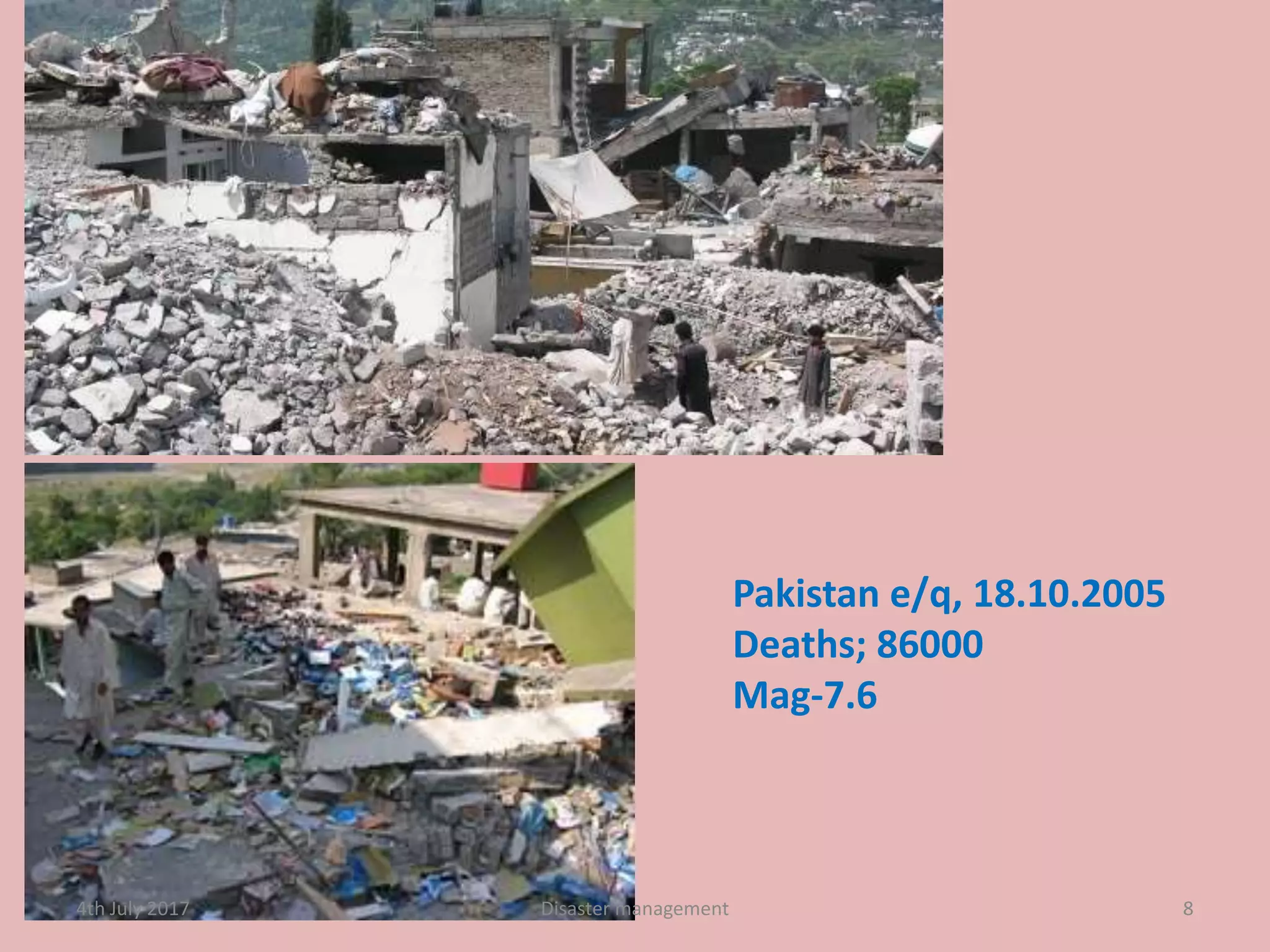
Pakistan e/q, 18.10.2005
Deaths; 86000
Mag-7.6
84th July 2017 Disaster management
Iran e/q, 20.6.1990
Deaths-50,000
Mag. 7.4
94th July 2017 Disaster management
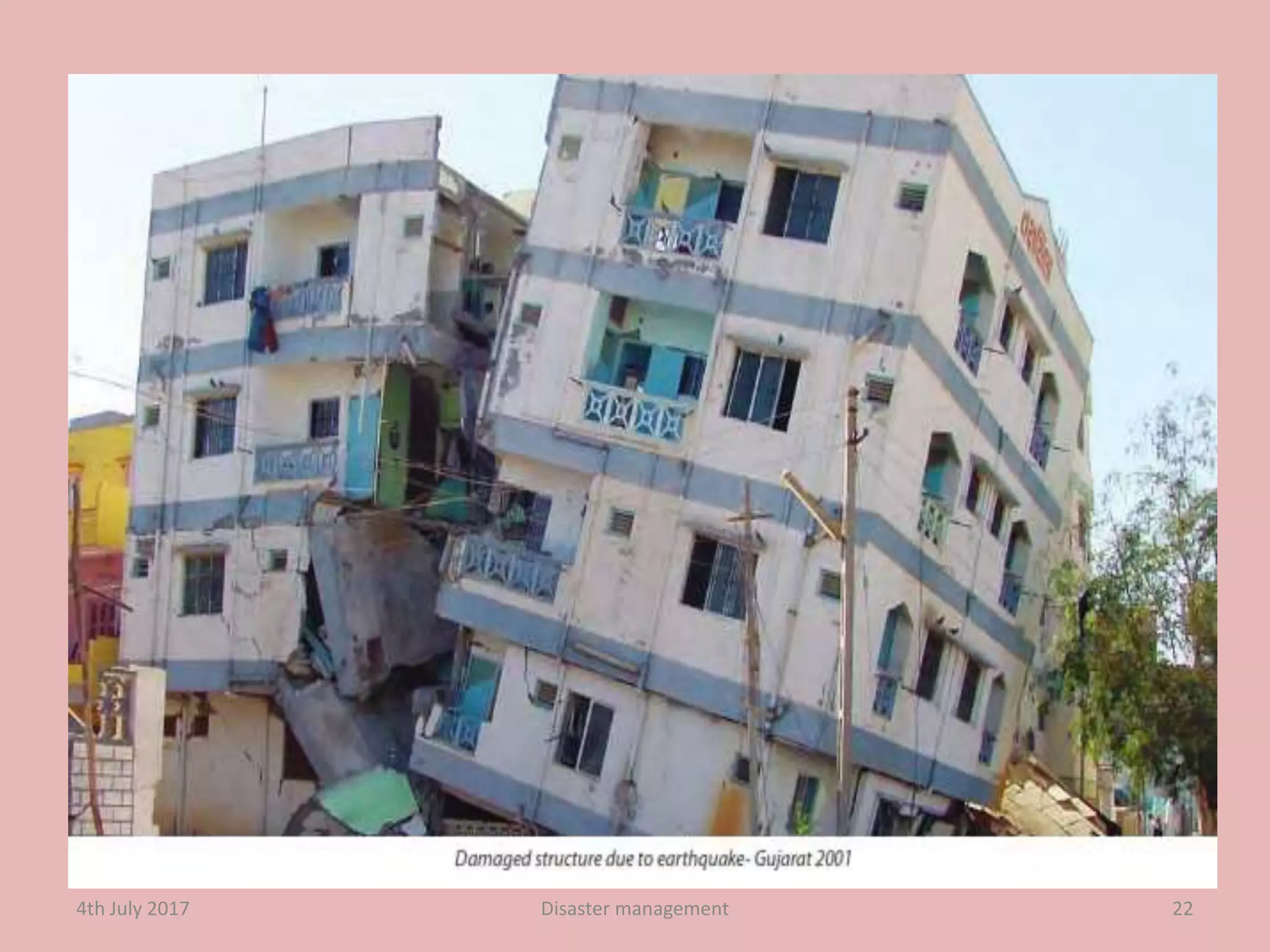
Gujarat e/q, 26.1.2001
Deaths-20,085, Mag. 7.6
104th July 2017 Disaster management
Latur, india e/q 29.3.1993
Deaths – 9748
Mag. 6.2
114th July 2017 Disaster management
NEPAL EARTHQUAKE
12
2015, Magnitude: 7.9, deaths over 5000
4th July 2017 Disaster management
134th July 2017 Disaster management
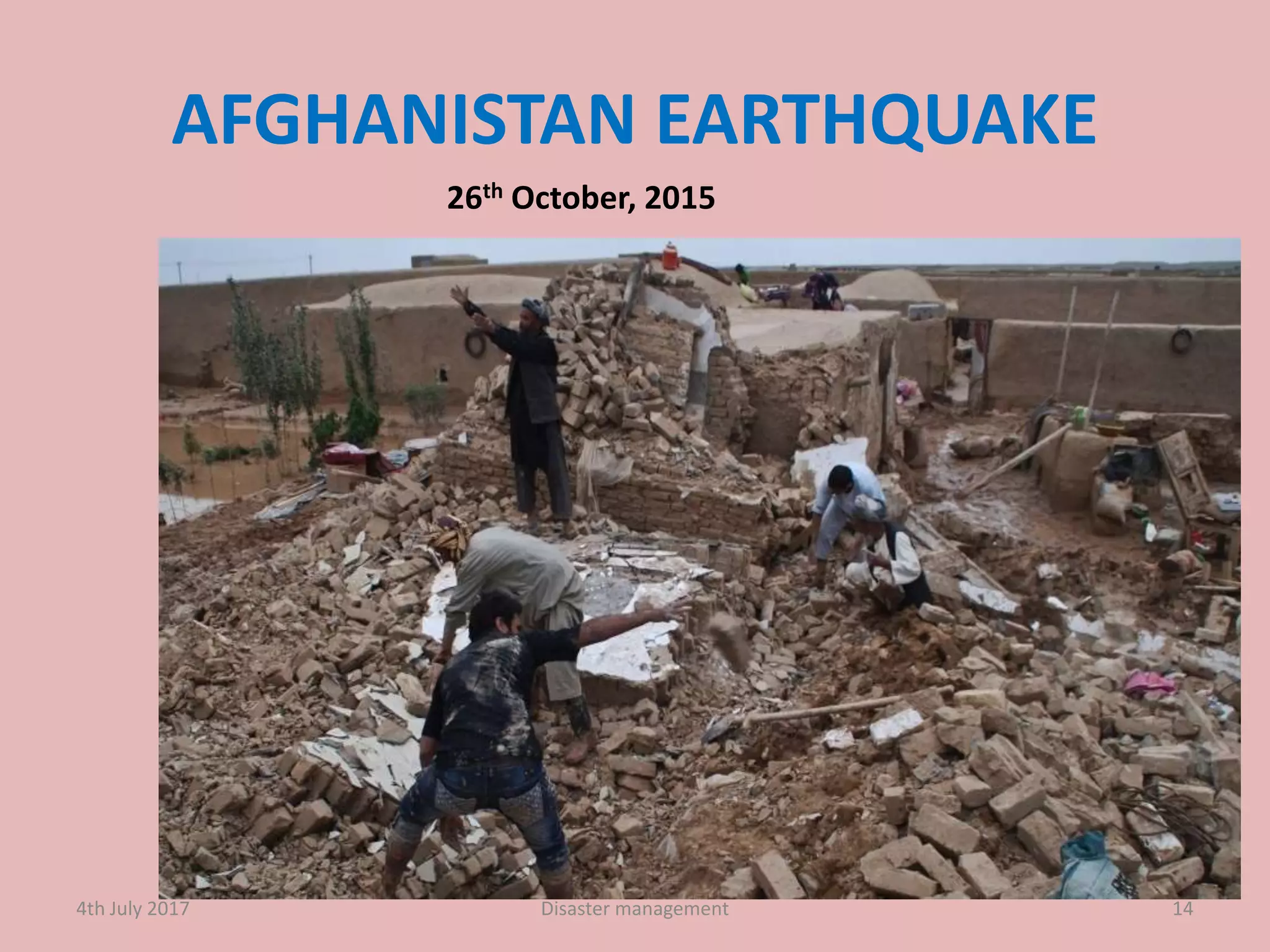
AFGHANISTAN EARTHQUAKE
14
26th October, 2015
4th July 2017 Disaster management
Disasters in India
• Natural disasters
– Earthquakes
– Floods
– Cyclones
– Tsunamis
– Droughts
– Landslides
• Man made disasters
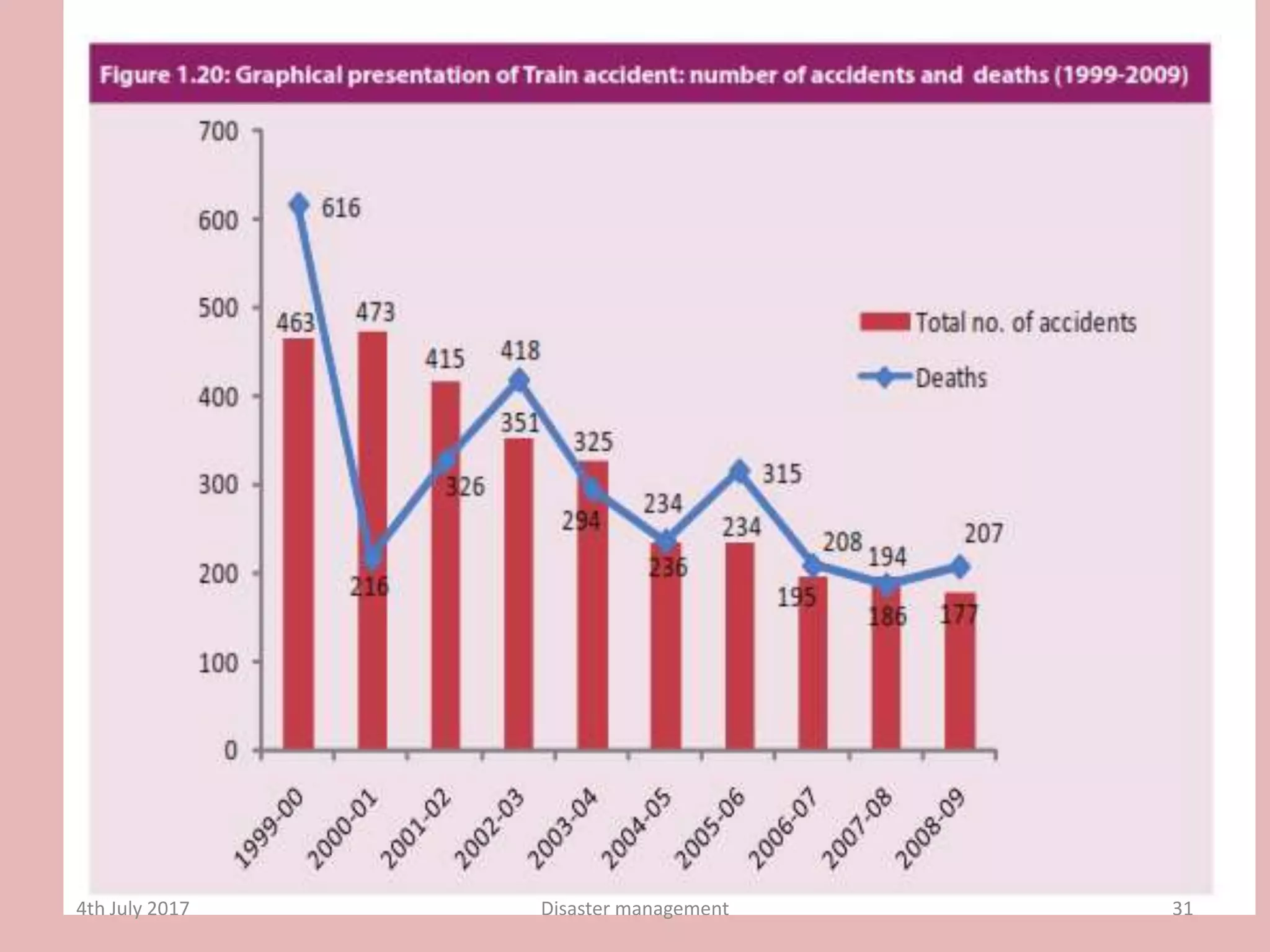
– Road/Rail accidents
– Chemical disasters
4th July 2017 15Disaster management
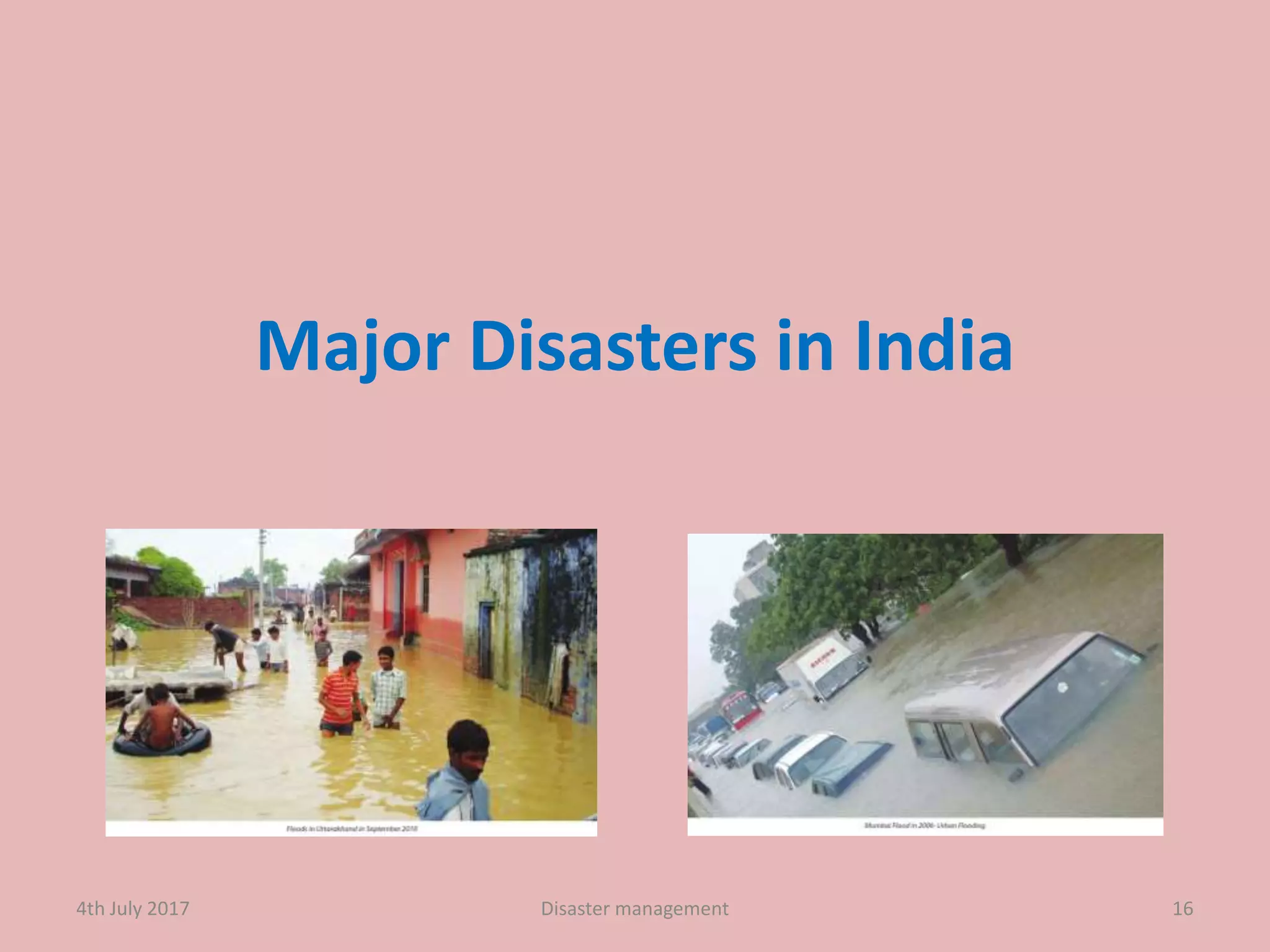
Major Disasters in India
4th July 2017 16Disaster management
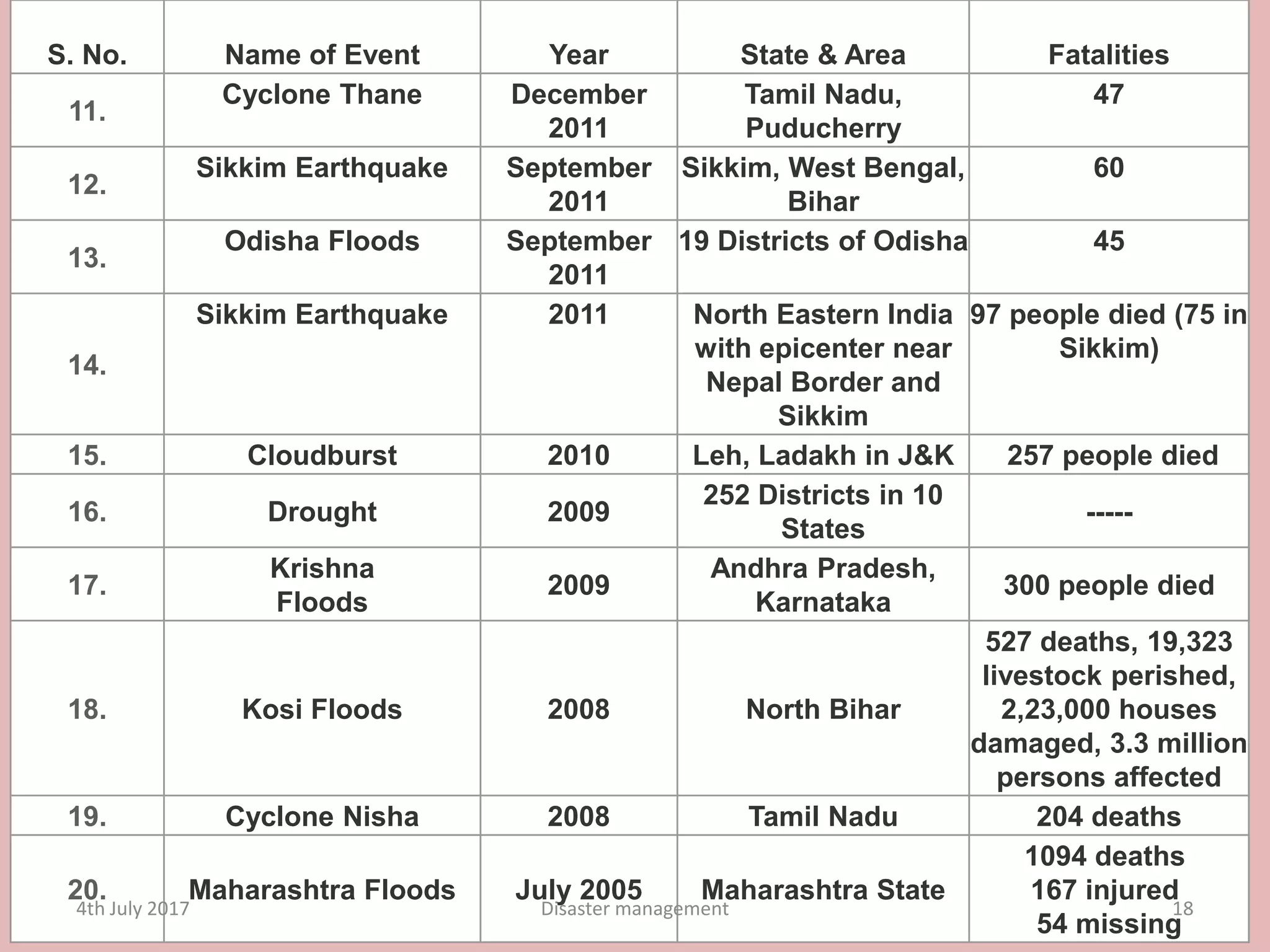
S. No. Name of Event Year State & Area Fatalities
1. Floods October 2014 Jammu & Kashmir
2.
Cyclone Hud
Hud
September
2014
Andhra Pradesh &
Odisha
3. Odisha Floods October 2013 Odisha 21
4. Andhra Floods October 2013 Andhra Pradesh 53
5.
Cyclone Phailin October 2013 Odisha and Andhra
Pradesh
23
6.
Floods/Landslid
es
June 2013 Uttarakhand and
Himachal Pradesh
4,094
7.
Cyclone
Mahasen
May 2013 Tamil Nadu 08
8. Cyclone Nilam October 2012 Tamil Nadu 65
9.
Uttarakhand
Floods
Aug – Sep
2012
Uttarkashi,
Rudraprayag and
Bageshwar
52
10.
Assam Floods July – Aug
2012
Assam ---
4th July 2017 17Disaster management
S. No. Name of Event Year State & Area Fatalities
11.
Cyclone Thane December
2011
Tamil Nadu,
Puducherry
47
12.
Sikkim Earthquake September
2011
Sikkim, West Bengal,
Bihar
60
13.
Odisha Floods September
2011
19 Districts of Odisha 45
14.
Sikkim Earthquake 2011 North Eastern India
with epicenter near
Nepal Border and
Sikkim
97 people died (75 in
Sikkim)
15. Cloudburst 2010 Leh, Ladakh in J&K 257 people died
16. Drought 2009
252 Districts in 10
States
-----
17.
Krishna
Floods
2009
Andhra Pradesh,
Karnataka
300 people died
18. Kosi Floods 2008 North Bihar
527 deaths, 19,323
livestock perished,
2,23,000 houses
damaged, 3.3 million
persons affected
19. Cyclone Nisha 2008 Tamil Nadu 204 deaths
20. Maharashtra Floods July 2005 Maharashtra State
1094 deaths
167 injured
54 missing
4th July 2017 18Disaster management
S. No. Name of Event Year State & Area Fatalities
21. Kashmir 2005
Mostly Pakistan,
Partially Kashmir
1400 deaths in Kashmir (86,000
deaths in total)
22. Tsunami 2004
Coastline of Tamil Nadu,
Kerala, Andhra Pradesh,
Pondicherry and
Andaman and Nicobar
Islands of India
10,749 deaths
5,640 persons missing
2.79 million people affected
11,827 hectares of crops damaged
300,000 fisher folk lost their
livelihood
23.
Gujarat
Earthquake
2001
Rapar, Bhuj, Bhachau,
Anjar, Ahmedabad and
Surat in Gujarat State
13,805 deaths
6.3 million people affected
24.
Orissa Super
Cyclone
1999 Orissa Over 10,000 deaths
25. Cyclone 1996 Andhra Pradesh
1,000 people died, 5,80,000 housed
destroyed, Rs. 20.26 billion
estimated damage
26.
Latur
Earthquake
1993
Latur, Marathwada
region of Maharashtra
7,928 people died
30,000 injured
27. Cyclone 1990 Andhra Pradesh
967 people died, 435,000 acres of
land affected
28. Drought 1987 15 States 300 million people affected
29. Cyclone 1977 Andhra Pradesh
10,000 deaths
hundreds of thousands homeless
40,000 cattle deaths4th July 2017 19Disaster management
4th July 2017 20Disaster management
4th July 2017 21Disaster management
4th July 2017 22Disaster management
4th July 2017 23Disaster management
4th July 2017 24Disaster management
4th July 2017 25Disaster management
4th July 2017 26Disaster management
Cascading Effect
• Earthquake
• Tsunami
• Fire
• Nuclear disaster
• Floods
• And so on...
4th July 2017 27Disaster management
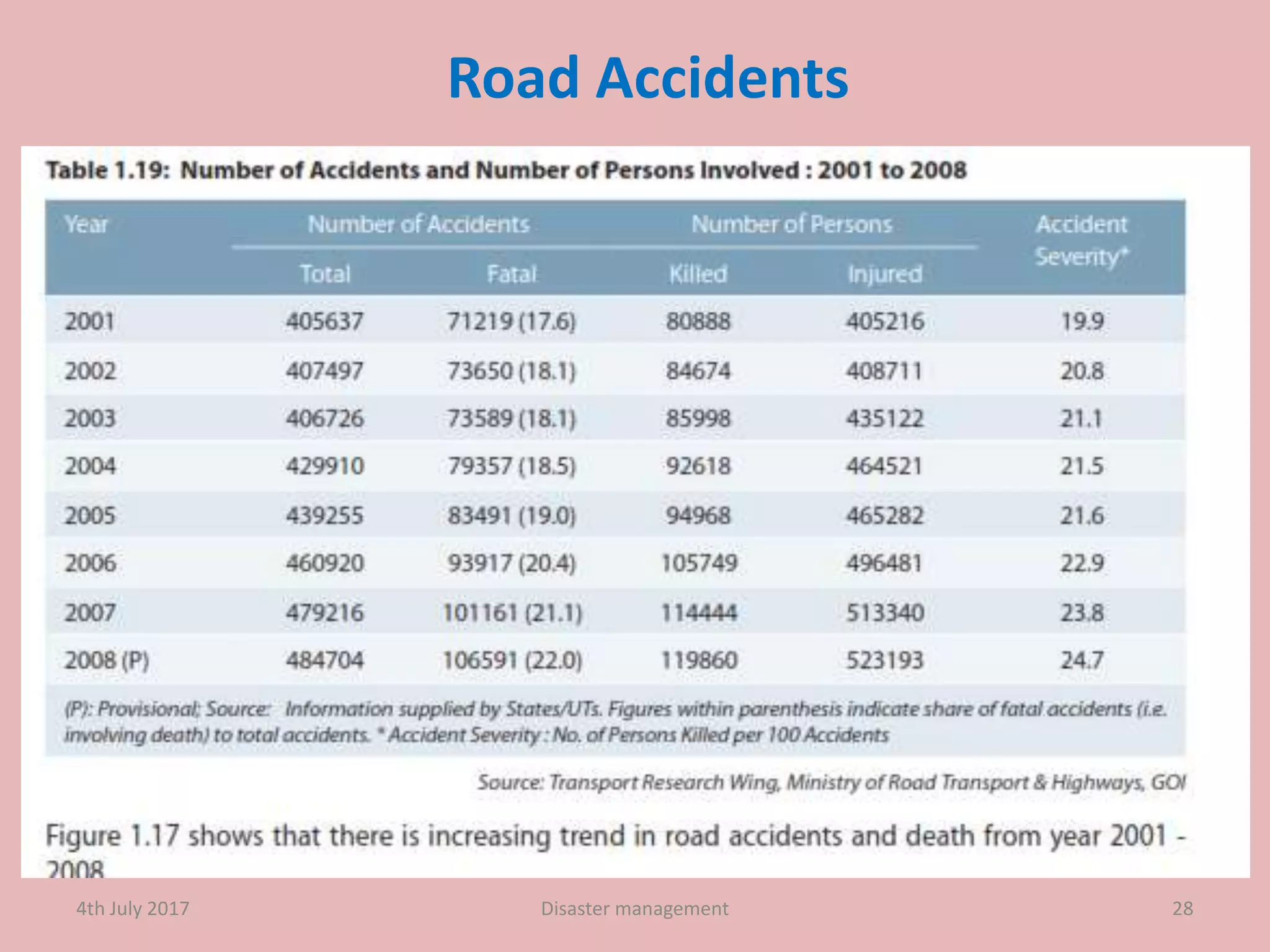
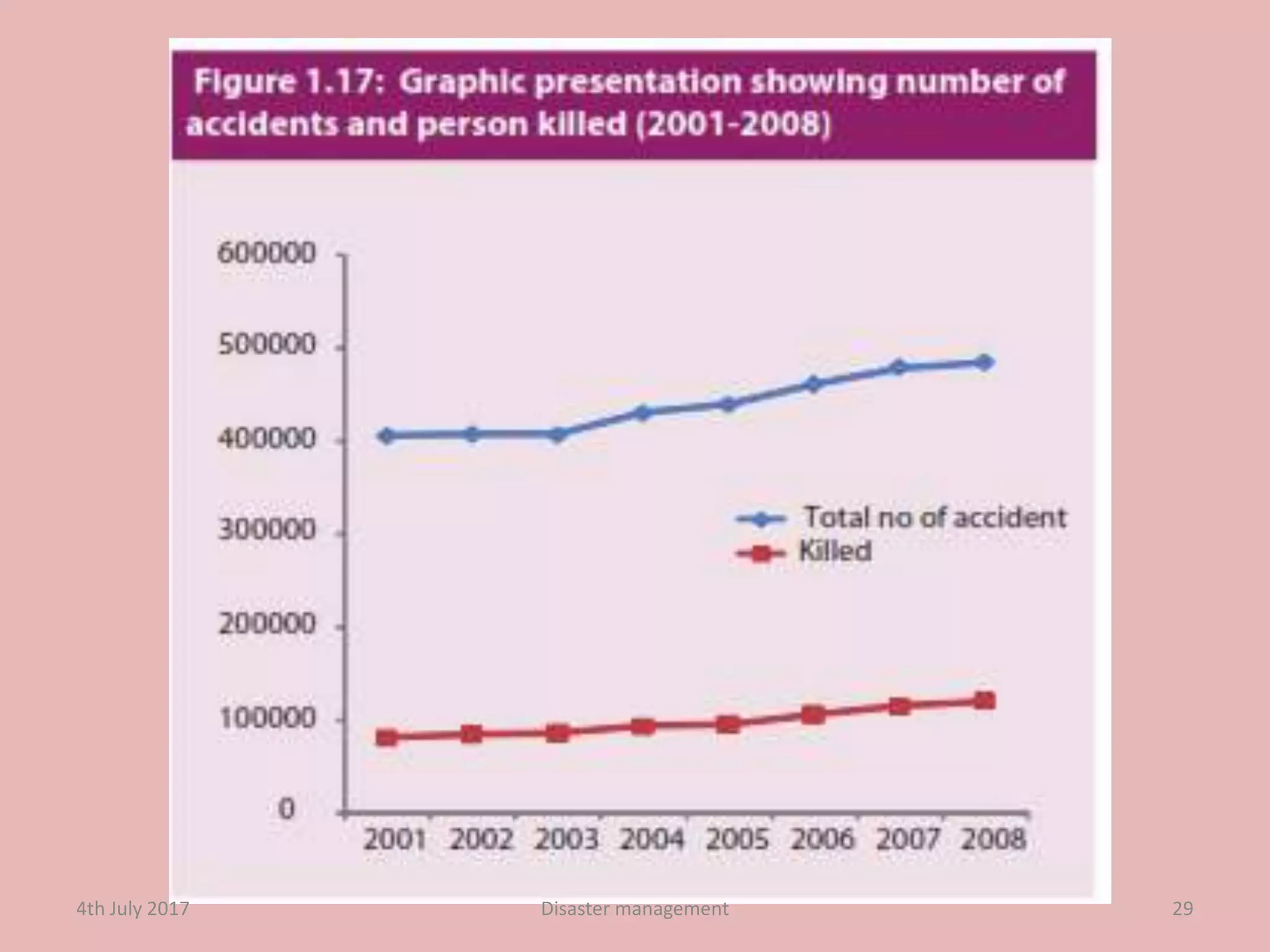
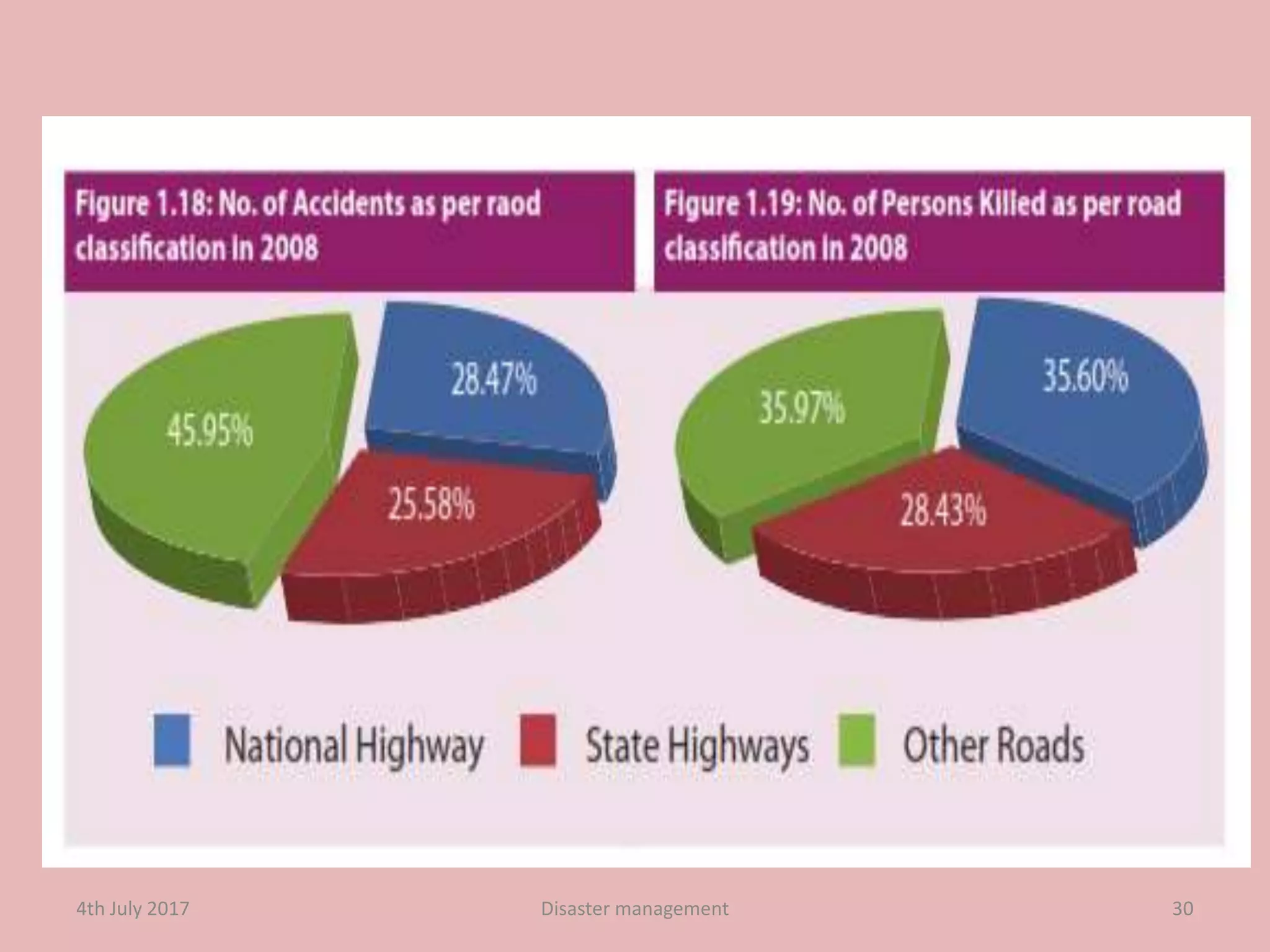
Road Accidents
4th July 2017 28Disaster management
4th July 2017 29Disaster management
4th July 2017 30Disaster management
4th July 2017 31Disaster management
4th July 2017 32Disaster management
4th July 2017 33Disaster management
Vulnerability Profile
4th July 2017 34Disaster management
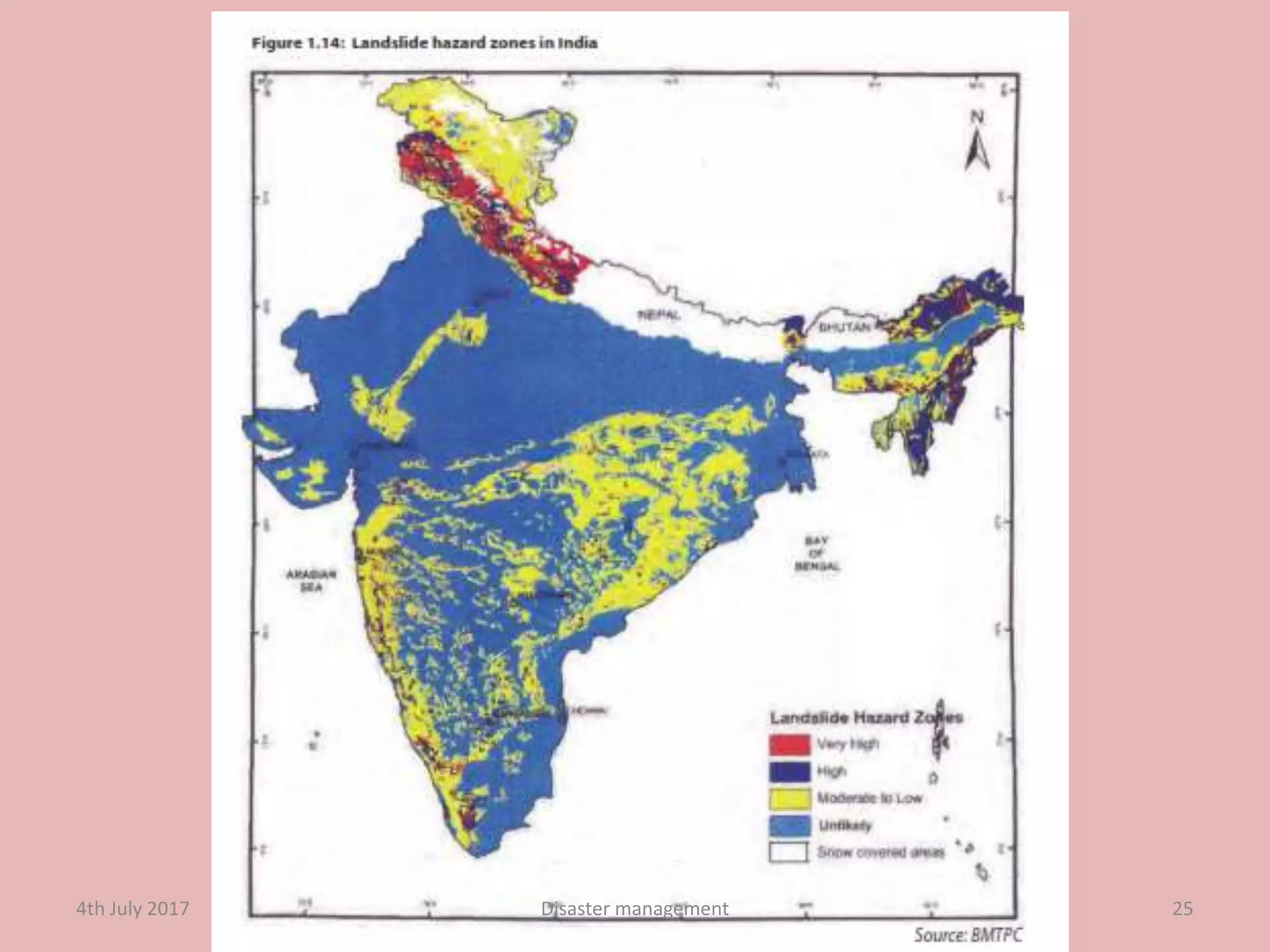
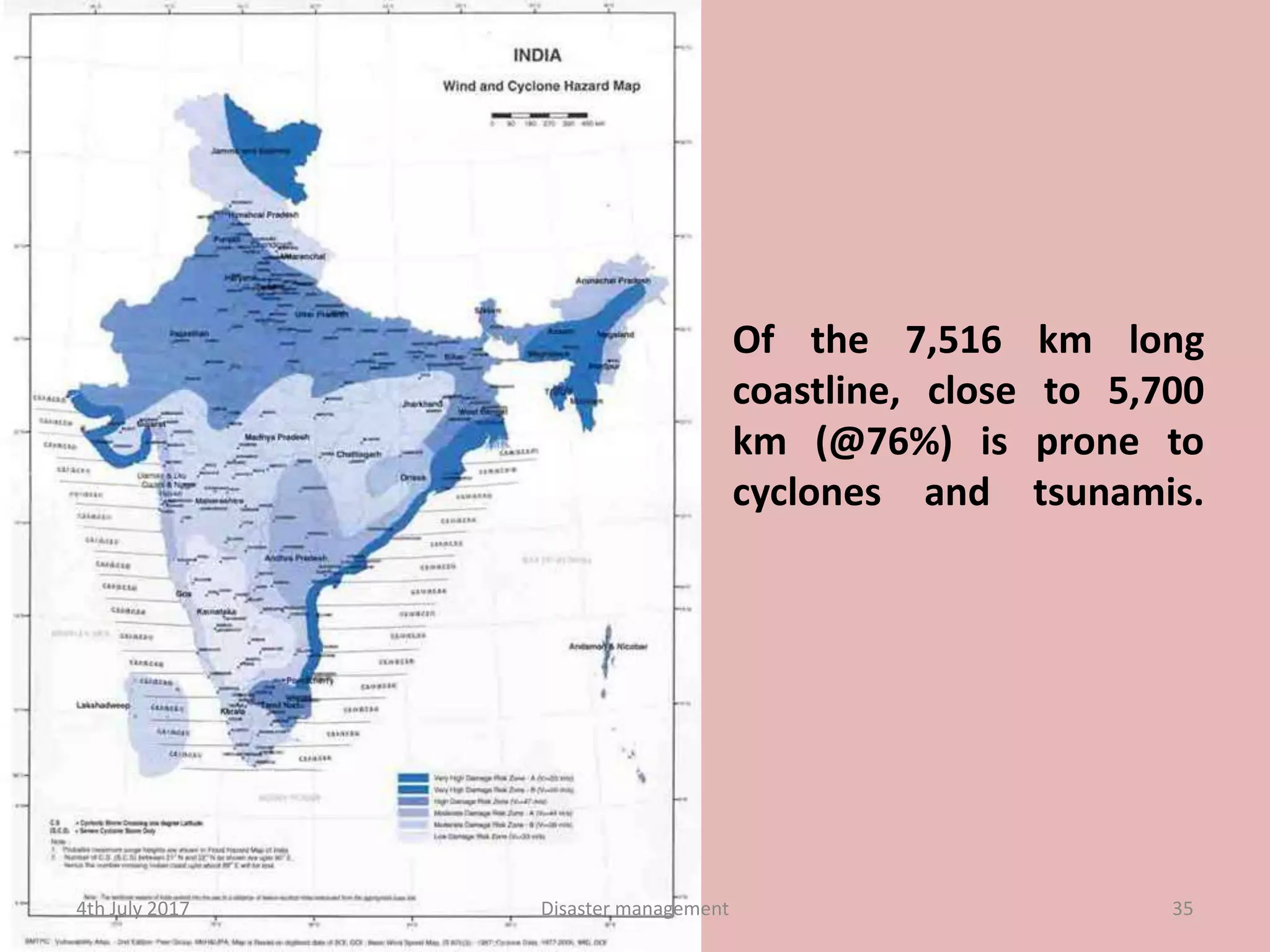
Of the 7,516 km long
coastline, close to 5,700
km (@76%) is prone to
cyclones and tsunamis.
4th July 2017 35Disaster management
58.6 per cent of the
landmass is prone to
earthquakes of moderate
to very high intensity.
4th July 2017 36Disaster management
Over 40 million hectares
(12 % of land) is prone to
floods and river erosion.
4th July 2017 37Disaster management
Disaster Management Act
On 23 December 2005, the Government of
India enacted the Disaster Management Act,
which envisaged the creation of National
Disaster Management Authority (NDMA),
headed by the Prime Minister, and State
Disaster Management Authorities (SDMAs)
headed by respective Chief Ministers, to
spearhead and implement a holistic and
integrated approach to Disaster Management
in India.
4th July 2017 38Disaster management
4th July 2017 39Disaster management
Functions & Responsibilities
• Lay down policies on disaster management ;
• Approve the National Plan;
• Approve plans prepared by the Ministries or Departments of the Government of
India in accordance with the National Plan;
• Lay down guidelines to be followed by the State Authorities in drawing up the
State Plan;
• Lay down guidelines to be followed by the different Ministries or Departments of
the Government of India for the Purpose of integrating the measures for
prevention of disaster or the mitigation of its effects in their development plans
and projects;
• Coordinate the enforcement and implementation of the policy and plans for
disaster management;
• Recommend provision of funds for the purpose of mitigation;
• Provide such support to other countries affected by major disasters as may be
determined by the Central Government;
• Take such other measures for the prevention of disaster, or the mitigation, or
preparedness and capacity building for dealing with threatening disaster
situations or disasters as it may consider necessary;
• Lay down broad policies and guidelines for the functioning of the National
Institute of Disaster Management.
4th July 2017 40Disaster management
Themes of the policy
• Community-based disaster management,
including last mile integration of the policy,
plans and execution.
• Capacity development in all related areas.
• Consolidation of past initiatives and best
practices.
• Cooperation with agencies at the national,
regional and international levels.
• Compliance and coordination to generate a
multi-sectoral synergy.
4th July 2017 41Disaster management
Disaster Management Cycle
4th July 2017 42Disaster management
4th July 2017 43Disaster management
4th July 2017 44Disaster management
Prevention and Mitigation
&
Capacity Building
4th July 2017 45Disaster management
Disaster Management
4th July 2017 46Disaster management
Disaster Management
4th July 2017 47Disaster management
Prepare
4th July 2017 48Disaster management
Capacity Building
to deal with new works to deal with
disasters, retrofitting and
repair/rehabilitation
4th July 2017 49Disaster management
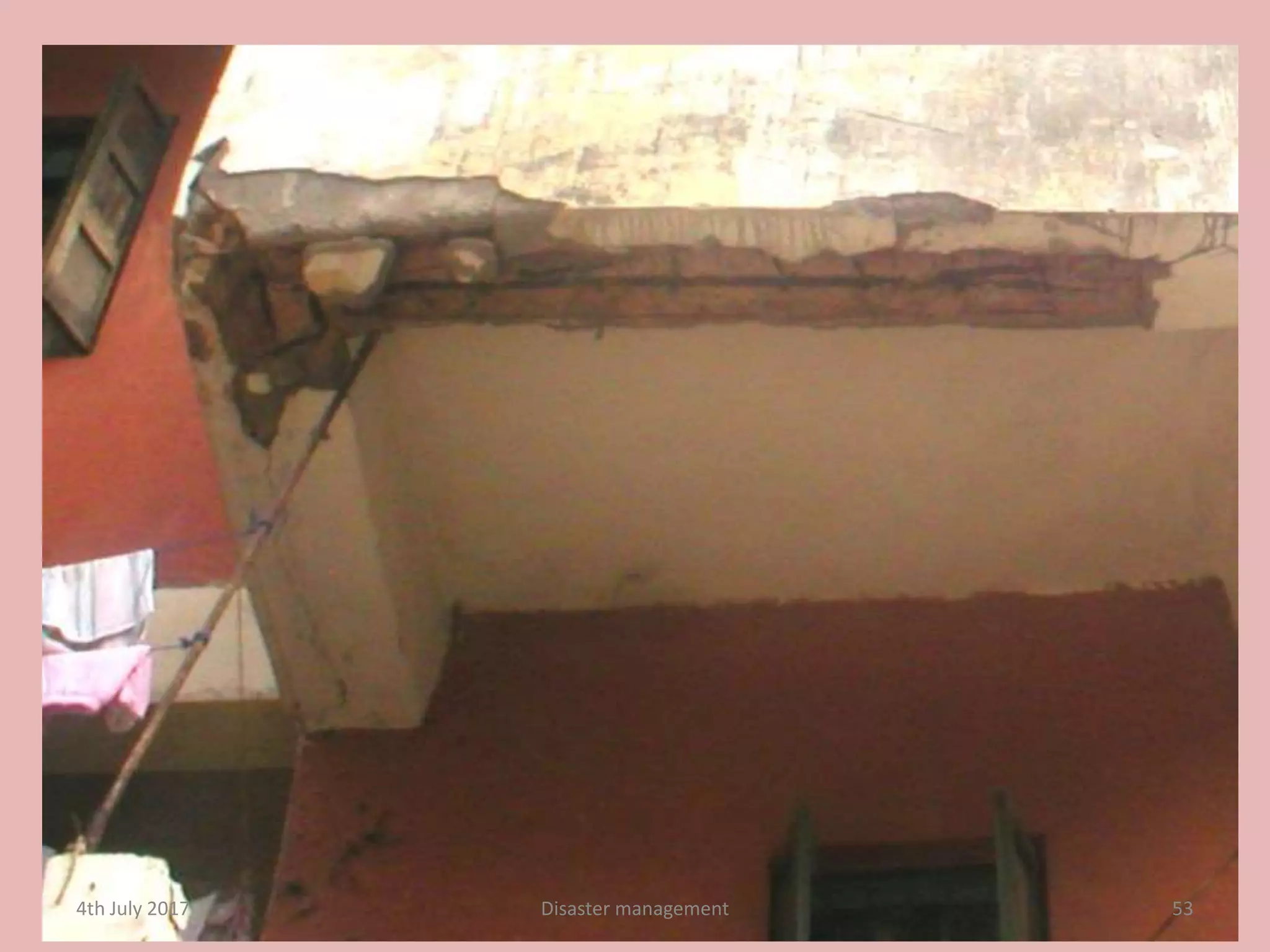
Damage/poor maintenance enhances
risk of damage/collapse of structures
during disasters
4th July 2017 50Disaster management
4th July 2017 51Disaster management
4th July 2017 52Disaster management
4th July 2017 53Disaster management
4th July 2017 54Disaster management
4th July 2017 55Disaster management
564th July 2017 Disaster management
574th July 2017 Disaster management
584th July 2017 Disaster management
594th July 2017 Disaster management
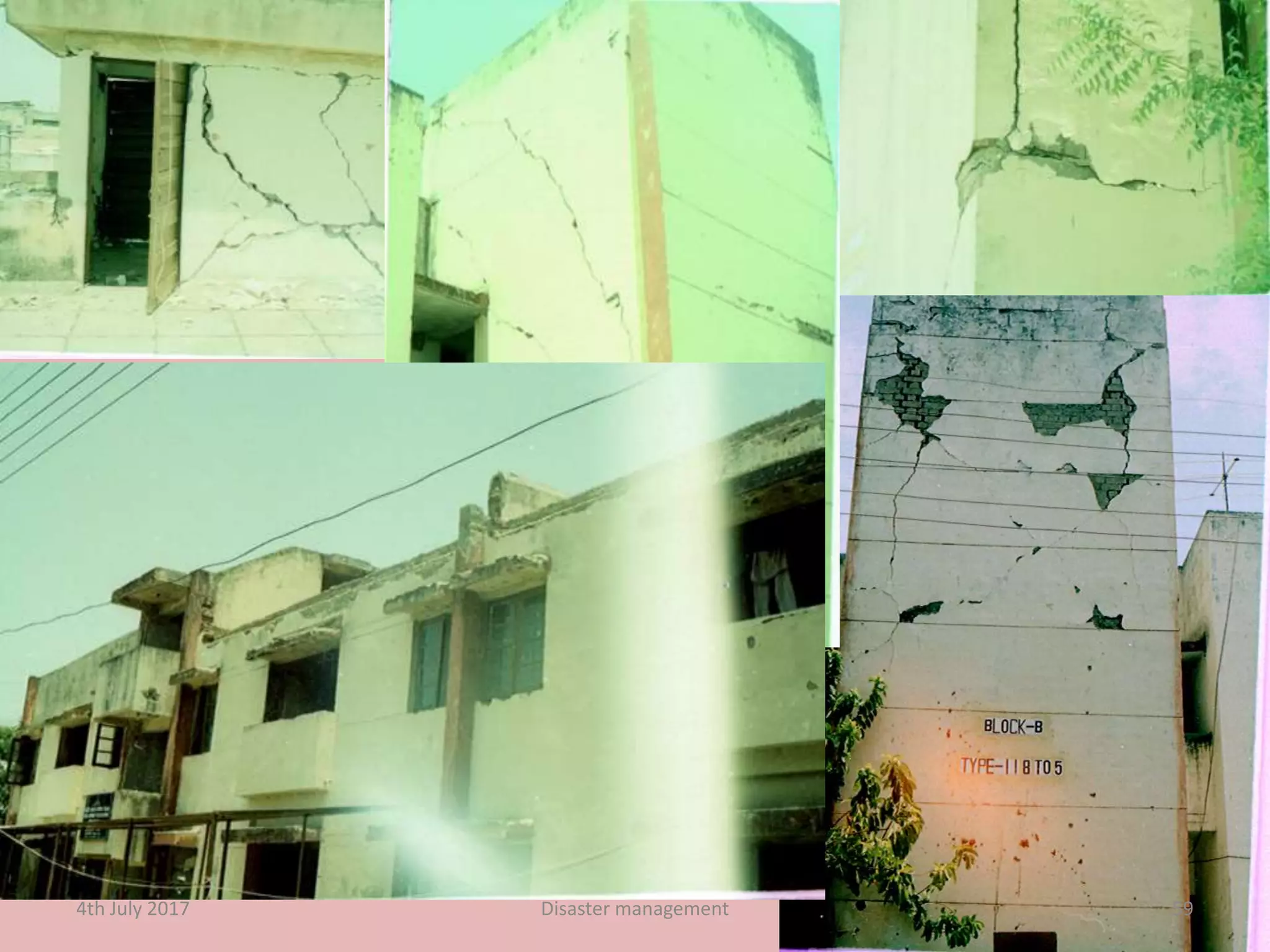
Types of Damages
• Damages could include both Structural and Non-Structural
• Non structural damage could include:
• Plaster,
• Panel/filler walls, parapets
• Doors, windows, window glass panes etc
• Dislocation of civil services like water supply, gas, drainage pipes and
electrical conduits/wiring
• Disturbed Roofing Tiles
• Flooring at ground level, etc
• Structural damage could cover
• Foundation system
• Load bearing walls
• RCC beams/columns
• Roofing
• Lintels over door/windows, etc
604th July 2017 Disaster management
Sequence of Operation
• Removal of Hazardous Components
• Propping & Supporting, wherever required
• Condition Survey to Determine Rehabilitation
• Evaluate Damage to each Structural
Component
• Restoration and strengthening
– Appropriate Structural Repair Method
– Non structural repairs covering civil &
electrical items
• Finish the Repaired Structure
4th July 2017 61Disaster management
Structural Damage Assessment
• Important to conduct ‘Condition Survey’
– Determining rehabilitability i/c part demolition
– Whether building to be got vacated for repairs?
– Detailed damage assessment and determining residual
strength.
– Details of temporary support arrangement to avoid further
distress under normal loads
4th July 2017 62Disaster management
Repairs, Rehabilitation and Retrofitting
• In New Building, the extra Cost of Seismic
Resistant features is nominal (i.e. 2% to 5% of
structure’s cost)
• In Existing Building, the seismic retrofitting is
costlier (i.e. 5 to 15% of structure’s cost)
• Structural Repairs of Corrosion distressed
structures are also costlier
• Replacement of structure is still more costly
• A Balanced View is required to be taken before
deciding upon the various options
4th July 2017 63Disaster management
Repair & retrofitting Vs
Reconstruction
• As a thumb rule, repair/ strengthening is
resorted, if its overall cost is less than 30%
of the cost of reconstruction
• Replacement/reconstruction is, generally
avoided due to
– Preservation of Historical Architecture
– Maintaining functional social and cultural
environment
4th July 2017 64Disaster management
Classification of Repair Materials
• Based on its Application
– Surface Preparation
– Rust Removers / Converters
– Passivators for Reinforcement Protection
– Bonding Agents
– Structural Repair Materials
– Injection Grouts
– Joint Sealants
– Protective Surface Coatings
4th July 2017 66Disaster management
Cement Concrete/Mortar as
Repair Material
• Cement Concretes/Mortars are the natural
Repair Materials for RCC structures but not
favoured due to inherent undesirable
properties like:
– Drying shrinkage
– Slow Setting
– Low Workability
– Prolonged Curing requirements
– Permeability
4th July 2017 68Disaster management
Repair Sequence for Corrosion Damaged &
Spalled cover Concrete
1. Surface Preparation
• Loose and carbonated concrete removal all-
around reinforcement
2. Fix Shear Connectors, if required
3. Apply bonding layer over Substrate concrete
4. Apply Passivating Coat over Steel
Reinforcement
5. Apply repair – Cement based repairs or
– Resin based repairs, or
– Sprayed concrete (shotcrete)
4th July 2017 Disaster management
Jacketing of
RCC Column
4th July 2017 72Disaster management
4th July 2017 73Disaster management
REHABILITATION AND SEISMIC
RETROFITTING
4th July 2017 74Disaster management
EARTHQUAKES
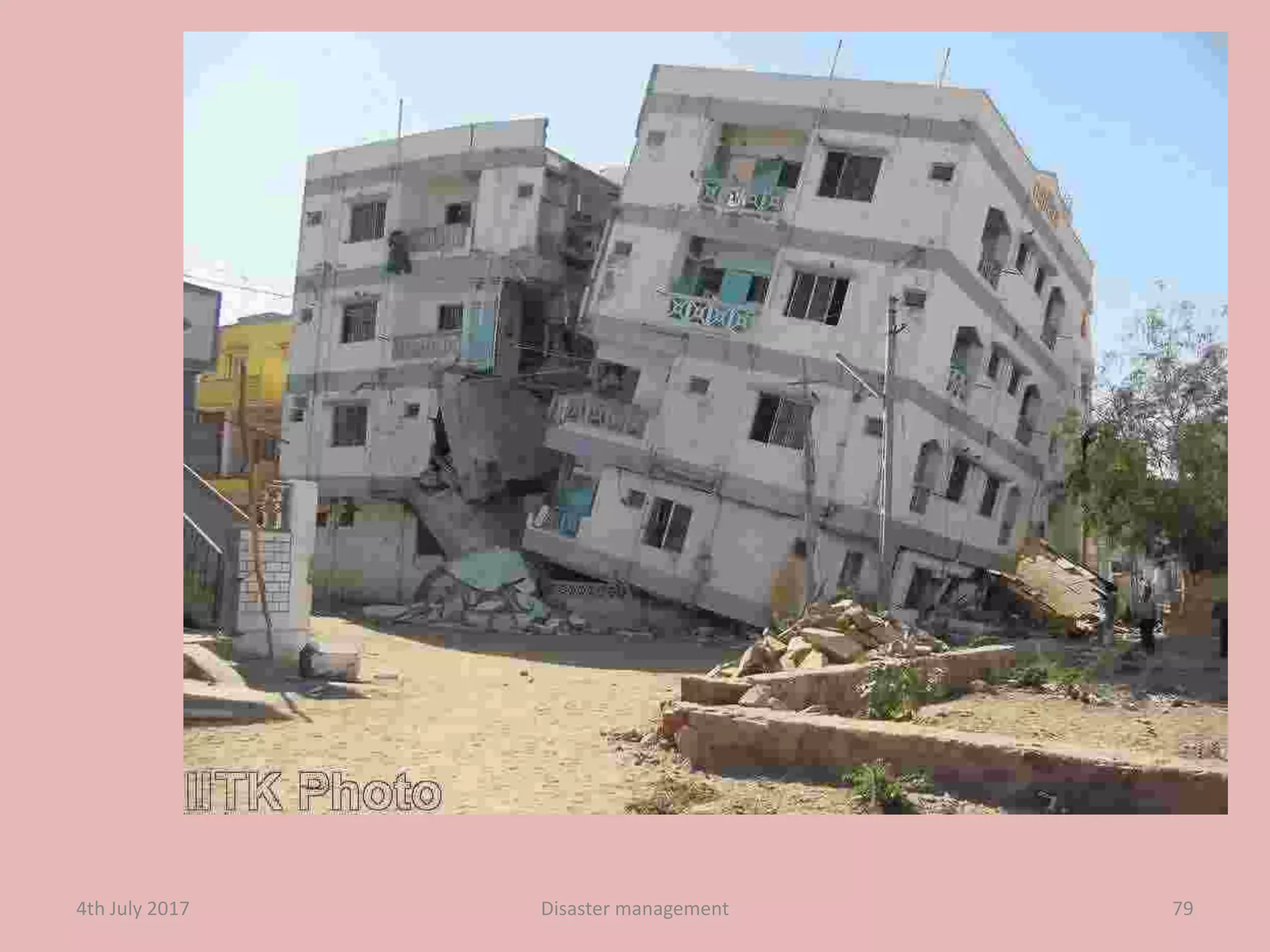
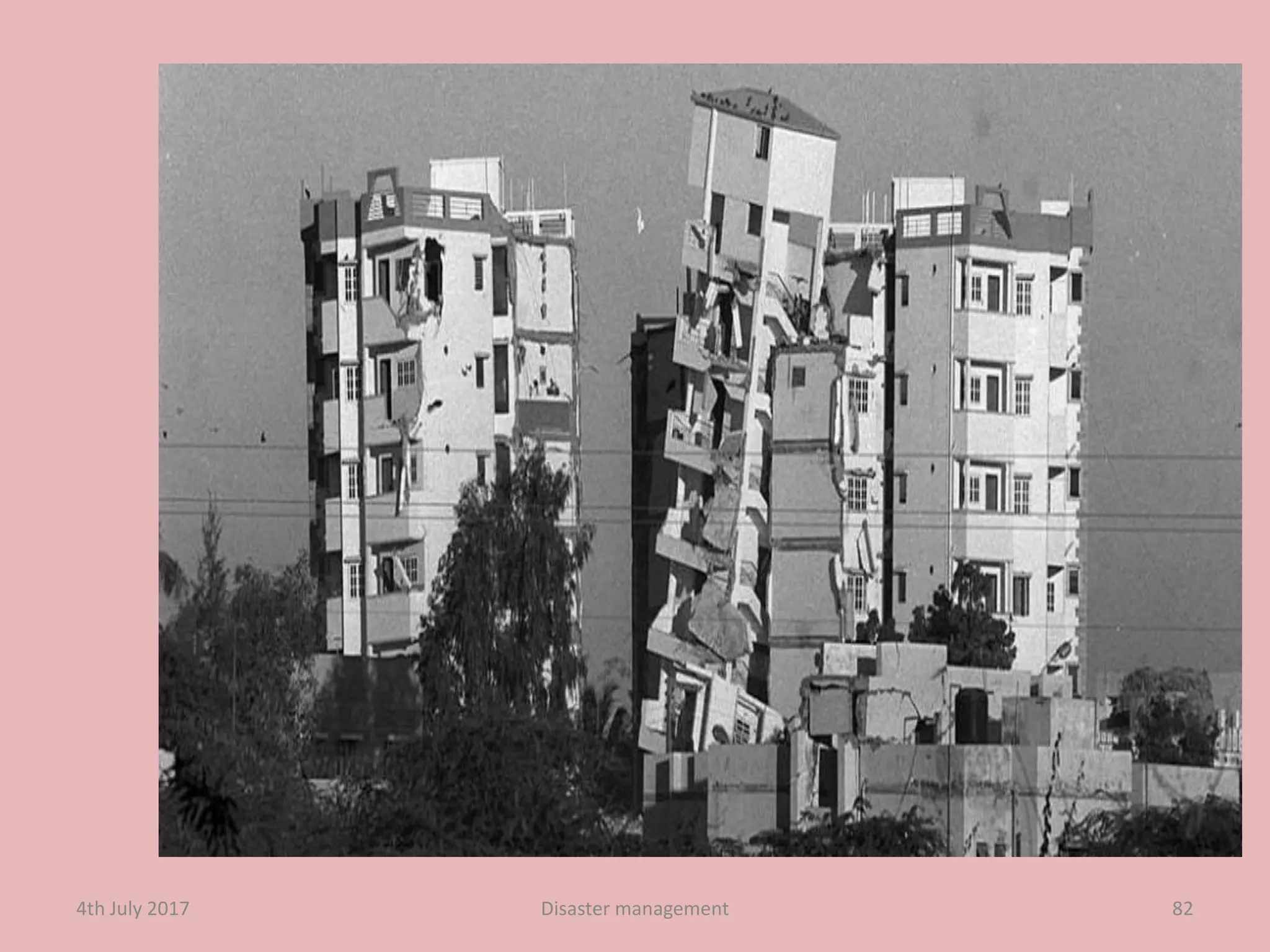
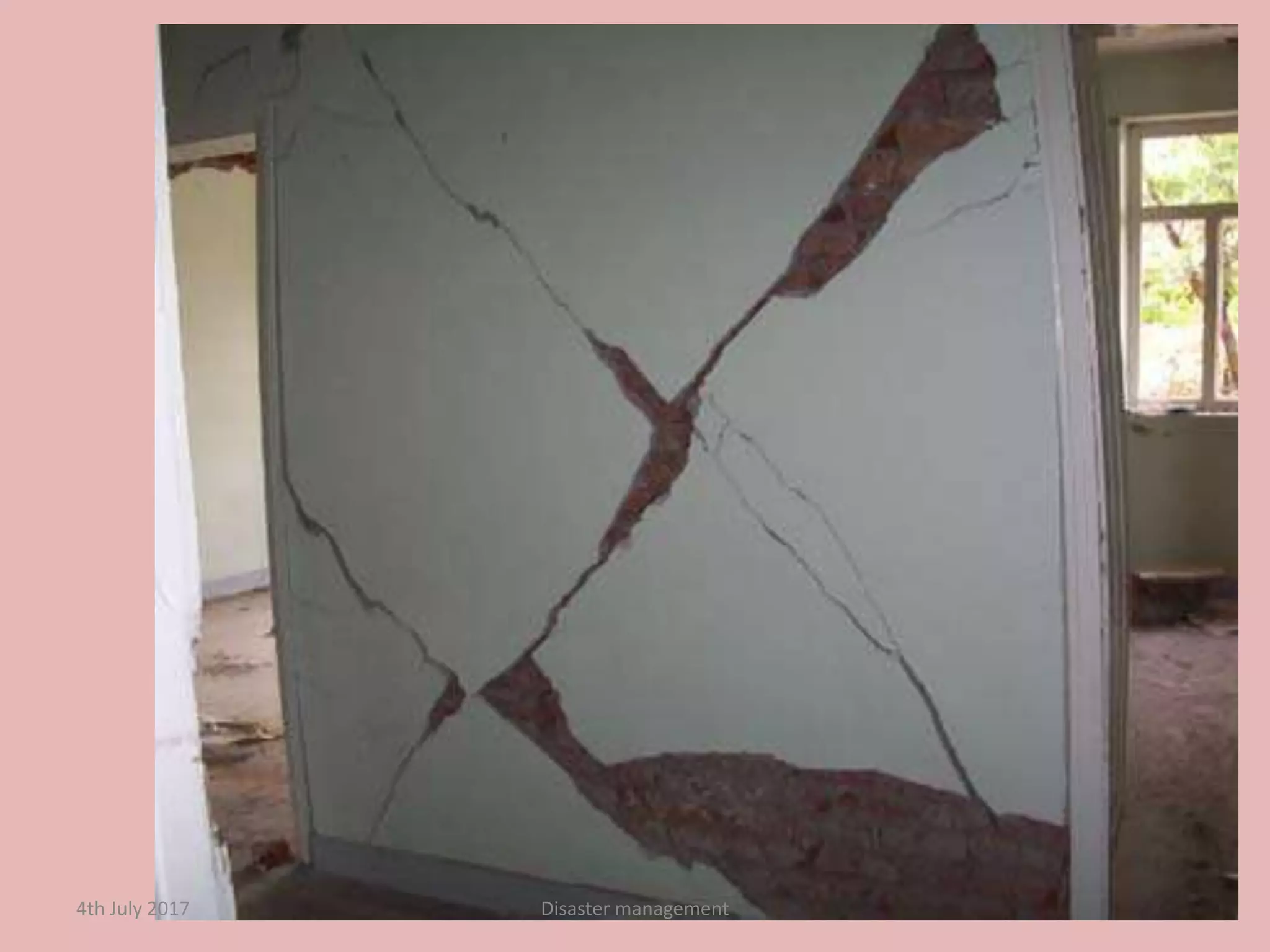
• EARTHQUAKES DO NOT KILL BUT IT IS THE BUILDINGS
WHICH KILL
• NEARLY 5,00,000 EARTHQUAKES OCCUR EVERY YEAR
• ABOUT 1,00,000 ARE FELT
• Minor earthquakes occur nearly constantly around
the world in places like California and Alaska in the
U.S., as well as in Mexico, Guatemala, Chile, Peru,
Indonesia, Iran, China, Pakistan, Portugal, Turkey,
New Zealand, Greece, Italy, India and Japan, but
earthquakes can occur almost anywhere.
754th July 2017 Disaster management
CASUALTIES
• LARGE NUMBER OF CASUALTIES OCCUR IN
DEVEOPING COUNTRIES. REASONS MAY BE;
– INADEQUATE DESIGN
– POOR CONSTRUCTION AND MAINTENANCE
– LACK OF RESOURCES
– INADEQUATE KNOWLEDGE
– INADEQUATE AWARENESS
– INADEQUATE TRAINING
– INADEQUATE SAFETY IMPLEMENTATION
764th July 2017 Disaster management
77
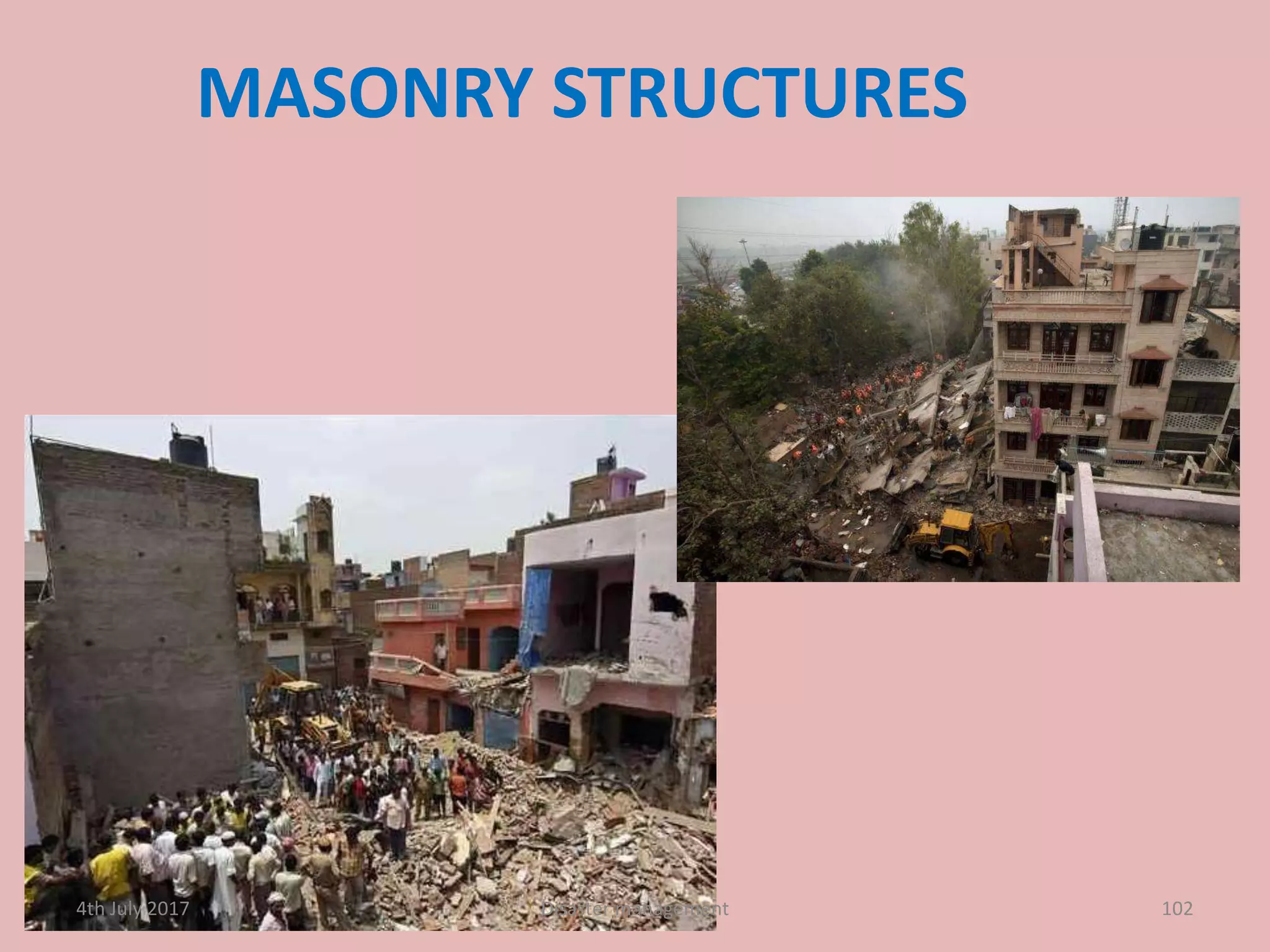
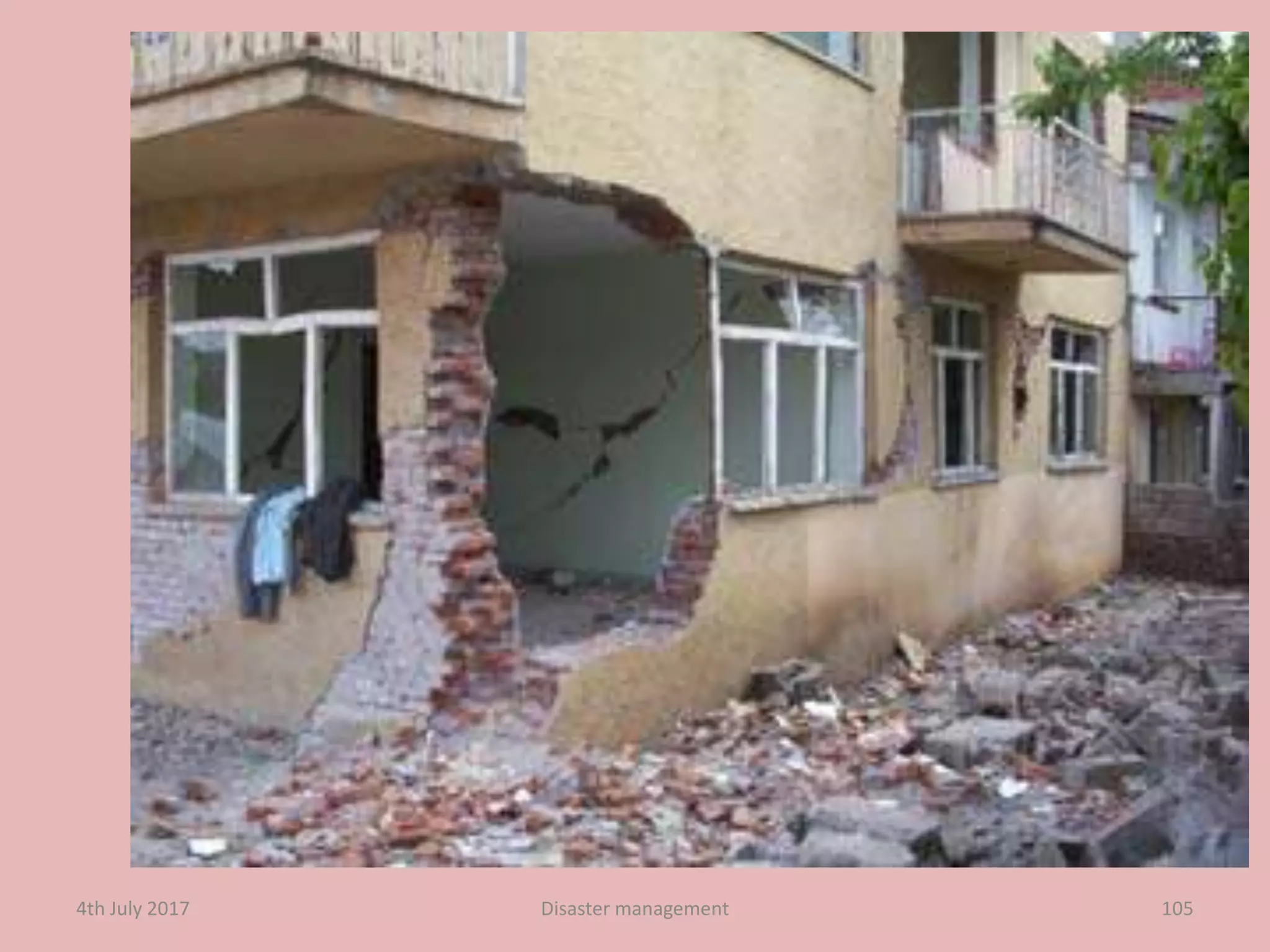
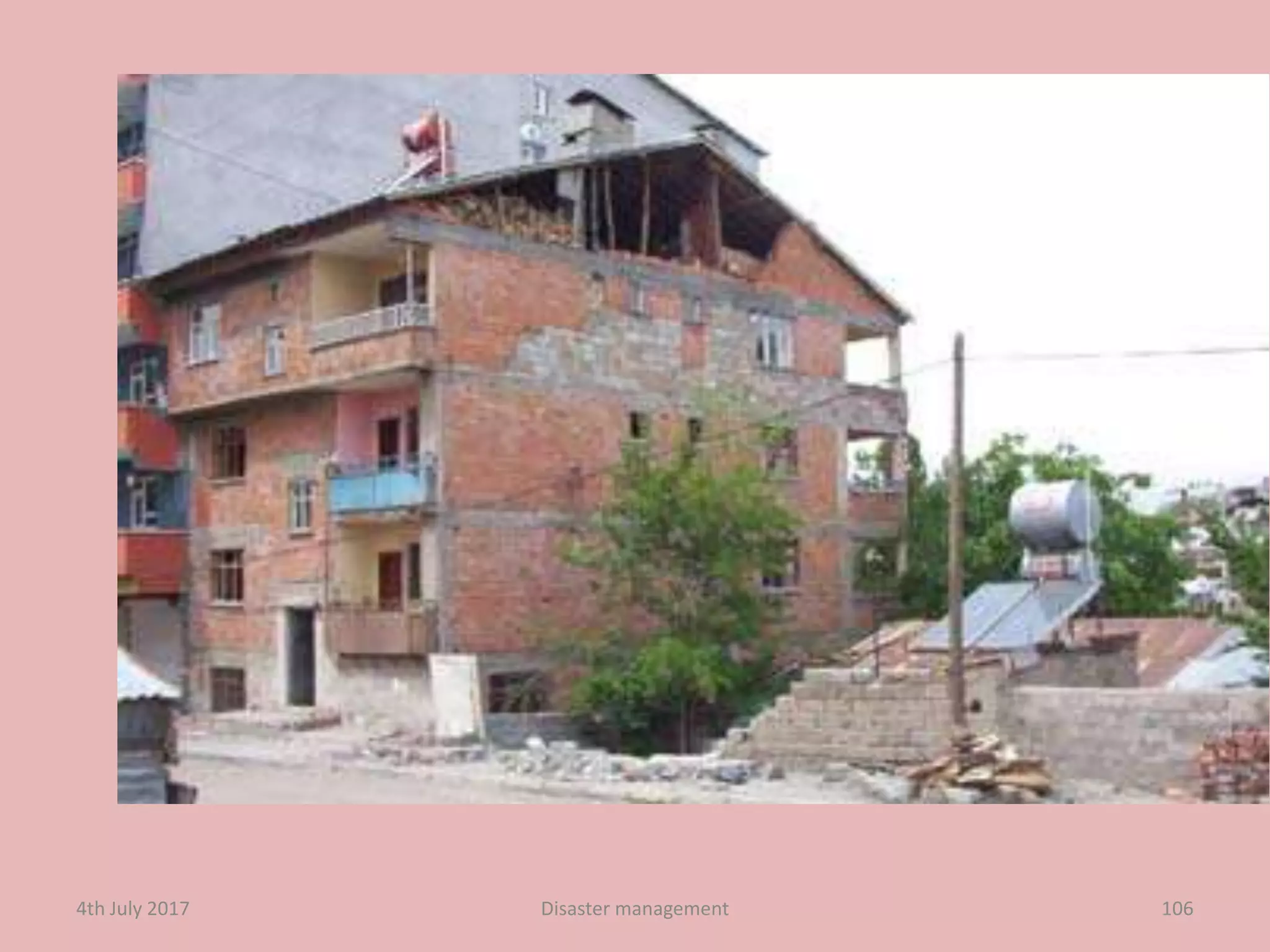
CAUSES OF FAILURE OF MASONRY
BUILDINGS
 POOR QUALITY OF MORTAR
 IRREGULARITY IN PLANE AND VERTICAL
DIRECTION
 NO PROVISION OF BANDS
 NO THOROUGH STONES
 HEAVY MASS CONCENTRATION AT ROOF LEVEL
 UNSYMMETRICAL BUILDINGS AND FULL
OPENINGS
 UNCONFINED WALL CORNERS
 INADEQUATELY DESIGNED CANTILEVER
ELEMENTS
77
4th July 2017 Disaster management
CAUSES OF FAILURE OF RCC
BUILDINGS
• SOFT STOREY (ONE IN WHICH LATERAL STIFFNESS IS LESS
THAN 70% OF THAT IN THE STOREY IMMEDIATELY ABOVE
OR LESS THAN 80% OF THE COMBINED STIFFNESS OF
THREE STOREYS ABOVE)
• POOR DETAILING OF BEAM COLUMN JUNCTIONS
• PROVISION OF FLOATING COLUMNS
• PLAN AND MASS IRREGULARITY
• INADEQUATE FOUNDATION
• POUNDING OF BUILDINGS
• INADEQUATE DESIGN AND DETAILING
• INADEQUATE CONNECTVITY LIKE ISOLATED STAIRCASES
AND WATER TANKS NOT PROPERLY ANCHORED
784th July 2017 Disaster management
794th July 2017 Disaster management
804th July 2017 Disaster management
814th July 2017 Disaster management
824th July 2017 Disaster management
834th July 2017 Disaster management
844th July 2017 Disaster management
854th July 2017 Disaster management
864th July 2017 Disaster management
87
NORMALLY STRUCTURES REQUIRING
REPAIR AND REHABILITATION ARE
MORE SUSCEPTIBLE TO DAMAGE,
HENCE REPAIR AND REHABILITATION
IS VERY IMPORTANT
87
4th July 2017 Disaster management
CAUSES OF DETERIORATION OF
RCC
• PENETRATION OF WATER/CHEMICALS
LEADING TO CARBONATION, CHLORIDE
INGRESS, LEACHING, SULPHATE ATTACK,
ALKALI SILICA REACTION ETC LEADING TO
CORROSION IN THE REINFORCEMENT
884th July 2017 Disaster management
MAIN REASON OF PENETRATION OF
WATER
• POROSITY OF CONCRETE
894th July 2017 Disaster management
PRECAUTIONS TAKEN TO PREVENT
POROSITY
• ADEQUATE STRENGTH OF CONCRETE
• PROPER COMPACTION
• WATER PROOFING ON ROOF
• PLASTER ON CONCRETE
• WATER PROOFING PAINTS ON EXPOSED
PLASTERED SURFACE
904th July 2017 Disaster management
CAUSES OF DETERIORATION OF
CONCRETE
• AGING OF STRUCTURE
• POOR QUALITY
– POOR QUALITY OF TESTING/INVESTIGATION
– POOR QUALITY OF DESIGN
– POOR QUALITY OF EXECUTION IN TERMS OF
MATERIALS/COMPACTION/PAINTS/COVER/RCC
– POOR QUALITY OF MAINTENANCE
914th July 2017 Disaster management
SELECTION OF MATERIALS FOR
REHABILITATION/ RETROFITTING
• TECHNICAL REQUIREMENTS
• COST
• AVAILABILITY
• EXPERT’S ADVICE
• IMPORTANCE OF THE STRUCTURE
• BALANCE LIFE OF THE STRUCTURE
• TOXICITY OF THE MATERIAL
• AESTHETIC CONSIDERATION
924th July 2017 Disaster management
REHABILITATION METHODS
• SAND BLASTING FOR REMOVAL OF CORROSION AND
APPLYING A COAT TO RETARD CORROSION
• BINDING/ADDING OF ADDITIONAL
REINFORCEMENT/CONCRETE
• WELDING
• ANCHORING TO THE EXISTING MEMBERS THROUGH
SHEAR KEYS OR ANCHORS
• SHOTCRETING
• PLATE BONDING
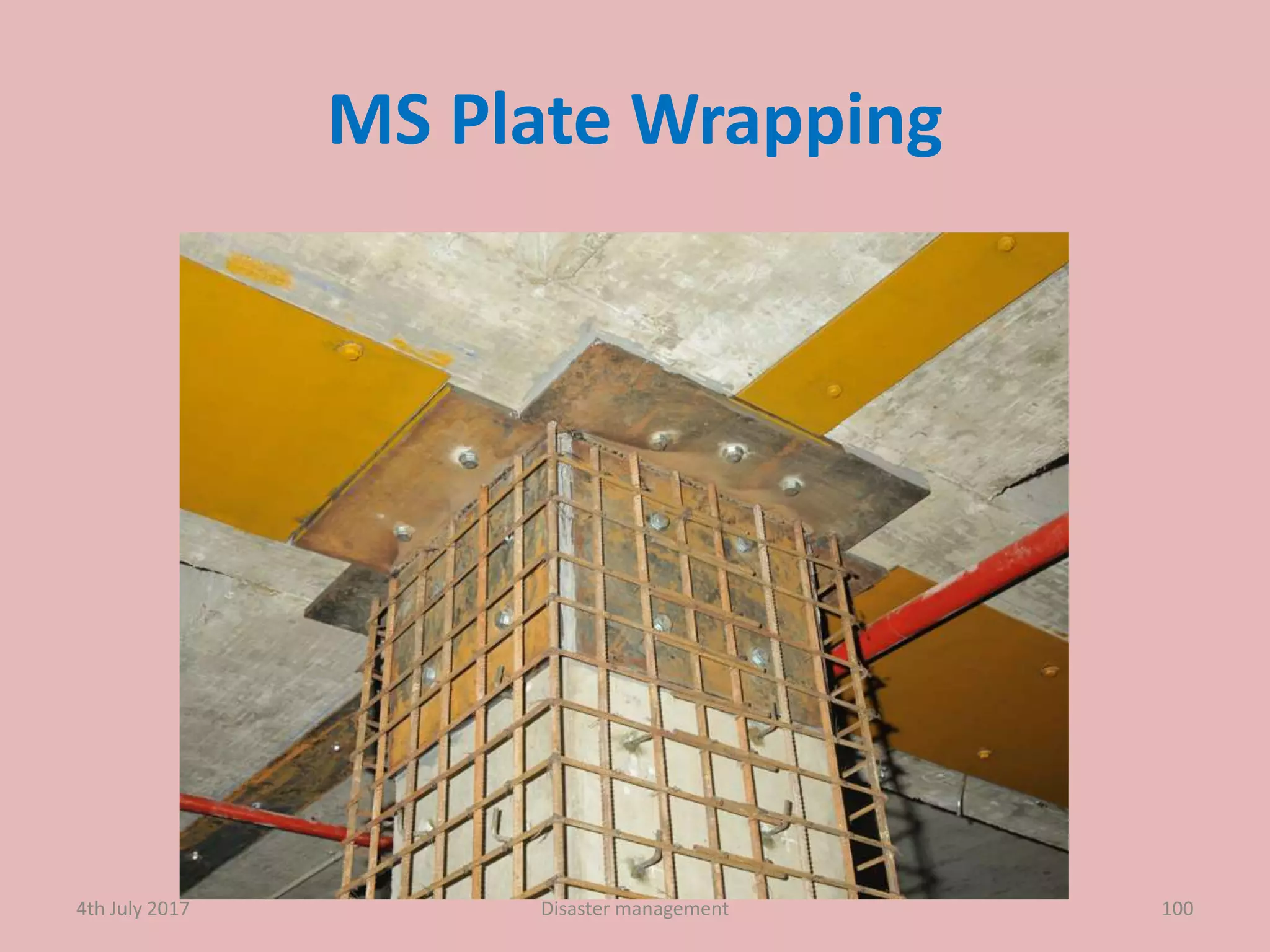
• JACKETING
• FIBRE WRAPPING
934th July 2017 Disaster management
PROCEDURE
• REMOVAL OF LOOSE MATERIALS/RUST
• PROVIDING PROTECTIVE LAYER/COATING
• PROVIDING BONDING COAT BETWEEN OLD
AND NEW MATERIAL/SURFACES
• PROVIDING STEEL
MEMBERS/WELDING/ANCHORS/ SHEAR KEYS
TO ENSURE MONOLITHIC ACTION
944th July 2017 Disaster management
RETROFITTING IN RCC
COLUMNS/BEAMS/SLABS
• PLATE BONDING
• FIBRE WRAP TECHNIQUES THROUGH GLASS
FIBRES/CARBON FIBRES
• RCC JACKETING
• NEW CASTING
• GUNITING/SHOTCRETING
954th July 2017 Disaster management
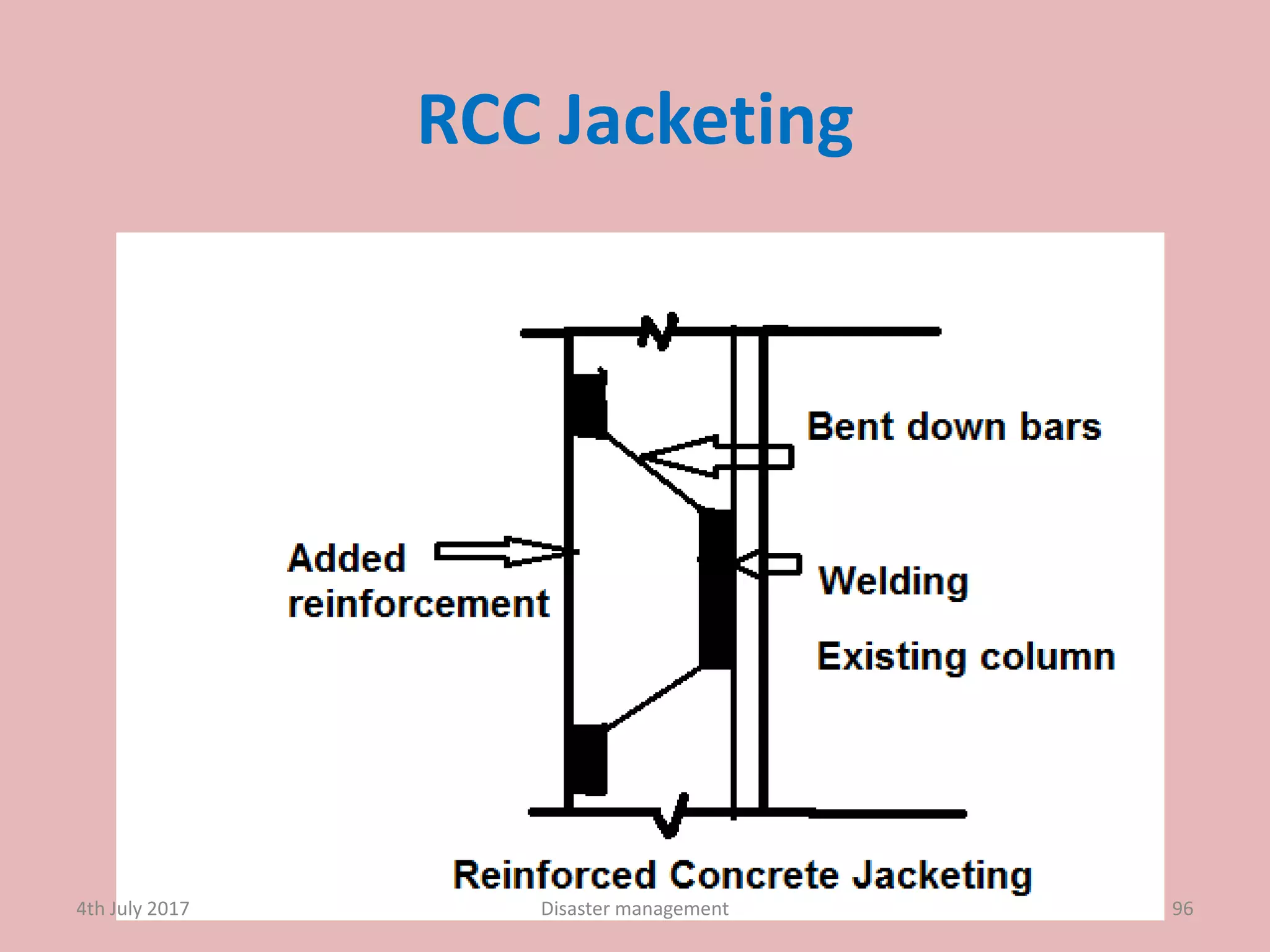
RCC Jacketing
4th July 2017 96Disaster management
Carbon Fibre Wrapping
4th July 2017 97Disaster management
Carbon Fibre
Wrapping
4th July 2017 98Disaster management
Glass Fibre Reinforcement Wrapping
4th July 2017 99Disaster management
MS Plate Wrapping
4th July 2017 100Disaster management
MASONRY STRUCTURES
1024th July 2017 Disaster management
1034th July 2017 Disaster management
1044th July 2017 Disaster management
1054th July 2017 Disaster management
1064th July 2017 Disaster management
1074th July 2017 Disaster management
VULNERABILITY
• BRICK/STONE MASONRY STRUCTURES ARE
MORE VULNERABLE AND THEN POORLY
CONSTRUCTED/REPAIRED?
• DISASTER= VULNERABILITY X HAZARD
• BRICK STRUCTURES ARE MORE IN THE COUNTRY
• SO WE NEED SAFE BRICK MASONRY
STRUCTURES
• IF NOT, WE NEED TO MAKE THEM SAFE BY
RETROFITTING.
1084th July 2017 Disaster management
SEISMIC STRENGTHENING/ RETROFITTING
 THE TECHNIQUE TO UPGRADE THE STRUCTURE
FOR EARTHQUAKE RESISTANCE TO THE LEVEL
OF PRESENT DAY CODAL REQUIREMENTS
HAVING ORIGINAL STRUCTURAL INADEQUACY
OR INADEQUACY DUE TO MATERIAL
DEGRADATION OVER TIME OR DUE TO
ALTERATIONS CARRIED OUT DURING ITS USE
OVER THE YEARS
1094th July 2017 Disaster management
SEISMIC STRENGTHENING
 MAIN PURPOSE OF SEISMIC STRENGTHEING IS
TO UPGRADE/PROVIDE THE SEISMIC
RESISTANCE ON A BUILDING SO THAT IT
BECOMES SAFER UNDER EARTHQUAKE
OCCURANCES
 AVOIDING THE POSSIBILITY OF BRITTLE MODES
OF FAILURE BY PROPER REINFORCEMENT AND
CONNECTION OF RESISTING MEMBERS
1104th July 2017 Disaster management
IS CODES
 CODES
◦ IS 13935 (JUNE 2009) – GUIDELINES FOR REPAIR,
RESTORATION, CONDITION ASSESSMENT AND
SEISMIC STRENGTHEING OF MASONRY BUILDINGS
1114th July 2017 Disaster management
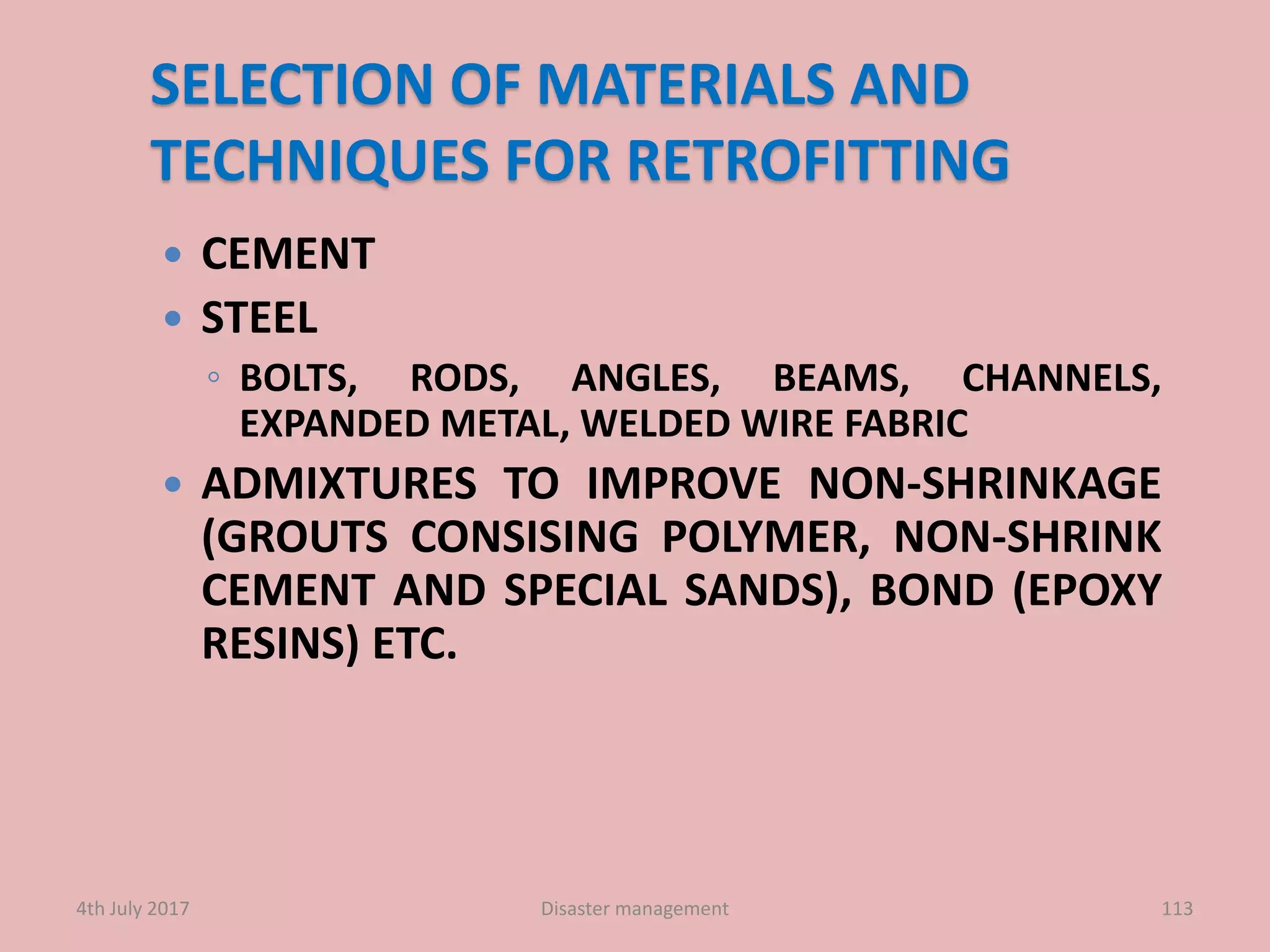
GENERAL PROVISIONS REQUIRED IN
MASONRY BUILDINGS
 PLINTH BAND
 LINTEL BAND
 ROOF SLAB/ROOF BAND
 CORNER REINFORCEMENT
 BRICK WORK IN CEMENT MORTAR OF
1:6
 RESTRICTED OPENINGS
 ADEQUATE FOUNDATION
1124th July 2017 Disaster management
SELECTION OF MATERIALS AND
TECHNIQUES FOR RETROFITTING
 CEMENT
 STEEL
◦ BOLTS, RODS, ANGLES, BEAMS, CHANNELS,
EXPANDED METAL, WELDED WIRE FABRIC
 ADMIXTURES TO IMPROVE NON-SHRINKAGE
(GROUTS CONSISING POLYMER, NON-SHRINK
CEMENT AND SPECIAL SANDS), BOND (EPOXY
RESINS) ETC.
1134th July 2017 Disaster management
114
114
4th July 2017 Disaster management
SEQUENCE OF RETROFITTING
 REPAIR/REHABILITATION
 ALL CRACKS SHOULD BE FULLY REPAIRED
◦ PRESSURE INJECTION OF NON-SHRINK CEMENT
POLYMER GROUT FOR 0.5 TO 5 MM CRACKS
◦ REPAIR BY EXPANSIVE CEMENT MORTAR, QUICK
SETTING CEMENT, ADDL. SHEAR OR FLEXURAL
REINFORCEMENT, STEEL MESH, STEEL RODS
1154th July 2017 Disaster management
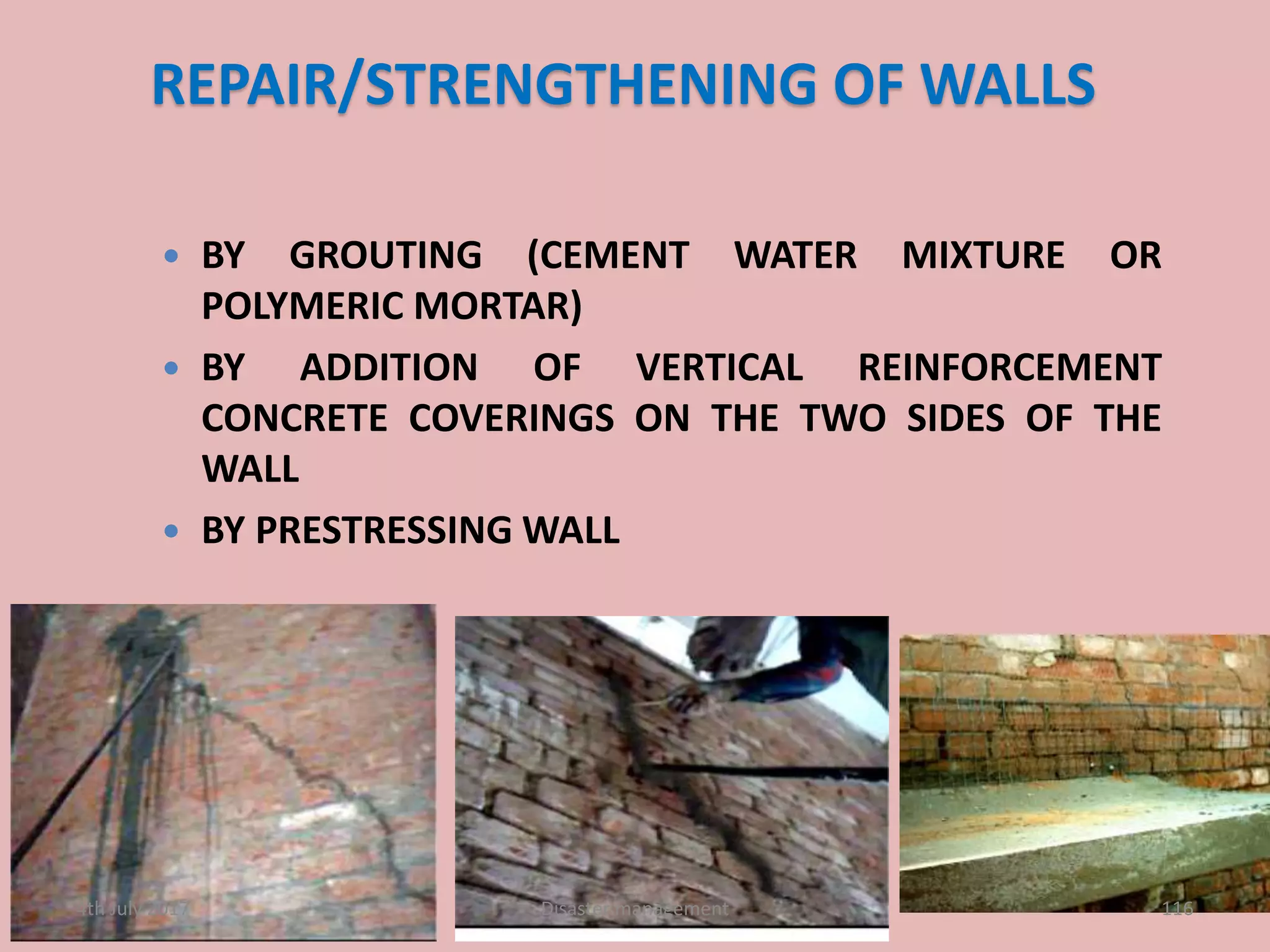
REPAIR/STRENGTHENING OF WALLS
 BY GROUTING (CEMENT WATER MIXTURE OR
POLYMERIC MORTAR)
 BY ADDITION OF VERTICAL REINFORCEMENT
CONCRETE COVERINGS ON THE TWO SIDES OF THE
WALL
 BY PRESTRESSING WALL
1164th July 2017 Disaster management
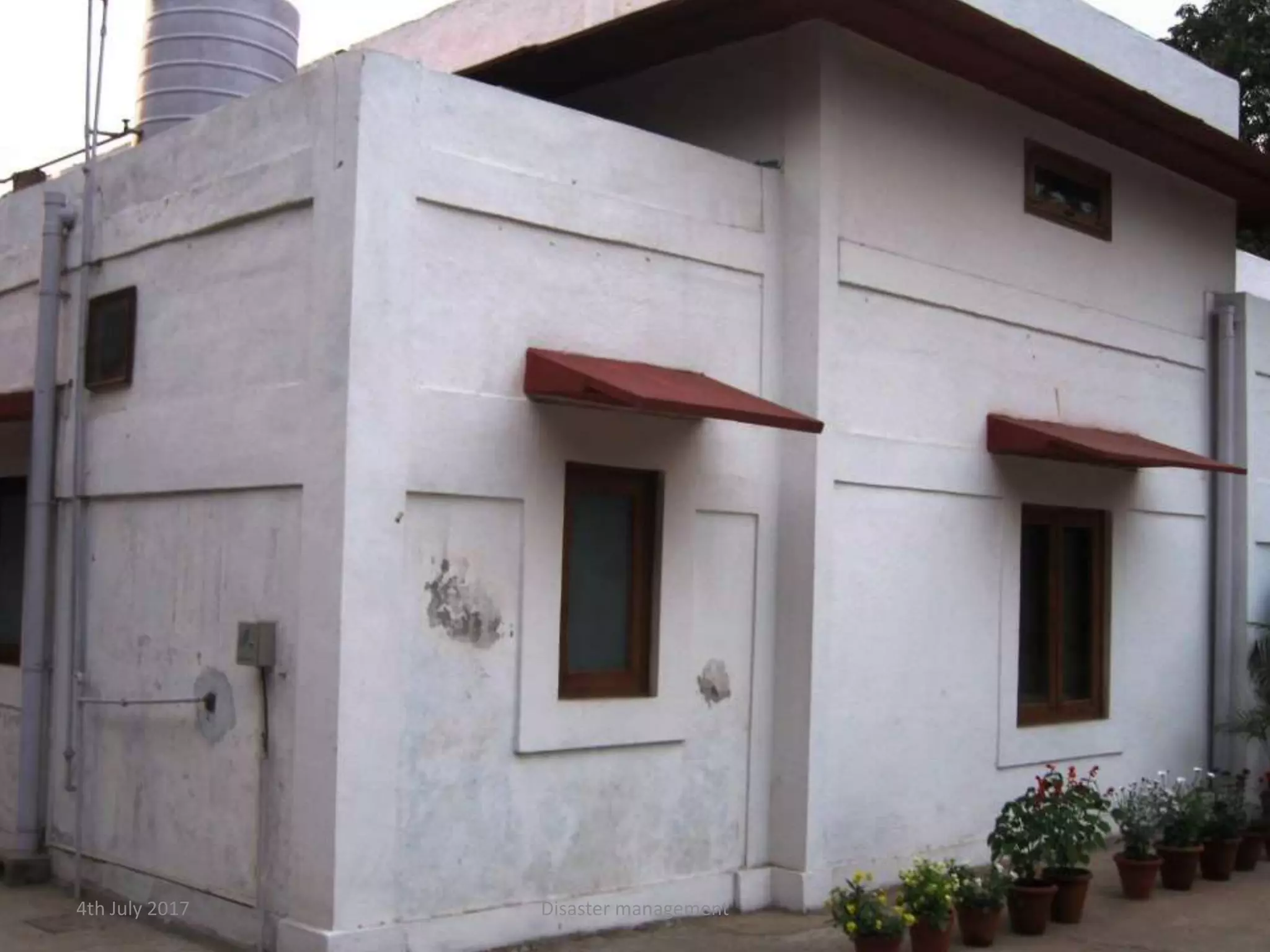
HORIZONTAL SEISMIC BELTS
 TO BE PROVIDED
◦ ON ALL WALLS
◦ ON BOTH THE FACES
◦ JUST ABOVE THE LINTEL
◦ BELOW ROOF
◦ BELOW FLOOR
◦ IN CASE OF RCC SLAB ROOF BELT NOT REQUIRED
◦ NOT REQUIRED AT PLINTH LEVEL UNLESS PLINTH
HEIGHT IS MORE THAN 900 MM
1174th July 2017 Disaster management
ON ALL WALLS
ON BOTH THE FACES
ABOVELINTEL
1184th July 2017 Disaster management
1194th July 2017 Disaster management
1204th July 2017 Disaster management
1214th July 2017 Disaster management
SEISMIC BELTS AROUND
DOOR/WINDOW OPENINGS
 IN CATEGORY “D” AND “E” BUILDINGS
 MESH OF GAUGE 10 WITH 8 WIRES IN VERTICAL
DIRECTION SPACED AT 25 MM IN A BELT WIDTH OF
200MM OR
 GAUGE 13 WITH 10 WIRES IN VERTICAL DIRECTION
SPACED AT 25 MM IN A BELT WIDTH OF 250MM (IN
CAT. C BUILDINGS ALSO)
1224th July 2017 Disaster management
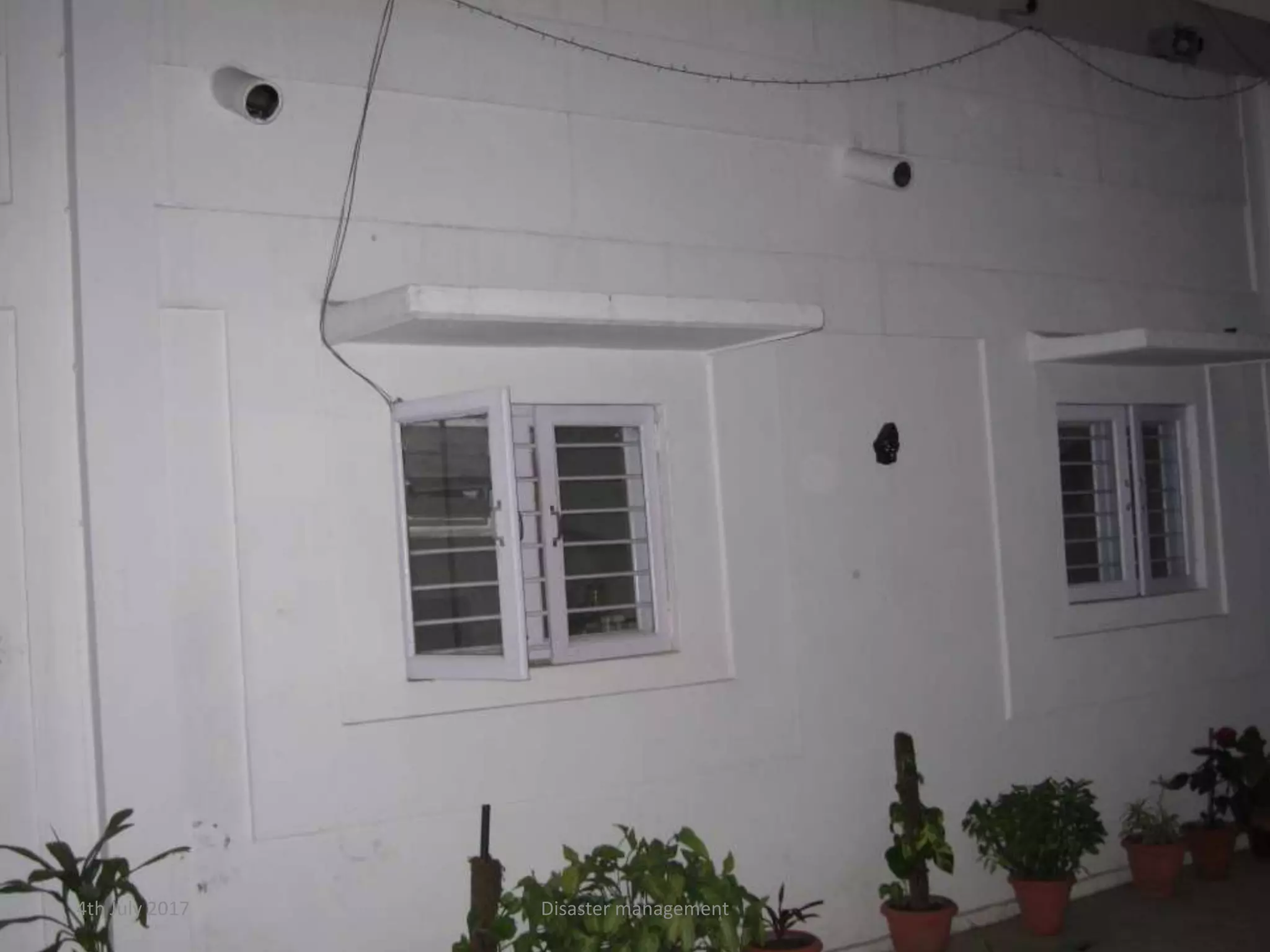
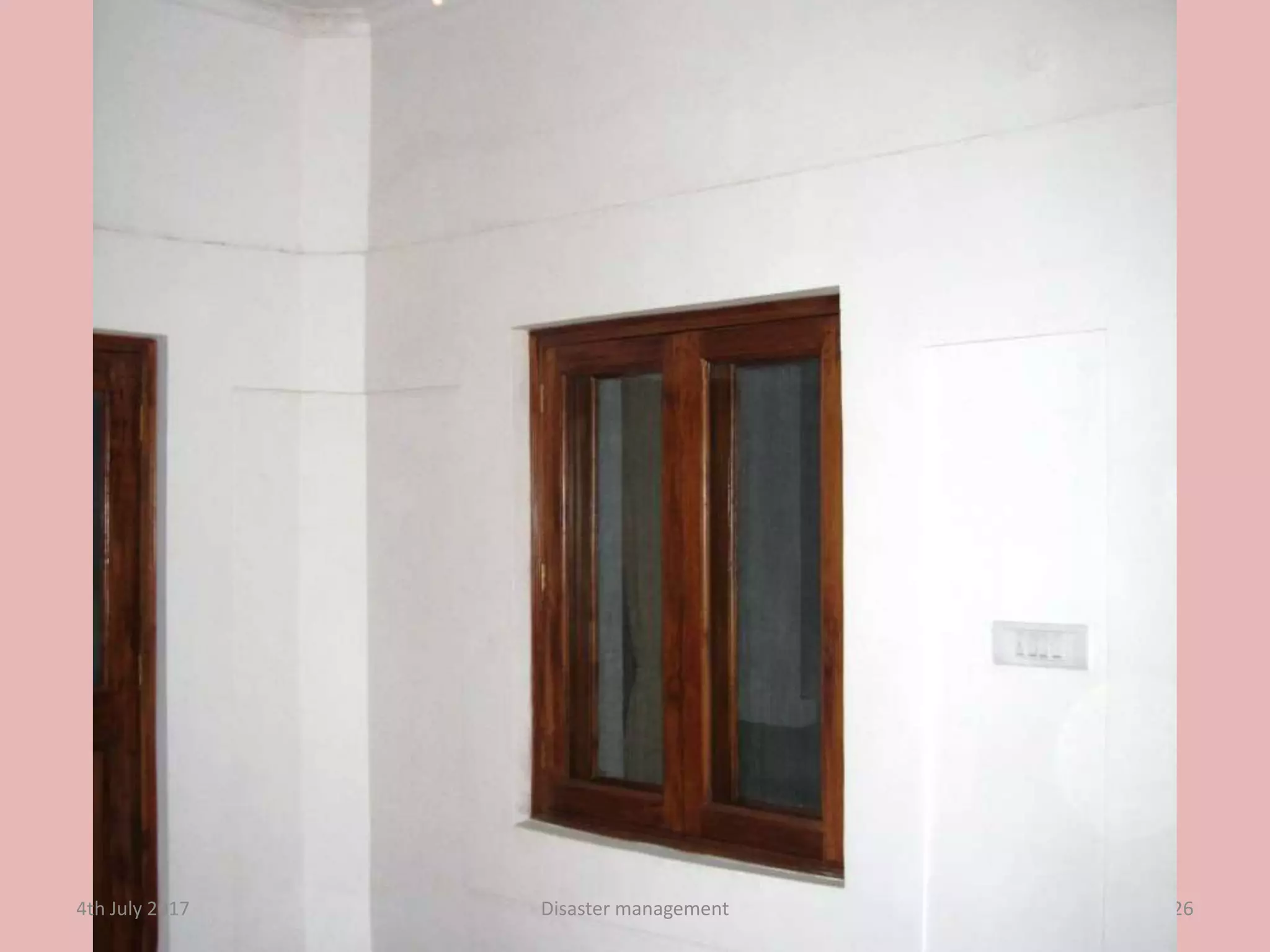
AROUND OPENINGS
1234th July 2017 Disaster management
1244th July 2017 Disaster management
1254th July 2017 Disaster management
1264th July 2017 Disaster management
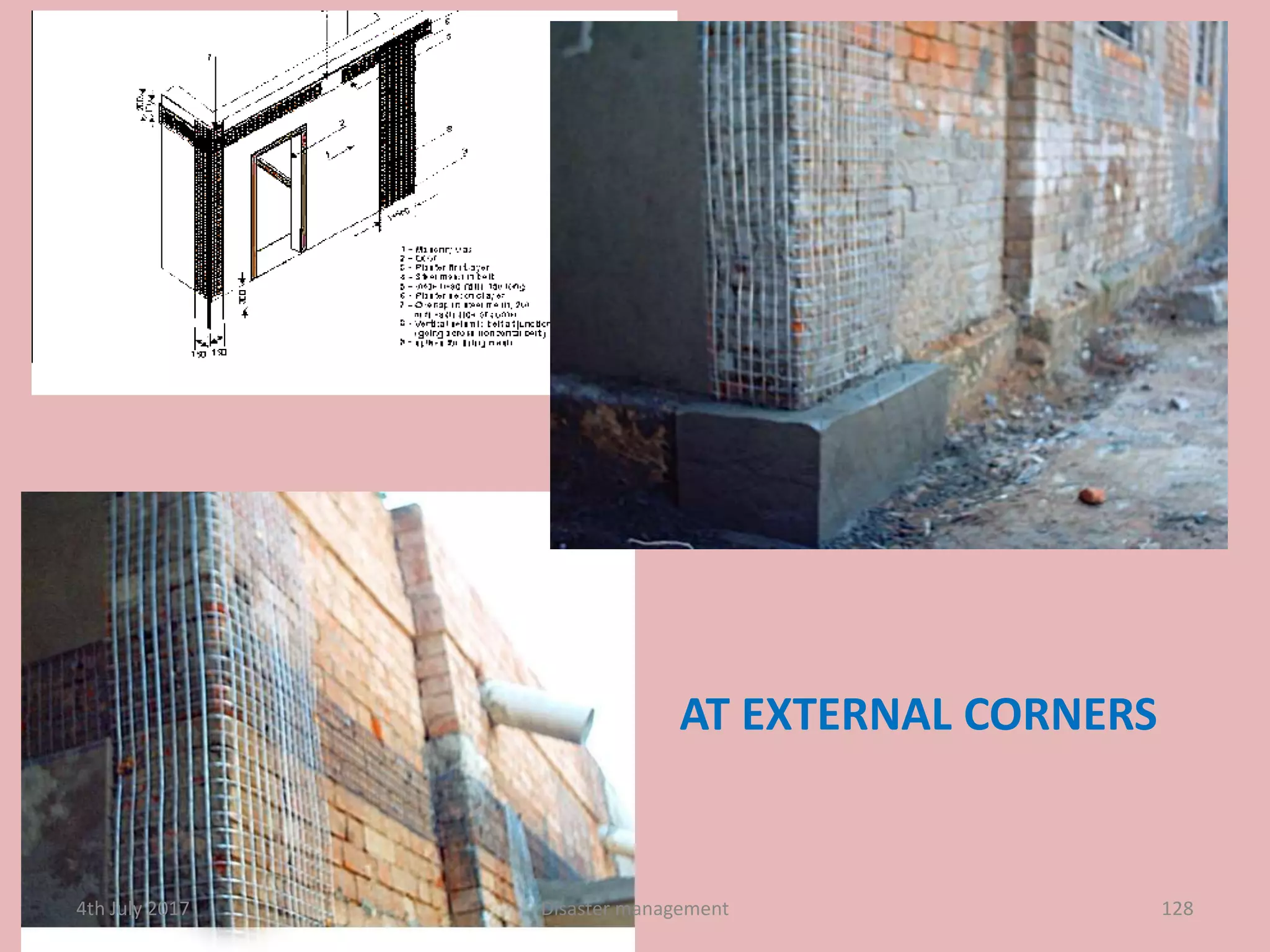
VERTICAL SEISMIC BELTS AT CORNERS
 AT THE CORNERS OF ROOMS
 JUNCTIONS OF THE WALLS
 WIDTH ON EACH SIDE OF THE CORNER
TO BE KEPT 25 MM EXTRA TO THE
WIDTH OF THE MESH
 REIFORCEMENT TO BE STARTED BELOW
300 MM BELOW PLINTH LEVEL
1274th July 2017 Disaster management
128
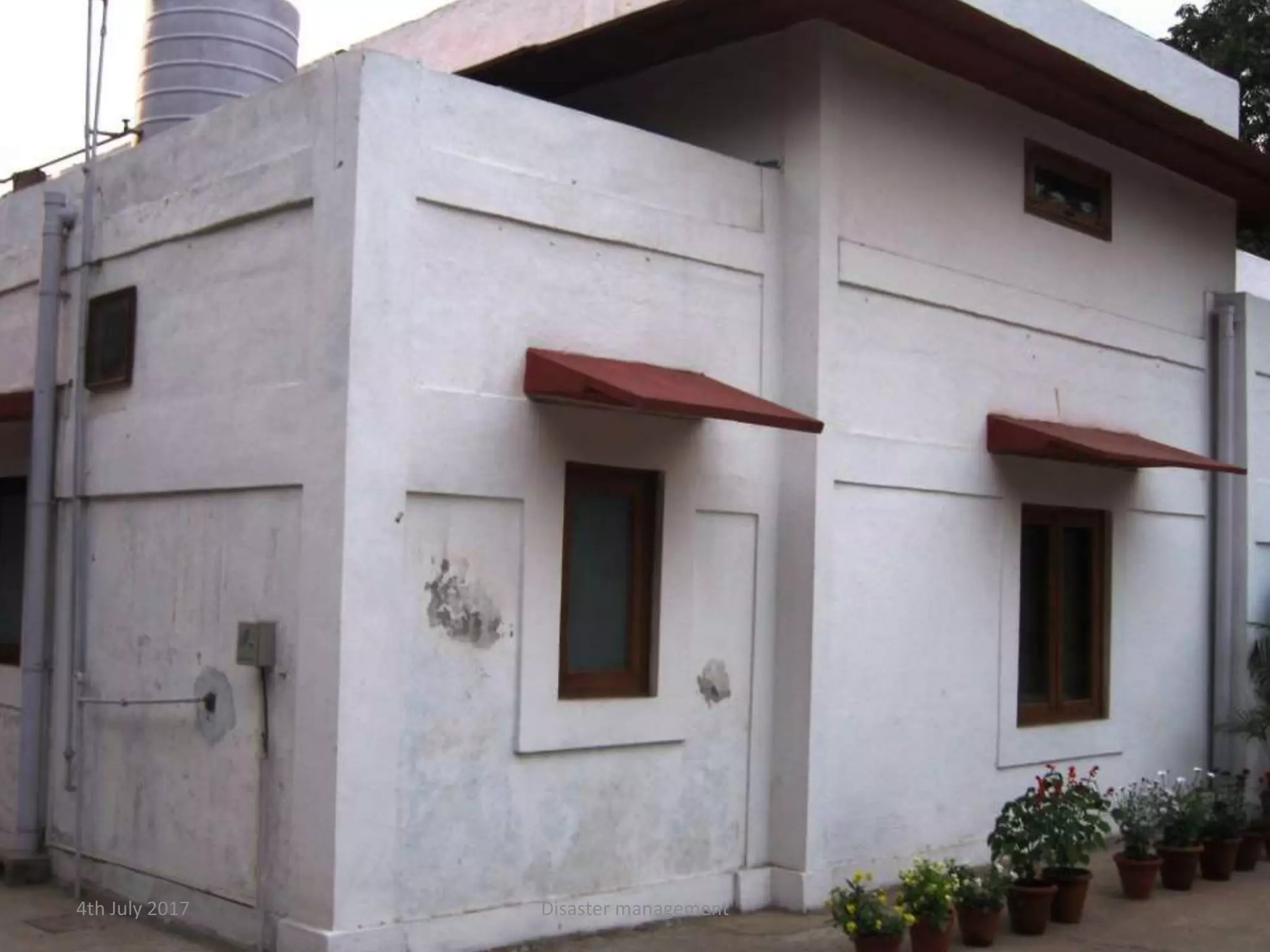
AT EXTERNAL CORNERS
4th July 2017 Disaster management
1294th July 2017 Disaster management
1304th July 2017 Disaster management
1314th July 2017 Disaster management
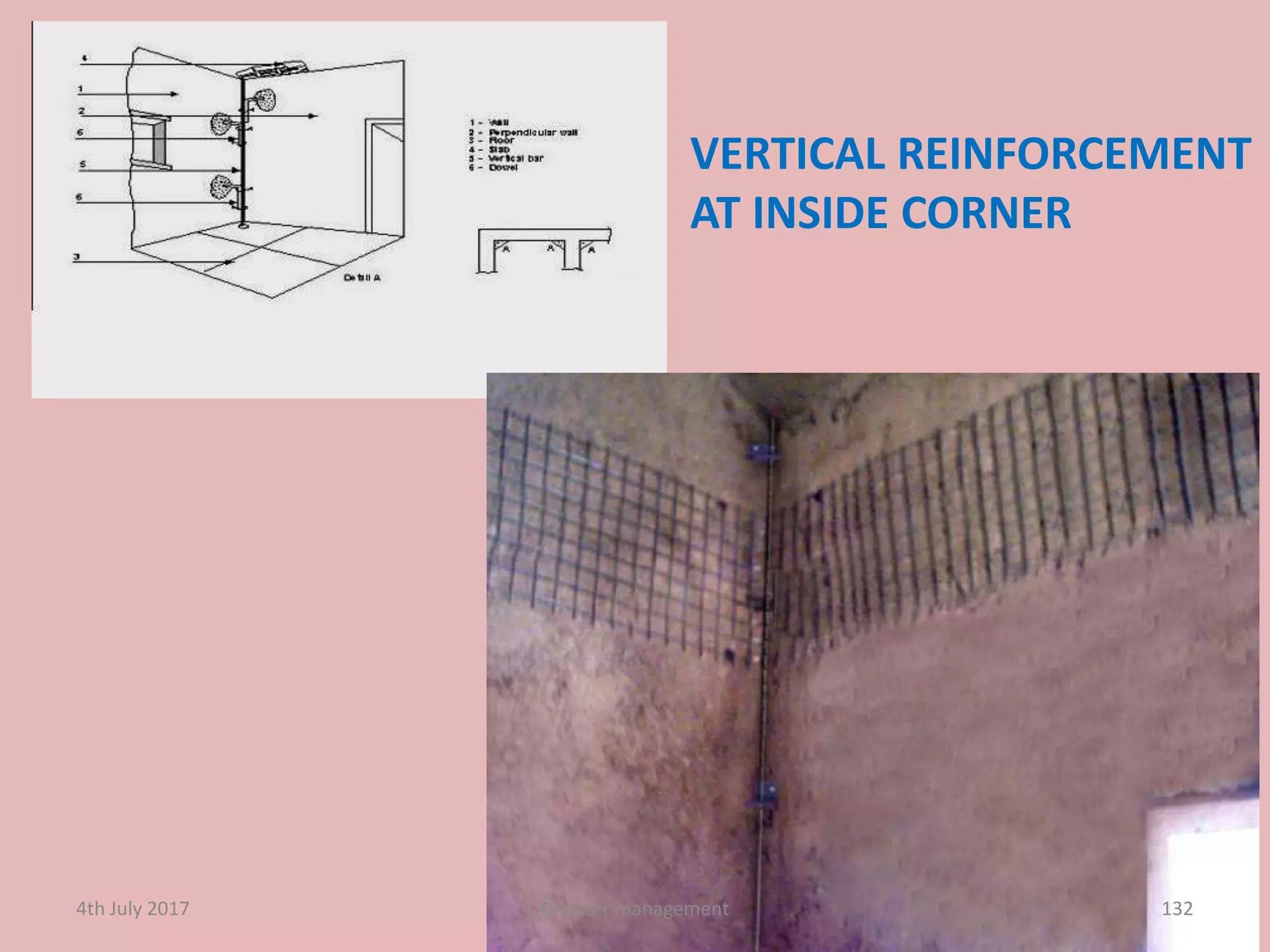
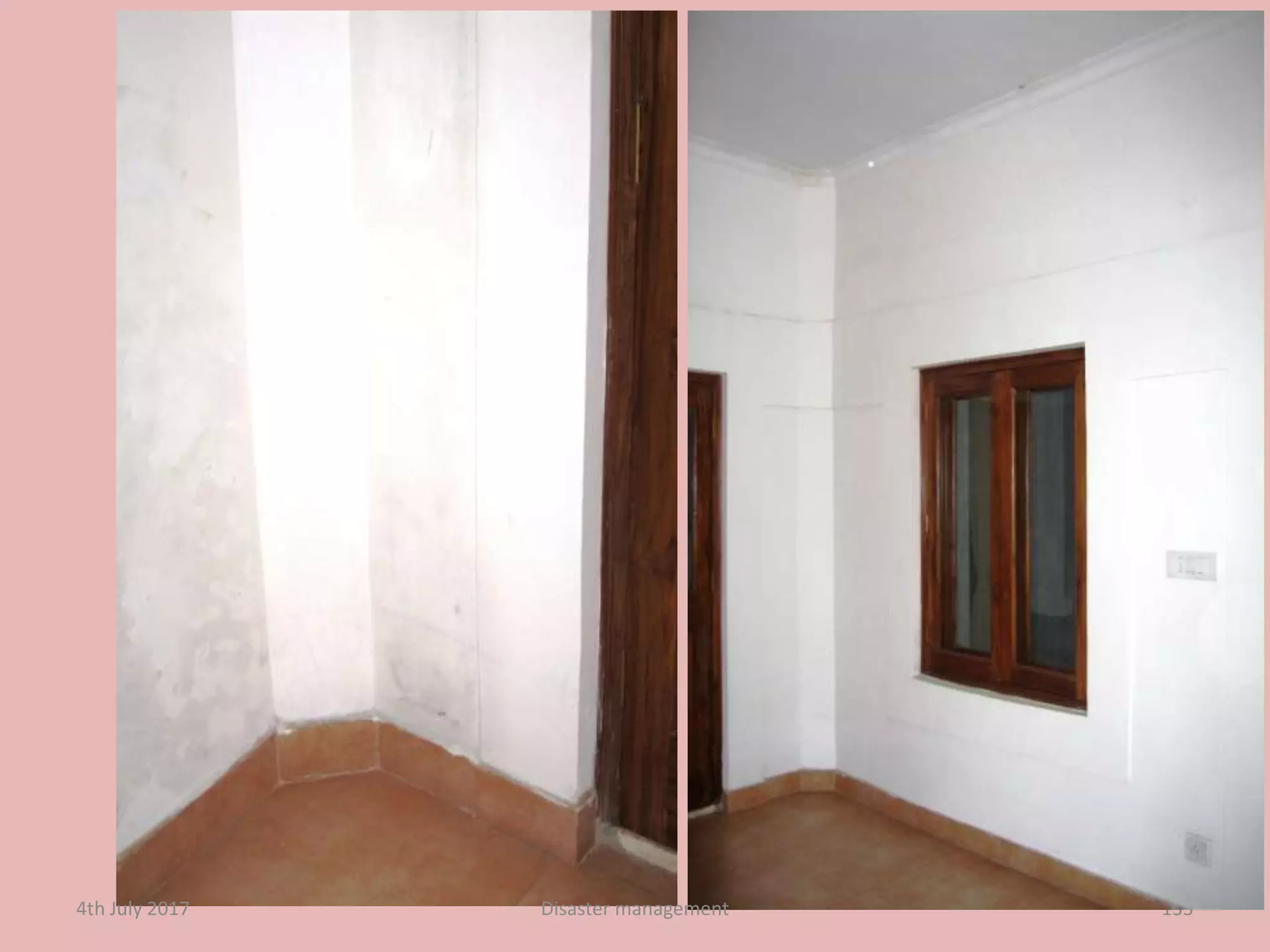
VERTICAL REINFORCEMENT
AT INSIDE CORNER
1324th July 2017 Disaster management
1334th July 2017 Disaster management
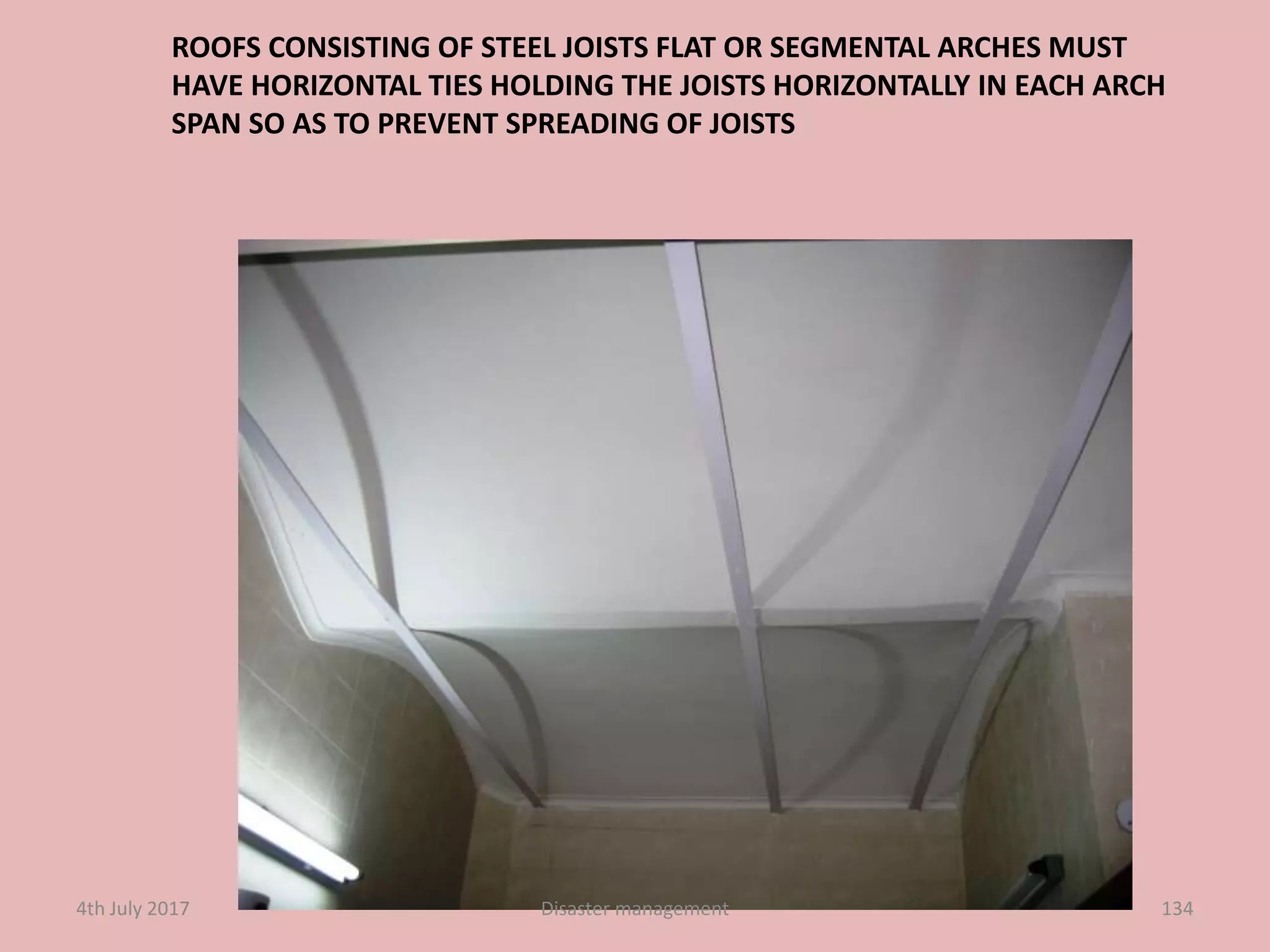
ROOFS CONSISTING OF STEEL JOISTS FLAT OR SEGMENTAL ARCHES MUST
HAVE HORIZONTAL TIES HOLDING THE JOISTS HORIZONTALLY IN EACH ARCH
SPAN SO AS TO PREVENT SPREADING OF JOISTS
1344th July 2017 Disaster management
ANCHORS
 MECHANICAL ANCHORS
 CHEMICAL ANCHORS
1354th July 2017 Disaster management
136
PROCEDURE OF ANCHORING
4th July 2017 Disaster management
1374th July 2017 Disaster management
SPECIFICATIO
NS FOR
HORIZONTAL
SEISMIC BELT
SPEC. FOR
VERITICAL
REINFORCEM
ENT
1384th July 2017 Disaster management
1394th July 2017 Disaster management
1404th July 2017 Disaster management
1414th July 2017 Disaster management
1424th July 2017 Disaster management
1434th July 2017 Disaster management
1444th July 2017 Disaster management
1454th July 2017 Disaster management
Additional steps
• Repair and rehabilitation to be carried out prior
to retrofitting.
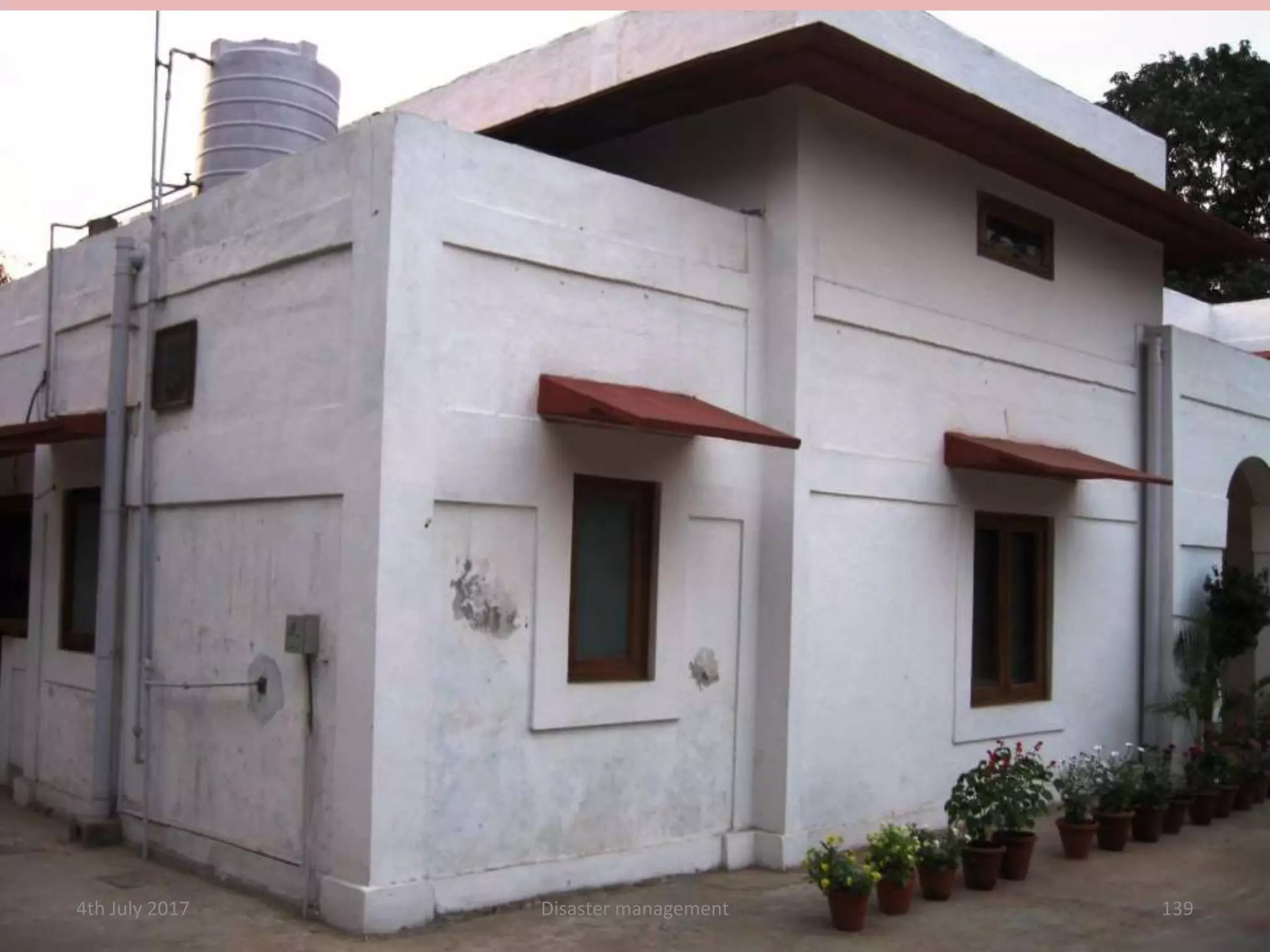
• At the external corners, on each face of the wall,
the width of the mesh for corner reinforcement
may be kept as minimum 250 mm on each wall
so that it covers minimum one brick.
• The mesh reinforcement at the corners may be
kept minimum 300 mm below ground level
1464th July 2017 Disaster management
Contd.
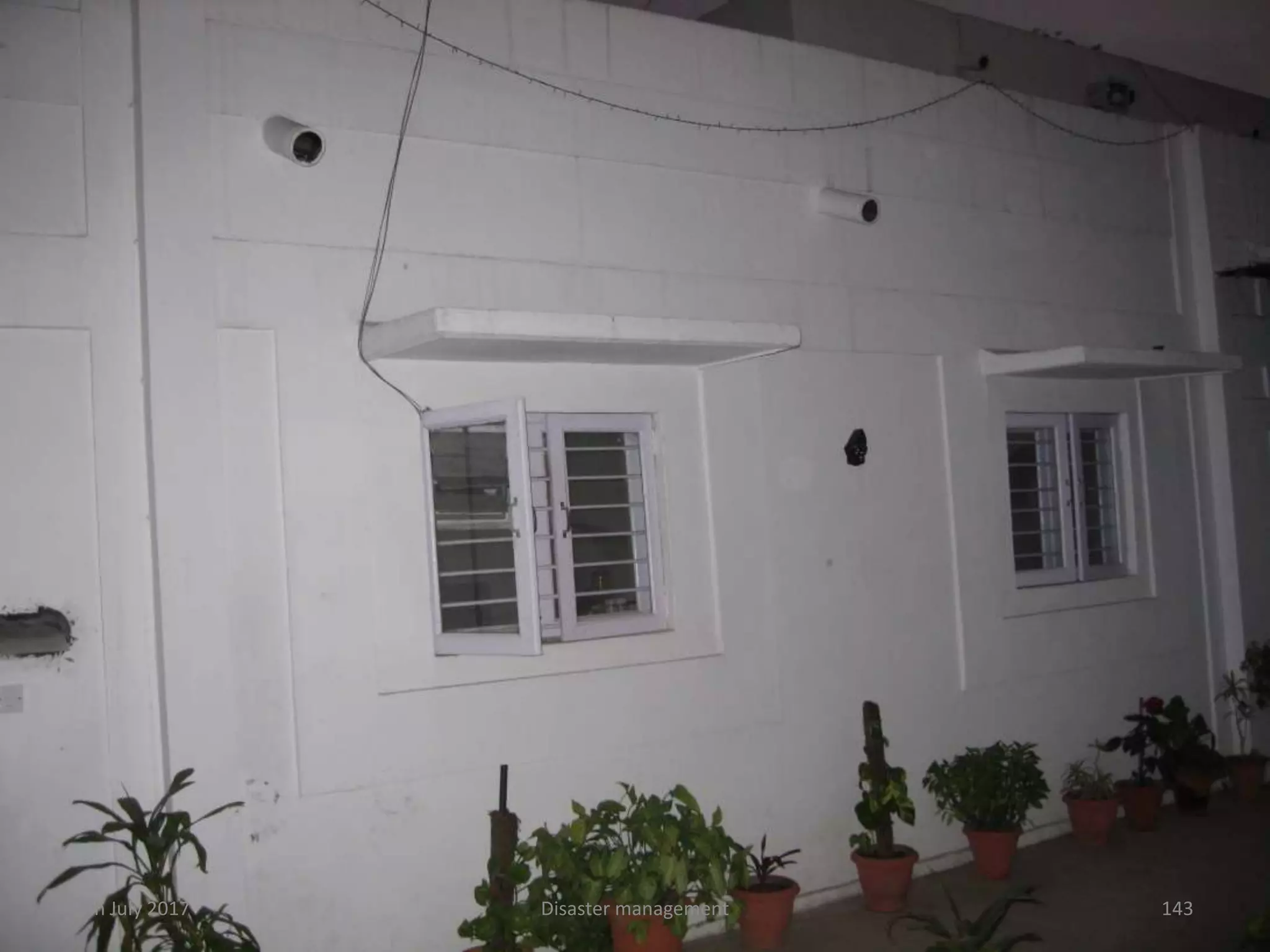
• Mesh reinforcement used should be galvanized steel
and anti rusting paint should be applied on the cut
points to prevent corrosion.
• MS washers used on wire mesh should be painted
with anti corrosive paint. In the present case, M.S.
washers of size 50X50X5 mm were used to anchor the
mesh reinforcement.
• Since it was not possible to provide roof belt of mesh
of required width in central portion due to segmental
arch construction and ventilators provided near the
top portion, MS flat belt was provided.
1484th July 2017 Disaster management
•The anchors are to be inserted into the
hole after the grout is inserted within gel
time, which is given 4 minutes for
temperature of 30 degree Celsius and 6
minutes for 20 degree Celsius for the
anchors and chemical grout used from Hilti
India Private Limited.
1494th July 2017 Disaster management
•In the inside corner reinforcement,
a prefabricated MS piece was used
having two holes, one used for
inserting into the bar which can be
adjusted at any position and other
end used for inserting anchor.
Chemical anchoring was done
thereafter.
Anchoring on wire mesh should be
in staggered (zig-zag) manner.
1504th July 2017 Disaster management
151
TRAINING, SKILL UPGRADATION AND
COMPETENCE DEVELOPMENT
• STAKEHOLDERS
– POLICY MAKERS
– TRAINERS
– PARTICIPANTS
– IMPLEMENTERS
POLICY MAKERS
TRAINERS
PARTICIPANTS
IMPLEMENTERS
151
4th July 2017 Disaster management
Item 1
• Providing and fixing 250 mm wide or required
size seismic belt for retrofitting with 12 gauge
(2.64 mm dia) galvanized iron welded mesh
with 25 mm spacing of wire on walls at
required height (inside and out side the
building ) fixed in position with headed nails at
required distance complete as per direction of
Engineer-in-charge. (Cut end of wire mesh to
be painted with NitoZinc Primer)
1524th July 2017 Disaster management
Item 2
• Providing and fixing stainless steel anchors of 8 mm dia
(HAS-EM8 x 80 / 14) of HILTI or equivalent on GI wire
mesh at required distance in staggered position i/c
drilling of 10 mm dia hole with HILTI hammer drill
machine TE-6S or equivalent and cleaning of hole by
brush and blow out pump. Anchors shall be fixed by
resin and hardener pack of HILTI make HY-150/330/2R
or equivalent (35 holes per tube of 330 ml) chemical.
Mesh will be fixed with MS washer of size 50x50x5 mm
painted with NitoZinc primer (FOSROC) on top of the
mesh with anchor screwed with nut complete as per
direction of Engineer- in- charge.
1534th July 2017 Disaster management
Item 3
• Painting on galvanized iron / steel work such
as M.S. angle, flat, cold twisted bars with
Protective / Bond coats i.e NitoZinc (FOSROC)
primer of approved brand and manufacture as
per direction of Engineer-in-charge.(Surface
area of steel work shall be measured for
payment)
1544th July 2017 Disaster management
Item 4
• Providing and Fixing steel reinforcement bar 10
mm dia for seismic strengthening of building at
inside corner i/c fixing with M.S. cleat 50x50x6
mm size having 2 holes. The reinforcement bar
shall pass through one hole and other hole shall
be used for anchoring into brick / CC wall.
(The payment for steel reinforcement, Anchor &
grouting at floor and roof shall be paid for
separately)
1554th July 2017 Disaster management
Item 5
• Providing and fixing seismic band for seismic
strengthening of size 50x5 mm flat iron
section at required level including making
necessary holes not more than 75 cm apart
and keeping in position with nails and finally
fixing with Anchors ( Payments for Anchors &
its fixing shall be made separately).
1564th July 2017 Disaster management
Item 6
• 28 mm thick Acrylic modified cement
mortar/micro concrete band at required level
with mix 1:1:2 (1 cement : 1 coarse sand : 2
graded stone aggregate 6 mm & down nominal
size) in two coats admixed with polymer
modified compound (Armourcrete / Tapecrete) @
10% of cement (by weight) used area and
including slurry coat of Acrylic cement @ 2.2 kg /
sqm mixed with polymer modified compound
(Armourcrete/ Tapecrete) @ 10% of cement used
and finished smooth complete (top layer will be
of 12 mm plaster).
1574th July 2017 Disaster management
1584th July 2017 Disaster management
Photos and References have been taken from various web sites.
Their contribution is gratefully acknowledged)

Disaster management and seismic retrofitting

  • 1.
    Disaster Management and SeismicRetrofitting Dr K M Soni Chief Engineer, CPWD, Mumbai
  • 2.
    Major Disasters Worldwide 4thJuly 2017 Disaster management 2 Sl. No. Name of Event Year Country and Region Fatalities in the known history 1 Earthquake 1556 China, Shaanxi 830000 2 Earthquake 1731 China 100000 3 Cyclone 1737 India, Calcutta 300000 4 Yellow River flood 1887 China 9,00,000-20,00,000 5 Messina Earthquake 1908 Italy 123000 6 Earthquake 1920 China, Gansu 235000 7 Great Kanto Earthquake 1923 Japan 142000 8 Great Chinese Famine 1958-1961 China 1958-1961 China 150,00,000- 430,00,000 9 Bhola Cyclone 1970 West Bengal, India & B/desh 5,00,000 10 Tangshan Earthquake 1976 China 2,42,419
  • 3.
    HAITI’S E/Q, 12.1.2010;DEATHS-3,16,000; MAGNITUDE:7 34th July 2017 Disaster management
  • 4.
    TANGSHAN, CHINA, 27.7.1976;DEATHS-242,769; MAG. 7.5 44th July 2017 Disaster management
  • 5.
    SUMATRA E/Q, 26.12.2004 DEATHS;2,27,898 MAG.9.1 54th July 2017 Disaster management
  • 6.
    Haiyuan, china e/q 16.12.1920 Deaths;2,00,000 Mag. 7.8 64th July 2017 Disaster management
  • 7.
    Kanto, e/q, Japan;1.9.1923 Deaths-1,42,800 Magnitude: 7.9 74th July 2017 Disaster management
  • 8.
    Pakistan e/q, 18.10.2005 Deaths;86000 Mag-7.6 84th July 2017 Disaster management
  • 9.
    Iran e/q, 20.6.1990 Deaths-50,000 Mag.7.4 94th July 2017 Disaster management
  • 10.
    Gujarat e/q, 26.1.2001 Deaths-20,085,Mag. 7.6 104th July 2017 Disaster management
  • 11.
    Latur, india e/q29.3.1993 Deaths – 9748 Mag. 6.2 114th July 2017 Disaster management
  • 12.
    NEPAL EARTHQUAKE 12 2015, Magnitude:7.9, deaths over 5000 4th July 2017 Disaster management
  • 13.
    134th July 2017Disaster management
  • 14.
    AFGHANISTAN EARTHQUAKE 14 26th October,2015 4th July 2017 Disaster management
  • 15.
    Disasters in India •Natural disasters – Earthquakes – Floods – Cyclones – Tsunamis – Droughts – Landslides • Man made disasters – Road/Rail accidents – Chemical disasters 4th July 2017 15Disaster management
  • 16.
    Major Disasters inIndia 4th July 2017 16Disaster management
  • 17.
    S. No. Nameof Event Year State & Area Fatalities 1. Floods October 2014 Jammu & Kashmir 2. Cyclone Hud Hud September 2014 Andhra Pradesh & Odisha 3. Odisha Floods October 2013 Odisha 21 4. Andhra Floods October 2013 Andhra Pradesh 53 5. Cyclone Phailin October 2013 Odisha and Andhra Pradesh 23 6. Floods/Landslid es June 2013 Uttarakhand and Himachal Pradesh 4,094 7. Cyclone Mahasen May 2013 Tamil Nadu 08 8. Cyclone Nilam October 2012 Tamil Nadu 65 9. Uttarakhand Floods Aug – Sep 2012 Uttarkashi, Rudraprayag and Bageshwar 52 10. Assam Floods July – Aug 2012 Assam --- 4th July 2017 17Disaster management
  • 18.
    S. No. Nameof Event Year State & Area Fatalities 11. Cyclone Thane December 2011 Tamil Nadu, Puducherry 47 12. Sikkim Earthquake September 2011 Sikkim, West Bengal, Bihar 60 13. Odisha Floods September 2011 19 Districts of Odisha 45 14. Sikkim Earthquake 2011 North Eastern India with epicenter near Nepal Border and Sikkim 97 people died (75 in Sikkim) 15. Cloudburst 2010 Leh, Ladakh in J&K 257 people died 16. Drought 2009 252 Districts in 10 States ----- 17. Krishna Floods 2009 Andhra Pradesh, Karnataka 300 people died 18. Kosi Floods 2008 North Bihar 527 deaths, 19,323 livestock perished, 2,23,000 houses damaged, 3.3 million persons affected 19. Cyclone Nisha 2008 Tamil Nadu 204 deaths 20. Maharashtra Floods July 2005 Maharashtra State 1094 deaths 167 injured 54 missing 4th July 2017 18Disaster management
  • 19.
    S. No. Nameof Event Year State & Area Fatalities 21. Kashmir 2005 Mostly Pakistan, Partially Kashmir 1400 deaths in Kashmir (86,000 deaths in total) 22. Tsunami 2004 Coastline of Tamil Nadu, Kerala, Andhra Pradesh, Pondicherry and Andaman and Nicobar Islands of India 10,749 deaths 5,640 persons missing 2.79 million people affected 11,827 hectares of crops damaged 300,000 fisher folk lost their livelihood 23. Gujarat Earthquake 2001 Rapar, Bhuj, Bhachau, Anjar, Ahmedabad and Surat in Gujarat State 13,805 deaths 6.3 million people affected 24. Orissa Super Cyclone 1999 Orissa Over 10,000 deaths 25. Cyclone 1996 Andhra Pradesh 1,000 people died, 5,80,000 housed destroyed, Rs. 20.26 billion estimated damage 26. Latur Earthquake 1993 Latur, Marathwada region of Maharashtra 7,928 people died 30,000 injured 27. Cyclone 1990 Andhra Pradesh 967 people died, 435,000 acres of land affected 28. Drought 1987 15 States 300 million people affected 29. Cyclone 1977 Andhra Pradesh 10,000 deaths hundreds of thousands homeless 40,000 cattle deaths4th July 2017 19Disaster management
  • 20.
    4th July 201720Disaster management
  • 21.
    4th July 201721Disaster management
  • 22.
    4th July 201722Disaster management
  • 23.
    4th July 201723Disaster management
  • 24.
    4th July 201724Disaster management
  • 25.
    4th July 201725Disaster management
  • 26.
    4th July 201726Disaster management
  • 27.
    Cascading Effect • Earthquake •Tsunami • Fire • Nuclear disaster • Floods • And so on... 4th July 2017 27Disaster management
  • 28.
    Road Accidents 4th July2017 28Disaster management
  • 29.
    4th July 201729Disaster management
  • 30.
    4th July 201730Disaster management
  • 31.
    4th July 201731Disaster management
  • 32.
    4th July 201732Disaster management
  • 33.
    4th July 201733Disaster management
  • 34.
    Vulnerability Profile 4th July2017 34Disaster management
  • 35.
    Of the 7,516km long coastline, close to 5,700 km (@76%) is prone to cyclones and tsunamis. 4th July 2017 35Disaster management
  • 36.
    58.6 per centof the landmass is prone to earthquakes of moderate to very high intensity. 4th July 2017 36Disaster management
  • 37.
    Over 40 millionhectares (12 % of land) is prone to floods and river erosion. 4th July 2017 37Disaster management
  • 38.
    Disaster Management Act On23 December 2005, the Government of India enacted the Disaster Management Act, which envisaged the creation of National Disaster Management Authority (NDMA), headed by the Prime Minister, and State Disaster Management Authorities (SDMAs) headed by respective Chief Ministers, to spearhead and implement a holistic and integrated approach to Disaster Management in India. 4th July 2017 38Disaster management
  • 39.
    4th July 201739Disaster management
  • 40.
    Functions & Responsibilities •Lay down policies on disaster management ; • Approve the National Plan; • Approve plans prepared by the Ministries or Departments of the Government of India in accordance with the National Plan; • Lay down guidelines to be followed by the State Authorities in drawing up the State Plan; • Lay down guidelines to be followed by the different Ministries or Departments of the Government of India for the Purpose of integrating the measures for prevention of disaster or the mitigation of its effects in their development plans and projects; • Coordinate the enforcement and implementation of the policy and plans for disaster management; • Recommend provision of funds for the purpose of mitigation; • Provide such support to other countries affected by major disasters as may be determined by the Central Government; • Take such other measures for the prevention of disaster, or the mitigation, or preparedness and capacity building for dealing with threatening disaster situations or disasters as it may consider necessary; • Lay down broad policies and guidelines for the functioning of the National Institute of Disaster Management. 4th July 2017 40Disaster management
  • 41.
    Themes of thepolicy • Community-based disaster management, including last mile integration of the policy, plans and execution. • Capacity development in all related areas. • Consolidation of past initiatives and best practices. • Cooperation with agencies at the national, regional and international levels. • Compliance and coordination to generate a multi-sectoral synergy. 4th July 2017 41Disaster management
  • 42.
    Disaster Management Cycle 4thJuly 2017 42Disaster management
  • 43.
    4th July 201743Disaster management
  • 44.
    4th July 201744Disaster management
  • 45.
    Prevention and Mitigation & CapacityBuilding 4th July 2017 45Disaster management
  • 46.
    Disaster Management 4th July2017 46Disaster management
  • 47.
    Disaster Management 4th July2017 47Disaster management
  • 48.
    Prepare 4th July 201748Disaster management
  • 49.
    Capacity Building to dealwith new works to deal with disasters, retrofitting and repair/rehabilitation 4th July 2017 49Disaster management
  • 50.
    Damage/poor maintenance enhances riskof damage/collapse of structures during disasters 4th July 2017 50Disaster management
  • 51.
    4th July 201751Disaster management
  • 52.
    4th July 201752Disaster management
  • 53.
    4th July 201753Disaster management
  • 54.
    4th July 201754Disaster management
  • 55.
    4th July 201755Disaster management
  • 56.
    564th July 2017Disaster management
  • 57.
    574th July 2017Disaster management
  • 58.
    584th July 2017Disaster management
  • 59.
    594th July 2017Disaster management
  • 60.
    Types of Damages •Damages could include both Structural and Non-Structural • Non structural damage could include: • Plaster, • Panel/filler walls, parapets • Doors, windows, window glass panes etc • Dislocation of civil services like water supply, gas, drainage pipes and electrical conduits/wiring • Disturbed Roofing Tiles • Flooring at ground level, etc • Structural damage could cover • Foundation system • Load bearing walls • RCC beams/columns • Roofing • Lintels over door/windows, etc 604th July 2017 Disaster management
  • 61.
    Sequence of Operation •Removal of Hazardous Components • Propping & Supporting, wherever required • Condition Survey to Determine Rehabilitation • Evaluate Damage to each Structural Component • Restoration and strengthening – Appropriate Structural Repair Method – Non structural repairs covering civil & electrical items • Finish the Repaired Structure 4th July 2017 61Disaster management
  • 62.
    Structural Damage Assessment •Important to conduct ‘Condition Survey’ – Determining rehabilitability i/c part demolition – Whether building to be got vacated for repairs? – Detailed damage assessment and determining residual strength. – Details of temporary support arrangement to avoid further distress under normal loads 4th July 2017 62Disaster management
  • 63.
    Repairs, Rehabilitation andRetrofitting • In New Building, the extra Cost of Seismic Resistant features is nominal (i.e. 2% to 5% of structure’s cost) • In Existing Building, the seismic retrofitting is costlier (i.e. 5 to 15% of structure’s cost) • Structural Repairs of Corrosion distressed structures are also costlier • Replacement of structure is still more costly • A Balanced View is required to be taken before deciding upon the various options 4th July 2017 63Disaster management
  • 64.
    Repair & retrofittingVs Reconstruction • As a thumb rule, repair/ strengthening is resorted, if its overall cost is less than 30% of the cost of reconstruction • Replacement/reconstruction is, generally avoided due to – Preservation of Historical Architecture – Maintaining functional social and cultural environment 4th July 2017 64Disaster management
  • 65.
    Classification of RepairMaterials • Based on its Application – Surface Preparation – Rust Removers / Converters – Passivators for Reinforcement Protection – Bonding Agents – Structural Repair Materials – Injection Grouts – Joint Sealants – Protective Surface Coatings 4th July 2017 66Disaster management
  • 66.
    Cement Concrete/Mortar as RepairMaterial • Cement Concretes/Mortars are the natural Repair Materials for RCC structures but not favoured due to inherent undesirable properties like: – Drying shrinkage – Slow Setting – Low Workability – Prolonged Curing requirements – Permeability 4th July 2017 68Disaster management
  • 67.
    Repair Sequence forCorrosion Damaged & Spalled cover Concrete 1. Surface Preparation • Loose and carbonated concrete removal all- around reinforcement 2. Fix Shear Connectors, if required 3. Apply bonding layer over Substrate concrete 4. Apply Passivating Coat over Steel Reinforcement 5. Apply repair – Cement based repairs or – Resin based repairs, or – Sprayed concrete (shotcrete) 4th July 2017 Disaster management
  • 68.
    Jacketing of RCC Column 4thJuly 2017 72Disaster management
  • 69.
    4th July 201773Disaster management
  • 70.
    REHABILITATION AND SEISMIC RETROFITTING 4thJuly 2017 74Disaster management
  • 71.
    EARTHQUAKES • EARTHQUAKES DONOT KILL BUT IT IS THE BUILDINGS WHICH KILL • NEARLY 5,00,000 EARTHQUAKES OCCUR EVERY YEAR • ABOUT 1,00,000 ARE FELT • Minor earthquakes occur nearly constantly around the world in places like California and Alaska in the U.S., as well as in Mexico, Guatemala, Chile, Peru, Indonesia, Iran, China, Pakistan, Portugal, Turkey, New Zealand, Greece, Italy, India and Japan, but earthquakes can occur almost anywhere. 754th July 2017 Disaster management
  • 72.
    CASUALTIES • LARGE NUMBEROF CASUALTIES OCCUR IN DEVEOPING COUNTRIES. REASONS MAY BE; – INADEQUATE DESIGN – POOR CONSTRUCTION AND MAINTENANCE – LACK OF RESOURCES – INADEQUATE KNOWLEDGE – INADEQUATE AWARENESS – INADEQUATE TRAINING – INADEQUATE SAFETY IMPLEMENTATION 764th July 2017 Disaster management
  • 73.
    77 CAUSES OF FAILUREOF MASONRY BUILDINGS  POOR QUALITY OF MORTAR  IRREGULARITY IN PLANE AND VERTICAL DIRECTION  NO PROVISION OF BANDS  NO THOROUGH STONES  HEAVY MASS CONCENTRATION AT ROOF LEVEL  UNSYMMETRICAL BUILDINGS AND FULL OPENINGS  UNCONFINED WALL CORNERS  INADEQUATELY DESIGNED CANTILEVER ELEMENTS 77 4th July 2017 Disaster management
  • 74.
    CAUSES OF FAILUREOF RCC BUILDINGS • SOFT STOREY (ONE IN WHICH LATERAL STIFFNESS IS LESS THAN 70% OF THAT IN THE STOREY IMMEDIATELY ABOVE OR LESS THAN 80% OF THE COMBINED STIFFNESS OF THREE STOREYS ABOVE) • POOR DETAILING OF BEAM COLUMN JUNCTIONS • PROVISION OF FLOATING COLUMNS • PLAN AND MASS IRREGULARITY • INADEQUATE FOUNDATION • POUNDING OF BUILDINGS • INADEQUATE DESIGN AND DETAILING • INADEQUATE CONNECTVITY LIKE ISOLATED STAIRCASES AND WATER TANKS NOT PROPERLY ANCHORED 784th July 2017 Disaster management
  • 75.
    794th July 2017Disaster management
  • 76.
    804th July 2017Disaster management
  • 77.
    814th July 2017Disaster management
  • 78.
    824th July 2017Disaster management
  • 79.
    834th July 2017Disaster management
  • 80.
    844th July 2017Disaster management
  • 81.
    854th July 2017Disaster management
  • 82.
    864th July 2017Disaster management
  • 83.
    87 NORMALLY STRUCTURES REQUIRING REPAIRAND REHABILITATION ARE MORE SUSCEPTIBLE TO DAMAGE, HENCE REPAIR AND REHABILITATION IS VERY IMPORTANT 87 4th July 2017 Disaster management
  • 84.
    CAUSES OF DETERIORATIONOF RCC • PENETRATION OF WATER/CHEMICALS LEADING TO CARBONATION, CHLORIDE INGRESS, LEACHING, SULPHATE ATTACK, ALKALI SILICA REACTION ETC LEADING TO CORROSION IN THE REINFORCEMENT 884th July 2017 Disaster management
  • 85.
    MAIN REASON OFPENETRATION OF WATER • POROSITY OF CONCRETE 894th July 2017 Disaster management
  • 86.
    PRECAUTIONS TAKEN TOPREVENT POROSITY • ADEQUATE STRENGTH OF CONCRETE • PROPER COMPACTION • WATER PROOFING ON ROOF • PLASTER ON CONCRETE • WATER PROOFING PAINTS ON EXPOSED PLASTERED SURFACE 904th July 2017 Disaster management
  • 87.
    CAUSES OF DETERIORATIONOF CONCRETE • AGING OF STRUCTURE • POOR QUALITY – POOR QUALITY OF TESTING/INVESTIGATION – POOR QUALITY OF DESIGN – POOR QUALITY OF EXECUTION IN TERMS OF MATERIALS/COMPACTION/PAINTS/COVER/RCC – POOR QUALITY OF MAINTENANCE 914th July 2017 Disaster management
  • 88.
    SELECTION OF MATERIALSFOR REHABILITATION/ RETROFITTING • TECHNICAL REQUIREMENTS • COST • AVAILABILITY • EXPERT’S ADVICE • IMPORTANCE OF THE STRUCTURE • BALANCE LIFE OF THE STRUCTURE • TOXICITY OF THE MATERIAL • AESTHETIC CONSIDERATION 924th July 2017 Disaster management
  • 89.
    REHABILITATION METHODS • SANDBLASTING FOR REMOVAL OF CORROSION AND APPLYING A COAT TO RETARD CORROSION • BINDING/ADDING OF ADDITIONAL REINFORCEMENT/CONCRETE • WELDING • ANCHORING TO THE EXISTING MEMBERS THROUGH SHEAR KEYS OR ANCHORS • SHOTCRETING • PLATE BONDING • JACKETING • FIBRE WRAPPING 934th July 2017 Disaster management
  • 90.
    PROCEDURE • REMOVAL OFLOOSE MATERIALS/RUST • PROVIDING PROTECTIVE LAYER/COATING • PROVIDING BONDING COAT BETWEEN OLD AND NEW MATERIAL/SURFACES • PROVIDING STEEL MEMBERS/WELDING/ANCHORS/ SHEAR KEYS TO ENSURE MONOLITHIC ACTION 944th July 2017 Disaster management
  • 91.
    RETROFITTING IN RCC COLUMNS/BEAMS/SLABS •PLATE BONDING • FIBRE WRAP TECHNIQUES THROUGH GLASS FIBRES/CARBON FIBRES • RCC JACKETING • NEW CASTING • GUNITING/SHOTCRETING 954th July 2017 Disaster management
  • 92.
    RCC Jacketing 4th July2017 96Disaster management
  • 93.
    Carbon Fibre Wrapping 4thJuly 2017 97Disaster management
  • 94.
    Carbon Fibre Wrapping 4th July2017 98Disaster management
  • 95.
    Glass Fibre ReinforcementWrapping 4th July 2017 99Disaster management
  • 96.
    MS Plate Wrapping 4thJuly 2017 100Disaster management
  • 97.
    MASONRY STRUCTURES 1024th July2017 Disaster management
  • 98.
    1034th July 2017Disaster management
  • 99.
    1044th July 2017Disaster management
  • 100.
    1054th July 2017Disaster management
  • 101.
    1064th July 2017Disaster management
  • 102.
    1074th July 2017Disaster management
  • 103.
    VULNERABILITY • BRICK/STONE MASONRYSTRUCTURES ARE MORE VULNERABLE AND THEN POORLY CONSTRUCTED/REPAIRED? • DISASTER= VULNERABILITY X HAZARD • BRICK STRUCTURES ARE MORE IN THE COUNTRY • SO WE NEED SAFE BRICK MASONRY STRUCTURES • IF NOT, WE NEED TO MAKE THEM SAFE BY RETROFITTING. 1084th July 2017 Disaster management
  • 104.
    SEISMIC STRENGTHENING/ RETROFITTING THE TECHNIQUE TO UPGRADE THE STRUCTURE FOR EARTHQUAKE RESISTANCE TO THE LEVEL OF PRESENT DAY CODAL REQUIREMENTS HAVING ORIGINAL STRUCTURAL INADEQUACY OR INADEQUACY DUE TO MATERIAL DEGRADATION OVER TIME OR DUE TO ALTERATIONS CARRIED OUT DURING ITS USE OVER THE YEARS 1094th July 2017 Disaster management
  • 105.
    SEISMIC STRENGTHENING  MAINPURPOSE OF SEISMIC STRENGTHEING IS TO UPGRADE/PROVIDE THE SEISMIC RESISTANCE ON A BUILDING SO THAT IT BECOMES SAFER UNDER EARTHQUAKE OCCURANCES  AVOIDING THE POSSIBILITY OF BRITTLE MODES OF FAILURE BY PROPER REINFORCEMENT AND CONNECTION OF RESISTING MEMBERS 1104th July 2017 Disaster management
  • 106.
    IS CODES  CODES ◦IS 13935 (JUNE 2009) – GUIDELINES FOR REPAIR, RESTORATION, CONDITION ASSESSMENT AND SEISMIC STRENGTHEING OF MASONRY BUILDINGS 1114th July 2017 Disaster management
  • 107.
    GENERAL PROVISIONS REQUIREDIN MASONRY BUILDINGS  PLINTH BAND  LINTEL BAND  ROOF SLAB/ROOF BAND  CORNER REINFORCEMENT  BRICK WORK IN CEMENT MORTAR OF 1:6  RESTRICTED OPENINGS  ADEQUATE FOUNDATION 1124th July 2017 Disaster management
  • 108.
    SELECTION OF MATERIALSAND TECHNIQUES FOR RETROFITTING  CEMENT  STEEL ◦ BOLTS, RODS, ANGLES, BEAMS, CHANNELS, EXPANDED METAL, WELDED WIRE FABRIC  ADMIXTURES TO IMPROVE NON-SHRINKAGE (GROUTS CONSISING POLYMER, NON-SHRINK CEMENT AND SPECIAL SANDS), BOND (EPOXY RESINS) ETC. 1134th July 2017 Disaster management
  • 109.
    114 114 4th July 2017Disaster management
  • 110.
    SEQUENCE OF RETROFITTING REPAIR/REHABILITATION  ALL CRACKS SHOULD BE FULLY REPAIRED ◦ PRESSURE INJECTION OF NON-SHRINK CEMENT POLYMER GROUT FOR 0.5 TO 5 MM CRACKS ◦ REPAIR BY EXPANSIVE CEMENT MORTAR, QUICK SETTING CEMENT, ADDL. SHEAR OR FLEXURAL REINFORCEMENT, STEEL MESH, STEEL RODS 1154th July 2017 Disaster management
  • 111.
    REPAIR/STRENGTHENING OF WALLS BY GROUTING (CEMENT WATER MIXTURE OR POLYMERIC MORTAR)  BY ADDITION OF VERTICAL REINFORCEMENT CONCRETE COVERINGS ON THE TWO SIDES OF THE WALL  BY PRESTRESSING WALL 1164th July 2017 Disaster management
  • 112.
    HORIZONTAL SEISMIC BELTS TO BE PROVIDED ◦ ON ALL WALLS ◦ ON BOTH THE FACES ◦ JUST ABOVE THE LINTEL ◦ BELOW ROOF ◦ BELOW FLOOR ◦ IN CASE OF RCC SLAB ROOF BELT NOT REQUIRED ◦ NOT REQUIRED AT PLINTH LEVEL UNLESS PLINTH HEIGHT IS MORE THAN 900 MM 1174th July 2017 Disaster management
  • 113.
    ON ALL WALLS ONBOTH THE FACES ABOVELINTEL 1184th July 2017 Disaster management
  • 114.
    1194th July 2017Disaster management
  • 115.
    1204th July 2017Disaster management
  • 116.
    1214th July 2017Disaster management
  • 117.
    SEISMIC BELTS AROUND DOOR/WINDOWOPENINGS  IN CATEGORY “D” AND “E” BUILDINGS  MESH OF GAUGE 10 WITH 8 WIRES IN VERTICAL DIRECTION SPACED AT 25 MM IN A BELT WIDTH OF 200MM OR  GAUGE 13 WITH 10 WIRES IN VERTICAL DIRECTION SPACED AT 25 MM IN A BELT WIDTH OF 250MM (IN CAT. C BUILDINGS ALSO) 1224th July 2017 Disaster management
  • 118.
    AROUND OPENINGS 1234th July2017 Disaster management
  • 119.
    1244th July 2017Disaster management
  • 120.
    1254th July 2017Disaster management
  • 121.
    1264th July 2017Disaster management
  • 122.
    VERTICAL SEISMIC BELTSAT CORNERS  AT THE CORNERS OF ROOMS  JUNCTIONS OF THE WALLS  WIDTH ON EACH SIDE OF THE CORNER TO BE KEPT 25 MM EXTRA TO THE WIDTH OF THE MESH  REIFORCEMENT TO BE STARTED BELOW 300 MM BELOW PLINTH LEVEL 1274th July 2017 Disaster management
  • 123.
    128 AT EXTERNAL CORNERS 4thJuly 2017 Disaster management
  • 124.
    1294th July 2017Disaster management
  • 125.
    1304th July 2017Disaster management
  • 126.
    1314th July 2017Disaster management
  • 127.
    VERTICAL REINFORCEMENT AT INSIDECORNER 1324th July 2017 Disaster management
  • 128.
    1334th July 2017Disaster management
  • 129.
    ROOFS CONSISTING OFSTEEL JOISTS FLAT OR SEGMENTAL ARCHES MUST HAVE HORIZONTAL TIES HOLDING THE JOISTS HORIZONTALLY IN EACH ARCH SPAN SO AS TO PREVENT SPREADING OF JOISTS 1344th July 2017 Disaster management
  • 130.
    ANCHORS  MECHANICAL ANCHORS CHEMICAL ANCHORS 1354th July 2017 Disaster management
  • 131.
    136 PROCEDURE OF ANCHORING 4thJuly 2017 Disaster management
  • 132.
    1374th July 2017Disaster management
  • 133.
    SPECIFICATIO NS FOR HORIZONTAL SEISMIC BELT SPEC.FOR VERITICAL REINFORCEM ENT 1384th July 2017 Disaster management
  • 134.
    1394th July 2017Disaster management
  • 135.
    1404th July 2017Disaster management
  • 136.
    1414th July 2017Disaster management
  • 137.
    1424th July 2017Disaster management
  • 138.
    1434th July 2017Disaster management
  • 139.
    1444th July 2017Disaster management
  • 140.
    1454th July 2017Disaster management
  • 141.
    Additional steps • Repairand rehabilitation to be carried out prior to retrofitting. • At the external corners, on each face of the wall, the width of the mesh for corner reinforcement may be kept as minimum 250 mm on each wall so that it covers minimum one brick. • The mesh reinforcement at the corners may be kept minimum 300 mm below ground level 1464th July 2017 Disaster management
  • 142.
    Contd. • Mesh reinforcementused should be galvanized steel and anti rusting paint should be applied on the cut points to prevent corrosion. • MS washers used on wire mesh should be painted with anti corrosive paint. In the present case, M.S. washers of size 50X50X5 mm were used to anchor the mesh reinforcement. • Since it was not possible to provide roof belt of mesh of required width in central portion due to segmental arch construction and ventilators provided near the top portion, MS flat belt was provided. 1484th July 2017 Disaster management
  • 143.
    •The anchors areto be inserted into the hole after the grout is inserted within gel time, which is given 4 minutes for temperature of 30 degree Celsius and 6 minutes for 20 degree Celsius for the anchors and chemical grout used from Hilti India Private Limited. 1494th July 2017 Disaster management
  • 144.
    •In the insidecorner reinforcement, a prefabricated MS piece was used having two holes, one used for inserting into the bar which can be adjusted at any position and other end used for inserting anchor. Chemical anchoring was done thereafter. Anchoring on wire mesh should be in staggered (zig-zag) manner. 1504th July 2017 Disaster management
  • 145.
    151 TRAINING, SKILL UPGRADATIONAND COMPETENCE DEVELOPMENT • STAKEHOLDERS – POLICY MAKERS – TRAINERS – PARTICIPANTS – IMPLEMENTERS POLICY MAKERS TRAINERS PARTICIPANTS IMPLEMENTERS 151 4th July 2017 Disaster management
  • 146.
    Item 1 • Providingand fixing 250 mm wide or required size seismic belt for retrofitting with 12 gauge (2.64 mm dia) galvanized iron welded mesh with 25 mm spacing of wire on walls at required height (inside and out side the building ) fixed in position with headed nails at required distance complete as per direction of Engineer-in-charge. (Cut end of wire mesh to be painted with NitoZinc Primer) 1524th July 2017 Disaster management
  • 147.
    Item 2 • Providingand fixing stainless steel anchors of 8 mm dia (HAS-EM8 x 80 / 14) of HILTI or equivalent on GI wire mesh at required distance in staggered position i/c drilling of 10 mm dia hole with HILTI hammer drill machine TE-6S or equivalent and cleaning of hole by brush and blow out pump. Anchors shall be fixed by resin and hardener pack of HILTI make HY-150/330/2R or equivalent (35 holes per tube of 330 ml) chemical. Mesh will be fixed with MS washer of size 50x50x5 mm painted with NitoZinc primer (FOSROC) on top of the mesh with anchor screwed with nut complete as per direction of Engineer- in- charge. 1534th July 2017 Disaster management
  • 148.
    Item 3 • Paintingon galvanized iron / steel work such as M.S. angle, flat, cold twisted bars with Protective / Bond coats i.e NitoZinc (FOSROC) primer of approved brand and manufacture as per direction of Engineer-in-charge.(Surface area of steel work shall be measured for payment) 1544th July 2017 Disaster management
  • 149.
    Item 4 • Providingand Fixing steel reinforcement bar 10 mm dia for seismic strengthening of building at inside corner i/c fixing with M.S. cleat 50x50x6 mm size having 2 holes. The reinforcement bar shall pass through one hole and other hole shall be used for anchoring into brick / CC wall. (The payment for steel reinforcement, Anchor & grouting at floor and roof shall be paid for separately) 1554th July 2017 Disaster management
  • 150.
    Item 5 • Providingand fixing seismic band for seismic strengthening of size 50x5 mm flat iron section at required level including making necessary holes not more than 75 cm apart and keeping in position with nails and finally fixing with Anchors ( Payments for Anchors & its fixing shall be made separately). 1564th July 2017 Disaster management
  • 151.
    Item 6 • 28mm thick Acrylic modified cement mortar/micro concrete band at required level with mix 1:1:2 (1 cement : 1 coarse sand : 2 graded stone aggregate 6 mm & down nominal size) in two coats admixed with polymer modified compound (Armourcrete / Tapecrete) @ 10% of cement (by weight) used area and including slurry coat of Acrylic cement @ 2.2 kg / sqm mixed with polymer modified compound (Armourcrete/ Tapecrete) @ 10% of cement used and finished smooth complete (top layer will be of 12 mm plaster). 1574th July 2017 Disaster management
  • 152.
    1584th July 2017Disaster management Photos and References have been taken from various web sites. Their contribution is gratefully acknowledged)