DISASTER
A disaster is a sudden, calamitous event that
seriously disrupts the functioning of a
community or society and causes human,
material, and economic or environmental
losses that exceed the
community’s or society’s ability to cope using
its own resources. Though often caused by
nature, disasters can have human origins.
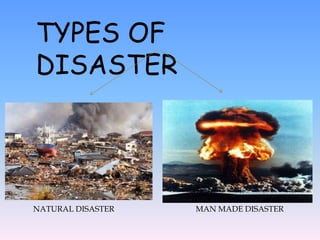
TYPES OF
DISASTER
NATURAL DISASTER MAN MADE DISASTER
NATURAL HAZARD
A natural hazard is a natural process or phenomenon that may cause
loss of life, injury or other health impacts, property damage, loss of
livelihoods and services, social and economic disruption,
or environmental damage. Various phenomena like earthquakes,
landslides, volcanic eruptions, floods, hurricanes,
tornadoes, blizzards, tsunamis, and cyclones are all natural
hazards that kill thousands of people and destroy billions of dollars of
habitat and property each year. However, the rapid
growth of the world's population and its increased concentration often
in hazardous environments has escalated both the frequency and
severity of disasters. With the tropical
climate and unstable land forms, coupled with deforestation, unplanned
growth proliferation, non engineered constructions which make the
disaster prone areas more vulnerable, tardy
communication, and poor or no budgetary allocation
for disaster prevention, developing
countries suffer more or less chronically from natural disasters. Asia
tops the list of casualties caused by natural hazards.
MANMADE
Human instigated disasters are the consequence of technological
hazards.
Examples include stampedes, fires, transport accidents, industrial
accidents, oil spills and nuclear explosions/radiation. War and
deliberate attacks may also be put in this category. As with
natural hazards, manmade hazards are events that have not
happened— for instance, terrorism. Manmade disasters are
examples of specific cases where manmade hazards have
become reality in an event.
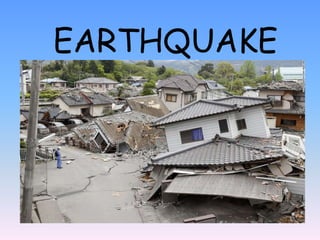
EARTHQUAKE
CASE – STUDY
The Haiti earthquake-2010
Haiti is part of a large Caribbean island called Hispaniola. On 12
January 2010, a magnitude 7 earthquake hit Haiti at 16:53 local
time. The earthquake’s epicentre was 25 km west of Port-au-
Prince, the capital.
Cause of the earthquake
Haiti lies right on the boundary of the Caribbean and North
American plates. There was slippage along a conservative plate
boundary that runs through Haiti.
Social impacts of the earthquake (effects on people)
3 million people affected.
Over 220,000 deaths.
300,000 injured.
1.3 million made homeless.
Several hospitals collapsed.
Economic impacts of the earthquake (effects on money and jobs)
30,000 commercial buildings collapsed.
Businesses destroyed.
Damage to the main clothing industry.
Airport and port damaged.
Response to the earthquake
Haiti is a very poor country without the money and resources to
redevelop. It is one of the least developed countries in the world
with most Haitians living on $2 or less per day, about £1.30.
Because there were few earthquake-resistant buildings the damage
was massive.
Neighbouring Dominican Republic provided emergency water and
medical supplies as well as heavy machinery to help with search and
rescue underneath the rubble.
Local people made up the majority of the rescuers.
Temporary shelters became home for more than a year for the
homeless, while medical care was very limited.
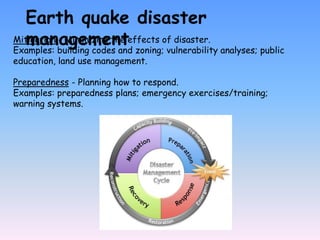
Mitigation - Minimizing the effects of disaster.
Examples: building codes and zoning; vulnerability analyses; public
education, land use management.
Preparedness - Planning how to respond.
Examples: preparedness plans; emergency exercises/training;
warning systems.
Earth quake disaster
management
Response - Efforts to minimize the hazards created by a
disaster. The aim of emergency response is to provide
immediate assistance to maintain life, improve health and
support the morale of the affected population.
Examples: search and rescue; emergency relief .
Recovery - Returning the community to normal.
Examples: temporary housing; grants; medical care.
Recovery activities continue until all systems return to
normal or better. Recovery measures, both short and long
term, include returning vital life-support systems to
minimum operating standards; temporary housing; public
information; health and safety education; reconstruction;
counseling programs; and economic impact studies.
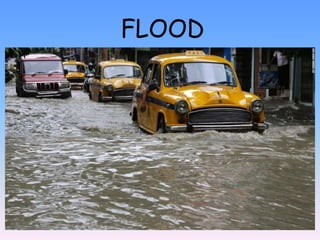
FLOOD
CASE STUDY
UTTARAKHAND FLOODS-2013
Cause
In June 2013, a multi-day cloudburst centered on the North Indian state
of Uttarakhand caused devastating floods and landslides becoming the country's
worst natural disaster since the 2004 Tsunami. The reason the floods were on
such a larger scale than the regular floods the state usually received was because
of the debris of the building of dams upstream. The debris blocked up the rivers,
causing major overflow. The main day of the flood is said to be on 16 June 2013.
Effects
Though some parts of Himachal Pradesh, Haryana, Delhi and Uttar Pradesh in
India experienced the flood, some regions of Western Nepal, and some parts of
Western Tibet also experienced heavy rainfall, over 89 % of the casualties
occurred in Uttarakhand . The floods also affected our four main holy shrines.
As of 16 July 2013, according to figures provided by the Uttarakhand
government, more than 5,700 people were "presumed dead. This total included
934 local residents.
Destruction of bridges and roads left about 100,000 pilgrims and tourists trapped
in the valleys
Response
The Indian Air Force, the Indian Army, and paramilitary troops
evacuated more than 110,000 people from the flood ravaged area.
2000 strong ITBP force with its mountaineering skills and
improvisation methods started rescue of stranded pilgrims
Relief
The Prime Minister of India undertook an aerial survey of the
affected areas and announced ₹10 billion (US$150 million) aid package
for disaster relief efforts in the state.
Disaster Management of Floods
Preparedness and Mitigation
Although flooding is a natural phenomenon, we cannot completely
stop it but we can minimize its adverse effects by better planning .
For reduction of vulnerability in the study area to flood hazard
there is urgent need toadopt long-term strategies by skillfully
combining the engineering devices with proper planning like proper
structural drainage system, avoiding encroachment on natural
watershed/ catchment areas, desilting of rivers, provision of proper
waterways, improvement of embankments, etc.
Proper warning systems should also be installed.
Houses in flood prone areas should be built with proper structural
planning.
Response and Relief
Immediate response in case of floods include providing food & water,
clothing, shelter and appropriate medical supplies to all the affected people
in order to prevent outbreak of various waterborne diseases like cholera,
etc.
Each response depends on the nature of the flood. Some of the boarder
categories of response for a flood are-
Evacuation procedure
Search and rescue
Activating special installations
Activating distributions systems
Preparing emergency reception centers and shelters
Activating emergency programs for airports, harbors and land transport.
Once an effective flood preparedness plan is in place, these responses can
be done successfully.
After the disaster appropriate measures need to be taken to ensure
rehabilitation of all the people affected by the floods. Provision for
shelters, jobs, agriculture, livestock, water supply, schools, hospitals, etc.
should be taken care of.
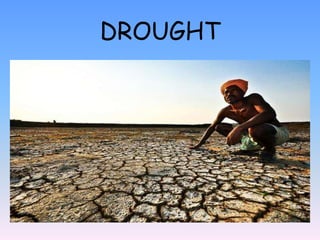
DROUGHT
CASE STUDY
Drought in Gujarat- Banaskantha district
All the drought prone talukas of Banaskantha district are located near
Rann of Kachchh. The drought prone talukas are confined on the
western part of the district, which is covering an area of 6201.7 sq. km,
that is 6.5% of the total drought prone area of the State and 48.82%
of the total area of the district.
Cause
a. late onset and early withdrawal of the monsoon,
b. lean rainfall due to paucity of depression and low pressure systems
and
c. prolonged breaks in monsoon rainfall.
d. lack of a perennial river
Drought in the district is mainly meteorological as it occurs due to the
deficit in total rainfall which results in an imbalance in water supply.
After that if the percentage of aridity index increases, meteorological
drought is further followed by hydrological, agricultural and ecological
drought.
Effects
The total population living in the drought affected area of the
district is 728,233 (1991), which is 7.72% of the total persons living
in the drought affected areas of Gujarat and 33.67% of the total
population of Banaskantha district.
Due to the lack of rainfall, soil loses its natural moisture and aridity
index increases. High aridity index causes low crop yield and leads
to the loss of vegetation and grass cover which further affects the
supply of fodder for cattle. The 1999- 2000 drought in the district
is an example of an ecological drought. The drought in the district
has diminished the resources of water and grass; forcing farmers
to look for some relief work to earn their livelihood and cattle
rearers to migrate in some areas in search of fodder and water for
their animals.
Drought Management
Through an improved understanding of the inevitability and
characteristics of drought, as well as its differences from other
natural hazards, scientists, policymakers, and the public will be
better equipped to establish much-needed policies and plans whereby
future vulnerability to drought can be reduced.
Drought Preparedness and Mitigation
It is critical that the people inhabiting each geographic region
understand their exposure to the drought hazard: for example, the
probability of drought occurrence at various severity levels.
Management Alternatives during Drought.
Many of the management alternatives available to water suppliers to
prepare for and respond to drought events fall into two broad
categories: demand management and supply augmentation.
DEMAND MANGEMENT
• Public information and education campaigns
• Emergency conservation programs
• Water service restrictions
• Restrictions on nonessential uses of water
• Prohibition of selected commercial uses
• Drought emergency pricing
• Water rationing programs
• Improvements in water systems (for example, leak detection, lining of
transmission canals)
• Emergency sources of supply (for example, emergency interconnections,
drilling new wells)
• Management of available water resources (for example, emergency water
banks, overdrafting of groundwater aquifers)
• Search for new supplies of water
In summary, increased emphasis can and should be placed on drought mitigation
and preparedness, as well as prediction and early warning capabilities, if society
is to reduce the economic and environmental damages associated with drought
and its personal hardships. This will require interdisciplinary cooperation and a
collaborative effort with policymakers at all levels.

Disaster

  • 1.
    DISASTER A disaster isa sudden, calamitous event that seriously disrupts the functioning of a community or society and causes human, material, and economic or environmental losses that exceed the community’s or society’s ability to cope using its own resources. Though often caused by nature, disasters can have human origins.
  • 2.
  • 3.
    NATURAL HAZARD A naturalhazard is a natural process or phenomenon that may cause loss of life, injury or other health impacts, property damage, loss of livelihoods and services, social and economic disruption, or environmental damage. Various phenomena like earthquakes, landslides, volcanic eruptions, floods, hurricanes, tornadoes, blizzards, tsunamis, and cyclones are all natural hazards that kill thousands of people and destroy billions of dollars of habitat and property each year. However, the rapid growth of the world's population and its increased concentration often in hazardous environments has escalated both the frequency and severity of disasters. With the tropical climate and unstable land forms, coupled with deforestation, unplanned growth proliferation, non engineered constructions which make the disaster prone areas more vulnerable, tardy communication, and poor or no budgetary allocation for disaster prevention, developing countries suffer more or less chronically from natural disasters. Asia tops the list of casualties caused by natural hazards.
  • 4.
    MANMADE Human instigated disastersare the consequence of technological hazards. Examples include stampedes, fires, transport accidents, industrial accidents, oil spills and nuclear explosions/radiation. War and deliberate attacks may also be put in this category. As with natural hazards, manmade hazards are events that have not happened— for instance, terrorism. Manmade disasters are examples of specific cases where manmade hazards have become reality in an event.
  • 5.
  • 6.
    CASE – STUDY TheHaiti earthquake-2010 Haiti is part of a large Caribbean island called Hispaniola. On 12 January 2010, a magnitude 7 earthquake hit Haiti at 16:53 local time. The earthquake’s epicentre was 25 km west of Port-au- Prince, the capital. Cause of the earthquake Haiti lies right on the boundary of the Caribbean and North American plates. There was slippage along a conservative plate boundary that runs through Haiti. Social impacts of the earthquake (effects on people) 3 million people affected. Over 220,000 deaths. 300,000 injured. 1.3 million made homeless. Several hospitals collapsed.
  • 7.
    Economic impacts ofthe earthquake (effects on money and jobs) 30,000 commercial buildings collapsed. Businesses destroyed. Damage to the main clothing industry. Airport and port damaged. Response to the earthquake Haiti is a very poor country without the money and resources to redevelop. It is one of the least developed countries in the world with most Haitians living on $2 or less per day, about £1.30. Because there were few earthquake-resistant buildings the damage was massive. Neighbouring Dominican Republic provided emergency water and medical supplies as well as heavy machinery to help with search and rescue underneath the rubble. Local people made up the majority of the rescuers. Temporary shelters became home for more than a year for the homeless, while medical care was very limited.
  • 8.
    Mitigation - Minimizingthe effects of disaster. Examples: building codes and zoning; vulnerability analyses; public education, land use management. Preparedness - Planning how to respond. Examples: preparedness plans; emergency exercises/training; warning systems. Earth quake disaster management
  • 9.
    Response - Effortsto minimize the hazards created by a disaster. The aim of emergency response is to provide immediate assistance to maintain life, improve health and support the morale of the affected population. Examples: search and rescue; emergency relief . Recovery - Returning the community to normal. Examples: temporary housing; grants; medical care. Recovery activities continue until all systems return to normal or better. Recovery measures, both short and long term, include returning vital life-support systems to minimum operating standards; temporary housing; public information; health and safety education; reconstruction; counseling programs; and economic impact studies.
  • 10.
  • 11.
    CASE STUDY UTTARAKHAND FLOODS-2013 Cause InJune 2013, a multi-day cloudburst centered on the North Indian state of Uttarakhand caused devastating floods and landslides becoming the country's worst natural disaster since the 2004 Tsunami. The reason the floods were on such a larger scale than the regular floods the state usually received was because of the debris of the building of dams upstream. The debris blocked up the rivers, causing major overflow. The main day of the flood is said to be on 16 June 2013. Effects Though some parts of Himachal Pradesh, Haryana, Delhi and Uttar Pradesh in India experienced the flood, some regions of Western Nepal, and some parts of Western Tibet also experienced heavy rainfall, over 89 % of the casualties occurred in Uttarakhand . The floods also affected our four main holy shrines. As of 16 July 2013, according to figures provided by the Uttarakhand government, more than 5,700 people were "presumed dead. This total included 934 local residents. Destruction of bridges and roads left about 100,000 pilgrims and tourists trapped in the valleys
  • 12.
    Response The Indian AirForce, the Indian Army, and paramilitary troops evacuated more than 110,000 people from the flood ravaged area. 2000 strong ITBP force with its mountaineering skills and improvisation methods started rescue of stranded pilgrims Relief The Prime Minister of India undertook an aerial survey of the affected areas and announced ₹10 billion (US$150 million) aid package for disaster relief efforts in the state.
  • 13.
    Disaster Management ofFloods Preparedness and Mitigation Although flooding is a natural phenomenon, we cannot completely stop it but we can minimize its adverse effects by better planning . For reduction of vulnerability in the study area to flood hazard there is urgent need toadopt long-term strategies by skillfully combining the engineering devices with proper planning like proper structural drainage system, avoiding encroachment on natural watershed/ catchment areas, desilting of rivers, provision of proper waterways, improvement of embankments, etc. Proper warning systems should also be installed. Houses in flood prone areas should be built with proper structural planning.
  • 14.
    Response and Relief Immediateresponse in case of floods include providing food & water, clothing, shelter and appropriate medical supplies to all the affected people in order to prevent outbreak of various waterborne diseases like cholera, etc. Each response depends on the nature of the flood. Some of the boarder categories of response for a flood are- Evacuation procedure Search and rescue Activating special installations Activating distributions systems Preparing emergency reception centers and shelters Activating emergency programs for airports, harbors and land transport. Once an effective flood preparedness plan is in place, these responses can be done successfully. After the disaster appropriate measures need to be taken to ensure rehabilitation of all the people affected by the floods. Provision for shelters, jobs, agriculture, livestock, water supply, schools, hospitals, etc. should be taken care of.
  • 15.
  • 16.
    CASE STUDY Drought inGujarat- Banaskantha district All the drought prone talukas of Banaskantha district are located near Rann of Kachchh. The drought prone talukas are confined on the western part of the district, which is covering an area of 6201.7 sq. km, that is 6.5% of the total drought prone area of the State and 48.82% of the total area of the district. Cause a. late onset and early withdrawal of the monsoon, b. lean rainfall due to paucity of depression and low pressure systems and c. prolonged breaks in monsoon rainfall. d. lack of a perennial river Drought in the district is mainly meteorological as it occurs due to the deficit in total rainfall which results in an imbalance in water supply. After that if the percentage of aridity index increases, meteorological drought is further followed by hydrological, agricultural and ecological drought.
  • 17.
    Effects The total populationliving in the drought affected area of the district is 728,233 (1991), which is 7.72% of the total persons living in the drought affected areas of Gujarat and 33.67% of the total population of Banaskantha district. Due to the lack of rainfall, soil loses its natural moisture and aridity index increases. High aridity index causes low crop yield and leads to the loss of vegetation and grass cover which further affects the supply of fodder for cattle. The 1999- 2000 drought in the district is an example of an ecological drought. The drought in the district has diminished the resources of water and grass; forcing farmers to look for some relief work to earn their livelihood and cattle rearers to migrate in some areas in search of fodder and water for their animals.
  • 18.
    Drought Management Through animproved understanding of the inevitability and characteristics of drought, as well as its differences from other natural hazards, scientists, policymakers, and the public will be better equipped to establish much-needed policies and plans whereby future vulnerability to drought can be reduced. Drought Preparedness and Mitigation It is critical that the people inhabiting each geographic region understand their exposure to the drought hazard: for example, the probability of drought occurrence at various severity levels. Management Alternatives during Drought. Many of the management alternatives available to water suppliers to prepare for and respond to drought events fall into two broad categories: demand management and supply augmentation.
  • 19.
    DEMAND MANGEMENT • Publicinformation and education campaigns • Emergency conservation programs • Water service restrictions • Restrictions on nonessential uses of water • Prohibition of selected commercial uses • Drought emergency pricing • Water rationing programs • Improvements in water systems (for example, leak detection, lining of transmission canals) • Emergency sources of supply (for example, emergency interconnections, drilling new wells) • Management of available water resources (for example, emergency water banks, overdrafting of groundwater aquifers) • Search for new supplies of water In summary, increased emphasis can and should be placed on drought mitigation and preparedness, as well as prediction and early warning capabilities, if society is to reduce the economic and environmental damages associated with drought and its personal hardships. This will require interdisciplinary cooperation and a collaborative effort with policymakers at all levels.