CONCEPT OF DISASTER RISK REDUCTION (DRR) AND
DISASTER RISK REDUCTION AND MANAGEMENT (DRRM)
9.1 Disaster Risk Reduction
9.2 Community-Based Disaster Risk Reduction
and Management (CBDRRM) for Preparedness
REID CHRYSLER C. MANARES
D
D
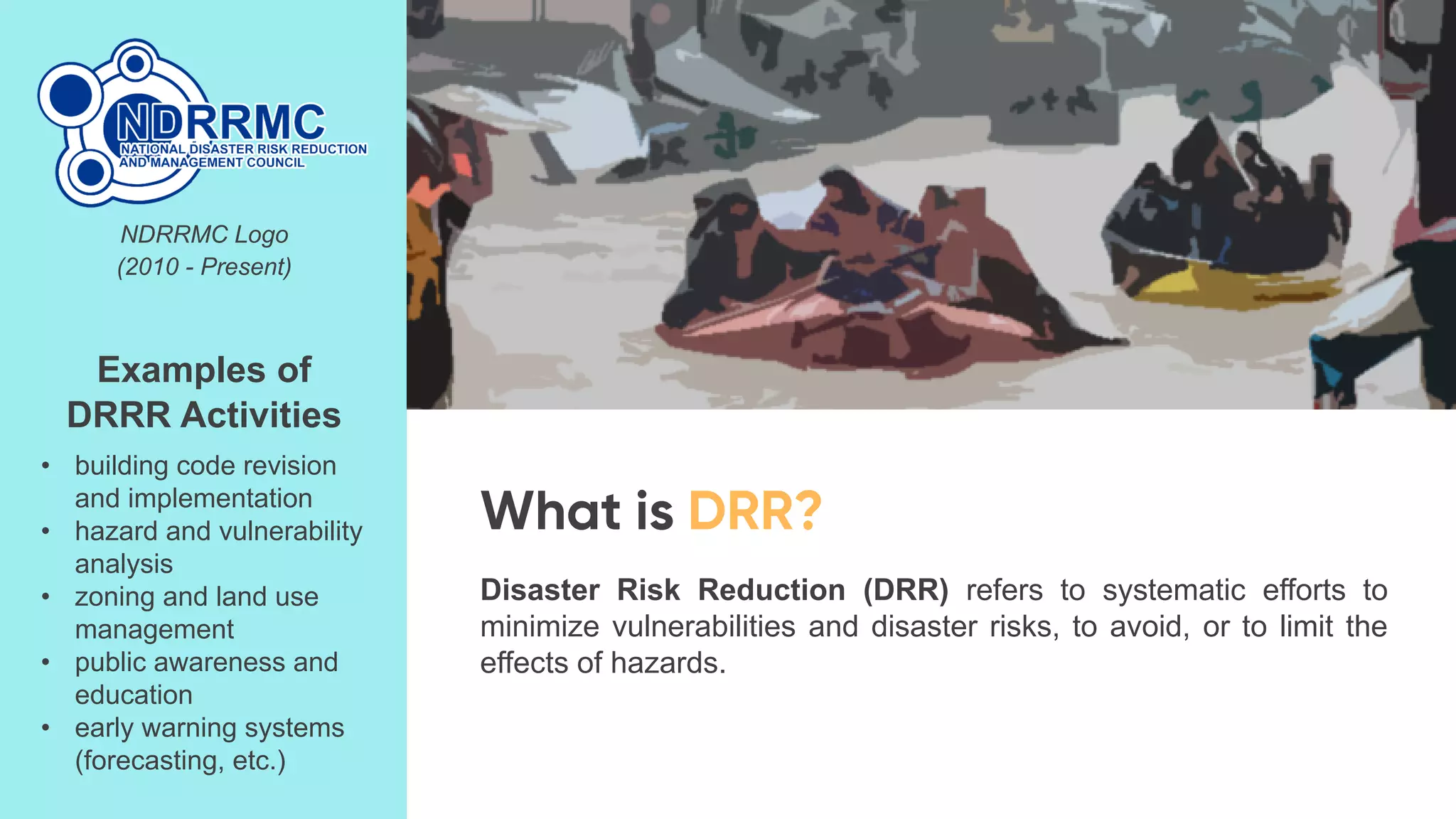
Disaster Risk Reduction (DRR) refers to systematic efforts to
minimize vulnerabilities and disaster risks, to avoid, or to limit the
effects of hazards.
Examples of
DRRR Activities
• building code revision
and implementation
• hazard and vulnerability
analysis
• zoning and land use
management
• public awareness and
education
• early warning systems
(forecasting, etc.)
NDRRMC Logo
(2010 - Present)
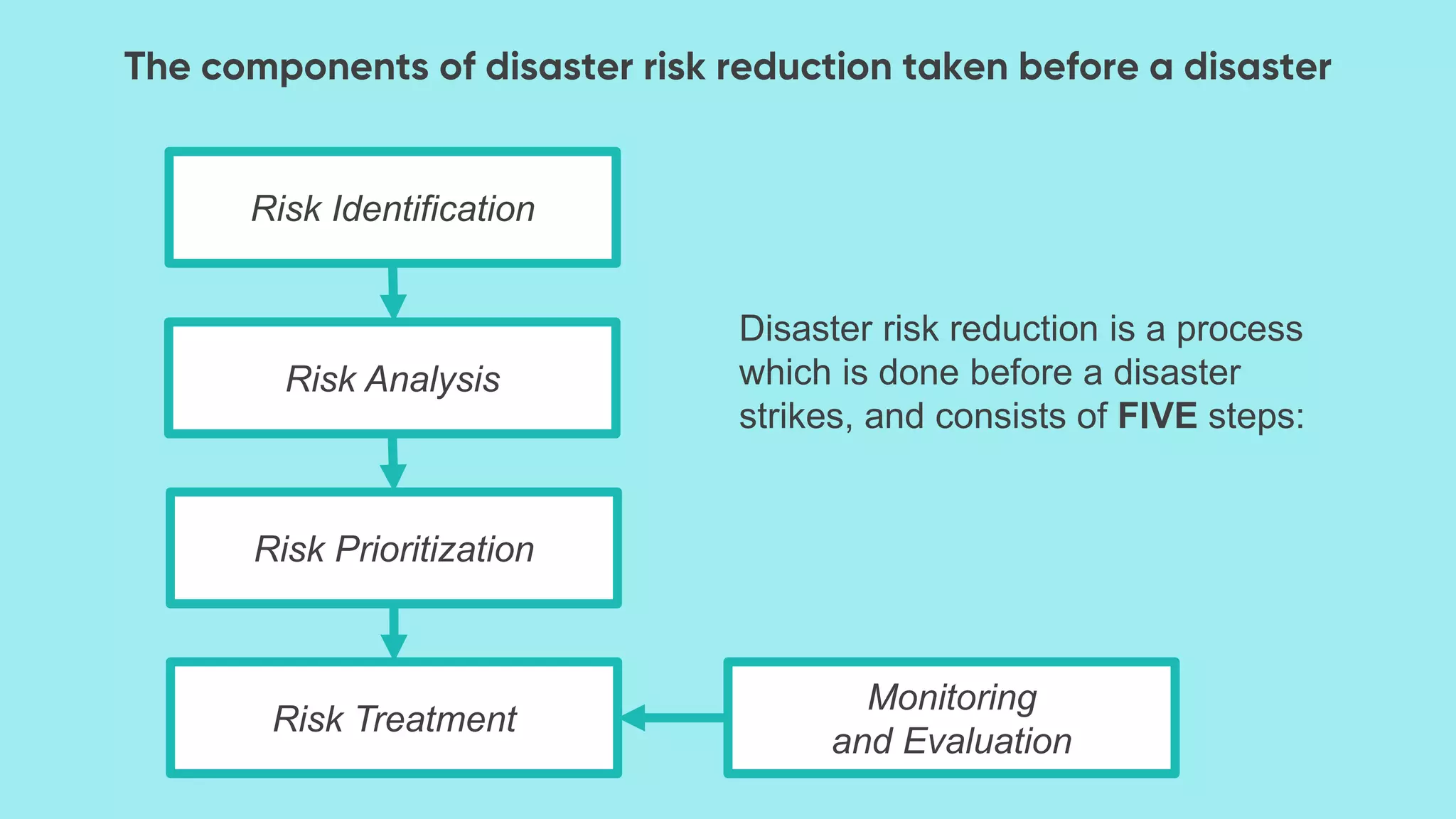
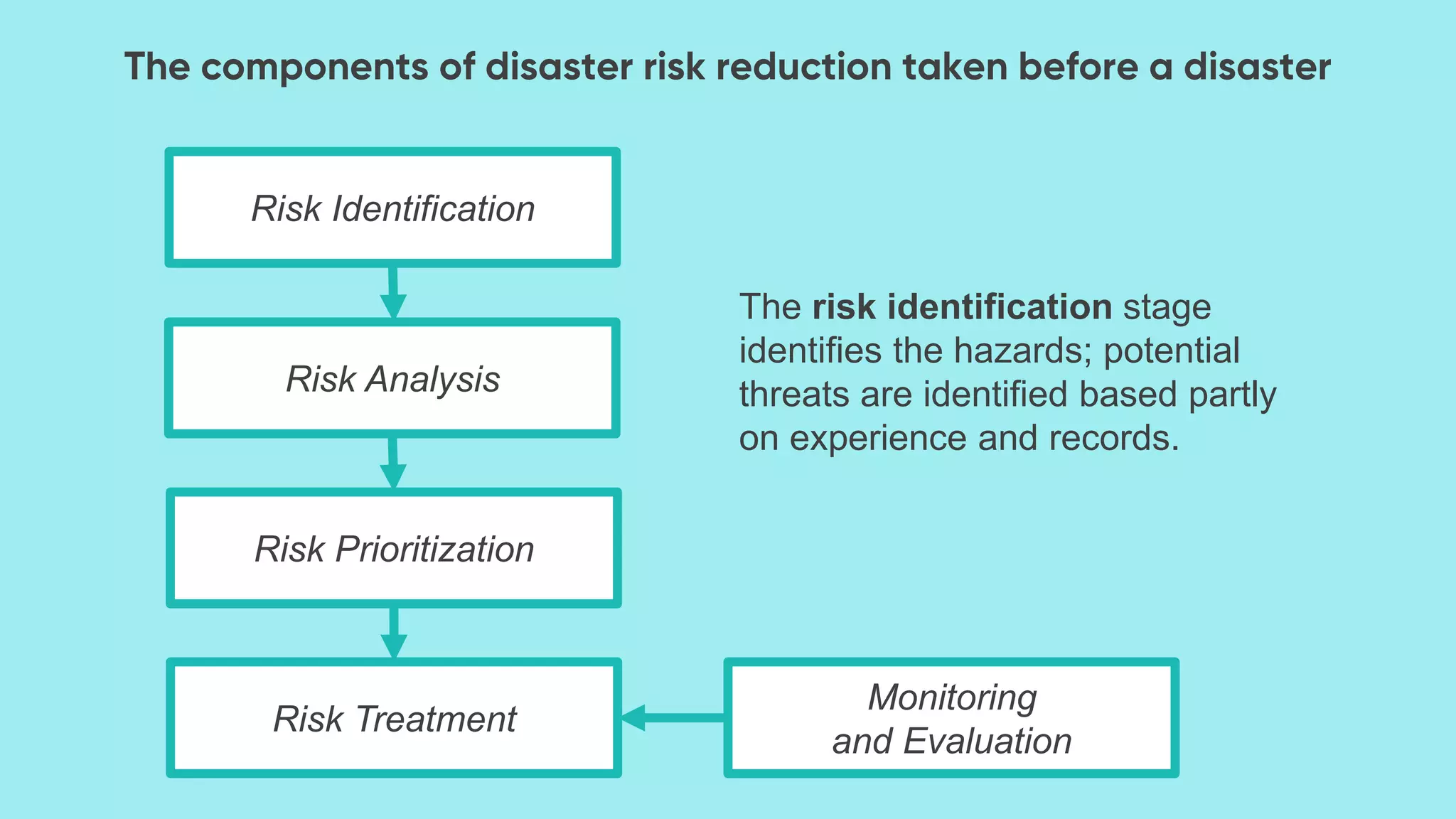
Risk Identification
Risk Analysis
Risk Prioritization
Risk Treatment
Monitoring
and Evaluation
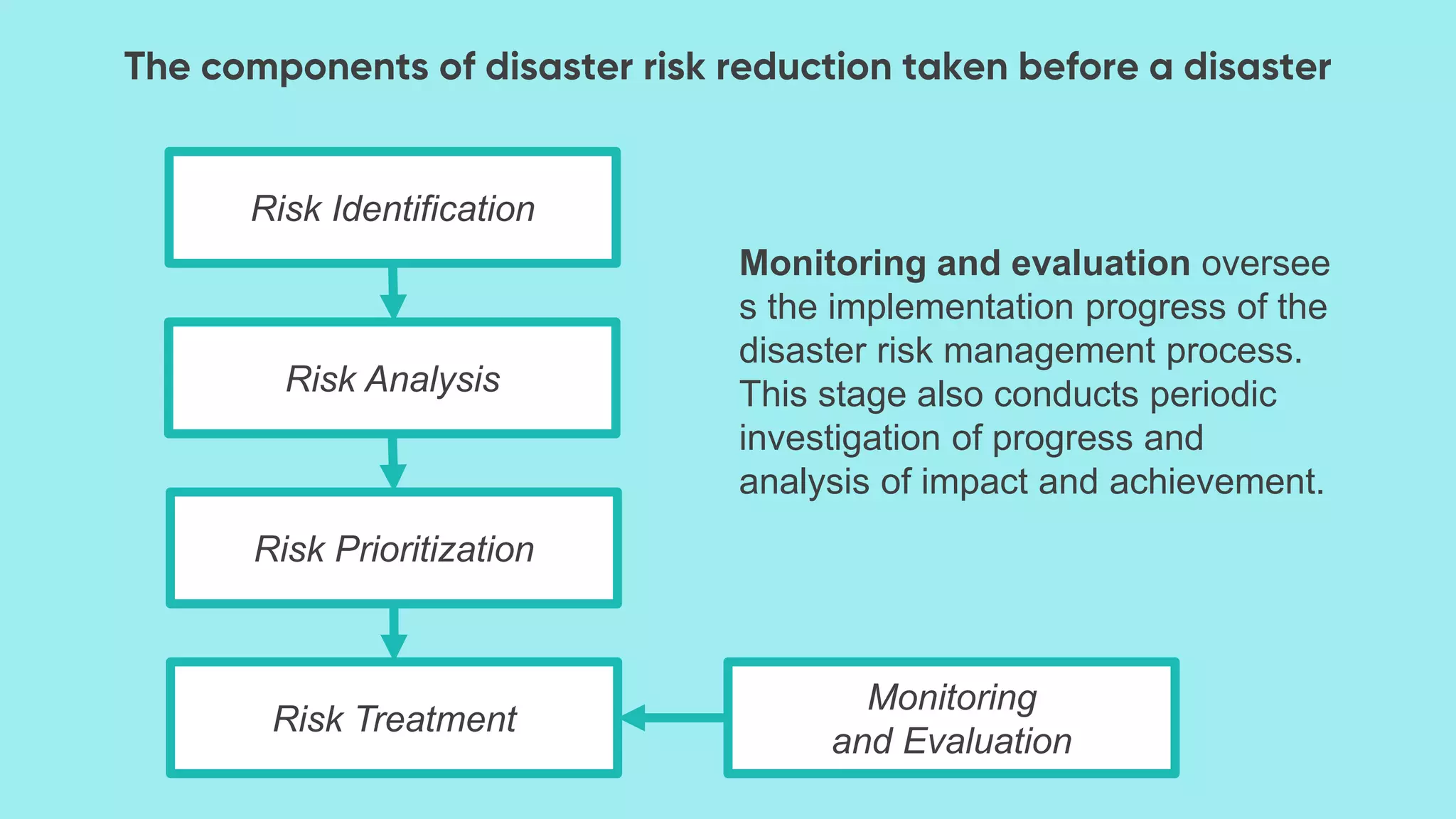
Disaster risk reduction is a process
which is done before a disaster
strikes, and consists of FIVE steps:
Risk Identification
Risk Analysis
Risk Prioritization
Risk Treatment
Monitoring
and Evaluation
The risk identification stage
identifies the hazards; potential
threats are identified based partly
on experience and records.
Risk Identification
Risk Analysis
Risk Prioritization
Risk Treatment
Monitoring
and Evaluation
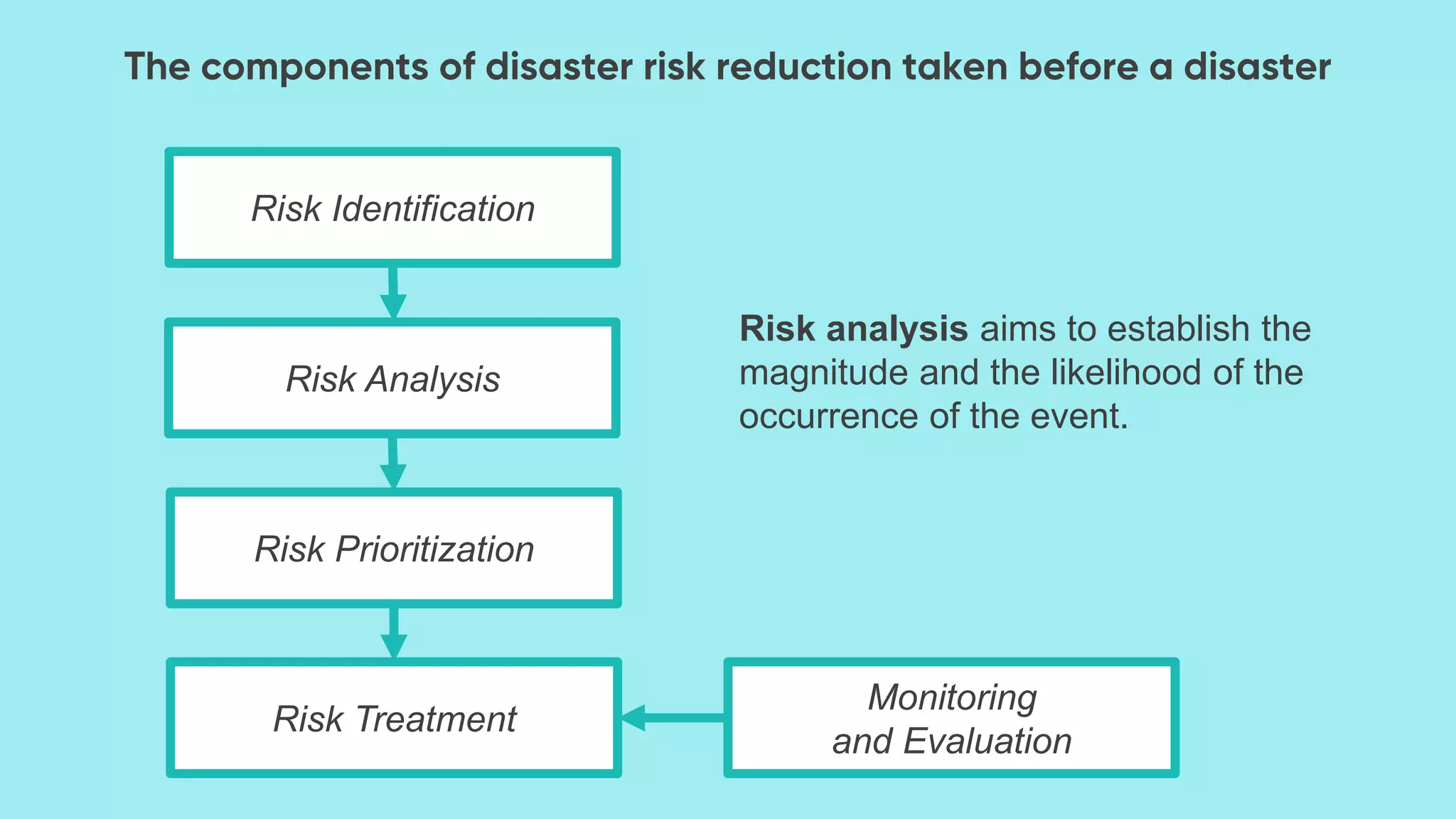
Risk analysis aims to establish the
magnitude and the likelihood of the
occurrence of the event.
Risk Identification
Risk Analysis
Risk Prioritization
Risk Treatment
Monitoring
and Evaluation
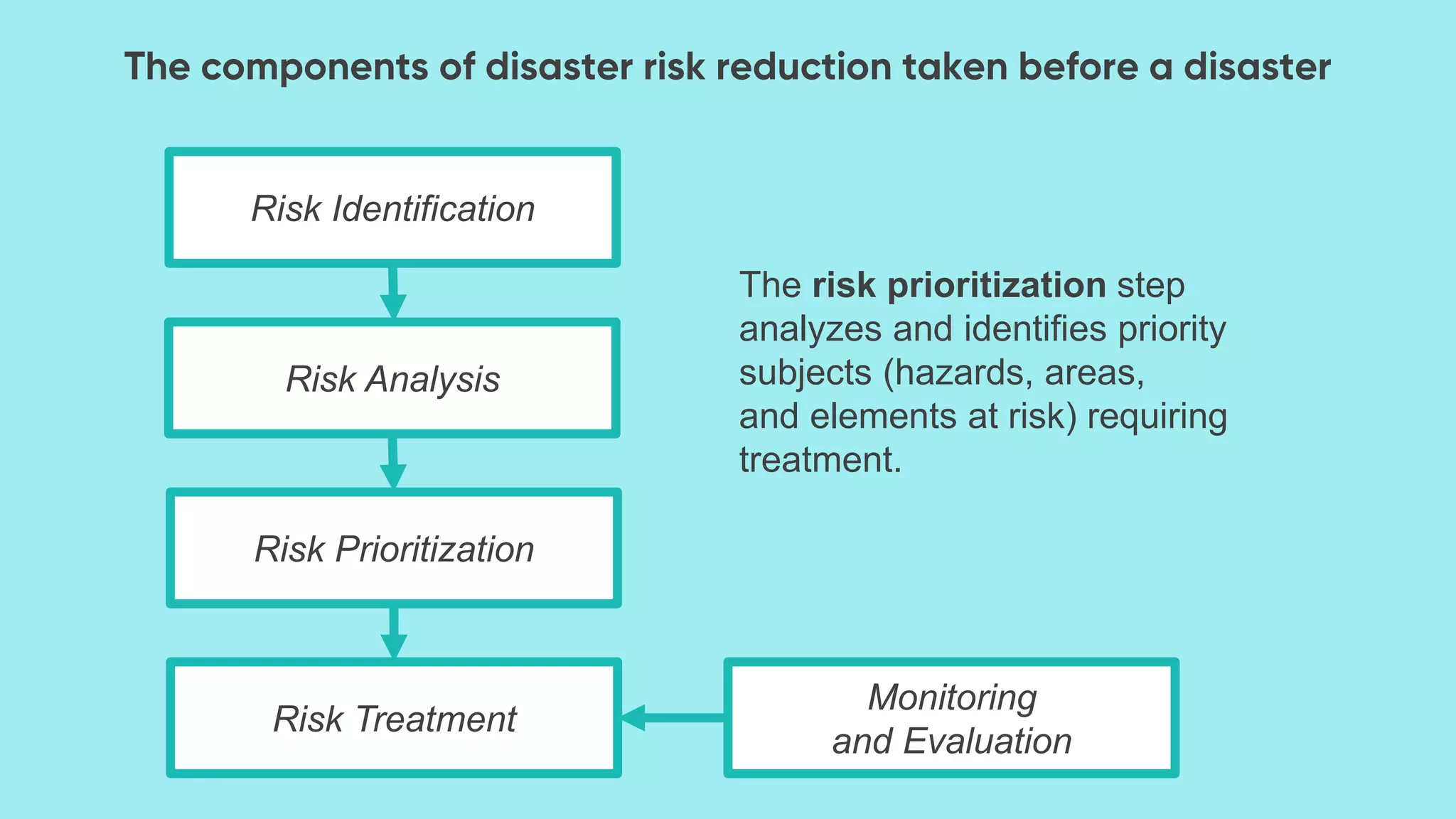
The risk prioritization step
analyzes and identifies priority
subjects (hazards, areas,
and elements at risk) requiring
treatment.
Risk Identification
Risk Analysis
Risk Prioritization
Risk Treatment
Monitoring
and Evaluation
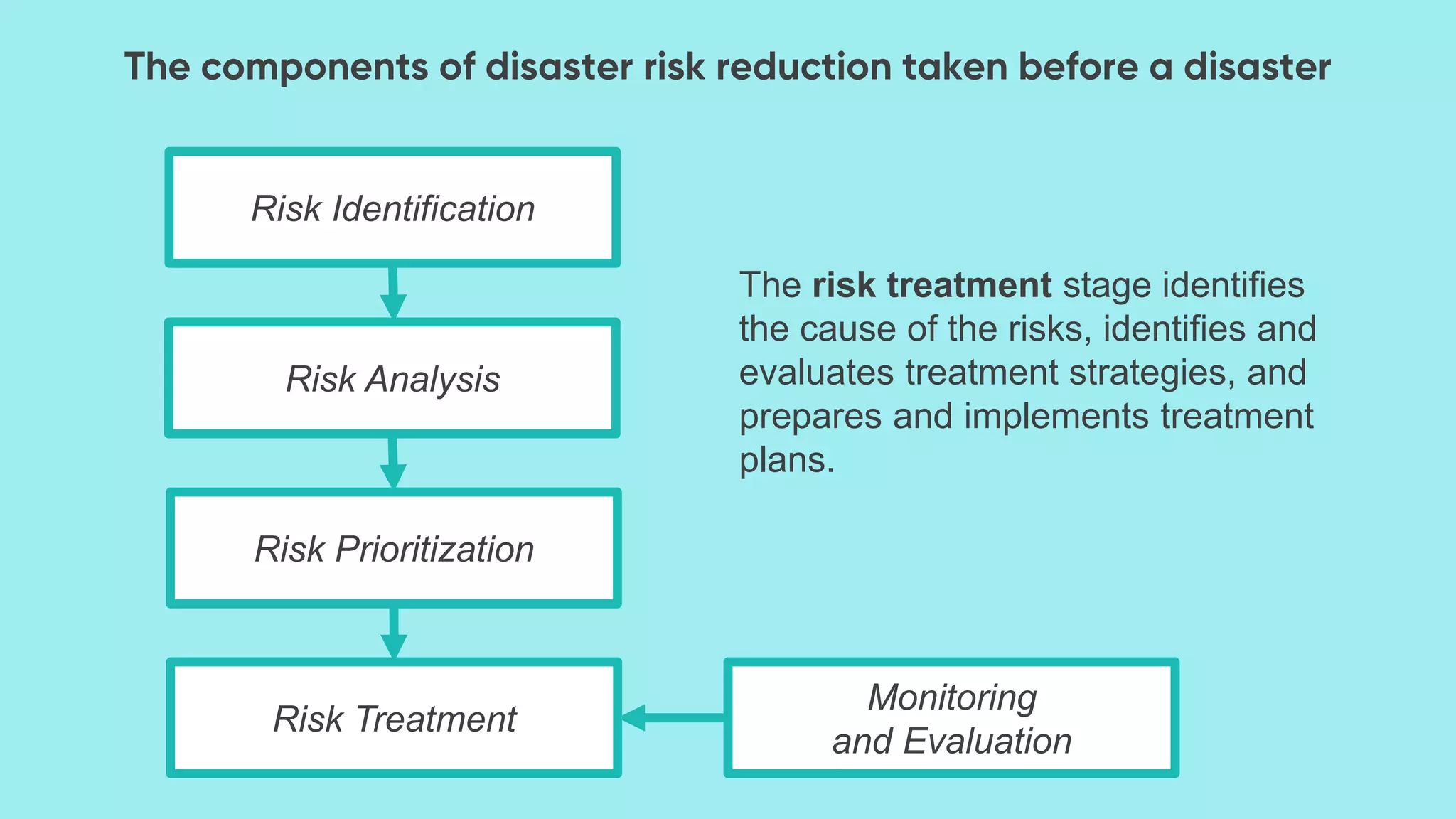
The risk treatment stage identifies
the cause of the risks, identifies and
evaluates treatment strategies, and
prepares and implements treatment
plans.
Risk Identification
Risk Analysis
Risk Prioritization
Risk Treatment
Monitoring
and Evaluation
Monitoring and evaluation oversee
s the implementation progress of the
disaster risk management process.
This stage also conducts periodic
investigation of progress and
analysis of impact and achievement.
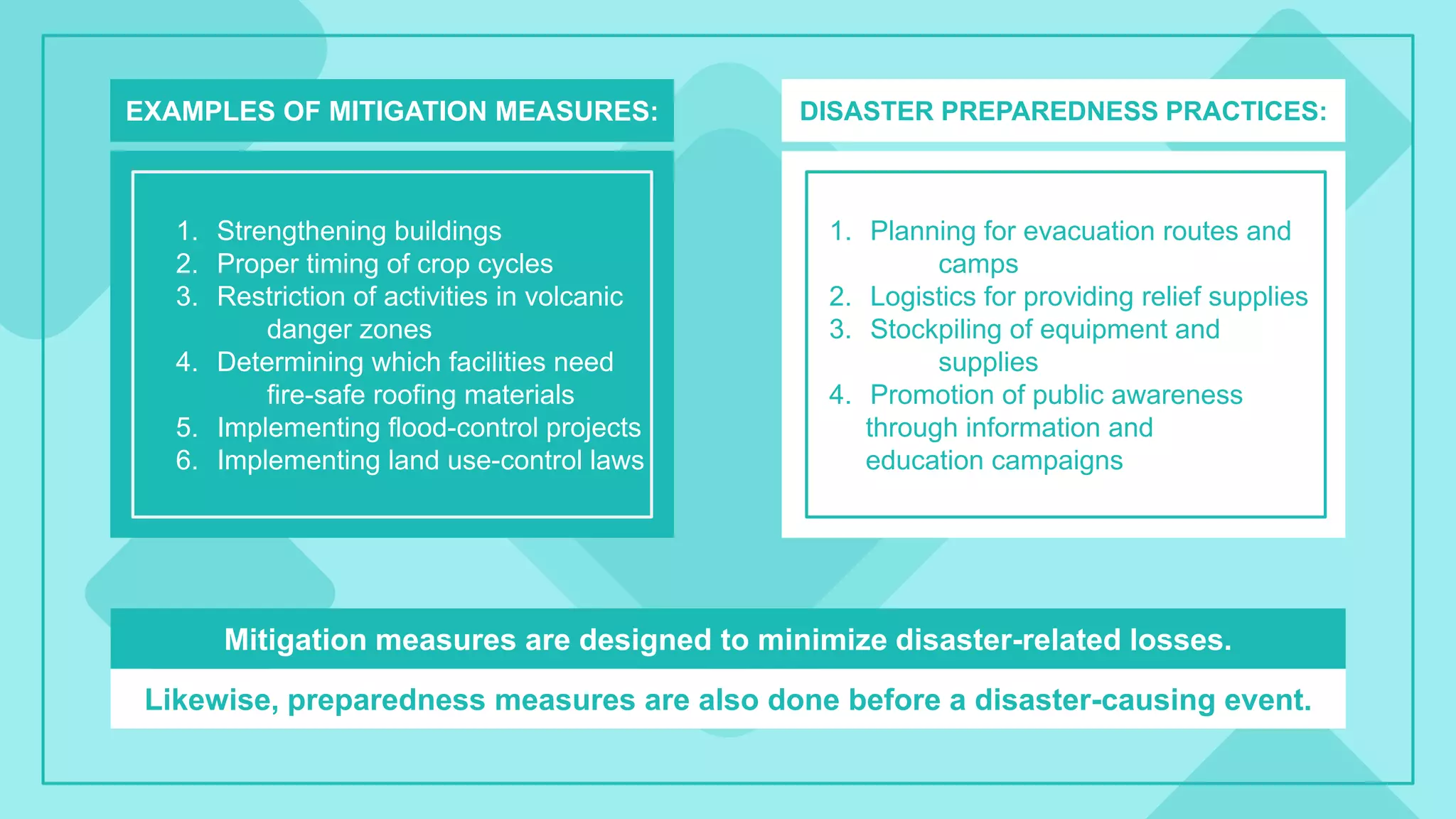
Mitigation measures are designed to minimize disaster-related losses.
EXAMPLES OF MITIGATION MEASURES:
1. Strengthening buildings
2. Proper timing of crop cycles
3. Restriction of activities in volcanic
danger zones
4. Determining which facilities need
fire-safe roofing materials
5. Implementing flood-control projects
6. Implementing land use-control laws
DISASTER PREPAREDNESS PRACTICES:
1. Planning for evacuation routes and
camps
2. Logistics for providing relief supplies
3. Stockpiling of equipment and
supplies
4. Promotion of public awareness
through information and
education campaigns
Likewise, preparedness measures are also done before a disaster-causing event.
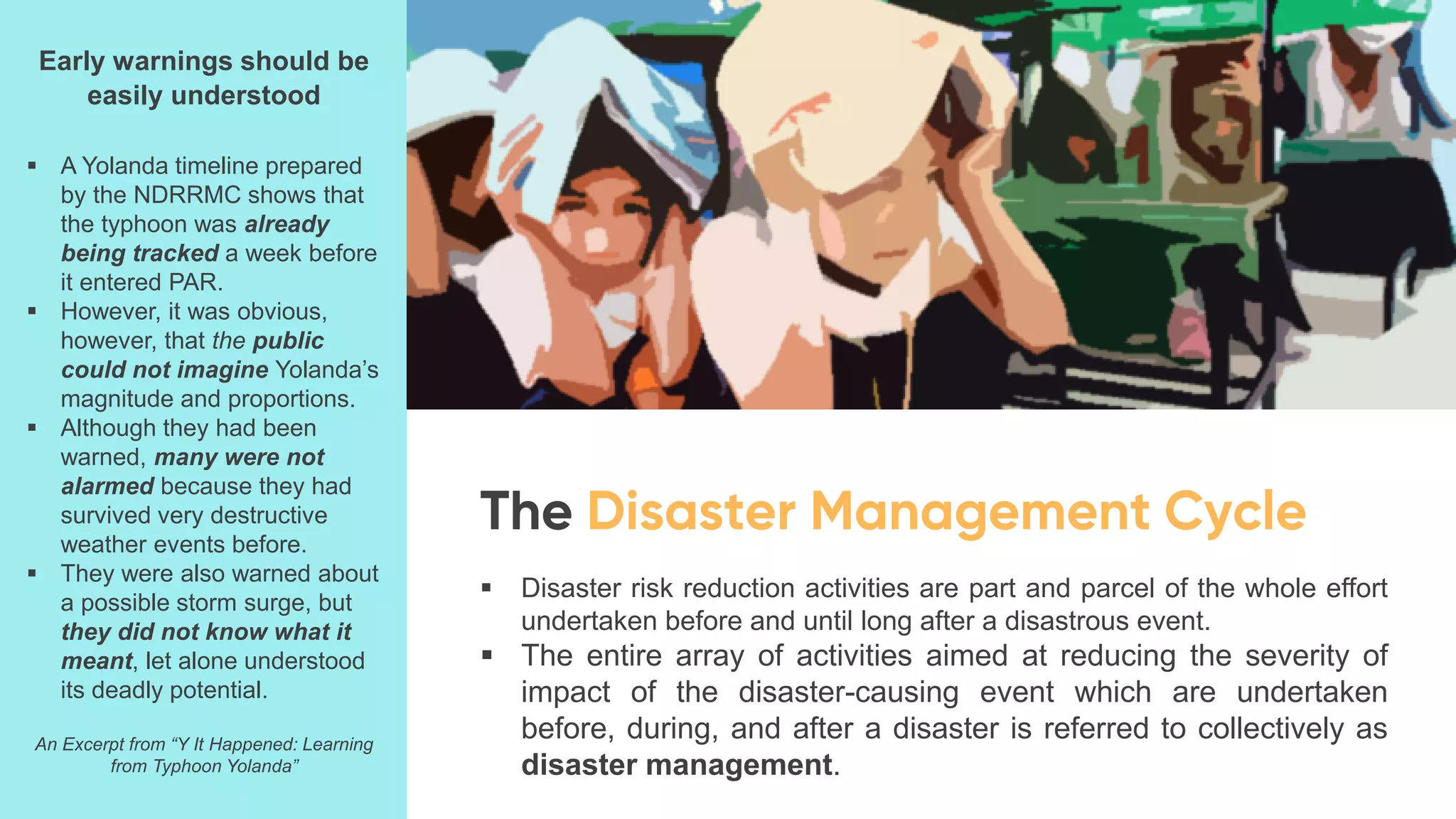
▪ Disaster risk reduction activities are part and parcel of the whole effort
undertaken before and until long after a disastrous event.
▪ The entire array of activities aimed at reducing the severity of
impact of the disaster-causing event which are undertaken
before, during, and after a disaster is referred to collectively as
disaster management.
Early warnings should be
easily understood
▪ A Yolanda timeline prepared
by the NDRRMC shows that
the typhoon was already
being tracked a week before
it entered PAR.
▪ However, it was obvious,
however, that the public
could not imagine Yolanda’s
magnitude and proportions.
▪ Although they had been
warned, many were not
alarmed because they had
survived very destructive
weather events before.
▪ They were also warned about
a possible storm surge, but
they did not know what it
meant, let alone understood
its deadly potential.
An Excerpt from “Y It Happened: Learning
from Typhoon Yolanda”
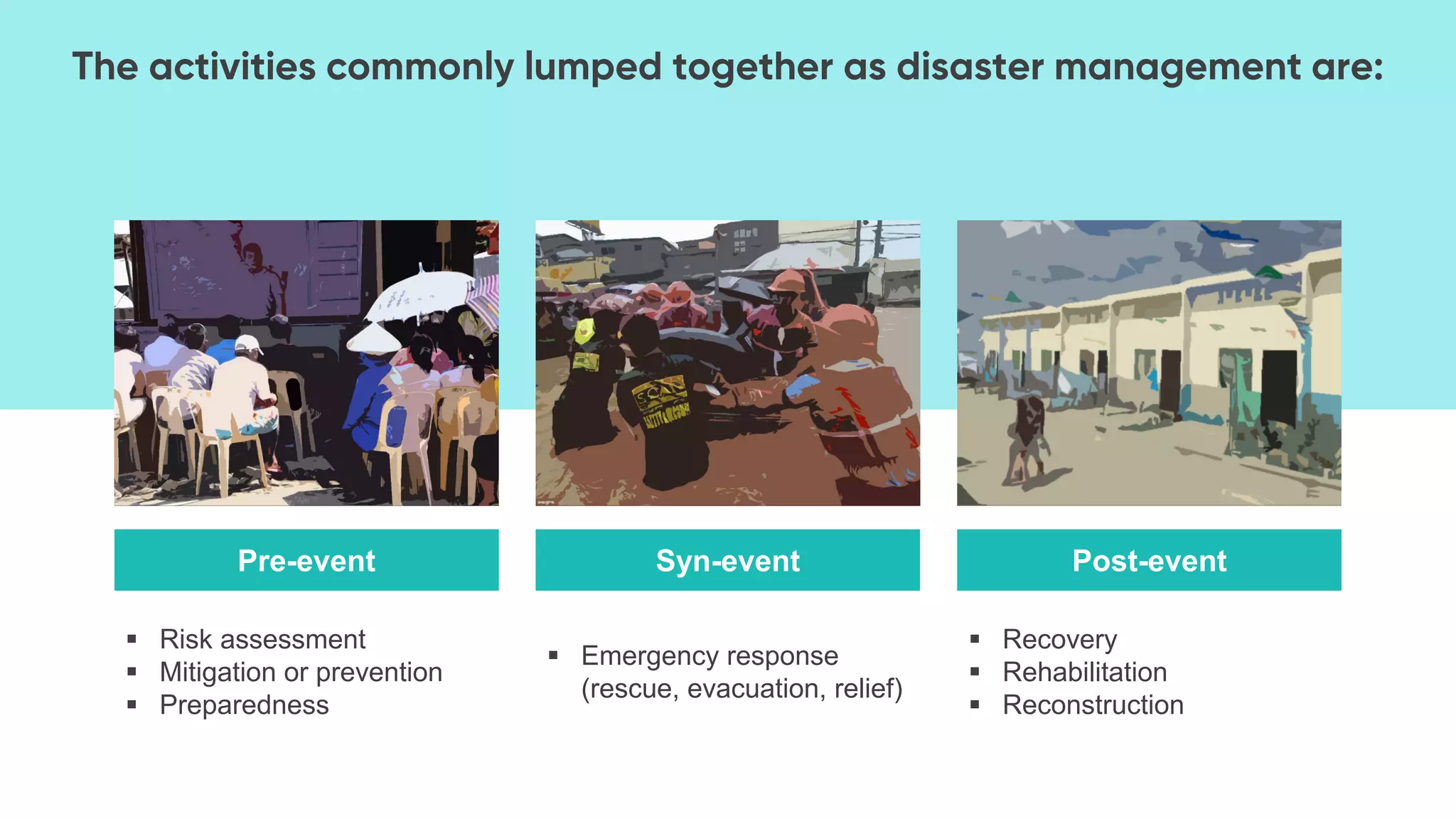
Pre-event Syn-event Post-event
▪ Risk assessment
▪ Mitigation or prevention
▪ Preparedness
▪ Emergency response
(rescue, evacuation, relief)
▪ Recovery
▪ Rehabilitation
▪ Reconstruction
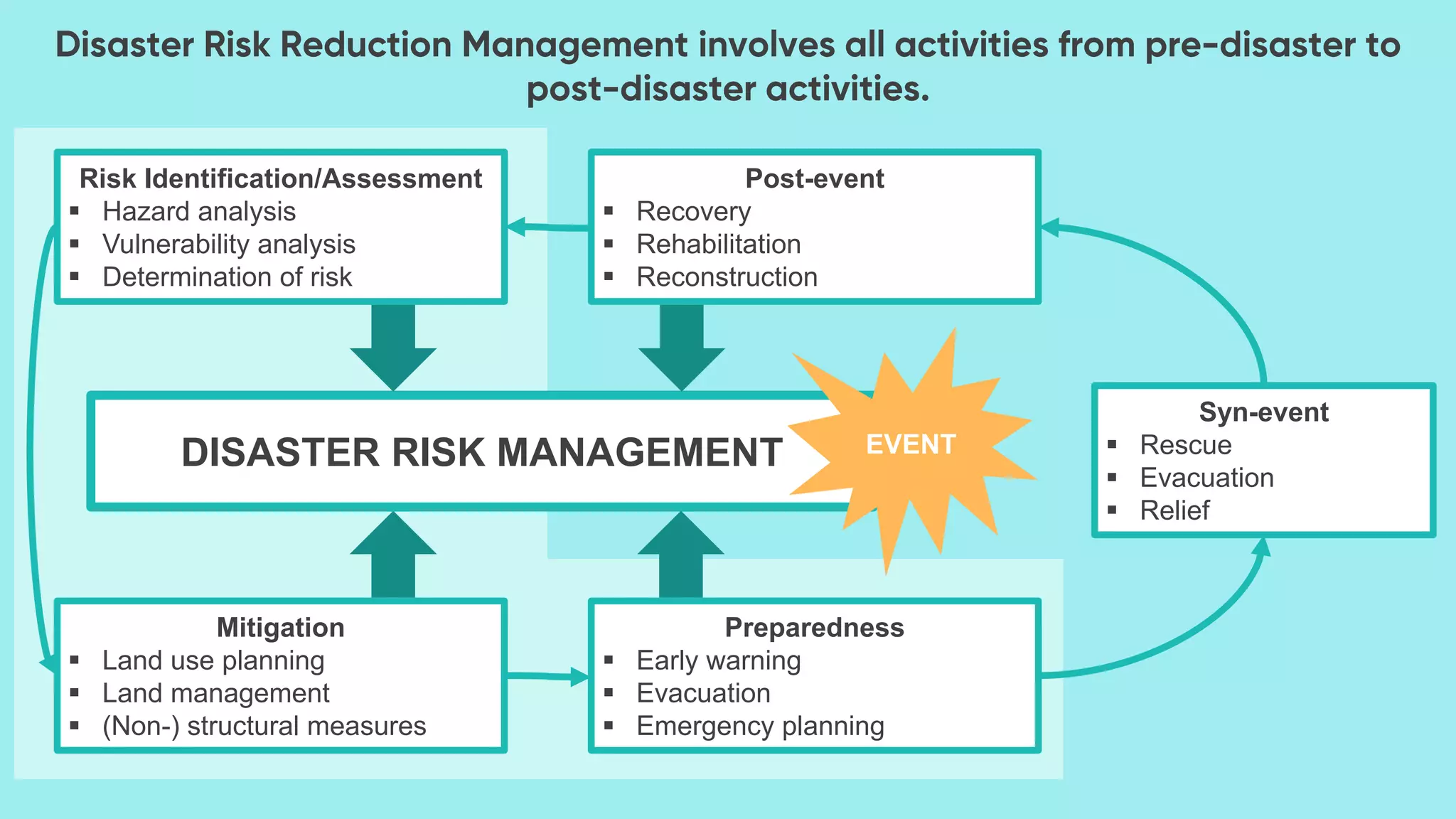
Risk Identification/Assessment
▪ Hazard analysis
▪ Vulnerability analysis
▪ Determination of risk
DISASTER RISK MANAGEMENT EVENT
Post-event
▪ Recovery
▪ Rehabilitation
▪ Reconstruction
Syn-event
▪ Rescue
▪ Evacuation
▪ Relief
Preparedness
▪ Early warning
▪ Evacuation
▪ Emergency planning
Mitigation
▪ Land use planning
▪ Land management
▪ (Non-) structural measures
D
D
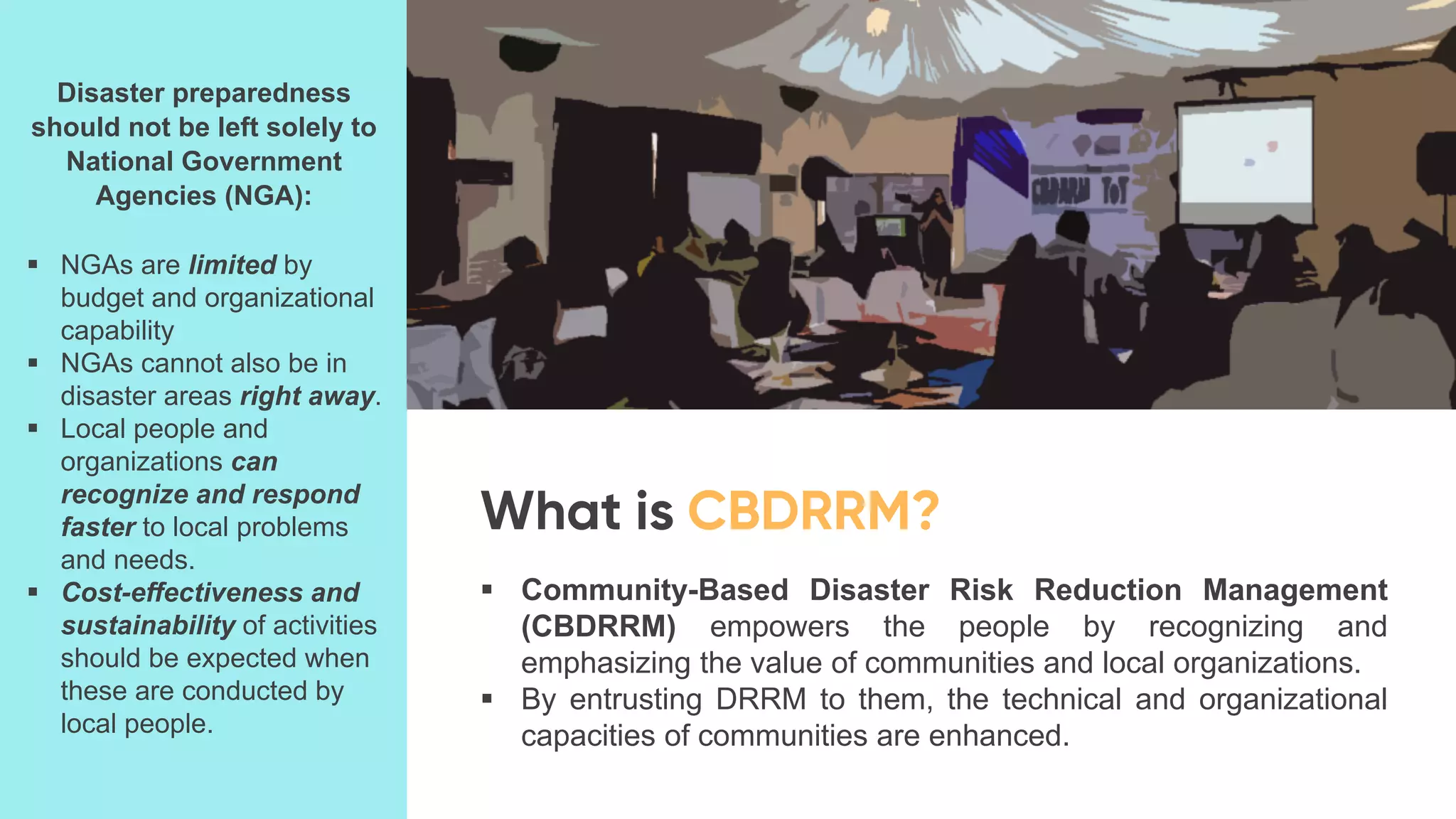
▪ Community-Based Disaster Risk Reduction Management
(CBDRRM) empowers the people by recognizing and
emphasizing the value of communities and local organizations.
▪ By entrusting DRRM to them, the technical and organizational
capacities of communities are enhanced.
Disaster preparedness
should not be left solely to
National Government
Agencies (NGA):
▪ NGAs are limited by
budget and organizational
capability
▪ NGAs cannot also be in
disaster areas right away.
▪ Local people and
organizations can
recognize and respond
faster to local problems
and needs.
▪ Cost-effectiveness and
sustainability of activities
should be expected when
these are conducted by
local people.
WHO ARE THE PARTICIPANTS IN CBDRRM?
CBDRRM engages in communities,
not only in DRR, but also in all phases
of the disaster management cycle.
The tasks of decision-making and
activity implementation rest primarily
on local people and organizations,
with the national government
assuming a supportive partner’s role.
WHAT ARE THE AIMS OF CBDRRM?
CBDRRM aims to create resilient
communities which are able to reduce
their vulnerabilities and exposure, and
at the same time, enhance their
capacities before, during, and after
a disaster.
Capacity refers to the ability to reduce the probability of failure through
risk reduction measures, to reduce the consequences of failure, and to reduce
recovery time and patterns of vulnerability during reconstruction.
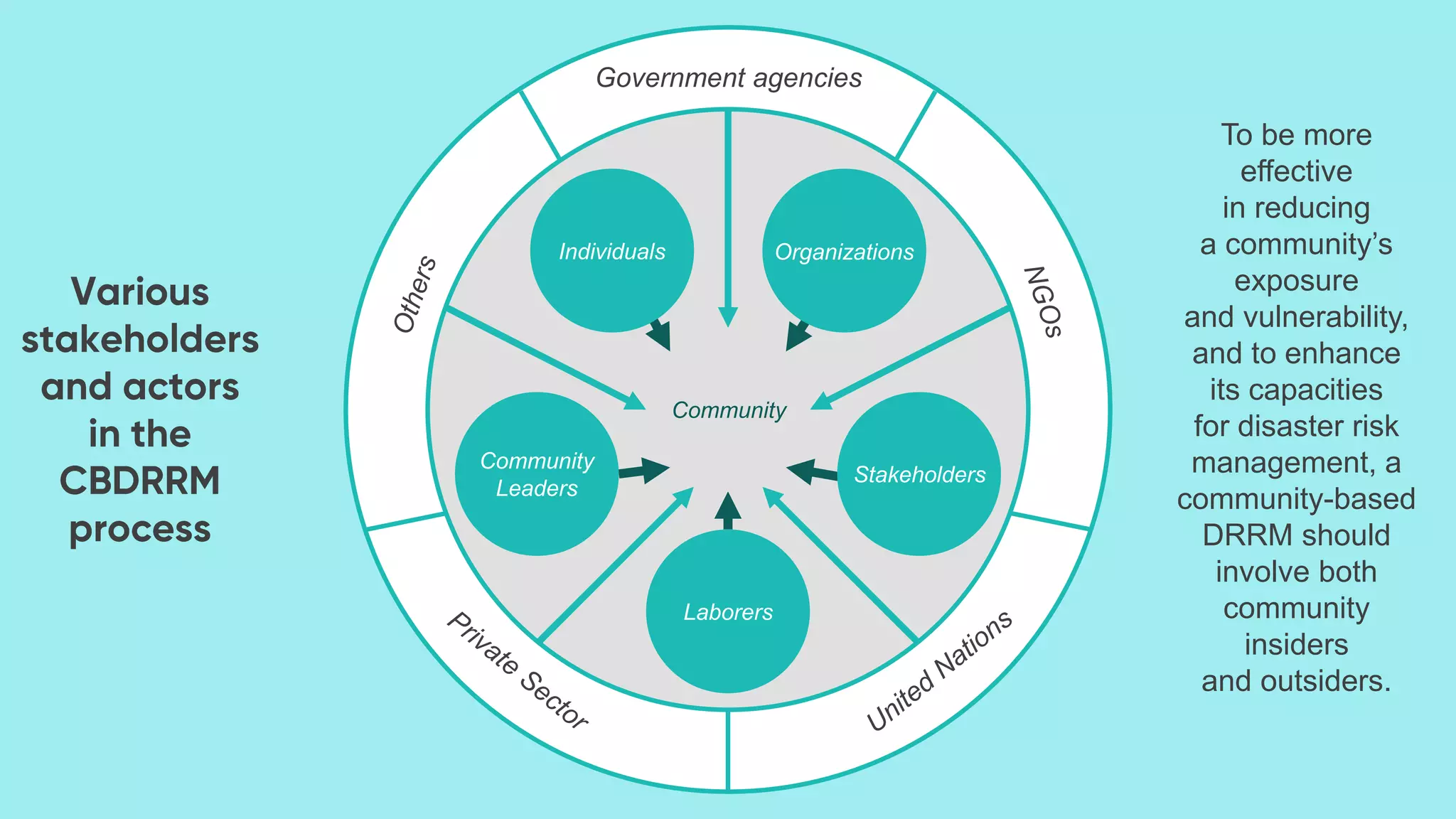
Government agencies
Individuals Organizations
Community
Leaders
Stakeholders
Laborers
Community
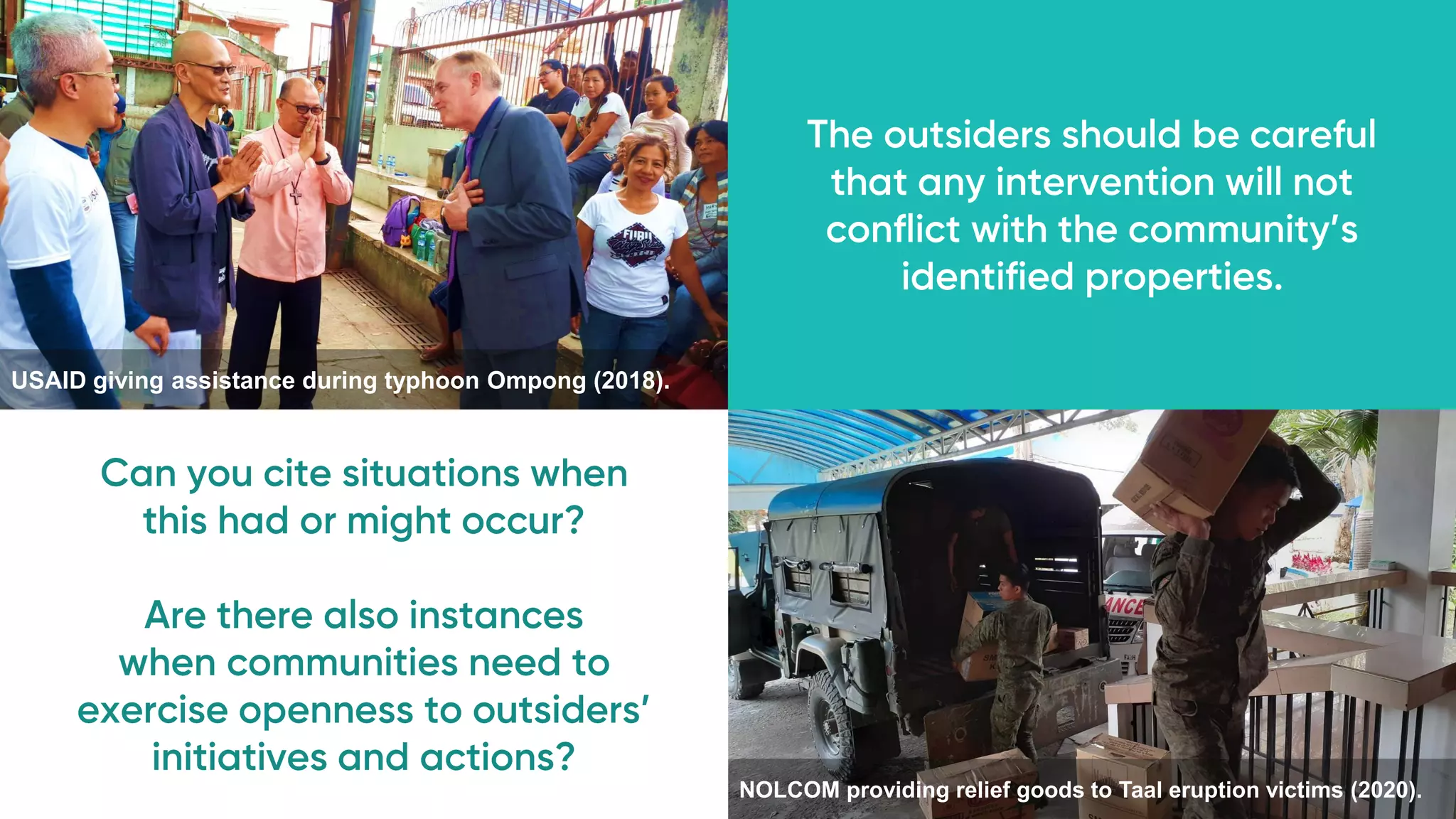
To be more
effective
in reducing
a community’s
exposure
and vulnerability,
and to enhance
its capacities
for disaster risk
management, a
community-based
DRRM should
involve both
community
insiders
and outsiders.
NOLCOM providing relief goods to Taal eruption victims (2020).
USAID giving assistance during typhoon Ompong (2018).
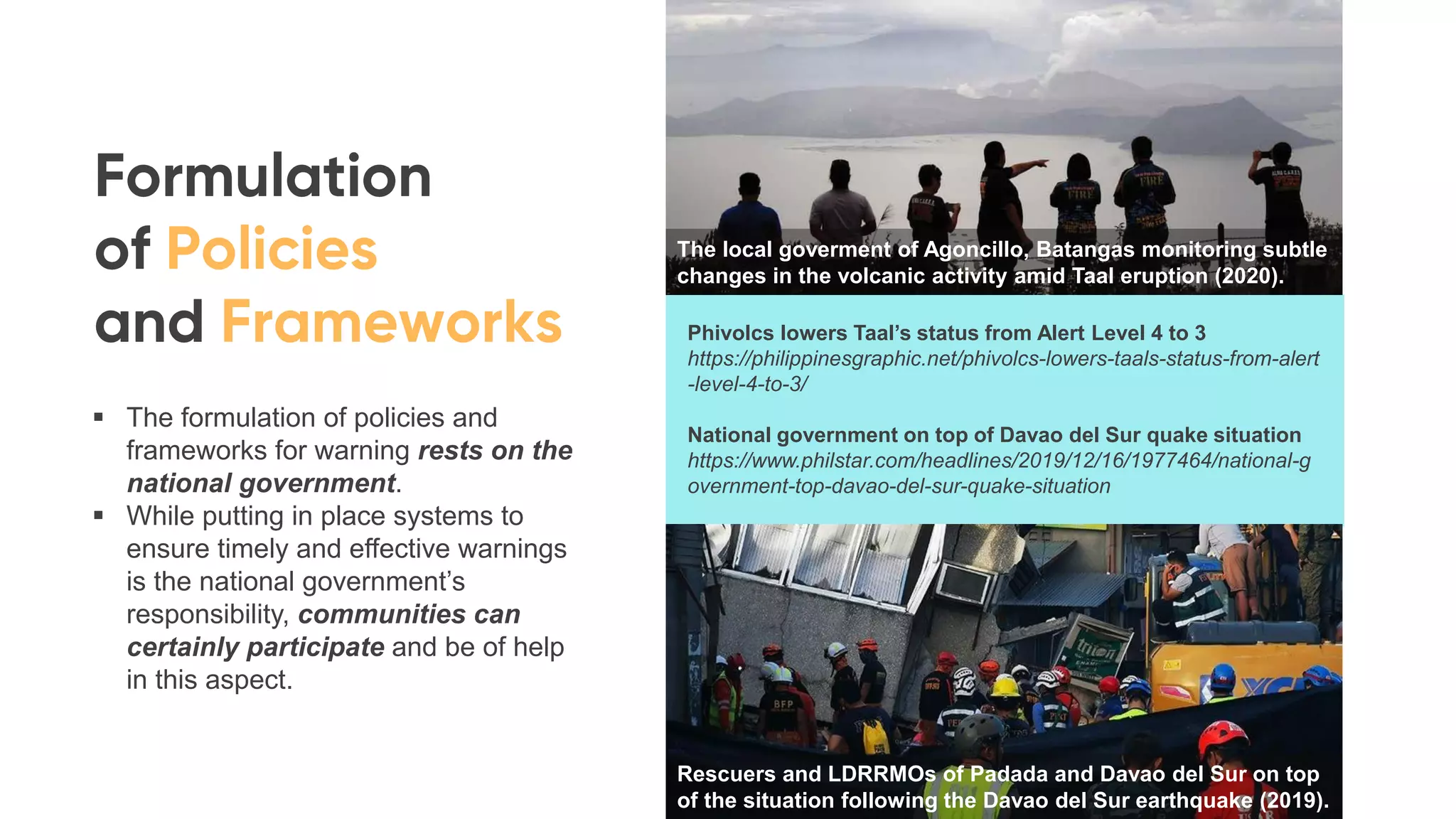
Phivolcs lowers Taal’s status from Alert Level 4 to 3
https://philippinesgraphic.net/phivolcs-lowers-taals-status-from-alert
-level-4-to-3/
National government on top of Davao del Sur quake situation
https://www.philstar.com/headlines/2019/12/16/1977464/national-g
overnment-top-davao-del-sur-quake-situation
▪ The formulation of policies and
frameworks for warning rests on the
national government.
▪ While putting in place systems to
ensure timely and effective warnings
is the national government’s
responsibility, communities can
certainly participate and be of help
in this aspect.
The local goverment of Agoncillo, Batangas monitoring subtle
changes in the volcanic activity amid Taal eruption (2020).
Rescuers and LDRRMOs of Padada and Davao del Sur on top
of the situation following the Davao del Sur earthquake (2019).
▪ Predictions and warnings are
indispensable preparedness
tools undertaken before a disaster
strikes.
▪ People, however, should be made
to understand the nature and
consequences of the hazards they
are faced with when warnings are
issued.
▪ The severity of hazards and the
consequences of not heeding
predictions and warnings should be
properly explained.
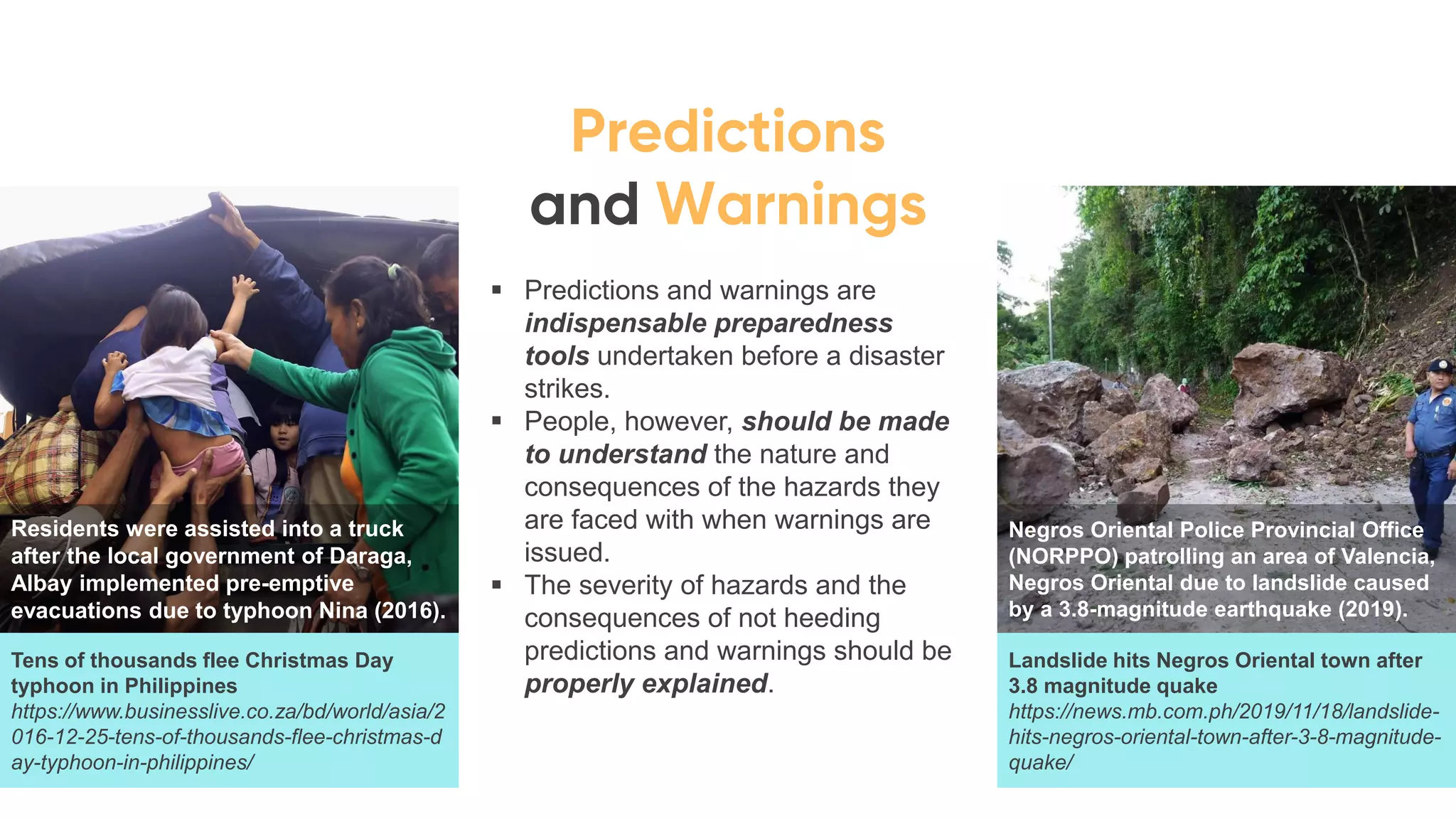
Residents were assisted into a truck
after the local government of Daraga,
Albay implemented pre-emptive
evacuations due to typhoon Nina (2016).
Negros Oriental Police Provincial Office
(NORPPO) patrolling an area of Valencia,
Negros Oriental due to landslide caused
by a 3.8-magnitude earthquake (2019).
Tens of thousands flee Christmas Day
typhoon in Philippines
https://www.businesslive.co.za/bd/world/asia/2
016-12-25-tens-of-thousands-flee-christmas-d
ay-typhoon-in-philippines/
Landslide hits Negros Oriental town after
3.8 magnitude quake
https://news.mb.com.ph/2019/11/18/landslide-
hits-negros-oriental-town-after-3-8-magnitude-
quake/
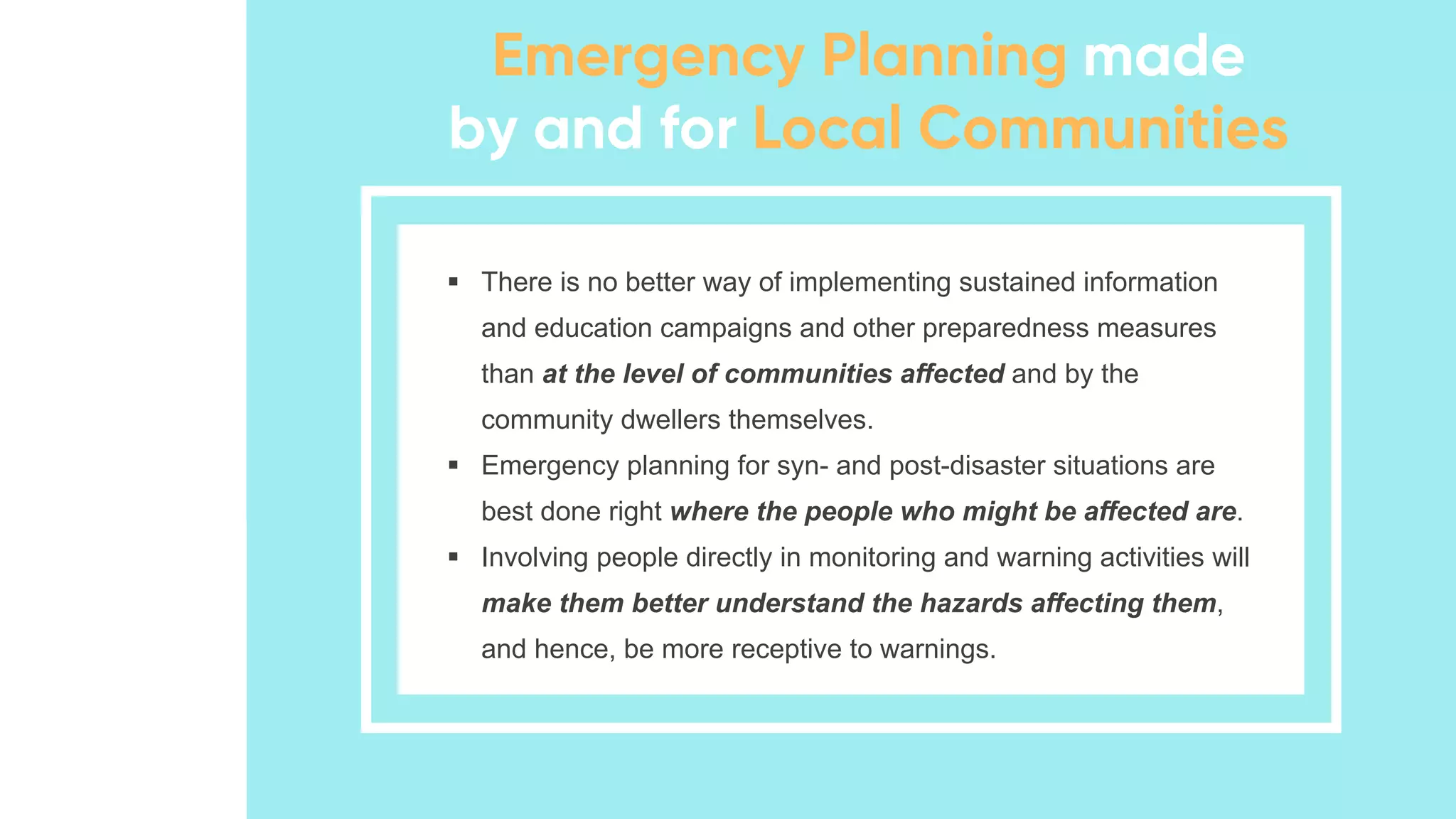
▪ There is no better way of implementing sustained information
and education campaigns and other preparedness measures
than at the level of communities affected and by the
community dwellers themselves.
▪ Emergency planning for syn- and post-disaster situations are
best done right where the people who might be affected are.
▪ Involving people directly in monitoring and warning activities will
make them better understand the hazards affecting them,
and hence, be more receptive to warnings.
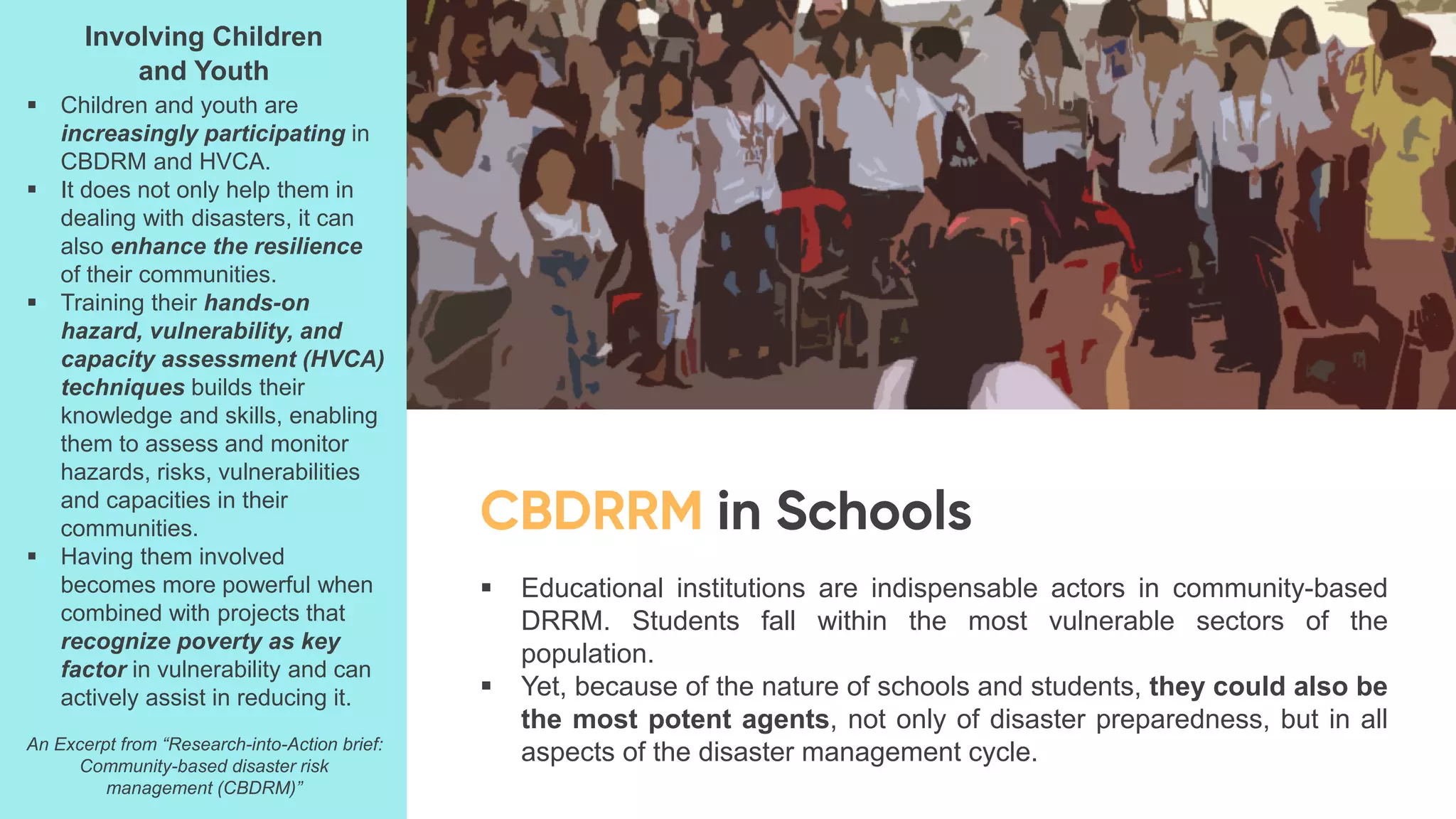
▪ Educational institutions are indispensable actors in community-based
DRRM. Students fall within the most vulnerable sectors of the
population.
▪ Yet, because of the nature of schools and students, they could also be
the most potent agents, not only of disaster preparedness, but in all
aspects of the disaster management cycle.
Involving Children
and Youth
▪ Children and youth are
increasingly participating in
CBDRM and HVCA.
▪ It does not only help them in
dealing with disasters, it can
also enhance the resilience
of their communities.
▪ Training their hands-on
hazard, vulnerability, and
capacity assessment (HVCA)
techniques builds their
knowledge and skills, enabling
them to assess and monitor
hazards, risks, vulnerabilities
and capacities in their
communities.
▪ Having them involved
becomes more powerful when
combined with projects that
recognize poverty as key
factor in vulnerability and can
actively assist in reducing it.
An Excerpt from “Research-into-Action brief:
Community-based disaster risk
management (CBDRM)”

DRRR – Concept of DRR and DRRM

  • 1.
    CONCEPT OF DISASTERRISK REDUCTION (DRR) AND DISASTER RISK REDUCTION AND MANAGEMENT (DRRM) 9.1 Disaster Risk Reduction 9.2 Community-Based Disaster Risk Reduction and Management (CBDRRM) for Preparedness REID CHRYSLER C. MANARES
  • 2.
  • 3.
    Disaster Risk Reduction(DRR) refers to systematic efforts to minimize vulnerabilities and disaster risks, to avoid, or to limit the effects of hazards. Examples of DRRR Activities • building code revision and implementation • hazard and vulnerability analysis • zoning and land use management • public awareness and education • early warning systems (forecasting, etc.) NDRRMC Logo (2010 - Present)
  • 4.
    Risk Identification Risk Analysis RiskPrioritization Risk Treatment Monitoring and Evaluation Disaster risk reduction is a process which is done before a disaster strikes, and consists of FIVE steps:
  • 5.
    Risk Identification Risk Analysis RiskPrioritization Risk Treatment Monitoring and Evaluation The risk identification stage identifies the hazards; potential threats are identified based partly on experience and records.
  • 6.
    Risk Identification Risk Analysis RiskPrioritization Risk Treatment Monitoring and Evaluation Risk analysis aims to establish the magnitude and the likelihood of the occurrence of the event.
  • 7.
    Risk Identification Risk Analysis RiskPrioritization Risk Treatment Monitoring and Evaluation The risk prioritization step analyzes and identifies priority subjects (hazards, areas, and elements at risk) requiring treatment.
  • 8.
    Risk Identification Risk Analysis RiskPrioritization Risk Treatment Monitoring and Evaluation The risk treatment stage identifies the cause of the risks, identifies and evaluates treatment strategies, and prepares and implements treatment plans.
  • 9.
    Risk Identification Risk Analysis RiskPrioritization Risk Treatment Monitoring and Evaluation Monitoring and evaluation oversee s the implementation progress of the disaster risk management process. This stage also conducts periodic investigation of progress and analysis of impact and achievement.
  • 10.
    Mitigation measures aredesigned to minimize disaster-related losses. EXAMPLES OF MITIGATION MEASURES: 1. Strengthening buildings 2. Proper timing of crop cycles 3. Restriction of activities in volcanic danger zones 4. Determining which facilities need fire-safe roofing materials 5. Implementing flood-control projects 6. Implementing land use-control laws DISASTER PREPAREDNESS PRACTICES: 1. Planning for evacuation routes and camps 2. Logistics for providing relief supplies 3. Stockpiling of equipment and supplies 4. Promotion of public awareness through information and education campaigns Likewise, preparedness measures are also done before a disaster-causing event.
  • 11.
    ▪ Disaster riskreduction activities are part and parcel of the whole effort undertaken before and until long after a disastrous event. ▪ The entire array of activities aimed at reducing the severity of impact of the disaster-causing event which are undertaken before, during, and after a disaster is referred to collectively as disaster management. Early warnings should be easily understood ▪ A Yolanda timeline prepared by the NDRRMC shows that the typhoon was already being tracked a week before it entered PAR. ▪ However, it was obvious, however, that the public could not imagine Yolanda’s magnitude and proportions. ▪ Although they had been warned, many were not alarmed because they had survived very destructive weather events before. ▪ They were also warned about a possible storm surge, but they did not know what it meant, let alone understood its deadly potential. An Excerpt from “Y It Happened: Learning from Typhoon Yolanda”
  • 12.
    Pre-event Syn-event Post-event ▪Risk assessment ▪ Mitigation or prevention ▪ Preparedness ▪ Emergency response (rescue, evacuation, relief) ▪ Recovery ▪ Rehabilitation ▪ Reconstruction
  • 13.
    Risk Identification/Assessment ▪ Hazardanalysis ▪ Vulnerability analysis ▪ Determination of risk DISASTER RISK MANAGEMENT EVENT Post-event ▪ Recovery ▪ Rehabilitation ▪ Reconstruction Syn-event ▪ Rescue ▪ Evacuation ▪ Relief Preparedness ▪ Early warning ▪ Evacuation ▪ Emergency planning Mitigation ▪ Land use planning ▪ Land management ▪ (Non-) structural measures
  • 14.
  • 15.
    ▪ Community-Based DisasterRisk Reduction Management (CBDRRM) empowers the people by recognizing and emphasizing the value of communities and local organizations. ▪ By entrusting DRRM to them, the technical and organizational capacities of communities are enhanced. Disaster preparedness should not be left solely to National Government Agencies (NGA): ▪ NGAs are limited by budget and organizational capability ▪ NGAs cannot also be in disaster areas right away. ▪ Local people and organizations can recognize and respond faster to local problems and needs. ▪ Cost-effectiveness and sustainability of activities should be expected when these are conducted by local people.
  • 16.
    WHO ARE THEPARTICIPANTS IN CBDRRM? CBDRRM engages in communities, not only in DRR, but also in all phases of the disaster management cycle. The tasks of decision-making and activity implementation rest primarily on local people and organizations, with the national government assuming a supportive partner’s role. WHAT ARE THE AIMS OF CBDRRM? CBDRRM aims to create resilient communities which are able to reduce their vulnerabilities and exposure, and at the same time, enhance their capacities before, during, and after a disaster. Capacity refers to the ability to reduce the probability of failure through risk reduction measures, to reduce the consequences of failure, and to reduce recovery time and patterns of vulnerability during reconstruction.
  • 17.
    Government agencies Individuals Organizations Community Leaders Stakeholders Laborers Community Tobe more effective in reducing a community’s exposure and vulnerability, and to enhance its capacities for disaster risk management, a community-based DRRM should involve both community insiders and outsiders.
  • 18.
    NOLCOM providing reliefgoods to Taal eruption victims (2020). USAID giving assistance during typhoon Ompong (2018).
  • 19.
    Phivolcs lowers Taal’sstatus from Alert Level 4 to 3 https://philippinesgraphic.net/phivolcs-lowers-taals-status-from-alert -level-4-to-3/ National government on top of Davao del Sur quake situation https://www.philstar.com/headlines/2019/12/16/1977464/national-g overnment-top-davao-del-sur-quake-situation ▪ The formulation of policies and frameworks for warning rests on the national government. ▪ While putting in place systems to ensure timely and effective warnings is the national government’s responsibility, communities can certainly participate and be of help in this aspect. The local goverment of Agoncillo, Batangas monitoring subtle changes in the volcanic activity amid Taal eruption (2020). Rescuers and LDRRMOs of Padada and Davao del Sur on top of the situation following the Davao del Sur earthquake (2019).
  • 20.
    ▪ Predictions andwarnings are indispensable preparedness tools undertaken before a disaster strikes. ▪ People, however, should be made to understand the nature and consequences of the hazards they are faced with when warnings are issued. ▪ The severity of hazards and the consequences of not heeding predictions and warnings should be properly explained. Residents were assisted into a truck after the local government of Daraga, Albay implemented pre-emptive evacuations due to typhoon Nina (2016). Negros Oriental Police Provincial Office (NORPPO) patrolling an area of Valencia, Negros Oriental due to landslide caused by a 3.8-magnitude earthquake (2019). Tens of thousands flee Christmas Day typhoon in Philippines https://www.businesslive.co.za/bd/world/asia/2 016-12-25-tens-of-thousands-flee-christmas-d ay-typhoon-in-philippines/ Landslide hits Negros Oriental town after 3.8 magnitude quake https://news.mb.com.ph/2019/11/18/landslide- hits-negros-oriental-town-after-3-8-magnitude- quake/
  • 21.
    ▪ There isno better way of implementing sustained information and education campaigns and other preparedness measures than at the level of communities affected and by the community dwellers themselves. ▪ Emergency planning for syn- and post-disaster situations are best done right where the people who might be affected are. ▪ Involving people directly in monitoring and warning activities will make them better understand the hazards affecting them, and hence, be more receptive to warnings.
  • 22.
    ▪ Educational institutionsare indispensable actors in community-based DRRM. Students fall within the most vulnerable sectors of the population. ▪ Yet, because of the nature of schools and students, they could also be the most potent agents, not only of disaster preparedness, but in all aspects of the disaster management cycle. Involving Children and Youth ▪ Children and youth are increasingly participating in CBDRM and HVCA. ▪ It does not only help them in dealing with disasters, it can also enhance the resilience of their communities. ▪ Training their hands-on hazard, vulnerability, and capacity assessment (HVCA) techniques builds their knowledge and skills, enabling them to assess and monitor hazards, risks, vulnerabilities and capacities in their communities. ▪ Having them involved becomes more powerful when combined with projects that recognize poverty as key factor in vulnerability and can actively assist in reducing it. An Excerpt from “Research-into-Action brief: Community-based disaster risk management (CBDRM)”