CHAPTER 1
Disaster &
Disaster Risk
WHAT IS A DISASTER?
WHAT IS A DISASTER RISK?
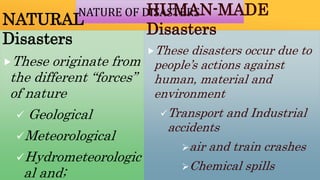
NATURE OF DISASTERS
NATURAL
Disasters
These originate from
the different “forces”
of nature
 Geological
Meteorological
Hydrometeorologic
al and;
HUMAN-MADE
Disasters
These disasters occur due to
people’s actions against
human, material and
environment
Transport and Industrial
accidents
air and train crashes
Chemical spills
TYPES OF DISASTERS (HEWITH AND BURTON, 1971)
 Storm surge
 Earthquakes
 Landslide
 Thunderstorms
 Lightning
 Tornadoes
 Tsunamis
 Wildfires
 Sinkholes
 Flash floods
 Hurricanes
 Tropical storms
• Hazardous materials
• Power service disruption and blackout
• Nuclear power plant and nuclear blast
• Radiological emergencies
• Chemical threat and biological weapons
• Cyber attacks
• Explosion
• Civil unrest
HUMAN-MADE
&
TECHNOLOGIC
AL
NATURAL
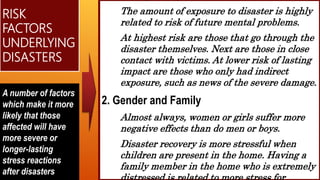
RISK
FACTORS
UNDERLYING
DISASTERS
The amount of exposure to disaster is highly
related to risk of future mental problems.
At highest risk are those that go through the
disaster themselves. Next are those in close
contact with victims. At lower risk of lasting
impact are those who only had indirect
exposure, such as news of the severe damage.
2. Gender and Family
Almost always, women or girls suffer more
negative effects than do men or boys.
Disaster recovery is more stressful when
children are present in the home. Having a
family member in the home who is extremely
A number of factors
which make it more
likely that those
affected will have
more severe or
longer-lasting
stress reactions
after disasters
3. Age
Adults who are in the age range of 40-60 are likely to be more
distressed after disaster. The thinking is that if one is in that age
range, he/she has more demands from job and family.
In general, children show more severe distress after disasters
than do adults.
4. Developing countries
Disasters in developing countries, like the Philippines, have more
severe mental health impact than do disasters in developed
countries.
5. Low or negative social support
The support of others can be both a risk and a resilience factor.
Social support can weaken after disaster.
This may be due to stress and the need for members of the
EFFECTS OF NATURAL DISASTERS ON HUMAN
LIFE
1. Displaced Populations
 One of the most immediate effects of natural disaster is population displacement. When countries are
ravaged by earthquakes many people ha or other powerful forces of nature like floods and super
typhoons, many people have to abandon their homes and seek shelter in other regions.
2.Health Risks
 Severe flooding can result in stagnant water that allows breeding of waterborne bacteria and malaria
carrying mosquitoes.
3.Food Scarcity
 Thousands of people around the world go hungry as a result of destroyed crops and loss of
agricultural supplies, whether it happens suddenly in a storm or gradually in a drought.
4.Emotional Aftershocks
 Natural disasters can be particularly traumatic for young children. Confronted with scenes of
destruction and the deaths of friends and loved ones, many children develop post-traumatic stress
disorder (PTSD), a serious psychological condition resulting from extreme trauma.
HOW & WHEN AN
EVENT BECOMES A
DISASTER?
When it is
sudden or
progressive,
causing
widespread
human,
material or
environmenta
ASSESSMENT:
1. Explain the meaning of disaster.
2. Differentiate the risk factors underlying
disaster
3. Describe the effects of disaster on human’s life
4. Explain how and when an event becomes a
disaster
A. Based on your understanding, identify some
areas in the Philippines that are exposed to
hazard. Using a table, indicate what potential
hazards these areas/locations are exposed to.
B. Read an account of Super Typhoon Yolanda
that struck Samar and Leyte in 2013. Analyse
its impacts from the different perspectives:
Physical, Psychological, Socio-cultural,
OUTPUT:
END OF
CHAPTER 1

Chapter 1 (disaster & disaster risk)

  • 1.
  • 3.
    WHAT IS ADISASTER?
  • 4.
    WHAT IS ADISASTER RISK?
  • 5.
    NATURE OF DISASTERS NATURAL Disasters Theseoriginate from the different “forces” of nature  Geological Meteorological Hydrometeorologic al and; HUMAN-MADE Disasters These disasters occur due to people’s actions against human, material and environment Transport and Industrial accidents air and train crashes Chemical spills
  • 6.
    TYPES OF DISASTERS(HEWITH AND BURTON, 1971)  Storm surge  Earthquakes  Landslide  Thunderstorms  Lightning  Tornadoes  Tsunamis  Wildfires  Sinkholes  Flash floods  Hurricanes  Tropical storms • Hazardous materials • Power service disruption and blackout • Nuclear power plant and nuclear blast • Radiological emergencies • Chemical threat and biological weapons • Cyber attacks • Explosion • Civil unrest HUMAN-MADE & TECHNOLOGIC AL NATURAL
  • 7.
    RISK FACTORS UNDERLYING DISASTERS The amount ofexposure to disaster is highly related to risk of future mental problems. At highest risk are those that go through the disaster themselves. Next are those in close contact with victims. At lower risk of lasting impact are those who only had indirect exposure, such as news of the severe damage. 2. Gender and Family Almost always, women or girls suffer more negative effects than do men or boys. Disaster recovery is more stressful when children are present in the home. Having a family member in the home who is extremely A number of factors which make it more likely that those affected will have more severe or longer-lasting stress reactions after disasters
  • 8.
    3. Age Adults whoare in the age range of 40-60 are likely to be more distressed after disaster. The thinking is that if one is in that age range, he/she has more demands from job and family. In general, children show more severe distress after disasters than do adults. 4. Developing countries Disasters in developing countries, like the Philippines, have more severe mental health impact than do disasters in developed countries. 5. Low or negative social support The support of others can be both a risk and a resilience factor. Social support can weaken after disaster. This may be due to stress and the need for members of the
  • 9.
    EFFECTS OF NATURALDISASTERS ON HUMAN LIFE 1. Displaced Populations  One of the most immediate effects of natural disaster is population displacement. When countries are ravaged by earthquakes many people ha or other powerful forces of nature like floods and super typhoons, many people have to abandon their homes and seek shelter in other regions. 2.Health Risks  Severe flooding can result in stagnant water that allows breeding of waterborne bacteria and malaria carrying mosquitoes. 3.Food Scarcity  Thousands of people around the world go hungry as a result of destroyed crops and loss of agricultural supplies, whether it happens suddenly in a storm or gradually in a drought. 4.Emotional Aftershocks  Natural disasters can be particularly traumatic for young children. Confronted with scenes of destruction and the deaths of friends and loved ones, many children develop post-traumatic stress disorder (PTSD), a serious psychological condition resulting from extreme trauma.
  • 10.
    HOW & WHENAN EVENT BECOMES A DISASTER? When it is sudden or progressive, causing widespread human, material or environmenta
  • 11.
    ASSESSMENT: 1. Explain themeaning of disaster. 2. Differentiate the risk factors underlying disaster 3. Describe the effects of disaster on human’s life 4. Explain how and when an event becomes a disaster
  • 12.
    A. Based onyour understanding, identify some areas in the Philippines that are exposed to hazard. Using a table, indicate what potential hazards these areas/locations are exposed to. B. Read an account of Super Typhoon Yolanda that struck Samar and Leyte in 2013. Analyse its impacts from the different perspectives: Physical, Psychological, Socio-cultural, OUTPUT:
  • 13.