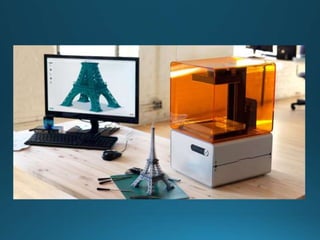
•Concept modellers, often called
office modellers, are a class of
rapid prototyping (RP) system
designed specifically to make
models quickly and inexpensively,
without a great deal of effort
•The systems are usually small,
inexpensive, quiet, and require
very little or no training to
operate.
•For these reasons, the systems are
targeted to reside in design office
environments, where they can
ideally be operated much like a
standard printer, only the prints
from these systems are in three
dimensions
Ink Jet Printing
•Ink jet printing comes from the printer
and plotter industry where the
technique involves shooting tiny
droplets of ink on paper to produce
graphic images.
•RP ink jet techniques utilize ink jet
technology to shoot droplets of liquid-
to-solid compound and form a layer of
an RP model.
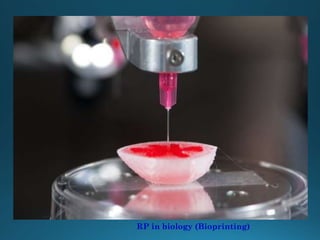
RP in biology (Bioprinting)
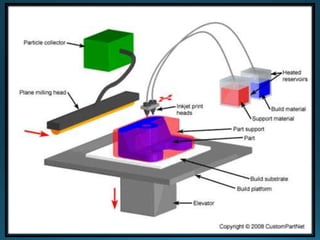
•The additive fabrication technique of
inkjet printing is based on the 2D
printer technique of using a jet to
deposit tiny drops of ink onto paper.
•In the additive process, the ink is
replaced with thermoplastic and wax
materials, which are held in a melted
state.
•When printed, liquid drops of these
materials instantly cool and solidify to
form a layer of the part.
•For this reason, the process if often
referred to as thermal phase change
inkjet printing
•Inkjet printing offers the advantages of
excellent accuracy and surface finishes.
•However, the limitations include slow
build speeds, few material options,
and fragile parts.
•As a result, the most common
application of inkjet printing is
prototypes used for form and fit
testing
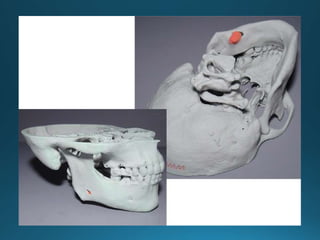
•Other applications include jewellery,
medical devices, and high-precisions
products
•Several manufactures have developed
different inkjet printing devices that
use the basic technique described
above.
•Inkjet printers from Solidscape Inc.,
such as the ModelMaker (MM), use a
single jet for the build material and
another jet for support material.
•3D Systems has implemented their
MultiJet Modelling (MJM) technology
into their ThermoJet Modeller
machines that utilize several hundred
nozzles to enable faster build times
Types of printing techniques
Common ink jet printing
techniques, such as
a) Sanders Model Maker
b) Multi-Jet Modelling
c) Z402 Ink Jet System
d) Three-Dimensional Printing
e) Genisys Xs printer
f) Object Quadra systems
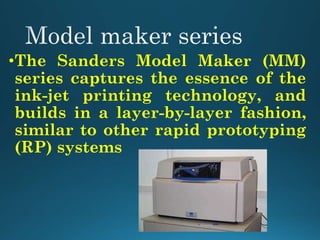
•The Sanders Model Maker (MM)
series captures the essence of the
ink-jet printing technology, and
builds in a layer-by-layer fashion,
similar to other rapid prototyping
(RP) systems
•The MM uses several different types of
data file formats but has only one base
type for the build and support
materials, wax.
•The MM was developed by Sanders
Prototype, Inc. (SPI), a subsidiary of
Sanders Design in Wilton, NH, in the
early 1990s with the intention of
revolutionizing the industry as it
pertains to accuracy and precision
•The MM system has evolved
through three "models," Model
•Maker (original model), Model
Maker II (MMII, second
generation), and recently Rapid
Tool Maker (RTM)
•The original modeller has a build
envelope of 7" x 7" and the MMII has
an envelope size of 13" x 7", whereas
the RTM has a 12" x 12" working
area.
•While both MMs are desktop models,
the RTM is a self contained unit with
an on-board computer
Software for MM
•Both modellers utilize MW
(MW) software, manufactured
by SPI, to prepare and
manipulate the incoming file
for use in the MM machine
•The software can be operated through
a variety of workstations, from UNIX
to PC , and the current modeller has
an on-board computer that can
function alone after it receives the
prepared file from a "dummy" PC
whose sole purpose is for file slicing
and preparation
Build materials
•Both models use a build and support
material to produce a 3-D model.
•These materials are wax based with
the support having a lower melting
point than the build
•So, the Postprocessing becomes
easier.
•The support material can be removed
easily
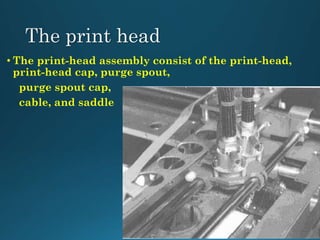
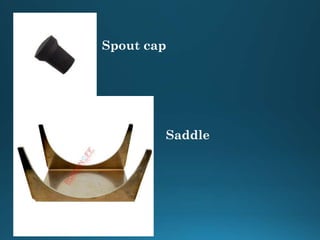
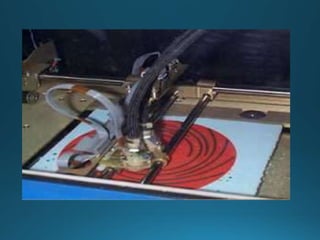
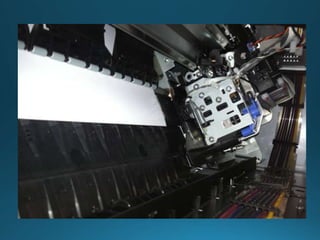
• The print-head assembly consist of the print-head,
print-head cap, purge spout,
purge spout cap,
cable, and saddle
Spout cap
Saddle
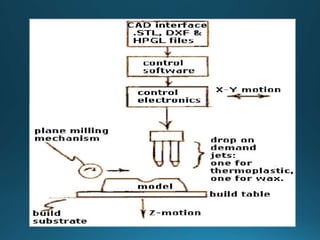
•There are two print-heads, one for
building the part and the other for
generating the necessary support
•The jets sit on a carriage that enables
them to move in the X and Y direction
(left to right), while the stage moves in
the Z direction (up and down)
Model maker operation
1.CAD file preparation
2.Slicing
3.Sending the data to the
model maker
4.Building a part
5.Post processing
Advantages and disadvantages
•The power of the MM family of systems
lies primarily with the production of
small, intricately detailed wax patterns
•The jewellery and medical industries have
capitalized on this advantage due to their
needs for highly accurate, small parts
•Perhaps the most apparent drawback of
these systems are the slow build speed
when it comes to fabricating parts larger
than a 3- inch working cube
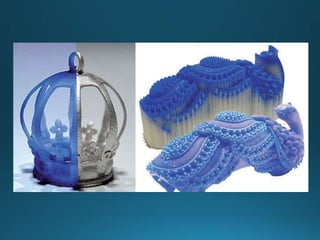
•The ThermoJet and the Actua 2100, both
made by 3D Systems in Valencia, CA, fall
into the growing area of the rapid
prototyping (RP) market known as
concept modelling.
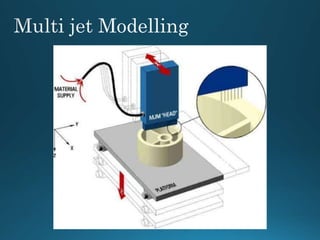
•Both systems apply the Multi Jet
Modelling (MJM) build style to produce
wax prototypes with an array of ink jets.
•The systems are one of the least
expensive in the line of RP technologies
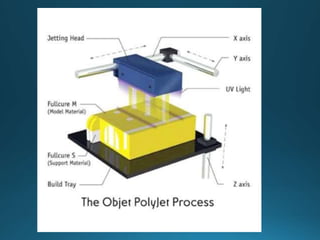
•The MJM process builds parts by
printing thin consecutive layers of the
molten wax in the shape of the part cross
sections.
•Like most RP systems, the parts are built
onto a movable z stage, which lowers as
the part is "printed."
•Currently, the Actua 2100 system prints
with a layer thickness of 0.0039 inches, or
three passes of 0.0013 inches, whereas
the ThermoJet system prints multiple
passes of thinner layers for higher
resolution
•Three-dimensional printing, or 3DP, is
an MIT-licensed process
•Liquid binder is jetted onto a powder
media using ink jets to "print" a
physical part from computer aided
design (CAD) data
•Z Corporation (Z Corp) incorporates
the 3DP process into the Z402 system.
•The Z402 is the fastest modeller on the
market, with speeds 5 to 10 times
faster than other current rapid
prototyping (RP) systems
•The process is similar to SLS
•Instead of laser, we use a liquid
adhesive to bind the powder
•Surface finish is not as good as SLS
but it is faster than SLS
•The Z402 is currently available in only
one size, which can build models up to
8" x 11" x 8".
•Parts built with the starch material can
be hardened to fit the application
necessary.
•These parts can be hardened by wax
infiltration
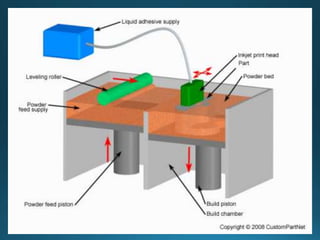
i. Build and feed pistons
ii. Binder feed system
iii.Printing head
iv.Powder roller
Build and feed pistons:
•These pistons provide the build
area and supply material for
constructing parts.
•The build piston lowers as part
layers are printed, while the feed
piston raises to provide a layer-by-
layer supply of new material.
•This provides the z motion of the
part build
Binder feed system:
•The liquid binder is fed from
the container to the printer
head by siphon technique, and
excess pulled through the
printer cleaning station is
drained into a separate
container
•The parts are built in layer-by-layer
fashion
•First, blank layers of powder are
spread as a starting point for
building upon.
•This is called “landscaping”.
•This landscaping is done manually
•The remaining steps are carried out
after this landscaping automatically.
Powder removal-After the parts are
taken from the machine, the excess
powder must be removed. It is done
manually by using vacuum cleaner
Heat for infiltration- The part is
placed in a small oven and heated to a
temperature just above that of the
infiltrant wax, to provide a wicking
characteristic as opposed to coating
Infiltration- Immediately after the
part is heated, it is dipped for a few
seconds into a vat of molten wax, then
removed and placed on a sheet to dry.
After drying the part is complete
Uses
•Used as concept-verification models
in a design environment.
•The nontoxic materials allow for the
models to be safely handled in
meetings or the office, directly after
fabrication.
•Parts can be used for investment or
sandcast patterns.
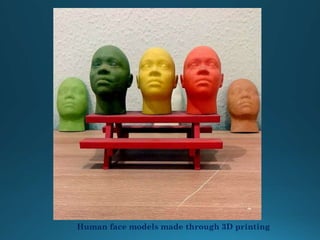
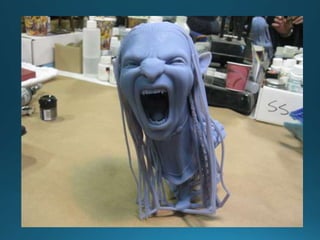
Human face models made through 3D printing
Genisys Xs HP Printer
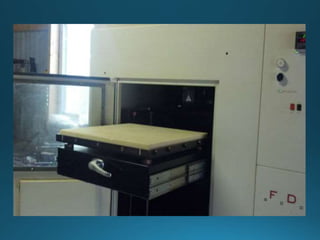
•The Genisys (and Genisys Xs) system,
produced by Stratasys, Inc. is an office-
friendly modelling system that builds
parts with a durable polyester material
•The current line of Genisys systems are
small, compact table-top rapid
prototyping (RP) machines that deliver
single- material capability, and
interoffice network queues for
operation much like a printer.
Software:
•The software of the Genisys systems,
which is compatible on both Unix and NT
platforms, is designed for ease of
operation
•Parts can be set to be scaled
automatically as well, although there is a
manual scaling feature.
•Multiple parts may be nested in the -x, -y
plane, again with single-click operability
Build Material:
•The current build material is quoted
as a "durable polyester".
•Since the systems have only one
extrusion tip, the support structures
are built of the same material,
requiring mechanical removal upon
completion of the part
Hardware
•The Genisys has a maximum build
capacity of 12" X 8" x 8", whereas the
entire system occupies a space of only 36"
x 32" x 29".
•The unit weighs in at about 210 pounds
and can operate on standard house
current of 110 to 120 Volts AC.
•The polyester material comes stock in
the form of wafers, which are loaded into
a bank of cartridges within the machine.
•One wafer is loaded into the deposition
head, where it is melted and deposited in
thin layers through a single extrusion tip
while tracing the cross section of the part
being built.
•Once the wafer in the head is spent, it is
replaced by another automatically and
the build resumes.
•The build chamber is operated at
ambient temperature, and fabricated
parts can maintain dimensional accuracy
in the range of +0.013 inches
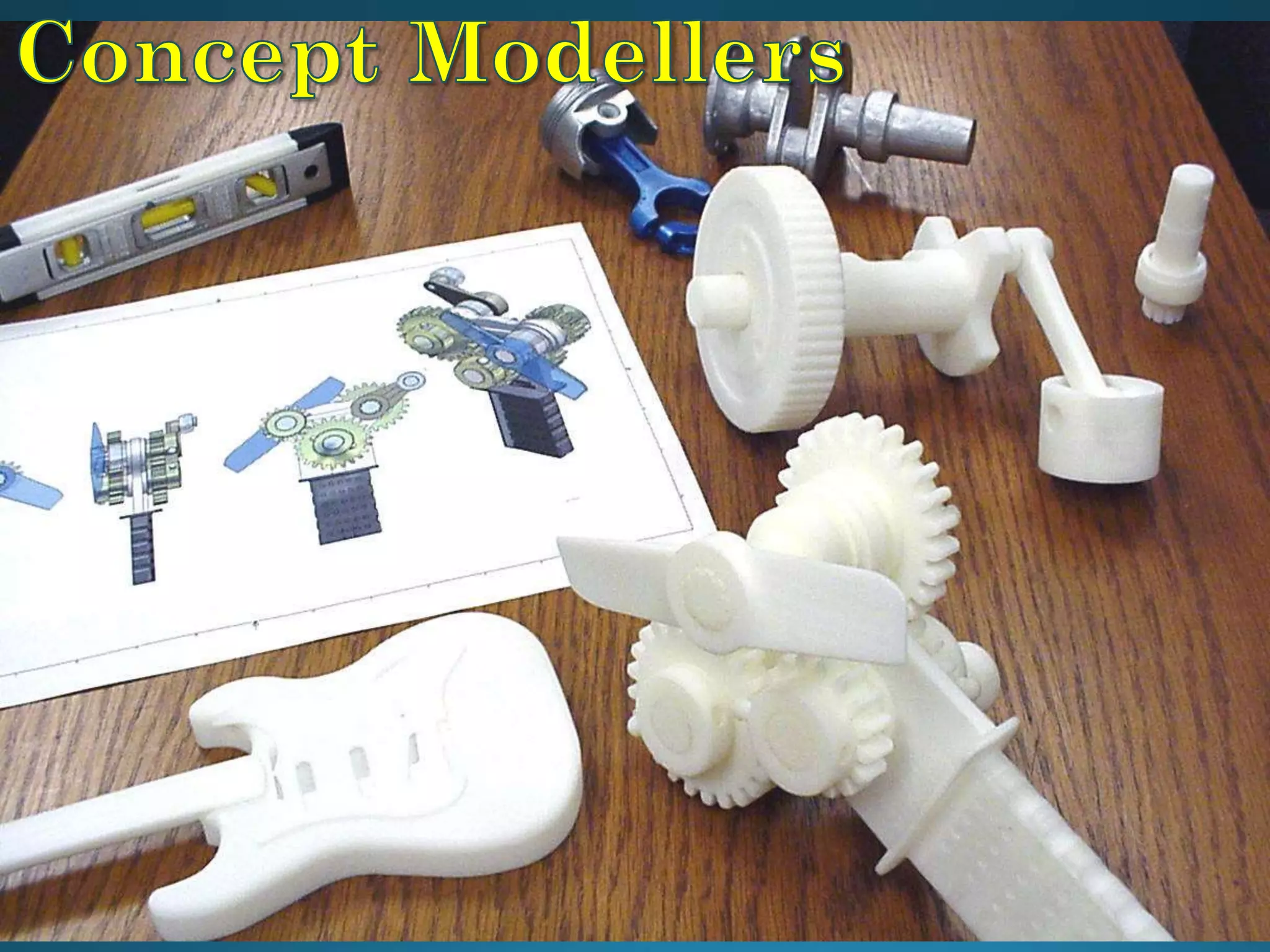
Concept modellers

Concept modellers

  • 2.
    •Concept modellers, oftencalled office modellers, are a class of rapid prototyping (RP) system designed specifically to make models quickly and inexpensively, without a great deal of effort
  • 3.
    •The systems areusually small, inexpensive, quiet, and require very little or no training to operate. •For these reasons, the systems are targeted to reside in design office environments, where they can ideally be operated much like a standard printer, only the prints from these systems are in three dimensions
  • 4.
    Ink Jet Printing •Inkjet printing comes from the printer and plotter industry where the technique involves shooting tiny droplets of ink on paper to produce graphic images. •RP ink jet techniques utilize ink jet technology to shoot droplets of liquid- to-solid compound and form a layer of an RP model.
  • 5.
    RP in biology(Bioprinting)
  • 7.
    •The additive fabricationtechnique of inkjet printing is based on the 2D printer technique of using a jet to deposit tiny drops of ink onto paper. •In the additive process, the ink is replaced with thermoplastic and wax materials, which are held in a melted state.
  • 8.
    •When printed, liquiddrops of these materials instantly cool and solidify to form a layer of the part. •For this reason, the process if often referred to as thermal phase change inkjet printing •Inkjet printing offers the advantages of excellent accuracy and surface finishes.
  • 9.
    •However, the limitationsinclude slow build speeds, few material options, and fragile parts. •As a result, the most common application of inkjet printing is prototypes used for form and fit testing •Other applications include jewellery, medical devices, and high-precisions products
  • 10.
    •Several manufactures havedeveloped different inkjet printing devices that use the basic technique described above. •Inkjet printers from Solidscape Inc., such as the ModelMaker (MM), use a single jet for the build material and another jet for support material. •3D Systems has implemented their MultiJet Modelling (MJM) technology into their ThermoJet Modeller machines that utilize several hundred nozzles to enable faster build times
  • 11.
    Types of printingtechniques Common ink jet printing techniques, such as a) Sanders Model Maker b) Multi-Jet Modelling c) Z402 Ink Jet System d) Three-Dimensional Printing e) Genisys Xs printer f) Object Quadra systems
  • 12.
    •The Sanders ModelMaker (MM) series captures the essence of the ink-jet printing technology, and builds in a layer-by-layer fashion, similar to other rapid prototyping (RP) systems
  • 13.
    •The MM usesseveral different types of data file formats but has only one base type for the build and support materials, wax. •The MM was developed by Sanders Prototype, Inc. (SPI), a subsidiary of Sanders Design in Wilton, NH, in the early 1990s with the intention of revolutionizing the industry as it pertains to accuracy and precision
  • 14.
    •The MM systemhas evolved through three "models," Model •Maker (original model), Model Maker II (MMII, second generation), and recently Rapid Tool Maker (RTM)
  • 15.
    •The original modellerhas a build envelope of 7" x 7" and the MMII has an envelope size of 13" x 7", whereas the RTM has a 12" x 12" working area. •While both MMs are desktop models, the RTM is a self contained unit with an on-board computer
  • 16.
    Software for MM •Bothmodellers utilize MW (MW) software, manufactured by SPI, to prepare and manipulate the incoming file for use in the MM machine
  • 17.
    •The software canbe operated through a variety of workstations, from UNIX to PC , and the current modeller has an on-board computer that can function alone after it receives the prepared file from a "dummy" PC whose sole purpose is for file slicing and preparation
  • 18.
    Build materials •Both modelsuse a build and support material to produce a 3-D model. •These materials are wax based with the support having a lower melting point than the build •So, the Postprocessing becomes easier. •The support material can be removed easily
  • 19.
    • The print-headassembly consist of the print-head, print-head cap, purge spout, purge spout cap, cable, and saddle
  • 20.
  • 23.
    •There are twoprint-heads, one for building the part and the other for generating the necessary support •The jets sit on a carriage that enables them to move in the X and Y direction (left to right), while the stage moves in the Z direction (up and down)
  • 25.
    Model maker operation 1.CADfile preparation 2.Slicing 3.Sending the data to the model maker 4.Building a part 5.Post processing
  • 26.
    Advantages and disadvantages •Thepower of the MM family of systems lies primarily with the production of small, intricately detailed wax patterns •The jewellery and medical industries have capitalized on this advantage due to their needs for highly accurate, small parts •Perhaps the most apparent drawback of these systems are the slow build speed when it comes to fabricating parts larger than a 3- inch working cube
  • 30.
    •The ThermoJet andthe Actua 2100, both made by 3D Systems in Valencia, CA, fall into the growing area of the rapid prototyping (RP) market known as concept modelling. •Both systems apply the Multi Jet Modelling (MJM) build style to produce wax prototypes with an array of ink jets. •The systems are one of the least expensive in the line of RP technologies
  • 31.
    •The MJM processbuilds parts by printing thin consecutive layers of the molten wax in the shape of the part cross sections. •Like most RP systems, the parts are built onto a movable z stage, which lowers as the part is "printed." •Currently, the Actua 2100 system prints with a layer thickness of 0.0039 inches, or three passes of 0.0013 inches, whereas the ThermoJet system prints multiple passes of thinner layers for higher resolution
  • 33.
    •Three-dimensional printing, or3DP, is an MIT-licensed process •Liquid binder is jetted onto a powder media using ink jets to "print" a physical part from computer aided design (CAD) data
  • 34.
    •Z Corporation (ZCorp) incorporates the 3DP process into the Z402 system. •The Z402 is the fastest modeller on the market, with speeds 5 to 10 times faster than other current rapid prototyping (RP) systems •The process is similar to SLS •Instead of laser, we use a liquid adhesive to bind the powder •Surface finish is not as good as SLS but it is faster than SLS
  • 35.
    •The Z402 iscurrently available in only one size, which can build models up to 8" x 11" x 8". •Parts built with the starch material can be hardened to fit the application necessary. •These parts can be hardened by wax infiltration
  • 38.
    i. Build andfeed pistons ii. Binder feed system iii.Printing head iv.Powder roller
  • 39.
    Build and feedpistons: •These pistons provide the build area and supply material for constructing parts. •The build piston lowers as part layers are printed, while the feed piston raises to provide a layer-by- layer supply of new material. •This provides the z motion of the part build
  • 40.
    Binder feed system: •Theliquid binder is fed from the container to the printer head by siphon technique, and excess pulled through the printer cleaning station is drained into a separate container
  • 41.
    •The parts arebuilt in layer-by-layer fashion •First, blank layers of powder are spread as a starting point for building upon. •This is called “landscaping”. •This landscaping is done manually •The remaining steps are carried out after this landscaping automatically.
  • 42.
    Powder removal-After theparts are taken from the machine, the excess powder must be removed. It is done manually by using vacuum cleaner Heat for infiltration- The part is placed in a small oven and heated to a temperature just above that of the infiltrant wax, to provide a wicking characteristic as opposed to coating Infiltration- Immediately after the part is heated, it is dipped for a few seconds into a vat of molten wax, then removed and placed on a sheet to dry. After drying the part is complete
  • 43.
    Uses •Used as concept-verificationmodels in a design environment. •The nontoxic materials allow for the models to be safely handled in meetings or the office, directly after fabrication. •Parts can be used for investment or sandcast patterns.
  • 44.
    Human face modelsmade through 3D printing
  • 48.
    Genisys Xs HPPrinter •The Genisys (and Genisys Xs) system, produced by Stratasys, Inc. is an office- friendly modelling system that builds parts with a durable polyester material •The current line of Genisys systems are small, compact table-top rapid prototyping (RP) machines that deliver single- material capability, and interoffice network queues for operation much like a printer.
  • 49.
    Software: •The software ofthe Genisys systems, which is compatible on both Unix and NT platforms, is designed for ease of operation •Parts can be set to be scaled automatically as well, although there is a manual scaling feature. •Multiple parts may be nested in the -x, -y plane, again with single-click operability
  • 50.
    Build Material: •The currentbuild material is quoted as a "durable polyester". •Since the systems have only one extrusion tip, the support structures are built of the same material, requiring mechanical removal upon completion of the part
  • 51.
    Hardware •The Genisys hasa maximum build capacity of 12" X 8" x 8", whereas the entire system occupies a space of only 36" x 32" x 29". •The unit weighs in at about 210 pounds and can operate on standard house current of 110 to 120 Volts AC. •The polyester material comes stock in the form of wafers, which are loaded into a bank of cartridges within the machine.
  • 52.
    •One wafer isloaded into the deposition head, where it is melted and deposited in thin layers through a single extrusion tip while tracing the cross section of the part being built. •Once the wafer in the head is spent, it is replaced by another automatically and the build resumes. •The build chamber is operated at ambient temperature, and fabricated parts can maintain dimensional accuracy in the range of +0.013 inches