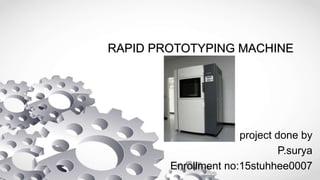
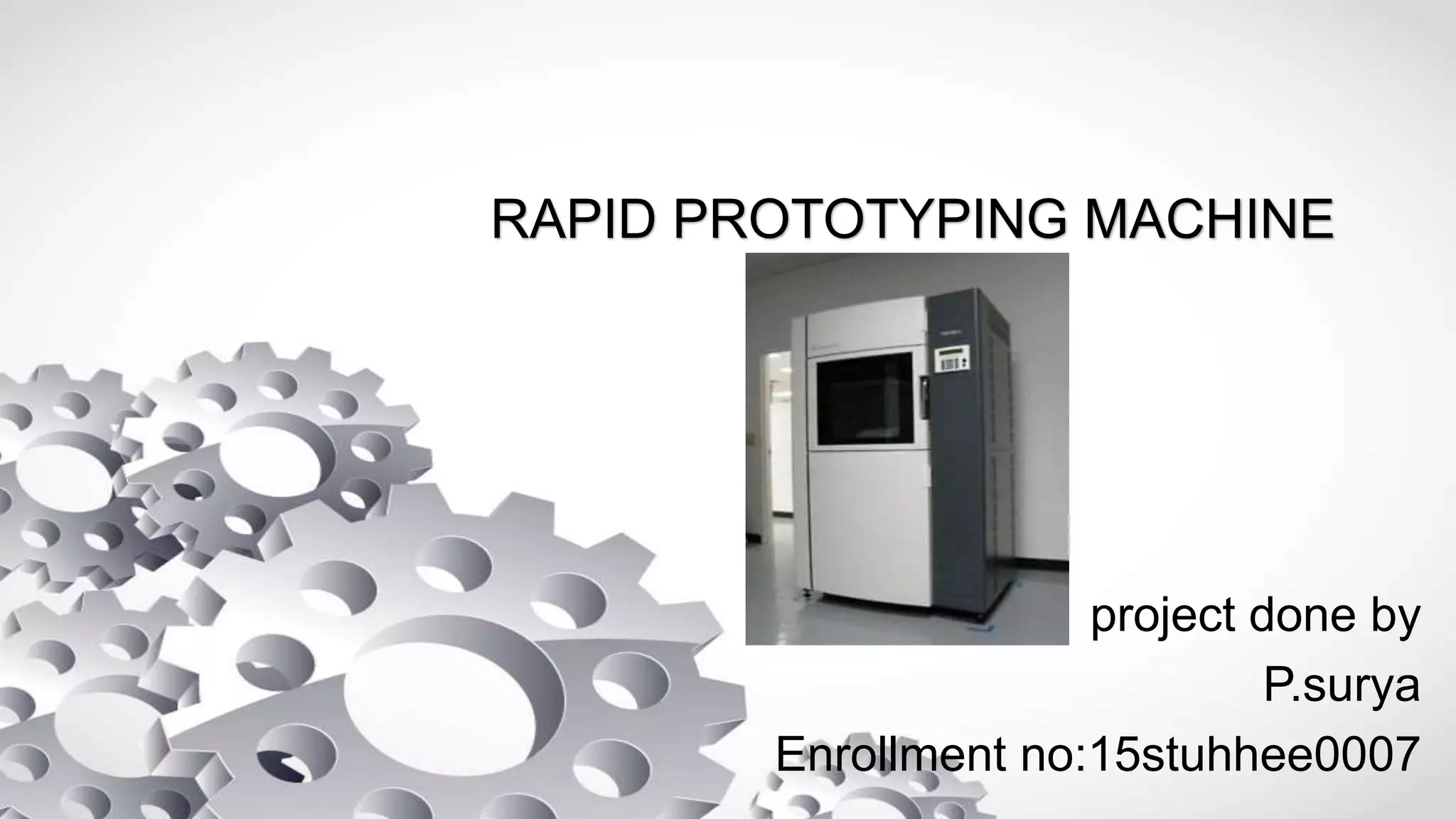
RAPID PROTOTYPING MACHINE
project done by
P.surya
Enrollment no:15stuhhee0007
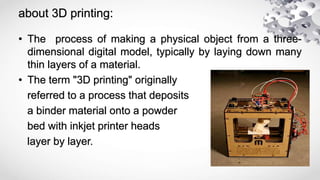
about 3D printing:
• The process of making a physical object from a three-
dimensional digital model, typically by laying down many
thin layers of a material.
• The term "3D printing" originally
referred to a process that deposits
a binder material onto a powder
bed with inkjet printer heads
layer by layer.
History of 3D Printing:
• 3D-printing manufacturing equipment and materials were
developed in the 1980s.
• It was developed in the year 1988 by S. Scott Crump.
• That was commercialized by his company Stratasys,
which marketed its first FDM machine in 1992.
• In the year 1993 also saw the start of a company called
Solidscape, introducing a high-precision polymer jet
fabrication system.
How does a 3D printing works?
• It all starts with making a virtual design of the object you
want to create. This virtual design is for instance a CAD
(Computer Aided Design) file. This CAD file is created
using a 3D modeling application or with a 3D scanner .
• A 3D scanner can make a 3D digital copy of an object.
• 3D scanners use different technologies to generate a 3D
model.
• 3D modeling software also comes in many forms. There’s
industrial grade software that costs thousands a year per
license, but also free open source software.
Types of 3D printing models:
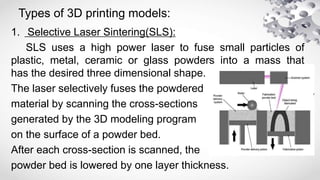
1. Selective Laser Sintering(SLS):
SLS uses a high power laser to fuse small particles of
plastic, metal, ceramic or glass powders into a mass that
has the desired three dimensional shape.
The laser selectively fuses the powdered
material by scanning the cross-sections
generated by the 3D modeling program
on the surface of a powder bed.
After each cross-section is scanned, the
powder bed is lowered by one layer thickness.
2.Fused Deposition Modeling (FDM)
FDM was invented by Scott Crump in the late 80’s. technology
he started the company Stratasys in 1988. The software that
comes with this technology automatically generates support
structures if required.
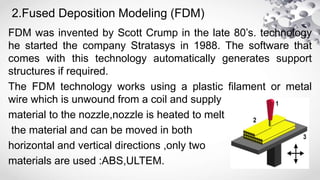
The FDM technology works using a plastic filament or metal
wire which is unwound from a coil and supply
material to the nozzle,nozzle is heated to melt
the material and can be moved in both
horizontal and vertical directions ,only two
materials are used :ABS,ULTEM.
3. Stereolithography (SLA)
This is one most commonly used technology in our daily life.
This technology make use of a large quantity of liquid
ultraviolet curable photopolymer resin and an ultraviolet laser
to build the object’s layers one at a time.
when we talk about curing a photo-reactive resin with a UV
laser or another similar power source one layer at a time. The
most common technology using this method is called
Stereolithography
After the pattern has been traced, the SLA’s elevator platform
descends by a distance equal to the thickness of a single
layer, typically 0.05 mm to 0.15 mm
Different Types of 3D Printers:
• Cartesian-XY-head:The extruder head moves over the X
and Y axis and the bed over the Z.
• Cartesian-XZ-head: This arrangement differs form
Cartesian-XY-head because it moves the bed over the Y
axis and the extruder head over the X axis and the Z axis.
• Delta:work within the Cartesian plane, however the setup of
the frame is totally different. They are called Delta because
the extruder head is suspended by three arms in a
triangular configuration.
• ore-XY:Cartesian arrangement that is rapidly growing in
popularity. The movement on the XY gantry depends on
a combined effect of X and Y motors
• Polar: Polar 3D printers have a rotating print bed, plus
an extruder head that can move left, right up and down.
 A polar 3D printer is energy efficient because it only
needs two stepper motors in contrary to for instance a
Cartesian arrangement which requires a minimum of one
stepper motor for each axis, so usually at least four.
Foremost, it is really cool to see in action.
Process of implementing 3D printing software:
• 3 steps are required:
1. Solid works software : used to convert CAD model to STL
file.
1. Insight software: used to convert STL file to CMB file.
process of the job :
a)x,y,z
b)Model sliceing
c)Support sliceing
d)Tool path
e)Estimation build time
3)Control centre:
• In the control centre ,the part which we build in the insight
software, that file should be opened in this control centre.
1.Open the particular job.
2.Click on the build job.
3 D Printing
3 D Printing
3 D Printing

3 D Printing

  • 1.
    RAPID PROTOTYPING MACHINE projectdone by P.surya Enrollment no:15stuhhee0007
  • 2.
    about 3D printing: •The process of making a physical object from a three- dimensional digital model, typically by laying down many thin layers of a material. • The term "3D printing" originally referred to a process that deposits a binder material onto a powder bed with inkjet printer heads layer by layer.
  • 3.
    History of 3DPrinting: • 3D-printing manufacturing equipment and materials were developed in the 1980s. • It was developed in the year 1988 by S. Scott Crump. • That was commercialized by his company Stratasys, which marketed its first FDM machine in 1992. • In the year 1993 also saw the start of a company called Solidscape, introducing a high-precision polymer jet fabrication system.
  • 4.
    How does a3D printing works? • It all starts with making a virtual design of the object you want to create. This virtual design is for instance a CAD (Computer Aided Design) file. This CAD file is created using a 3D modeling application or with a 3D scanner . • A 3D scanner can make a 3D digital copy of an object. • 3D scanners use different technologies to generate a 3D model. • 3D modeling software also comes in many forms. There’s industrial grade software that costs thousands a year per license, but also free open source software.
  • 5.
    Types of 3Dprinting models: 1. Selective Laser Sintering(SLS): SLS uses a high power laser to fuse small particles of plastic, metal, ceramic or glass powders into a mass that has the desired three dimensional shape. The laser selectively fuses the powdered material by scanning the cross-sections generated by the 3D modeling program on the surface of a powder bed. After each cross-section is scanned, the powder bed is lowered by one layer thickness.
  • 6.
    2.Fused Deposition Modeling(FDM) FDM was invented by Scott Crump in the late 80’s. technology he started the company Stratasys in 1988. The software that comes with this technology automatically generates support structures if required. The FDM technology works using a plastic filament or metal wire which is unwound from a coil and supply material to the nozzle,nozzle is heated to melt the material and can be moved in both horizontal and vertical directions ,only two materials are used :ABS,ULTEM.
  • 7.
    3. Stereolithography (SLA) Thisis one most commonly used technology in our daily life. This technology make use of a large quantity of liquid ultraviolet curable photopolymer resin and an ultraviolet laser to build the object’s layers one at a time. when we talk about curing a photo-reactive resin with a UV laser or another similar power source one layer at a time. The most common technology using this method is called Stereolithography After the pattern has been traced, the SLA’s elevator platform descends by a distance equal to the thickness of a single layer, typically 0.05 mm to 0.15 mm
  • 8.
    Different Types of3D Printers: • Cartesian-XY-head:The extruder head moves over the X and Y axis and the bed over the Z. • Cartesian-XZ-head: This arrangement differs form Cartesian-XY-head because it moves the bed over the Y axis and the extruder head over the X axis and the Z axis. • Delta:work within the Cartesian plane, however the setup of the frame is totally different. They are called Delta because the extruder head is suspended by three arms in a triangular configuration.
  • 9.
    • ore-XY:Cartesian arrangementthat is rapidly growing in popularity. The movement on the XY gantry depends on a combined effect of X and Y motors • Polar: Polar 3D printers have a rotating print bed, plus an extruder head that can move left, right up and down.  A polar 3D printer is energy efficient because it only needs two stepper motors in contrary to for instance a Cartesian arrangement which requires a minimum of one stepper motor for each axis, so usually at least four. Foremost, it is really cool to see in action.
  • 10.
    Process of implementing3D printing software: • 3 steps are required: 1. Solid works software : used to convert CAD model to STL file. 1. Insight software: used to convert STL file to CMB file. process of the job : a)x,y,z b)Model sliceing c)Support sliceing d)Tool path e)Estimation build time
  • 11.
    3)Control centre: • Inthe control centre ,the part which we build in the insight software, that file should be opened in this control centre. 1.Open the particular job. 2.Click on the build job.