Seminar -1 presentation  on Snap Fit Design PreparedBy:  Neeraj Kumar Jha (www.erway.in)
My Presentation 1. Introduction: - what is snap fit -  types - applications 2. Design features: - Theory  - design - material selection 3. Modifications
1. Introduction Assembly techniques for Plastic parts are: Allowing disassembly  ( Mechanical Fasteners, Plastic Threads, Press-Fittings and Snap-Fits) Creating a permanent joint i.e. welding
1.1 what is snap fit Snap-fits are the simplest, quickest and most cost effective method of assembling two parts. Snap fitting provides a simple, inexpensive and rapid means of assembling plastic parts. In such assembly technique basically, a molded undercut on one part engages a mating lip on the other
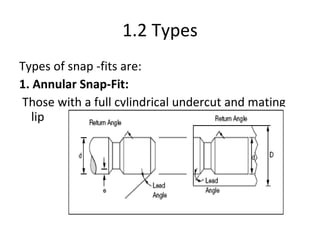
1.2 Types Types of snap -fits are: 1. Annular Snap-Fit: Those with a full cylindrical undercut and mating lip
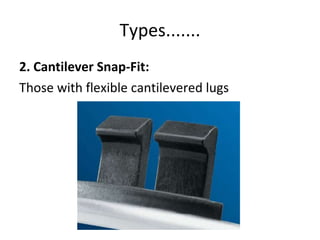
Types....... 2. Cantilever Snap-Fit:   Those with flexible cantilevered lugs
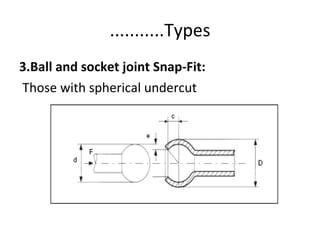
...........Types 3.Ball and socket joint Snap-Fit: Those with spherical undercut
1.3 Applications Toys ,Small Appliances, Automotive, Electronic Fields
2.  Design features Designing a snap-fit is rather complex due to a combination of factors: Functional requirements of the product. Assembly requirements. Mechanical properties of the thermoplastic. Design of the mold and notably part ejection. Integrated Snap Fits No extra part Simple & reliable Design freedom
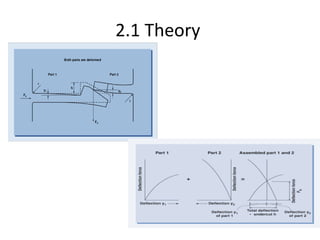
2.1  Theory
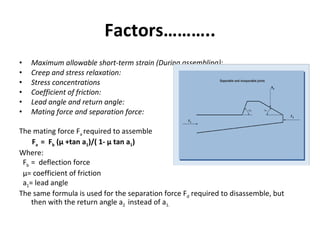
Factors……….. Maximum allowable short-term strain (During assembling): Creep and stress relaxation: Stress concentrations  Coefficient of friction: Lead angle and return angle: Mating force and separation force:   The mating force F a  required to assemble F a  =  F b  (µ +tan a 1 )/( 1- µ tan a 1 ) Where: F b  =  deflection force µ= coefficient of friction a 1 = lead angle The same formula is used for the separation force F d  required to disassemble, but then with the return angle a 2  instead of a 1.
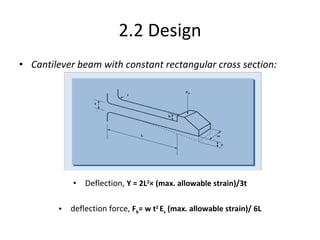
2.2  Design Cantilever beam with constant rectangular cross section: Deflection,  Y = 2L 2 × (max. allowable strain)/3t   deflection force,  F b = w t 2  E s  (max. allowable strain)/ 6L
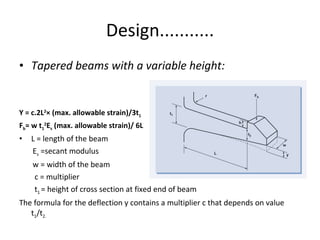
Design........... Tapered beams with a variable height: Y = c.2L 2 × (max. allowable strain)/3t 1 F b = w t 1 2 E s  (max. allowable strain)/ 6L L = length of the beam E s  =secant modulus w = width of the beam  c = multiplier  t 1  = height of cross section at fixed end of beam The formula for the deflection y contains a multiplier c that depends on value t 1 /t 2.
2.3  Material Selection The ultimate success of any design also depends on selecting the material that best fulfills all requirements of a specific application. the ideal material is thermoplastic because of  high flexibility relatively high elongation  low coefficient of friction sufficient strength and rigidity and  its ability to be easily and inexpensively molded into complex geometries. Thermoplastics are ideal for integrative designs,  permitting one-piece molding of complex geometries, which consolidates multiple parts into one.
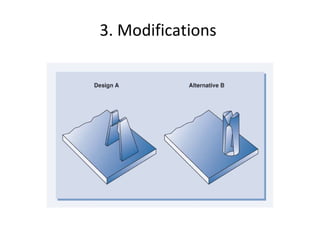
3. Modifications
Modifications...
Modifications...
Modifications...
Modifications...
Take care of………….. Aim for uniform wall thickness. Design wall thickness as thin as possible and only as thick as necessary. Use ribbing instead of greater wall thickness. Provide radiousing. Provide demoulding tapers. Avoid undercuts. Do not design to greater precision than required. Design multi-functional components. Use economic assembly techniques. Gate moulding on the thickest wall.
. Thank you. (www.erway.in)

Snap Fit Design by Neeraj Kumar Jha

  • 1.
    Seminar -1 presentation on Snap Fit Design PreparedBy: Neeraj Kumar Jha (www.erway.in)
  • 2.
    My Presentation 1.Introduction: - what is snap fit - types - applications 2. Design features: - Theory - design - material selection 3. Modifications
  • 3.
    1. Introduction Assemblytechniques for Plastic parts are: Allowing disassembly ( Mechanical Fasteners, Plastic Threads, Press-Fittings and Snap-Fits) Creating a permanent joint i.e. welding
  • 4.
    1.1 what issnap fit Snap-fits are the simplest, quickest and most cost effective method of assembling two parts. Snap fitting provides a simple, inexpensive and rapid means of assembling plastic parts. In such assembly technique basically, a molded undercut on one part engages a mating lip on the other
  • 5.
    1.2 Types Typesof snap -fits are: 1. Annular Snap-Fit: Those with a full cylindrical undercut and mating lip
  • 6.
    Types....... 2. CantileverSnap-Fit: Those with flexible cantilevered lugs
  • 7.
    ...........Types 3.Ball andsocket joint Snap-Fit: Those with spherical undercut
  • 8.
    1.3 Applications Toys,Small Appliances, Automotive, Electronic Fields
  • 9.
    2. Designfeatures Designing a snap-fit is rather complex due to a combination of factors: Functional requirements of the product. Assembly requirements. Mechanical properties of the thermoplastic. Design of the mold and notably part ejection. Integrated Snap Fits No extra part Simple & reliable Design freedom
  • 10.
  • 11.
    Factors……….. Maximum allowableshort-term strain (During assembling): Creep and stress relaxation: Stress concentrations Coefficient of friction: Lead angle and return angle: Mating force and separation force:   The mating force F a required to assemble F a = F b (µ +tan a 1 )/( 1- µ tan a 1 ) Where: F b = deflection force µ= coefficient of friction a 1 = lead angle The same formula is used for the separation force F d required to disassemble, but then with the return angle a 2 instead of a 1.
  • 12.
    2.2 DesignCantilever beam with constant rectangular cross section: Deflection, Y = 2L 2 × (max. allowable strain)/3t   deflection force, F b = w t 2 E s (max. allowable strain)/ 6L
  • 13.
    Design........... Tapered beamswith a variable height: Y = c.2L 2 × (max. allowable strain)/3t 1 F b = w t 1 2 E s (max. allowable strain)/ 6L L = length of the beam E s =secant modulus w = width of the beam c = multiplier t 1 = height of cross section at fixed end of beam The formula for the deflection y contains a multiplier c that depends on value t 1 /t 2.
  • 14.
    2.3 MaterialSelection The ultimate success of any design also depends on selecting the material that best fulfills all requirements of a specific application. the ideal material is thermoplastic because of high flexibility relatively high elongation low coefficient of friction sufficient strength and rigidity and its ability to be easily and inexpensively molded into complex geometries. Thermoplastics are ideal for integrative designs, permitting one-piece molding of complex geometries, which consolidates multiple parts into one.
  • 15.
  • 16.
  • 17.
  • 18.
  • 19.
  • 20.
    Take care of…………..Aim for uniform wall thickness. Design wall thickness as thin as possible and only as thick as necessary. Use ribbing instead of greater wall thickness. Provide radiousing. Provide demoulding tapers. Avoid undercuts. Do not design to greater precision than required. Design multi-functional components. Use economic assembly techniques. Gate moulding on the thickest wall.
  • 21.
    . Thank you.(www.erway.in)