Rapid Prototyping
& Manufacturing
Technologies
Introduction
• In many fields, there is great uncertainty as to whether a new
design will actually do what is desired. New designs often have
unexpected problems. A prototype is often used as part of the
product design process to allow engineers and designers the
ability to explore design alternatives, test theories and confirm
performance prior to starting production of a new product.
Engineers use their experience to tailor the prototype according
to the specific unknowns still present in the intended design.
Definition
• Rapid Prototyping technology employs various
engineering to directly produce a physical model layer by
layer (Layer Manufacturing) in accordance with the
geometrical data delivered from a 3D CAD model.
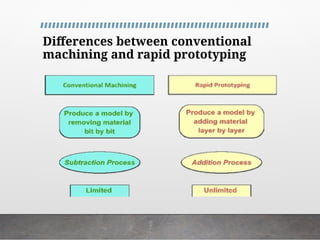
Differences between conventional
machining and rapid prototyping
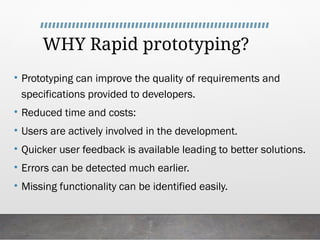
WHY Rapid prototyping?
• Prototyping can improve the quality of requirements and
specifications provided to developers.
• Reduced time and costs:
• Users are actively involved in the development.
• Quicker user feedback is available leading to better solutions.
• Errors can be detected much earlier.
• Missing functionality can be identified easily.
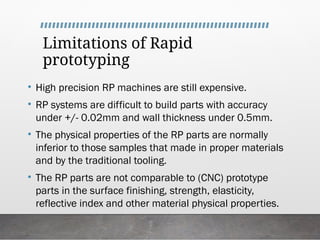
Limitations of Rapid
prototyping
• High precision RP machines are still expensive.
• RP systems are difficult to build parts with accuracy
under +/- 0.02mm and wall thickness under 0.5mm.
• The physical properties of the RP parts are normally
inferior to those samples that made in proper materials
and by the traditional tooling.
• The RP parts are not comparable to (CNC) prototype
parts in the surface finishing, strength, elasticity,
reflective index and other material physical properties.
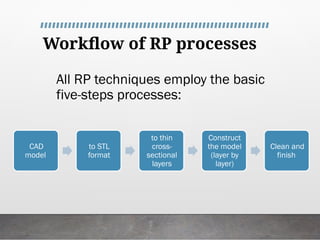
Workflow of RP processes
All RP techniques employ the basic
five-steps processes:
CAD
model
to STL
format
to thin
cross-
sectional
layers
Construct
the model
(layer by
layer)
Clean and
finish
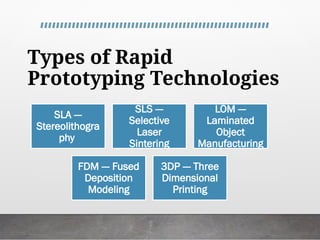
Types of Rapid
Prototyping Technologies
SLA ---
Stereolithogra
phy
SLS ---
Selective
Laser
Sintering
LOM ---
Laminated
Object
Manufacturing
FDM --- Fused
Deposition
Modeling
3DP --- Three
Dimensional
Printing
1. Stereolithography (SLA)
• Patented in 1986, Stereolithography started the rapid
prototyping revolution. The technique builds three-
dimensional models from liquid photosensitive polymers
that solidify when exposed to ultraviolet light.
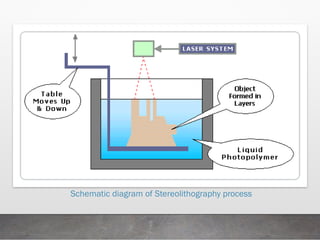
Schematic diagram of Stereolithography process
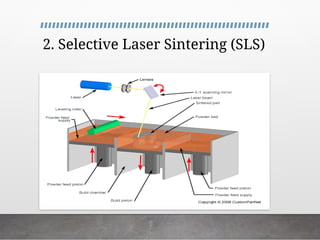
2. Selective Laser Sintering (SLS)
 Advantages
◦ Flexibility of materials used
• PVC, Nylon, Sand for building sand casting cores, metal and
investment casting wax.
◦ No need to create a structure to support the part
◦ Parts do not require any post curing except when ceramic is used.
 Disadvantages
◦ During solidification, additional powder may be hardened at the border
line.
◦ The roughness is most visible when parts contain sloping (stepped)
surfaces.
 Application Range
◦ Visual Representation models
◦ Functional and tough prototypes
◦ cast metal parts
3. Laminated Object Manufacture
(LOM)
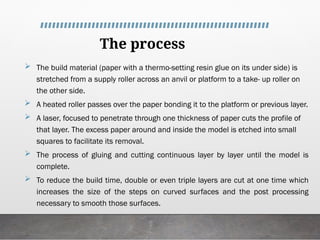
• As the name implies the process laminates thin sheets of film
(paper or plastic).
• The laser has only to cut/scan the periphery of each layer.
The process
 The build material (paper with a thermo-setting resin glue on its under side) is
stretched from a supply roller across an anvil or platform to a take- up roller on
the other side.
 A heated roller passes over the paper bonding it to the platform or previous layer.
 A laser, focused to penetrate through one thickness of paper cuts the profile of
that layer. The excess paper around and inside the model is etched into small
squares to facilitate its removal.
 The process of gluing and cutting continuous layer by layer until the model is
complete.
 To reduce the build time, double or even triple layers are cut at one time which
increases the size of the steps on curved surfaces and the post processing
necessary to smooth those surfaces.
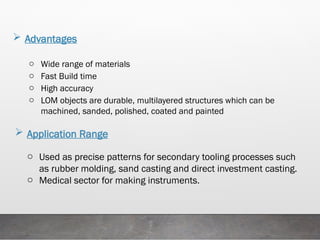
 Advantages
o Wide range of materials
o Fast Build time
o High accuracy
o LOM objects are durable, multilayered structures which can be
machined, sanded, polished, coated and painted
 Application Range
o Used as precise patterns for secondary tooling processes such
as rubber molding, sand casting and direct investment casting.
o Medical sector for making instruments.
4. Fused Deposition Modeling
(FDM)
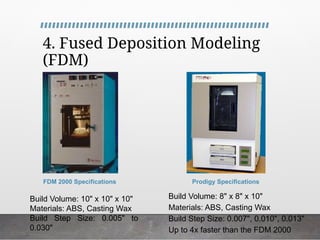
FDM 2000 Specifications Prodigy Specifications
Build Volume: 10" x 10" x 10"
Materials: ABS, Casting Wax
Build Step Size: 0.005" to
0.030"
Build Volume: 8" x 8" x 10"
Materials: ABS, Casting Wax
Build Step Size: 0.007", 0.010", 0.013"
Up to 4x faster than the FDM 2000
 (FDM) is a solid-based rapid prototyping method that
extrudes material, layer-by-layer, to build a model.
 A thread of plastic is fed into an extrusion head, where
it is heated into a semi-liquid state and extruded
through a very small hole onto the previous layer of
material.
 Support material is also laid down in a similar manner.
 Advantages
o Easy fabrication
o Minimal wastage
o Ease of removal
o Easy handling
 Application Range
o Designing
o Engineering analysis and planning
o Tooling and manufacturing
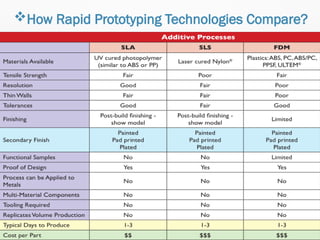
How Rapid Prototyping Technologies Compare?
5. Three-Dimensional
Printing (3DP)
• What is 3DP?
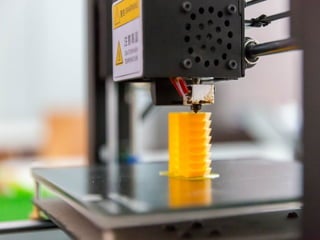
3DP is the process of creating an object using a machine that puts
down material layer by layer in three dimensions until the desired
object is formed. A 3D printer extrudes melted plastic filament or
other material, building objects based on specifications that come
from modeling software or from a scan of an existing object.
How does 3D printing work?
• To create something with a 3D printer, a user begins either by scanning an existing
object with a 3D scanner to obtain the needed specifications or by generating the
specs in a 3D modeling application.
• The specifications are then sent to an extrusion printer, where plastic filament or
other material is used to create the three-dimensional model one layer at a time.
• As the material is extruded from the nozzle of the printer, the software controlling
the machine moves either the platform or the nozzle itself such that the material is
deposited in a succession of layers to create the object. Often, the completed object
is a single color, but printers are now available with two nozzles for dual-color prints.
Printing can take a few minutes for a small object the size of a keychain or several
hours for larger, more complicated objects.
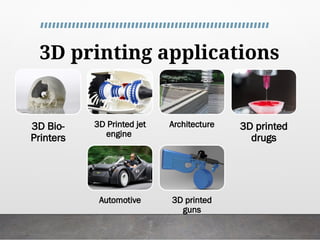
3D printing applications
3D Bio-
Printers
3D Printed jet
engine
Architecture 3D printed
drugs
Automotive 3D printed
guns
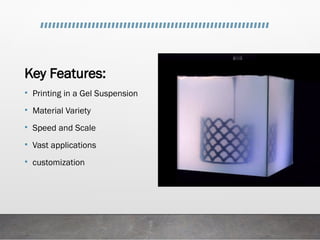
Rapid Liquid Printing (RLP)
an advanced 3D printing technique designed for large-
scale, high-speed fabrication. It stands out because it
eliminates the layer-by-layer process typically used in
traditional additive manufacturing. Instead, RLP directly
prints freeform structures within a viscous liquid gel
medium, enabling faster and more flexible production
Key Features:
• Printing in a Gel Suspension
• Material Variety
• Speed and Scale
• Vast applications
• customization
rapid prototyping ppt.pptx power point prsesntation

rapid prototyping ppt.pptx power point prsesntation

  • 1.
  • 2.
    Introduction • In manyfields, there is great uncertainty as to whether a new design will actually do what is desired. New designs often have unexpected problems. A prototype is often used as part of the product design process to allow engineers and designers the ability to explore design alternatives, test theories and confirm performance prior to starting production of a new product. Engineers use their experience to tailor the prototype according to the specific unknowns still present in the intended design.
  • 3.
    Definition • Rapid Prototypingtechnology employs various engineering to directly produce a physical model layer by layer (Layer Manufacturing) in accordance with the geometrical data delivered from a 3D CAD model.
  • 4.
  • 5.
    WHY Rapid prototyping? •Prototyping can improve the quality of requirements and specifications provided to developers. • Reduced time and costs: • Users are actively involved in the development. • Quicker user feedback is available leading to better solutions. • Errors can be detected much earlier. • Missing functionality can be identified easily.
  • 6.
    Limitations of Rapid prototyping •High precision RP machines are still expensive. • RP systems are difficult to build parts with accuracy under +/- 0.02mm and wall thickness under 0.5mm. • The physical properties of the RP parts are normally inferior to those samples that made in proper materials and by the traditional tooling. • The RP parts are not comparable to (CNC) prototype parts in the surface finishing, strength, elasticity, reflective index and other material physical properties.
  • 7.
    Workflow of RPprocesses All RP techniques employ the basic five-steps processes: CAD model to STL format to thin cross- sectional layers Construct the model (layer by layer) Clean and finish
  • 8.
    Types of Rapid PrototypingTechnologies SLA --- Stereolithogra phy SLS --- Selective Laser Sintering LOM --- Laminated Object Manufacturing FDM --- Fused Deposition Modeling 3DP --- Three Dimensional Printing
  • 9.
    1. Stereolithography (SLA) •Patented in 1986, Stereolithography started the rapid prototyping revolution. The technique builds three- dimensional models from liquid photosensitive polymers that solidify when exposed to ultraviolet light.
  • 10.
    Schematic diagram ofStereolithography process
  • 11.
    2. Selective LaserSintering (SLS)
  • 12.
     Advantages ◦ Flexibilityof materials used • PVC, Nylon, Sand for building sand casting cores, metal and investment casting wax. ◦ No need to create a structure to support the part ◦ Parts do not require any post curing except when ceramic is used.  Disadvantages ◦ During solidification, additional powder may be hardened at the border line. ◦ The roughness is most visible when parts contain sloping (stepped) surfaces.  Application Range ◦ Visual Representation models ◦ Functional and tough prototypes ◦ cast metal parts
  • 13.
    3. Laminated ObjectManufacture (LOM) • As the name implies the process laminates thin sheets of film (paper or plastic). • The laser has only to cut/scan the periphery of each layer.
  • 14.
    The process  Thebuild material (paper with a thermo-setting resin glue on its under side) is stretched from a supply roller across an anvil or platform to a take- up roller on the other side.  A heated roller passes over the paper bonding it to the platform or previous layer.  A laser, focused to penetrate through one thickness of paper cuts the profile of that layer. The excess paper around and inside the model is etched into small squares to facilitate its removal.  The process of gluing and cutting continuous layer by layer until the model is complete.  To reduce the build time, double or even triple layers are cut at one time which increases the size of the steps on curved surfaces and the post processing necessary to smooth those surfaces.
  • 15.
     Advantages o Widerange of materials o Fast Build time o High accuracy o LOM objects are durable, multilayered structures which can be machined, sanded, polished, coated and painted  Application Range o Used as precise patterns for secondary tooling processes such as rubber molding, sand casting and direct investment casting. o Medical sector for making instruments.
  • 16.
    4. Fused DepositionModeling (FDM) FDM 2000 Specifications Prodigy Specifications Build Volume: 10" x 10" x 10" Materials: ABS, Casting Wax Build Step Size: 0.005" to 0.030" Build Volume: 8" x 8" x 10" Materials: ABS, Casting Wax Build Step Size: 0.007", 0.010", 0.013" Up to 4x faster than the FDM 2000
  • 17.
     (FDM) isa solid-based rapid prototyping method that extrudes material, layer-by-layer, to build a model.  A thread of plastic is fed into an extrusion head, where it is heated into a semi-liquid state and extruded through a very small hole onto the previous layer of material.  Support material is also laid down in a similar manner.
  • 18.
     Advantages o Easyfabrication o Minimal wastage o Ease of removal o Easy handling  Application Range o Designing o Engineering analysis and planning o Tooling and manufacturing
  • 19.
    How Rapid PrototypingTechnologies Compare?
  • 20.
    5. Three-Dimensional Printing (3DP) •What is 3DP? 3DP is the process of creating an object using a machine that puts down material layer by layer in three dimensions until the desired object is formed. A 3D printer extrudes melted plastic filament or other material, building objects based on specifications that come from modeling software or from a scan of an existing object.
  • 22.
    How does 3Dprinting work? • To create something with a 3D printer, a user begins either by scanning an existing object with a 3D scanner to obtain the needed specifications or by generating the specs in a 3D modeling application. • The specifications are then sent to an extrusion printer, where plastic filament or other material is used to create the three-dimensional model one layer at a time. • As the material is extruded from the nozzle of the printer, the software controlling the machine moves either the platform or the nozzle itself such that the material is deposited in a succession of layers to create the object. Often, the completed object is a single color, but printers are now available with two nozzles for dual-color prints. Printing can take a few minutes for a small object the size of a keychain or several hours for larger, more complicated objects.
  • 23.
    3D printing applications 3DBio- Printers 3D Printed jet engine Architecture 3D printed drugs Automotive 3D printed guns
  • 24.
    Rapid Liquid Printing(RLP) an advanced 3D printing technique designed for large- scale, high-speed fabrication. It stands out because it eliminates the layer-by-layer process typically used in traditional additive manufacturing. Instead, RLP directly prints freeform structures within a viscous liquid gel medium, enabling faster and more flexible production
  • 25.
    Key Features: • Printingin a Gel Suspension • Material Variety • Speed and Scale • Vast applications • customization