Module 14
Constructivism: Knowledge
Construction / Concept Learning
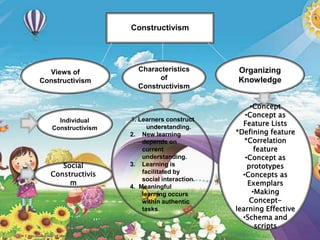
Constructivism
Views of
Constructivism
Characteristics
of
Constructivism
Organizing
Knowledge
Individual
Constructivism
Social
Constructivis
m
1. Learners construct
understanding.
2. New learning
depends on
current
understanding.
3. Learning is
facilitated by
social interaction.
4. Meaningful
learning occurs
within authentic
tasks.
•Concept
•Concept as
Feature Lists
*Defining feature
*Correlation
feature
•Concept as
prototypes
•Concepts as
Exemplars
•Making
Concept-
learning Effective
•Schema and
scripts
Two Views of Constructivism
Individual Constructivism.
This is also called cognitive constructivism. It
emphasizes individual, internal construction of
knowledge. They believe the learners should be
allowed to discover principles through their own
exploration rather than direct instruction by the
teacher.
Social Constructivism.
This view emphasize that “knowledge
exists in a social context and is
initially shared with others instead
of being represented solely in the
mind of an individual”.
1. Learners construct understanding.
As discussed earlier, constructivists do not
view as just empty vessels waiting to be filled
up.
2. New learning depends on current
understanding.
Background information is very important.
3.Learning is facilitated by social interaction.
Constructivists believe in creating a
“community of learners” within classroom.
4.Meaningful learning occurs within authentic
learning tasks.
An authentic task is one that
involves a learning activity that
involves constructing knowledge and
understanding that is the knowledge
and understanding needed when
applied in the real world.
 Concepts. A concept is away of grouping or
categorizing objects or events in our mind. A
concept of “teach” includes a group of tasks
such as model, discuss, illustrate, explain,
assists, etc.
 Concept as Feature Lists.
Learning a concept involves specific
features that characterize positive instance of
the concept.
Included here are defining features and
correlation feature.
A defining feature is a characteristics
present in ALL instances. Example, a triangle
has three sides.
A correlation feature is one that is present
in many positive instances but not essential
for concept membership. For example, a
mother is loving. Being loving is a feature
commonly present in the concept mother. But
a mother may not be loving. So “being
loving”, is only a correlation feature, not a
defining one.
 Concept as prototypes.
A prototype is an idea or a visual image
of a “typical” example. It is usually formed
based on the positive instances that
learners encounter most often. Example,
close your eyes now and for a moment
think of a cat. Picture in mind what it looks
like.
 Concept as Exemplars.
Exemplars represent a variety of examples.
It allows learners to know that an example
under a concept may have variability. Example,
a learner’s concept of vegetable may include a
wide variety of different examples like
cauliflowers, kangkong, cabbage, string beans,
squash, corn, potatoes. When he encounters a
new type of vegetable like “bitsuelas”, he would
from the exemplars he knows and look for one
that is most similar, like string beans.
 Make the defining features very concrete and
prominent
 Provide a clear definition of the concept
 Give a variety of positive instances
 Give a negative instances
 Cite a “best example” or a prototype
 Provide opportunity for learners to identify
positive and negative instances
 Ask learners to think of their own example of the
concept
 Point out how concepts can be related to each
other
 Schemas and scripts.

A schema is an organized body of
knowledge about something. It is like a file of
information you hold in your mind about
something. Like a schema of what is a teacher
is.
A scripts is a schema that includes a series
of predictable events about a specific activity.
Example would include knowing the series of
steps done when we visit a doctor, or what
transpires at the beginning of the class when
teacher arrives.
 Aim to make learners understand few key ideas
in an in-depth manner, rather than taking up so
many topics superficially.
 Give varied examples.
 Provide opportunities for experimentation.
 Provide lots of opportunities for quality
interaction.
 Have lots of hands-on activities.
 Relate your topic to real life situations.
 Do not depend on the explanation methods all
the time.
Thank you
and
God bless

cognitive process

  • 1.
  • 2.
    Constructivism Views of Constructivism Characteristics of Constructivism Organizing Knowledge Individual Constructivism Social Constructivis m 1. Learnersconstruct understanding. 2. New learning depends on current understanding. 3. Learning is facilitated by social interaction. 4. Meaningful learning occurs within authentic tasks. •Concept •Concept as Feature Lists *Defining feature *Correlation feature •Concept as prototypes •Concepts as Exemplars •Making Concept- learning Effective •Schema and scripts
  • 3.
    Two Views ofConstructivism Individual Constructivism. This is also called cognitive constructivism. It emphasizes individual, internal construction of knowledge. They believe the learners should be allowed to discover principles through their own exploration rather than direct instruction by the teacher.
  • 4.
    Social Constructivism. This viewemphasize that “knowledge exists in a social context and is initially shared with others instead of being represented solely in the mind of an individual”.
  • 5.
    1. Learners constructunderstanding. As discussed earlier, constructivists do not view as just empty vessels waiting to be filled up. 2. New learning depends on current understanding. Background information is very important. 3.Learning is facilitated by social interaction. Constructivists believe in creating a “community of learners” within classroom.
  • 6.
    4.Meaningful learning occurswithin authentic learning tasks. An authentic task is one that involves a learning activity that involves constructing knowledge and understanding that is the knowledge and understanding needed when applied in the real world.
  • 7.
     Concepts. Aconcept is away of grouping or categorizing objects or events in our mind. A concept of “teach” includes a group of tasks such as model, discuss, illustrate, explain, assists, etc.  Concept as Feature Lists. Learning a concept involves specific features that characterize positive instance of the concept.
  • 8.
    Included here aredefining features and correlation feature. A defining feature is a characteristics present in ALL instances. Example, a triangle has three sides. A correlation feature is one that is present in many positive instances but not essential for concept membership. For example, a mother is loving. Being loving is a feature commonly present in the concept mother. But a mother may not be loving. So “being loving”, is only a correlation feature, not a defining one.
  • 9.
     Concept asprototypes. A prototype is an idea or a visual image of a “typical” example. It is usually formed based on the positive instances that learners encounter most often. Example, close your eyes now and for a moment think of a cat. Picture in mind what it looks like.
  • 10.
     Concept asExemplars. Exemplars represent a variety of examples. It allows learners to know that an example under a concept may have variability. Example, a learner’s concept of vegetable may include a wide variety of different examples like cauliflowers, kangkong, cabbage, string beans, squash, corn, potatoes. When he encounters a new type of vegetable like “bitsuelas”, he would from the exemplars he knows and look for one that is most similar, like string beans.
  • 11.
     Make thedefining features very concrete and prominent  Provide a clear definition of the concept  Give a variety of positive instances  Give a negative instances  Cite a “best example” or a prototype  Provide opportunity for learners to identify positive and negative instances  Ask learners to think of their own example of the concept  Point out how concepts can be related to each other
  • 12.
     Schemas andscripts.  A schema is an organized body of knowledge about something. It is like a file of information you hold in your mind about something. Like a schema of what is a teacher is. A scripts is a schema that includes a series of predictable events about a specific activity. Example would include knowing the series of steps done when we visit a doctor, or what transpires at the beginning of the class when teacher arrives.
  • 13.
     Aim tomake learners understand few key ideas in an in-depth manner, rather than taking up so many topics superficially.  Give varied examples.  Provide opportunities for experimentation.  Provide lots of opportunities for quality interaction.  Have lots of hands-on activities.  Relate your topic to real life situations.  Do not depend on the explanation methods all the time.
  • 14.