Visual Imagination
The cognitive process, as we discussed
earlier, involves the decoding of the perceptual
code. What that code is, is at this time, an
unknown. But it is known that a code, in fact
does exist, and that cognition largely occurs
due to a process of association. This means
that the secondary visual cortex can associate
the new code with old, already decoded,
information.
Cognition occurs, when a meaningful
association occurs. (Meaningful, here, refers to
an “Aha! Moment”; something other than
vague.)
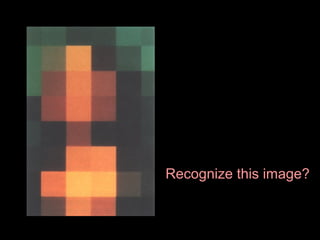
Let us look at an example at how this might
occur.
Recognize this image?
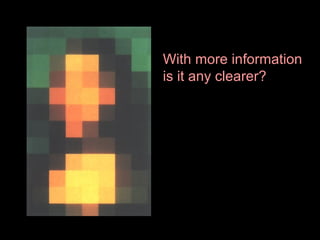
With more information
is it any clearer?
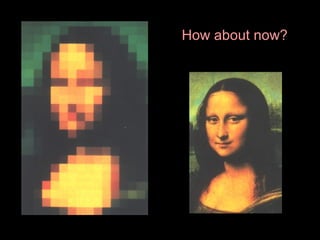
How about now?
These associations, which are, no more than,
“intelligent guesses”, are, also, responsible for
cognitive errors such as: expectancy effect, the
halo effect, selective observation, contrast
effect, projection and stereotyping.
It is, clearly, to our advantage to analyze
incoming data thoroughly, before we commit to
association. In the scene shop, carpenters call
it, the “measure twice-cut once” principle.”
We are often called upon, or, perhaps, have
an urgent need to represent our thoughts in
some visual way. This may be through
physical expression or symbol. A gesture is
a form of non-verbal communication used to
convey signals that have some universal
value. We are all familiar with physical
gestures. Actors employ them all the time.
Other types of symbolic gestures are
represented in another mediums,such as
paper for example.
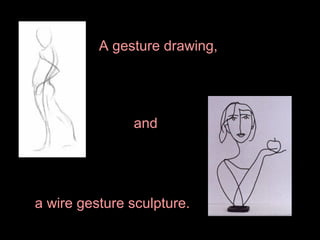
A gesture drawing,

and

a wire gesture sculpture.
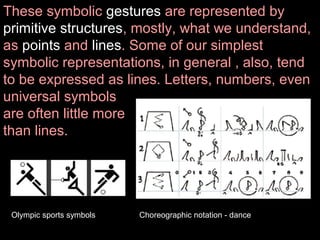
These symbolic gestures are represented by
primitive structures, mostly, what we understand,
as points and lines. Some of our simplest
symbolic representations, in general , also, tend
to be expressed as lines. Letters, numbers, even
universal symbols
are often little more
than lines.

Olympic sports symbols

Choreographic notation - dance
When attempting to communicate through
visual means, we rely on these primitive
constructs or “primitives” to carry our
meaning. Before we make these ideas visible,
it is traditional, to imagine them first.
Since, we’ve already talked about
imagination, hopefully, it won’t be difficult to
understand these conceptual elements of
design.
The conceptual elements are neither visible
nor perceived. They are, rather, imagined or
conceived.
The conceptual elements are instrumental to
the visualization of design. Although abstract
in nature, the conceptual elements have
their most practical application in
mathematics and physics, but they have also
made significant inroads into the arts,
including theatre
There are five (4) conceptual elements of
design.


Point



Line



Plane



Volume
Conceptual space
Conceptual space is a condition in which
imagination is possible.

 It has no length, width or height.
 In neither moves nor is stationary.
 It has no direction nor position.
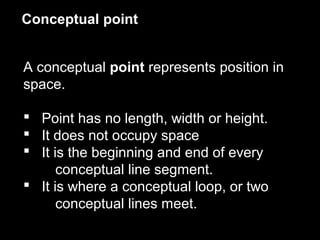
Conceptual point
A conceptual point represents position in
space.
 Point has no length, width or height.
 It does not occupy space
 It is the beginning and end of every
conceptual line segment.
 It is where a conceptual loop, or two
conceptual lines meet.
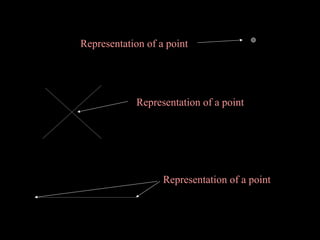
Representation of a point

Representation of a point

Representation of a point
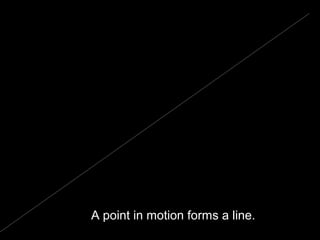
A point in motion forms a line.
Conceptual Line
A conceptual line is a path created by a
conceptual point in motion.
 A conceptual line has length and direction,
but has no width or height.
 A conceptual line has direction and
position.
 A conceptual line is bound by points.
 A conceptual line forms the boundaries of
a
plane.
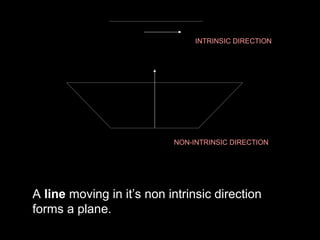
INTRINSIC DIRECTION

NON-INTRINSIC DIRECTION

A line moving in it’s non intrinsic direction
forms a plane.
Conceptual Plane
 A conceptual plane has length and width
but
no thickness.
 It has position and direction.
 It is bound by lines.
 It defines the external form of a volume.
 It marks the location of a loop
or where two lines intersect..
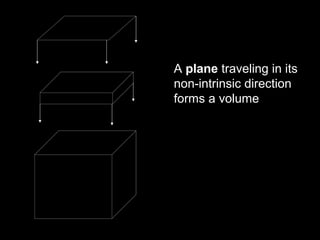
A plane traveling in its
non-intrinsic direction
forms a volume
Conceptual Volume

 Conceptual volume has position in space
and is bound by planes.
 It has length, width and height but no
weight.
 It defines the exact amount of space it
encompasses.
The conceptual elements may be represented in
two and three dimensional design. Once the
conceptual elements are represented in visual
terms they become visual elements and are,
then, defined differently.
11   the conceptual elements

11 the conceptual elements

  • 1.
  • 2.
    The cognitive process,as we discussed earlier, involves the decoding of the perceptual code. What that code is, is at this time, an unknown. But it is known that a code, in fact does exist, and that cognition largely occurs due to a process of association. This means that the secondary visual cortex can associate the new code with old, already decoded, information.
  • 3.
    Cognition occurs, whena meaningful association occurs. (Meaningful, here, refers to an “Aha! Moment”; something other than vague.) Let us look at an example at how this might occur.
  • 4.
  • 5.
    With more information isit any clearer?
  • 6.
  • 7.
    These associations, whichare, no more than, “intelligent guesses”, are, also, responsible for cognitive errors such as: expectancy effect, the halo effect, selective observation, contrast effect, projection and stereotyping.
  • 8.
    It is, clearly,to our advantage to analyze incoming data thoroughly, before we commit to association. In the scene shop, carpenters call it, the “measure twice-cut once” principle.”
  • 9.
    We are oftencalled upon, or, perhaps, have an urgent need to represent our thoughts in some visual way. This may be through physical expression or symbol. A gesture is a form of non-verbal communication used to convey signals that have some universal value. We are all familiar with physical gestures. Actors employ them all the time. Other types of symbolic gestures are represented in another mediums,such as paper for example.
  • 10.
    A gesture drawing, and awire gesture sculpture.
  • 11.
    These symbolic gesturesare represented by primitive structures, mostly, what we understand, as points and lines. Some of our simplest symbolic representations, in general , also, tend to be expressed as lines. Letters, numbers, even universal symbols are often little more than lines. Olympic sports symbols Choreographic notation - dance
  • 12.
    When attempting tocommunicate through visual means, we rely on these primitive constructs or “primitives” to carry our meaning. Before we make these ideas visible, it is traditional, to imagine them first. Since, we’ve already talked about imagination, hopefully, it won’t be difficult to understand these conceptual elements of design.
  • 13.
    The conceptual elementsare neither visible nor perceived. They are, rather, imagined or conceived. The conceptual elements are instrumental to the visualization of design. Although abstract in nature, the conceptual elements have their most practical application in mathematics and physics, but they have also made significant inroads into the arts, including theatre
  • 14.
    There are five(4) conceptual elements of design.  Point  Line  Plane  Volume
  • 15.
    Conceptual space Conceptual spaceis a condition in which imagination is possible.  It has no length, width or height.  In neither moves nor is stationary.  It has no direction nor position.
  • 16.
    Conceptual point A conceptualpoint represents position in space.  Point has no length, width or height.  It does not occupy space  It is the beginning and end of every conceptual line segment.  It is where a conceptual loop, or two conceptual lines meet.
  • 17.
    Representation of apoint Representation of a point Representation of a point
  • 18.
    A point inmotion forms a line.
  • 19.
    A point inmotion forms a line.
  • 20.
    Conceptual Line A conceptualline is a path created by a conceptual point in motion.  A conceptual line has length and direction, but has no width or height.  A conceptual line has direction and position.  A conceptual line is bound by points.  A conceptual line forms the boundaries of a plane.
  • 21.
    INTRINSIC DIRECTION NON-INTRINSIC DIRECTION Aline moving in it’s non intrinsic direction forms a plane.
  • 22.
    Conceptual Plane  Aconceptual plane has length and width but no thickness.  It has position and direction.  It is bound by lines.  It defines the external form of a volume.  It marks the location of a loop or where two lines intersect..
  • 23.
    A plane travelingin its non-intrinsic direction forms a volume
  • 24.
    Conceptual Volume  Conceptualvolume has position in space and is bound by planes.  It has length, width and height but no weight.  It defines the exact amount of space it encompasses.
  • 25.
    The conceptual elementsmay be represented in two and three dimensional design. Once the conceptual elements are represented in visual terms they become visual elements and are, then, defined differently.