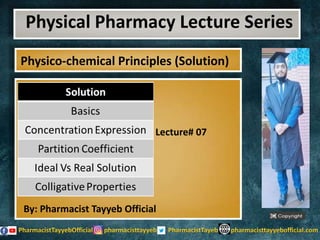
Physical Pharmacy Lecture Series
Lecture# 07
By: Pharmacist Tayyeb Official
Physico-chemical Principles (Solution)
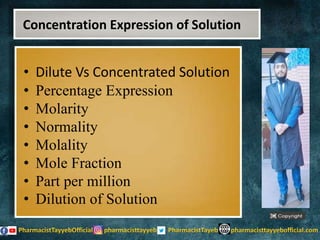
Concentration Expression of Solution
• Dilute Vs Concentrated Solution
• Percentage Expression
• Molarity
• Normality
• Molality
• Mole Fraction
• Part per million
• Dilution of Solution
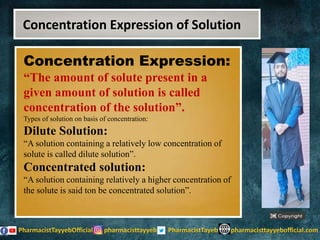
Concentration Expression:
“The amount of solute present in a
given amount of solution is called
concentration of the solution”.
Types of solution on basis of concentration:
Dilute Solution:
“A solution containing a relatively low concentration of
solute is called dilute solution”.
Concentrated solution:
“A solution containing relatively a higher concentration of
the solute is said ton be concentrated solution”.
Concentration Expression of Solution
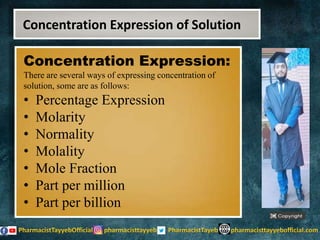
Concentration Expression:
There are several ways of expressing concentration of
solution, some are as follows:
• Percentage Expression
• Molarity
• Normality
• Molality
• Mole Fraction
• Part per million
• Part per billion
Concentration Expression of Solution
Percentage Expression:
“The specific amount of solute
present in 100 gm of solution”.
OR
“It is the part of the solute present in
100 parts of the solution”.
Types:
Following are 03 different types of %age expressions:
• % age w/w
• % age v/v
• % age w/v
Concentration Expression of Solution
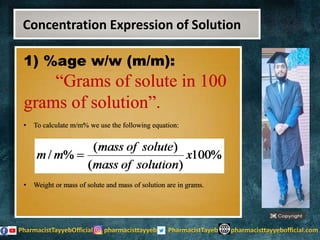
1) %age w/w (m/m):
“Grams of solute in 100
grams of solution”.
• To calculate m/m% we use the following equation:
• Weight or mass of solute and mass of solution are in grams.
1) %age w/w (m/m):
“Grams of solute in 100
grams of solution”.
• To calculate m/m% we use the following equation:
• Weight or mass of solute and mass of solution are in grams.
Concentration Expression of Solution
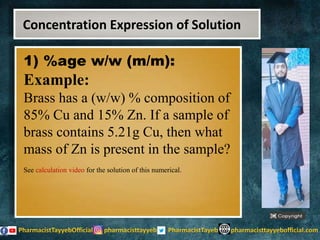
1) %age w/w (m/m):
Example:
Brass has a (w/w) % composition of
85% Cu and 15% Zn. If a sample of
brass contains 5.21g Cu, then what
mass of Zn is present in the sample?
See calculation video for the solution of this numerical.
Concentration Expression of Solution
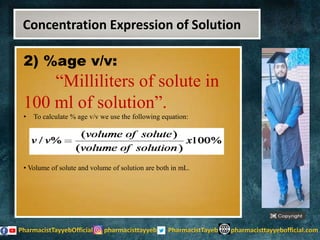
2) %age v/v:
“Milliliters of solute in
100 ml of solution”.
• To calculate % age v/v we use the following equation:
• Volume of solute and volume of solution are both in mL.
Concentration Expression of Solution
2) %age v/v:
Example:
Beer usually contains 5.0%
(v/v) ethanol. How much
pure ethanol is present in one
341mL bottle of beer?
See calculation video for the solution of this numerical.
Concentration Expression of Solution
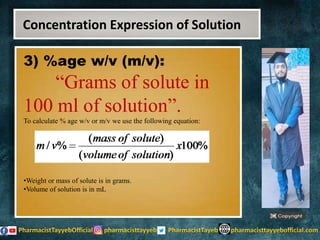
3) %age w/v (m/v):
“Grams of solute in
100 ml of solution”.
To calculate % age w/v or m/v we use the following equation:
•Weight or mass of solute is in grams.
•Volume of solution is in mL
Concentration Expression of Solution
3) %age w/v (m/v):
Example:
What mass of CuCl2(s) is
required to make 1.0L of 5.2%
(w/v) CuCl2 (aq)?
See calculation video for the solution of this numerical.
Concentration Expression of Solution
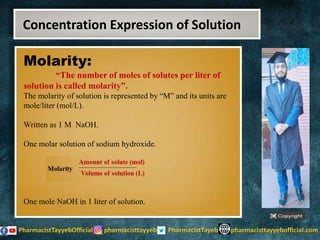
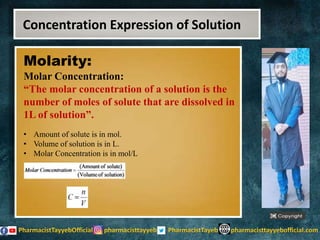
Molarity:
“The number of moles of solutes per liter of
solution is called molarity”.
The molarity of solution is represented by “M” and its units are
mole/liter (mol/L).
Written as 1 M NaOH.
One molar solution of sodium hydroxide.
One mole NaOH in 1 liter of solution.
Concentration Expression of Solution
Molarity:
Molar Concentration:
“The molar concentration of a solution is the
number of moles of solute that are dissolved in
1L of solution”.
• Amount of solute is in mol.
• Volume of solution is in L.
• Molar Concentration is in mol/L
Concentration Expression of Solution
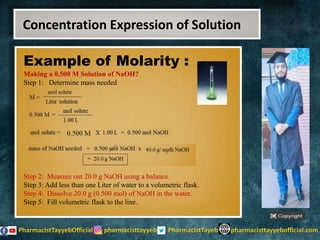
Example of Molarity :
Making a 0.500 M Solution of NaOH?
Step 1: Determine mass needed
Step 2: Measure out 20.0 g NaOH using a balance
Step 3: Add less than one Liter of water to a volumetric flask.
Step 4: Dissolve 20.0 g (0.500 mol) of NaOH in the water.
Step 5: Fill volumetric flask to the line.
Concentration Expression of Solution
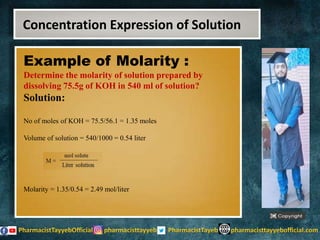
Example of Molarity :
Determine the molarity of solution prepared by
dissolving 75.5g of KOH in 540 ml of solution?
Solution:
No of moles of KOH = 75.5/56.1 = 1.35 moles
Volume of solution = 540/1000 = 0.54 liter
Molarity = 1.35/0.54 = 2.49 mol/liter
Concentration Expression of Solution
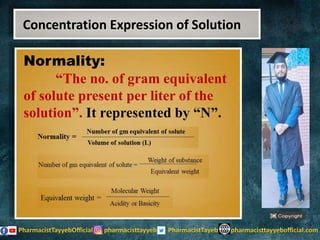
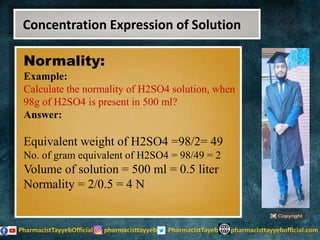
Normality:
“The no. of gram equivalent
of solute present per liter of the
solution”. It represented by “N”.
Concentration Expression of Solution
Normality:
Example:
Calculate the normality of H2SO4 solution, when
98g of H2SO4 is present in 500 ml?
Answer:
Equivalent weight of H2SO4 =98/2= 49
No. of gram equivalent of H2SO4 = 98/49 = 2
Volume of solution = 500 ml = 0.5 liter
Normality = 2/0.5 = 4 N
Concentration Expression of Solution
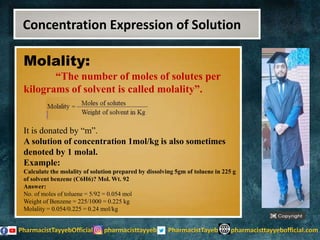
Molality:
“The number of moles of solutes per
kilograms of solvent is called molality”.
It is donated by “m”.
A solution of concentration 1mol/kg is also sometimes
denoted by 1 molal.
Example:
Calculate the molality of solution prepared by dissolving 5gm of toluene in 225 g
of solvent benzene (C6H6)? Mol. Wt. 92
Answer:
No. of moles of toluene = 5/92 = 0.054 mol
Weight of Benzene = 225/1000 = 0.225 kg
Molality = 0.054/0.225 = 0.24 mol/kg
Concentration Expression of Solution
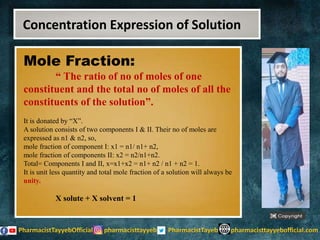
Mole Fraction:
“ The ratio of no of moles of one
constituent and the total no of moles of all the
constituents of the solution”.
It is donated by “X”.
A solution consists of two components I & II. Their no of moles are
expressed as n1 & n2, so,
mole fraction of component I: x1 = n1/ n1+ n2,
mole fraction of components II: x2 = n2/n1+n2.
Total= Components I and II, x=x1+x2 = n1+ n2 / n1 + n2 = 1.
It is unit less quantity and total mole fraction of a solution will always be
unity.
X solute + X solvent = 1
Concentration Expression of Solution
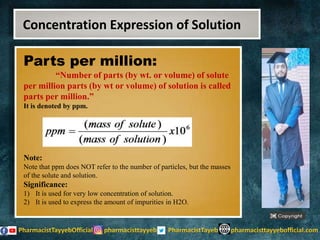
Parts per million:
“Number of parts (by wt. or volume) of solute
per million parts (by wt or volume) of solution is called
parts per million.”
It is denoted by ppm.
Note:
Note that ppm does NOT refer to the number of particles, but the masses
of the solute and solution.
Significance:
1) It is used for very low concentration of solution.
2) It is used to express the amount of impurities in H2O.
Concentration Expression of Solution
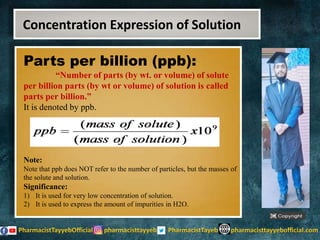
Parts per billion (ppb):
“Number of parts (by wt. or volume) of solute
per billion parts (by wt or volume) of solution is called
parts per billion.”
It is denoted by ppb.
Note:
Note that ppb does NOT refer to the number of particles, but the masses of
the solute and solution.
Significance:
1) It is used for very low concentration of solution.
2) It is used to express the amount of impurities in H2O.
Concentration Expression of Solution
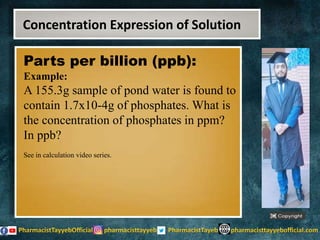
Parts per billion (ppb):
Example:
A 155.3g sample of pond water is found to
contain 1.7x10⁻⁴g of phosphates. What is
the concentration of phosphates in ppm?
In ppb?
See in calculation video series.
Concentration Expression of Solution
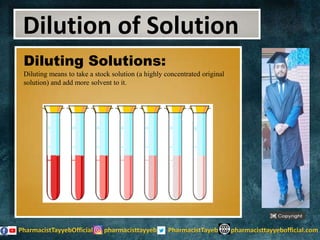
Diluting Solutions:
Diluting means to take a stock solution (a highly concentrated original
solution) and add more solvent to it.
Dilution of Solution
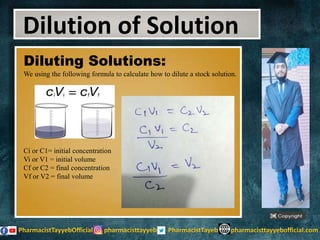
Diluting Solutions:
We using the following formula to calculate how to dilute a stock solution.
Ci or C1= initial concentration
Vi or V1 = initial volume
Cf or C2 = final concentration
Vf or V2 = final volume
Dilution of Solution
Diluting Solutions:
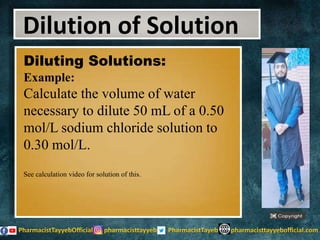
Example:
Calculate the volume of water
necessary to dilute 50 mL of a 0.50
mol/L sodium chloride solution to
0.30 mol/L.
See calculation video for solution of this.
Dilution of Solution
Solution
Other topic of solution:
Lecture# 07 (Done)
Lecture# 06 (prev.)
End
 Do not forget to subscribe
my channel.
 Press the bell icon to get
more and latest video from
me.
 Share with our student
family of Pharmacy.
 Thanks for watching.
 Allah Hafiz

Concentration Expression of Solution| L 07|PhysicalPharmacyLectureSeries

  • 1.
    Physical Pharmacy LectureSeries Lecture# 07 By: Pharmacist Tayyeb Official Physico-chemical Principles (Solution)
  • 2.
    Concentration Expression ofSolution • Dilute Vs Concentrated Solution • Percentage Expression • Molarity • Normality • Molality • Mole Fraction • Part per million • Dilution of Solution
  • 3.
    Concentration Expression: “The amountof solute present in a given amount of solution is called concentration of the solution”. Types of solution on basis of concentration: Dilute Solution: “A solution containing a relatively low concentration of solute is called dilute solution”. Concentrated solution: “A solution containing relatively a higher concentration of the solute is said ton be concentrated solution”. Concentration Expression of Solution
  • 4.
    Concentration Expression: There areseveral ways of expressing concentration of solution, some are as follows: • Percentage Expression • Molarity • Normality • Molality • Mole Fraction • Part per million • Part per billion Concentration Expression of Solution
  • 5.
    Percentage Expression: “The specificamount of solute present in 100 gm of solution”. OR “It is the part of the solute present in 100 parts of the solution”. Types: Following are 03 different types of %age expressions: • % age w/w • % age v/v • % age w/v Concentration Expression of Solution
  • 6.
    1) %age w/w(m/m): “Grams of solute in 100 grams of solution”. • To calculate m/m% we use the following equation: • Weight or mass of solute and mass of solution are in grams. 1) %age w/w (m/m): “Grams of solute in 100 grams of solution”. • To calculate m/m% we use the following equation: • Weight or mass of solute and mass of solution are in grams. Concentration Expression of Solution
  • 7.
    1) %age w/w(m/m): Example: Brass has a (w/w) % composition of 85% Cu and 15% Zn. If a sample of brass contains 5.21g Cu, then what mass of Zn is present in the sample? See calculation video for the solution of this numerical. Concentration Expression of Solution
  • 8.
    2) %age v/v: “Millilitersof solute in 100 ml of solution”. • To calculate % age v/v we use the following equation: • Volume of solute and volume of solution are both in mL. Concentration Expression of Solution
  • 9.
    2) %age v/v: Example: Beerusually contains 5.0% (v/v) ethanol. How much pure ethanol is present in one 341mL bottle of beer? See calculation video for the solution of this numerical. Concentration Expression of Solution
  • 10.
    3) %age w/v(m/v): “Grams of solute in 100 ml of solution”. To calculate % age w/v or m/v we use the following equation: •Weight or mass of solute is in grams. •Volume of solution is in mL Concentration Expression of Solution
  • 11.
    3) %age w/v(m/v): Example: What mass of CuCl2(s) is required to make 1.0L of 5.2% (w/v) CuCl2 (aq)? See calculation video for the solution of this numerical. Concentration Expression of Solution
  • 12.
    Molarity: “The number ofmoles of solutes per liter of solution is called molarity”. The molarity of solution is represented by “M” and its units are mole/liter (mol/L). Written as 1 M NaOH. One molar solution of sodium hydroxide. One mole NaOH in 1 liter of solution. Concentration Expression of Solution
  • 13.
    Molarity: Molar Concentration: “The molarconcentration of a solution is the number of moles of solute that are dissolved in 1L of solution”. • Amount of solute is in mol. • Volume of solution is in L. • Molar Concentration is in mol/L Concentration Expression of Solution
  • 14.
    Example of Molarity: Making a 0.500 M Solution of NaOH? Step 1: Determine mass needed Step 2: Measure out 20.0 g NaOH using a balance Step 3: Add less than one Liter of water to a volumetric flask. Step 4: Dissolve 20.0 g (0.500 mol) of NaOH in the water. Step 5: Fill volumetric flask to the line. Concentration Expression of Solution
  • 15.
    Example of Molarity: Determine the molarity of solution prepared by dissolving 75.5g of KOH in 540 ml of solution? Solution: No of moles of KOH = 75.5/56.1 = 1.35 moles Volume of solution = 540/1000 = 0.54 liter Molarity = 1.35/0.54 = 2.49 mol/liter Concentration Expression of Solution
  • 16.
    Normality: “The no. ofgram equivalent of solute present per liter of the solution”. It represented by “N”. Concentration Expression of Solution
  • 17.
    Normality: Example: Calculate the normalityof H2SO4 solution, when 98g of H2SO4 is present in 500 ml? Answer: Equivalent weight of H2SO4 =98/2= 49 No. of gram equivalent of H2SO4 = 98/49 = 2 Volume of solution = 500 ml = 0.5 liter Normality = 2/0.5 = 4 N Concentration Expression of Solution
  • 18.
    Molality: “The number ofmoles of solutes per kilograms of solvent is called molality”. It is donated by “m”. A solution of concentration 1mol/kg is also sometimes denoted by 1 molal. Example: Calculate the molality of solution prepared by dissolving 5gm of toluene in 225 g of solvent benzene (C6H6)? Mol. Wt. 92 Answer: No. of moles of toluene = 5/92 = 0.054 mol Weight of Benzene = 225/1000 = 0.225 kg Molality = 0.054/0.225 = 0.24 mol/kg Concentration Expression of Solution
  • 19.
    Mole Fraction: “ Theratio of no of moles of one constituent and the total no of moles of all the constituents of the solution”. It is donated by “X”. A solution consists of two components I & II. Their no of moles are expressed as n1 & n2, so, mole fraction of component I: x1 = n1/ n1+ n2, mole fraction of components II: x2 = n2/n1+n2. Total= Components I and II, x=x1+x2 = n1+ n2 / n1 + n2 = 1. It is unit less quantity and total mole fraction of a solution will always be unity. X solute + X solvent = 1 Concentration Expression of Solution
  • 20.
    Parts per million: “Numberof parts (by wt. or volume) of solute per million parts (by wt or volume) of solution is called parts per million.” It is denoted by ppm. Note: Note that ppm does NOT refer to the number of particles, but the masses of the solute and solution. Significance: 1) It is used for very low concentration of solution. 2) It is used to express the amount of impurities in H2O. Concentration Expression of Solution
  • 21.
    Parts per billion(ppb): “Number of parts (by wt. or volume) of solute per billion parts (by wt or volume) of solution is called parts per billion.” It is denoted by ppb. Note: Note that ppb does NOT refer to the number of particles, but the masses of the solute and solution. Significance: 1) It is used for very low concentration of solution. 2) It is used to express the amount of impurities in H2O. Concentration Expression of Solution
  • 22.
    Parts per billion(ppb): Example: A 155.3g sample of pond water is found to contain 1.7x10⁻⁴g of phosphates. What is the concentration of phosphates in ppm? In ppb? See in calculation video series. Concentration Expression of Solution
  • 23.
    Diluting Solutions: Diluting meansto take a stock solution (a highly concentrated original solution) and add more solvent to it. Dilution of Solution
  • 24.
    Diluting Solutions: We usingthe following formula to calculate how to dilute a stock solution. Ci or C1= initial concentration Vi or V1 = initial volume Cf or C2 = final concentration Vf or V2 = final volume Dilution of Solution
  • 25.
    Diluting Solutions: Example: Calculate thevolume of water necessary to dilute 50 mL of a 0.50 mol/L sodium chloride solution to 0.30 mol/L. See calculation video for solution of this. Dilution of Solution
  • 26.
    Solution Other topic ofsolution: Lecture# 07 (Done) Lecture# 06 (prev.)
  • 27.
    End  Do notforget to subscribe my channel.  Press the bell icon to get more and latest video from me.  Share with our student family of Pharmacy.  Thanks for watching.  Allah Hafiz