Concentration Units
Percent by Mass
Molarity
Molality
Concentration Units
Qualitative Quantitative
Tells how much solute is dissolved in a
given amount of solution or solvent
Concentrated solution is one in which there is a large
amount of solute in a given amount of solvent.
A dilute solution is one in which there is a small amount
of solute in a given amount of solvent. Dilution is the
process of
diluting a solution.
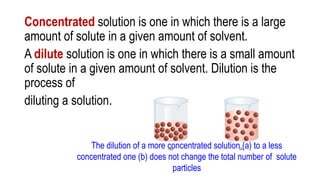
The dilution of a more concentrated solution (a) to a less
concentrated one (b) does not change the total number of solute
particles
Types of Concentration Units:
Percent by Mass
The percent by mass (also called the percent by
weight or the weight percent) is defined as
Example:
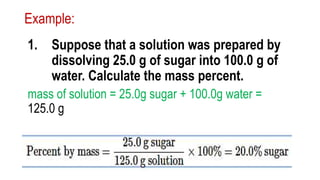
1. Suppose that a solution was prepared by
dissolving 25.0 g of sugar into 100.0 g of
water. Calculate the mass percent.
mass of solution = 25.0g sugar + 100.0g water =
125.0 g
Example:
1. How many grams of NaBr are needed to
make 50.0 g of a 5.0% solution?
Types of Concentration Units: Molarity (M)
The molarity unit is the number of moles of solute in
1 L of solution; that is,
Molarity has the units of mole per liter (mol/L)
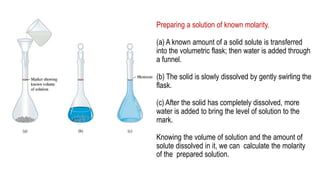
Preparing a solution of known molarity.
(a) A known amount of a solid solute is transferred
into the volumetric flask; then water is added through
a funnel.
(b) The solid is slowly dissolved by gently swirling the
flask.
(c) After the solid has completely dissolved, more
water is added to bring the level of solution to the
mark.
Knowing the volume of solution and the amount of
solute dissolved in it, we can calculate the molarity
of the prepared solution.
Example:
1. A solution has a volume
of 375.0 mL and contains
42.5 g of NaCl. What is
its molarity?
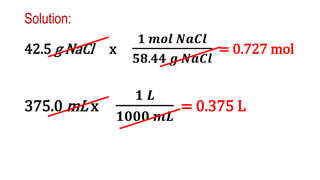
Solution:
42.5 g NaCl x
𝟏 𝒎𝒐𝒍 𝑵𝒂𝑪𝒍
𝟓𝟖.𝟒𝟒 𝒈 𝑵𝒂𝑪𝒍
= 0.727 mol
375.0 mL x
𝟏 𝑳
𝟏𝟎𝟎𝟎 𝒎𝑳
= 0.375 L
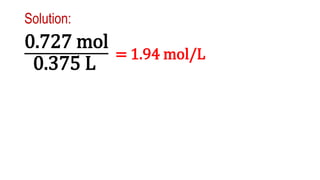
Solution:
0.727 mol
0.375 L
= 1.94 mol/L
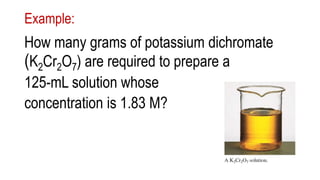
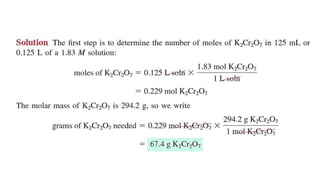
Example:
How many grams of potassium dichromate
(K2Cr2O7) are required to prepare a
125-mL solution whose
concentration is 1.83 M?
Types of Concentration Units: Molality (m)
Molality is the number of moles of solute dissolved in 1
kg (1000 g) of solvent—that is,
Molality has the units of mole per liter (mol/Kg)
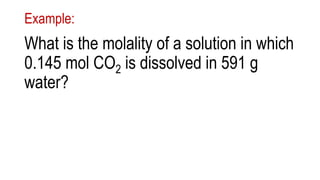
Example:
What is the molality of a solution in which
0.145 mol CO2 is dissolved in 591 g
water?
Example:
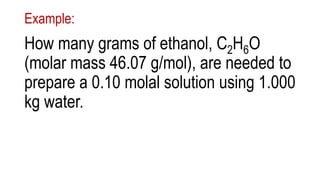
How many grams of ethanol, C2H6O
(molar mass 46.07 g/mol), are needed to
prepare a 0.10 molal solution using 1.000
kg water.
Try this!
Example:
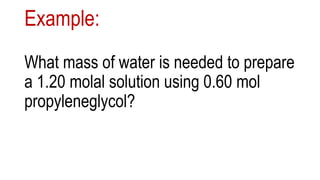
What mass of water is needed to prepare
a 1.20 molal solution using 0.60 mol
propyleneglycol?
Example:
An 800.0 g solution of Kool-Aid
contains 780 g of water. What is the
mass percent of solute in this
solution?
Example:
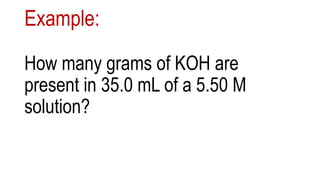
How many grams of KOH are
present in 35.0 mL of a 5.50 M
solution?
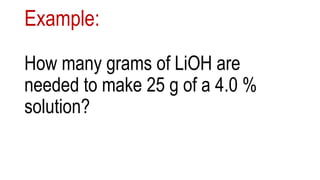
Example:
How many grams of LiOH are
needed to make 25 g of a 4.0 %
solution?
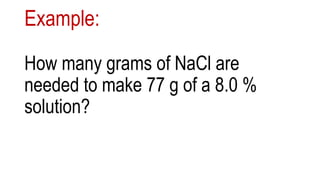
Example:
How many grams of NaCl are
needed to make 77 g of a 8.0 %
solution?
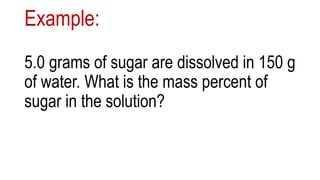
Example:
5.0 grams of sugar are dissolved in 150 g
of water. What is the mass percent of
sugar in the solution?
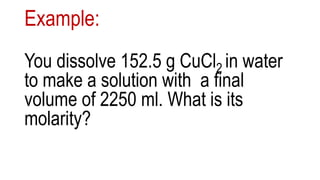
Example:
You dissolve 152.5 g CuCl2 in water
to make a solution with a final
volume of 2250 ml. What is its
molarity?
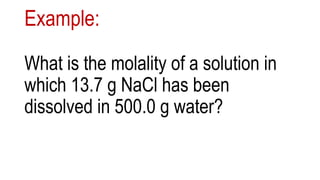
Example:
What is the molality of a solution in
which 13.7 g NaCl has been
dissolved in 500.0 g water?
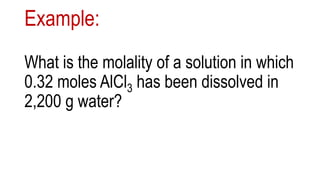
Example:
What is the molality of a solution in which
0.32 moles AlCl3 has been dissolved in
2,200 g water?
20. Concentration Units.pptx