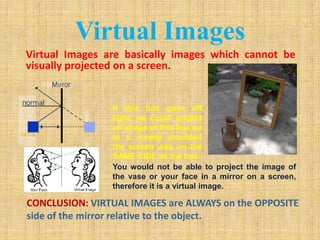
Virtual Images
Virtual Images are basically images which cannot be
visually projected on a screen.

If this box gave off
light, we could project
an image of this box on
to a screen provided
the screen was on the
SAME SIDE as the box.
You would not be able to project the image of
the vase or your face in a mirror on a screen,
therefore it is a virtual image.

CONCLUSION: VIRTUAL IMAGES are ALWAYS on the OPPOSITE
side of the mirror relative to the object.
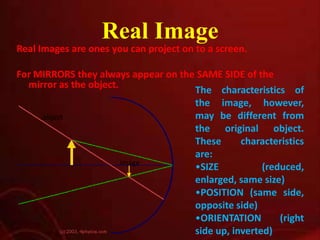
Real Image
Real Images are ones you can project on to a screen.
For MIRRORS they always appear on the SAME SIDE of the
mirror as the object.
The characteristics of
the image, however,
may be different from
object
the original object.
These
characteristics
are:
image
•SIZE
(reduced,
enlarged, same size)
•POSITION (same side,
opposite side)
•ORIENTATION
(right
side up, inverted)
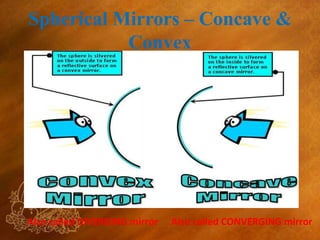
Spherical Mirrors – Concave &
Convex

Also called DIVERGING mirror

Also called CONVERGING mirror
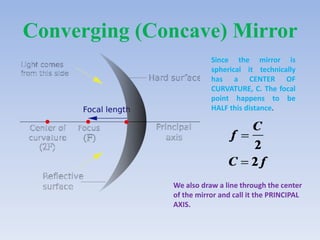
Converging (Concave) Mirror
Since the mirror is
spherical it technically
has a CENTER OF
CURVATURE, C. The focal
point happens to be
HALF this distance.

We also draw a line through the center
of the mirror and call it the PRINCIPAL
AXIS.
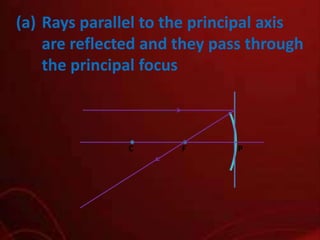
(a) Rays parallel to the principal axis
are reflected and they pass through
the principal focus

C

F

P
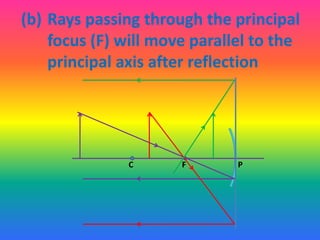
(b) Rays passing through the principal
focus (F) will move parallel to the
principal axis after reflection

C

F

P
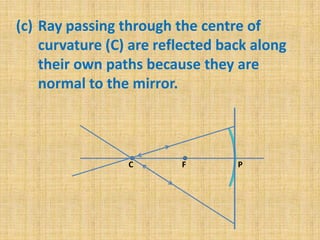
(c) Ray passing through the centre of
curvature (C) are reflected back along
their own paths because they are
normal to the mirror.

C

F

P
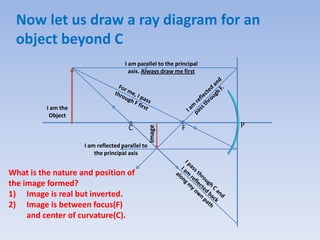
Now let us draw a ray diagram for an
object beyond C
I am parallel to the principal
axis. Always draw me first

C
I am reflected parallel to
the principal axis

What is the nature and position of
the image formed?
1) Image is real but inverted.
2) Image is between focus(F)
and center of curvature(C).

Image

I am the
Object

F

P
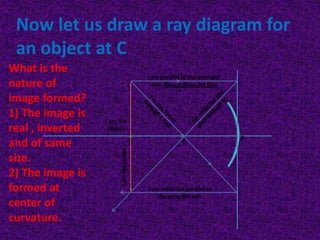
Now let us draw a ray diagram for
an object at C
I am parallel to the principal
axis. Always draw me first

I am the
Object

C

F

I am the image

What is the
nature of
image formed?
1) The image is
real , inverted
and of same
size.
2) The image is
formed at
center of
curvature.

I am reflected parallel to
the principal axis

P
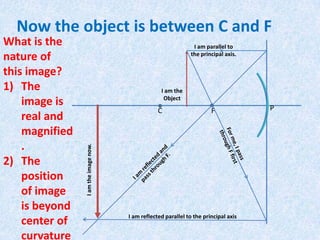
Now the object is between C and F
I am parallel to
the principal axis.

I am the
Object

C

F

I am the image now.

What is the
nature of
this image?
1) The
image is
real and
magnified
.
2) The
position
of image
is beyond
center of
curvature

I am reflected parallel to the principal axis

P
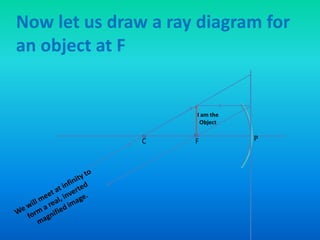
Now let us draw a ray diagram for
an object at F

I am the
Object

C

F

P
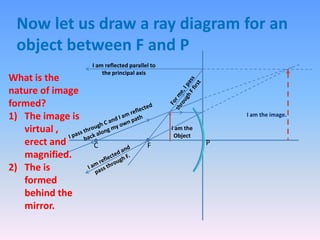
Now let us draw a ray diagram for an
object between F and P
What is the
nature of image
formed?
1) The image is
virtual ,
erect and
magnified.
2) The is
formed
behind the
mirror.

I am reflected parallel to
the principal axis

I am the image.
I am the
Object

C

F

P
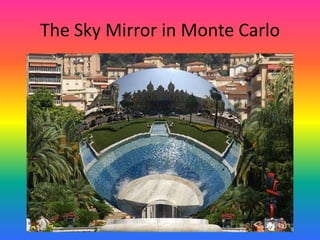
The Sky Mirror in Monte Carlo
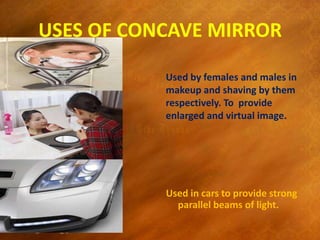
USES OF CONCAVE MIRROR
Used by females and males in
makeup and shaving by them
respectively. To provide
enlarged and virtual image.

Used in cars to provide strong
parallel beams of light.
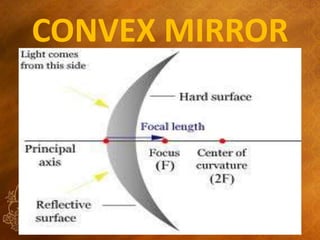
CONVEX MIRROR
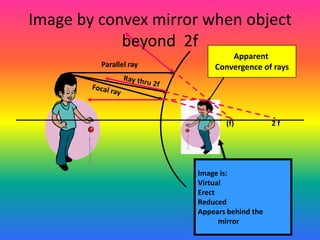
Image by convex mirror when object
beyond 2f
Parallel ray

Apparent
Convergence of rays

(f)

Image is:
Virtual
Erect
Reduced
Appears behind the
mirror

2f
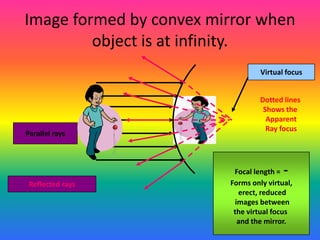
Image formed by convex mirror when
object is at infinity.
Virtual focus

Parallel rays

Dotted lines
Shows the
Apparent
Ray focus

-

Reflected rays

Focal length =
Forms only virtual,
erect, reduced
images between
the virtual focus
and the mirror.
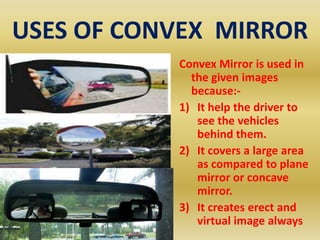
USES OF CONVEX MIRROR
Convex Mirror is used in
the given images
because:1) It help the driver to
see the vehicles
behind them.
2) It covers a large area
as compared to plane
mirror or concave
mirror.
3) It creates erect and
virtual image always
The Mirror
Equation

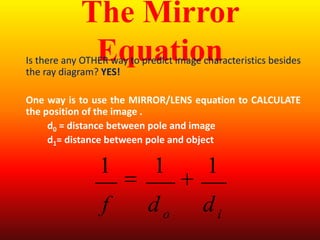
Is there any OTHER way to predict image characteristics besides
the ray diagram? YES!
One way is to use the MIRROR/LENS equation to CALCULATE
the position of the image .
d0 = distance between pole and image
d1= distance between pole and object

1

1

1

f

do

di
MAGNIFICATION
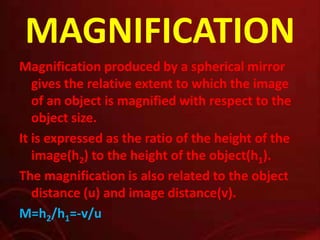
Magnification produced by a spherical mirror
gives the relative extent to which the image
of an object is magnified with respect to the
object size.
It is expressed as the ratio of the height of the
image(h2) to the height of the object(h1).
The magnification is also related to the object
distance (u) and image distance(v).
M=h2/h1=-v/u
THANK YOU
By:- Kshitiz Rai
10 A

Spherical mirror by Kshitiz Rai

  • 2.
    Virtual Images Virtual Imagesare basically images which cannot be visually projected on a screen. If this box gave off light, we could project an image of this box on to a screen provided the screen was on the SAME SIDE as the box. You would not be able to project the image of the vase or your face in a mirror on a screen, therefore it is a virtual image. CONCLUSION: VIRTUAL IMAGES are ALWAYS on the OPPOSITE side of the mirror relative to the object.
  • 3.
    Real Image Real Imagesare ones you can project on to a screen. For MIRRORS they always appear on the SAME SIDE of the mirror as the object. The characteristics of the image, however, may be different from object the original object. These characteristics are: image •SIZE (reduced, enlarged, same size) •POSITION (same side, opposite side) •ORIENTATION (right side up, inverted)
  • 4.
    Spherical Mirrors –Concave & Convex Also called DIVERGING mirror Also called CONVERGING mirror
  • 5.
    Converging (Concave) Mirror Sincethe mirror is spherical it technically has a CENTER OF CURVATURE, C. The focal point happens to be HALF this distance. We also draw a line through the center of the mirror and call it the PRINCIPAL AXIS.
  • 6.
    (a) Rays parallelto the principal axis are reflected and they pass through the principal focus C F P
  • 7.
    (b) Rays passingthrough the principal focus (F) will move parallel to the principal axis after reflection C F P
  • 8.
    (c) Ray passingthrough the centre of curvature (C) are reflected back along their own paths because they are normal to the mirror. C F P
  • 9.
    Now let usdraw a ray diagram for an object beyond C I am parallel to the principal axis. Always draw me first C I am reflected parallel to the principal axis What is the nature and position of the image formed? 1) Image is real but inverted. 2) Image is between focus(F) and center of curvature(C). Image I am the Object F P
  • 10.
    Now let usdraw a ray diagram for an object at C I am parallel to the principal axis. Always draw me first I am the Object C F I am the image What is the nature of image formed? 1) The image is real , inverted and of same size. 2) The image is formed at center of curvature. I am reflected parallel to the principal axis P
  • 11.
    Now the objectis between C and F I am parallel to the principal axis. I am the Object C F I am the image now. What is the nature of this image? 1) The image is real and magnified . 2) The position of image is beyond center of curvature I am reflected parallel to the principal axis P
  • 12.
    Now let usdraw a ray diagram for an object at F I am the Object C F P
  • 13.
    Now let usdraw a ray diagram for an object between F and P What is the nature of image formed? 1) The image is virtual , erect and magnified. 2) The is formed behind the mirror. I am reflected parallel to the principal axis I am the image. I am the Object C F P
  • 14.
    The Sky Mirrorin Monte Carlo
  • 15.
    USES OF CONCAVEMIRROR Used by females and males in makeup and shaving by them respectively. To provide enlarged and virtual image. Used in cars to provide strong parallel beams of light.
  • 16.
  • 17.
    Image by convexmirror when object beyond 2f Parallel ray Apparent Convergence of rays (f) Image is: Virtual Erect Reduced Appears behind the mirror 2f
  • 18.
    Image formed byconvex mirror when object is at infinity. Virtual focus Parallel rays Dotted lines Shows the Apparent Ray focus - Reflected rays Focal length = Forms only virtual, erect, reduced images between the virtual focus and the mirror.
  • 19.
    USES OF CONVEXMIRROR Convex Mirror is used in the given images because:1) It help the driver to see the vehicles behind them. 2) It covers a large area as compared to plane mirror or concave mirror. 3) It creates erect and virtual image always
  • 20.
    The Mirror Equation Is thereany OTHER way to predict image characteristics besides the ray diagram? YES! One way is to use the MIRROR/LENS equation to CALCULATE the position of the image . d0 = distance between pole and image d1= distance between pole and object 1 1 1 f do di
  • 21.
    MAGNIFICATION Magnification produced bya spherical mirror gives the relative extent to which the image of an object is magnified with respect to the object size. It is expressed as the ratio of the height of the image(h2) to the height of the object(h1). The magnification is also related to the object distance (u) and image distance(v). M=h2/h1=-v/u
  • 22.