Homework Notes
• If you are struggling with the homework, start
working on it early enough that you can come to
office hours if needed.
• You can go to the help room even when one of us
is not there, at least for the first half of the
course.
• Do not email me Wednesday night with
homework questions.
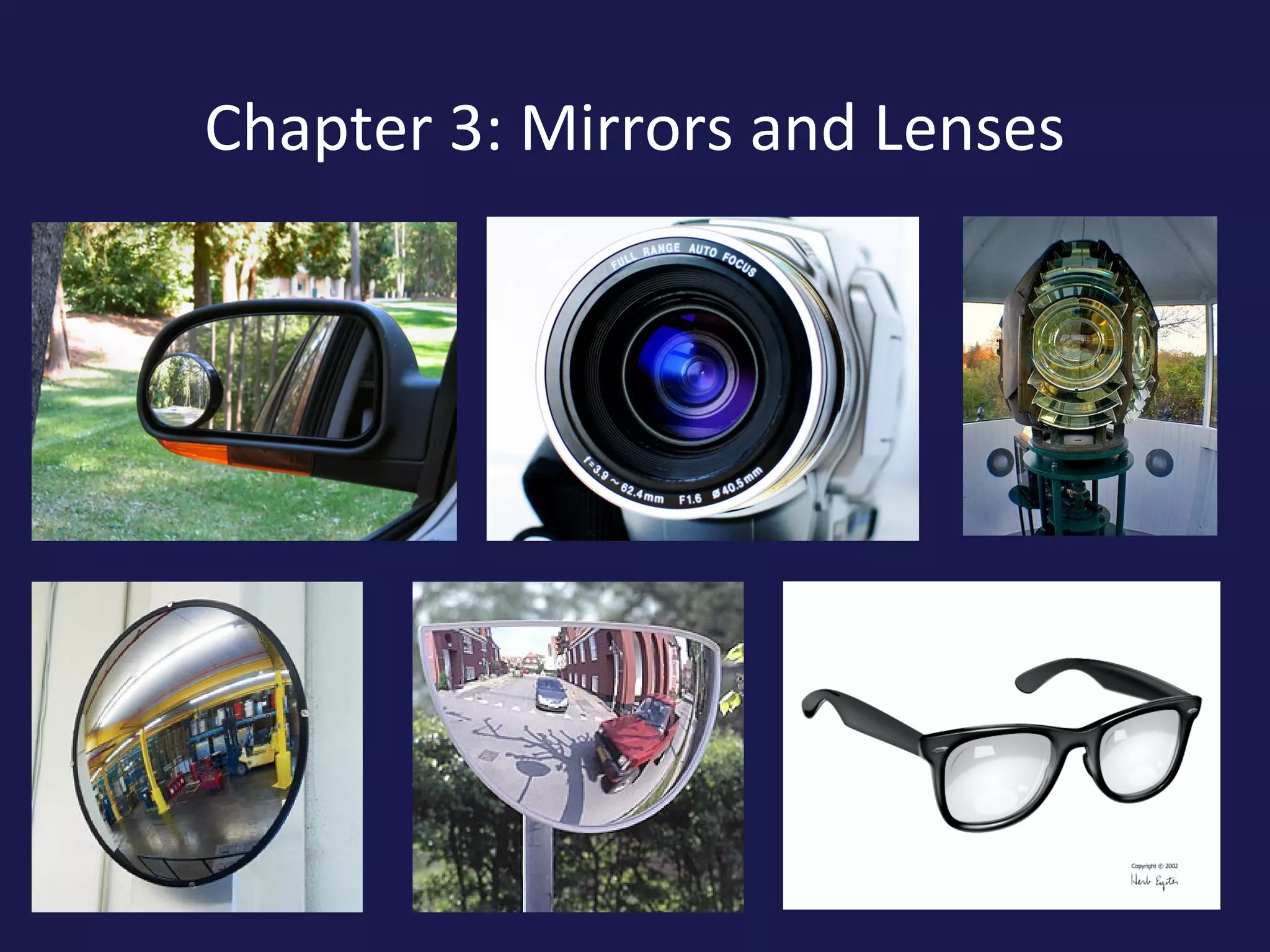
Chapter 3: Mirrors and Lenses
• Mirrors
– Spherical mirrors
– Ray tracing
• Convex mirrors
– Image formation
– Applications
• Concave mirrors
– Image formation
– Applications
• Lenses
– Refraction
– Converging rays
– Diverging rays
Reflection Review
• Recall our ray tracing of a flat mirror
• Recall that there are “special” rays that are
sufficient for locating the image
Clicker Question
• Which shows the correct location, orientation,
and size for the image?
A)
D) E)
C)B)
Spherical Mirrors
What is the normal to a curved surface
and how is it used to find rays?
• To find the normal to a curved
surface at a point where a ray hits
that surface (and will be reflected
or refracted)
– First draw a tangent line to the curve
(or tangent plane to the surface)
– The normal is perpendicular to that
line or plane and going through the
point
– Once you have drawn the normal you
can draw the reflected or refracted
ray
Ray Tracing & Spherical Mirrors
Radius of Curvature: The radius of the sphere the mirror is “cut from”
Center of Curvature (C): The center of the sphere the mirror is cut from
Focal Point (F): The point where rays from a distance appear to converge
For a spherical mirror, the focal point is halfway between the surface
and the center of curvature
Paraxial Ray: A ray coming on to the mirror parallel to the axis
CF
radius of curvature
paraxial rays
Convex vs. Concave
Convex Concave
• Spherical mirrors are drawn in two dimensions, so you have
to imagine the 3D mirror this line represents
• Both convex and concave mirrors obey the same law of
reflection, but they make different kinds of images
Sources of Paraxial Rays
• The rays coming from a distance source can be
considered approximately paraxial when they
reach a mirror
Convex mirror
• The rays from a nearby source, such as a candle
or bare light bulb, cannot be considered paraxial
Special Rays: Convex Mirror
CF
axis
Ray 1 Rule:
All rays incident parallel to the axis are reflected so that they
appear to be coming from the focal point, F.
Special Rays: Convex Mirror
CF
axis
Ray 2 Rule:
All rays that (when extended) pass through C are reflected back on
themselves
Special Rays: Convex Mirror
CF
axis
Ray 3 Rule:
All rays that (when extended) pass through F are reflected back
parallel to the axis.
Locating an Image: Convex Mirror
CF
axis
Image properties:
•virtual (behind the mirror)
•right-side up
•closer to the mirror than the object
•smaller than the object.
Compare to Flat Mirror
Image properties:
•virtual (behind the mirror)
•upside down
•the same distance from the mirror as
the object
•the same size as the object
Clicker Question
• The image formed in a convex mirror is smaller
than the object. This would make a convex mirror
useful for which application?
A.Makeup or shaving mirror
B. Wide-angle mirror, such as on a car or a blind
intersection
C. A mirror in a clothing store dressing room
Convex Mirrors
• Because the image is smaller than the object,
convex mirrors reflect from wider angles than flat
mirrors.
Concave Mirrors
C Faxis
Ray 1 Rule:
All rays incident parallel to the axis are reflected so that they pass
through the focal point, F.
C Faxis
Concave Mirrors
Ray 2 Rule:
All rays that pass through C are reflected back on themselves
Concave Mirrors
C Faxis
Ray 3 Rule:
All rays that pass through F are reflected back parallel to the axis.
Image Formation: Concave Mirrors
C F
Image properties:
•real (in front of the mirror)
•upside down
•farther from the mirror than the object
•larger than the object.
Object location:
Between the center of curvature and the
focal point
Concave Mirrors
C F
Image properties:
•virtual (behind the mirror)
•right-side up
•farther from the mirror than the object
•larger than the object.
Object location:
Between the surface and the focal point
Concave Mirrors
C F
Object location:
Past the center of curvature
Concave Mirrors: Clicker Question
C F
Object location:
Past the center of curvature
Is the image
A.Real and magnified
B.Real and reduced
C.Virtual and magnified
D.Virtual and reduced
Clicker Question
• The inside of a spoon bowl is a concave surface
with a radius of curvature of a couple of inches
(depending on the spoon). If you hold it about a
foot from your face, what will your face look like?
A.Normal size, upside down
B. Normal size, right side up
C. Smaller, upside down
D.Smaller, right side up
Concave Mirrors: Application
Because rays coming in parallel, as from a very distant source, are
all reflected to the focal point, a receiver placed there will pick up
the waves received over the large area of the dish, instead of just
the small area of the receiver itself.
Concave Mirrors: Application
• What if we put a light source at the
focal point of a concave mirror?
• All the rays emitted by the light go
through the focal point, and are
therefore reflected parallel to the
axis of the mirror.
Spherical Lenses
What if we don’t want to have to
look at a reflection to magnify or
reduce an image?
We can use refractive optics
instead (lenses)
Convex Glass Surface
CF
axis
A concave surface is called “converging” because parallel rays
converge towards one another
Convex Glass Surface
C Faxis
The surface is converging for both air to glass rays and glass to air
rays
C Faxis
A concave surface is called “diverging” because parallel rays
diverge away from one another
Concave Glass Surface
CF axis
Again, the surface is diverging for both air to glass rays and glass to
air rays
Concave Glass Surface

Mirrors and Reflections

  • 1.
    Homework Notes • Ifyou are struggling with the homework, start working on it early enough that you can come to office hours if needed. • You can go to the help room even when one of us is not there, at least for the first half of the course. • Do not email me Wednesday night with homework questions.
  • 2.
  • 3.
    Chapter 3: Mirrorsand Lenses • Mirrors – Spherical mirrors – Ray tracing • Convex mirrors – Image formation – Applications • Concave mirrors – Image formation – Applications • Lenses – Refraction – Converging rays – Diverging rays
  • 4.
    Reflection Review • Recallour ray tracing of a flat mirror • Recall that there are “special” rays that are sufficient for locating the image
  • 5.
    Clicker Question • Whichshows the correct location, orientation, and size for the image? A) D) E) C)B)
  • 6.
  • 7.
    What is thenormal to a curved surface and how is it used to find rays? • To find the normal to a curved surface at a point where a ray hits that surface (and will be reflected or refracted) – First draw a tangent line to the curve (or tangent plane to the surface) – The normal is perpendicular to that line or plane and going through the point – Once you have drawn the normal you can draw the reflected or refracted ray
  • 8.
    Ray Tracing &Spherical Mirrors Radius of Curvature: The radius of the sphere the mirror is “cut from” Center of Curvature (C): The center of the sphere the mirror is cut from Focal Point (F): The point where rays from a distance appear to converge For a spherical mirror, the focal point is halfway between the surface and the center of curvature Paraxial Ray: A ray coming on to the mirror parallel to the axis CF radius of curvature paraxial rays
  • 9.
    Convex vs. Concave ConvexConcave • Spherical mirrors are drawn in two dimensions, so you have to imagine the 3D mirror this line represents • Both convex and concave mirrors obey the same law of reflection, but they make different kinds of images
  • 10.
    Sources of ParaxialRays • The rays coming from a distance source can be considered approximately paraxial when they reach a mirror Convex mirror • The rays from a nearby source, such as a candle or bare light bulb, cannot be considered paraxial
  • 11.
    Special Rays: ConvexMirror CF axis Ray 1 Rule: All rays incident parallel to the axis are reflected so that they appear to be coming from the focal point, F.
  • 12.
    Special Rays: ConvexMirror CF axis Ray 2 Rule: All rays that (when extended) pass through C are reflected back on themselves
  • 13.
    Special Rays: ConvexMirror CF axis Ray 3 Rule: All rays that (when extended) pass through F are reflected back parallel to the axis.
  • 14.
    Locating an Image:Convex Mirror CF axis Image properties: •virtual (behind the mirror) •right-side up •closer to the mirror than the object •smaller than the object.
  • 15.
    Compare to FlatMirror Image properties: •virtual (behind the mirror) •upside down •the same distance from the mirror as the object •the same size as the object
  • 16.
    Clicker Question • Theimage formed in a convex mirror is smaller than the object. This would make a convex mirror useful for which application? A.Makeup or shaving mirror B. Wide-angle mirror, such as on a car or a blind intersection C. A mirror in a clothing store dressing room
  • 17.
    Convex Mirrors • Becausethe image is smaller than the object, convex mirrors reflect from wider angles than flat mirrors.
  • 18.
    Concave Mirrors C Faxis Ray1 Rule: All rays incident parallel to the axis are reflected so that they pass through the focal point, F.
  • 19.
    C Faxis Concave Mirrors Ray2 Rule: All rays that pass through C are reflected back on themselves
  • 20.
    Concave Mirrors C Faxis Ray3 Rule: All rays that pass through F are reflected back parallel to the axis.
  • 21.
    Image Formation: ConcaveMirrors C F Image properties: •real (in front of the mirror) •upside down •farther from the mirror than the object •larger than the object. Object location: Between the center of curvature and the focal point
  • 22.
    Concave Mirrors C F Imageproperties: •virtual (behind the mirror) •right-side up •farther from the mirror than the object •larger than the object. Object location: Between the surface and the focal point
  • 23.
    Concave Mirrors C F Objectlocation: Past the center of curvature
  • 24.
    Concave Mirrors: ClickerQuestion C F Object location: Past the center of curvature Is the image A.Real and magnified B.Real and reduced C.Virtual and magnified D.Virtual and reduced
  • 25.
    Clicker Question • Theinside of a spoon bowl is a concave surface with a radius of curvature of a couple of inches (depending on the spoon). If you hold it about a foot from your face, what will your face look like? A.Normal size, upside down B. Normal size, right side up C. Smaller, upside down D.Smaller, right side up
  • 26.
    Concave Mirrors: Application Becauserays coming in parallel, as from a very distant source, are all reflected to the focal point, a receiver placed there will pick up the waves received over the large area of the dish, instead of just the small area of the receiver itself.
  • 27.
    Concave Mirrors: Application •What if we put a light source at the focal point of a concave mirror? • All the rays emitted by the light go through the focal point, and are therefore reflected parallel to the axis of the mirror.
  • 28.
    Spherical Lenses What ifwe don’t want to have to look at a reflection to magnify or reduce an image? We can use refractive optics instead (lenses)
  • 29.
    Convex Glass Surface CF axis Aconcave surface is called “converging” because parallel rays converge towards one another
  • 30.
    Convex Glass Surface CFaxis The surface is converging for both air to glass rays and glass to air rays
  • 31.
    C Faxis A concavesurface is called “diverging” because parallel rays diverge away from one another Concave Glass Surface
  • 32.
    CF axis Again, thesurface is diverging for both air to glass rays and glass to air rays Concave Glass Surface