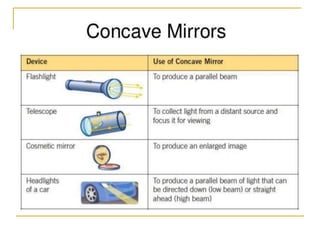
Reflection of Light in a
Curved Mirror
Practice “CAMALIG”:
 C - Clean and disinfect
 A - Avoid close contact (at least 1 meter or 3
feet)
 M - Maintain good hygiene
 A - Always wear face masks and face shields
 L - Limit public exposure
 I - Immediately inform health authorities if you
feel unwell
 G - Guide others (self-care and care for
others are of equal priority)
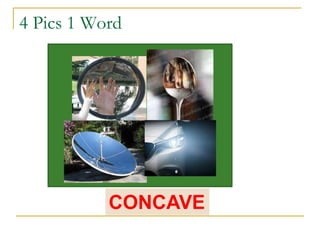
4 Pics 1 Word
CONCAVE
THINK and PICK
1. When the image of an object is seen in a
concave mirror the image will _____.
A. always be real
B. always be virtual
C. be either real or virtual
D. will always be magnified
2. When the object is at infinity in the case of a
concave mirror, the image formed has the
following properties.
A. The image is real.
B. The image is inverted.
C. The image is highly diminished to a point.
D. All of the above
3. Rays of light traveling parallel to the principal
axis of a concave mirror will come
together _____.
A. at the center of curvature
B. at the focal point
C. at infinity
D. at a point half way to the focal point
4. It is a curved mirror in which the reflective
surface bulges away from the light source.
A. concave mirror
B. convex mirror
C. plane mirror
D. all of these
5. The object in the image formed by this mirror
looks bigger than the original size of
the object.
A. concave mirror
B. convex mirror
C. plane mirror
D. all of these
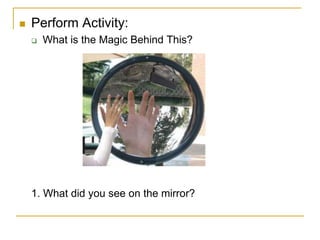
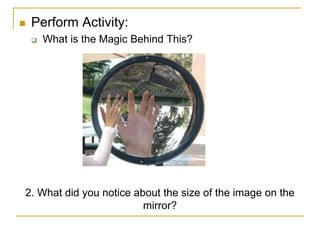
 Perform Activity:
 What is the Magic Behind This?
1. What did you see on the mirror?
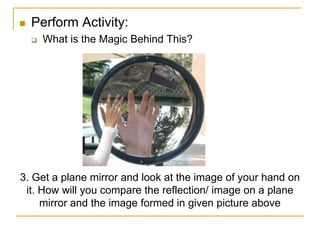
 Perform Activity:
 What is the Magic Behind This?
2. What did you notice about the size of the image on the
mirror?
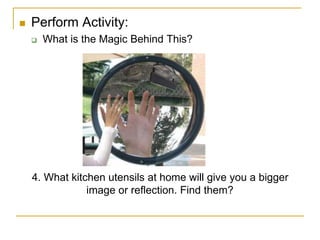
 Perform Activity:
 What is the Magic Behind This?
3. Get a plane mirror and look at the image of your hand on
it. How will you compare the reflection/ image on a plane
mirror and the image formed in given picture above
 Perform Activity:
 What is the Magic Behind This?
4. What kitchen utensils at home will give you a bigger
image or reflection. Find them?
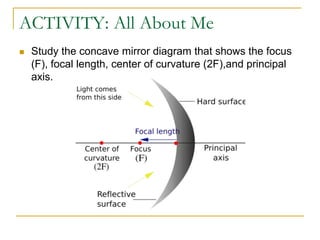
ACTIVITY: All About Me
 Study the concave mirror diagram that shows the focus
(F), focal length, center of curvature (2F),and principal
axis.
Quick guide in ray diagramming! 4:20 – 6:20
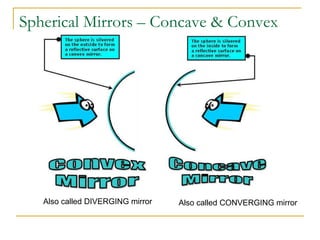
Spherical Mirrors – Concave & Convex
Also called CONVERGING mirror
Also called DIVERGING mirror
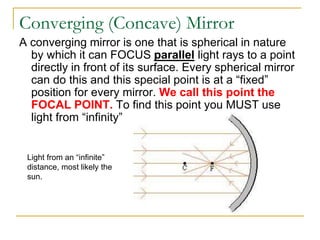
Converging (Concave) Mirror
A converging mirror is one that is spherical in nature
by which it can FOCUS parallel light rays to a point
directly in front of its surface. Every spherical mirror
can do this and this special point is at a “fixed”
position for every mirror. We call this point the
FOCAL POINT. To find this point you MUST use
light from “infinity”
Light from an “infinite”
distance, most likely the
sun.
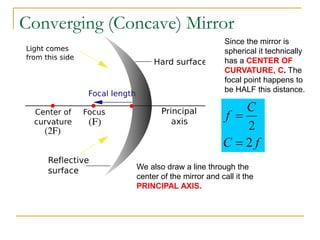
Converging (Concave) Mirror
f
C
C
f
2
2


Since the mirror is
spherical it technically
has a CENTER OF
CURVATURE, C. The
focal point happens to
be HALF this distance.
We also draw a line through the
center of the mirror and call it the
PRINCIPAL AXIS.
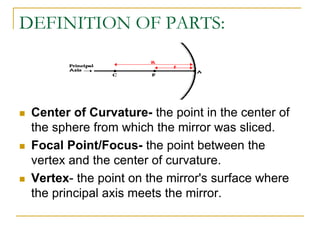
DEFINITION OF PARTS:
 Center of Curvature- the point in the center of
the sphere from which the mirror was sliced.
 Focal Point/Focus- the point between the
vertex and the center of curvature.
 Vertex- the point on the mirror's surface where
the principal axis meets the mirror.
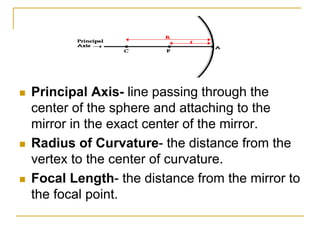
 Principal Axis- line passing through the
center of the sphere and attaching to the
mirror in the exact center of the mirror.

 Radius of Curvature- the distance from the
vertex to the center of curvature.
 Focal Length- the distance from the mirror to
the focal point.
Characteristics of Image Formed by
Concave Mirror
 Concave mirrors can produce both real and
virtual images.
 They can be upright (if virtual) or inverted (if
real).
 They can be behind the mirror (if virtual) or in
front of the mirror (if real).
 They can also be enlarged, reduced, or the
same size as object.
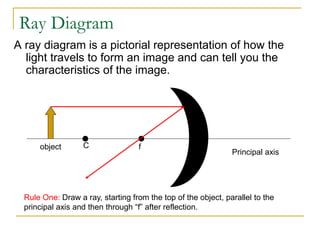
Ray Diagram
A ray diagram is a pictorial representation of how the
light travels to form an image and can tell you the
characteristics of the image.
Principal axis
f
C
object
Rule One: Draw a ray, starting from the top of the object, parallel to the
principal axis and then through “f” after reflection.
Ray Diagrams
Principal axis
f
C
object
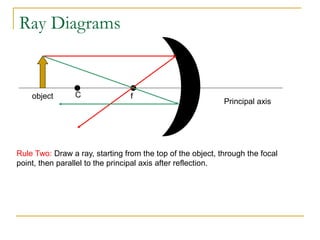
Rule Two: Draw a ray, starting from the top of the object, through the focal
point, then parallel to the principal axis after reflection.
Ray Diagrams
Principal axis
f
C
object
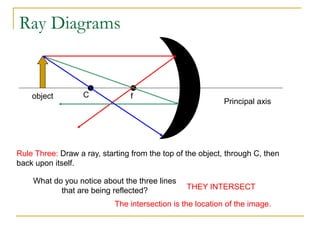
Rule Three: Draw a ray, starting from the top of the object, through C, then
back upon itself.
What do you notice about the three lines
that are being reflected? THEY INTERSECT
The intersection is the location of the image.
Ray Diagram – Image Characteristics
Principal axis
f
C
object
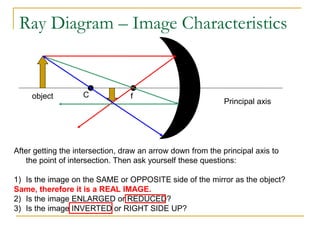
After getting the intersection, draw an arrow down from the principal axis to
the point of intersection. Then ask yourself these questions:
1) Is the image on the SAME or OPPOSITE side of the mirror as the object?
Same, therefore it is a REAL IMAGE.
2) Is the image ENLARGED or REDUCED?
3) Is the image INVERTED or RIGHT SIDE UP?
The Mirror/Lens Equation
Is there any OTHER way to predict image characteristics besides
the ray diagram?
YES!
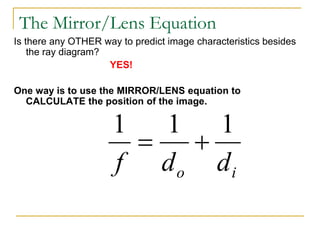
One way is to use the MIRROR/LENS equation to
CALCULATE the position of the image.
i
o d
d
f
1
1
1


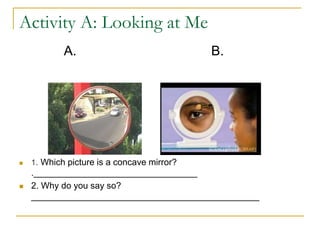
Activity A: Looking at Me
A. B.
 1. Which picture is a concave mirror?
._________________________________
 2. Why do you say so?
______________________________________________
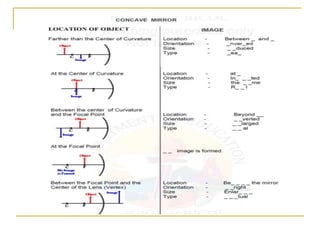
 Study the image in each situation
and supply the missing letters to
complete the words that will
identify the properties of a curved
mirror.
 Don’t forget to practice “CAMALIG”
in doing such activity.
Activity B: Words Completion
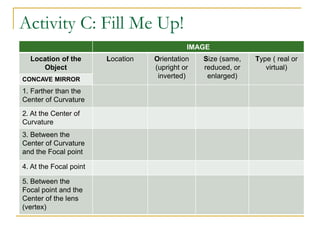
Activity C: Fill Me Up!
IMAGE
Location of the
Object
Location Orientation
(upright or
inverted)
Size (same,
reduced, or
enlarged)
Type ( real or
virtual)
CONCAVE MIRROR
1. Farther than the
Center of Curvature
2. At the Center of
Curvature
3. Between the
Center of Curvature
and the Focal point
4. At the Focal point
5. Between the
Focal point and the
Center of the lens
(vertex)
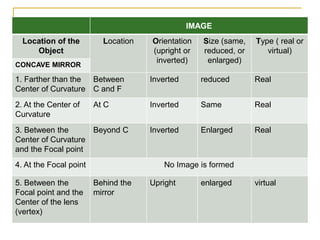
IMAGE
Location of the
Object
Location Orientation
(upright or
inverted)
Size (same,
reduced, or
enlarged)
Type ( real or
virtual)
CONCAVE MIRROR
1. Farther than the
Center of Curvature
Between
C and F
Inverted reduced Real
2. At the Center of
Curvature
At C Inverted Same Real
3. Between the
Center of Curvature
and the Focal point
Beyond C Inverted Enlarged Real
4. At the Focal point No Image is formed
5. Between the
Focal point and the
Center of the lens
(vertex)
Behind the
mirror
Upright enlarged virtual
THANK YOU!!!


reflection in curved mirror.ppt

  • 1.
    Reflection of Lightin a Curved Mirror
  • 2.
    Practice “CAMALIG”:  C- Clean and disinfect  A - Avoid close contact (at least 1 meter or 3 feet)  M - Maintain good hygiene  A - Always wear face masks and face shields  L - Limit public exposure  I - Immediately inform health authorities if you feel unwell  G - Guide others (self-care and care for others are of equal priority)
  • 3.
    4 Pics 1Word CONCAVE
  • 4.
    THINK and PICK 1.When the image of an object is seen in a concave mirror the image will _____. A. always be real B. always be virtual C. be either real or virtual D. will always be magnified
  • 5.
    2. When theobject is at infinity in the case of a concave mirror, the image formed has the following properties. A. The image is real. B. The image is inverted. C. The image is highly diminished to a point. D. All of the above
  • 6.
    3. Rays oflight traveling parallel to the principal axis of a concave mirror will come together _____. A. at the center of curvature B. at the focal point C. at infinity D. at a point half way to the focal point
  • 7.
    4. It isa curved mirror in which the reflective surface bulges away from the light source. A. concave mirror B. convex mirror C. plane mirror D. all of these
  • 8.
    5. The objectin the image formed by this mirror looks bigger than the original size of the object. A. concave mirror B. convex mirror C. plane mirror D. all of these
  • 9.
     Perform Activity: What is the Magic Behind This? 1. What did you see on the mirror?
  • 10.
     Perform Activity: What is the Magic Behind This? 2. What did you notice about the size of the image on the mirror?
  • 11.
     Perform Activity: What is the Magic Behind This? 3. Get a plane mirror and look at the image of your hand on it. How will you compare the reflection/ image on a plane mirror and the image formed in given picture above
  • 12.
     Perform Activity: What is the Magic Behind This? 4. What kitchen utensils at home will give you a bigger image or reflection. Find them?
  • 13.
    ACTIVITY: All AboutMe  Study the concave mirror diagram that shows the focus (F), focal length, center of curvature (2F),and principal axis.
  • 14.
    Quick guide inray diagramming! 4:20 – 6:20
  • 15.
    Spherical Mirrors –Concave & Convex Also called CONVERGING mirror Also called DIVERGING mirror
  • 16.
    Converging (Concave) Mirror Aconverging mirror is one that is spherical in nature by which it can FOCUS parallel light rays to a point directly in front of its surface. Every spherical mirror can do this and this special point is at a “fixed” position for every mirror. We call this point the FOCAL POINT. To find this point you MUST use light from “infinity” Light from an “infinite” distance, most likely the sun.
  • 17.
    Converging (Concave) Mirror f C C f 2 2   Sincethe mirror is spherical it technically has a CENTER OF CURVATURE, C. The focal point happens to be HALF this distance. We also draw a line through the center of the mirror and call it the PRINCIPAL AXIS.
  • 18.
    DEFINITION OF PARTS: Center of Curvature- the point in the center of the sphere from which the mirror was sliced.  Focal Point/Focus- the point between the vertex and the center of curvature.  Vertex- the point on the mirror's surface where the principal axis meets the mirror.
  • 19.
     Principal Axis-line passing through the center of the sphere and attaching to the mirror in the exact center of the mirror.  Radius of Curvature- the distance from the vertex to the center of curvature.  Focal Length- the distance from the mirror to the focal point.
  • 20.
    Characteristics of ImageFormed by Concave Mirror  Concave mirrors can produce both real and virtual images.  They can be upright (if virtual) or inverted (if real).  They can be behind the mirror (if virtual) or in front of the mirror (if real).  They can also be enlarged, reduced, or the same size as object.
  • 21.
    Ray Diagram A raydiagram is a pictorial representation of how the light travels to form an image and can tell you the characteristics of the image. Principal axis f C object Rule One: Draw a ray, starting from the top of the object, parallel to the principal axis and then through “f” after reflection.
  • 22.
    Ray Diagrams Principal axis f C object RuleTwo: Draw a ray, starting from the top of the object, through the focal point, then parallel to the principal axis after reflection.
  • 23.
    Ray Diagrams Principal axis f C object RuleThree: Draw a ray, starting from the top of the object, through C, then back upon itself. What do you notice about the three lines that are being reflected? THEY INTERSECT The intersection is the location of the image.
  • 24.
    Ray Diagram –Image Characteristics Principal axis f C object After getting the intersection, draw an arrow down from the principal axis to the point of intersection. Then ask yourself these questions: 1) Is the image on the SAME or OPPOSITE side of the mirror as the object? Same, therefore it is a REAL IMAGE. 2) Is the image ENLARGED or REDUCED? 3) Is the image INVERTED or RIGHT SIDE UP?
  • 25.
    The Mirror/Lens Equation Isthere any OTHER way to predict image characteristics besides the ray diagram? YES! One way is to use the MIRROR/LENS equation to CALCULATE the position of the image. i o d d f 1 1 1  
  • 27.
    Activity A: Lookingat Me A. B.  1. Which picture is a concave mirror? ._________________________________  2. Why do you say so? ______________________________________________
  • 28.
     Study theimage in each situation and supply the missing letters to complete the words that will identify the properties of a curved mirror.  Don’t forget to practice “CAMALIG” in doing such activity. Activity B: Words Completion
  • 30.
    Activity C: FillMe Up! IMAGE Location of the Object Location Orientation (upright or inverted) Size (same, reduced, or enlarged) Type ( real or virtual) CONCAVE MIRROR 1. Farther than the Center of Curvature 2. At the Center of Curvature 3. Between the Center of Curvature and the Focal point 4. At the Focal point 5. Between the Focal point and the Center of the lens (vertex)
  • 31.
    IMAGE Location of the Object LocationOrientation (upright or inverted) Size (same, reduced, or enlarged) Type ( real or virtual) CONCAVE MIRROR 1. Farther than the Center of Curvature Between C and F Inverted reduced Real 2. At the Center of Curvature At C Inverted Same Real 3. Between the Center of Curvature and the Focal point Beyond C Inverted Enlarged Real 4. At the Focal point No Image is formed 5. Between the Focal point and the Center of the lens (vertex) Behind the mirror Upright enlarged virtual
  • 32.