Light
Efforts by :- Aagman Saini
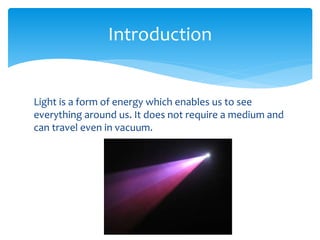
Light is a form of energy which enables us to see
everything around us. It does not require a medium and
can travel even in vacuum.
Introduction
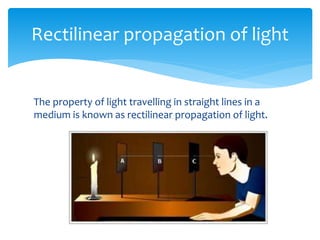
The property of light travelling in straight lines in a
medium is known as rectilinear propagation of light.
Rectilinear propagation of light
The bouncing of light from a surface is called reflection.
Reflection of light is of two kinds :-
Regular reflection
Irregular reflection
Reflection of light
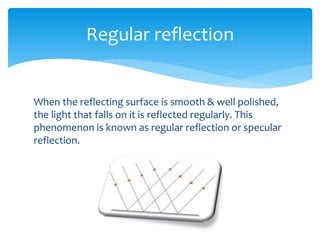
When the reflecting surface is smooth & well polished,
the light that falls on it is reflected regularly. This
phenomenon is known as regular reflection or specular
reflection.
Regular reflection
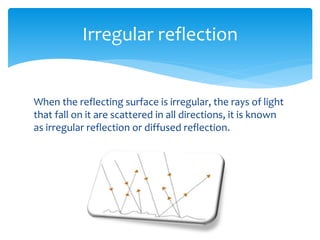
When the reflecting surface is irregular, the rays of light
that fall on it are scattered in all directions, it is known
as irregular reflection or diffused reflection.
Irregular reflection
There are two types of images:-
Real images
Virtual images
Types of images
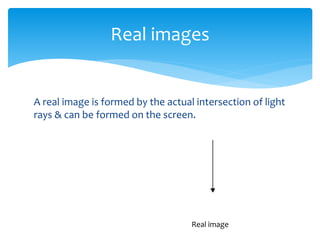
A real image is formed by the actual intersection of light
rays & can be formed on the screen.
Real images
Real image
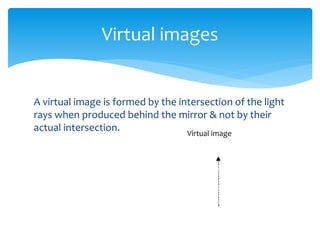
A virtual image is formed by the intersection of the light
rays when produced behind the mirror & not by their
actual intersection.
Virtual images
Virtual image
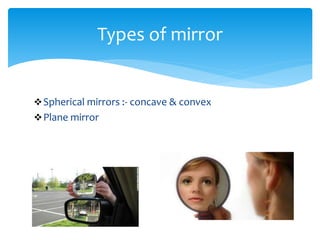
Spherical mirrors :- concave & convex
Plane mirror
Types of mirror
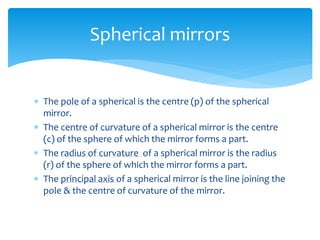
 The pole of a spherical is the centre (p) of the spherical
mirror.
 The centre of curvature of a spherical mirror is the centre
(c) of the sphere of which the mirror forms a part.
 The radius of curvature of a spherical mirror is the radius
(r) of the sphere of which the mirror forms a part.
 The principal axis of a spherical mirror is the line joining the
pole & the centre of curvature of the mirror.
Spherical mirrors
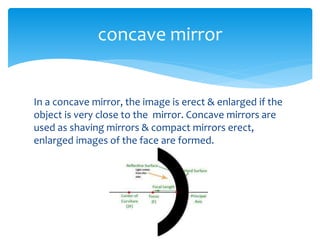
In a concave mirror, the image is erect & enlarged if the
object is very close to the mirror. Concave mirrors are
used as shaving mirrors & compact mirrors erect,
enlarged images of the face are formed.
concave mirror
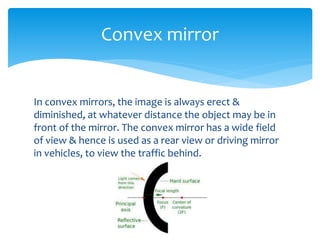
In convex mirrors, the image is always erect &
diminished, at whatever distance the object may be in
front of the mirror. The convex mirror has a wide field
of view & hence is used as a rear view or driving mirror
in vehicles, to view the traffic behind.
Convex mirror
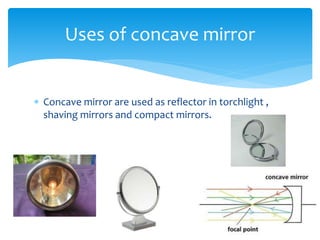
 Concave mirror are used as reflector in torchlight ,
shaving mirrors and compact mirrors.
Uses of concave mirror
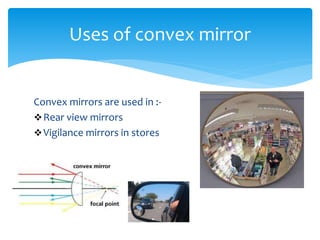
Convex mirrors are used in :-
Rear view mirrors
Vigilance mirrors in stores
Uses of convex mirror
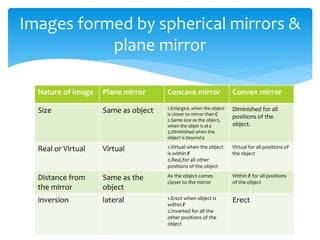
Images formed by spherical mirrors &
plane mirror
Nature of image Plane mirror Concave mirror Convex mirror
Size Same as object 1.Enlarged, when the object
is closer to mirror than C
2.Same size as the object,
when the objet is at c
3.Diminished when the
object is beyond c
Diminished for all
positions of the
object.
Real or Virtual Virtual 1.Virtual when the object
is within F
2.Real,for all other
positions of the object
Virtual for all positions of
the object
Distance from
the mirror
Same as the
object
As the object comes
closer to the mirror
Within F for all positions
of the object
inversion lateral 1.Erect when object is
within F
2.Inverted for all the
other positions of the
object
Erect
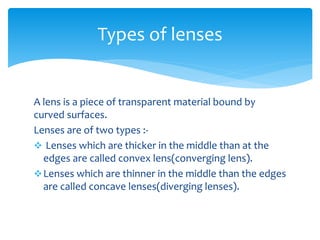
A lens is a piece of transparent material bound by
curved surfaces.
Lenses are of two types :-
 Lenses which are thicker in the middle than at the
edges are called convex lens(converging lens).
Lenses which are thinner in the middle than the edges
are called concave lenses(diverging lenses).
Types of lenses
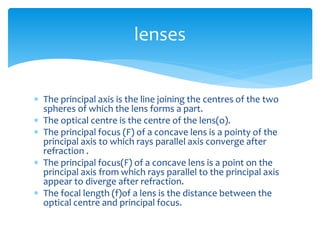
 The principal axis is the line joining the centres of the two
spheres of which the lens forms a part.
 The optical centre is the centre of the lens(o).
 The principal focus (F) of a concave lens is a pointy of the
principal axis to which rays parallel axis converge after
refraction .
 The principal focus(F) of a concave lens is a point on the
principal axis from which rays parallel to the principal axis
appear to diverge after refraction.
 The focal length (f)of a lens is the distance between the
optical centre and principal focus.
lenses
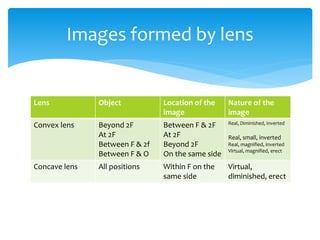
Lens Object Location of the
image
Nature of the
image
Convex lens Beyond 2F
At 2F
Between F & 2f
Between F & O
Between F & 2F
At 2F
Beyond 2F
On the same side
Real, Diminished, Inverted
Real, small, inverted
Real, magnified, inverted
Virtual, magnified, erect
Concave lens All positions Within F on the
same side
Virtual,
diminished, erect
Images formed by lens
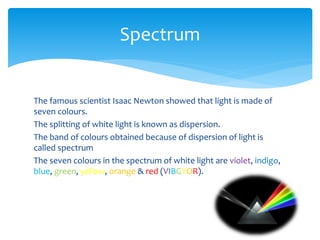
The famous scientist Isaac Newton showed that light is made of
seven colours.
The splitting of white light is known as dispersion.
The band of colours obtained because of dispersion of light is
called spectrum
The seven colours in the spectrum of white light are violet, indigo,
blue, green, yellow, orange & red (VIBGYOR).
Spectrum
Light(by aagman saini)

Light(by aagman saini)

  • 1.
    Light Efforts by :-Aagman Saini
  • 2.
    Light is aform of energy which enables us to see everything around us. It does not require a medium and can travel even in vacuum. Introduction
  • 3.
    The property oflight travelling in straight lines in a medium is known as rectilinear propagation of light. Rectilinear propagation of light
  • 4.
    The bouncing oflight from a surface is called reflection. Reflection of light is of two kinds :- Regular reflection Irregular reflection Reflection of light
  • 5.
    When the reflectingsurface is smooth & well polished, the light that falls on it is reflected regularly. This phenomenon is known as regular reflection or specular reflection. Regular reflection
  • 6.
    When the reflectingsurface is irregular, the rays of light that fall on it are scattered in all directions, it is known as irregular reflection or diffused reflection. Irregular reflection
  • 7.
    There are twotypes of images:- Real images Virtual images Types of images
  • 8.
    A real imageis formed by the actual intersection of light rays & can be formed on the screen. Real images Real image
  • 9.
    A virtual imageis formed by the intersection of the light rays when produced behind the mirror & not by their actual intersection. Virtual images Virtual image
  • 10.
    Spherical mirrors :-concave & convex Plane mirror Types of mirror
  • 11.
     The poleof a spherical is the centre (p) of the spherical mirror.  The centre of curvature of a spherical mirror is the centre (c) of the sphere of which the mirror forms a part.  The radius of curvature of a spherical mirror is the radius (r) of the sphere of which the mirror forms a part.  The principal axis of a spherical mirror is the line joining the pole & the centre of curvature of the mirror. Spherical mirrors
  • 12.
    In a concavemirror, the image is erect & enlarged if the object is very close to the mirror. Concave mirrors are used as shaving mirrors & compact mirrors erect, enlarged images of the face are formed. concave mirror
  • 13.
    In convex mirrors,the image is always erect & diminished, at whatever distance the object may be in front of the mirror. The convex mirror has a wide field of view & hence is used as a rear view or driving mirror in vehicles, to view the traffic behind. Convex mirror
  • 14.
     Concave mirrorare used as reflector in torchlight , shaving mirrors and compact mirrors. Uses of concave mirror
  • 15.
    Convex mirrors areused in :- Rear view mirrors Vigilance mirrors in stores Uses of convex mirror
  • 16.
    Images formed byspherical mirrors & plane mirror Nature of image Plane mirror Concave mirror Convex mirror Size Same as object 1.Enlarged, when the object is closer to mirror than C 2.Same size as the object, when the objet is at c 3.Diminished when the object is beyond c Diminished for all positions of the object. Real or Virtual Virtual 1.Virtual when the object is within F 2.Real,for all other positions of the object Virtual for all positions of the object Distance from the mirror Same as the object As the object comes closer to the mirror Within F for all positions of the object inversion lateral 1.Erect when object is within F 2.Inverted for all the other positions of the object Erect
  • 17.
    A lens isa piece of transparent material bound by curved surfaces. Lenses are of two types :-  Lenses which are thicker in the middle than at the edges are called convex lens(converging lens). Lenses which are thinner in the middle than the edges are called concave lenses(diverging lenses). Types of lenses
  • 18.
     The principalaxis is the line joining the centres of the two spheres of which the lens forms a part.  The optical centre is the centre of the lens(o).  The principal focus (F) of a concave lens is a pointy of the principal axis to which rays parallel axis converge after refraction .  The principal focus(F) of a concave lens is a point on the principal axis from which rays parallel to the principal axis appear to diverge after refraction.  The focal length (f)of a lens is the distance between the optical centre and principal focus. lenses
  • 19.
    Lens Object Locationof the image Nature of the image Convex lens Beyond 2F At 2F Between F & 2f Between F & O Between F & 2F At 2F Beyond 2F On the same side Real, Diminished, Inverted Real, small, inverted Real, magnified, inverted Virtual, magnified, erect Concave lens All positions Within F on the same side Virtual, diminished, erect Images formed by lens
  • 20.
    The famous scientistIsaac Newton showed that light is made of seven colours. The splitting of white light is known as dispersion. The band of colours obtained because of dispersion of light is called spectrum The seven colours in the spectrum of white light are violet, indigo, blue, green, yellow, orange & red (VIBGYOR). Spectrum