Concave Mirrors The laws remain the same
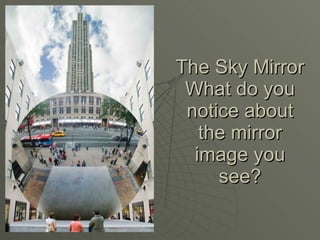
The Sky Mirror in Monte Carlo
The Sky Mirror What do you notice about the mirror image you see?
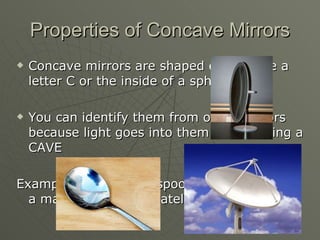
Properties of Concave Mirrors Concave mirrors are shaped curved like a letter C or the inside of a sphere You can identify them from other mirrors because light goes into them like entering a CAVE Examples: the side of spoon you put food on, a makeup mirror, a satellite dish
How do we draw ray diagrams for Concave mirrors? It all comes back to the… Angle of incidence Incident ray Normal Reflected ray Angle of reflection SO… How do you do this on a curved surface?
You apply the SAME rules of reflection If you could make the mirror INFINITELY small, you would notice that for an instant the mirror acts like a flat plane at the point where light hits it Therefore, you could consider that the curved mirror is made up of MANY small flat mirrors
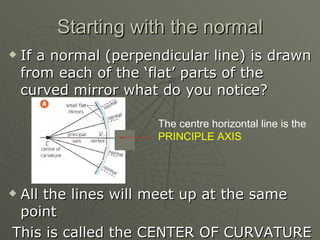
Starting with the normal If a normal (perpendicular line) is drawn from each of the ‘flat’ parts of the curved mirror what do you notice? All the lines will meet up at the same point This is called the CENTER OF CURVATURE The centre horizontal line is the  PRINCIPLE AXIS
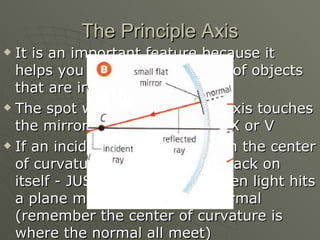
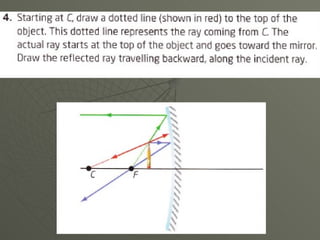
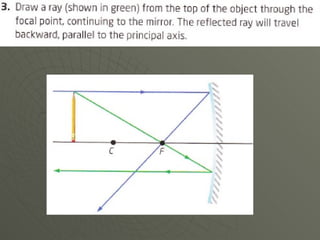
The Principle Axis It is an important feature because it helps you locate the positions of objects that are in front of the mirror The spot where the principle axis touches the mirror is called the VERTEX or V If an incident ray goes through the center of curvature it gets reflected back on itself - JUST LIKE IT DOES when light hits a plane mirror through the normal (remember the center of curvature is where the normal all meet)
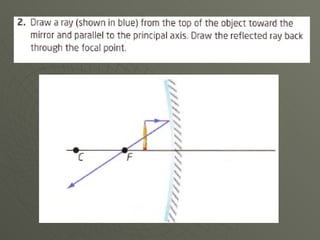
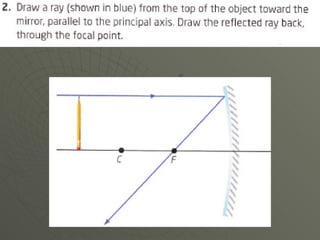
Rays Parallel to the Center of Curvature When rays run parallel to the  principal axis  what do you notice? They intersect at the same point on the  principal axis   This know as the  FOCAL POINT  or  F And the distance from the mirror  (V=vertex)  to the focal point is called the  FOCAL LENGTH
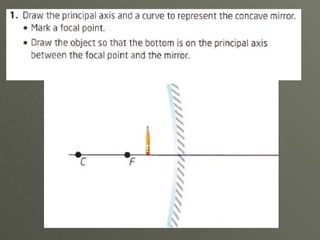
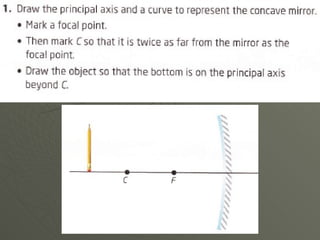
So how do we Draw the Diagram? The best way to begin? Put the bottom of the object on the principle axis Because the principle axis is ALSO a normal, this means our IMAGE will also be on the principle axis The next step is to find the TOP of the image in order to complete the diagram
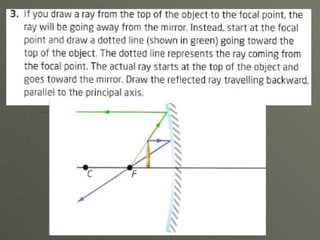
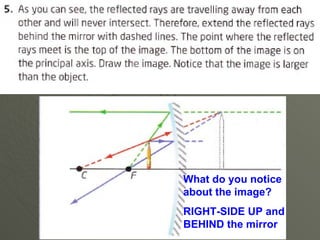
How to draw Objects between the Focal Point and the Mirror


What do you notice about the image? RIGHT-SIDE UP and BEHIND the mirror
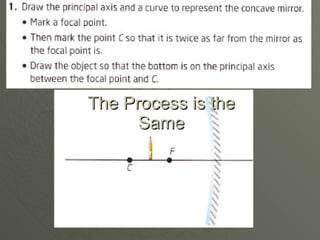
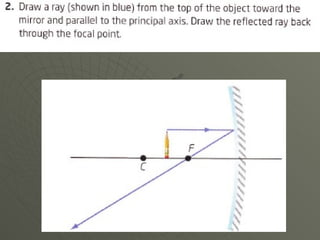
What if the Object is between the Focal Point and the Center of Curvature?
The Process is the Same
 
 
What do you notice about the image? UPSIDE-DOWN and in front of the center of curvature
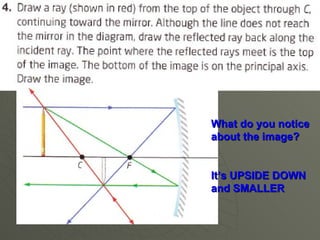
What about when the object is in front of (or beyond) the Center of Curvature


What do you notice about the image? It’s UPSIDE DOWN and SMALLER
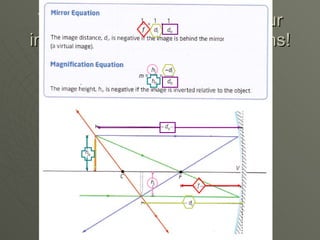
You can also Predict what your image looks like using equations!
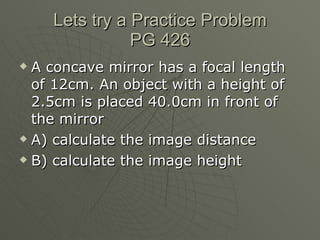
Lets try a Practice Problem PG 426 A concave mirror has a focal length of 12cm. An object with a height of 2.5cm is placed 40.0cm in front of the mirror A) calculate the image distance B) calculate the image height
More Practice Read pages 419-430 TB: questions 427, 1-5 WB: pg 134-136 STSE: TB 428-429 due Monday

Concave mirrors

  • 1.
    Concave Mirrors Thelaws remain the same
  • 2.
    The Sky Mirrorin Monte Carlo
  • 3.
    The Sky MirrorWhat do you notice about the mirror image you see?
  • 4.
    Properties of ConcaveMirrors Concave mirrors are shaped curved like a letter C or the inside of a sphere You can identify them from other mirrors because light goes into them like entering a CAVE Examples: the side of spoon you put food on, a makeup mirror, a satellite dish
  • 5.
    How do wedraw ray diagrams for Concave mirrors? It all comes back to the… Angle of incidence Incident ray Normal Reflected ray Angle of reflection SO… How do you do this on a curved surface?
  • 6.
    You apply theSAME rules of reflection If you could make the mirror INFINITELY small, you would notice that for an instant the mirror acts like a flat plane at the point where light hits it Therefore, you could consider that the curved mirror is made up of MANY small flat mirrors
  • 7.
    Starting with thenormal If a normal (perpendicular line) is drawn from each of the ‘flat’ parts of the curved mirror what do you notice? All the lines will meet up at the same point This is called the CENTER OF CURVATURE The centre horizontal line is the PRINCIPLE AXIS
  • 8.
    The Principle AxisIt is an important feature because it helps you locate the positions of objects that are in front of the mirror The spot where the principle axis touches the mirror is called the VERTEX or V If an incident ray goes through the center of curvature it gets reflected back on itself - JUST LIKE IT DOES when light hits a plane mirror through the normal (remember the center of curvature is where the normal all meet)
  • 9.
    Rays Parallel tothe Center of Curvature When rays run parallel to the principal axis what do you notice? They intersect at the same point on the principal axis This know as the FOCAL POINT or F And the distance from the mirror (V=vertex) to the focal point is called the FOCAL LENGTH
  • 10.
    So how dowe Draw the Diagram? The best way to begin? Put the bottom of the object on the principle axis Because the principle axis is ALSO a normal, this means our IMAGE will also be on the principle axis The next step is to find the TOP of the image in order to complete the diagram
  • 11.
    How to drawObjects between the Focal Point and the Mirror
  • 12.
  • 13.
  • 14.
  • 15.
  • 16.
    What do younotice about the image? RIGHT-SIDE UP and BEHIND the mirror
  • 17.
    What if theObject is between the Focal Point and the Center of Curvature?
  • 18.
  • 19.
  • 20.
  • 21.
    What do younotice about the image? UPSIDE-DOWN and in front of the center of curvature
  • 22.
    What about whenthe object is in front of (or beyond) the Center of Curvature
  • 23.
  • 24.
  • 25.
  • 26.
    What do younotice about the image? It’s UPSIDE DOWN and SMALLER
  • 27.
    You can alsoPredict what your image looks like using equations!
  • 28.
    Lets try aPractice Problem PG 426 A concave mirror has a focal length of 12cm. An object with a height of 2.5cm is placed 40.0cm in front of the mirror A) calculate the image distance B) calculate the image height
  • 29.
    More Practice Readpages 419-430 TB: questions 427, 1-5 WB: pg 134-136 STSE: TB 428-429 due Monday

Editor's Notes