Venus Fly Trap
While the Venus Flytrap is carnivorous, it isn't
dangerous to humans and will not bite your
finger.
The Venus Flytrap is a plant that does not
make its own food, but rather feeds on insects.
Venus Flytrap plants are
found in areas with
very damp soil that
typically doesn't
provide the nutrients
needed for it to
survive. Insects provide
the missing nutrients.
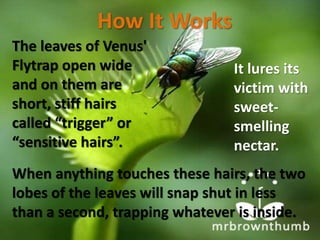
How It Works
When anything touches these hairs, the two
lobes of the leaves will snap shut in less
than a second, trapping whatever is inside.
The leaves of Venus'
Flytrap open wide
and on them are
short, stiff hairs
called “trigger” or
“sensitive hairs”.
It lures its
victim with
sweet-
smelling
nectar.
If an insect is too
large, it will stick
out of the trap.
This allows
bacteria and
molds to grow
on the insect.
Eventually the
trap turns black,
rots and falls off.
If the object isn't
food, e.g., a
stone or a nut,
the trap will
reopen in about
twelve hours
and 'spit' it out.
It dissolves the soft, inner
parts of the insect, but
not the tough, outer part
(exoskeleton).
The trap
compresses tightly
around the insect
and secretes
digestive juices,
much like those in
your stomach, and
an antiseptic juice.
This juice purifies
and keeps the
insect from
decaying over the
few days it is in the
trap.
At the end of the
digestive
process, which
takes from five to
twelve days, the
trap reabsorbs
the digestive
fluid and then
reopens.
The leftover parts
of the insect, the
exoskeleton, are
blown away by the
wind or washed
away by rain.

Venus fly trap

  • 1.
  • 2.
    While the VenusFlytrap is carnivorous, it isn't dangerous to humans and will not bite your finger. The Venus Flytrap is a plant that does not make its own food, but rather feeds on insects.
  • 3.
    Venus Flytrap plantsare found in areas with very damp soil that typically doesn't provide the nutrients needed for it to survive. Insects provide the missing nutrients.
  • 4.
    How It Works Whenanything touches these hairs, the two lobes of the leaves will snap shut in less than a second, trapping whatever is inside. The leaves of Venus' Flytrap open wide and on them are short, stiff hairs called “trigger” or “sensitive hairs”. It lures its victim with sweet- smelling nectar.
  • 5.
    If an insectis too large, it will stick out of the trap. This allows bacteria and molds to grow on the insect. Eventually the trap turns black, rots and falls off. If the object isn't food, e.g., a stone or a nut, the trap will reopen in about twelve hours and 'spit' it out.
  • 6.
    It dissolves thesoft, inner parts of the insect, but not the tough, outer part (exoskeleton). The trap compresses tightly around the insect and secretes digestive juices, much like those in your stomach, and an antiseptic juice. This juice purifies and keeps the insect from decaying over the few days it is in the trap.
  • 7.
    At the endof the digestive process, which takes from five to twelve days, the trap reabsorbs the digestive fluid and then reopens. The leftover parts of the insect, the exoskeleton, are blown away by the wind or washed away by rain.