 Iraq is located in
southwestern Asia, in the
heart of the Middle East.
 Iraq is about the size of
California.
 Iraq covers most of the
area of ancient
Mesopotamia, which
centered on the land
between the Tigris and
the Euphrates Rivers.
Mesopotamia, also called to as the “Fertile
Crescent”, was an important center of early
civilization.
 The first human civilization,
called Sumer, has
developed in Iraq around
4000 B.C.
 The land of Mesopotamia
belonged to the Sumerians,
who built:
1- Advanced irrigation
systems
2- Developed grain
agriculture
3- Invented the earliest form
of writing
4- Invented a math system
which the modern world is
based on
The Earliest Form
of Writing System
5- Invented the
wheel
6- Invented the first
plow
7- Literature was
produced, including
the first known
recorded story, the
Epic of Gilgamesh.
8- Science and art.
 Unlike the Egyptians who
believed that all land
belonged to the pharaoh,
Sumerians believed that
everyone needs their
private property.
 When the Sumerian
civilization collapsed in
1700 B.C., King
Hammurabi took over the
area and renamed it
Babylonia.
 Hammurabi, a great leader
known for creating the first
recorded laws in history,
united the Assyrians and
Babylonians in harmony.
King Hammurabi
 Babylon, which is south ofBabylon, which is south of
Baghdad, became the mostBaghdad, became the most
famous city in the world,famous city in the world,
and became proud of,and became proud of,
among other things, theamong other things, the
Hanging Gardens ofHanging Gardens of
Babylon.Babylon.
 The Hanging Gardens ofThe Hanging Gardens of
Babylon are considered oneBabylon are considered one
of the Seven Wonders ofof the Seven Wonders of
the Ancient World. It wasthe Ancient World. It was
built by thebuilt by the
Nebuchadnezzar II aroundNebuchadnezzar II around
600 BC to please his sick600 BC to please his sick
wife, Amytis who lovedwife, Amytis who loved
trees and delightful plantstrees and delightful plants
of her homeland Persia.of her homeland Persia.
The gardens wereThe gardens were
destroyed by severaldestroyed by several
earthquakes.earthquakes.
Babylonia became part of theBabylonia became part of the
Persian Empire, until ArabPersian Empire, until Arab
Muslims took over it.Muslims took over it.
Baghdad, capital city of
Iraq, was the
headquarters of the
Abbasid empire which
stretched out Islam all
over Asia and beyond.
They built many
mosques, schools,
universities all in one.
Madrasa Al-Mustansiriya
Math and
Science
books
destroyed
by the
Mongols
 In Iraq, its our high
priority to build
buildings according
to historic style, like
archaeological sites,
mosques, and
government
buildings.
 Ziggurats were built
by the Sumerians,
Babylonians, and
Assyrians for local
religions. Each
ziggurat was part of
a complex temple
which included other
buildings.
Ziggurat of Nana, the temple of
Ishtar, fortress of
Nebuchadnezzar, the Hanging
Gardens of Babylon are all
historic landmarks.
Ziggurat of Nana
(the Goddess of
the Moon )
Replica of the real Gate of Temple of
Ishtar
Assyrian Winged Lion and Bull Statue
Guardians
Almalweeya in
Samarra
Taq-i Kisra
Nice waterfall in Northern
parts of Iraq
 Tropical in the
east and
southeast
 The west is
mostly desert.
The northern
parts of Iraq are
mountainous and
experience cold,
harsh winters,
and pleasant
summer months.
 In the summer, a
dry, dusty wind
called the shamal
blasts through the
country with dust
storms, lasting for
several days.
 Since the country
is so dry, there
are few plants,
except for the
date palm tree,
known for its
dates. In fact,
more than 80% of
the world's date
supply is grown in
Iraq.
 95%of the population of Iraq
practice the religion Islam.(54%
Shias and 41% Sunnis)
 The second-largest cultural group is
the Kurds, who live in the highlands
and mountain valleys of the north.
 Then the rest of the people are
divided into several other ethnic
groups, including Assyrian,
Turkoman, Chaldean, Armenian,
Yazidi, Christians and Jewish.
Shrine of Imam Ali in Al-Najaf, South of
Iraq
Imam Abu Hanifa Shrine on
Prophet Muhammad’s (P.B.U.H)
Birthday
Buniya
Mosque
in
Baghdad
Marth Mariam Church in
Baghdad
Syriaan Church in Basra,
Southern of Iraq
 The traditional dress that
Iraqi men wear is the
dishdasha. The shmag, a
white or checkered square
scarf folded into a triangle
and sometimes worn over a
small white cap with the
agal, a circular black rope
or plaited-cord device to
hold the shmag in place.
 The traditional costume
includes the abayah, a long
black cloak worn over a
dress and covering the
wearer from head to foot.
Traditionally, Kurdish women wear
colorful skirts and blouses. Men wear
baggy, colorful pants with a plain shirt
having very full sleeves, which were
tied at the elbow.
 Football is the most
popular sport in Iraq.
Other popular sports in
Iraq include wrestling,
volleyball, taekwondo,
karate and basketball.
 The Iraqi football team is called the "Brazil of Asia”. This team
is one of the Asia's most successful. It won fourth place during
the 27th
Summer Olympic Games held in Athens, Greece. In
2004. Iraq was the only Asian country in the finals.
 Younis Mahmoud is an Iraqi football
icon. He is best known as the athlete
who scored the winning goal for Iraq
in the Asian Cup in 2007.
Coach Ammo Baba, One of the BEST
players and coaches.
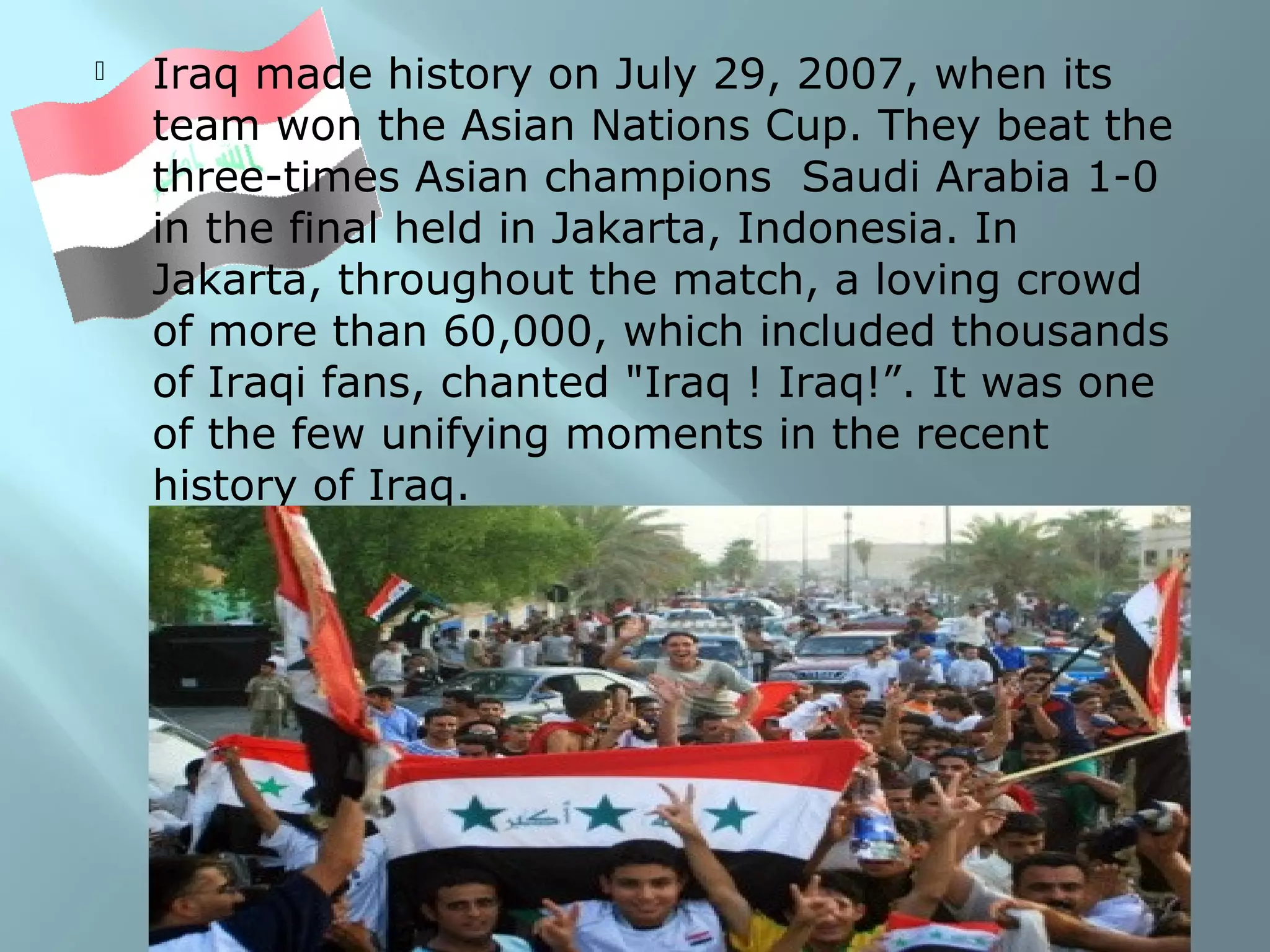
 Iraq made history on July 29, 2007, when its
team won the Asian Nations Cup. They beat the
three-times Asian champions Saudi Arabia 1-0
in the final held in Jakarta, Indonesia. In
Jakarta, throughout the match, a loving crowd
of more than 60,000, which included thousands
of Iraqi fans, chanted "Iraq ! Iraq!”. It was one
of the few unifying moments in the recent
history of Iraq.
The country of Iraq is known for its poets
and painters and sculptors whom are
among the best in the Arab world.
 Iraqi food is strongly influenced by its
neighboring countries, Turkey and Iran.
 There are several dishes native to the
country. Masgoof is a fish on a stick
barbequed on an outdoor grill.
 Other common dishes include kebabs,
and Dolma (spicy rice stuffing in
vegetables)
 A popular side dish, turshi, is a mixture
of pickled vegetables
 Other popular dishes include
Chicken with Fruit, Kubbat Burghul,
Kubat Halab, Biryani…etc.
 Desserts are a favorite among the Iraqis. They
include Baklawa and Zlabia, a pastry made of
honey and nuts layered between paper-thin sheets
of dough. There’s Kleacha. Dough inside it dates.
Iraqis always prefer
to drink tea with
Kleacha.
 Iraqis are known for being very generous
and polite, especially when it comes to
mealtime. Many Iraqis feed their guests
well before themselves. Most Iraqis hosts
feel that they are failing in their role as
hosts if their guests have not tried all of
their dishes. In fact, proper appreciation is
shown by overeating.
THANKYOU GUYS FORTHANKYOU GUYS FOR
LISTENING!LISTENING! HOPE YOUHOPE YOU
ENJOYED THEENJOYED THE
SLIDESHOW ANDSLIDESHOW AND
LEARNED SOMETHINGSLEARNED SOMETHINGS
ABOUT IRAQ!ABOUT IRAQ!

Iraq Cultural Project

  • 4.
     Iraq islocated in southwestern Asia, in the heart of the Middle East.  Iraq is about the size of California.  Iraq covers most of the area of ancient Mesopotamia, which centered on the land between the Tigris and the Euphrates Rivers. Mesopotamia, also called to as the “Fertile Crescent”, was an important center of early civilization.
  • 5.
     The firsthuman civilization, called Sumer, has developed in Iraq around 4000 B.C.  The land of Mesopotamia belonged to the Sumerians, who built: 1- Advanced irrigation systems 2- Developed grain agriculture 3- Invented the earliest form of writing 4- Invented a math system which the modern world is based on The Earliest Form of Writing System
  • 6.
    5- Invented the wheel 6-Invented the first plow 7- Literature was produced, including the first known recorded story, the Epic of Gilgamesh. 8- Science and art.
  • 7.
     Unlike theEgyptians who believed that all land belonged to the pharaoh, Sumerians believed that everyone needs their private property.  When the Sumerian civilization collapsed in 1700 B.C., King Hammurabi took over the area and renamed it Babylonia.  Hammurabi, a great leader known for creating the first recorded laws in history, united the Assyrians and Babylonians in harmony. King Hammurabi
  • 8.
     Babylon, whichis south ofBabylon, which is south of Baghdad, became the mostBaghdad, became the most famous city in the world,famous city in the world, and became proud of,and became proud of, among other things, theamong other things, the Hanging Gardens ofHanging Gardens of Babylon.Babylon.  The Hanging Gardens ofThe Hanging Gardens of Babylon are considered oneBabylon are considered one of the Seven Wonders ofof the Seven Wonders of the Ancient World. It wasthe Ancient World. It was built by thebuilt by the Nebuchadnezzar II aroundNebuchadnezzar II around 600 BC to please his sick600 BC to please his sick wife, Amytis who lovedwife, Amytis who loved trees and delightful plantstrees and delightful plants of her homeland Persia.of her homeland Persia. The gardens wereThe gardens were destroyed by severaldestroyed by several earthquakes.earthquakes. Babylonia became part of theBabylonia became part of the Persian Empire, until ArabPersian Empire, until Arab Muslims took over it.Muslims took over it.
  • 9.
    Baghdad, capital cityof Iraq, was the headquarters of the Abbasid empire which stretched out Islam all over Asia and beyond. They built many mosques, schools, universities all in one. Madrasa Al-Mustansiriya Math and Science books destroyed by the Mongols
  • 11.
     In Iraq,its our high priority to build buildings according to historic style, like archaeological sites, mosques, and government buildings.  Ziggurats were built by the Sumerians, Babylonians, and Assyrians for local religions. Each ziggurat was part of a complex temple which included other buildings. Ziggurat of Nana, the temple of Ishtar, fortress of Nebuchadnezzar, the Hanging Gardens of Babylon are all historic landmarks. Ziggurat of Nana (the Goddess of the Moon )
  • 12.
    Replica of thereal Gate of Temple of Ishtar
  • 13.
    Assyrian Winged Lionand Bull Statue Guardians
  • 14.
  • 15.
  • 16.
    Nice waterfall inNorthern parts of Iraq
  • 18.
     Tropical inthe east and southeast  The west is mostly desert.
  • 19.
    The northern parts ofIraq are mountainous and experience cold, harsh winters, and pleasant summer months.
  • 20.
     In thesummer, a dry, dusty wind called the shamal blasts through the country with dust storms, lasting for several days.  Since the country is so dry, there are few plants, except for the date palm tree, known for its dates. In fact, more than 80% of the world's date supply is grown in Iraq.
  • 23.
     95%of thepopulation of Iraq practice the religion Islam.(54% Shias and 41% Sunnis)  The second-largest cultural group is the Kurds, who live in the highlands and mountain valleys of the north.  Then the rest of the people are divided into several other ethnic groups, including Assyrian, Turkoman, Chaldean, Armenian, Yazidi, Christians and Jewish.
  • 24.
    Shrine of ImamAli in Al-Najaf, South of Iraq
  • 25.
    Imam Abu HanifaShrine on Prophet Muhammad’s (P.B.U.H) Birthday
  • 26.
  • 27.
  • 28.
    Syriaan Church inBasra, Southern of Iraq
  • 30.
     The traditionaldress that Iraqi men wear is the dishdasha. The shmag, a white or checkered square scarf folded into a triangle and sometimes worn over a small white cap with the agal, a circular black rope or plaited-cord device to hold the shmag in place.  The traditional costume includes the abayah, a long black cloak worn over a dress and covering the wearer from head to foot.
  • 31.
    Traditionally, Kurdish womenwear colorful skirts and blouses. Men wear baggy, colorful pants with a plain shirt having very full sleeves, which were tied at the elbow.
  • 33.
     Football isthe most popular sport in Iraq. Other popular sports in Iraq include wrestling, volleyball, taekwondo, karate and basketball.
  • 34.
     The Iraqifootball team is called the "Brazil of Asia”. This team is one of the Asia's most successful. It won fourth place during the 27th Summer Olympic Games held in Athens, Greece. In 2004. Iraq was the only Asian country in the finals.
  • 35.
     Younis Mahmoudis an Iraqi football icon. He is best known as the athlete who scored the winning goal for Iraq in the Asian Cup in 2007. Coach Ammo Baba, One of the BEST players and coaches.
  • 36.
     Iraq madehistory on July 29, 2007, when its team won the Asian Nations Cup. They beat the three-times Asian champions Saudi Arabia 1-0 in the final held in Jakarta, Indonesia. In Jakarta, throughout the match, a loving crowd of more than 60,000, which included thousands of Iraqi fans, chanted "Iraq ! Iraq!”. It was one of the few unifying moments in the recent history of Iraq.
  • 38.
    The country ofIraq is known for its poets and painters and sculptors whom are among the best in the Arab world.
  • 40.
     Iraqi foodis strongly influenced by its neighboring countries, Turkey and Iran.  There are several dishes native to the country. Masgoof is a fish on a stick barbequed on an outdoor grill.
  • 41.
     Other commondishes include kebabs, and Dolma (spicy rice stuffing in vegetables)  A popular side dish, turshi, is a mixture of pickled vegetables
  • 42.
     Other populardishes include Chicken with Fruit, Kubbat Burghul, Kubat Halab, Biryani…etc.
  • 43.
     Desserts area favorite among the Iraqis. They include Baklawa and Zlabia, a pastry made of honey and nuts layered between paper-thin sheets of dough. There’s Kleacha. Dough inside it dates. Iraqis always prefer to drink tea with Kleacha.
  • 44.
     Iraqis areknown for being very generous and polite, especially when it comes to mealtime. Many Iraqis feed their guests well before themselves. Most Iraqis hosts feel that they are failing in their role as hosts if their guests have not tried all of their dishes. In fact, proper appreciation is shown by overeating.
  • 45.
    THANKYOU GUYS FORTHANKYOUGUYS FOR LISTENING!LISTENING! HOPE YOUHOPE YOU ENJOYED THEENJOYED THE SLIDESHOW ANDSLIDESHOW AND LEARNED SOMETHINGSLEARNED SOMETHINGS ABOUT IRAQ!ABOUT IRAQ!