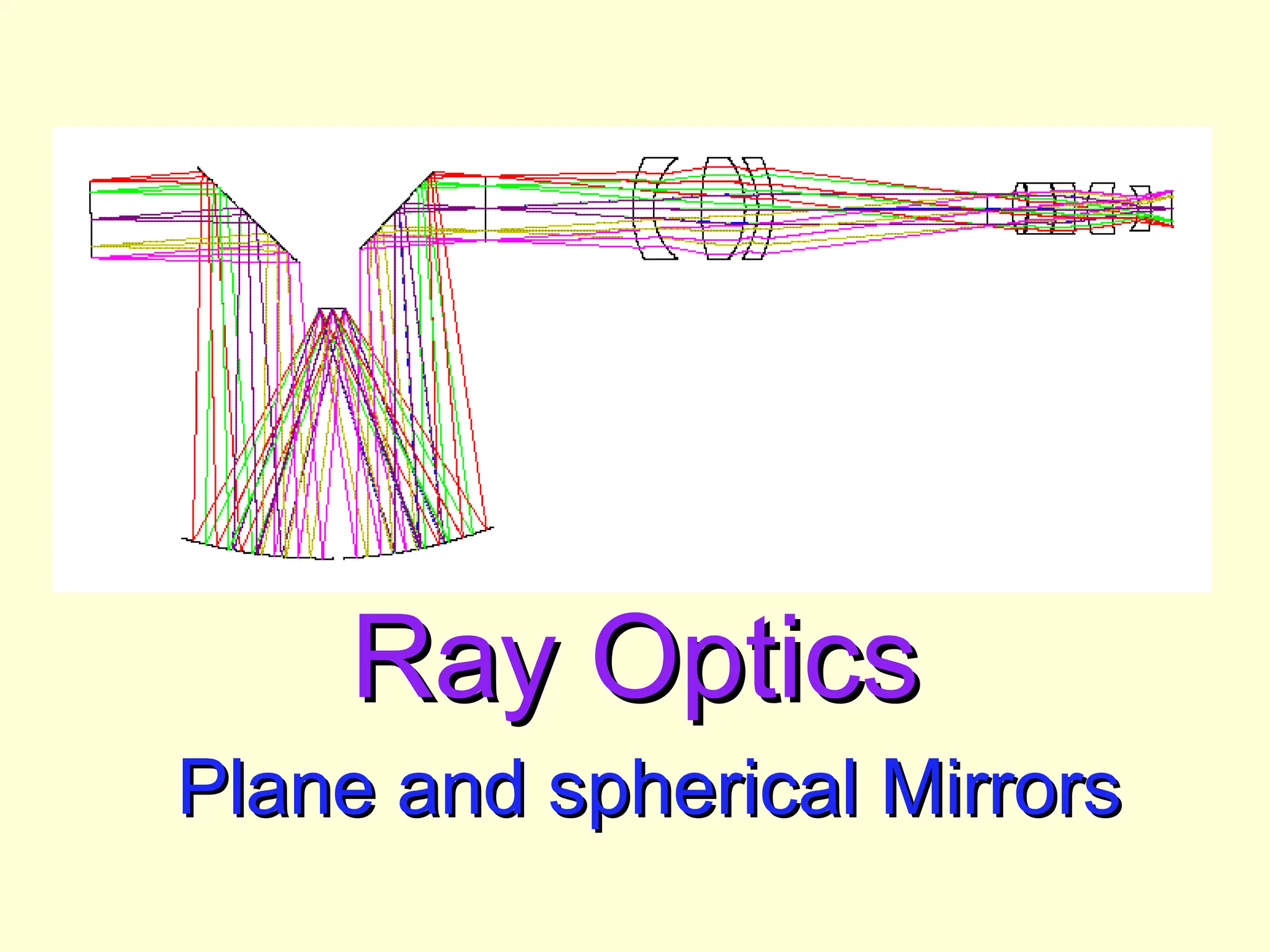
Ray Optics
Ray Optics
Plane and spherical Mirrors
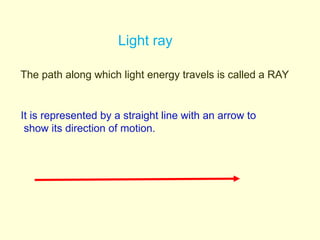
Light ray
The path along which light energy travels is called a RAY
It is represented by a straight line with an arrow to
show its direction of motion.
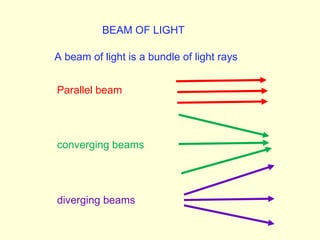
BEAM OF LIGHT
A beam of light is a bundle of light rays
Parallel beam
diverging beams
converging beams
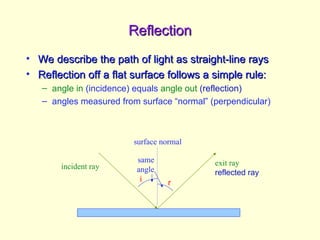
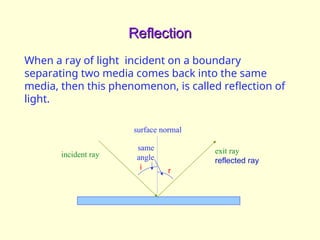
Reflection
Reflection
• We describe the path of light as straight-line rays
We describe the path of light as straight-line rays
• Reflection off a flat surface follows a simple rule:
Reflection off a flat surface follows a simple rule:
– angle in (incidence) equals angle out (reflection)
– angles measured from surface “normal” (perpendicular)
surface normal
same
angle
incident ray exit ray
reflected ray
i r
Reflection
Reflection
surface normal
same
angle
incident ray exit ray
reflected ray
i r
When a ray of light incident on a boundary
separating two media comes back into the same
media, then this phenomenon, is called reflection of
light.
Reflection
Reflection
surface normal
same
angle
incident ray exit ray
reflected ray
i r
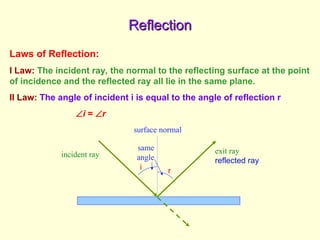
Laws of Reflection:
I Law: The incident ray, the normal to the reflecting surface at the point
of incidence and the reflected ray all lie in the same plane.
II Law: The angle of incident i is equal to the angle of reflection r
i = r
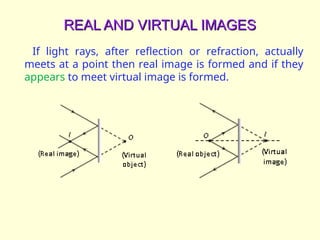
REAL AND VIRTUAL IMAGES
If light rays, after reflection or refraction, actually
meets at a point then real image is formed and if they
appears to meet virtual image is formed.
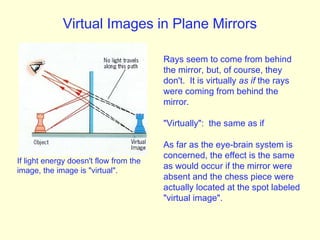
Virtual Images in Plane Mirrors
If light energy doesn't flow from the
image, the image is "virtual".
Rays seem to come from behind
the mirror, but, of course, they
don't. It is virtually as if the rays
were coming from behind the
mirror.
"Virtually": the same as if
As far as the eye-brain system is
concerned, the effect is the same
as would occur if the mirror were
absent and the chess piece were
actually located at the spot labeled
"virtual image".
9
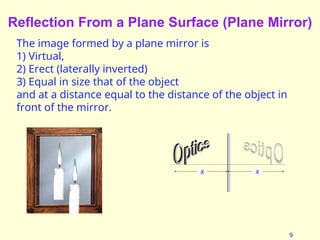
Reflection From a Plane Surface (Plane Mirror)
The image formed by a plane mirror is
1) Virtual,
2) Erect (laterally inverted)
3) Equal in size that of the object
and at a distance equal to the distance of the object in
front of the mirror.
x x
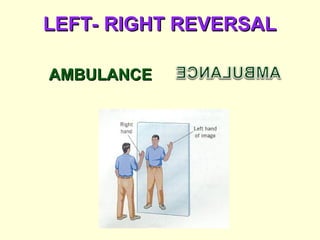
LEFT- RIGHT REVERSAL
AMBULANCE
AMBULANCE
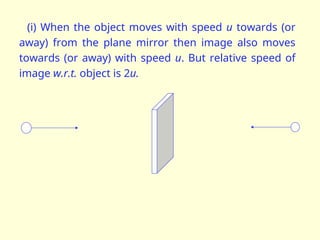
(i) When the object moves with speed u towards (or
away) from the plane mirror then image also moves
towards (or away) with speed u. But relative speed of
image w.r.t. object is 2u.
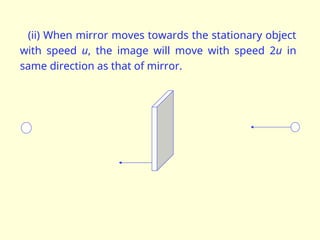
(ii) When mirror moves towards the stationary object
with speed u, the image will move with speed 2u in
same direction as that of mirror.
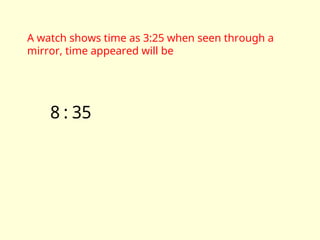
A watch shows time as 3:25 when seen through a
mirror, time appeared will be
35
:
8
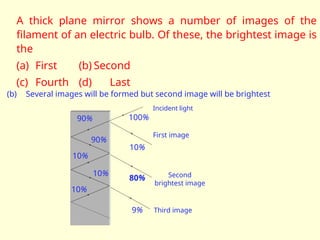
A thick plane mirror shows a number of images of the
filament of an electric bulb. Of these, the brightest image is
the
(a) First (b) Second
(c) Fourth (d) Last
100%
90%
90%
10%
10%
10%
10%
80%
9%
First image
Second
brightest image
Third image
Incident light
(b) Several images will be formed but second image will be brightest
Hall Mirror
Hall Mirror
“image” you
“real” you
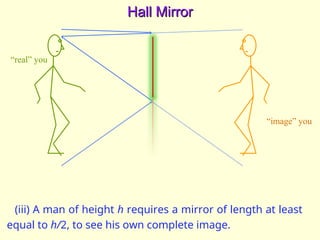
(iii) A man of height h requires a mirror of length at least
equal to h/2, to see his own complete image.
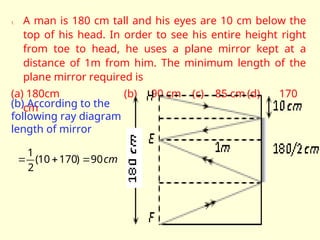
1. A man is 180 cm tall and his eyes are 10 cm below the
top of his head. In order to see his entire height right
from toe to head, he uses a plane mirror kept at a
distance of 1m from him. The minimum length of the
plane mirror required is
(a) 180cm (b) 90 cm (c) 85 cm (d) 170
cm
(b) According to the
following ray diagram
length of mirror
cm
90
)
170
10
(
2
1



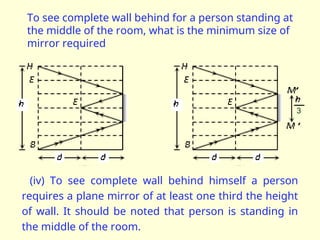
(iv) To see complete wall behind himself a person
requires a plane mirror of at least one third the height
of wall. It should be noted that person is standing in
the middle of the room.
3
To see complete wall behind for a person standing at
the middle of the room, what is the minimum size of
mirror required
18
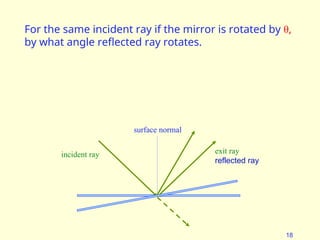
For the same incident ray if the mirror is rotated by θ,
by what angle reflected ray rotates.
surface normal
incident ray exit ray
reflected ray
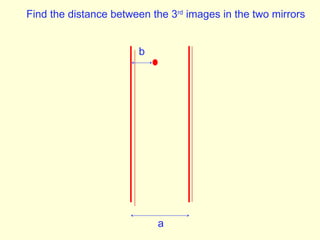
Find the distance between the 3rd
images in the two mirrors
a
b
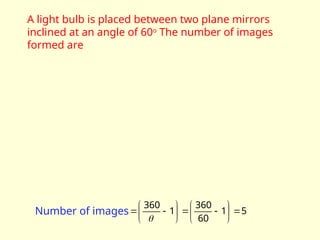
A light bulb is placed between two plane mirrors
inclined at an angle of 60o
The number of images
formed are
5
1
60
360
1
360


















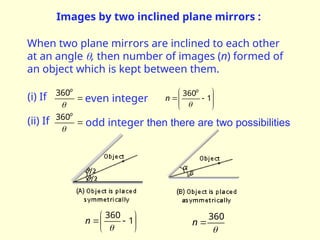
Number of images
Images by two inclined plane mirrors :
When two plane mirrors are inclined to each other
at an angle , then number of images (n) formed of
an object which is kept between them.









 1
360

o
n


o
360
even integer
(i) If


o
360
odd integer then there are two possibilities
(ii) If







 1
360

n

360

n
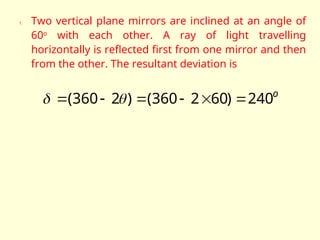
1. Two vertical plane mirrors are inclined at an angle of
60o
with each other. A ray of light travelling
horizontally is reflected first from one mirror and then
from the other. The resultant deviation is
o
240
)
60
2
360
(
)
2
360
( 




 

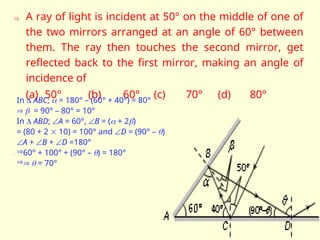
13. A ray of light is incident at 50° on the middle of one of
the two mirrors arranged at an angle of 60° between
them. The ray then touches the second mirror, get
reflected back to the first mirror, making an angle of
incidence of
(a) 50° (b) 60° (c) 70° (d) 80°

In  ABC;  = 180° – (60° + 40°) = 80°
  = 90° – 80° = 10°
In  ABD; A = 60°, B = ( + 2)
= (80 + 2  10) = 100° and D = (90° – )
A + B + D =180°
60° + 100° + (90° – ) = 180°
  = 70°
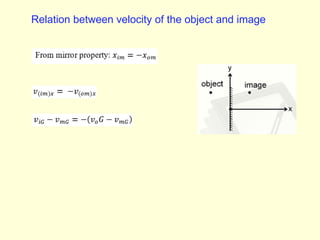
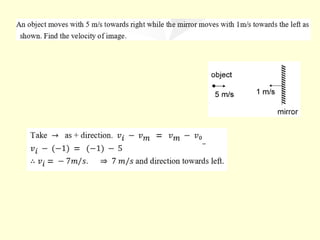
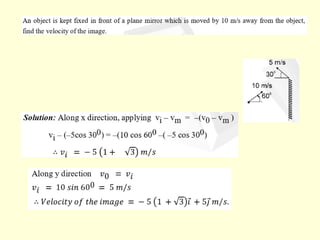
Relation between velocity of the object and image
Curved mirrors
Curved mirrors
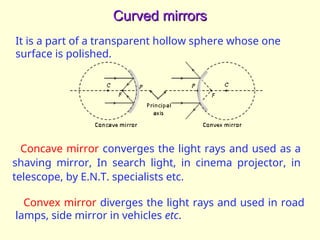
It is a part of a transparent hollow sphere whose one
surface is polished.
Concave mirror converges the light rays and used as a
shaving mirror, In search light, in cinema projector, in
telescope, by E.N.T. specialists etc.
Convex mirror diverges the light rays and used in road
lamps, side mirror in vehicles etc.
Terminology
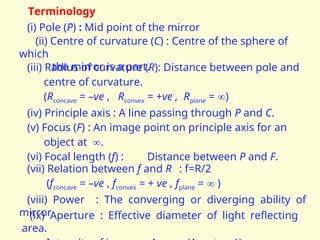
(i) Pole (P) : Mid point of the mirror
(ii) Centre of curvature (C) : Centre of the sphere of
which
the mirror is a part.
(iii) Radius of curvature (R): Distance between pole and
centre of curvature.
(Rconcave = –ve , Rconvex = +ve , Rplane = )
(iv) Principle axis : A line passing through P and C.
(v) Focus (F) : An image point on principle axis for an
object at .
(vi) Focal length (f) : Distance between P and F.
(vii) Relation between f and R : f=R/2
(fconcave = –ve , fconvex = + ve , fplane =  )
(viii) Power : The converging or diverging ability of
mirror
(ix) Aperture : Effective diameter of light reflecting
area.
Curved mirrors
Curved mirrors
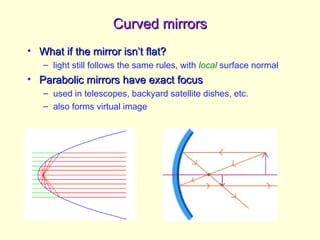
• What if the mirror isn’t flat?
What if the mirror isn’t flat?
– light still follows the same rules, with local surface normal
• Parabolic mirrors have exact focus
Parabolic mirrors have exact focus
– used in telescopes, backyard satellite dishes, etc.
– also forms virtual image
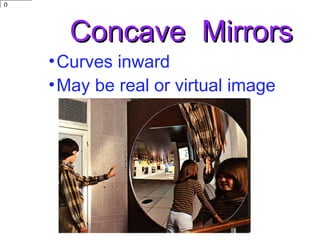
Concave Mirrors
Concave Mirrors
•Curves inward
•May be real or virtual image
82a425d7
0
0
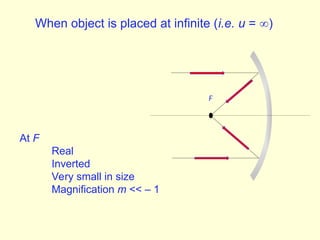
When object is placed at infinite (i.e. u = )
At F
Real
Inverted
Very small in size
Magnification m << – 1
F
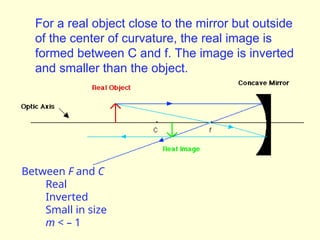
For a real object close to the mirror but outside
of the center of curvature, the real image is
formed between C and f. The image is inverted
and smaller than the object.
Between F and C
Real
Inverted
Small in size
m < – 1
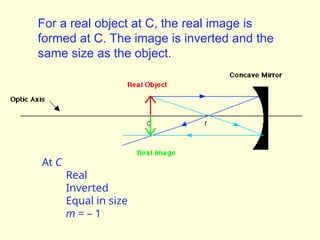
For a real object at C, the real image is
formed at C. The image is inverted and the
same size as the object.
At C
Real
Inverted
Equal in size
m = – 1
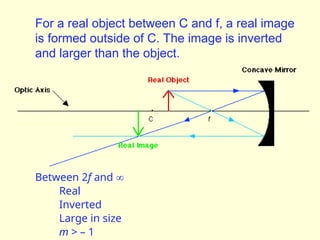
For a real object between C and f, a real image
is formed outside of C. The image is inverted
and larger than the object.
Between 2f and 
Real
Inverted
Large in size
m > – 1
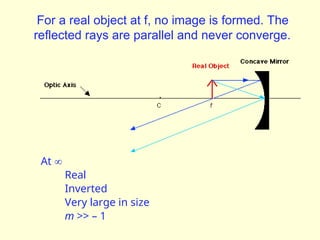
For a real object at f, no image is formed. The
reflected rays are parallel and never converge.
At 
Real
Inverted
Very large in size
m >> – 1
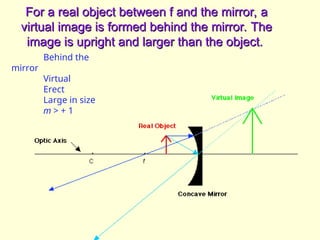
For a real object between f and the mirror, a
virtual image is formed behind the mirror. The
image is upright and larger than the object.
Behind the
mirror
Virtual
Erect
Large in size
m > + 1
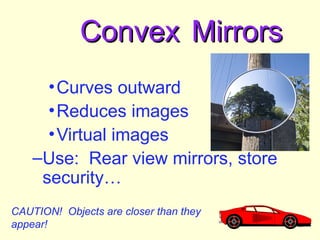
Convex
Convex Mirrors
Mirrors
•Curves outward
•Reduces images
•Virtual images
–Use: Rear view mirrors, store
security…
CAUTION! Objects are closer than they
appear!
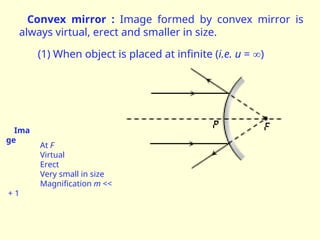
Convex mirror : Image formed by convex mirror is
always virtual, erect and smaller in size.
(1) When object is placed at infinite (i.e. u = )
Ima
ge
At F
Virtual
Erect
Very small in size
Magnification m <<
+ 1
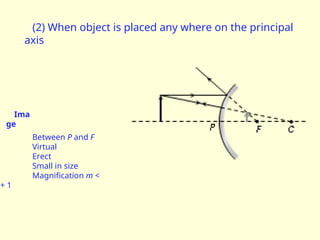
(2) When object is placed any where on the principal
axis
Ima
ge
Between P and F
Virtual
Erect
Small in size
Magnification m <
+ 1
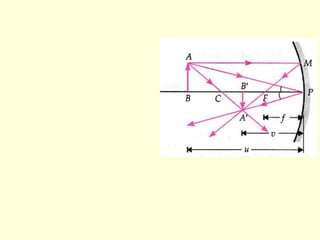
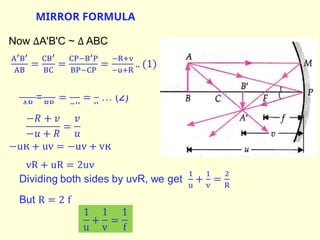
MIRROR FORMULA
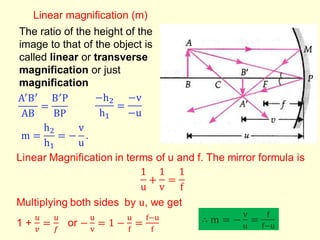
Linear magnification (m)
The ratio of the height of the
image to that of the object is
called linear or transverse
magnification or just
magnification
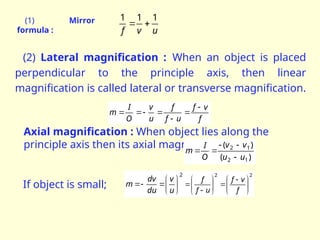
(1) Mirror
formula : u
v
f
1
1
1


(2) Lateral magnification : When an object is placed
perpendicular to the principle axis, then linear
magnification is called lateral or transverse magnification.
f
v
f
u
f
f
u
v
O
I
m







Axial magnification : When object lies along the
principle axis then its axial magnification
)
(
)
(
1
2
1
2
u
u
v
v
O
I
m





If object is small;
2









u
v
du
dv
m
2
2







 











f
v
f
u
f
f
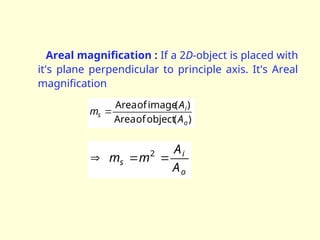
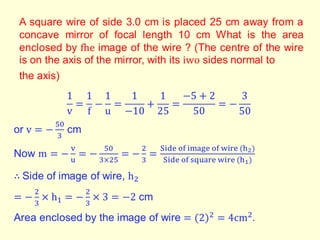
Areal magnification : If a 2D-object is placed with
it's plane perpendicular to principle axis. It's Areal
magnification
)
(
object
of
Area
)
(
image
of
Area
o
i
s
A
A
m 
o
i
s
A
A
m
m 

 2
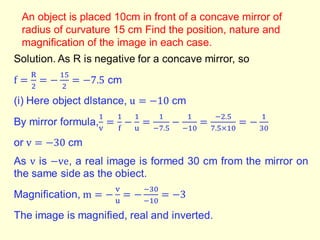
An object is placed 10cm in front of a concave mirror of
radius of curvature 15 cm Find the position, nature and
magnification of the image in each case.
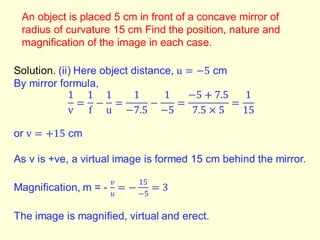
An object is placed 5 cm in front of a concave mirror of
radius of curvature 15 cm Find the position, nature and
magnification of the image in each case.
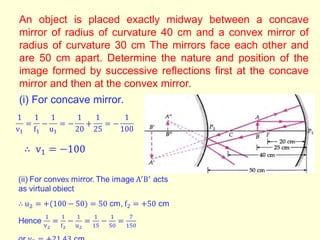
An object is placed exactly midway between a concave
mirror of radius of curvature 40 cm and a convex mirror of
radius of curvature 30 cm The mirrors face each other and
are 50 cm apart. Determine the nature and position of the
image formed by successive reflections first at the concave
mirror and then at the convex mirror.
(i) For concave mirror.
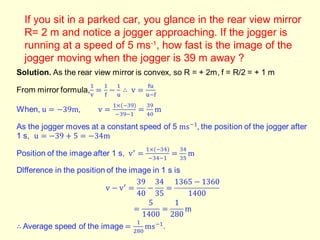
If you sit in a parked car, you glance in the rear view mirror
R= 2 m and notice a jogger approaching. If the jogger is
running at a speed of 5 ms-1
, how fast is the image of the
jogger moving when the jogger is 39 m away ?
optics - reflection plane spherical-1 .ppt

optics - reflection plane spherical-1 .ppt

  • 1.
    Ray Optics Ray Optics Planeand spherical Mirrors Plane and spherical Mirrors
  • 2.
    Light ray The pathalong which light energy travels is called a RAY It is represented by a straight line with an arrow to show its direction of motion.
  • 3.
    BEAM OF LIGHT Abeam of light is a bundle of light rays Parallel beam diverging beams converging beams
  • 4.
    Reflection Reflection • We describethe path of light as straight-line rays We describe the path of light as straight-line rays • Reflection off a flat surface follows a simple rule: Reflection off a flat surface follows a simple rule: – angle in (incidence) equals angle out (reflection) – angles measured from surface “normal” (perpendicular) surface normal same angle incident ray exit ray reflected ray i r
  • 5.
    Reflection Reflection surface normal same angle incident rayexit ray reflected ray i r When a ray of light incident on a boundary separating two media comes back into the same media, then this phenomenon, is called reflection of light.
  • 6.
    Reflection Reflection surface normal same angle incident rayexit ray reflected ray i r Laws of Reflection: I Law: The incident ray, the normal to the reflecting surface at the point of incidence and the reflected ray all lie in the same plane. II Law: The angle of incident i is equal to the angle of reflection r i = r
  • 7.
    REAL AND VIRTUALIMAGES REAL AND VIRTUAL IMAGES If light rays, after reflection or refraction, actually meets at a point then real image is formed and if they appears to meet virtual image is formed.
  • 8.
    Virtual Images inPlane Mirrors If light energy doesn't flow from the image, the image is "virtual". Rays seem to come from behind the mirror, but, of course, they don't. It is virtually as if the rays were coming from behind the mirror. "Virtually": the same as if As far as the eye-brain system is concerned, the effect is the same as would occur if the mirror were absent and the chess piece were actually located at the spot labeled "virtual image".
  • 9.
    9 Reflection From aPlane Surface (Plane Mirror) The image formed by a plane mirror is 1) Virtual, 2) Erect (laterally inverted) 3) Equal in size that of the object and at a distance equal to the distance of the object in front of the mirror. x x
  • 10.
    LEFT- RIGHT REVERSAL LEFT-RIGHT REVERSAL AMBULANCE AMBULANCE
  • 11.
    (i) When theobject moves with speed u towards (or away) from the plane mirror then image also moves towards (or away) with speed u. But relative speed of image w.r.t. object is 2u.
  • 12.
    (ii) When mirrormoves towards the stationary object with speed u, the image will move with speed 2u in same direction as that of mirror.
  • 13.
    A watch showstime as 3:25 when seen through a mirror, time appeared will be 35 : 8
  • 14.
    A thick planemirror shows a number of images of the filament of an electric bulb. Of these, the brightest image is the (a) First (b) Second (c) Fourth (d) Last 100% 90% 90% 10% 10% 10% 10% 80% 9% First image Second brightest image Third image Incident light (b) Several images will be formed but second image will be brightest
  • 15.
    Hall Mirror Hall Mirror “image”you “real” you (iii) A man of height h requires a mirror of length at least equal to h/2, to see his own complete image.
  • 16.
    1. A manis 180 cm tall and his eyes are 10 cm below the top of his head. In order to see his entire height right from toe to head, he uses a plane mirror kept at a distance of 1m from him. The minimum length of the plane mirror required is (a) 180cm (b) 90 cm (c) 85 cm (d) 170 cm (b) According to the following ray diagram length of mirror cm 90 ) 170 10 ( 2 1   
  • 17.
    (iv) To seecomplete wall behind himself a person requires a plane mirror of at least one third the height of wall. It should be noted that person is standing in the middle of the room. 3 To see complete wall behind for a person standing at the middle of the room, what is the minimum size of mirror required
  • 18.
    18 For the sameincident ray if the mirror is rotated by θ, by what angle reflected ray rotates. surface normal incident ray exit ray reflected ray
  • 19.
    Find the distancebetween the 3rd images in the two mirrors a b
  • 20.
    A light bulbis placed between two plane mirrors inclined at an angle of 60o The number of images formed are 5 1 60 360 1 360                   Number of images
  • 21.
    Images by twoinclined plane mirrors : When two plane mirrors are inclined to each other at an angle , then number of images (n) formed of an object which is kept between them.           1 360  o n   o 360 even integer (i) If   o 360 odd integer then there are two possibilities (ii) If         1 360  n  360  n
  • 25.
    1. Two verticalplane mirrors are inclined at an angle of 60o with each other. A ray of light travelling horizontally is reflected first from one mirror and then from the other. The resultant deviation is o 240 ) 60 2 360 ( ) 2 360 (        
  • 26.
    13. A rayof light is incident at 50° on the middle of one of the two mirrors arranged at an angle of 60° between them. The ray then touches the second mirror, get reflected back to the first mirror, making an angle of incidence of (a) 50° (b) 60° (c) 70° (d) 80°  In  ABC;  = 180° – (60° + 40°) = 80°   = 90° – 80° = 10° In  ABD; A = 60°, B = ( + 2) = (80 + 2  10) = 100° and D = (90° – ) A + B + D =180° 60° + 100° + (90° – ) = 180°   = 70°
  • 27.
    Relation between velocityof the object and image
  • 31.
    Curved mirrors Curved mirrors Itis a part of a transparent hollow sphere whose one surface is polished. Concave mirror converges the light rays and used as a shaving mirror, In search light, in cinema projector, in telescope, by E.N.T. specialists etc. Convex mirror diverges the light rays and used in road lamps, side mirror in vehicles etc.
  • 32.
    Terminology (i) Pole (P): Mid point of the mirror (ii) Centre of curvature (C) : Centre of the sphere of which the mirror is a part. (iii) Radius of curvature (R): Distance between pole and centre of curvature. (Rconcave = –ve , Rconvex = +ve , Rplane = ) (iv) Principle axis : A line passing through P and C. (v) Focus (F) : An image point on principle axis for an object at . (vi) Focal length (f) : Distance between P and F. (vii) Relation between f and R : f=R/2 (fconcave = –ve , fconvex = + ve , fplane =  ) (viii) Power : The converging or diverging ability of mirror (ix) Aperture : Effective diameter of light reflecting area.
  • 33.
    Curved mirrors Curved mirrors •What if the mirror isn’t flat? What if the mirror isn’t flat? – light still follows the same rules, with local surface normal • Parabolic mirrors have exact focus Parabolic mirrors have exact focus – used in telescopes, backyard satellite dishes, etc. – also forms virtual image
  • 34.
    Concave Mirrors Concave Mirrors •Curvesinward •May be real or virtual image 82a425d7 0 0
  • 35.
    When object isplaced at infinite (i.e. u = ) At F Real Inverted Very small in size Magnification m << – 1 F
  • 36.
    For a realobject close to the mirror but outside of the center of curvature, the real image is formed between C and f. The image is inverted and smaller than the object. Between F and C Real Inverted Small in size m < – 1
  • 37.
    For a realobject at C, the real image is formed at C. The image is inverted and the same size as the object. At C Real Inverted Equal in size m = – 1
  • 38.
    For a realobject between C and f, a real image is formed outside of C. The image is inverted and larger than the object. Between 2f and  Real Inverted Large in size m > – 1
  • 39.
    For a realobject at f, no image is formed. The reflected rays are parallel and never converge. At  Real Inverted Very large in size m >> – 1
  • 40.
    For a realobject between f and the mirror, a For a real object between f and the mirror, a virtual image is formed behind the mirror. The virtual image is formed behind the mirror. The image is upright and larger than the object. image is upright and larger than the object. Behind the mirror Virtual Erect Large in size m > + 1
  • 41.
    Convex Convex Mirrors Mirrors •Curves outward •Reducesimages •Virtual images –Use: Rear view mirrors, store security… CAUTION! Objects are closer than they appear!
  • 42.
    Convex mirror :Image formed by convex mirror is always virtual, erect and smaller in size. (1) When object is placed at infinite (i.e. u = ) Ima ge At F Virtual Erect Very small in size Magnification m << + 1
  • 43.
    (2) When objectis placed any where on the principal axis Ima ge Between P and F Virtual Erect Small in size Magnification m < + 1
  • 45.
  • 46.
    Linear magnification (m) Theratio of the height of the image to that of the object is called linear or transverse magnification or just magnification
  • 47.
    (1) Mirror formula :u v f 1 1 1   (2) Lateral magnification : When an object is placed perpendicular to the principle axis, then linear magnification is called lateral or transverse magnification. f v f u f f u v O I m        Axial magnification : When object lies along the principle axis then its axial magnification ) ( ) ( 1 2 1 2 u u v v O I m      If object is small; 2          u v du dv m 2 2                     f v f u f f
  • 48.
    Areal magnification :If a 2D-object is placed with it's plane perpendicular to principle axis. It's Areal magnification ) ( object of Area ) ( image of Area o i s A A m  o i s A A m m    2
  • 49.
    An object isplaced 10cm in front of a concave mirror of radius of curvature 15 cm Find the position, nature and magnification of the image in each case.
  • 50.
    An object isplaced 5 cm in front of a concave mirror of radius of curvature 15 cm Find the position, nature and magnification of the image in each case.
  • 51.
    An object isplaced exactly midway between a concave mirror of radius of curvature 40 cm and a convex mirror of radius of curvature 30 cm The mirrors face each other and are 50 cm apart. Determine the nature and position of the image formed by successive reflections first at the concave mirror and then at the convex mirror. (i) For concave mirror.
  • 53.
    If you sitin a parked car, you glance in the rear view mirror R= 2 m and notice a jogger approaching. If the jogger is running at a speed of 5 ms-1 , how fast is the image of the jogger moving when the jogger is 39 m away ?