Definitions
• Incident wave-the incoming light wave.
• Reflected wave-the wave that is bounced away from the
surface.
• Refracted-light waves are bent.
• Total internal reflection- an optical phenomenon that occurs
when a ray of light strikes a medium boundary at an angle

larger than a particular critical angle with respect to the
normal to the surface.
• Critical angle- the angle of incidence above which total
internal reflection occurs.
• Normal- to a flat surface is a vector that is perpendicular to
that surface. To a non-flat surface at a point P on the surface
is a vector perpendicular to the tangent plane to that surface
at P.
Reflection
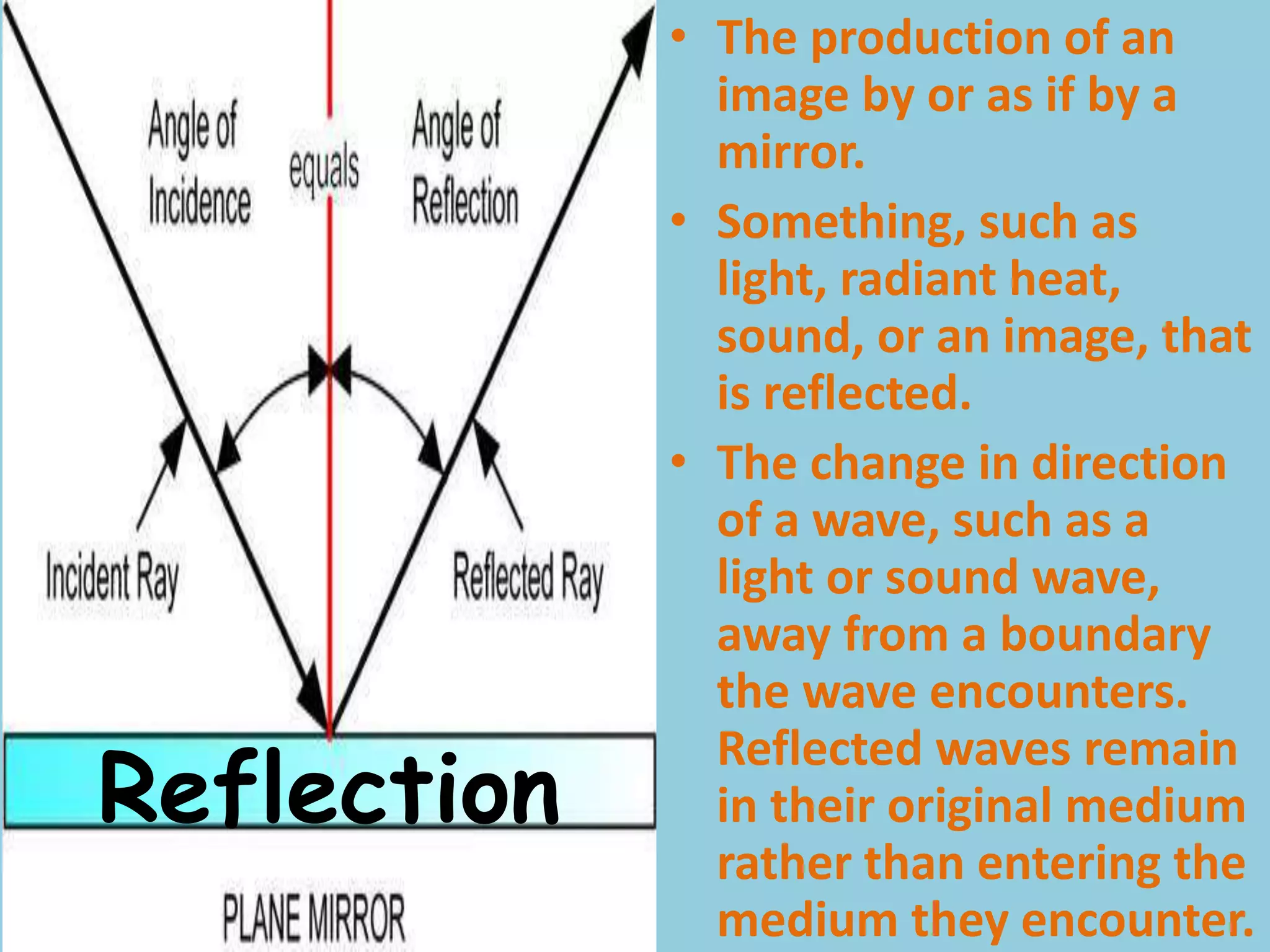
• The production of an
image by or as if by a
mirror.
• Something, such as
light, radiant heat,
sound, or an image, that
is reflected.
• The change in direction
of a wave, such as a
light or sound wave,
away from a boundary
the wave encounters.
Reflected waves remain
in their original medium
rather than entering the
medium they encounter.
Reflection
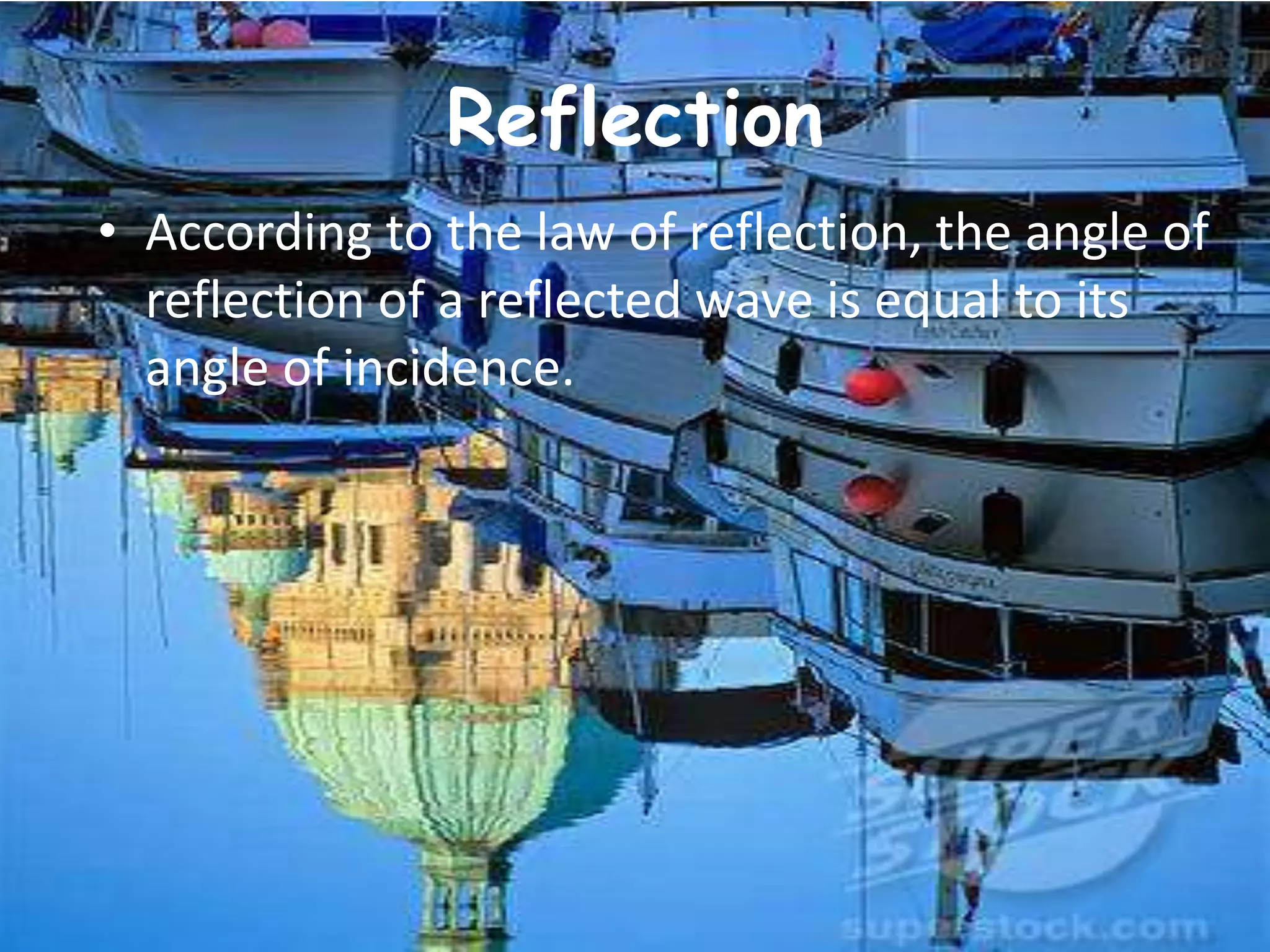
• According to the law of reflection, the angle of
reflection of a reflected wave is equal to its
angle of incidence.
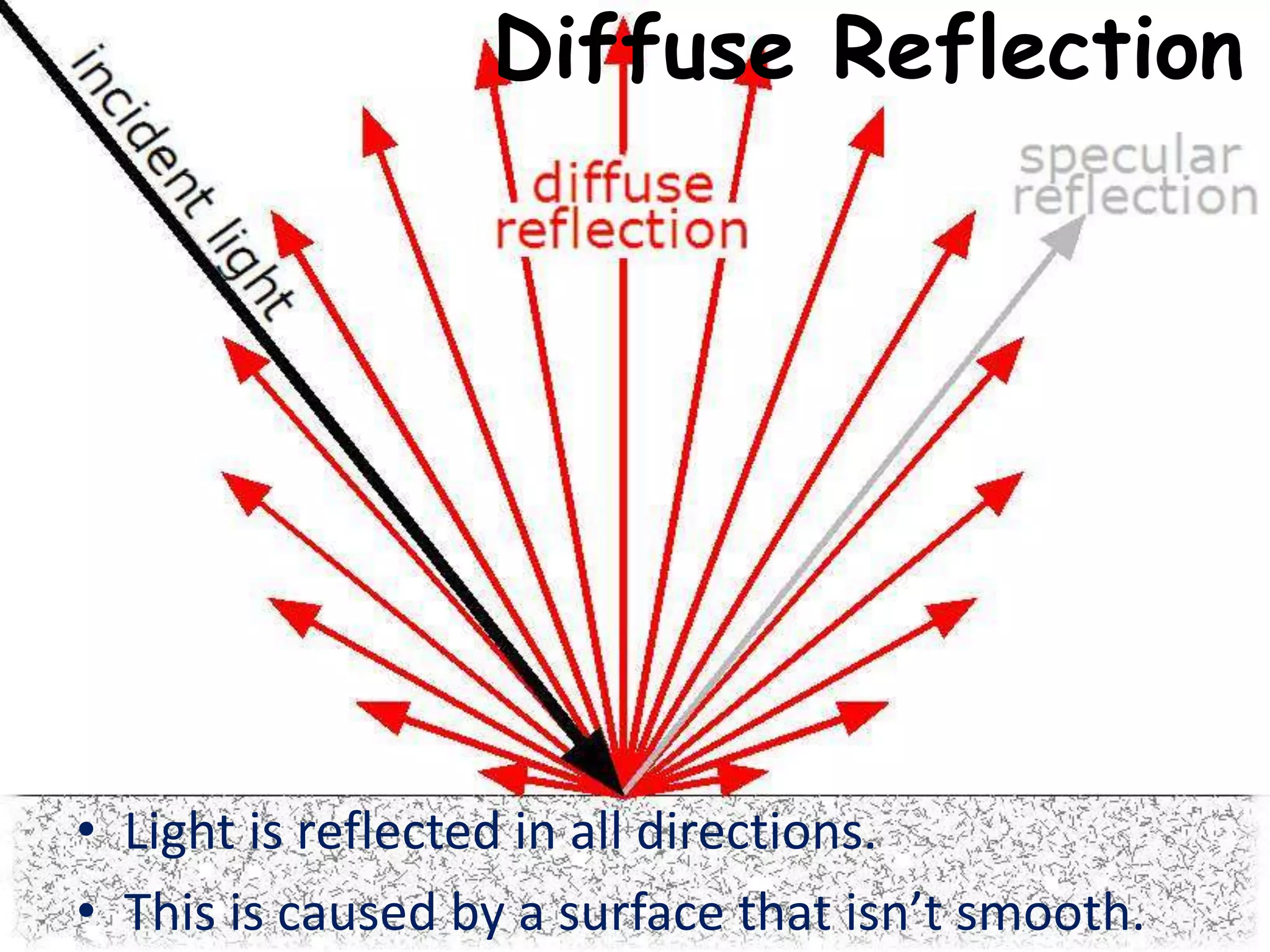
Diffuse Reflection
• Light is reflected in all directions.
• This is caused by a surface that isn’t smooth.
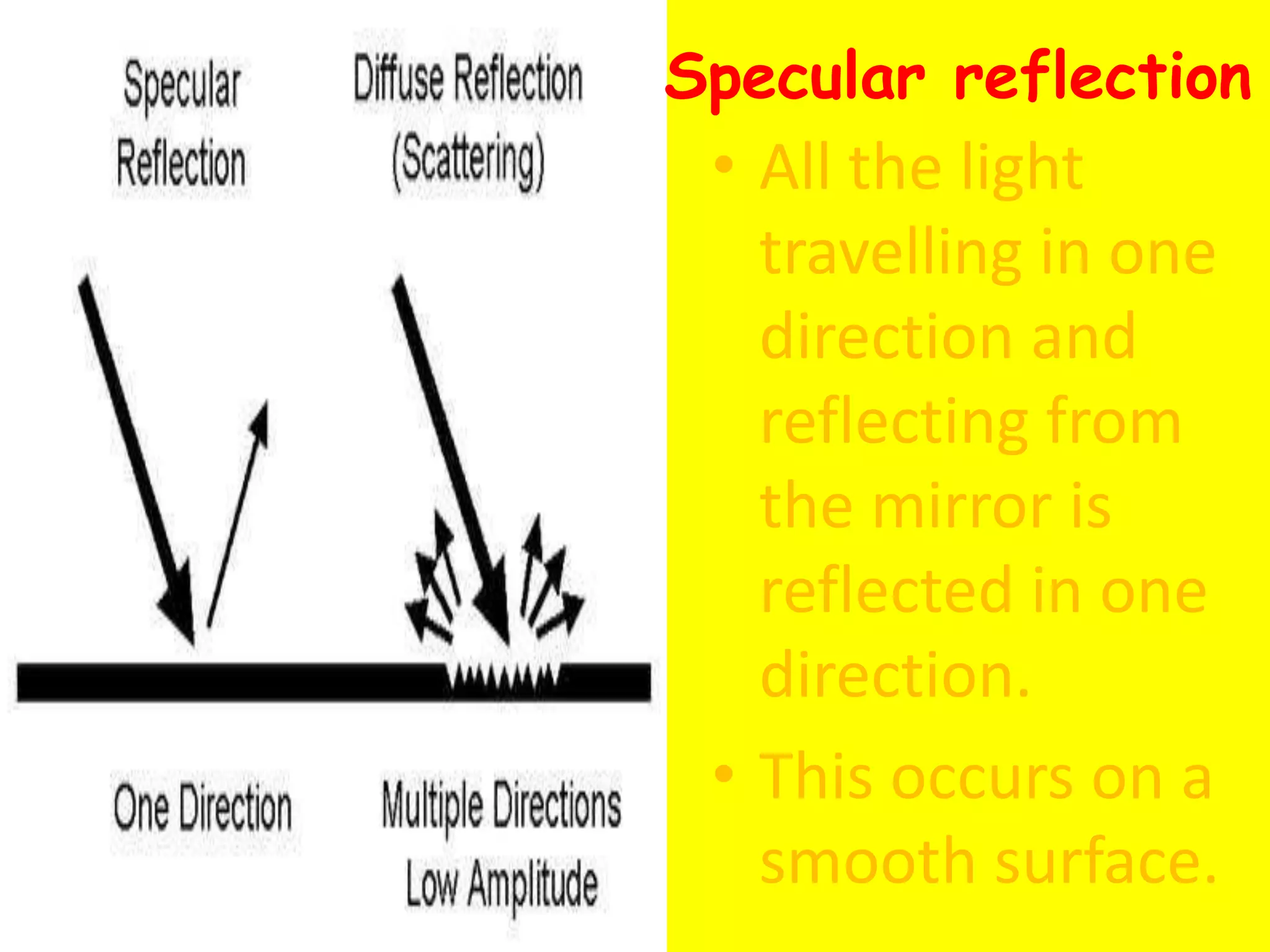
Specular reflection
• All the light
travelling in one
direction and
reflecting from
the mirror is
reflected in one
direction.
• This occurs on a
smooth surface.
Definitions
• Focal point- the single point where light from the object
hits or is focused. Located half the distance from the mirror
to the center of curvature.
• Focal length- the distance from the reflecting surface to the
focal point.
• Real- formed when the incident and reflected rays intersect
in front of the mirror.
• Virtual- does not actually exist (no light is produced). Occur
at points where extensions from incident and reflected rays
converge behind the mirror.
• Center of Curvature- the center of that original sphere.
• Radius of Curvature- the radius of the sphere.
• Vertex- the point where the mirror crosses the principal
axis.
• Principal axis- a line drawn through the vertex, focus and
center of curvature.
Plane Mirrors
Just kidding
Plane Mirrors
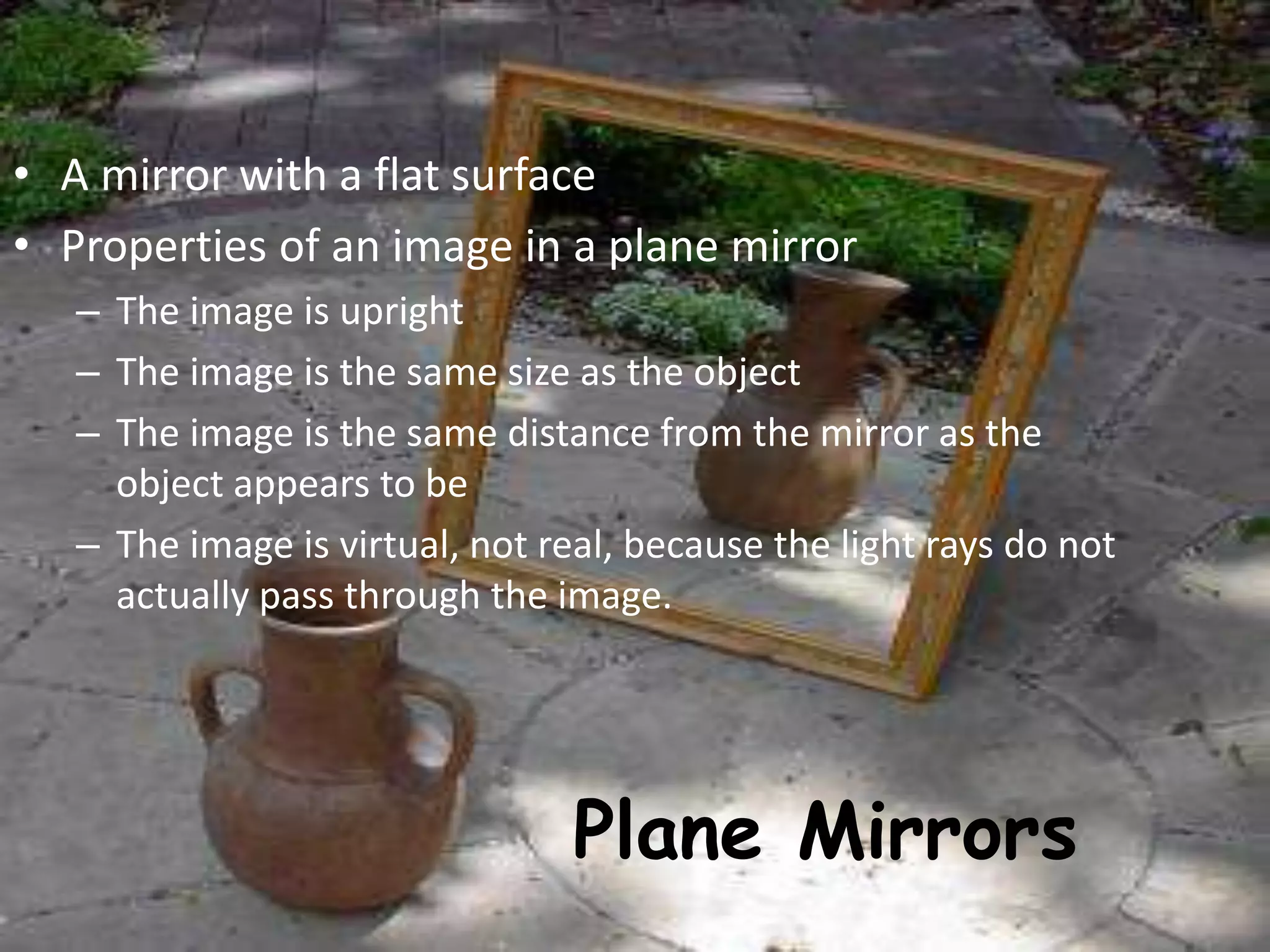
• A mirror with a flat surface
• Properties of an image in a plane mirror
– The image is upright
– The image is the same size as the object
– The image is the same distance from the mirror as the
object appears to be
– The image is virtual, not real, because the light rays do not
actually pass through the image.
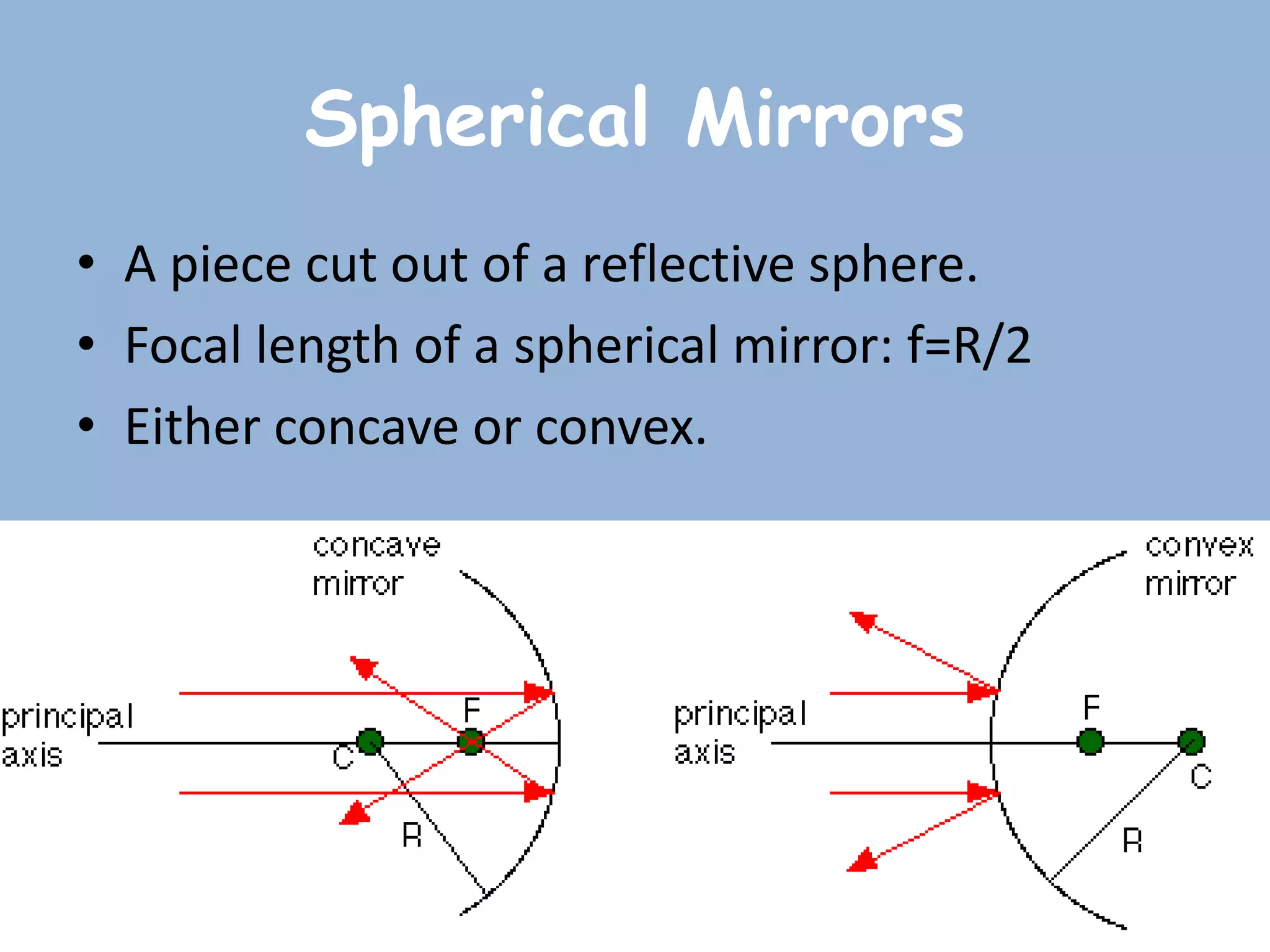
Spherical Mirrors
• A piece cut out of a reflective sphere.
• Focal length of a spherical mirror: f=R/2
• Either concave or convex.
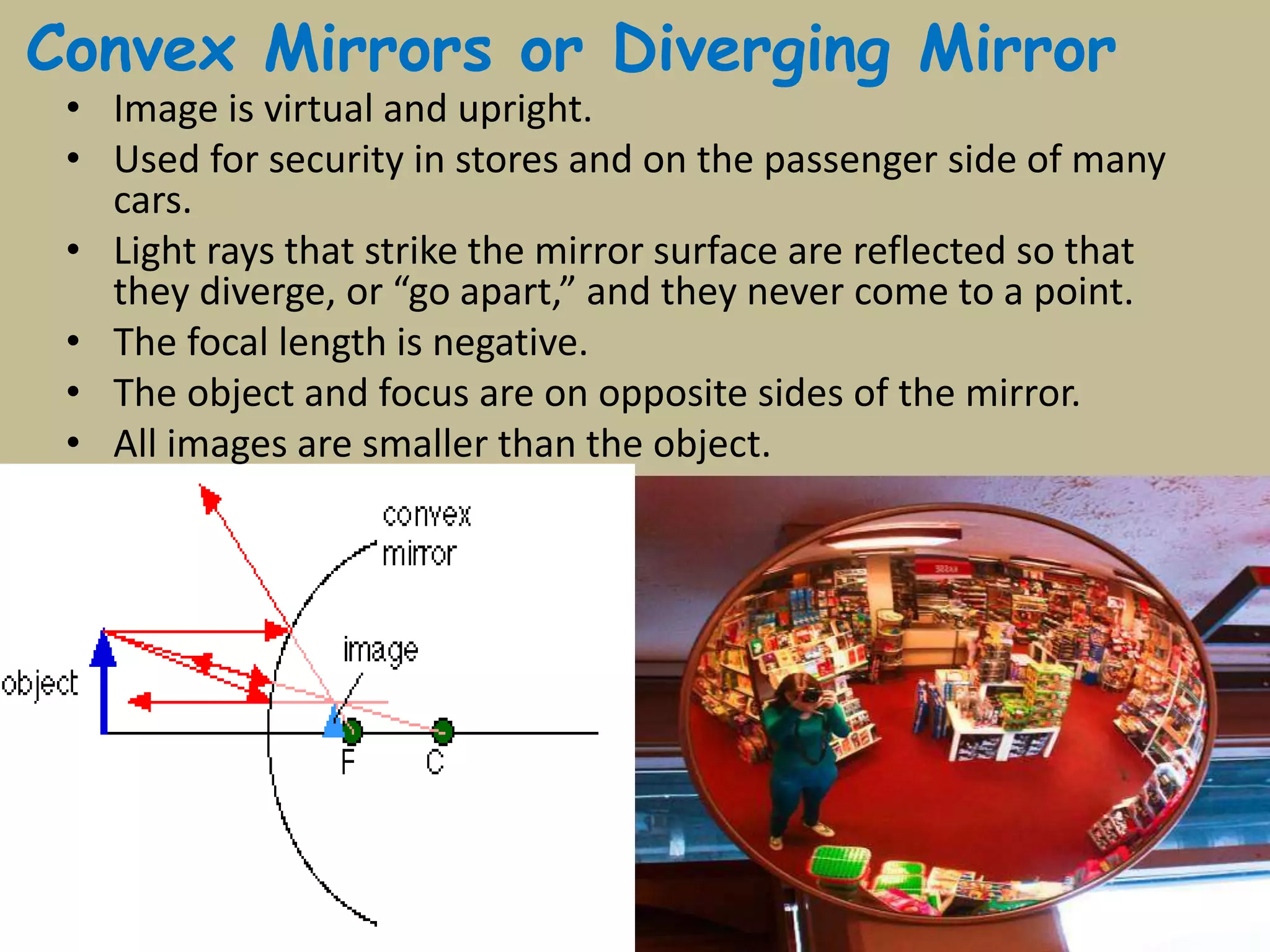
Convex Mirrors or Diverging Mirror
• Image is virtual and upright.
• Used for security in stores and on the passenger side of many
cars.
• Light rays that strike the mirror surface are reflected so that
they diverge, or “go apart,” and they never come to a point.
• The focal length is negative.
• The object and focus are on opposite sides of the mirror.
• All images are smaller than the object.
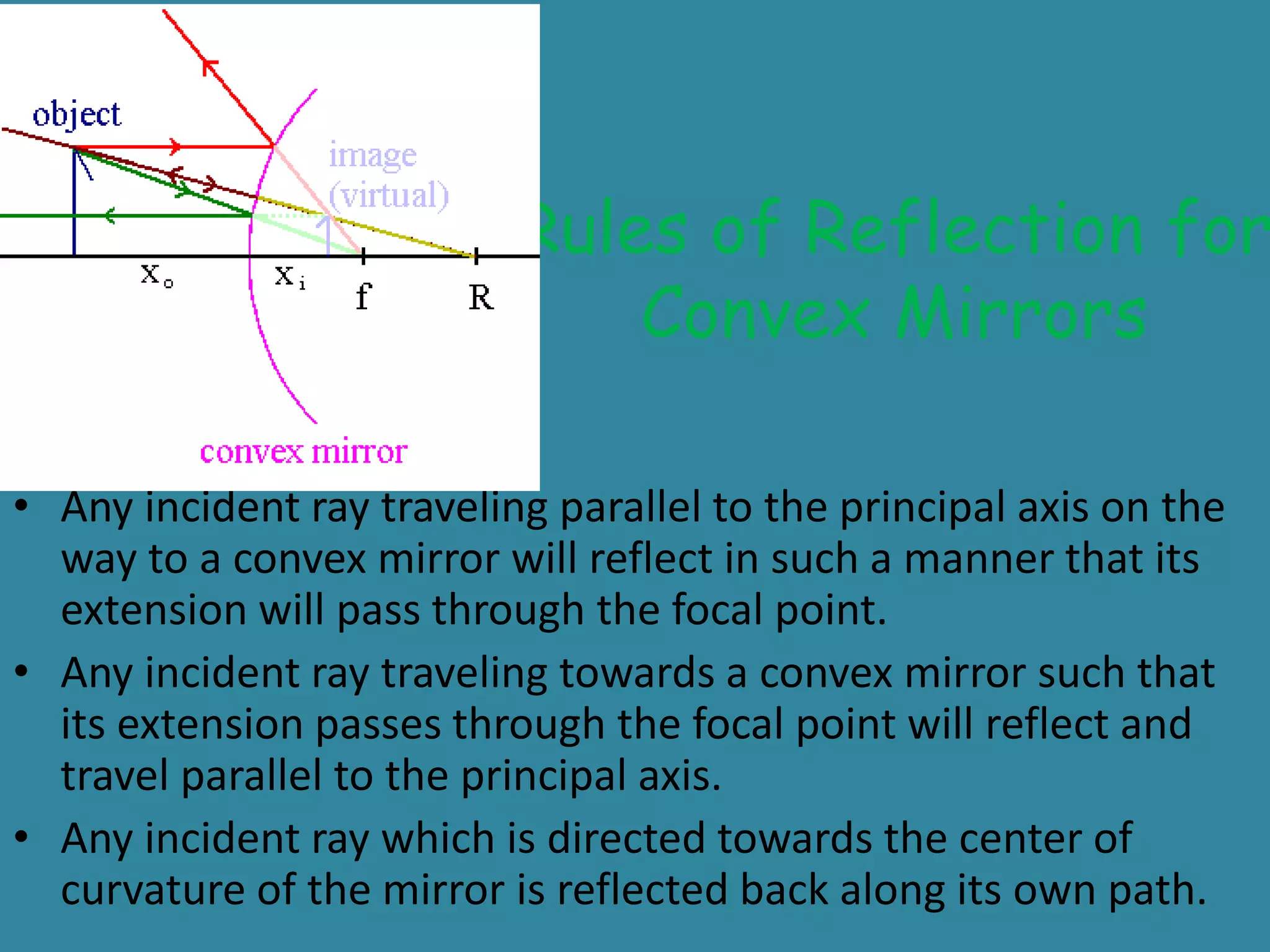
Rules of Reflection for
Convex Mirrors
• Any incident ray traveling parallel to the principal axis on the
way to a convex mirror will reflect in such a manner that its
extension will pass through the focal point.
• Any incident ray traveling towards a convex mirror such that
its extension passes through the focal point will reflect and
travel parallel to the principal axis.
• Any incident ray which is directed towards the center of
curvature of the mirror is reflected back along its own path.
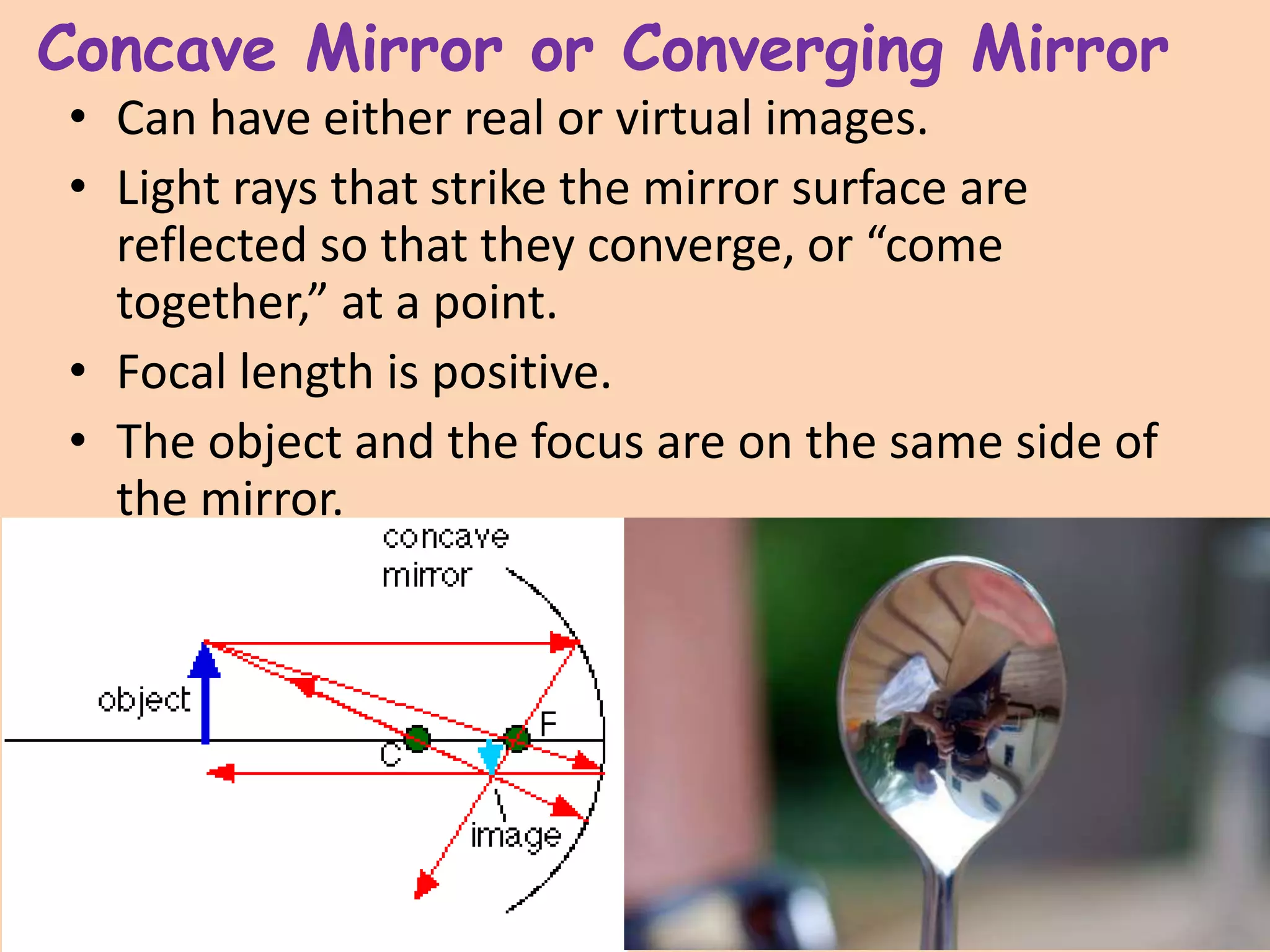
Concave Mirror or Converging Mirror
• Can have either real or virtual images.
• Light rays that strike the mirror surface are
reflected so that they converge, or “come
together,” at a point.
• Focal length is positive.
• The object and the focus are on the same side of
the mirror.
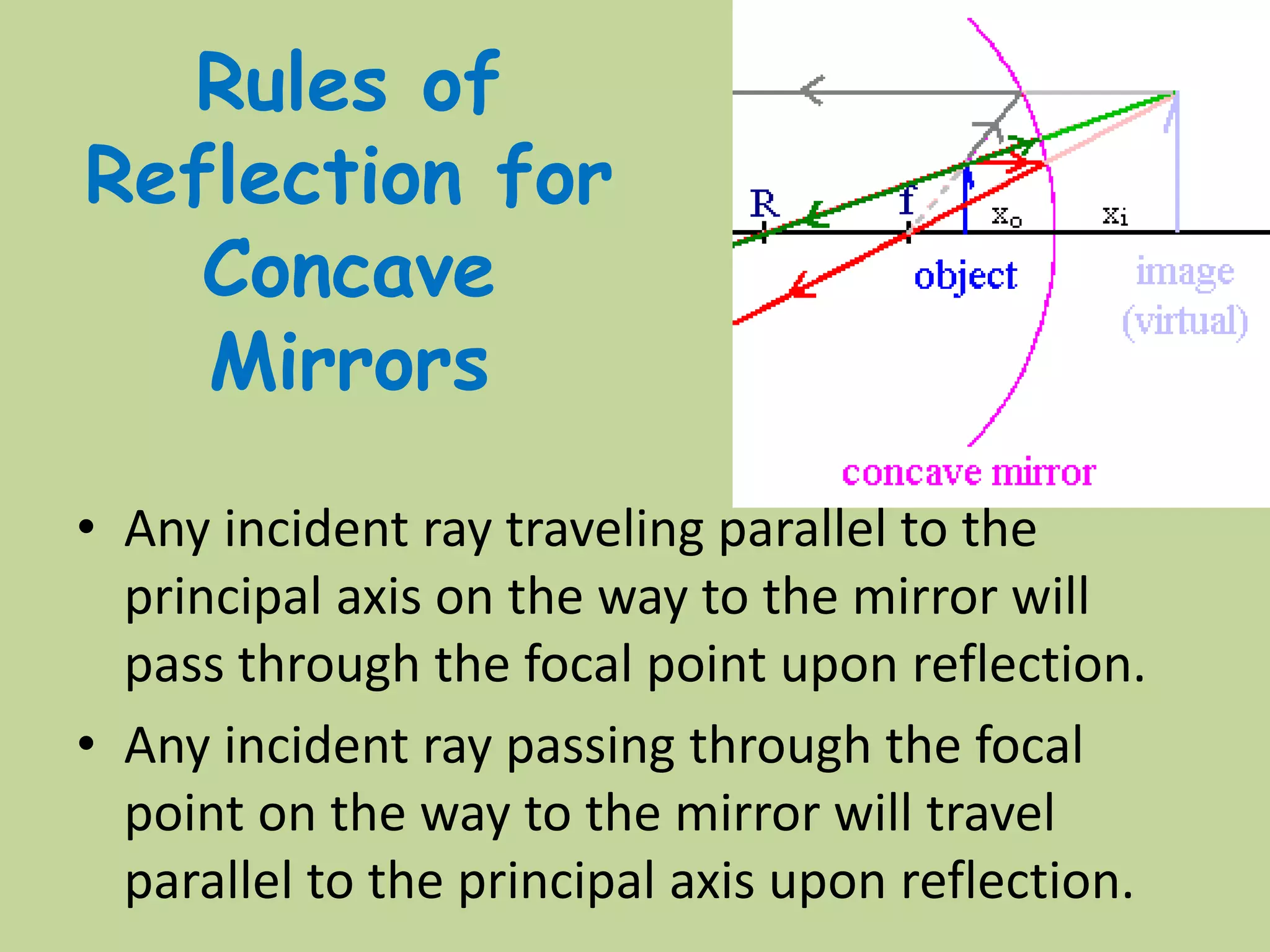
Rules of
Reflection for
Concave
Mirrors
• Any incident ray traveling parallel to the
principal axis on the way to the mirror will
pass through the focal point upon reflection.
• Any incident ray passing through the focal
point on the way to the mirror will travel
parallel to the principal axis upon reflection.
The Mirror
Equation
• 1/do+1/di=1/f
– do is the distance from
the mirror to the object
– di is the distance from the
mirror to the image
– f is the focal length of the
mirror
Magnification
• In most cases the
height of the image
differs from the
height of the object.
This means that the
mirror has done
some magnifying or
reducing.
Magnification
• M=hi/ho=-di/do
– The ratio of the image
height to the object
height, which is
closely related to the
ratio of the image
distance to the object
distance.
Magnification
• M=hi/ho=-di/do
– If magnification is 1
then the object and the
image are the same
size. If m>1 then the
image is larger. If m<1
then the image is
smaller. If m>0 then the
image is upright and if
m<0 then the image is
inverted.
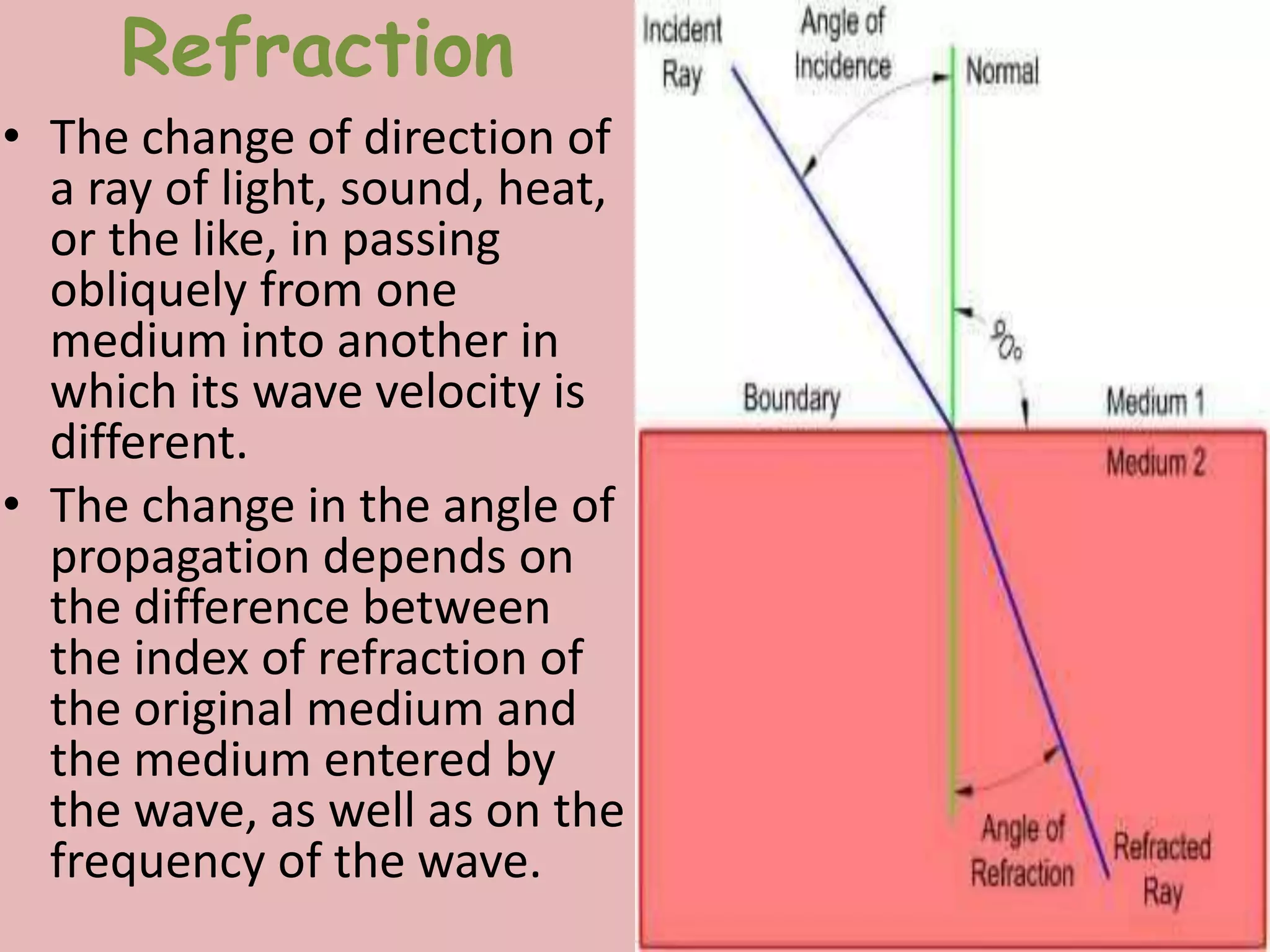
Refraction
• The change of direction of
a ray of light, sound, heat,
or the like, in passing
obliquely from one
medium into another in
which its wave velocity is
different.
• The change in the angle of
propagation depends on
the difference between
the index of refraction of
the original medium and
the medium entered by
the wave, as well as on the
frequency of the wave.
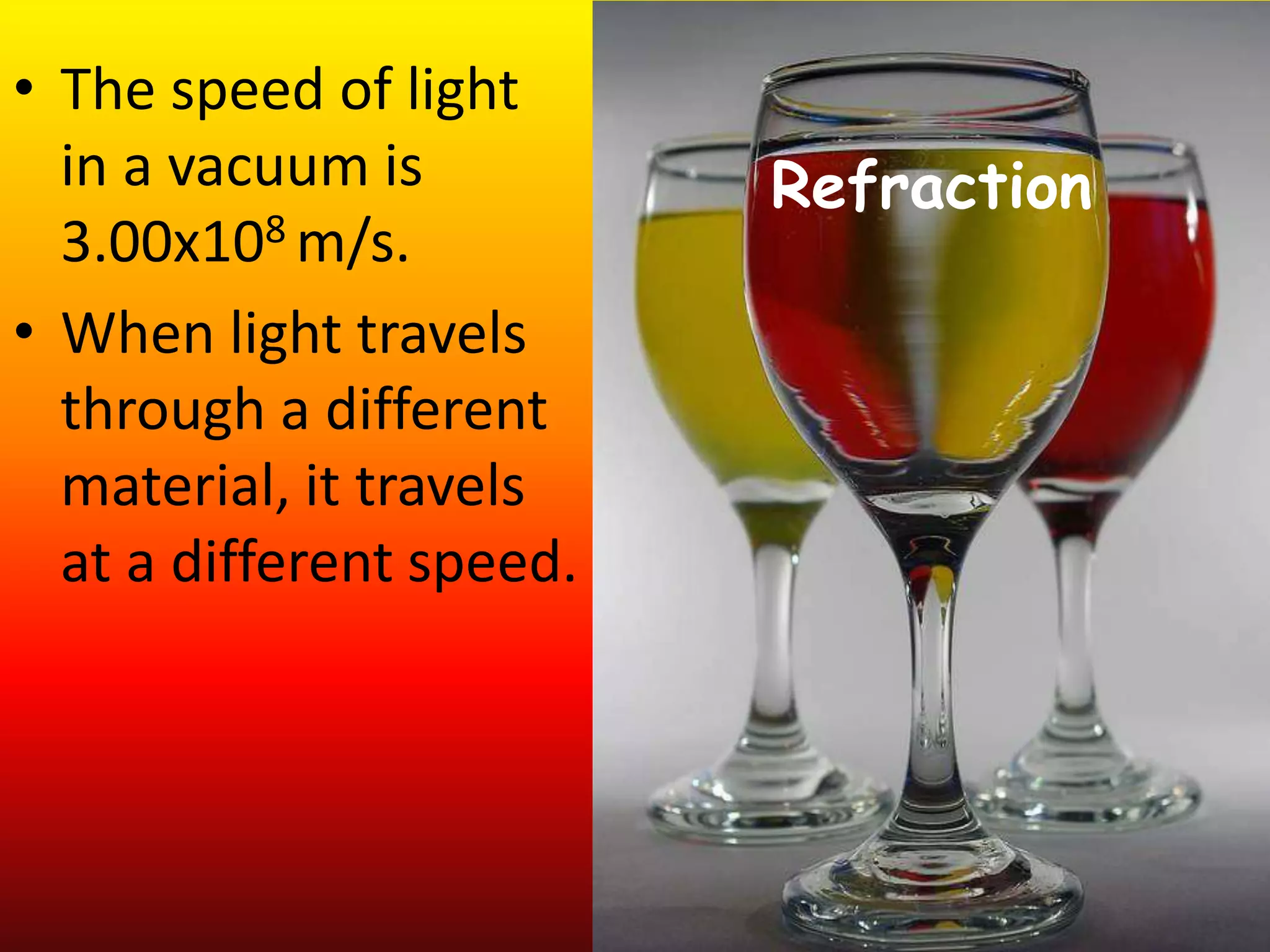
Refraction
• The speed of light
in a vacuum is
3.00x10⁸ m/s.
• When light travels
through a different
material, it travels
at a different speed.
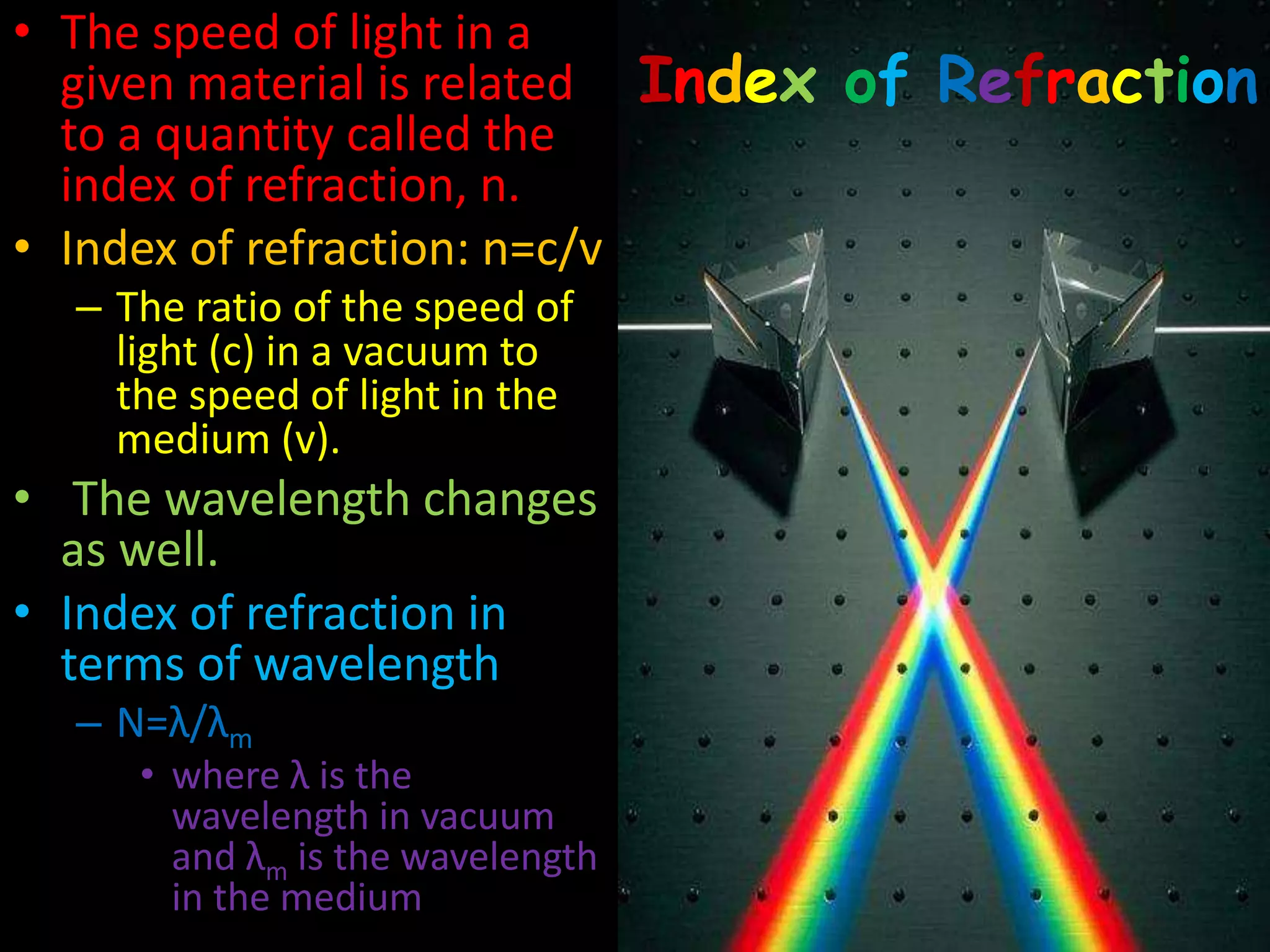
Index of Refraction
• The speed of light in a
given material is related
to a quantity called the
index of refraction, n.
• Index of refraction: n=c/v
– The ratio of the speed of
light (c) in a vacuum to
the speed of light in the
medium (v).
• The wavelength changes
as well.
• Index of refraction in
terms of wavelength
– N=λ/λm
• where λ is the
wavelength in vacuum
and λm is the wavelength
in the medium
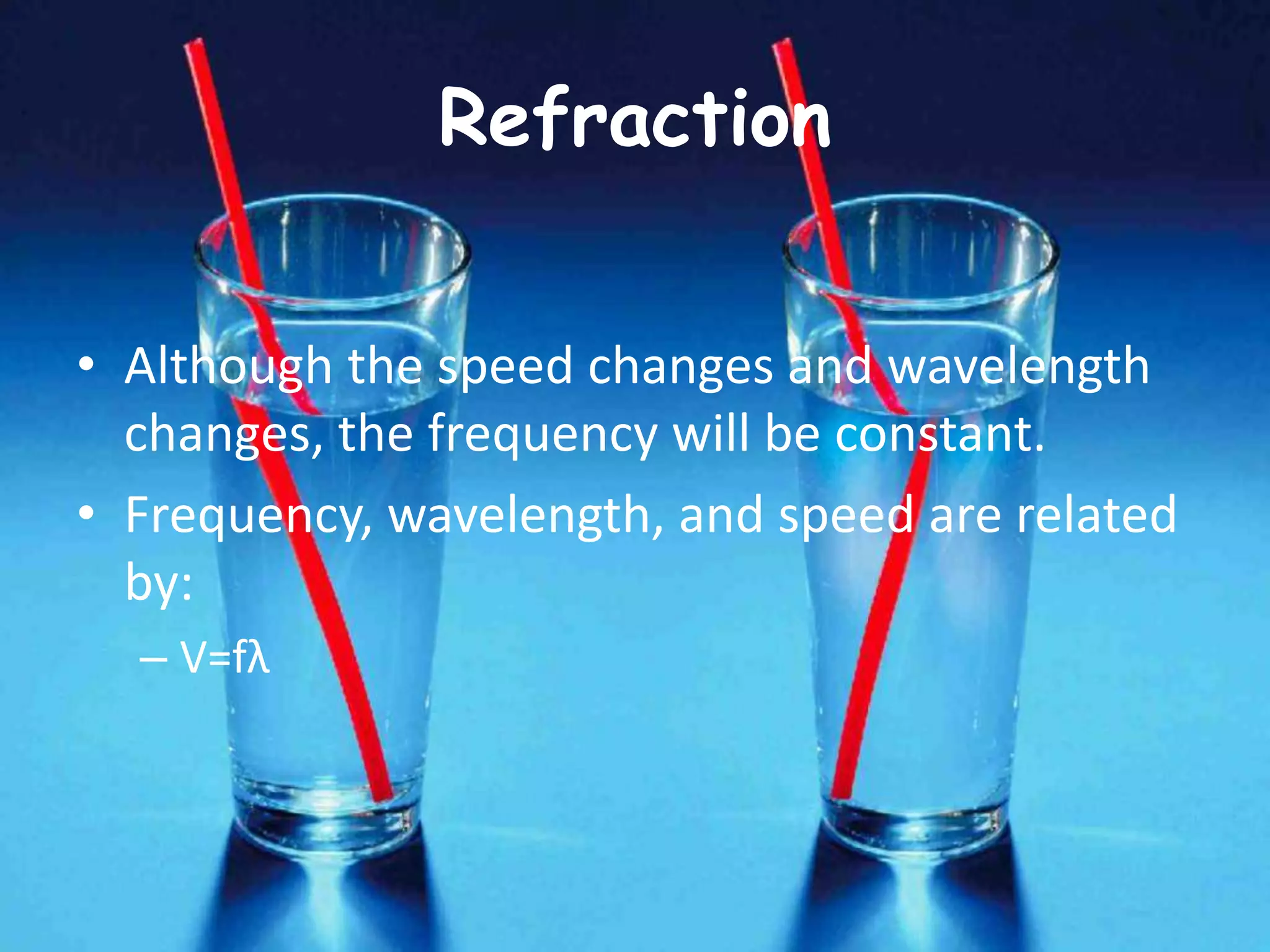
Refraction
• Although the speed changes and wavelength
changes, the frequency will be constant.
• Frequency, wavelength, and speed are related
by:
– V=fλ
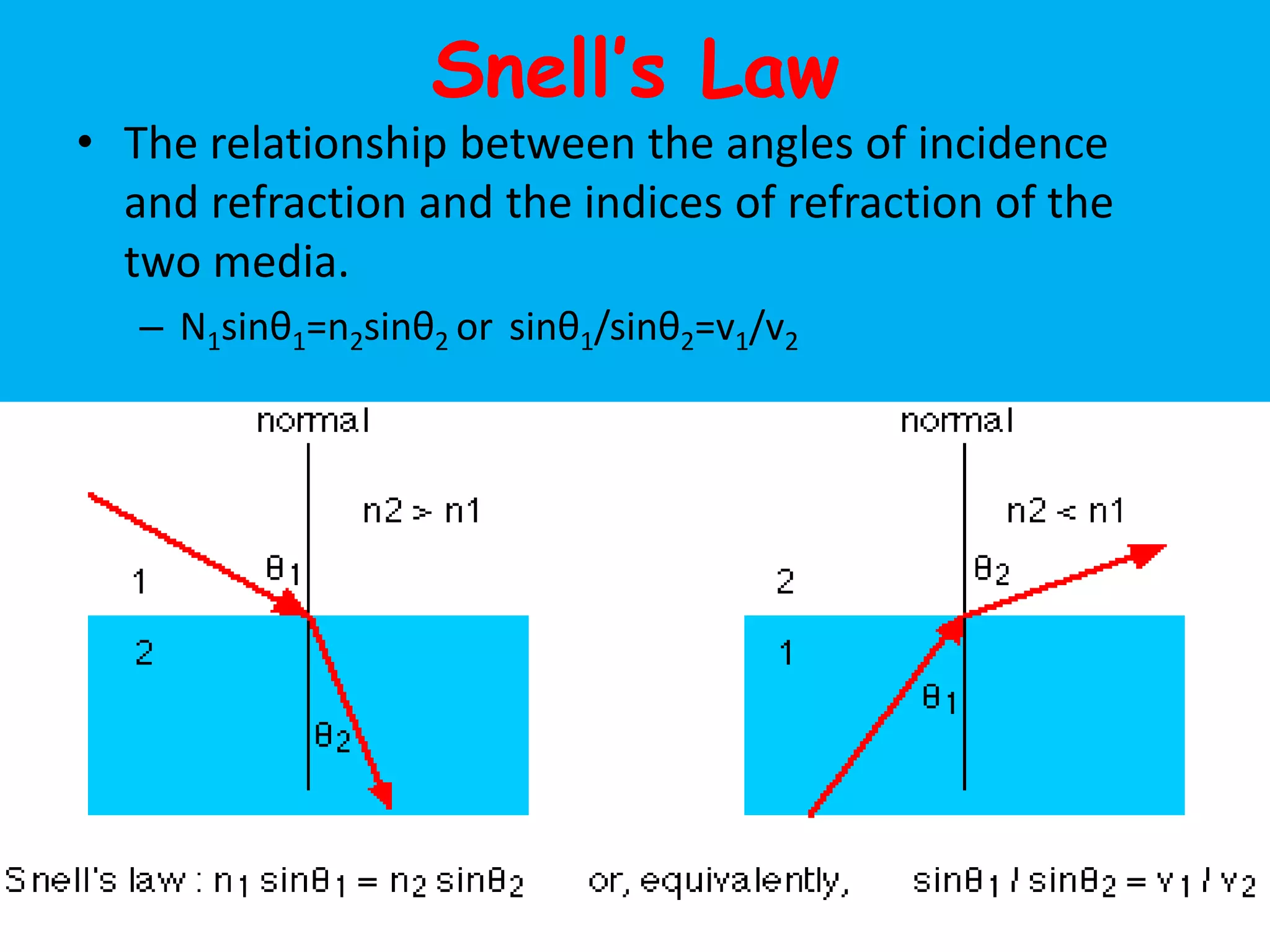
Snell’s Law
• The relationship between the angles of incidence
and refraction and the indices of refraction of the
two media.
– N1sinθ1=n2sinθ2 or sinθ1/sinθ2=v1/v2
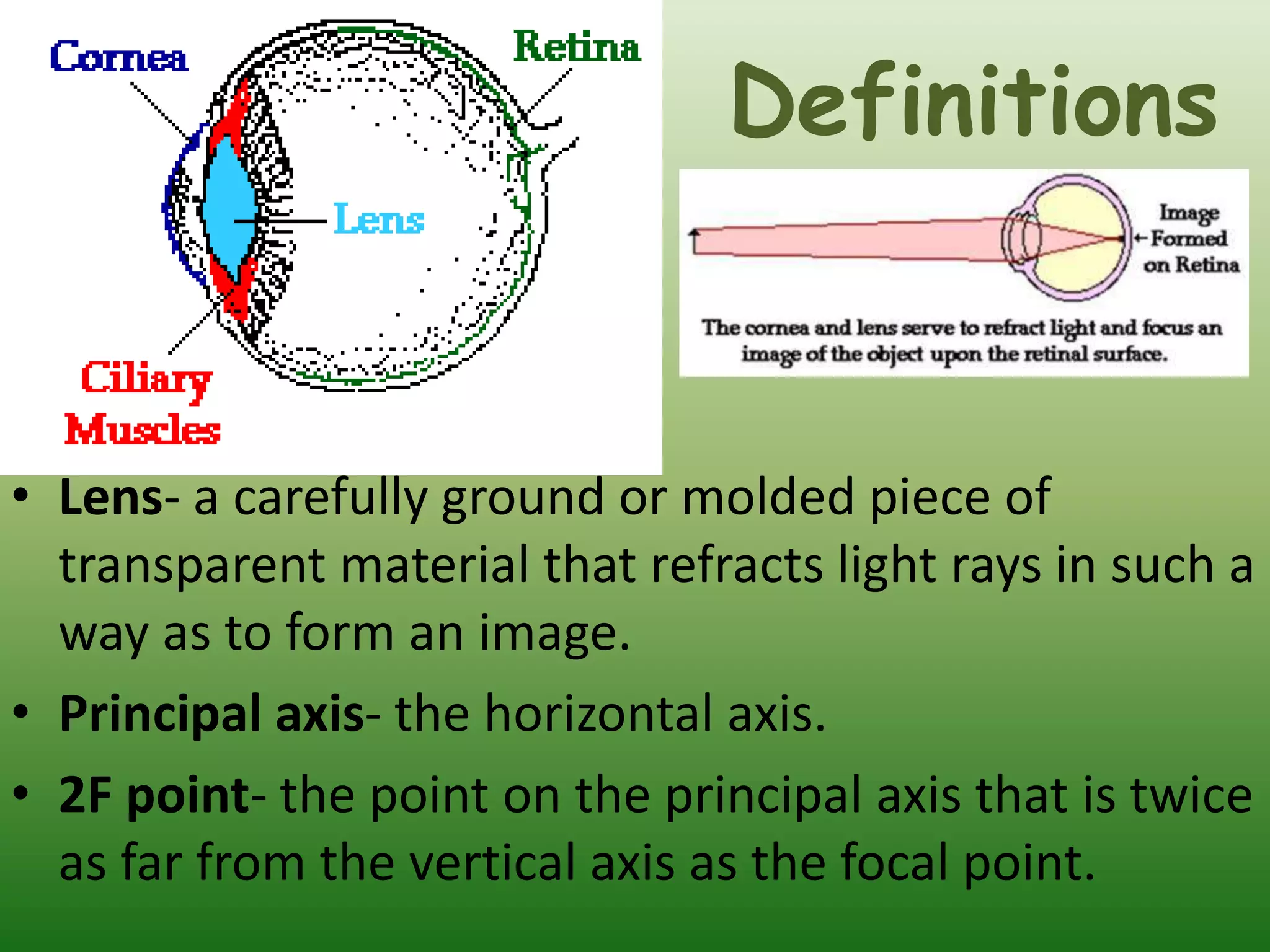
Definitions
• Lens- a carefully ground or molded piece of
transparent material that refracts light rays in such a
way as to form an image.
• Principal axis- the horizontal axis.
• 2F point- the point on the principal axis that is twice
as far from the vertical axis as the focal point.
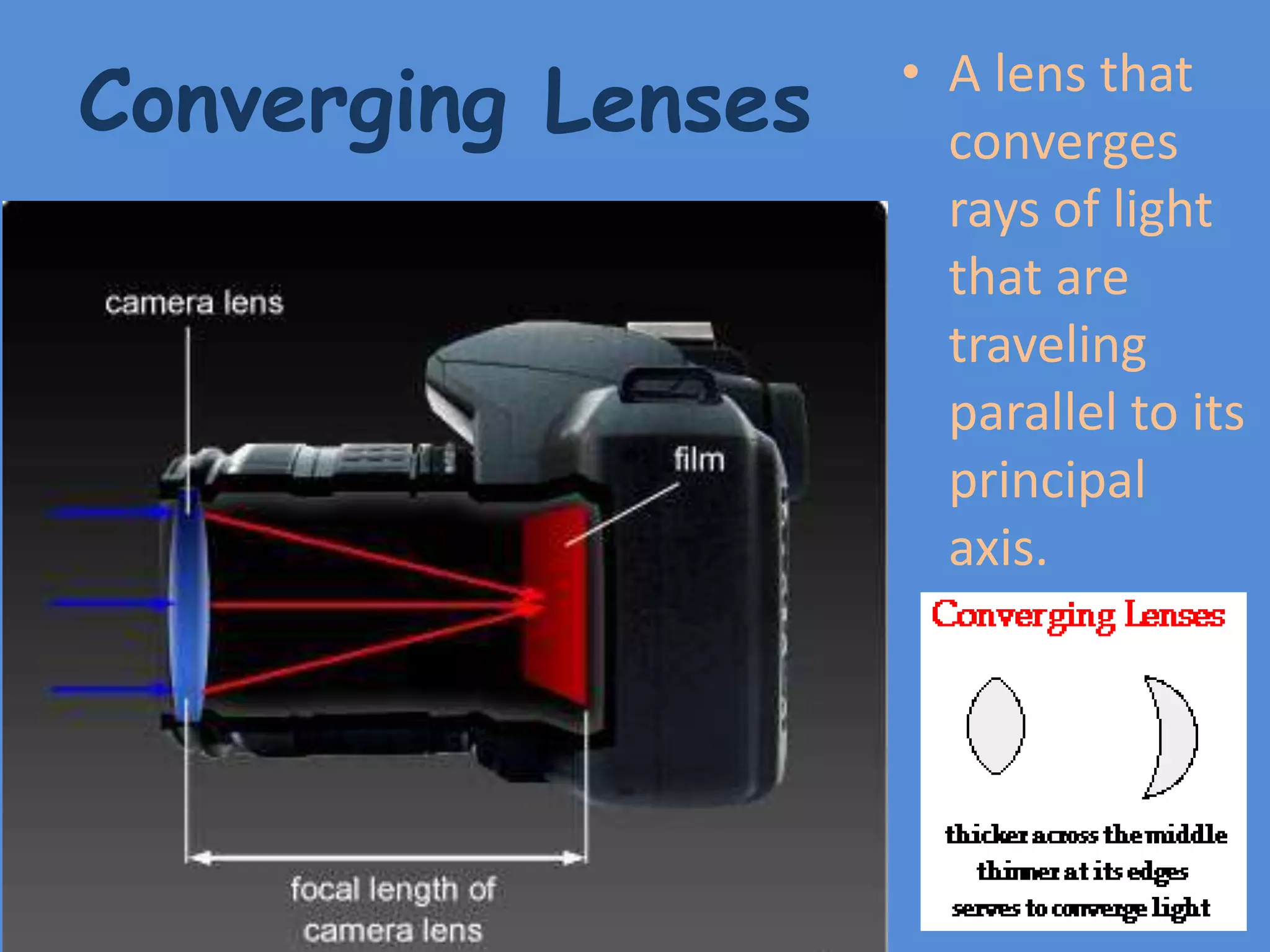
Converging Lenses • A lens that
converges
rays of light
that are
traveling
parallel to its
principal
axis.
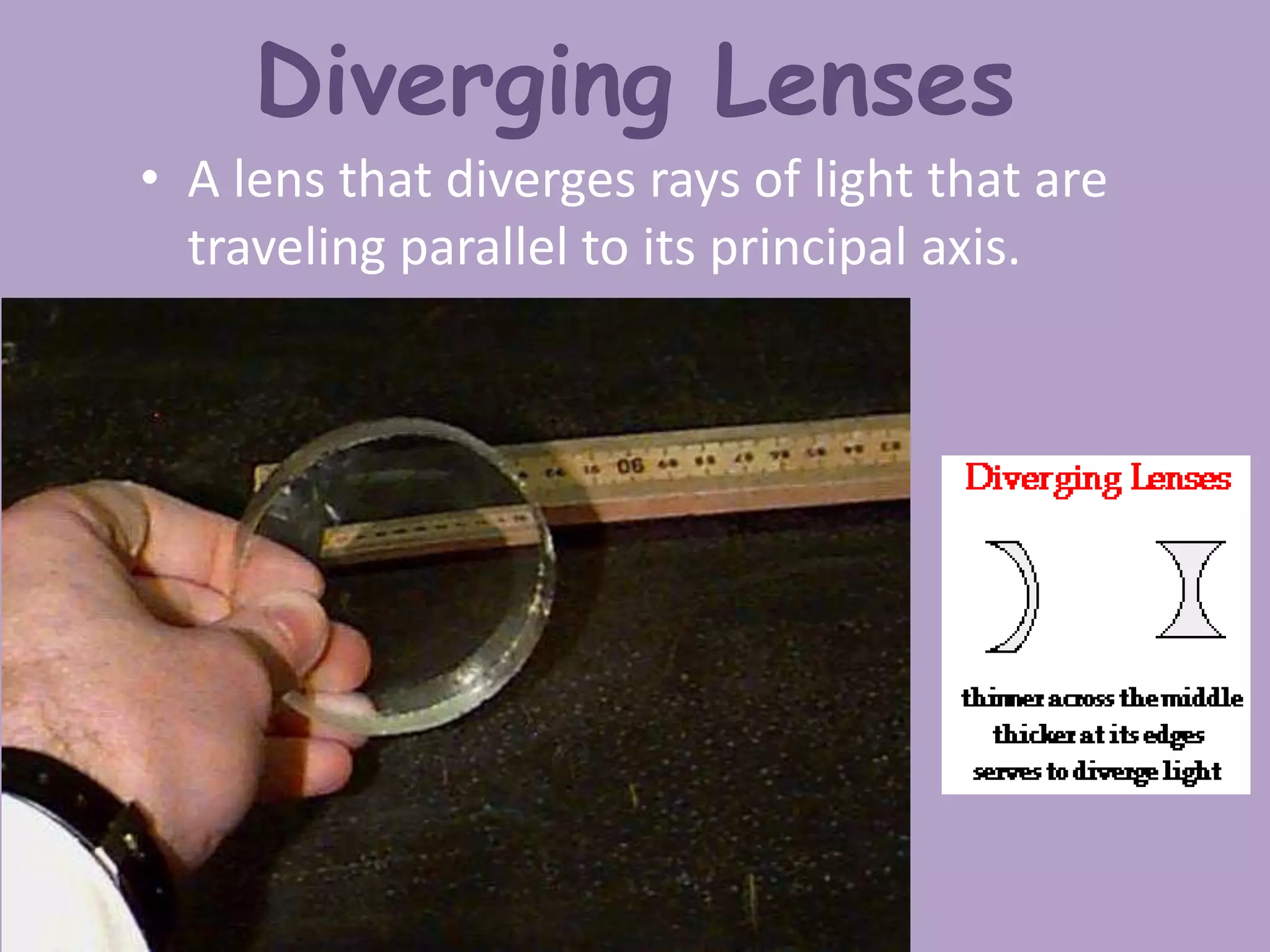
Diverging Lenses
• A lens that diverges rays of light that are
traveling parallel to its principal axis.
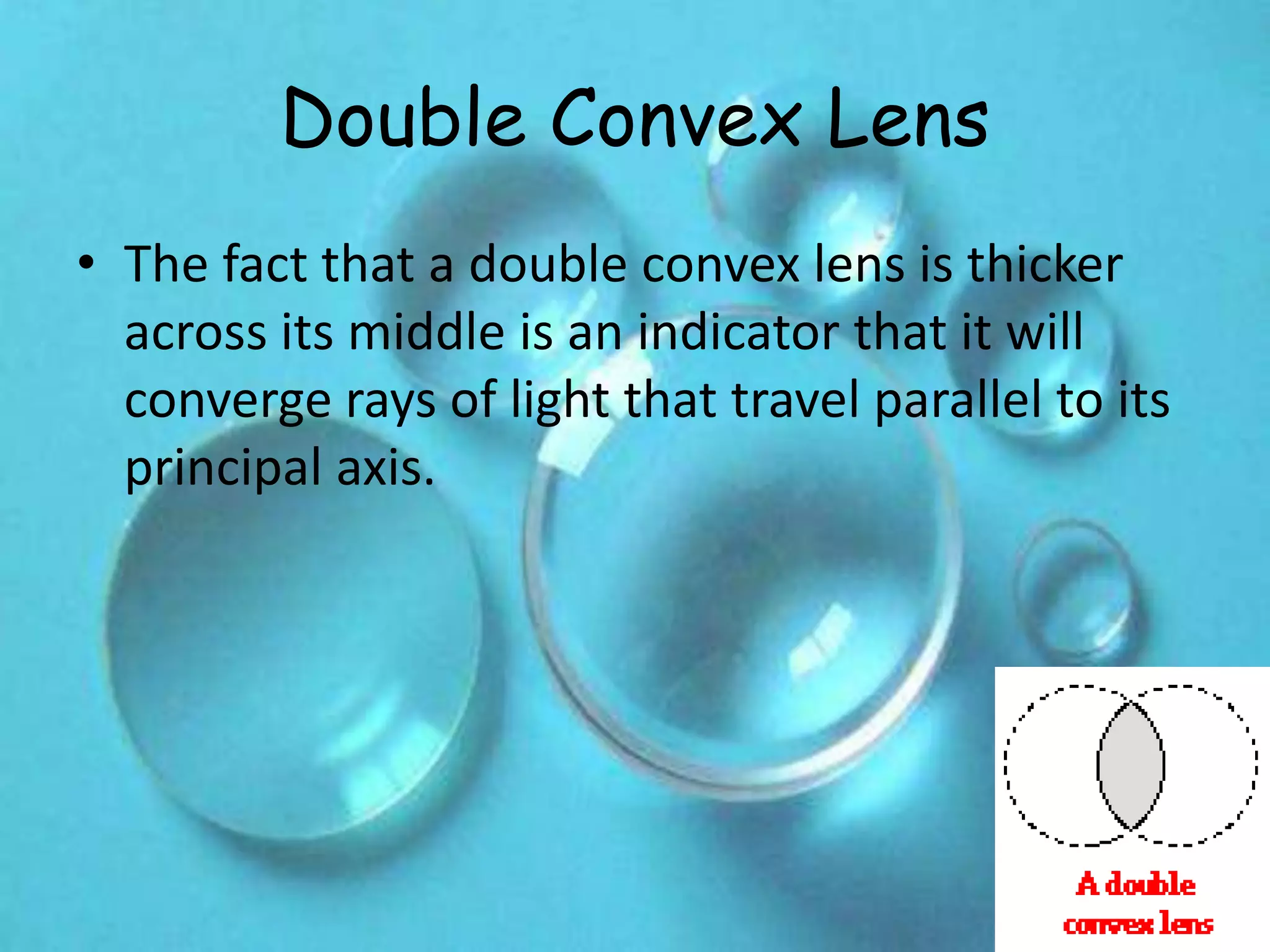
Double Convex Lens
• The fact that a double convex lens is thicker
across its middle is an indicator that it will
converge rays of light that travel parallel to its
principal axis.
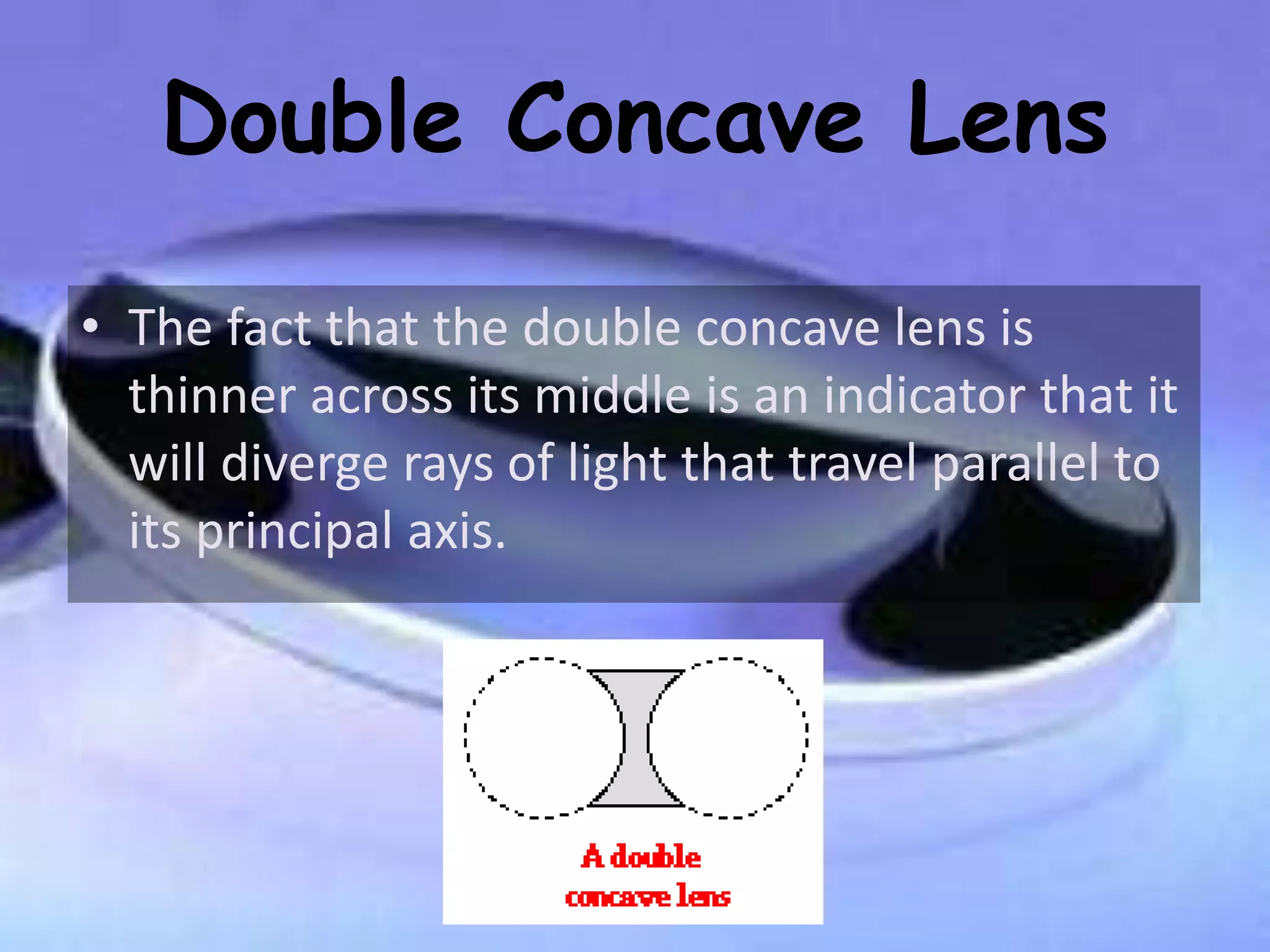
Double Concave Lens
• The fact that the double concave lens is
thinner across its middle is an indicator that it
will diverge rays of light that travel parallel to
its principal axis.
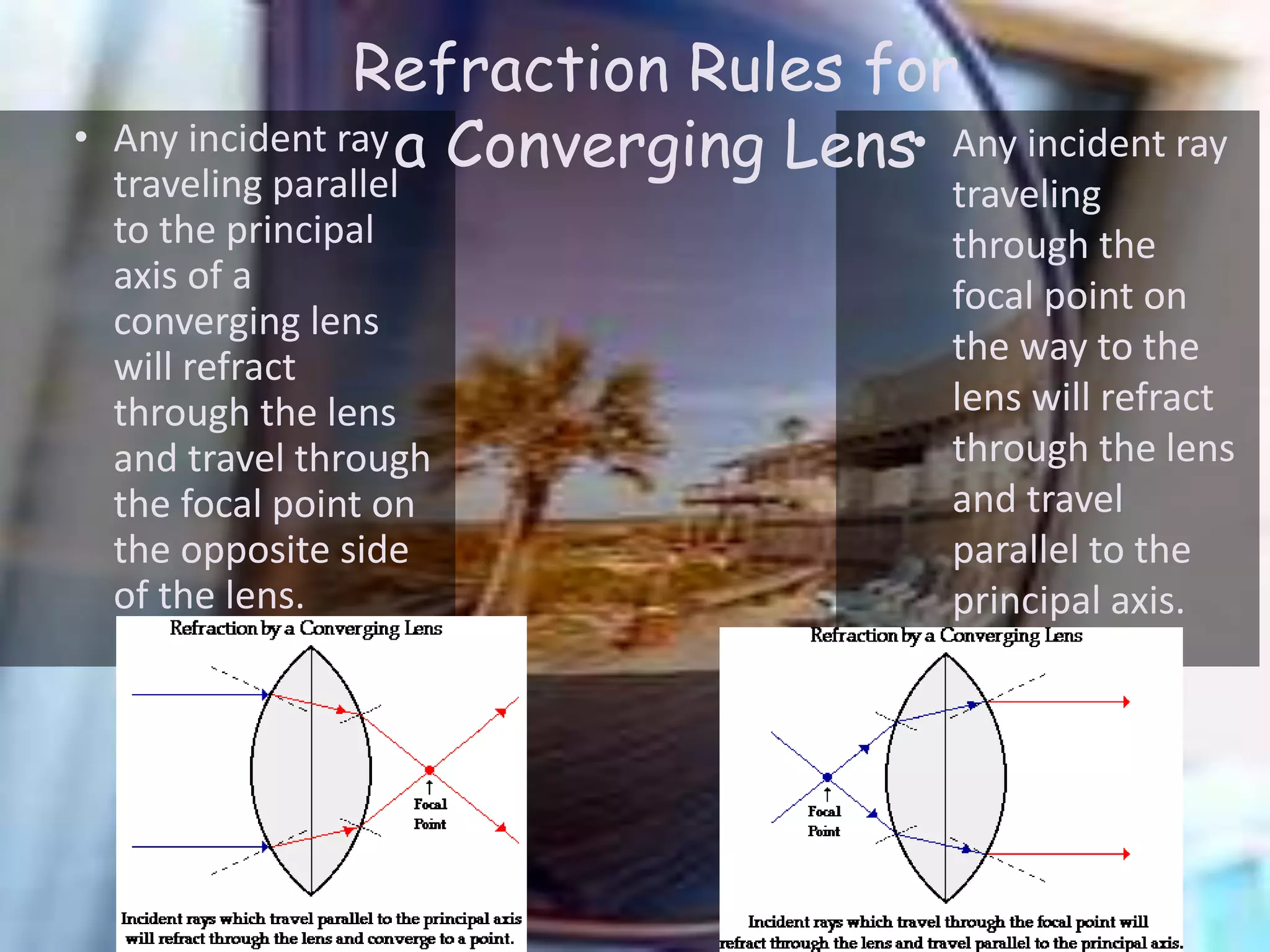
• Any incident ray
traveling parallel
to the principal
axis of a
converging lens
will refract
through the lens
and travel through
the focal point on
the opposite side
of the lens.
• Any incident ray
traveling
through the
focal point on
the way to the
lens will refract
through the lens
and travel
parallel to the
principal axis.
Refraction Rules for
a Converging Lens
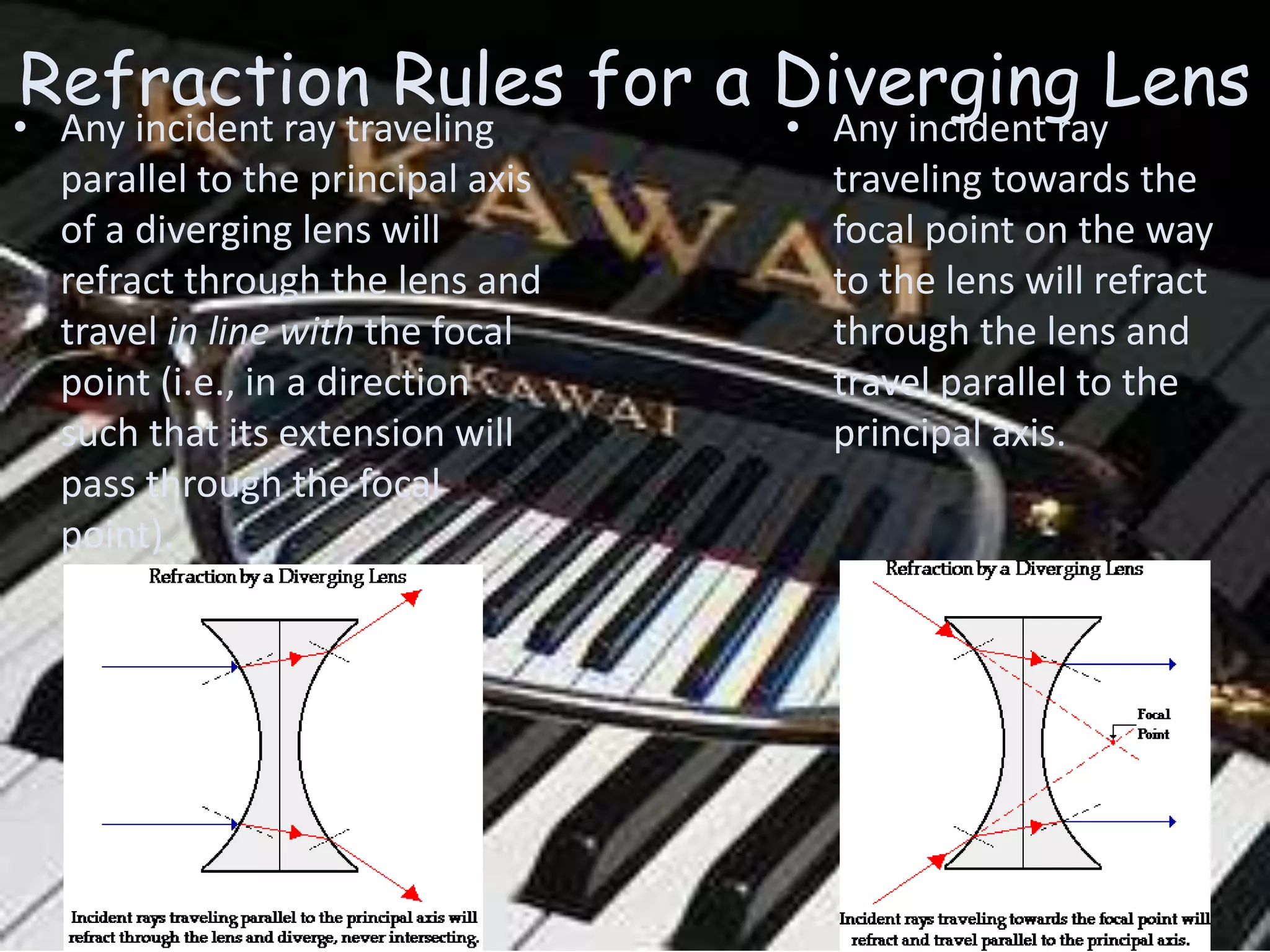
Refraction Rules for a Diverging Lens
• Any incident ray
traveling towards the
focal point on the way
to the lens will refract
through the lens and
travel parallel to the
principal axis.
• Any incident ray traveling
parallel to the principal axis
of a diverging lens will
refract through the lens and
travel in line with the focal
point (i.e., in a direction
such that its extension will
pass through the focal
point).
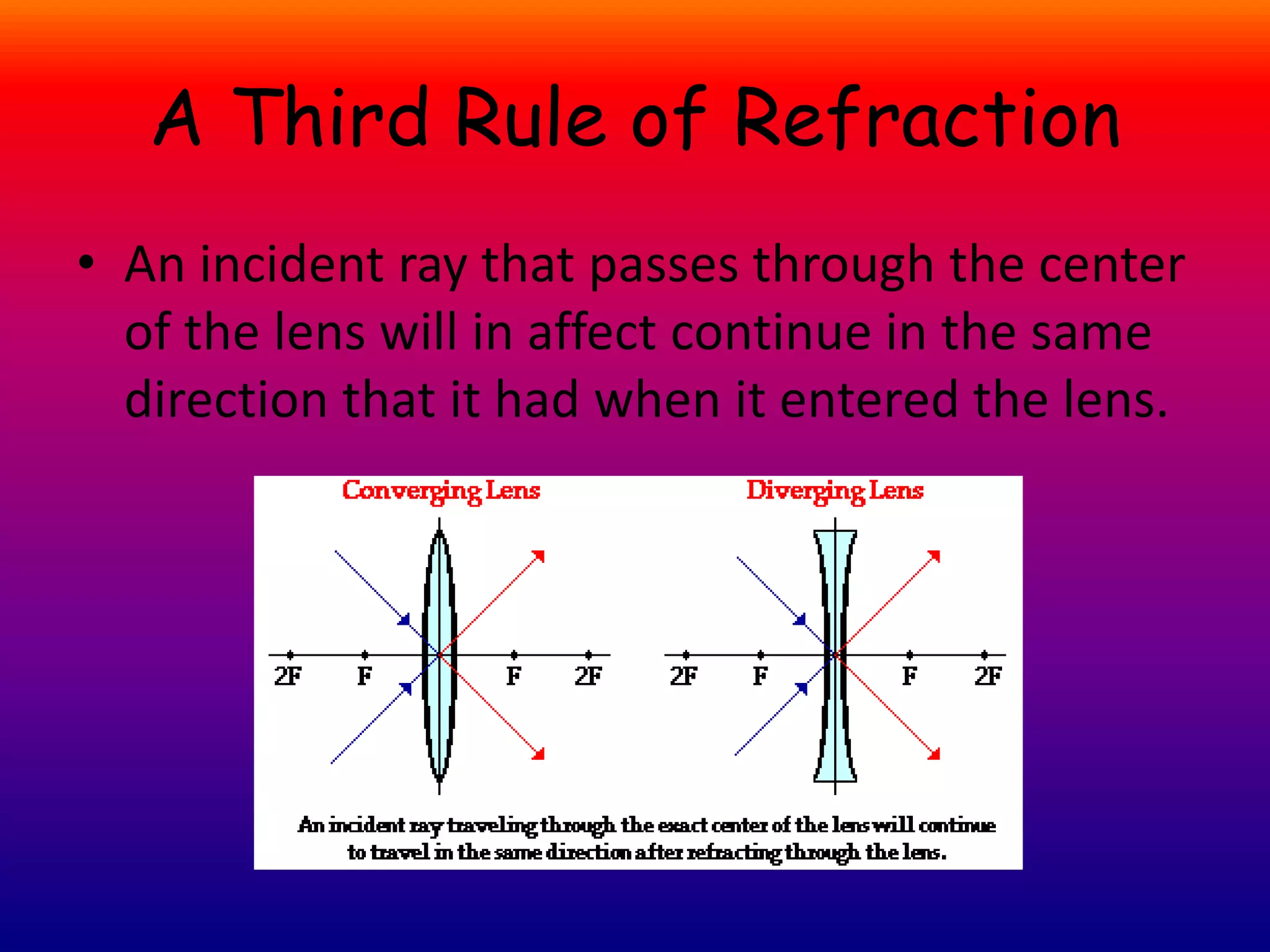
A Third Rule of Refraction
• An incident ray that passes through the center
of the lens will in affect continue in the same
direction that it had when it entered the lens.
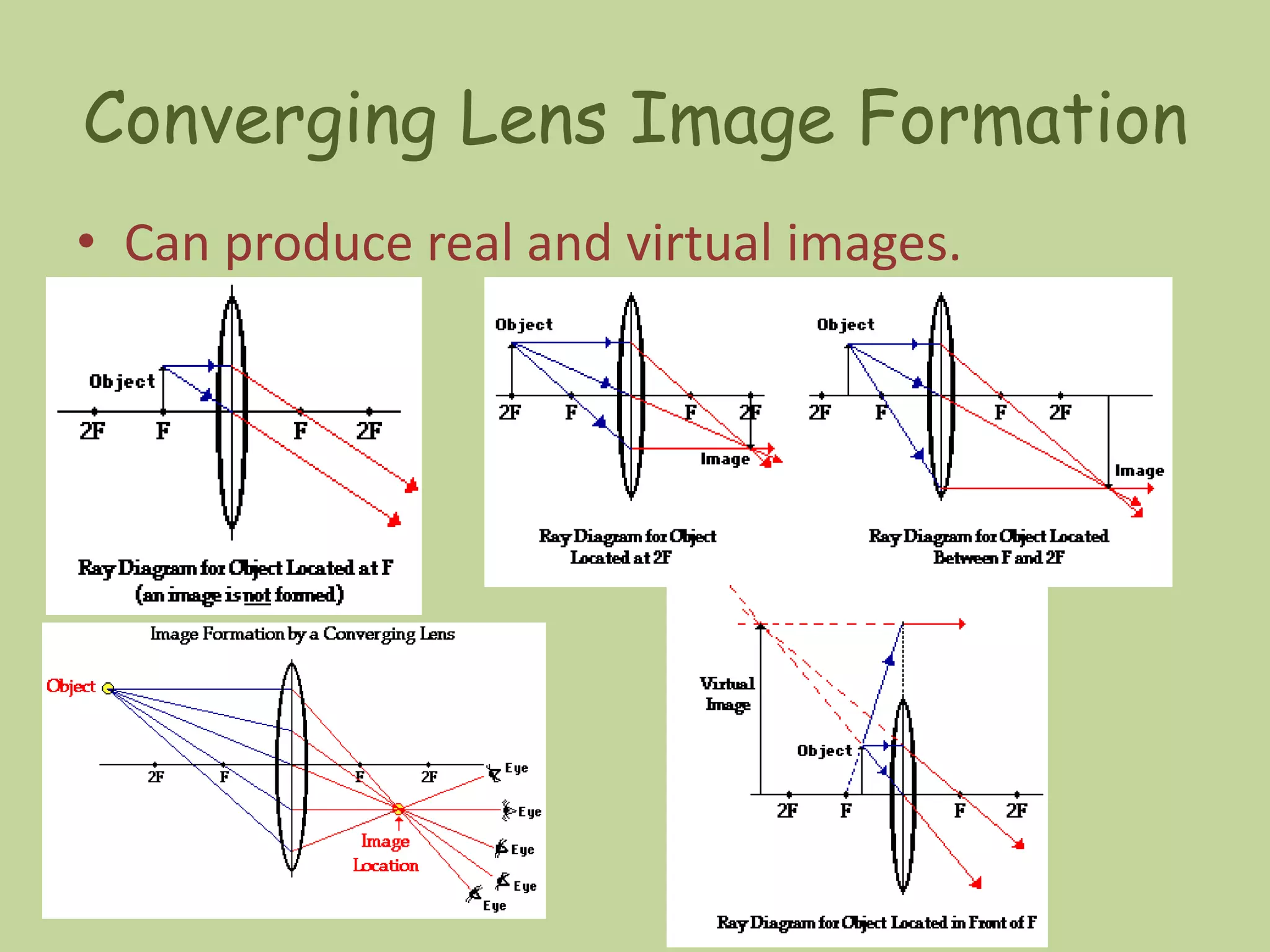
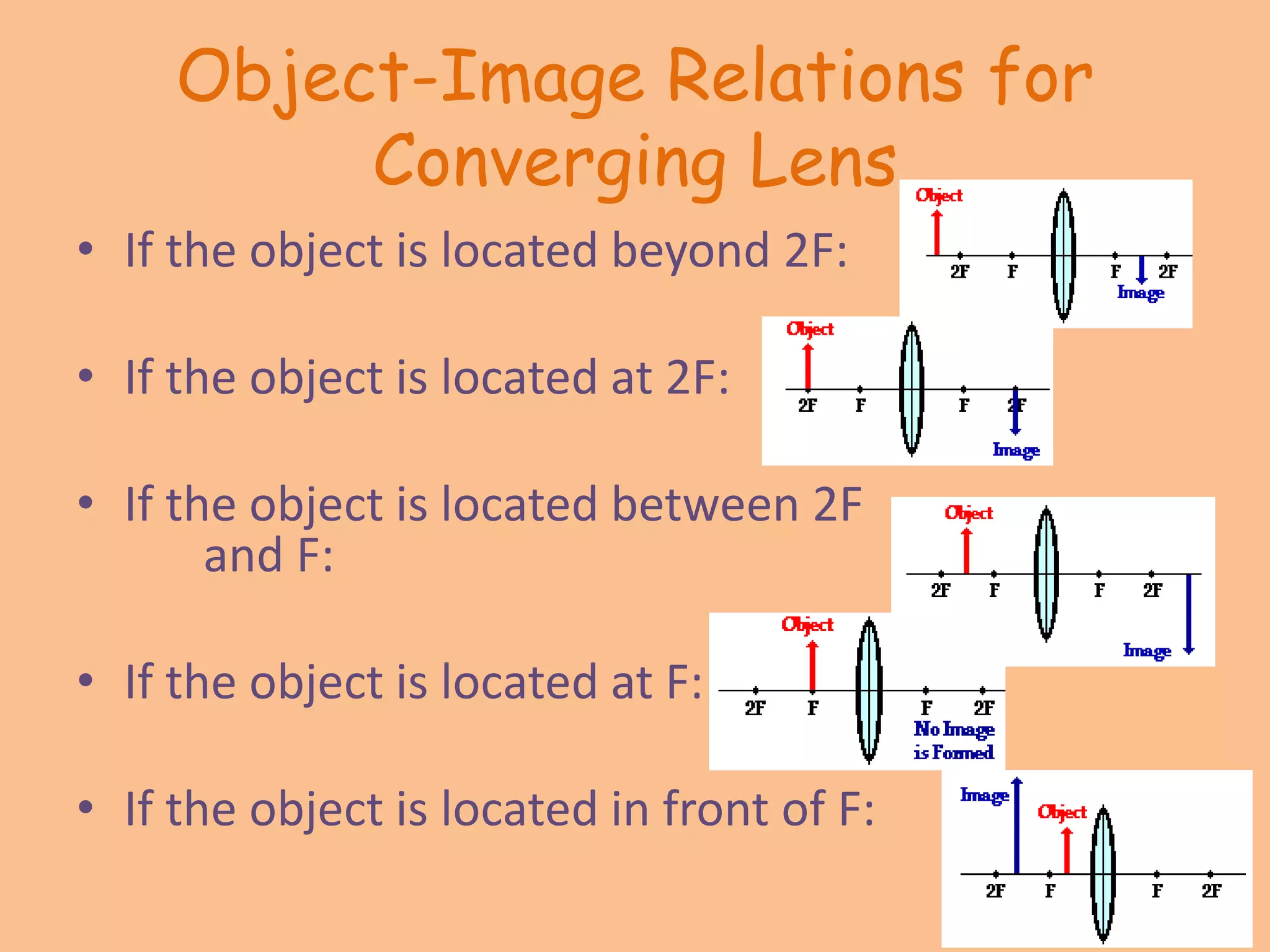
Converging Lens Image Formation
• Can produce real and virtual images.
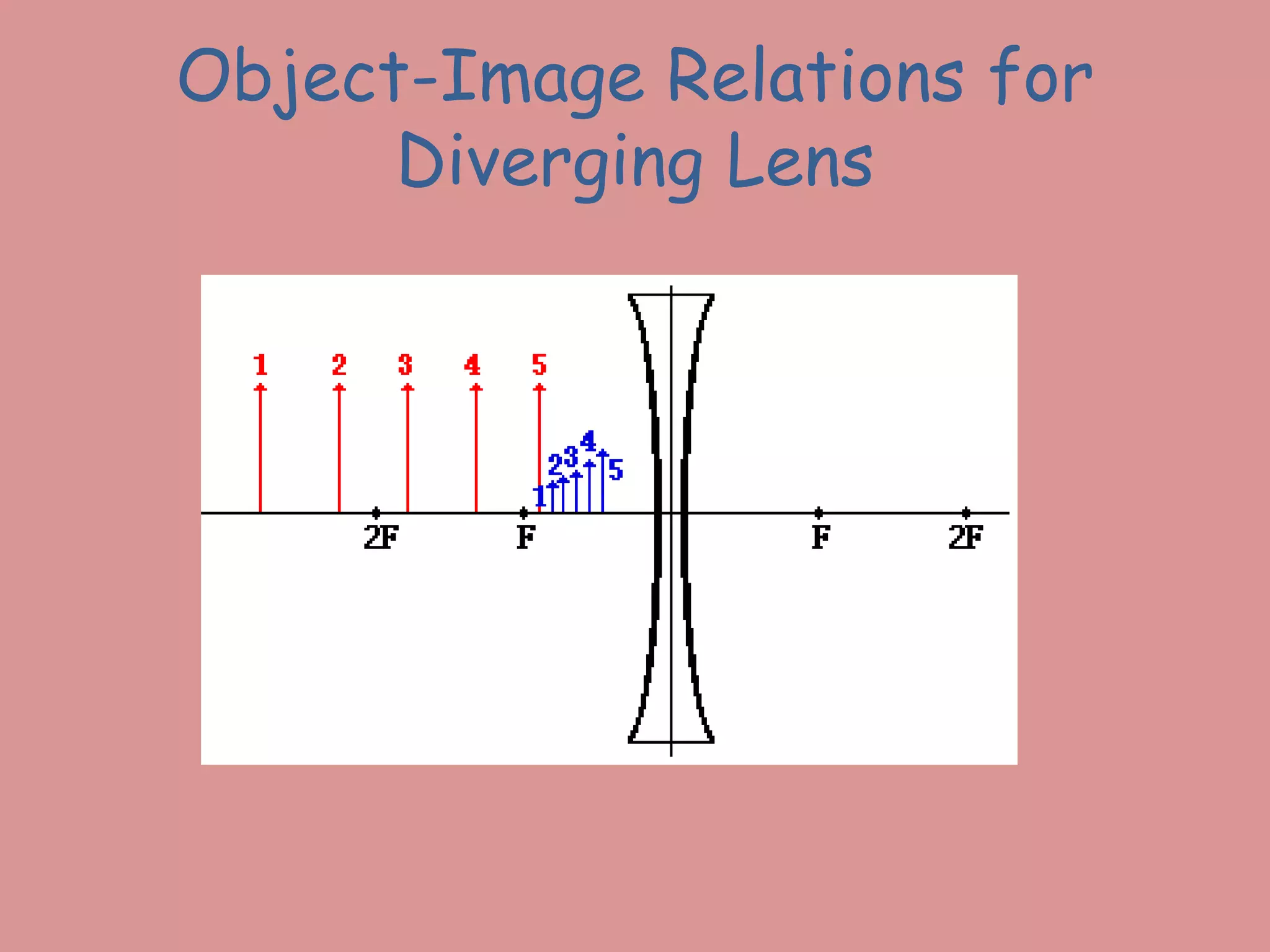
Object-Image Relations for
Diverging Lens
Object-Image Relations for
Converging Lens
• If the object is located beyond 2F:
• If the object is located at 2F:
• If the object is located between 2F
and F:
• If the object is located at F:
• If the object is located in front of F:
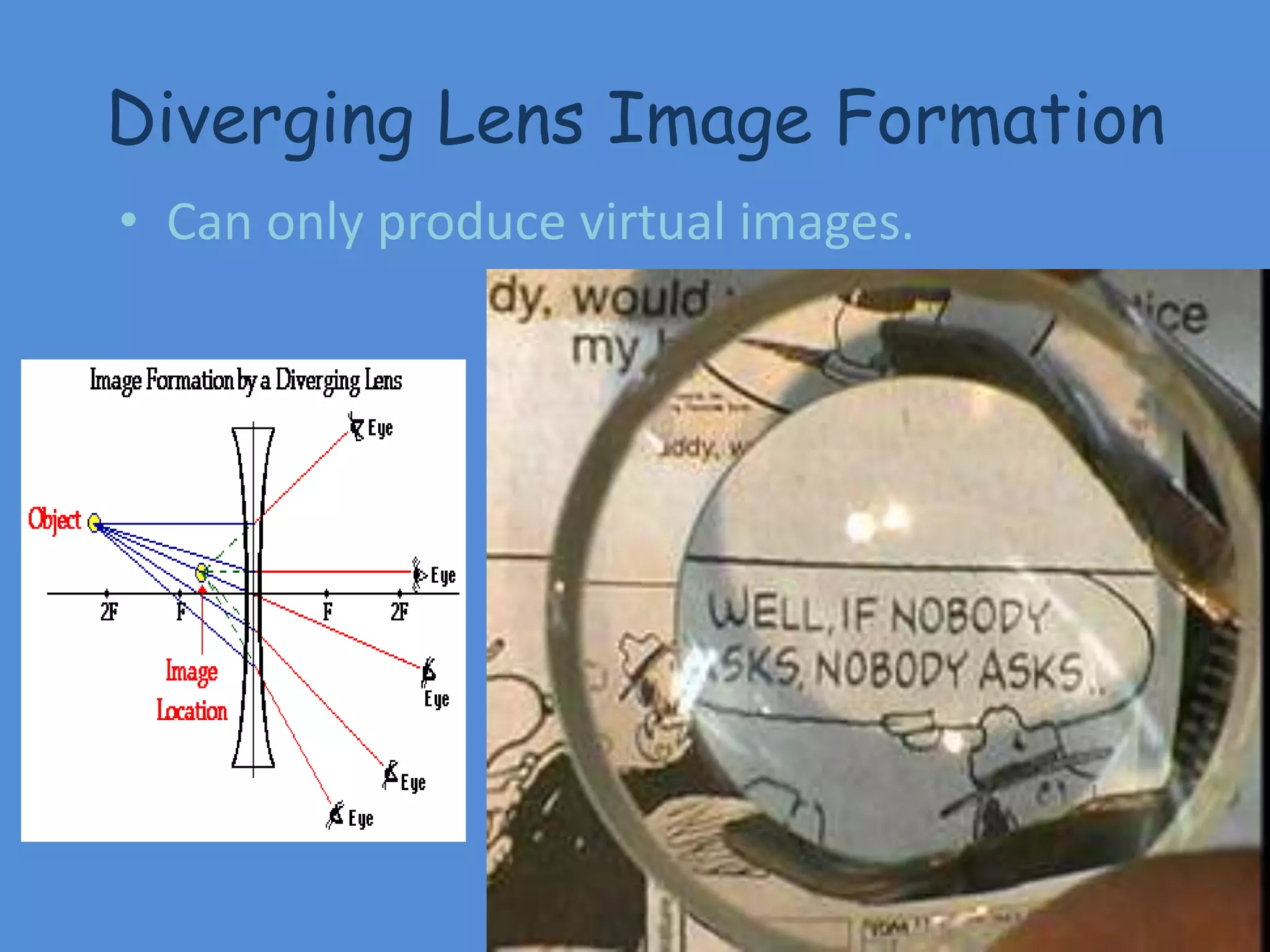
Diverging Lens Image Formation
• Can only produce virtual images.
Thanks to:
• http://www.bing.com/images/search?q=reflection+and+refraction+of+light&view=deta
il&id=E4D2AA8D76FC3701A83E162D491416A100BD1B55&first=0&FORM=IDFRIR
• http://micro.magnet.fsu.edu/primer/lightandcolor/reflectionintro.html
• http://uk.ask.com/wiki/Surface_normal
• http://dictionary.reference.com/browse/reflection
• http://physics.bu.edu/~duffy/PY106/Reflection.html
• http://micro.magnet.fsu.edu/primer/lightandcolor/reflectionintro.htmlhttp://www.pa.
msu.edu/courses/2000spring/PHY232/lectures/mirrors/focal.html
• http://www.micro.magnet.fsu.edu/primer/lightandcolor/mirrorsintro.html
• http://gbhsweb.glenbrook225.org/gbs/science/phys/Class/refln/u13l4a.html
• http://electron9.phys.utk.edu/optics421/modules/m1/mirrors.htm
• http://peggyschweiger.tripod.com/mirrors.html
• http://physics.bu.edu/~duffy/PY106/Reflection.html
• http://www.physicsclassroom.com/Class/refrn/u14l2b.cfm
• http://www.physicsclassroom.com/class/refrn/U14l5b.cfm
• http://learn.uci.edu/oo/getOCWPage.php?course=OC0811004&lesson=005&topic=009&page=36

Reflection-and-Refraction-of-light.ppt

  • 2.
    Definitions • Incident wave-theincoming light wave. • Reflected wave-the wave that is bounced away from the surface. • Refracted-light waves are bent. • Total internal reflection- an optical phenomenon that occurs when a ray of light strikes a medium boundary at an angle larger than a particular critical angle with respect to the normal to the surface. • Critical angle- the angle of incidence above which total internal reflection occurs. • Normal- to a flat surface is a vector that is perpendicular to that surface. To a non-flat surface at a point P on the surface is a vector perpendicular to the tangent plane to that surface at P.
  • 3.
    Reflection • The productionof an image by or as if by a mirror. • Something, such as light, radiant heat, sound, or an image, that is reflected. • The change in direction of a wave, such as a light or sound wave, away from a boundary the wave encounters. Reflected waves remain in their original medium rather than entering the medium they encounter.
  • 4.
    Reflection • According tothe law of reflection, the angle of reflection of a reflected wave is equal to its angle of incidence.
  • 5.
    Diffuse Reflection • Lightis reflected in all directions. • This is caused by a surface that isn’t smooth.
  • 6.
    Specular reflection • Allthe light travelling in one direction and reflecting from the mirror is reflected in one direction. • This occurs on a smooth surface.
  • 7.
    Definitions • Focal point-the single point where light from the object hits or is focused. Located half the distance from the mirror to the center of curvature. • Focal length- the distance from the reflecting surface to the focal point. • Real- formed when the incident and reflected rays intersect in front of the mirror. • Virtual- does not actually exist (no light is produced). Occur at points where extensions from incident and reflected rays converge behind the mirror. • Center of Curvature- the center of that original sphere. • Radius of Curvature- the radius of the sphere. • Vertex- the point where the mirror crosses the principal axis. • Principal axis- a line drawn through the vertex, focus and center of curvature.
  • 8.
  • 9.
    Plane Mirrors • Amirror with a flat surface • Properties of an image in a plane mirror – The image is upright – The image is the same size as the object – The image is the same distance from the mirror as the object appears to be – The image is virtual, not real, because the light rays do not actually pass through the image.
  • 10.
    Spherical Mirrors • Apiece cut out of a reflective sphere. • Focal length of a spherical mirror: f=R/2 • Either concave or convex.
  • 11.
    Convex Mirrors orDiverging Mirror • Image is virtual and upright. • Used for security in stores and on the passenger side of many cars. • Light rays that strike the mirror surface are reflected so that they diverge, or “go apart,” and they never come to a point. • The focal length is negative. • The object and focus are on opposite sides of the mirror. • All images are smaller than the object.
  • 12.
    Rules of Reflectionfor Convex Mirrors • Any incident ray traveling parallel to the principal axis on the way to a convex mirror will reflect in such a manner that its extension will pass through the focal point. • Any incident ray traveling towards a convex mirror such that its extension passes through the focal point will reflect and travel parallel to the principal axis. • Any incident ray which is directed towards the center of curvature of the mirror is reflected back along its own path.
  • 13.
    Concave Mirror orConverging Mirror • Can have either real or virtual images. • Light rays that strike the mirror surface are reflected so that they converge, or “come together,” at a point. • Focal length is positive. • The object and the focus are on the same side of the mirror.
  • 14.
    Rules of Reflection for Concave Mirrors •Any incident ray traveling parallel to the principal axis on the way to the mirror will pass through the focal point upon reflection. • Any incident ray passing through the focal point on the way to the mirror will travel parallel to the principal axis upon reflection.
  • 15.
    The Mirror Equation • 1/do+1/di=1/f –do is the distance from the mirror to the object – di is the distance from the mirror to the image – f is the focal length of the mirror
  • 16.
    Magnification • In mostcases the height of the image differs from the height of the object. This means that the mirror has done some magnifying or reducing.
  • 17.
    Magnification • M=hi/ho=-di/do – Theratio of the image height to the object height, which is closely related to the ratio of the image distance to the object distance.
  • 18.
    Magnification • M=hi/ho=-di/do – Ifmagnification is 1 then the object and the image are the same size. If m>1 then the image is larger. If m<1 then the image is smaller. If m>0 then the image is upright and if m<0 then the image is inverted.
  • 19.
    Refraction • The changeof direction of a ray of light, sound, heat, or the like, in passing obliquely from one medium into another in which its wave velocity is different. • The change in the angle of propagation depends on the difference between the index of refraction of the original medium and the medium entered by the wave, as well as on the frequency of the wave.
  • 20.
    Refraction • The speedof light in a vacuum is 3.00x10⁸ m/s. • When light travels through a different material, it travels at a different speed.
  • 21.
    Index of Refraction •The speed of light in a given material is related to a quantity called the index of refraction, n. • Index of refraction: n=c/v – The ratio of the speed of light (c) in a vacuum to the speed of light in the medium (v). • The wavelength changes as well. • Index of refraction in terms of wavelength – N=λ/λm • where λ is the wavelength in vacuum and λm is the wavelength in the medium
  • 22.
    Refraction • Although thespeed changes and wavelength changes, the frequency will be constant. • Frequency, wavelength, and speed are related by: – V=fλ
  • 23.
    Snell’s Law • Therelationship between the angles of incidence and refraction and the indices of refraction of the two media. – N1sinθ1=n2sinθ2 or sinθ1/sinθ2=v1/v2
  • 24.
    Definitions • Lens- acarefully ground or molded piece of transparent material that refracts light rays in such a way as to form an image. • Principal axis- the horizontal axis. • 2F point- the point on the principal axis that is twice as far from the vertical axis as the focal point.
  • 25.
    Converging Lenses •A lens that converges rays of light that are traveling parallel to its principal axis.
  • 26.
    Diverging Lenses • Alens that diverges rays of light that are traveling parallel to its principal axis.
  • 27.
    Double Convex Lens •The fact that a double convex lens is thicker across its middle is an indicator that it will converge rays of light that travel parallel to its principal axis.
  • 28.
    Double Concave Lens •The fact that the double concave lens is thinner across its middle is an indicator that it will diverge rays of light that travel parallel to its principal axis.
  • 29.
    • Any incidentray traveling parallel to the principal axis of a converging lens will refract through the lens and travel through the focal point on the opposite side of the lens. • Any incident ray traveling through the focal point on the way to the lens will refract through the lens and travel parallel to the principal axis. Refraction Rules for a Converging Lens
  • 30.
    Refraction Rules fora Diverging Lens • Any incident ray traveling towards the focal point on the way to the lens will refract through the lens and travel parallel to the principal axis. • Any incident ray traveling parallel to the principal axis of a diverging lens will refract through the lens and travel in line with the focal point (i.e., in a direction such that its extension will pass through the focal point).
  • 31.
    A Third Ruleof Refraction • An incident ray that passes through the center of the lens will in affect continue in the same direction that it had when it entered the lens.
  • 32.
    Converging Lens ImageFormation • Can produce real and virtual images.
  • 33.
  • 34.
    Object-Image Relations for ConvergingLens • If the object is located beyond 2F: • If the object is located at 2F: • If the object is located between 2F and F: • If the object is located at F: • If the object is located in front of F:
  • 35.
    Diverging Lens ImageFormation • Can only produce virtual images.
  • 36.
    Thanks to: • http://www.bing.com/images/search?q=reflection+and+refraction+of+light&view=deta il&id=E4D2AA8D76FC3701A83E162D491416A100BD1B55&first=0&FORM=IDFRIR •http://micro.magnet.fsu.edu/primer/lightandcolor/reflectionintro.html • http://uk.ask.com/wiki/Surface_normal • http://dictionary.reference.com/browse/reflection • http://physics.bu.edu/~duffy/PY106/Reflection.html • http://micro.magnet.fsu.edu/primer/lightandcolor/reflectionintro.htmlhttp://www.pa. msu.edu/courses/2000spring/PHY232/lectures/mirrors/focal.html • http://www.micro.magnet.fsu.edu/primer/lightandcolor/mirrorsintro.html • http://gbhsweb.glenbrook225.org/gbs/science/phys/Class/refln/u13l4a.html • http://electron9.phys.utk.edu/optics421/modules/m1/mirrors.htm • http://peggyschweiger.tripod.com/mirrors.html • http://physics.bu.edu/~duffy/PY106/Reflection.html • http://physics.bu.edu/~duffy/PY106/Reflection.html • http://www.physicsclassroom.com/Class/refrn/u14l2b.cfm • http://www.physicsclassroom.com/class/refrn/U14l5b.cfm • http://learn.uci.edu/oo/getOCWPage.php?course=OC0811004&lesson=005&topic=009&page=36

Editor's Notes

  • #2 http://www.bing.com/images/search?q=reflection+and+refraction+of+light&view=detail&id=E4D2AA8D76FC3701A83E162D491416A100BD1B55&first=0&FORM=IDFRIR
  • #3 http://micro.magnet.fsu.edu/primer/lightandcolor/reflectionintro.html http://uk.ask.com/wiki/Surface_normal
  • #4 http://dictionary.reference.com/browse/reflection
  • #6 http://physics.bu.edu/~duffy/PY106/Reflection.html
  • #8 http://micro.magnet.fsu.edu/primer/lightandcolor/reflectionintro.htmlhttp://www.pa.msu.edu/courses/2000spring/PHY232/lectures/mirrors/focal.html http://www.micro.magnet.fsu.edu/primer/lightandcolor/mirrorsintro.html
  • #13 http://gbhsweb.glenbrook225.org/gbs/science/phys/Class/refln/u13l4a.html http://electron9.phys.utk.edu/optics421/modules/m1/mirrors.htm
  • #14 http://peggyschweiger.tripod.com/mirrors.html
  • #17 http://physics.bu.edu/~duffy/PY106/Reflection.html
  • #18 http://physics.bu.edu/~duffy/PY106/Reflection.html
  • #19 http://physics.bu.edu/~duffy/PY106/Reflection.html
  • #24 http://physics.bu.edu/~duffy/PY106/Reflection.html http://www.physicsclassroom.com/Class/refrn/u14l2b.cfm
  • #26 http://learn.uci.edu/oo/getOCWPage.php?course=OC0811004&lesson=005&topic=009&page=36
  • #37 http://www.ehow.com/info_8044492_childrens-activities-dealing-refraction-reflection.html for activities http://galileo.phys.virginia.edu/Education/outreach/8thgradesol/InternalReflection.htm for activities