CURVED MIRRORS
(CONCAVE AND CONVEX)
Sophia Marie D. Verdeflor
Grade 10-1 STE
CURVED/SPHERICAL MIRROR
 A curved mirror is a mirror with a curved reflecting
surface. The surface may be either convex (bulging
outward) or concave (bulging inward). Most curved
mirrors have surfaces that are shaped like part of
a sphere, but other shapes are sometimes used in
optical devices.
 A curved mirror is a reflecting surface in which its
surface is a section of sphere. There are two kind of
a curved mirror, the concave and the convex
mirrors.
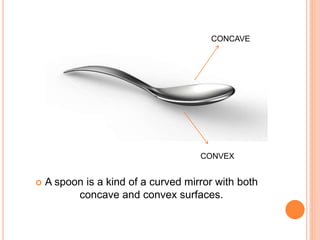
 A spoon is a kind of a curved mirror with both
concave and convex surfaces.
CONCAVE
CONVEX
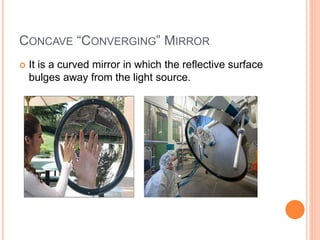
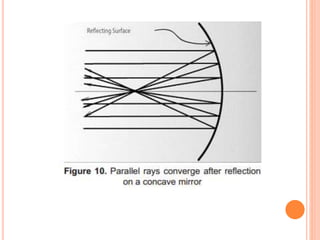
CONCAVE “CONVERGING” MIRROR
 It is a curved mirror in which the reflective surface
bulges away from the light source.
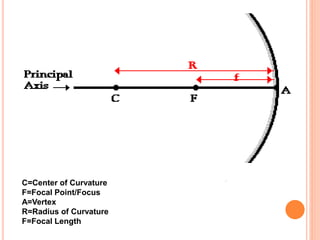
C=Center of Curvature
F=Focal Point/Focus
A=Vertex
R=Radius of Curvature
F=Focal Length
DEFINITION OF PARTS:
 Center of Curvature- the point in the center of the
sphere from which the mirror was sliced.
 Focal Point/Focus- the point between the vertex
and the center of curvature.
 Vertex- the point on the mirror's surface where the
principal axis meets the mirror.
 Principal Axis- line passing through the center of
the sphere and attaching to the mirror in the exact
center of the mirror.
 Radius of Curvature- the distance from the vertex
to the center of curvature.
 Focal Length- the distance from the mirror to the
focal point.
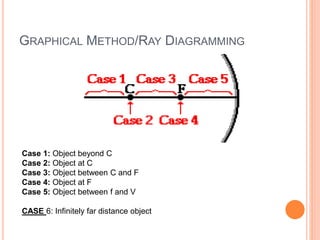
GRAPHICAL METHOD/RAY DIAGRAMMING
Case 1: Object beyond C
Case 2: Object at C
Case 3: Object between C and F
Case 4: Object at F
Case 5: Object between f and V
CASE 6: Infinitely far distance object
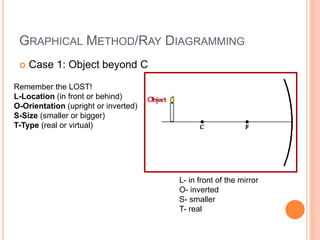
GRAPHICAL METHOD/RAY DIAGRAMMING
 Case 1: Object beyond C
L- in front of the mirror
O- inverted
S- smaller
T- real
Remember the LOST!
L-Location (in front or behind)
O-Orientation (upright or inverted)
S-Size (smaller or bigger)
T-Type (real or virtual)
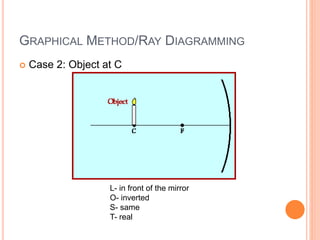
GRAPHICAL METHOD/RAY DIAGRAMMING
 Case 2: Object at C
L- in front of the mirror
O- inverted
S- same
T- real
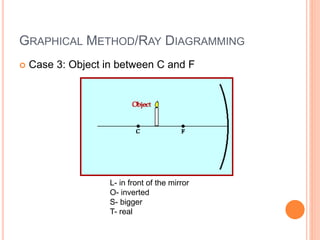
GRAPHICAL METHOD/RAY DIAGRAMMING
 Case 3: Object in between C and F
L- in front of the mirror
O- inverted
S- bigger
T- real
GRAPHICAL METHOD/RAY DIAGRAMMING
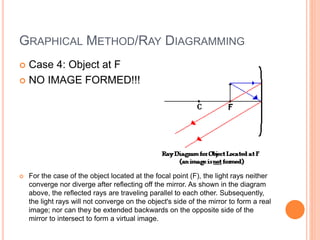
 Case 4: Object at F
 NO IMAGE FORMED!!!
 For the case of the object located at the focal point (F), the light rays neither
converge nor diverge after reflecting off the mirror. As shown in the diagram
above, the reflected rays are traveling parallel to each other. Subsequently,
the light rays will not converge on the object's side of the mirror to form a real
image; nor can they be extended backwards on the opposite side of the
mirror to intersect to form a virtual image.
GRAPHICAL METHOD/RAY DIAGRAMMING
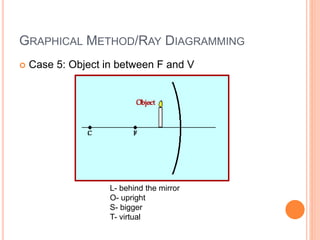
 Case 5: Object in between F and V
L- behind the mirror
O- upright
S- bigger
T- virtual
GRAPHICAL METHOD/RAY DIAGRAMMING
 Case 6: Infinitely far distance object
L- at I
O- inverted
S- infinitely small
T- real image
(Concave image is distance dependent)
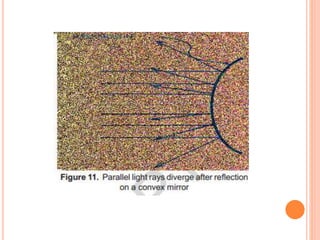
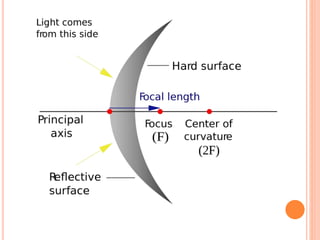
CONVEX “DIVERGING” MIRROR
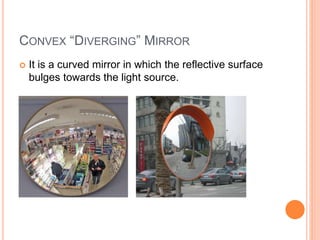
 It is a curved mirror in which the reflective surface
bulges towards the light source.
DEFINITION OF PARTS:
 Center of Curvature- the point in the center of the
sphere from which the mirror was sliced.
 Focal Point/Focus- the point between the vertex
and the center of curvature.
 Principal Axis- line passing through the center of
the sphere and attaching to the mirror in the exact
center of the mirror.
 Focal Length- the distance from the mirror to the
focal point.
STEP-BY-STEP PROCEDURE FOR DRAWING
RAY DIAGRAMS
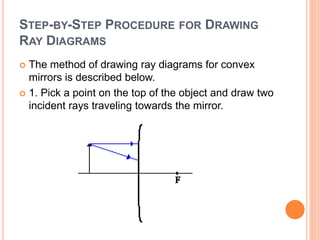
 The method of drawing ray diagrams for convex
mirrors is described below.
 1. Pick a point on the top of the object and draw two
incident rays traveling towards the mirror.
STEP-BY-STEP PROCEDURE FOR DRAWING
RAY DIAGRAMS
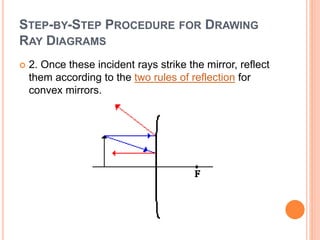
 2. Once these incident rays strike the mirror, reflect
them according to the two rules of reflection for
convex mirrors.
STEP-BY-STEP PROCEDURE FOR DRAWING
RAY DIAGRAMS
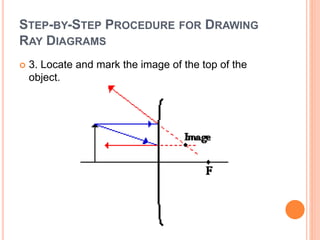
 3. Locate and mark the image of the top of the
object.
STEP-BY-STEP PROCEDURE FOR DRAWING
RAY DIAGRAMS
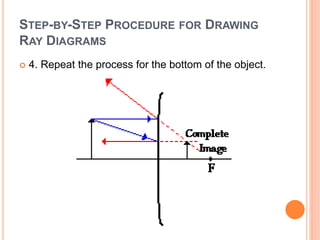
 4. Repeat the process for the bottom of the object.
GRAPHICAL METHOD/RAY DIAGRAMMING
 The image formed in a convex mirror is ALWAYS:
 L- behind the mirror
 O- upright
 S- smaller
 T- virtual

Curved Mirrors (Concave and Convex)

  • 1.
    CURVED MIRRORS (CONCAVE ANDCONVEX) Sophia Marie D. Verdeflor Grade 10-1 STE
  • 2.
    CURVED/SPHERICAL MIRROR  Acurved mirror is a mirror with a curved reflecting surface. The surface may be either convex (bulging outward) or concave (bulging inward). Most curved mirrors have surfaces that are shaped like part of a sphere, but other shapes are sometimes used in optical devices.  A curved mirror is a reflecting surface in which its surface is a section of sphere. There are two kind of a curved mirror, the concave and the convex mirrors.
  • 3.
     A spoonis a kind of a curved mirror with both concave and convex surfaces. CONCAVE CONVEX
  • 4.
    CONCAVE “CONVERGING” MIRROR It is a curved mirror in which the reflective surface bulges away from the light source.
  • 6.
    C=Center of Curvature F=FocalPoint/Focus A=Vertex R=Radius of Curvature F=Focal Length
  • 7.
    DEFINITION OF PARTS: Center of Curvature- the point in the center of the sphere from which the mirror was sliced.  Focal Point/Focus- the point between the vertex and the center of curvature.  Vertex- the point on the mirror's surface where the principal axis meets the mirror.  Principal Axis- line passing through the center of the sphere and attaching to the mirror in the exact center of the mirror.  Radius of Curvature- the distance from the vertex to the center of curvature.  Focal Length- the distance from the mirror to the focal point.
  • 8.
    GRAPHICAL METHOD/RAY DIAGRAMMING Case1: Object beyond C Case 2: Object at C Case 3: Object between C and F Case 4: Object at F Case 5: Object between f and V CASE 6: Infinitely far distance object
  • 9.
    GRAPHICAL METHOD/RAY DIAGRAMMING Case 1: Object beyond C L- in front of the mirror O- inverted S- smaller T- real Remember the LOST! L-Location (in front or behind) O-Orientation (upright or inverted) S-Size (smaller or bigger) T-Type (real or virtual)
  • 10.
    GRAPHICAL METHOD/RAY DIAGRAMMING Case 2: Object at C L- in front of the mirror O- inverted S- same T- real
  • 11.
    GRAPHICAL METHOD/RAY DIAGRAMMING Case 3: Object in between C and F L- in front of the mirror O- inverted S- bigger T- real
  • 12.
    GRAPHICAL METHOD/RAY DIAGRAMMING Case 4: Object at F  NO IMAGE FORMED!!!  For the case of the object located at the focal point (F), the light rays neither converge nor diverge after reflecting off the mirror. As shown in the diagram above, the reflected rays are traveling parallel to each other. Subsequently, the light rays will not converge on the object's side of the mirror to form a real image; nor can they be extended backwards on the opposite side of the mirror to intersect to form a virtual image.
  • 13.
    GRAPHICAL METHOD/RAY DIAGRAMMING Case 5: Object in between F and V L- behind the mirror O- upright S- bigger T- virtual
  • 14.
    GRAPHICAL METHOD/RAY DIAGRAMMING Case 6: Infinitely far distance object L- at I O- inverted S- infinitely small T- real image (Concave image is distance dependent)
  • 15.
    CONVEX “DIVERGING” MIRROR It is a curved mirror in which the reflective surface bulges towards the light source.
  • 18.
    DEFINITION OF PARTS: Center of Curvature- the point in the center of the sphere from which the mirror was sliced.  Focal Point/Focus- the point between the vertex and the center of curvature.  Principal Axis- line passing through the center of the sphere and attaching to the mirror in the exact center of the mirror.  Focal Length- the distance from the mirror to the focal point.
  • 19.
    STEP-BY-STEP PROCEDURE FORDRAWING RAY DIAGRAMS  The method of drawing ray diagrams for convex mirrors is described below.  1. Pick a point on the top of the object and draw two incident rays traveling towards the mirror.
  • 20.
    STEP-BY-STEP PROCEDURE FORDRAWING RAY DIAGRAMS  2. Once these incident rays strike the mirror, reflect them according to the two rules of reflection for convex mirrors.
  • 21.
    STEP-BY-STEP PROCEDURE FORDRAWING RAY DIAGRAMS  3. Locate and mark the image of the top of the object.
  • 22.
    STEP-BY-STEP PROCEDURE FORDRAWING RAY DIAGRAMS  4. Repeat the process for the bottom of the object.
  • 23.
    GRAPHICAL METHOD/RAY DIAGRAMMING The image formed in a convex mirror is ALWAYS:  L- behind the mirror  O- upright  S- smaller  T- virtual