Computer Integrated
Manufacturing
Introduction
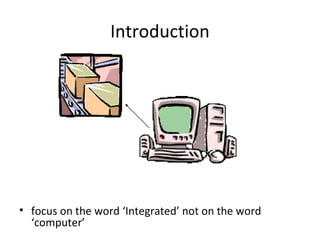
• focus on the word ‘Integrated’ not on the word
‘computer’
Formal Definition
• “The integration of business, engineering, manufacturing
and management information that spans company
functions from marketing to product distribution.”
Harrington
• Originally, to integrate what had already been
computerized.
• Shop floor processes
• Manufacturing engineering planning of those processes
• Production planning and control of both the shop floor and
the materials used.
Synonyms
• CIE - computer integrated enterprise
• CIME - computer integrated manufacturing
enterprise
• CIM means many different things to many
different people.
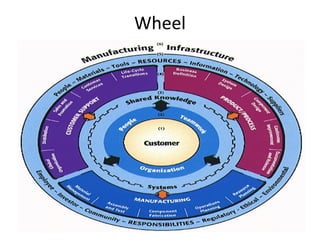
CASA/SME CIM Wheel
From CASA/SME
CASA/SME CIM wheel is a good
overview of CIM
• Revised version (quality no longer separate)
• No hierarchy
• Which are aided by CIM?
CASA/SME CIM Wheel (background)
• 1985 - The Computer and Automated Systems Association of
the Society of Manufacturing Engineers (CASA/SME)
published its vision of enterprise-wide teaming--the CIM
Enterprise Wheel
• 1992 - New Manufacturing Enterprise Wheel. This updated
vision preserves the understanding gained from the previous
CIM Enterprise Wheel. The old Wheel looked primarily at
automation and integration inside the enterprise. The new
Wheel looks outside as well. It adds understanding in these
six areas:
CASA/SME CIM Wheel (background)
• The central role of a customer-oriented mission and vision to strive for continuous
improvement.
• The importance of teams and human networking in the new manufacturing
environment.
• The continuing importance of computer tools, now increasingly distributed and
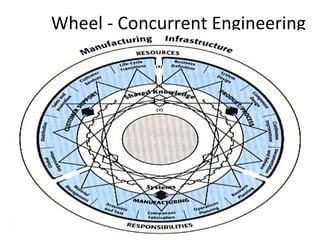
networked. This includes tools to support networking and concurrent engineering.
• A focus on key processes and best practices throughout the enterprise, from
marketing through design, manufacturing, and customer support.
• Recognition of the move away from bureaucratic structures, to leaner and more
agile organizations.
• The need to integrate an understanding of the external environment, including
customers, competitors, suppliers, and the global manufacturing infrastructure.
Wheel - Six Elements
• The new Manufacturing Enterprise Wheel
describes six fundamental elements for
competitive manufacturing:
– The central role of the customer and evolving customer needs.
– The role of people and teamwork in the organization.
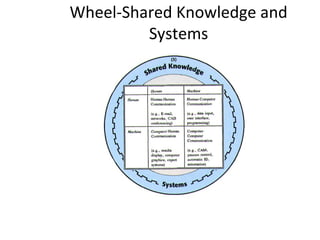
– The revolutionary impact of shared knowledge and systems to support people
and processes.
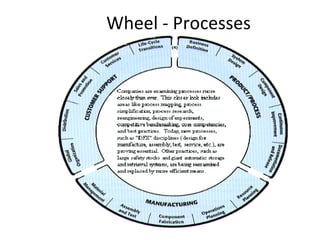
– Key processes from product definition through manufacturing and customer
support.
– Enterprise resources (inputs) and responsibilities (outputs).
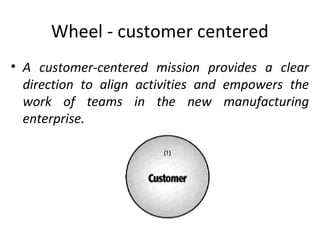
Wheel - customer centered
• A customer-centered mission provides a clear
direction to align activities and empowers the
work of teams in the new manufacturing
enterprise.
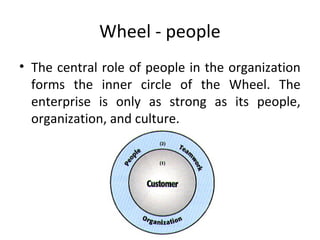
Wheel - people
• The central role of people in the organization
forms the inner circle of the Wheel. The
enterprise is only as strong as its people,
organization, and culture.
Wheel-Shared Knowledge and
Systems
Wheel - Processes
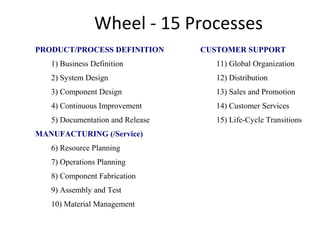
Wheel - 15 Processes
PRODUCT/PROCESS DEFINITION
1) Business Definition
2) System Design
3) Component Design
4) Continuous Improvement
5) Documentation and Release
MANUFACTURING (/Service)
6) Resource Planning
7) Operations Planning
8) Component Fabrication
9) Assembly and Test
10) Material Management
CUSTOMER SUPPORT
11) Global Organization
12) Distribution
13) Sales and Promotion
14) Customer Services
15) Life-Cycle Transitions
Wheel - Concurrent Engineering
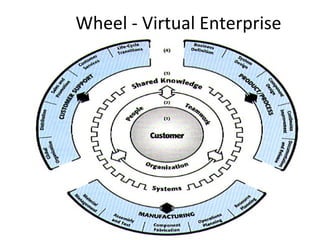
Wheel - Virtual Enterprise
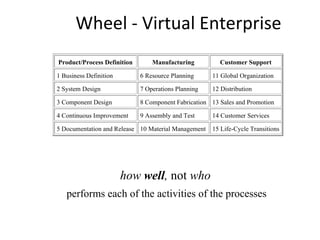
Product/Process Definition Manufacturing Customer Support
1 Business Definition 6 Resource Planning 11 Global Organization
2 System Design 7 Operations Planning 12 Distribution
3 Component Design 8 Component Fabrication 13 Sales and Promotion
4 Continuous Improvement 9 Assembly and Test 14 Customer Services
5 Documentation and Release 10 Material Management 15 Life-Cycle Transitions
how well, not who
performs each of the activities of the processes
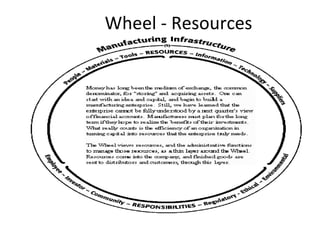
Wheel - Resources
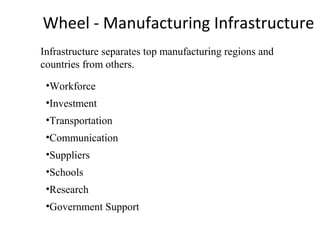
Wheel - Manufacturing Infrastructure
•Workforce
•Investment
•Transportation
•Communication
•Suppliers
•Schools
•Research
•Government Support
Infrastructure separates top manufacturing regions and
countries from others.
Wheel
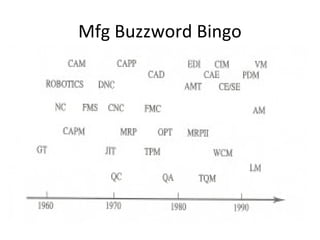
Mfg Buzzword Bingo
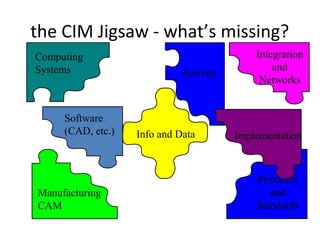
the CIM Jigsaw - what’s missing?
Computing
Systems
Software
(CAD, etc.)
Manufacturing
CAM
Info and Data
Activity
Integration
and
Networks
Protocols
and
Standards
Implementation
Why CIM?
• Because It Is Cool - NO!
• Because Everyone Else Is -No!
• CIM Is Not An End, It Is The Means To An End
• Must Be Linked To Strategy!
Why CIM - to meet competitive
pressures
• To reduce lead times
• To reduce costs
• To reduce inventory (or need for)
Why CIM - to coordinate and organize
data
• Functional - about organization (still important)
• Product - about parts
• Operational - plan or instructions
• Performance - reporting on performance
Why CIM - others
• To eliminate paper
• Automate communication
• Simultaneous engineering (IPD)
• Because it is possible?
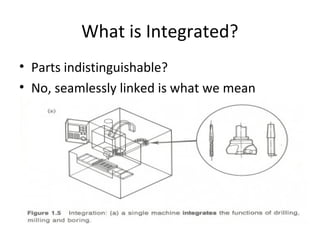
What is Integrated?
• Parts indistinguishable?
• No, seamlessly linked is what we mean
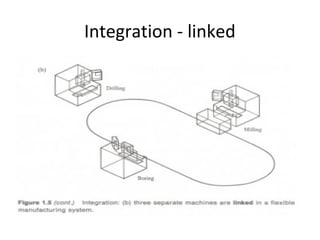
Integration - linked
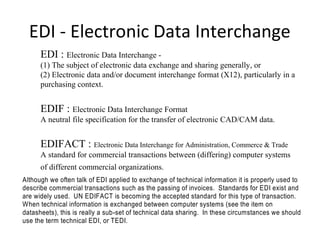
EDI - Electronic Data Interchange
EDI : Electronic Data Interchange -
(1) The subject of electronic data exchange and sharing generally, or
(2) Electronic data and/or document interchange format (X12), particularly in a
purchasing context.
EDIF : Electronic Data Interchange Format
A neutral file specification for the transfer of electronic CAD/CAM data.
EDIFACT : Electronic Data Interchange for Administration, Commerce & Trade
A standard for commercial transactions between (differing) computer systems
of different commercial organizations.
Although we often talk of EDI applied to exchange of technical information it is properly used to
describe commercial transactions such as the passing of invoices. Standards for EDI exist and
are widely used. UN EDIFACT is becoming the accepted standard for this type of transaction.
When technical information is exchanged between computer systems (see the item on
datasheets), this is really a sub-set of technical data sharing. In these circumstances we should
use the term technical EDI, or TEDI.
Islands of Automation
Local optimization
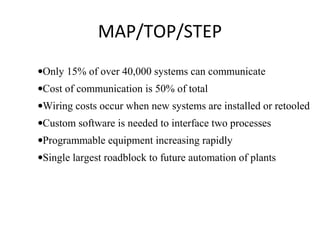
MAP/TOP/STEP
•Only 15% of over 40,000 systems can communicate
•Cost of communication is 50% of total
•Wiring costs occur when new systems are installed or retooled
•Custom software is needed to interface two processes
•Programmable equipment increasing rapidly
•Single largest roadblock to future automation of plants
MAP
• Based on Open Systems Interconnection (OSI)
• Seven layer broadband token-bus communication spec
• MAP and TOP always connected, differ in applications
• GM has 8 plants running MAP with 25 (1990 )
• GM installing MAP as they overhaul plant
• Tests on Ethernet
• Lotus 1-2-3 "Factory" has MAP protocols
TOP
• Exchange of info in electronic mail,
• Word processing,
• File transfer,
• Graphics,
• Database management,
• Business analysis tools
TOP objectives
• Allow the interconnection of multiple office local-area networks (LANs),
which could be connected to wide-area networks (WANs) and digital
private-branch exchanges (PBXs) for long-distance communications
• Specify existing or emerging international and industry standards
• Make possible an office communications network in which equipment from
multiple suppliers can be used
• Facilitate free and easy data access and the interchange of data by equipment
from different suppliers
• Lower office systems costs by reducing the need for multiple cables and
customized networking software
• Improve the flexibility and adaptability of production systems to meet
changing demands
• Shorten the lead time for designing and implementing integrated office
systems

Computer integrated manufacturing

  • 1.
  • 2.
    Introduction • focus onthe word ‘Integrated’ not on the word ‘computer’
  • 3.
    Formal Definition • “Theintegration of business, engineering, manufacturing and management information that spans company functions from marketing to product distribution.” Harrington • Originally, to integrate what had already been computerized. • Shop floor processes • Manufacturing engineering planning of those processes • Production planning and control of both the shop floor and the materials used.
  • 4.
    Synonyms • CIE -computer integrated enterprise • CIME - computer integrated manufacturing enterprise • CIM means many different things to many different people.
  • 5.
  • 6.
    CASA/SME CIM wheelis a good overview of CIM • Revised version (quality no longer separate) • No hierarchy • Which are aided by CIM?
  • 7.
    CASA/SME CIM Wheel(background) • 1985 - The Computer and Automated Systems Association of the Society of Manufacturing Engineers (CASA/SME) published its vision of enterprise-wide teaming--the CIM Enterprise Wheel • 1992 - New Manufacturing Enterprise Wheel. This updated vision preserves the understanding gained from the previous CIM Enterprise Wheel. The old Wheel looked primarily at automation and integration inside the enterprise. The new Wheel looks outside as well. It adds understanding in these six areas:
  • 8.
    CASA/SME CIM Wheel(background) • The central role of a customer-oriented mission and vision to strive for continuous improvement. • The importance of teams and human networking in the new manufacturing environment. • The continuing importance of computer tools, now increasingly distributed and networked. This includes tools to support networking and concurrent engineering. • A focus on key processes and best practices throughout the enterprise, from marketing through design, manufacturing, and customer support. • Recognition of the move away from bureaucratic structures, to leaner and more agile organizations. • The need to integrate an understanding of the external environment, including customers, competitors, suppliers, and the global manufacturing infrastructure.
  • 9.
    Wheel - SixElements • The new Manufacturing Enterprise Wheel describes six fundamental elements for competitive manufacturing: – The central role of the customer and evolving customer needs. – The role of people and teamwork in the organization. – The revolutionary impact of shared knowledge and systems to support people and processes. – Key processes from product definition through manufacturing and customer support. – Enterprise resources (inputs) and responsibilities (outputs).
  • 10.
    Wheel - customercentered • A customer-centered mission provides a clear direction to align activities and empowers the work of teams in the new manufacturing enterprise.
  • 11.
    Wheel - people •The central role of people in the organization forms the inner circle of the Wheel. The enterprise is only as strong as its people, organization, and culture.
  • 12.
  • 13.
  • 14.
    Wheel - 15Processes PRODUCT/PROCESS DEFINITION 1) Business Definition 2) System Design 3) Component Design 4) Continuous Improvement 5) Documentation and Release MANUFACTURING (/Service) 6) Resource Planning 7) Operations Planning 8) Component Fabrication 9) Assembly and Test 10) Material Management CUSTOMER SUPPORT 11) Global Organization 12) Distribution 13) Sales and Promotion 14) Customer Services 15) Life-Cycle Transitions
  • 15.
    Wheel - ConcurrentEngineering
  • 16.
    Wheel - VirtualEnterprise
  • 17.
    Wheel - VirtualEnterprise Product/Process Definition Manufacturing Customer Support 1 Business Definition 6 Resource Planning 11 Global Organization 2 System Design 7 Operations Planning 12 Distribution 3 Component Design 8 Component Fabrication 13 Sales and Promotion 4 Continuous Improvement 9 Assembly and Test 14 Customer Services 5 Documentation and Release 10 Material Management 15 Life-Cycle Transitions how well, not who performs each of the activities of the processes
  • 18.
  • 19.
    Wheel - ManufacturingInfrastructure •Workforce •Investment •Transportation •Communication •Suppliers •Schools •Research •Government Support Infrastructure separates top manufacturing regions and countries from others.
  • 20.
  • 21.
  • 22.
    the CIM Jigsaw- what’s missing? Computing Systems Software (CAD, etc.) Manufacturing CAM Info and Data Activity Integration and Networks Protocols and Standards Implementation
  • 23.
    Why CIM? • BecauseIt Is Cool - NO! • Because Everyone Else Is -No! • CIM Is Not An End, It Is The Means To An End • Must Be Linked To Strategy!
  • 24.
    Why CIM -to meet competitive pressures • To reduce lead times • To reduce costs • To reduce inventory (or need for)
  • 25.
    Why CIM -to coordinate and organize data • Functional - about organization (still important) • Product - about parts • Operational - plan or instructions • Performance - reporting on performance
  • 26.
    Why CIM -others • To eliminate paper • Automate communication • Simultaneous engineering (IPD) • Because it is possible?
  • 27.
    What is Integrated? •Parts indistinguishable? • No, seamlessly linked is what we mean
  • 28.
  • 29.
    EDI - ElectronicData Interchange EDI : Electronic Data Interchange - (1) The subject of electronic data exchange and sharing generally, or (2) Electronic data and/or document interchange format (X12), particularly in a purchasing context. EDIF : Electronic Data Interchange Format A neutral file specification for the transfer of electronic CAD/CAM data. EDIFACT : Electronic Data Interchange for Administration, Commerce & Trade A standard for commercial transactions between (differing) computer systems of different commercial organizations. Although we often talk of EDI applied to exchange of technical information it is properly used to describe commercial transactions such as the passing of invoices. Standards for EDI exist and are widely used. UN EDIFACT is becoming the accepted standard for this type of transaction. When technical information is exchanged between computer systems (see the item on datasheets), this is really a sub-set of technical data sharing. In these circumstances we should use the term technical EDI, or TEDI.
  • 30.
  • 31.
    MAP/TOP/STEP •Only 15% ofover 40,000 systems can communicate •Cost of communication is 50% of total •Wiring costs occur when new systems are installed or retooled •Custom software is needed to interface two processes •Programmable equipment increasing rapidly •Single largest roadblock to future automation of plants
  • 32.
    MAP • Based onOpen Systems Interconnection (OSI) • Seven layer broadband token-bus communication spec • MAP and TOP always connected, differ in applications • GM has 8 plants running MAP with 25 (1990 ) • GM installing MAP as they overhaul plant • Tests on Ethernet • Lotus 1-2-3 "Factory" has MAP protocols
  • 33.
    TOP • Exchange ofinfo in electronic mail, • Word processing, • File transfer, • Graphics, • Database management, • Business analysis tools
  • 34.
    TOP objectives • Allowthe interconnection of multiple office local-area networks (LANs), which could be connected to wide-area networks (WANs) and digital private-branch exchanges (PBXs) for long-distance communications • Specify existing or emerging international and industry standards • Make possible an office communications network in which equipment from multiple suppliers can be used • Facilitate free and easy data access and the interchange of data by equipment from different suppliers • Lower office systems costs by reducing the need for multiple cables and customized networking software • Improve the flexibility and adaptability of production systems to meet changing demands • Shorten the lead time for designing and implementing integrated office systems