COMPUTERCOMPUTER
HARDWAREHARDWARE
COMPONENTSCOMPONENTS
COMPUTER HARDWARECOMPUTER HARDWARE
COMPONENTSCOMPONENTS
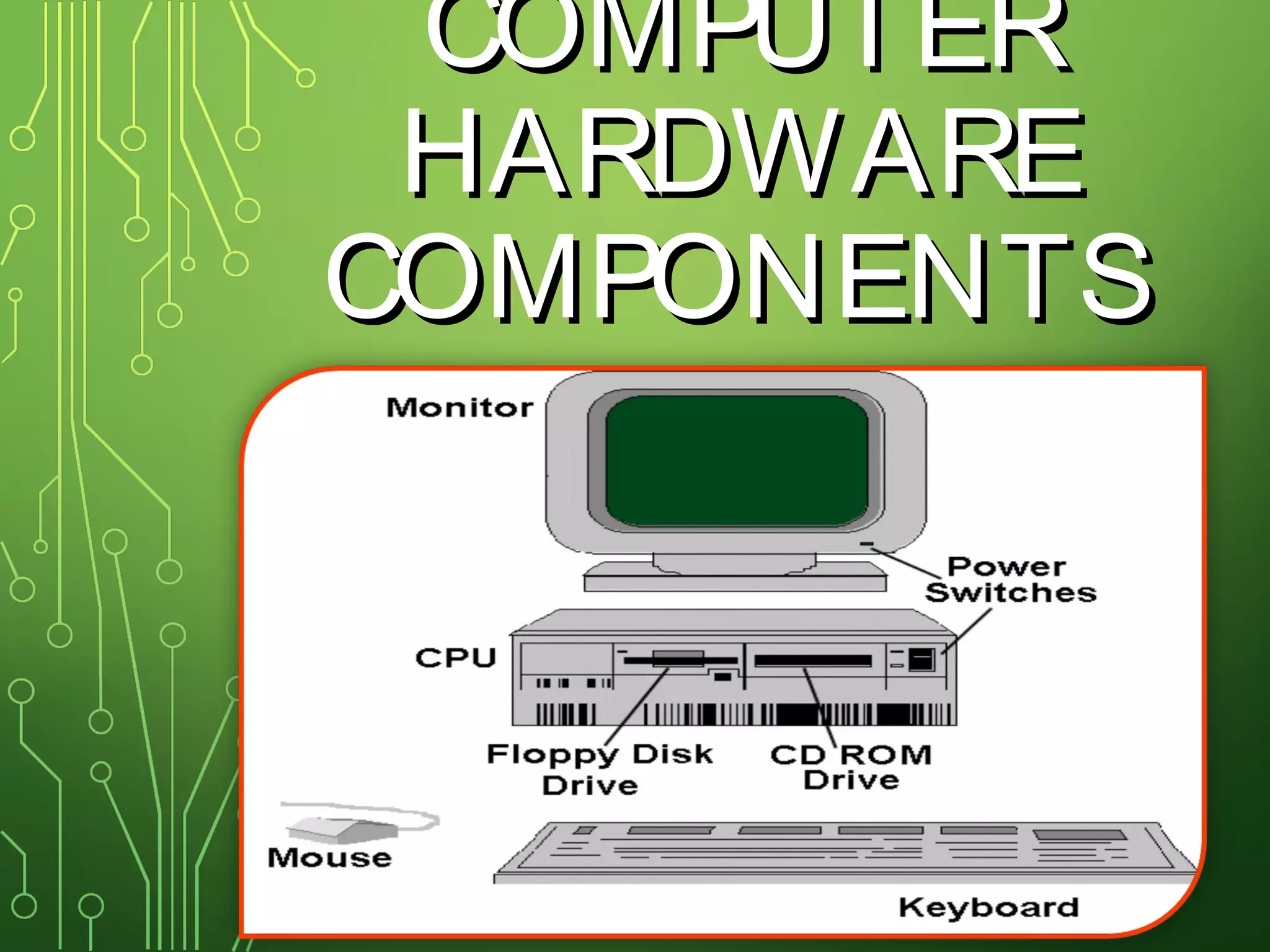
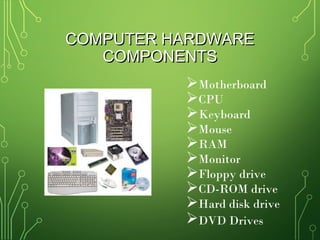
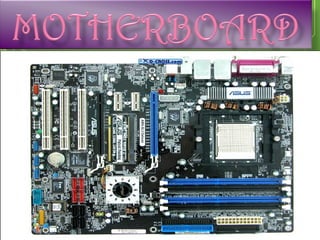
Motherboard
CPU
Keyboard
Mouse
RAM
Monitor
Floppy drive
CD-ROM drive
Hard disk drive
DVD Drives
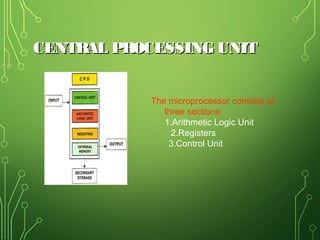
CENTRAL PROCESSING UNITCENTRAL PROCESSING UNIT
The microprocessor consists of
three sections:
1.Arithmetic Logic Unit
2.Registers
3.Control Unit
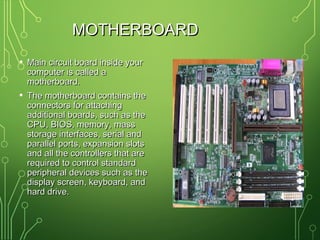
MOTHERBOARDMOTHERBOARD
• Main circuit board inside yourMain circuit board inside your
computer is called acomputer is called a
motherboard.motherboard.
• The motherboard contains theThe motherboard contains the
connectors for attachingconnectors for attaching
additional boards, such as theadditional boards, such as the
CPU, BIOS, memory, massCPU, BIOS, memory, mass
storage interfaces, serial andstorage interfaces, serial and
parallel ports, expansion slotsparallel ports, expansion slots
and all the controllers that areand all the controllers that are
required to control standardrequired to control standard
peripheral devices such as theperipheral devices such as the
display screen, keyboard, anddisplay screen, keyboard, and
hard drive.hard drive.
MOTHERBOARDMOTHERBOARD
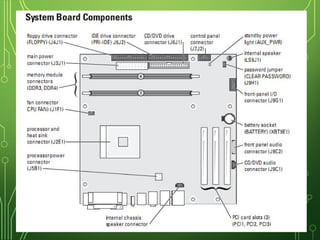
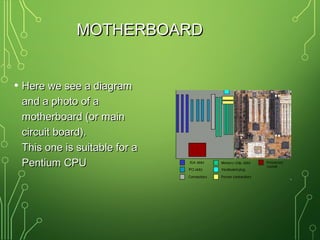
• Here we see a diagramHere we see a diagram
and a photo of aand a photo of a
motherboard (or mainmotherboard (or main
circuit board).circuit board).
This one is suitable for aThis one is suitable for a
Pentium CPUPentium CPU
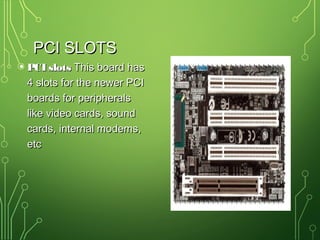
PCI SLOTSPCI SLOTS
• PCI slotsPCI slots This board hasThis board has
4 slots for the newer PCI4 slots for the newer PCI
boards for peripheralsboards for peripherals
like video cards, soundlike video cards, sound
cards, internal modems,cards, internal modems,
etcetc
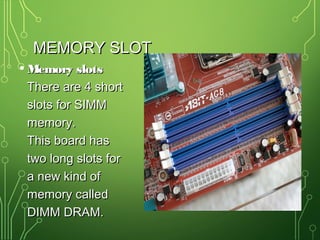
MEMORY SLOTMEMORY SLOT
• Memory slotsMemory slots
There are 4 shortThere are 4 short
slots for SIMMslots for SIMM
memory.memory.
This board hasThis board has
two long slots fortwo long slots for
a new kind ofa new kind of
memory calledmemory called
DIMM DRAM.DIMM DRAM.
MOTHERBOARDMOTHERBOARD
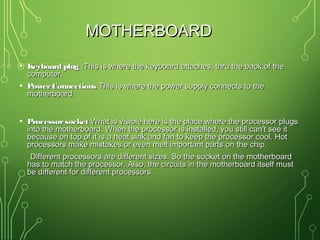
• Keyboard plugKeyboard plug :This is where the keyboard attaches, thru the back of the:This is where the keyboard attaches, thru the back of the
computer.computer.
• PowerConnectionsPowerConnections This is where the power supply connects to theThis is where the power supply connects to the
motherboardmotherboard
• ProcessorsocketProcessorsocket What is visible here is the place where the processor plugsWhat is visible here is the place where the processor plugs
into the motherboard. When the processor is installed, you still can't see itinto the motherboard. When the processor is installed, you still can't see it
because on top of it is a heat sink and fan to keep the processor cool. Hotbecause on top of it is a heat sink and fan to keep the processor cool. Hot
processors make mistakes or even melt important parts on the chip.processors make mistakes or even melt important parts on the chip.
Different processors are different sizes. So the socket on the motherboardDifferent processors are different sizes. So the socket on the motherboard
has to match the processor. Also, the circuits in the motherboard itself musthas to match the processor. Also, the circuits in the motherboard itself must
be different for different processors.be different for different processors.
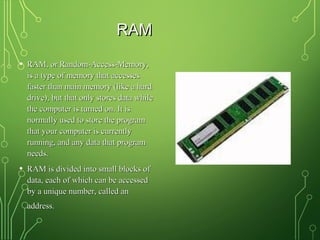
RAMRAM
• RAM, or Random-Access-Memory,RAM, or Random-Access-Memory,
is a type of memory that accessesis a type of memory that accesses
faster than main memory (like a hardfaster than main memory (like a hard
drive), but that only stores data whiledrive), but that only stores data while
the computer is turned on. It isthe computer is turned on. It is
normally used to store the programnormally used to store the program
that your computer is currentlythat your computer is currently
running, and any data that programrunning, and any data that program
needs.needs.
• RAM is divided into small blocks ofRAM is divided into small blocks of
data, each of which can be accesseddata, each of which can be accessed
by a unique number, called anby a unique number, called an
address.address.
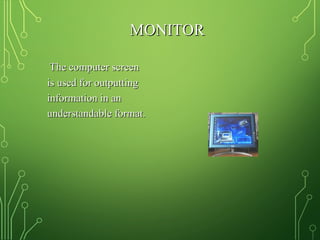
MONITORMONITOR
The computer screenThe computer screen
is used for outputtingis used for outputting
information in aninformation in an
understandable format.understandable format.
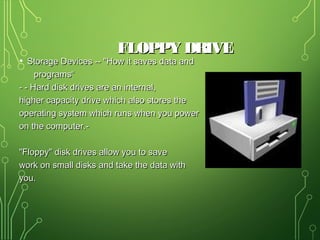
FLOPPY DRIVEFLOPPY DRIVE
• Storage Devices -- "How it saves data andStorage Devices -- "How it saves data and
programs“programs“
- - Hard disk drives are an internal,- - Hard disk drives are an internal,
higher capacity drive which also stores thehigher capacity drive which also stores the
operating system which runs when you poweroperating system which runs when you power
on the computer.-on the computer.-
"Floppy" disk drives allow you to save"Floppy" disk drives allow you to save
work on small disks and take the data withwork on small disks and take the data with
you.you.
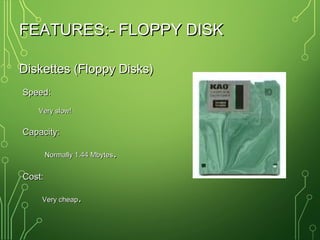
FEATURES:- FLOPPY DISKFEATURES:- FLOPPY DISK
Diskettes (Floppy Disks)Diskettes (Floppy Disks)
Speed:Speed:
Very slow!Very slow!
Capacity:Capacity:
Normally 1.44 MbytesNormally 1.44 Mbytes..
Cost:Cost:
Very cheapVery cheap..
EXTRA FEATURESEXTRA FEATURES
HARD DIHARD DI SSKSKS
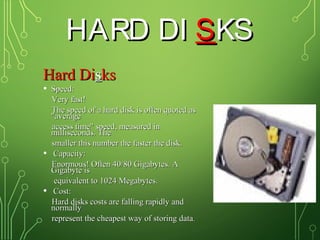
Hard DiHard Dissksks
• Speed:Speed:
Very fast!Very fast!
The speed of a hard disk is often quoted asThe speed of a hard disk is often quoted as
"average"average
access time" speed, measured inaccess time" speed, measured in
milliseconds. Themilliseconds. The
smaller this number the faster the disk.smaller this number the faster the disk.
• Capacity:Capacity:
Enormous! Often 40/80 Gigabytes. AEnormous! Often 40/80 Gigabytes. A
Gigabyte isGigabyte is
equivalent to 1024 Megabytes.equivalent to 1024 Megabytes.
• Cost:Cost:
Hard disks costs are falling rapidly andHard disks costs are falling rapidly and
normallynormally
represent the cheapest way of storing datarepresent the cheapest way of storing data..
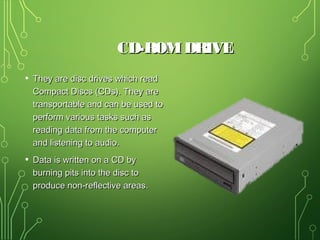
CD-ROMDRIVECD-ROMDRIVE
• They are disc drives which readThey are disc drives which read
Compact Discs (CDs). They areCompact Discs (CDs). They are
transportable and can be used totransportable and can be used to
perform various tasks such asperform various tasks such as
reading data from the computerreading data from the computer
and listening to audio.and listening to audio.
• Data is written on a CD byData is written on a CD by
burning pits into the disc toburning pits into the disc to
produce non-reflective areas.produce non-reflective areas.
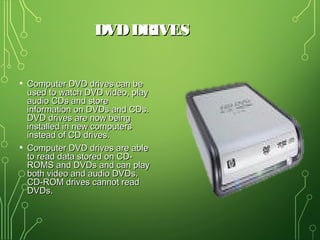
DVDDRIVESDVDDRIVES
• Computer DVD drives can beComputer DVD drives can be
used to watch DVD video, playused to watch DVD video, play
audio CDs and storeaudio CDs and store
information on DVDs and CDs.information on DVDs and CDs.
DVD drives are now beingDVD drives are now being
installed in new computersinstalled in new computers
instead of CD drives.instead of CD drives.
• Computer DVD drives are ableComputer DVD drives are able
to read data stored on CD-to read data stored on CD-
ROMS and DVDs and can playROMS and DVDs and can play
both video and audio DVDs.both video and audio DVDs.
CD-ROM drives cannot readCD-ROM drives cannot read
DVDs.DVDs.
Presented by:- Pawar ParmeshwarPresented by:- Pawar Parmeshwar
33rdrd
Sem. Electrical Eng.Sem. Electrical Eng.

Computer hardware component Created by king parmeshwar pawar

  • 1.
  • 2.
  • 5.
    CENTRAL PROCESSING UNITCENTRALPROCESSING UNIT The microprocessor consists of three sections: 1.Arithmetic Logic Unit 2.Registers 3.Control Unit
  • 6.
    MOTHERBOARDMOTHERBOARD • Main circuitboard inside yourMain circuit board inside your computer is called acomputer is called a motherboard.motherboard. • The motherboard contains theThe motherboard contains the connectors for attachingconnectors for attaching additional boards, such as theadditional boards, such as the CPU, BIOS, memory, massCPU, BIOS, memory, mass storage interfaces, serial andstorage interfaces, serial and parallel ports, expansion slotsparallel ports, expansion slots and all the controllers that areand all the controllers that are required to control standardrequired to control standard peripheral devices such as theperipheral devices such as the display screen, keyboard, anddisplay screen, keyboard, and hard drive.hard drive.
  • 7.
    MOTHERBOARDMOTHERBOARD • Here wesee a diagramHere we see a diagram and a photo of aand a photo of a motherboard (or mainmotherboard (or main circuit board).circuit board). This one is suitable for aThis one is suitable for a Pentium CPUPentium CPU
  • 8.
    PCI SLOTSPCI SLOTS •PCI slotsPCI slots This board hasThis board has 4 slots for the newer PCI4 slots for the newer PCI boards for peripheralsboards for peripherals like video cards, soundlike video cards, sound cards, internal modems,cards, internal modems, etcetc
  • 9.
    MEMORY SLOTMEMORY SLOT •Memory slotsMemory slots There are 4 shortThere are 4 short slots for SIMMslots for SIMM memory.memory. This board hasThis board has two long slots fortwo long slots for a new kind ofa new kind of memory calledmemory called DIMM DRAM.DIMM DRAM.
  • 10.
    MOTHERBOARDMOTHERBOARD • Keyboard plugKeyboardplug :This is where the keyboard attaches, thru the back of the:This is where the keyboard attaches, thru the back of the computer.computer. • PowerConnectionsPowerConnections This is where the power supply connects to theThis is where the power supply connects to the motherboardmotherboard • ProcessorsocketProcessorsocket What is visible here is the place where the processor plugsWhat is visible here is the place where the processor plugs into the motherboard. When the processor is installed, you still can't see itinto the motherboard. When the processor is installed, you still can't see it because on top of it is a heat sink and fan to keep the processor cool. Hotbecause on top of it is a heat sink and fan to keep the processor cool. Hot processors make mistakes or even melt important parts on the chip.processors make mistakes or even melt important parts on the chip. Different processors are different sizes. So the socket on the motherboardDifferent processors are different sizes. So the socket on the motherboard has to match the processor. Also, the circuits in the motherboard itself musthas to match the processor. Also, the circuits in the motherboard itself must be different for different processors.be different for different processors.
  • 11.
    RAMRAM • RAM, orRandom-Access-Memory,RAM, or Random-Access-Memory, is a type of memory that accessesis a type of memory that accesses faster than main memory (like a hardfaster than main memory (like a hard drive), but that only stores data whiledrive), but that only stores data while the computer is turned on. It isthe computer is turned on. It is normally used to store the programnormally used to store the program that your computer is currentlythat your computer is currently running, and any data that programrunning, and any data that program needs.needs. • RAM is divided into small blocks ofRAM is divided into small blocks of data, each of which can be accesseddata, each of which can be accessed by a unique number, called anby a unique number, called an address.address.
  • 12.
    MONITORMONITOR The computer screenThecomputer screen is used for outputtingis used for outputting information in aninformation in an understandable format.understandable format.
  • 13.
    FLOPPY DRIVEFLOPPY DRIVE •Storage Devices -- "How it saves data andStorage Devices -- "How it saves data and programs“programs“ - - Hard disk drives are an internal,- - Hard disk drives are an internal, higher capacity drive which also stores thehigher capacity drive which also stores the operating system which runs when you poweroperating system which runs when you power on the computer.-on the computer.- "Floppy" disk drives allow you to save"Floppy" disk drives allow you to save work on small disks and take the data withwork on small disks and take the data with you.you.
  • 14.
    FEATURES:- FLOPPY DISKFEATURES:-FLOPPY DISK Diskettes (Floppy Disks)Diskettes (Floppy Disks) Speed:Speed: Very slow!Very slow! Capacity:Capacity: Normally 1.44 MbytesNormally 1.44 Mbytes.. Cost:Cost: Very cheapVery cheap..
  • 15.
  • 16.
    HARD DIHARD DISSKSKS Hard DiHard Dissksks • Speed:Speed: Very fast!Very fast! The speed of a hard disk is often quoted asThe speed of a hard disk is often quoted as "average"average access time" speed, measured inaccess time" speed, measured in milliseconds. Themilliseconds. The smaller this number the faster the disk.smaller this number the faster the disk. • Capacity:Capacity: Enormous! Often 40/80 Gigabytes. AEnormous! Often 40/80 Gigabytes. A Gigabyte isGigabyte is equivalent to 1024 Megabytes.equivalent to 1024 Megabytes. • Cost:Cost: Hard disks costs are falling rapidly andHard disks costs are falling rapidly and normallynormally represent the cheapest way of storing datarepresent the cheapest way of storing data..
  • 17.
    CD-ROMDRIVECD-ROMDRIVE • They aredisc drives which readThey are disc drives which read Compact Discs (CDs). They areCompact Discs (CDs). They are transportable and can be used totransportable and can be used to perform various tasks such asperform various tasks such as reading data from the computerreading data from the computer and listening to audio.and listening to audio. • Data is written on a CD byData is written on a CD by burning pits into the disc toburning pits into the disc to produce non-reflective areas.produce non-reflective areas.
  • 18.
    DVDDRIVESDVDDRIVES • Computer DVDdrives can beComputer DVD drives can be used to watch DVD video, playused to watch DVD video, play audio CDs and storeaudio CDs and store information on DVDs and CDs.information on DVDs and CDs. DVD drives are now beingDVD drives are now being installed in new computersinstalled in new computers instead of CD drives.instead of CD drives. • Computer DVD drives are ableComputer DVD drives are able to read data stored on CD-to read data stored on CD- ROMS and DVDs and can playROMS and DVDs and can play both video and audio DVDs.both video and audio DVDs. CD-ROM drives cannot readCD-ROM drives cannot read DVDs.DVDs.
  • 19.
    Presented by:- PawarParmeshwarPresented by:- Pawar Parmeshwar 33rdrd Sem. Electrical Eng.Sem. Electrical Eng.