Abstract: The use of magnetic nanomaterials in biosensing applications is growing as a consequence of
their remarkable properties; but controlling the composition and shape of metallic nanoalloys is
problematic when more than one precursor is required for wet chemistry synthesis. We have developed a
successful simultaneous reduction method for preparation of near-spherical platinum-based nanoalloys
containing magnetic solutes. We avoided particular difficulties in preparing platinum nanoalloys containing
Ni, Co and Fe by the identification of appropriate synthesis temperatures and chemistry. We used
transmission electron microscopy (TEM) to show that our particles have a narrow size distribution,
uniform size and morphology, and good crystallinity in the as-synthesized condition. Energy dispersive
spectroscopy (EDS) and X-ray diffraction (XRD) confirms the coexistence of Pt with the magnetic solute
in a face-centered cubic (FCC) solid solution.
What is biosensor
A biosensor is a self-contained integrated device, which
is capable of providing specific quantitative or semi-
quantitative analytical information using a biological
recognition element (biochemical receptor) which is
retained in direct spatial contact with a transduction
element.
Applications of biosensors


Glucose monitoring in diabetes patients
Other medical health related targets
Environmental applications
Remote sensing of airborne bacteria
Detection of pathogens
Determining levels of toxic substances
Detection of toxic metabolites


Detection and determining of organophosphate
Routine analytical measurements
Determination of drug residues in food
Drug discovery and evaluation of biological activity
of new compounds
Protein engineering in biosensors
Glucose monitoring in diabetes patients
Other medical health related targets
Environmental applications
Remote sensing of airborne bacteria
Detection of pathogens
Determining levels of toxic substances
Detection of toxic metabolites
Applications of biosensors
Nanomaterials in biosensors
The use of nanomaterials and structures such as
semiconductors and conducting polymer nanowires,
and nanoparticles (carbon nanotubes, silica
nanoparticles, dendrimers, noble metals
nanoparticles, gold nanoshells, superparamagnetic
nanoparticles quantum dots, polymeric
nanoparticles) for biosensor applications is
expanding rapidly.
Nanomaterials in
biosensors Ibtisam E.
10 Unique and novel physical and/or chemical
characteristics of nanomaterials can aid the design
of bio-sensors with improved analytical
characteristics.
High surface / volume ratio
Novel elctro-optical properties
Increased catalytical activity
Enhanced electron transfer
Nanomaterials in
biosensors
Ibtisam E. Tothill, World Mycotoxin Journal, 2011, 4 (4) 361-374 Organic
based:
•Fullerenes
•Carbon nanotubes
•Dendrimers
•Liposomes Inorganic:
•Quantum dots
•Metal nanorods
•Metal nanoparticles
● Examples of nanoparticles used in sensors developments .
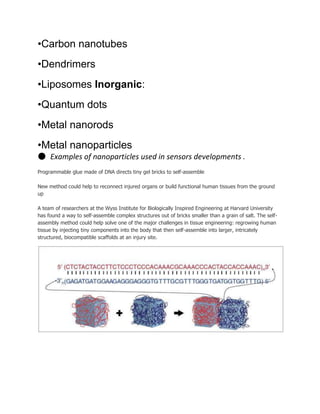
Programmable glue made of DNA directs tiny gel bricks to self-assemble
New method could help to reconnect injured organs or build functional human tissues from the ground
up
A team of researchers at the Wyss Institute for Biologically Inspired Engineering at Harvard University
has found a way to self-assemble complex structures out of bricks smaller than a grain of salt. The self-
assembly method could help solve one of the major challenges in tissue engineering: regrowing human
tissue by injecting tiny components into the body that then self-assemble into larger, intricately
structured, biocompatible scaffolds at an injury site.
IBN’s novel technique brings researchers closer to viable organ implants
An Organized Approach to 3D Tissue Engineering
Researchers at the Institute of Bioengineering and Nanotechnology (IBN) have developed a simple
method of organizing cells and their microenvironments in hydrogel fibers. Their unique technology
provides a feasible template for assembling complex structures, such as liver and fat tissues, as described
in their recent publication in Nature Communications.
According to IBN Executive Director Professor Jackie Y. Ying, “Our tissue engineering approach gives
researchers great control and flexibility over the arrangement of individual cell types, making it possible
to engineer prevascularized tissue constructs easily. This innovation brings us a step closer toward
developing viable tissue or organ replacements.”
Mini Mona Lisa Painted On World's Smallest 'Canvas' Using Nanotechnology
The enigmatic image is perhaps the most reproduced in art history, but it's never before been painted on
such a small canvas.
Using a novel nanotechnique, researchers have made a miniature Mona Lisa that stretches 30 microns
across, just a third of the width of a human hair.
Just months after setting a record for detecting the smallest single virus in solution, researchers at the
Polytechnic Institute of New York University (NYU-Poly) have announced a new breakthrough: They used
a nano-enhanced version of their patented microcavity biosensor to detect a single cancer marker
protein, which is one-sixth the size of the smallest virus, and even smaller molecules below the mass of
all known markers. This achievement shatters the previous record, setting a new benchmark for the most
sensitive limit of detection, and may significantly advance early disease diagnostics. Unlike current
technology, which attaches a fluorescent molecule, or label, to the antigen to allow it to be seen, the new
process detects the antigen without an interfering label.
Stephen Arnold, university professor of applied physics and member of the Othmer-Jacobs Department of
Chemical and Biomolecular Engineering, published details of the achievement in Nano Letters, a
publication of the American Chemical Society
, NRL scientists are developing unique systems aimed at the spontaneous decontamination of a variety of
materials via the incorporation of functional additives such as quaternary ammonium salt (QAS) biocides,
polyoxometalates (POMs), fullerenes, and phthalocyanines capable of neutralizing chemical and biological
agents.
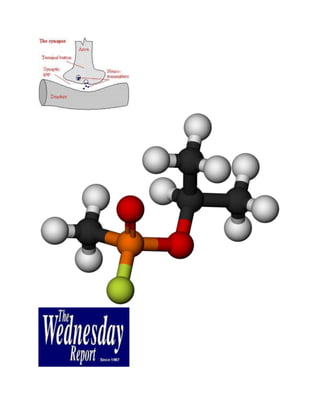
The nerve agents are chemical warfare agents known to be used during terrorist attacks. An inexpensive
and portable system to be used by first responders and military personnel is of interest owing to the
continuing threat of possible terrorist attacks. Amperometric biosensors based on cholinesterase
inhibition show such potentialities. In this work butyrylcholinesterase was immobilized onto screen-printed
electrodes modified with Prussian blue and the nerve agent detection was performed by measuring the
residual activity of enzyme. The optimized biosensor was tested with sarin and VX standard solutions,
showing detection limits of 12 and 14 ppb (10% of inhibition), respectively. The enzymatic inhibition was
also obtained by exposing the biosensors to sarin in gas phase. Two different concentrations of sarin gas
(0.1 and 0.5 mg m(-3)) at different incubation times (from 30 s up to 10 min) were tested. It is possible to
detect sarin at a concentration of 0.1 mg m(-3) with 30-s incubation time, with a degree of inhibition of
34%, which match the legal limits (immediate danger to life and health).
Abstract
A highly sensitive flow injection amperometric biosensor for organophosphate pesticides and nerve
agents based on self-assembled acetylcholinesterase (AChE) on a carbon nanotube (CNT)-modified
glassy carbon (GC) electrode is described. AChE is immobilized on the negatively charged CNT surface
by alternatively assembling a cationic poly(diallyldimethylammonium chloride) (PDDA) layer and an AChE
layer. Transmission electron microscopy images confirm the formation of layer-by-layer nanostructures on
carboxyl-functionalized CNTs. Fourier transform infrared reflectance spectrum indicates the AChE was
immobilized successfully on the CNT/PDDA surface. The unique sandwich-like structure
(PDDA/AChE/PDDA) on the CNT surface formed by self-assembling provides a favorable
microenvironment to keep the bioactivity of AChE. The electrocatalytic activity of CNT leads to a greatly
improved electrochemical detection of the enzymatically generated thiocholine product, including a low
oxidation overvoltage (+150 mV), higher sensitivity, and stability. The developed
PDDA/AChE/PDDA/CNT/GC biosensor integrated into a flow injection system was used to monitor
organophosphate pesticides and nerve agents, such as paraoxon. The sensor performance, including
inhibition time and regeneration conditions, was optimized with respect to operating conditions. Under the
optimal conditions, the biosensor was used to measure as low as 0.4 pM paraoxon with a 6-min inhibition
time. The biosensor had excellent operational lifetime stability with no decrease in the activity of enzymes
for more than 20 repeated measurements over a 1-week period. The developed biosensor system is an
ideal tool for online monitoring of organophosphate pesticides and nerve agents.
Abstract
In this study, a novel acetylcholinesterase (AChE) biosensor was developed based on dual-layer
membranes (chitosan membrane and prussian blue membrane) modifying glassy carbon electrode
(GCE). A chitosan membrane was used for immobilizing AChE through glutaraldehyde cross-linking
attachment to recognize pesticides selectively. A prussian blue (PB) membrane was electrodeposited on
the surface of GCE to enhance electron transfer. Before the detection, the chitosan enzyme membrane
was quickly fixed on the surface of PB/GCE with O-ring to prepare an amperometric AChE-PB/GCE
sensor for organophosphorus (OP) pesticides. The electrochemical behaviour of AChE-PB/GCE was
studied, and the results showed that the chitosan membrane as carrier can absorb a large amount of
enzyme, and PB has a significant synergistic effect towards enzymatic catalysis. As a result of these two
important enhancement factors, the proposed biosensor exhibited extreme sensitivity to OP pesticides
compared to the other kinds of AChE biosensor. The influences of phosphate buffer pH, substrate
concentration, incubation time of pesticide on the response of the fabricated biosensor were investigated.
Under optimum conditions, the inhibition rates of these pesticides were proportional to their
concentrations in the range of 0.01-10 microg l(-1), 0.05-10 microg l(-1), 0.03-5 microg l(-1), and 0.05-10
microg l(-1), respectively. The detection limits were found to be 2.5 ng l(-1) for dichlorvos, 15 ng l(-1) for
omethoate, 5 ng l(-1) for trichlorfon and 10 ng l(-1) for phoxim. Moreover, the biosensor exhibited good
reproducibility and stability, and it was suitable for trace detection of OP pesticide residue.
Organophosphorus compounds or organophosphates are commonly used in the
industrial, agricultural and home settings. They were initially developed as insecticides
but some of them i.e. sarin, soman, tabun and VX have been developed as
“nerve gases”. These are used as chemical warfare and in terrorist attacks.
Some organophosphorus compounds are used as pesticides in agriculture. These are
highly toxic and include tetraethyl pyrophosphate and parathione. Other
organophosphates such as coumaphos, chlorpyrifos and trichlorfon are used as
animal insecticides and have intermediate toxicity. Low toxicity compounds
are malathione, diazinon and dichlorovos. These are used as household
insecticides.
Read more: Organophosphorus Poisoning |
Medindia http://www.medindia.net/patients/patientinfo/organophosphorus-poisoning.htm#ixzz2f9bnm33f

Abstract

  • 1.
    Abstract: The useof magnetic nanomaterials in biosensing applications is growing as a consequence of their remarkable properties; but controlling the composition and shape of metallic nanoalloys is problematic when more than one precursor is required for wet chemistry synthesis. We have developed a successful simultaneous reduction method for preparation of near-spherical platinum-based nanoalloys containing magnetic solutes. We avoided particular difficulties in preparing platinum nanoalloys containing Ni, Co and Fe by the identification of appropriate synthesis temperatures and chemistry. We used transmission electron microscopy (TEM) to show that our particles have a narrow size distribution, uniform size and morphology, and good crystallinity in the as-synthesized condition. Energy dispersive spectroscopy (EDS) and X-ray diffraction (XRD) confirms the coexistence of Pt with the magnetic solute in a face-centered cubic (FCC) solid solution. What is biosensor A biosensor is a self-contained integrated device, which is capable of providing specific quantitative or semi- quantitative analytical information using a biological recognition element (biochemical receptor) which is retained in direct spatial contact with a transduction element. Applications of biosensors   Glucose monitoring in diabetes patients Other medical health related targets Environmental applications Remote sensing of airborne bacteria Detection of pathogens Determining levels of toxic substances Detection of toxic metabolites
  • 2.
      Detection and determiningof organophosphate Routine analytical measurements Determination of drug residues in food Drug discovery and evaluation of biological activity of new compounds Protein engineering in biosensors Glucose monitoring in diabetes patients Other medical health related targets Environmental applications Remote sensing of airborne bacteria Detection of pathogens Determining levels of toxic substances Detection of toxic metabolites Applications of biosensors Nanomaterials in biosensors The use of nanomaterials and structures such as semiconductors and conducting polymer nanowires,
  • 3.
    and nanoparticles (carbonnanotubes, silica nanoparticles, dendrimers, noble metals nanoparticles, gold nanoshells, superparamagnetic nanoparticles quantum dots, polymeric nanoparticles) for biosensor applications is expanding rapidly. Nanomaterials in biosensors Ibtisam E. 10 Unique and novel physical and/or chemical characteristics of nanomaterials can aid the design of bio-sensors with improved analytical characteristics. High surface / volume ratio Novel elctro-optical properties Increased catalytical activity Enhanced electron transfer Nanomaterials in biosensors Ibtisam E. Tothill, World Mycotoxin Journal, 2011, 4 (4) 361-374 Organic based: •Fullerenes
  • 4.
    •Carbon nanotubes •Dendrimers •Liposomes Inorganic: •Quantumdots •Metal nanorods •Metal nanoparticles ● Examples of nanoparticles used in sensors developments . Programmable glue made of DNA directs tiny gel bricks to self-assemble New method could help to reconnect injured organs or build functional human tissues from the ground up A team of researchers at the Wyss Institute for Biologically Inspired Engineering at Harvard University has found a way to self-assemble complex structures out of bricks smaller than a grain of salt. The self- assembly method could help solve one of the major challenges in tissue engineering: regrowing human tissue by injecting tiny components into the body that then self-assemble into larger, intricately structured, biocompatible scaffolds at an injury site.
  • 5.
    IBN’s novel techniquebrings researchers closer to viable organ implants An Organized Approach to 3D Tissue Engineering Researchers at the Institute of Bioengineering and Nanotechnology (IBN) have developed a simple method of organizing cells and their microenvironments in hydrogel fibers. Their unique technology provides a feasible template for assembling complex structures, such as liver and fat tissues, as described in their recent publication in Nature Communications. According to IBN Executive Director Professor Jackie Y. Ying, “Our tissue engineering approach gives researchers great control and flexibility over the arrangement of individual cell types, making it possible to engineer prevascularized tissue constructs easily. This innovation brings us a step closer toward developing viable tissue or organ replacements.” Mini Mona Lisa Painted On World's Smallest 'Canvas' Using Nanotechnology The enigmatic image is perhaps the most reproduced in art history, but it's never before been painted on such a small canvas. Using a novel nanotechnique, researchers have made a miniature Mona Lisa that stretches 30 microns
  • 6.
    across, just athird of the width of a human hair. Just months after setting a record for detecting the smallest single virus in solution, researchers at the Polytechnic Institute of New York University (NYU-Poly) have announced a new breakthrough: They used a nano-enhanced version of their patented microcavity biosensor to detect a single cancer marker protein, which is one-sixth the size of the smallest virus, and even smaller molecules below the mass of all known markers. This achievement shatters the previous record, setting a new benchmark for the most sensitive limit of detection, and may significantly advance early disease diagnostics. Unlike current technology, which attaches a fluorescent molecule, or label, to the antigen to allow it to be seen, the new process detects the antigen without an interfering label. Stephen Arnold, university professor of applied physics and member of the Othmer-Jacobs Department of
  • 7.
    Chemical and BiomolecularEngineering, published details of the achievement in Nano Letters, a publication of the American Chemical Society , NRL scientists are developing unique systems aimed at the spontaneous decontamination of a variety of materials via the incorporation of functional additives such as quaternary ammonium salt (QAS) biocides, polyoxometalates (POMs), fullerenes, and phthalocyanines capable of neutralizing chemical and biological agents. The nerve agents are chemical warfare agents known to be used during terrorist attacks. An inexpensive and portable system to be used by first responders and military personnel is of interest owing to the continuing threat of possible terrorist attacks. Amperometric biosensors based on cholinesterase inhibition show such potentialities. In this work butyrylcholinesterase was immobilized onto screen-printed electrodes modified with Prussian blue and the nerve agent detection was performed by measuring the residual activity of enzyme. The optimized biosensor was tested with sarin and VX standard solutions, showing detection limits of 12 and 14 ppb (10% of inhibition), respectively. The enzymatic inhibition was also obtained by exposing the biosensors to sarin in gas phase. Two different concentrations of sarin gas
  • 8.
    (0.1 and 0.5mg m(-3)) at different incubation times (from 30 s up to 10 min) were tested. It is possible to detect sarin at a concentration of 0.1 mg m(-3) with 30-s incubation time, with a degree of inhibition of 34%, which match the legal limits (immediate danger to life and health). Abstract A highly sensitive flow injection amperometric biosensor for organophosphate pesticides and nerve agents based on self-assembled acetylcholinesterase (AChE) on a carbon nanotube (CNT)-modified glassy carbon (GC) electrode is described. AChE is immobilized on the negatively charged CNT surface by alternatively assembling a cationic poly(diallyldimethylammonium chloride) (PDDA) layer and an AChE layer. Transmission electron microscopy images confirm the formation of layer-by-layer nanostructures on carboxyl-functionalized CNTs. Fourier transform infrared reflectance spectrum indicates the AChE was immobilized successfully on the CNT/PDDA surface. The unique sandwich-like structure (PDDA/AChE/PDDA) on the CNT surface formed by self-assembling provides a favorable microenvironment to keep the bioactivity of AChE. The electrocatalytic activity of CNT leads to a greatly improved electrochemical detection of the enzymatically generated thiocholine product, including a low oxidation overvoltage (+150 mV), higher sensitivity, and stability. The developed PDDA/AChE/PDDA/CNT/GC biosensor integrated into a flow injection system was used to monitor organophosphate pesticides and nerve agents, such as paraoxon. The sensor performance, including inhibition time and regeneration conditions, was optimized with respect to operating conditions. Under the optimal conditions, the biosensor was used to measure as low as 0.4 pM paraoxon with a 6-min inhibition time. The biosensor had excellent operational lifetime stability with no decrease in the activity of enzymes for more than 20 repeated measurements over a 1-week period. The developed biosensor system is an ideal tool for online monitoring of organophosphate pesticides and nerve agents. Abstract In this study, a novel acetylcholinesterase (AChE) biosensor was developed based on dual-layer membranes (chitosan membrane and prussian blue membrane) modifying glassy carbon electrode (GCE). A chitosan membrane was used for immobilizing AChE through glutaraldehyde cross-linking attachment to recognize pesticides selectively. A prussian blue (PB) membrane was electrodeposited on the surface of GCE to enhance electron transfer. Before the detection, the chitosan enzyme membrane was quickly fixed on the surface of PB/GCE with O-ring to prepare an amperometric AChE-PB/GCE sensor for organophosphorus (OP) pesticides. The electrochemical behaviour of AChE-PB/GCE was studied, and the results showed that the chitosan membrane as carrier can absorb a large amount of enzyme, and PB has a significant synergistic effect towards enzymatic catalysis. As a result of these two important enhancement factors, the proposed biosensor exhibited extreme sensitivity to OP pesticides compared to the other kinds of AChE biosensor. The influences of phosphate buffer pH, substrate concentration, incubation time of pesticide on the response of the fabricated biosensor were investigated. Under optimum conditions, the inhibition rates of these pesticides were proportional to their concentrations in the range of 0.01-10 microg l(-1), 0.05-10 microg l(-1), 0.03-5 microg l(-1), and 0.05-10 microg l(-1), respectively. The detection limits were found to be 2.5 ng l(-1) for dichlorvos, 15 ng l(-1) for omethoate, 5 ng l(-1) for trichlorfon and 10 ng l(-1) for phoxim. Moreover, the biosensor exhibited good reproducibility and stability, and it was suitable for trace detection of OP pesticide residue.
  • 10.
    Organophosphorus compounds ororganophosphates are commonly used in the industrial, agricultural and home settings. They were initially developed as insecticides but some of them i.e. sarin, soman, tabun and VX have been developed as “nerve gases”. These are used as chemical warfare and in terrorist attacks. Some organophosphorus compounds are used as pesticides in agriculture. These are highly toxic and include tetraethyl pyrophosphate and parathione. Other organophosphates such as coumaphos, chlorpyrifos and trichlorfon are used as animal insecticides and have intermediate toxicity. Low toxicity compounds are malathione, diazinon and dichlorovos. These are used as household insecticides. Read more: Organophosphorus Poisoning | Medindia http://www.medindia.net/patients/patientinfo/organophosphorus-poisoning.htm#ixzz2f9bnm33f