COMPUTER FUNDAMENTALS
2
WHAT IS COMPUTER?
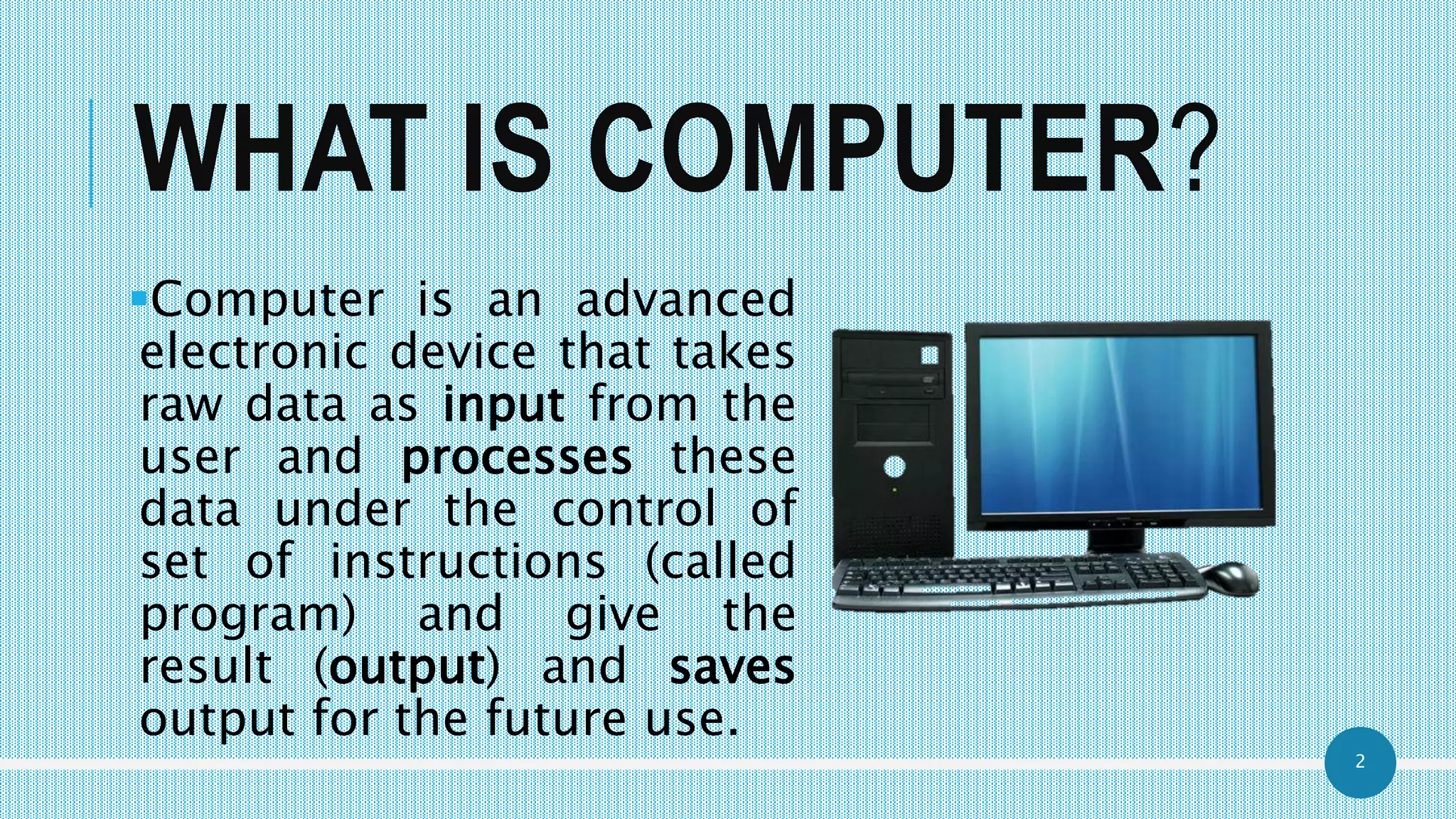
Computer is an advanced
electronic device that takes
raw data as input from the
user and processes these
data under the control of
set of instructions (called
program) and give the
result (output) and saves
output for the future use.
3
A COMPUTER HAS FOUR
FUNCTIONS:
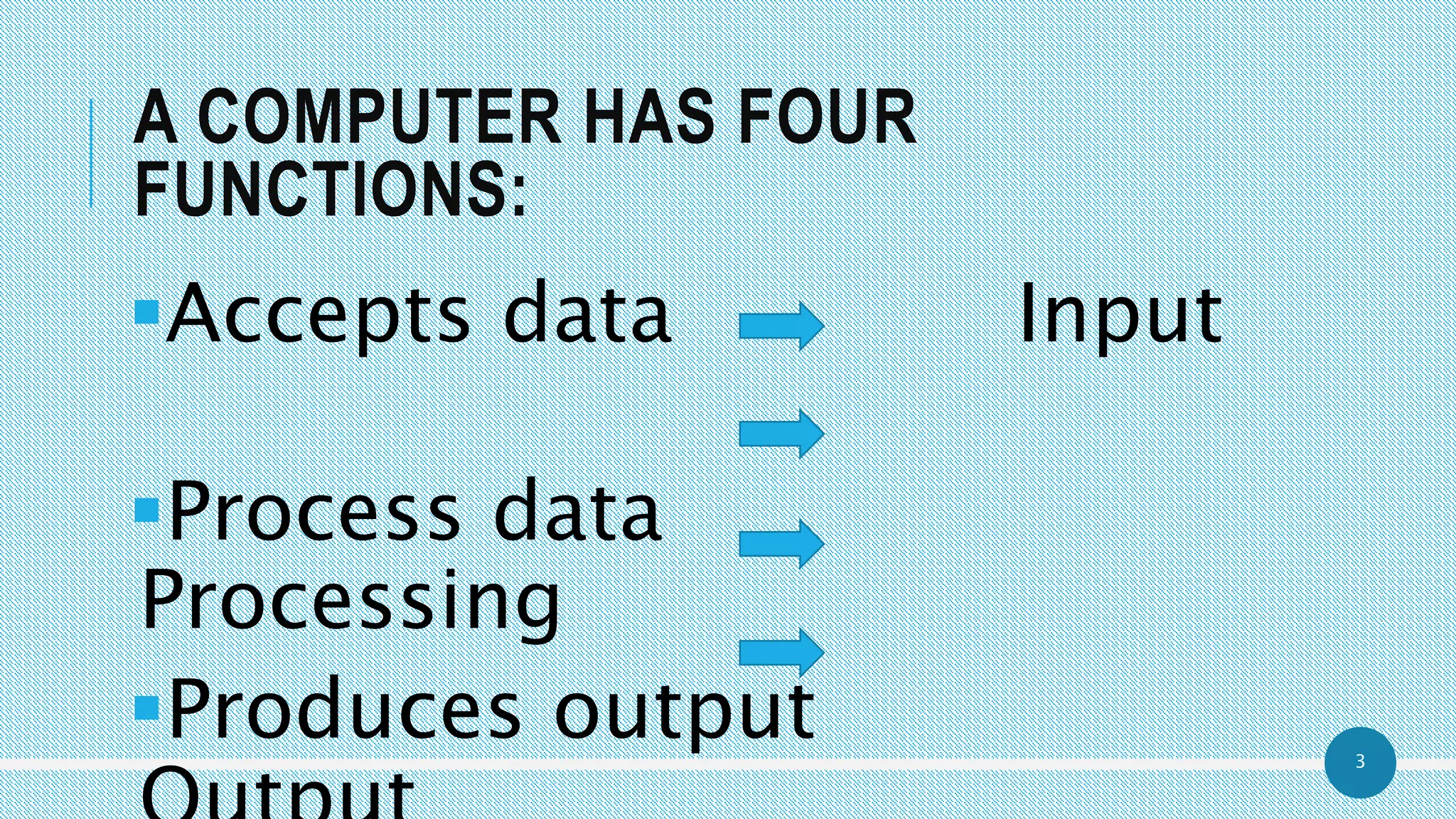
Accepts data Input
Process data
Processing
Produces output
Input
Output
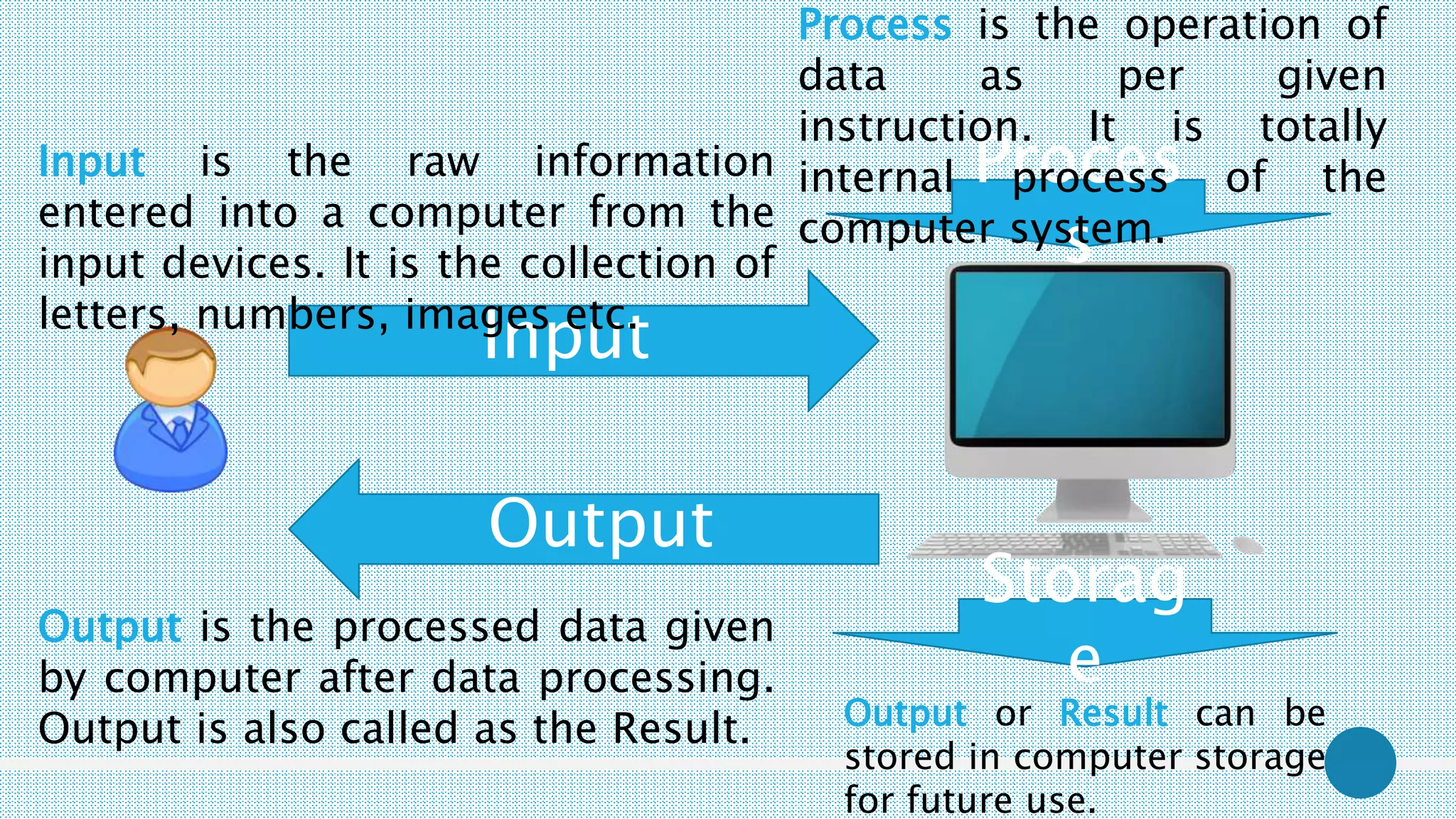
Input is the raw information
entered into a computer from the
input devices. It is the collection of
letters, numbers, images etc.
Proces
s
Process is the operation of
data as per given
instruction. It is totally
internal process of the
computer system.
Storag
e
Output is the processed data given
by computer after data processing.
Output is also called as the Result. Output or Result can be
stored in computer storage
for future use.
5
COMPUTER SYSTEM
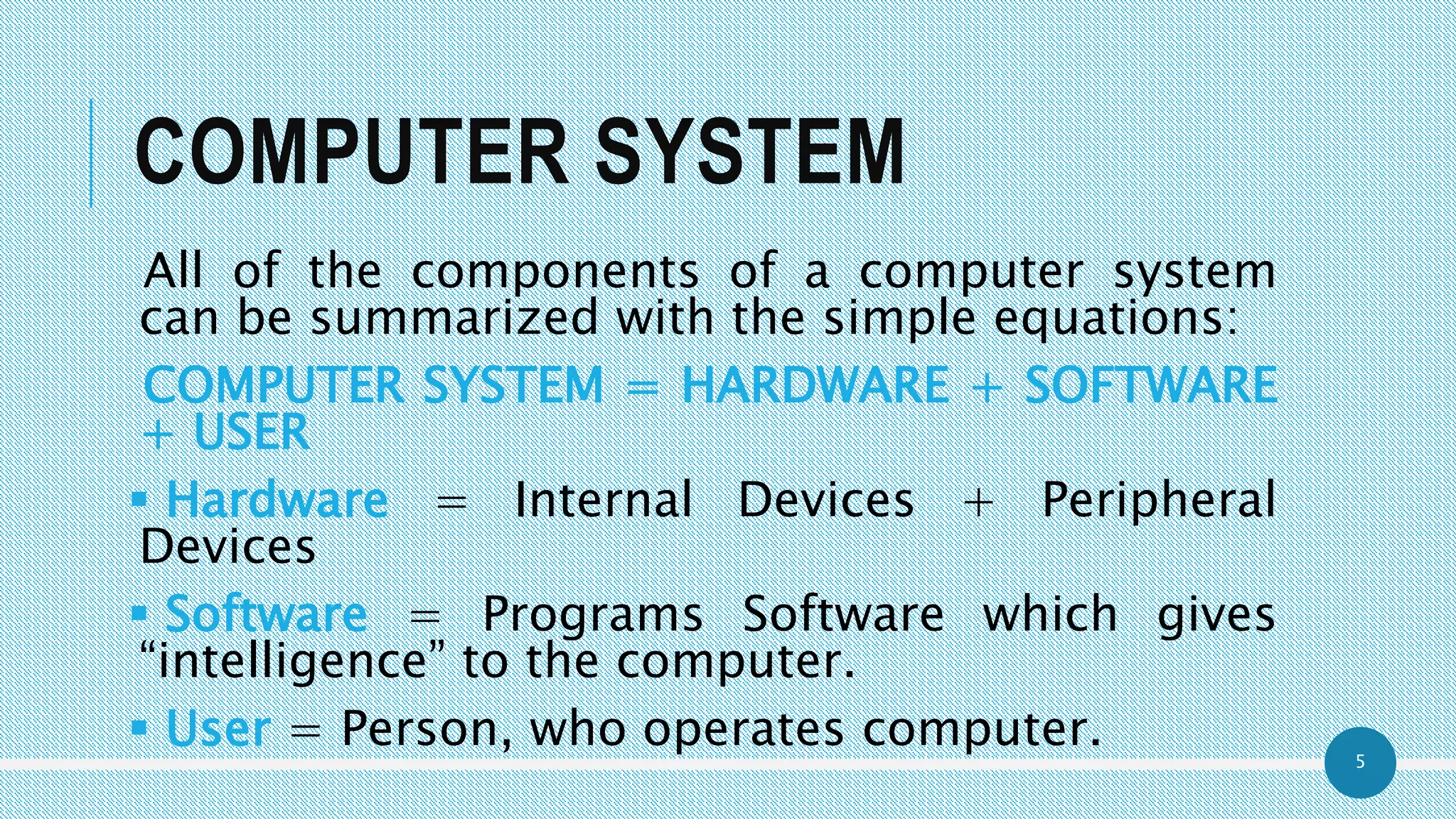
All of the components of a computer system
can be summarized with the simple equations:
COMPUTER SYSTEM = HARDWARE + SOFTWARE
+ USER
 Hardware = Internal Devices + Peripheral
Devices
 Software = Programs Software which gives
“intelligence” to the computer.
 User = Person, who operates computer.
6
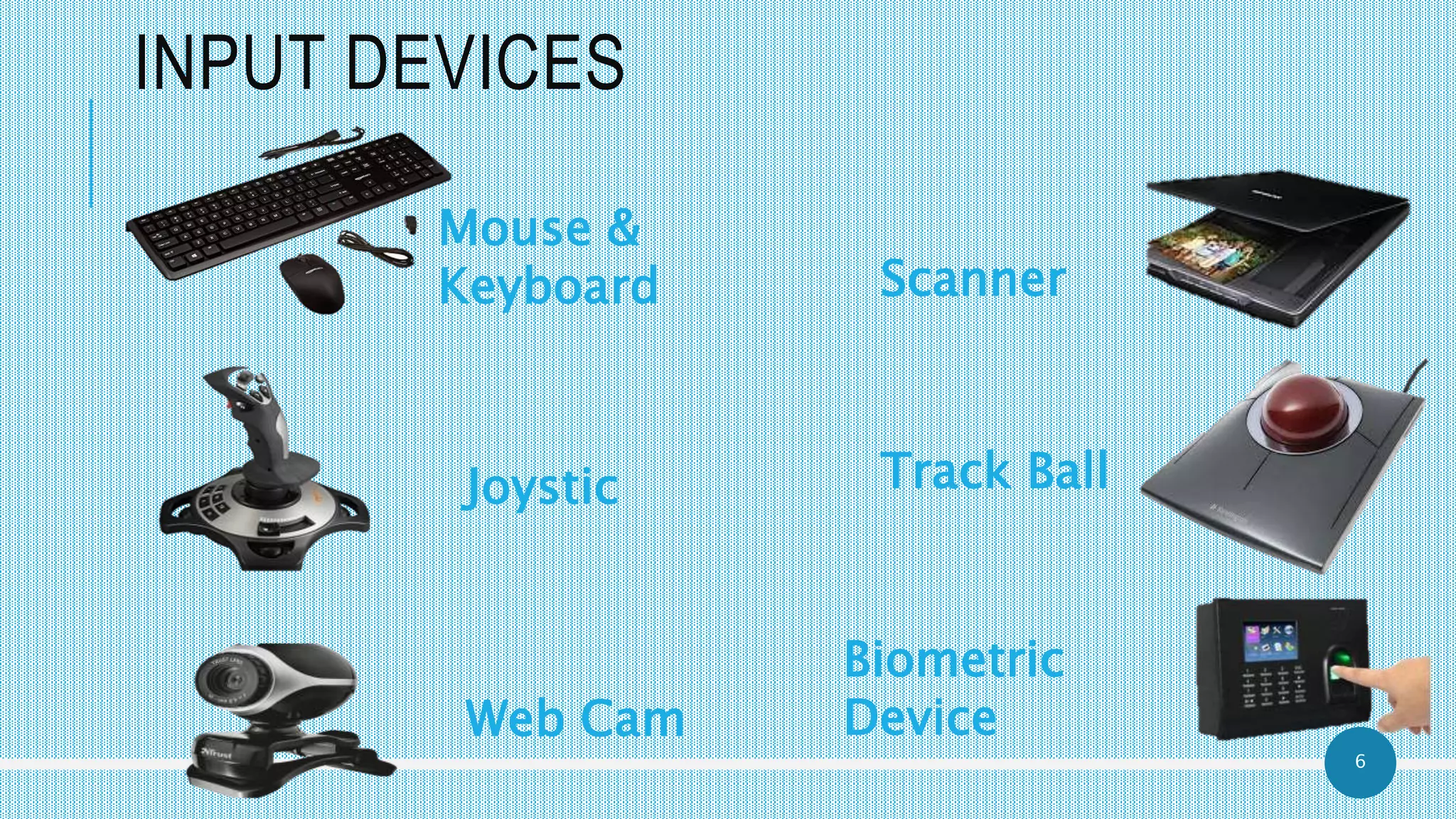
INPUT DEVICES
Mouse &
Keyboard Scanner
Track Ball
Biometric
Device
Joystic
Web Cam
7
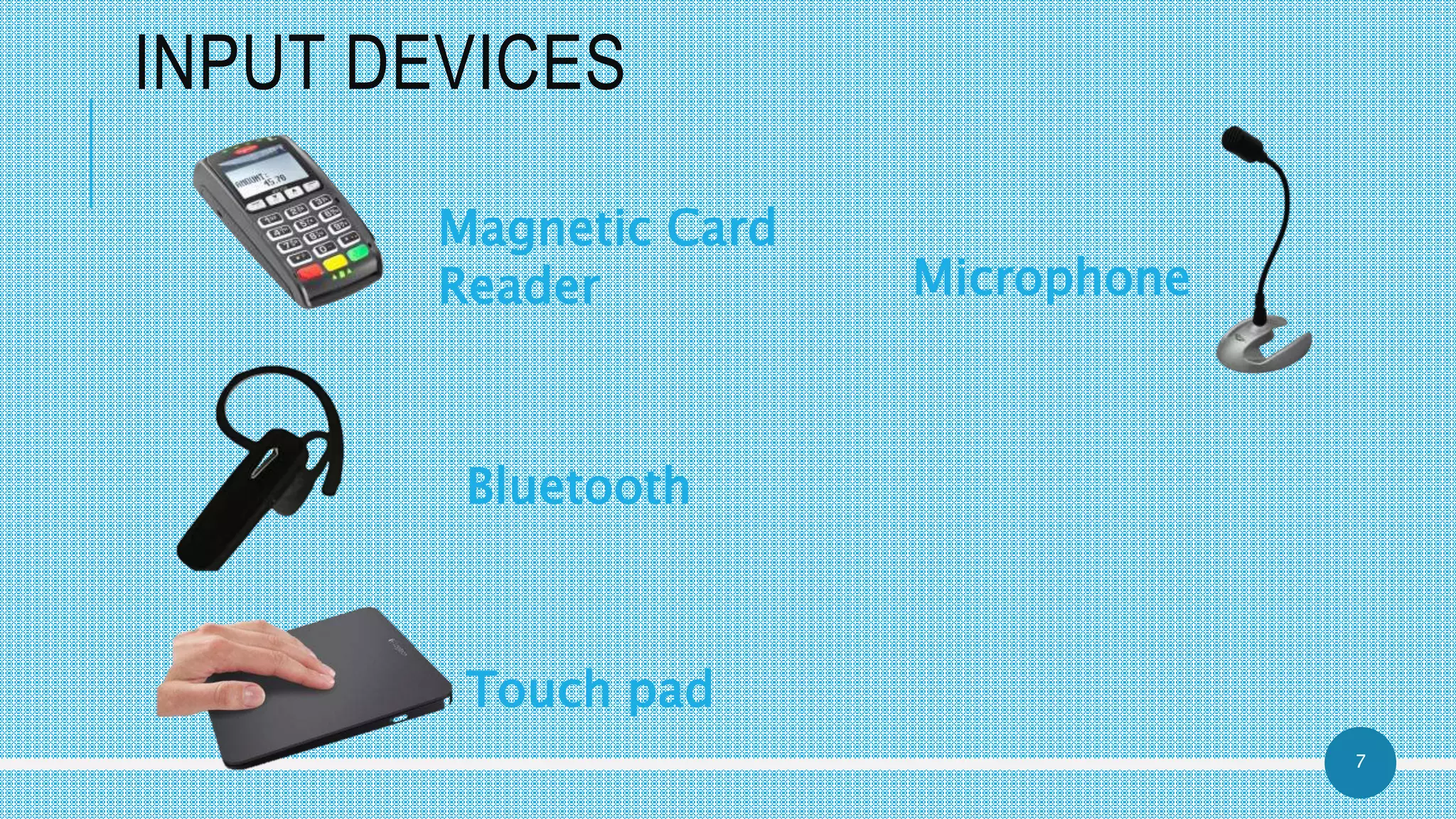
INPUT DEVICES
Magnetic Card
Reader Microphone
Bluetooth
Touch pad
8
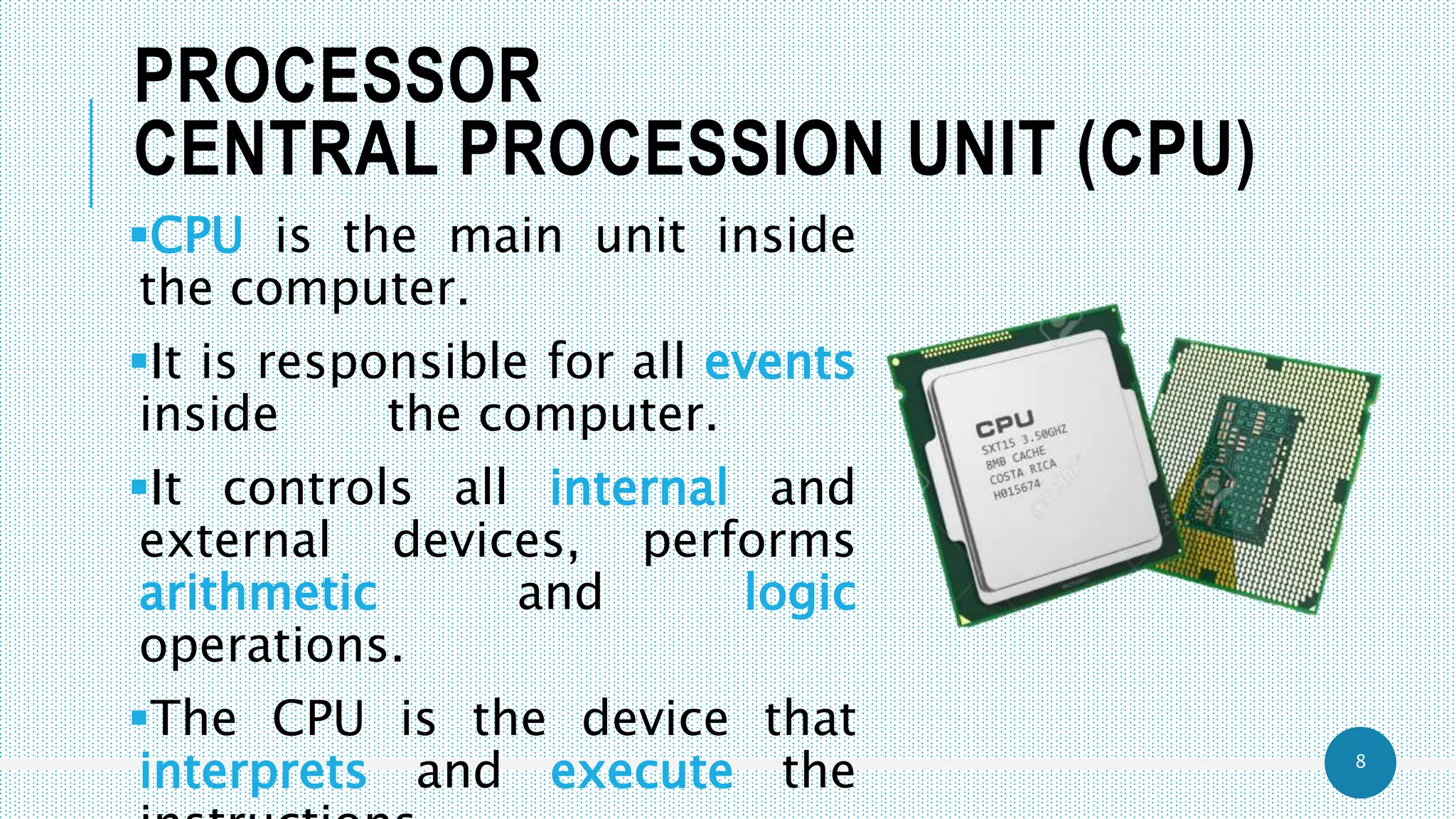
PROCESSOR
CENTRAL PROCESSION UNIT (CPU)
CPU is the main unit inside
the computer.
It is responsible for all events
inside the computer.
It controls all internal and
external devices, performs
arithmetic and logic
operations.
The CPU is the device that
interprets and execute the
9
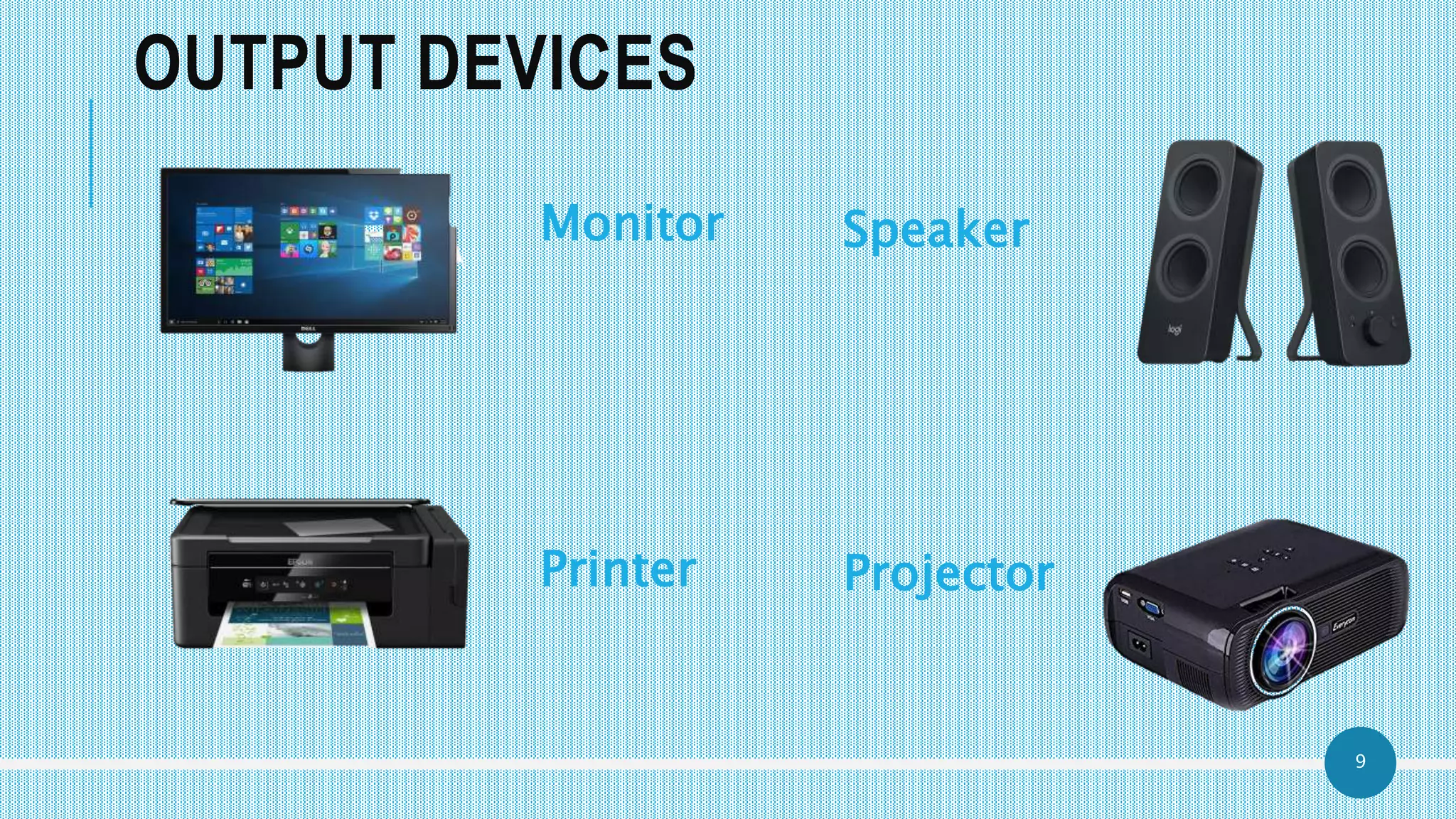
OUTPUT DEVICES
Monitor Speaker
Printer Projector
10
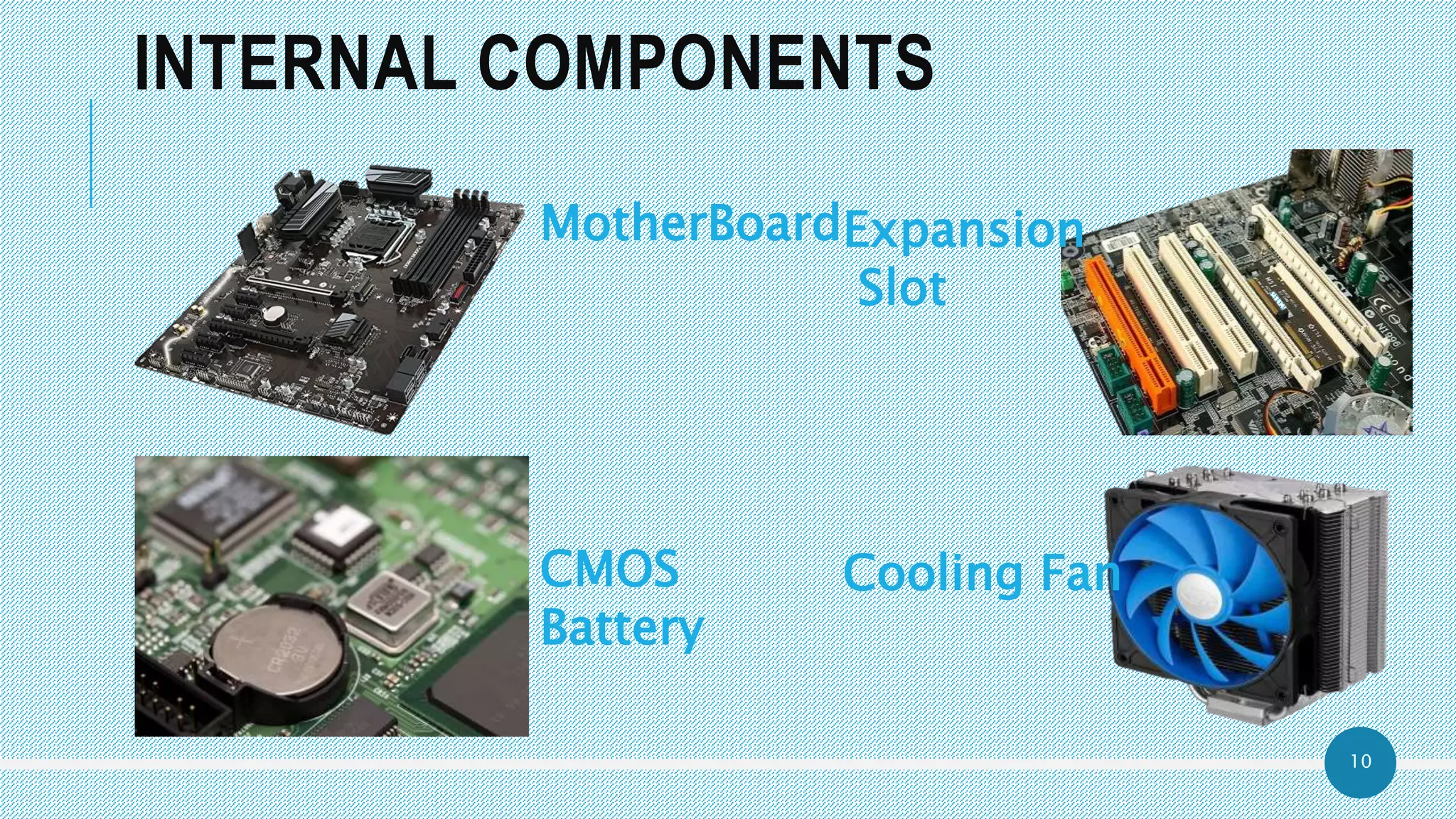
INTERNAL COMPONENTS
MotherBoardExpansion
Slot
CMOS
Battery
Cooling Fan
11
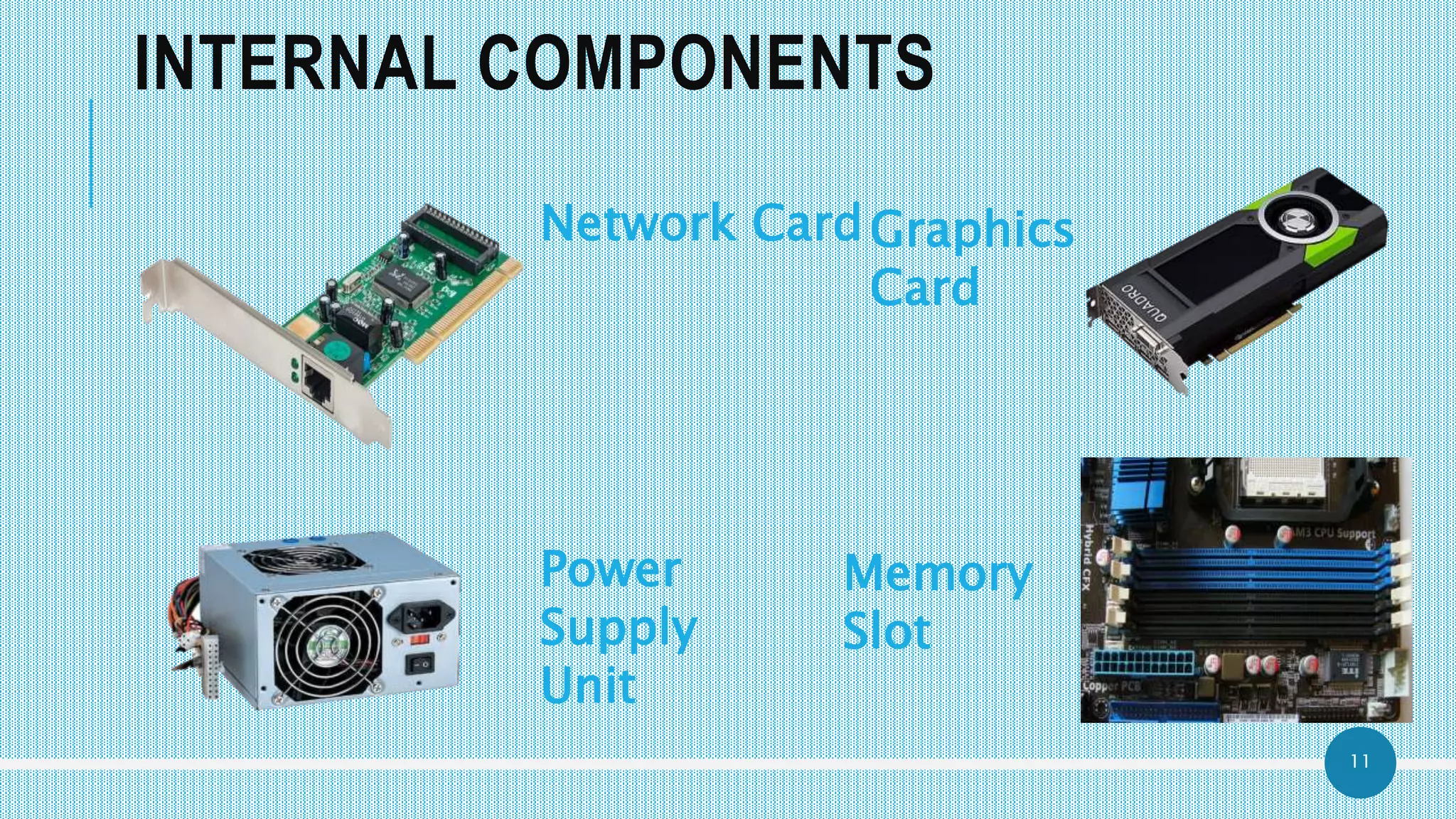
INTERNAL COMPONENTS
Network CardGraphics
Card
Power
Supply
Unit
Memory
Slot
12
TYPES OF COMPUTER
ON THE BASES OF WORKING PRINCIPLE
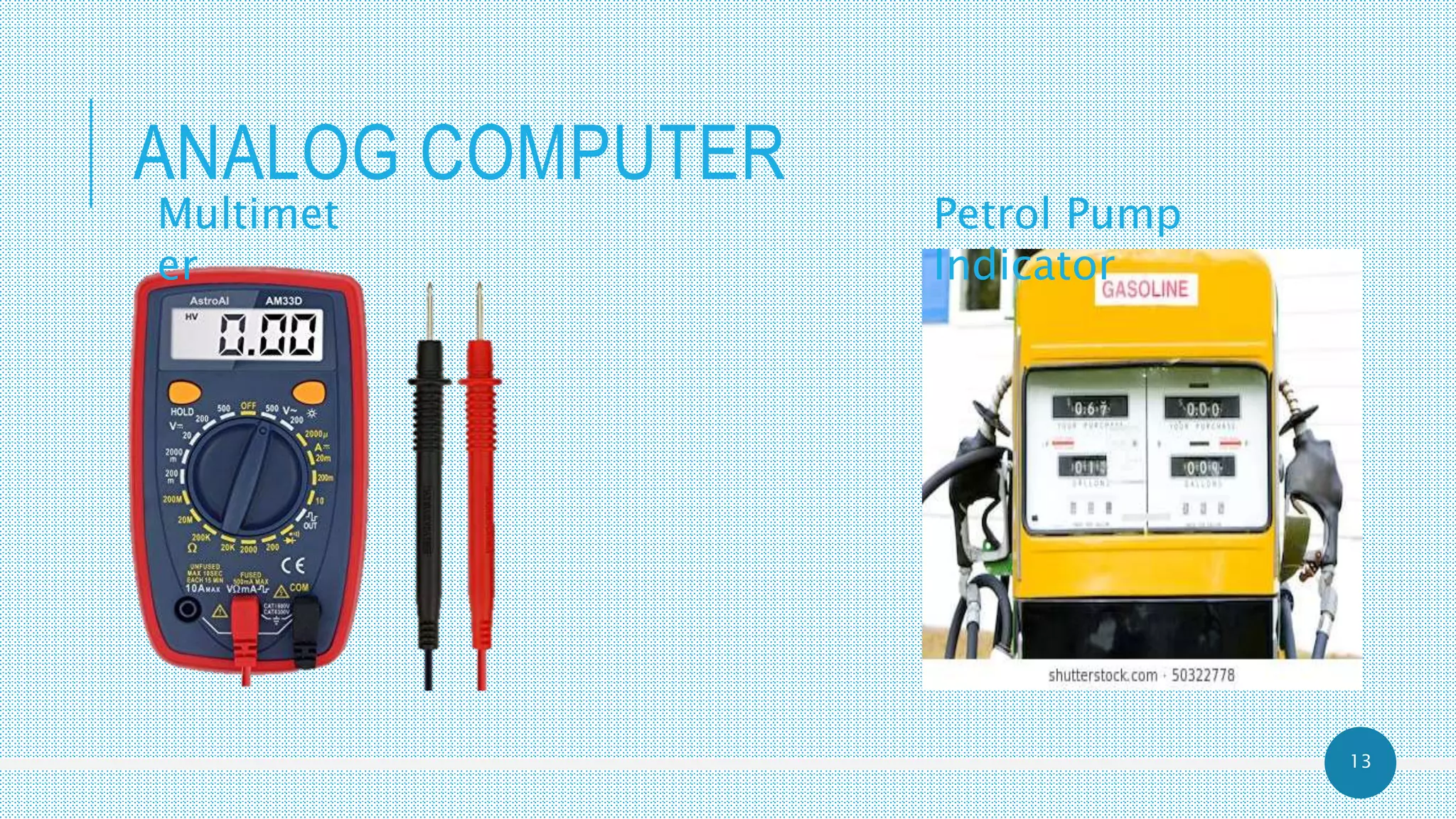
a) Analog Computer
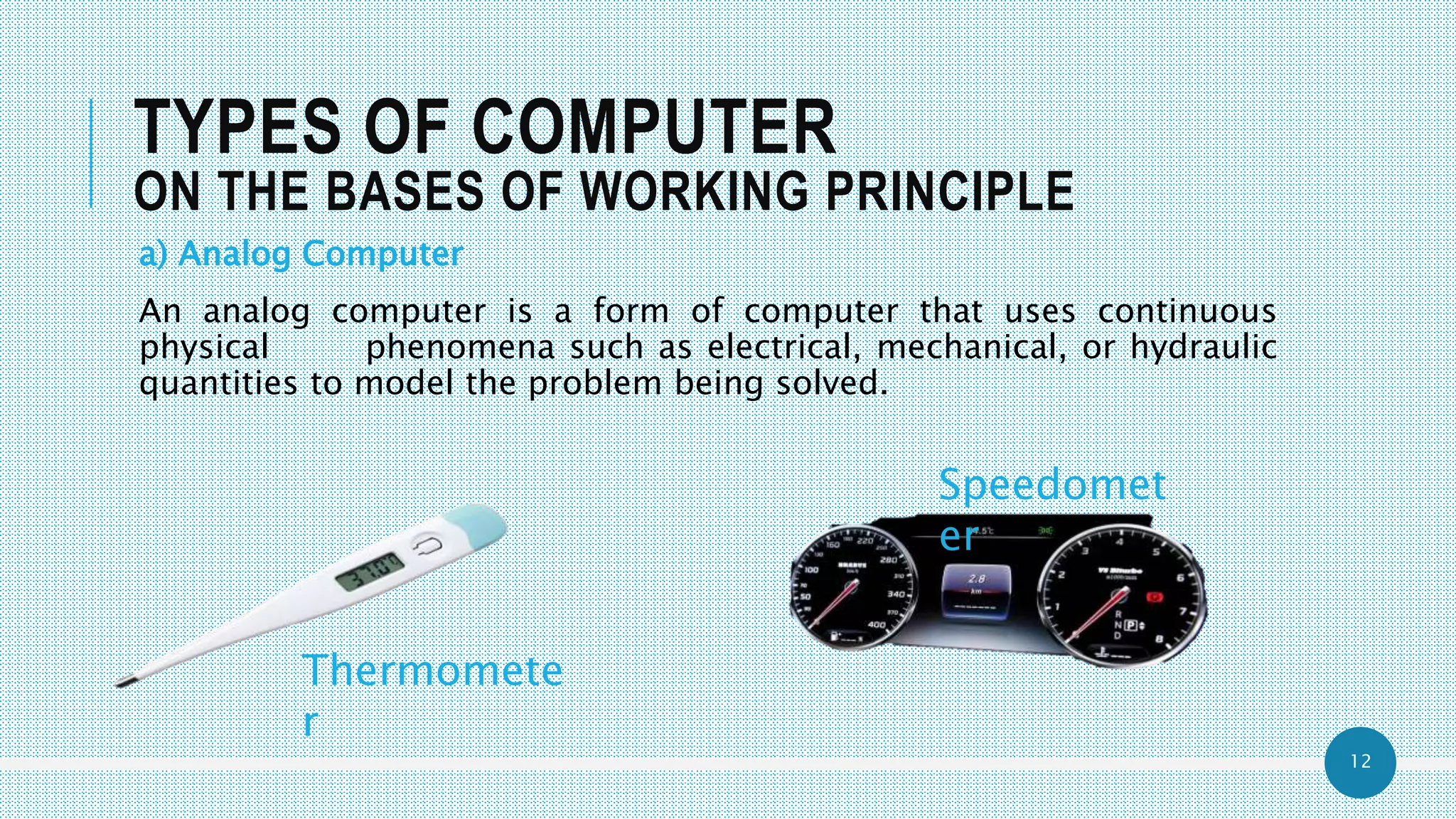
An analog computer is a form of computer that uses continuous
physical phenomena such as electrical, mechanical, or hydraulic
quantities to model the problem being solved.
Thermomete
r
Speedomet
er
13
ANALOG COMPUTER
Multimet
er
Petrol Pump
Indicator
14
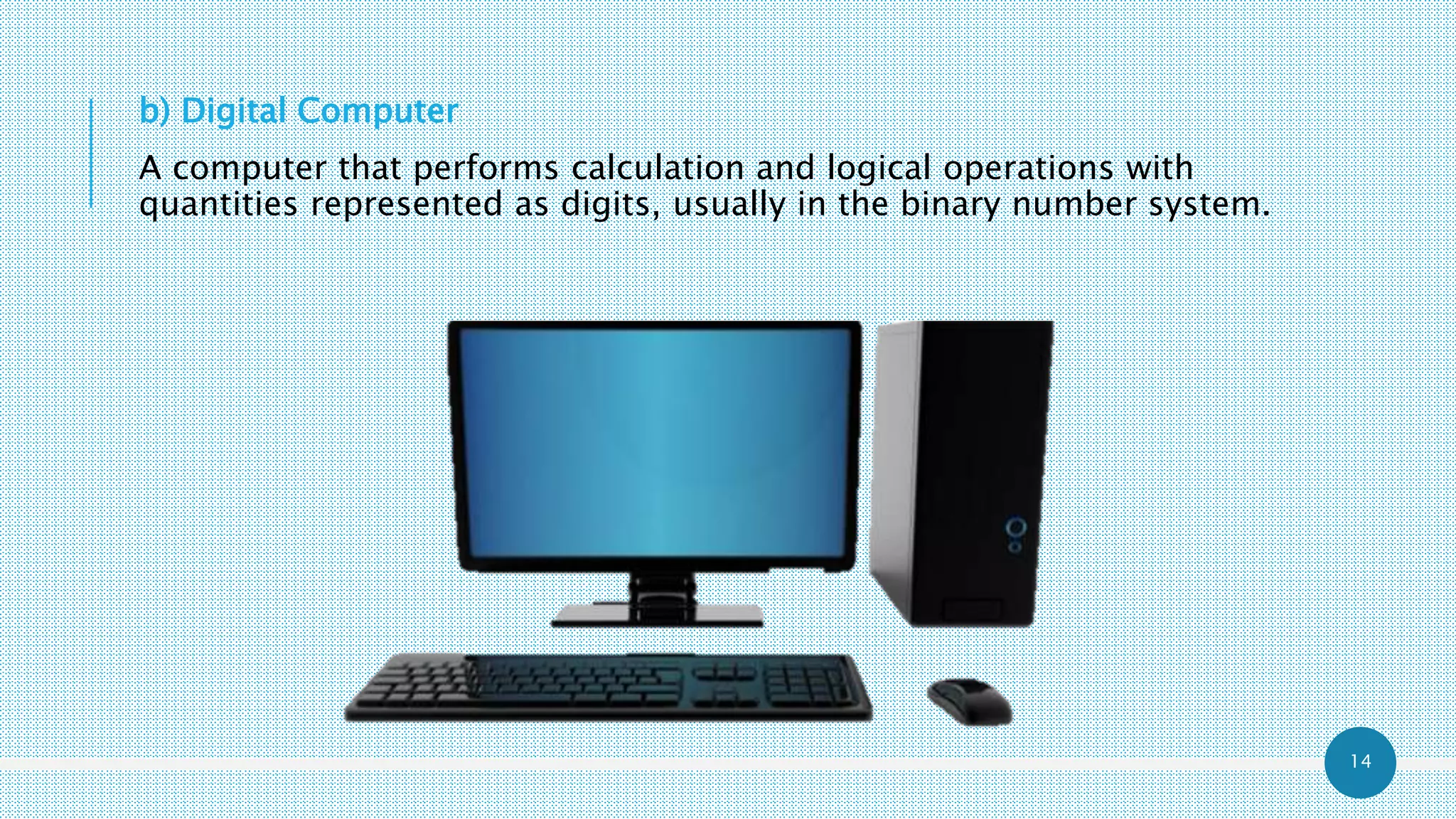
b) Digital Computer
A computer that performs calculation and logical operations with
quantities represented as digits, usually in the binary number system.
15
b) Hybrid Computer (Analog + Digital)
A combination of computers those are capable of inputting and
outputting in both digital and analog signals.
16
ON THE BASIS OF SIZE
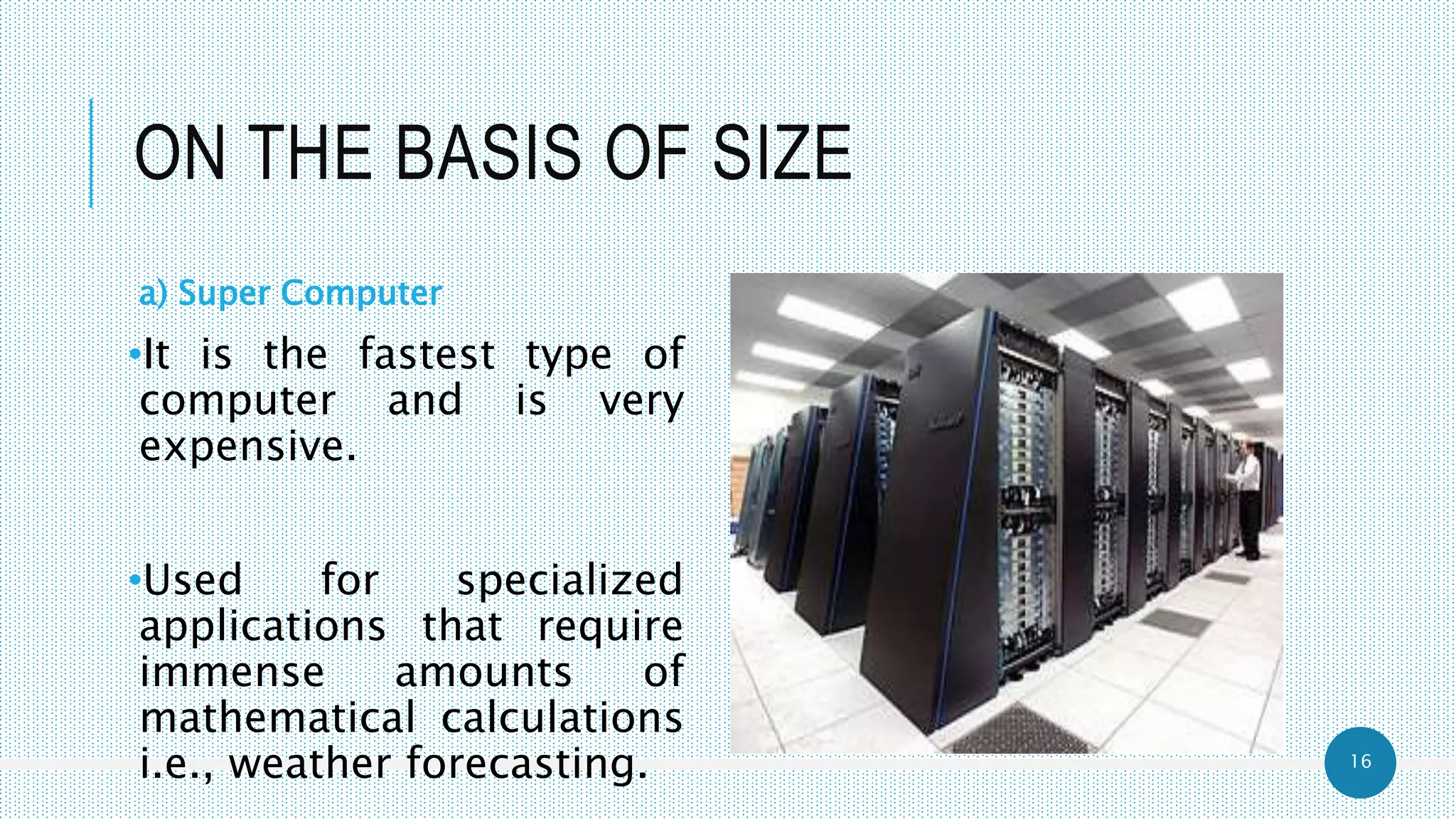
a) Super Computer
•It is the fastest type of
computer and is very
expensive.
•Used for specialized
applications that require
immense amounts of
mathematical calculations
i.e., weather forecasting.
17
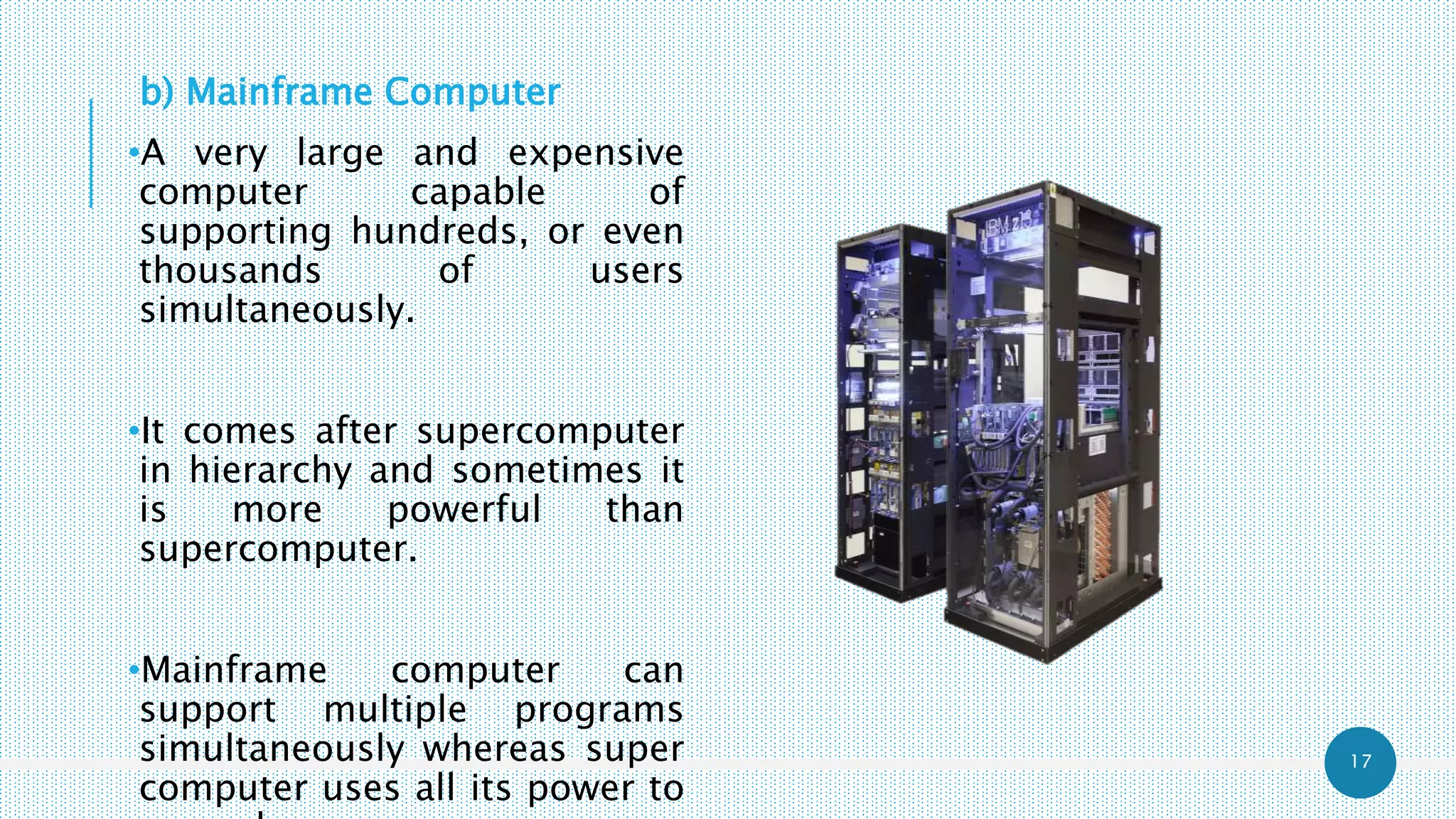
b) Mainframe Computer
•A very large and expensive
computer capable of
supporting hundreds, or even
thousands of users
simultaneously.
•It comes after supercomputer
in hierarchy and sometimes it
is more powerful than
supercomputer.
•Mainframe computer can
support multiple programs
simultaneously whereas super
computer uses all its power to
18
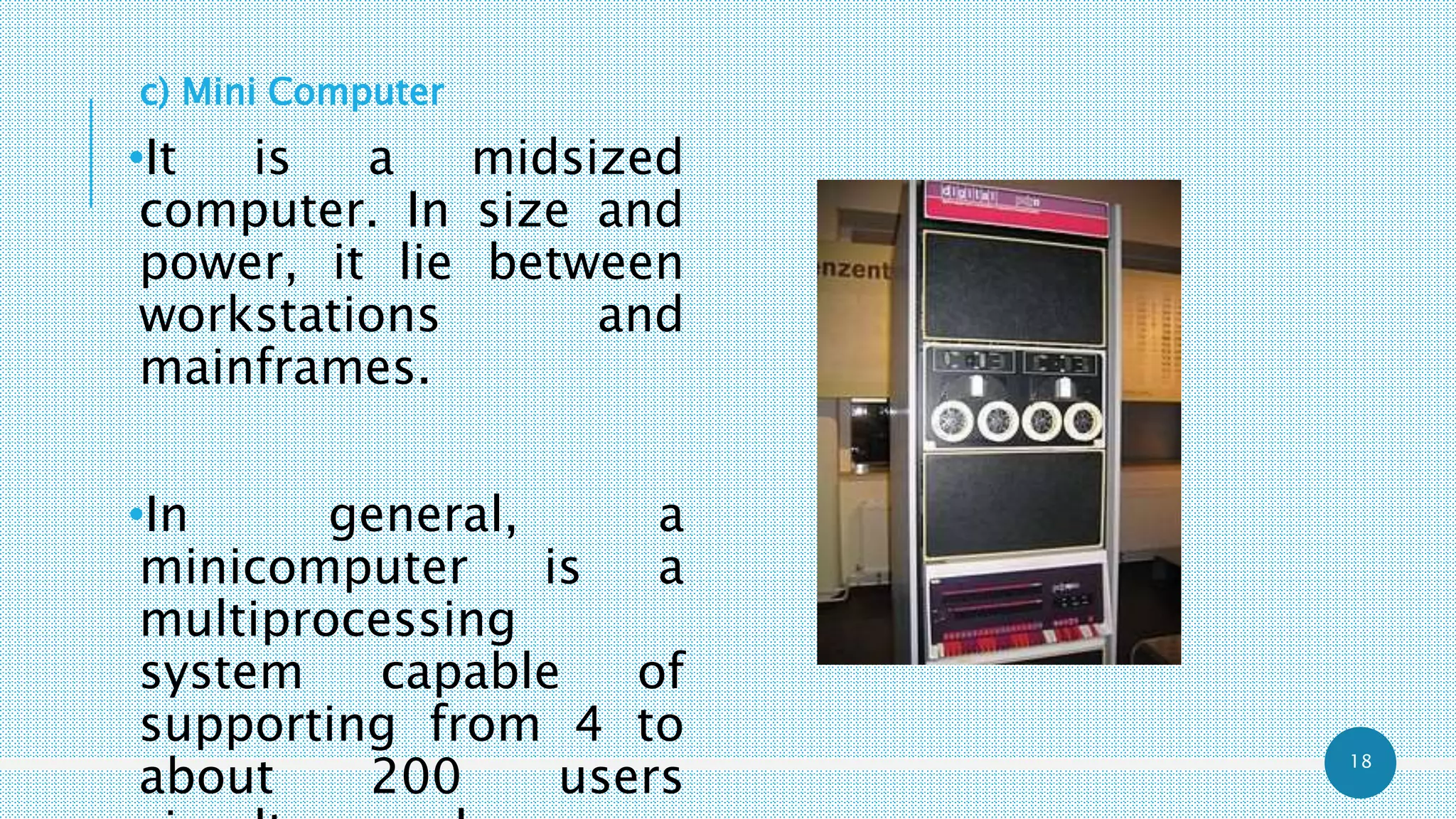
c) Mini Computer
•It is a midsized
computer. In size and
power, it lie between
workstations and
mainframes.
•In general, a
minicomputer is a
multiprocessing
system capable of
supporting from 4 to
about 200 users
19
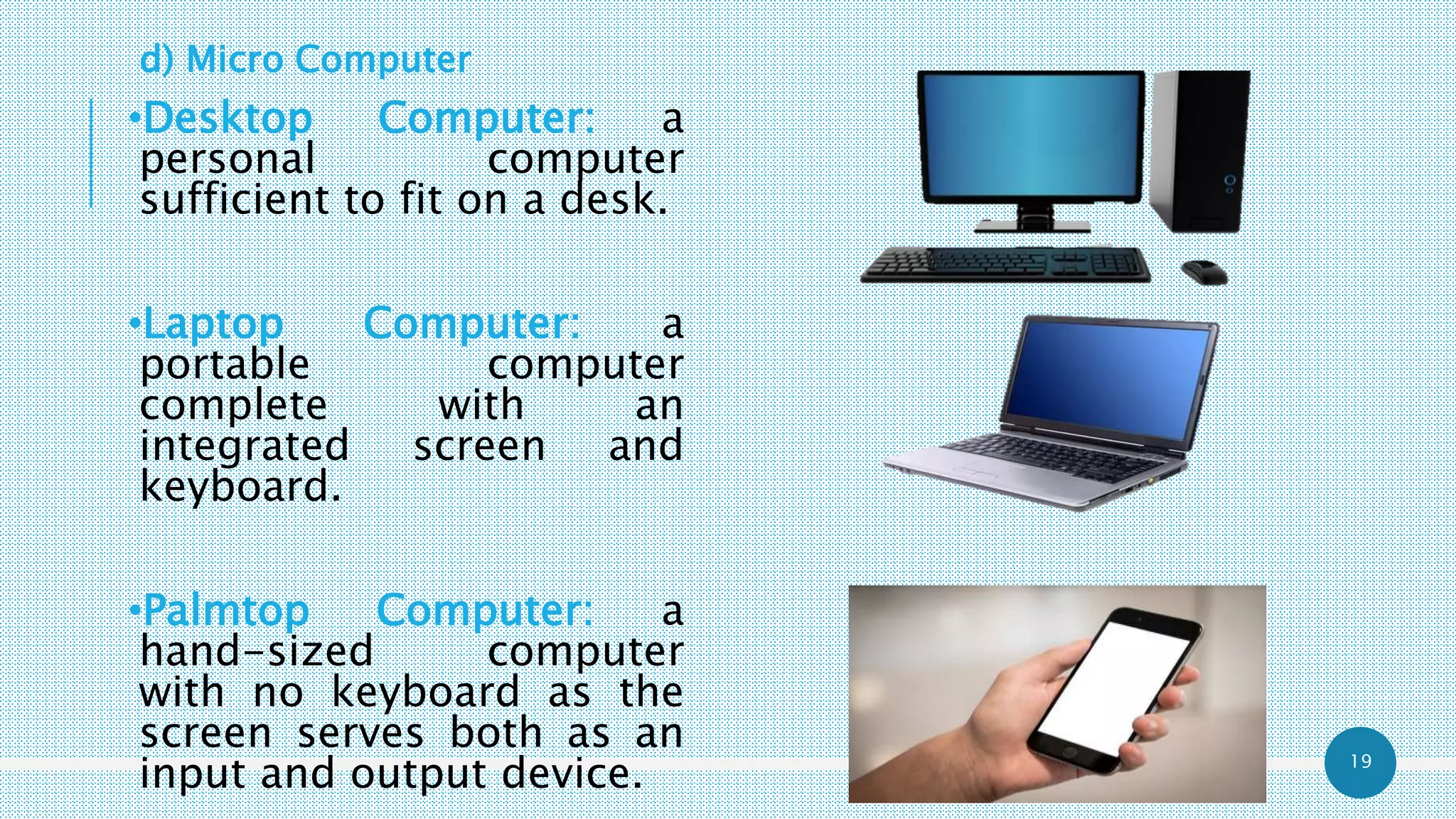
d) Micro Computer
•Desktop Computer: a
personal computer
sufficient to fit on a desk.
•Laptop Computer: a
portable computer
complete with an
integrated screen and
keyboard.
•Palmtop Computer: a
hand-sized computer
with no keyboard as the
screen serves both as an
input and output device.

Computer fundamentals

  • 1.
  • 2.
    2 WHAT IS COMPUTER? Computeris an advanced electronic device that takes raw data as input from the user and processes these data under the control of set of instructions (called program) and give the result (output) and saves output for the future use.
  • 3.
    3 A COMPUTER HASFOUR FUNCTIONS: Accepts data Input Process data Processing Produces output
  • 4.
    Input Output Input is theraw information entered into a computer from the input devices. It is the collection of letters, numbers, images etc. Proces s Process is the operation of data as per given instruction. It is totally internal process of the computer system. Storag e Output is the processed data given by computer after data processing. Output is also called as the Result. Output or Result can be stored in computer storage for future use.
  • 5.
    5 COMPUTER SYSTEM All ofthe components of a computer system can be summarized with the simple equations: COMPUTER SYSTEM = HARDWARE + SOFTWARE + USER  Hardware = Internal Devices + Peripheral Devices  Software = Programs Software which gives “intelligence” to the computer.  User = Person, who operates computer.
  • 6.
    6 INPUT DEVICES Mouse & KeyboardScanner Track Ball Biometric Device Joystic Web Cam
  • 7.
    7 INPUT DEVICES Magnetic Card ReaderMicrophone Bluetooth Touch pad
  • 8.
    8 PROCESSOR CENTRAL PROCESSION UNIT(CPU) CPU is the main unit inside the computer. It is responsible for all events inside the computer. It controls all internal and external devices, performs arithmetic and logic operations. The CPU is the device that interprets and execute the
  • 9.
  • 10.
  • 11.
  • 12.
    12 TYPES OF COMPUTER ONTHE BASES OF WORKING PRINCIPLE a) Analog Computer An analog computer is a form of computer that uses continuous physical phenomena such as electrical, mechanical, or hydraulic quantities to model the problem being solved. Thermomete r Speedomet er
  • 13.
  • 14.
    14 b) Digital Computer Acomputer that performs calculation and logical operations with quantities represented as digits, usually in the binary number system.
  • 15.
    15 b) Hybrid Computer(Analog + Digital) A combination of computers those are capable of inputting and outputting in both digital and analog signals.
  • 16.
    16 ON THE BASISOF SIZE a) Super Computer •It is the fastest type of computer and is very expensive. •Used for specialized applications that require immense amounts of mathematical calculations i.e., weather forecasting.
  • 17.
    17 b) Mainframe Computer •Avery large and expensive computer capable of supporting hundreds, or even thousands of users simultaneously. •It comes after supercomputer in hierarchy and sometimes it is more powerful than supercomputer. •Mainframe computer can support multiple programs simultaneously whereas super computer uses all its power to
  • 18.
    18 c) Mini Computer •Itis a midsized computer. In size and power, it lie between workstations and mainframes. •In general, a minicomputer is a multiprocessing system capable of supporting from 4 to about 200 users
  • 19.
    19 d) Micro Computer •DesktopComputer: a personal computer sufficient to fit on a desk. •Laptop Computer: a portable computer complete with an integrated screen and keyboard. •Palmtop Computer: a hand-sized computer with no keyboard as the screen serves both as an input and output device.