1
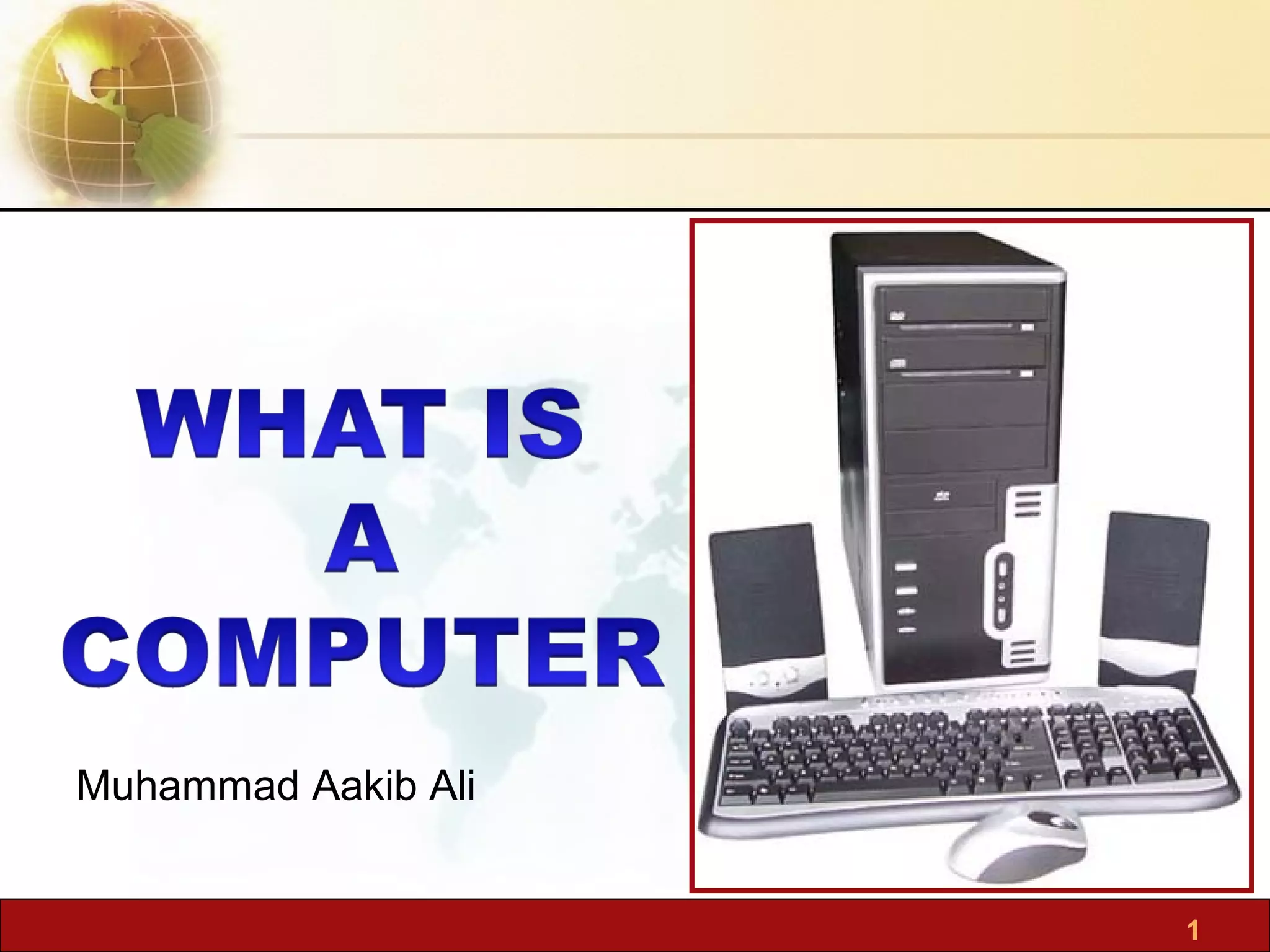
Muhammad Aakib Ali
2
Definition ofDefinition of
ComputerComputer
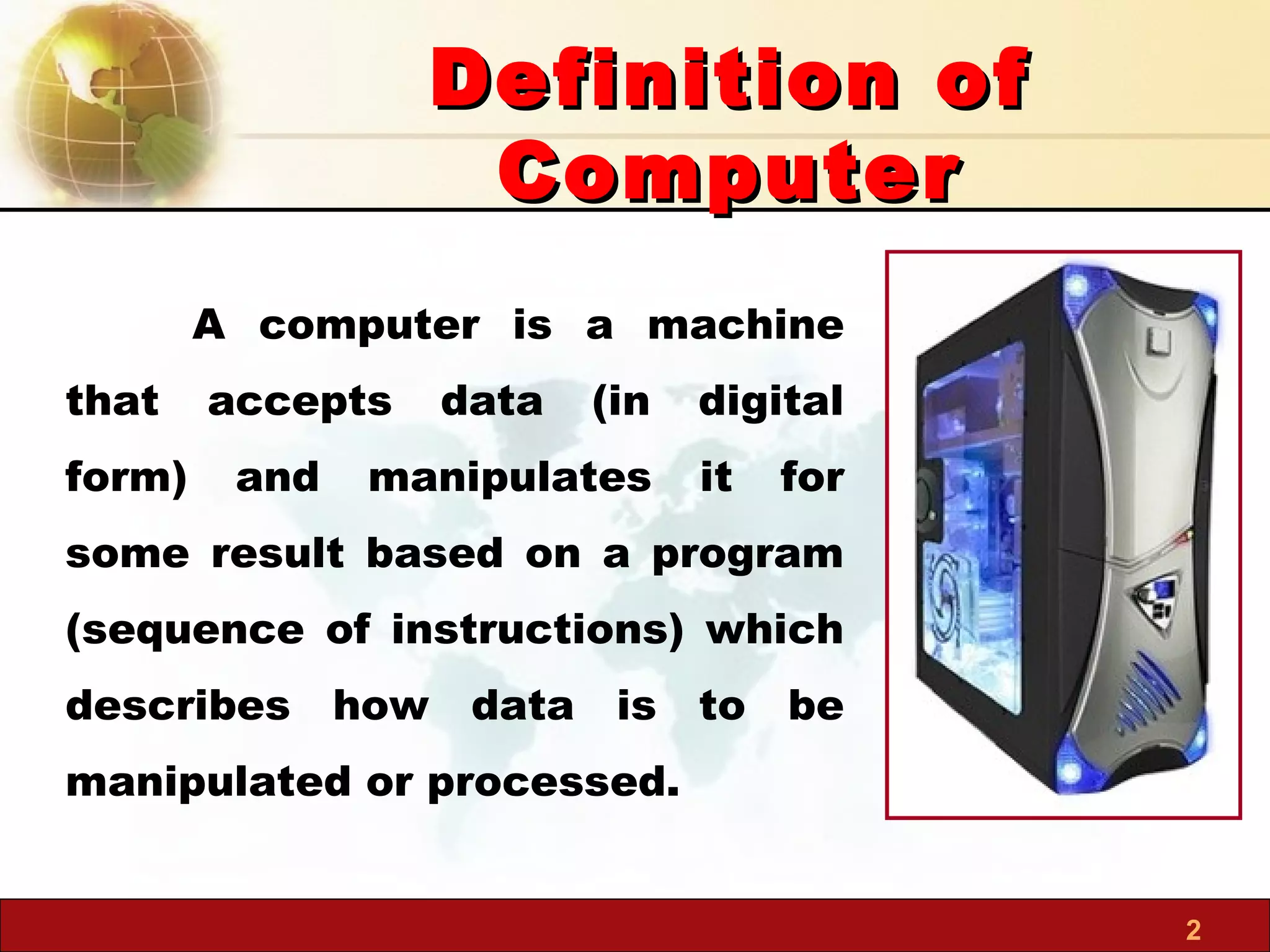
A computer is a machine
that accepts data (in digital
form) and manipulates it for
some result based on a program
(sequence of instructions) which
describes how data is to be
manipulated or processed.
3
History of ComputerHistory of Computer
Computer is normally made for
calculation work. Before the invention of the
computer many other devices were used for
calculations. These are:
 Abacus
 Napier Bones
 Pacaline (Pascal’s Calculator)
 Arthmetical Replica
 The Analytical and Differential Engine
4
History of ComputerHistory of Computer
 Atanasoff and Berry invented the first ever digital
computer. It is called ABC.
 The first large scale electronic digital computer was
named ENIAC (Electronic Numerical Integrator and
Computer). It contained 13000 vacuum tubes. It
became operational in 1964.
 Somewhere near 1964, a Hungarian born
mathematician built a more efficient computer
called EDVAC (Electronic Discrete Variable
Automatic Computer).
5
History of ComputerHistory of Computer
 In 1985, the second generation of computers
evolved by discarding the use of vacuum tubes and
introducing transistors.
 On 7 April, 1964 IBM announced the system 360. It
consisted of six computer, all compatible with 40
different input / output and auxiliary storage
devices.
 Back in 80s, the first PC (Personal Computer) came
on market.
6
Types of ComputersTypes of Computers
 Super Computers
 Main Frame
 Mini Computers
 Micro Computers
 Laptop Computers
7
Components ofComponents of
ComputerComputer
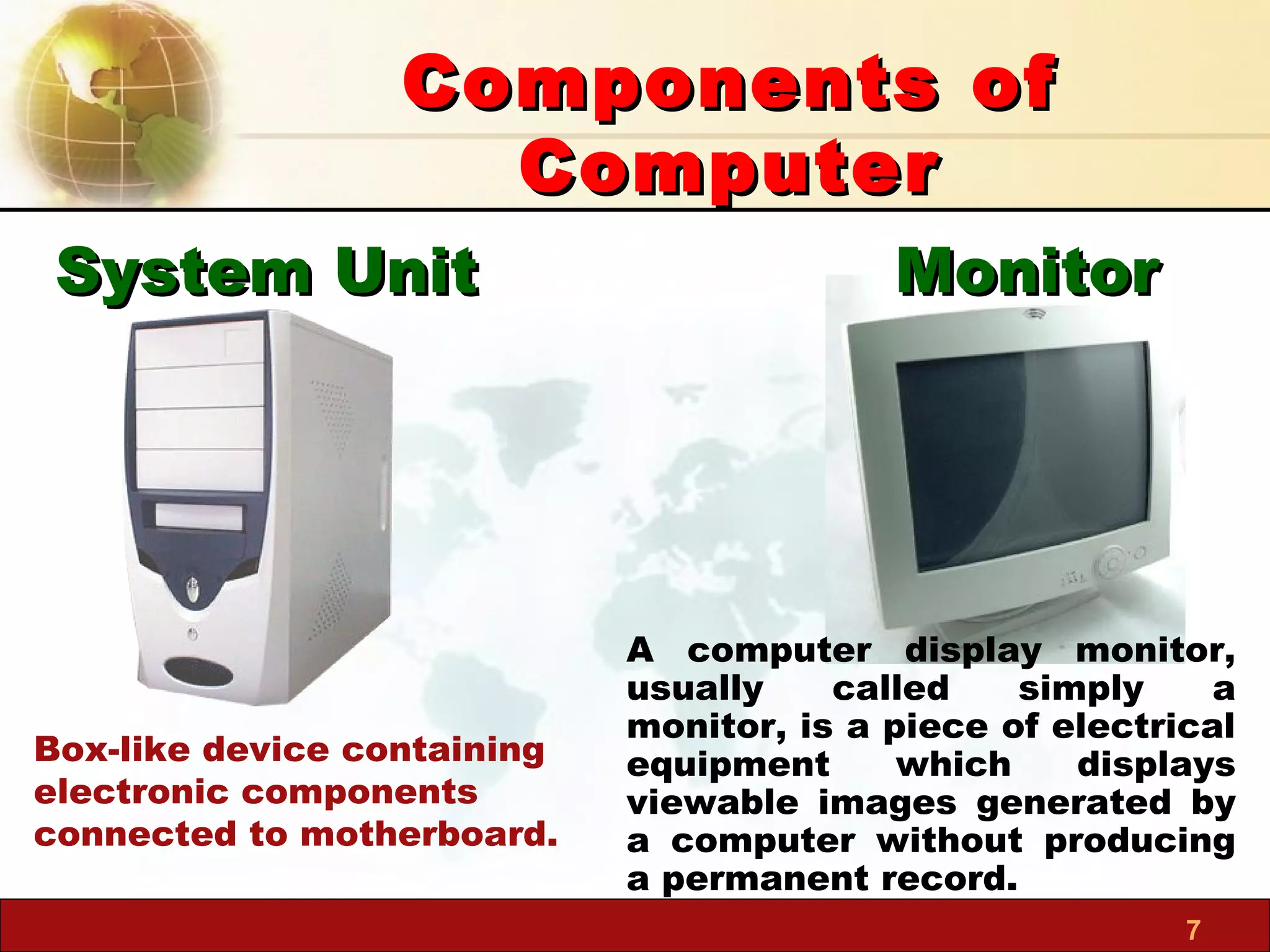
System UnitSystem Unit
Box-like device containing
electronic components
connected to motherboard.
MonitorMonitor
A computer display monitor,
usually called simply a
monitor, is a piece of electrical
equipment which displays
viewable images generated by
a computer without producing
a permanent record.
8
Components ofComponents of
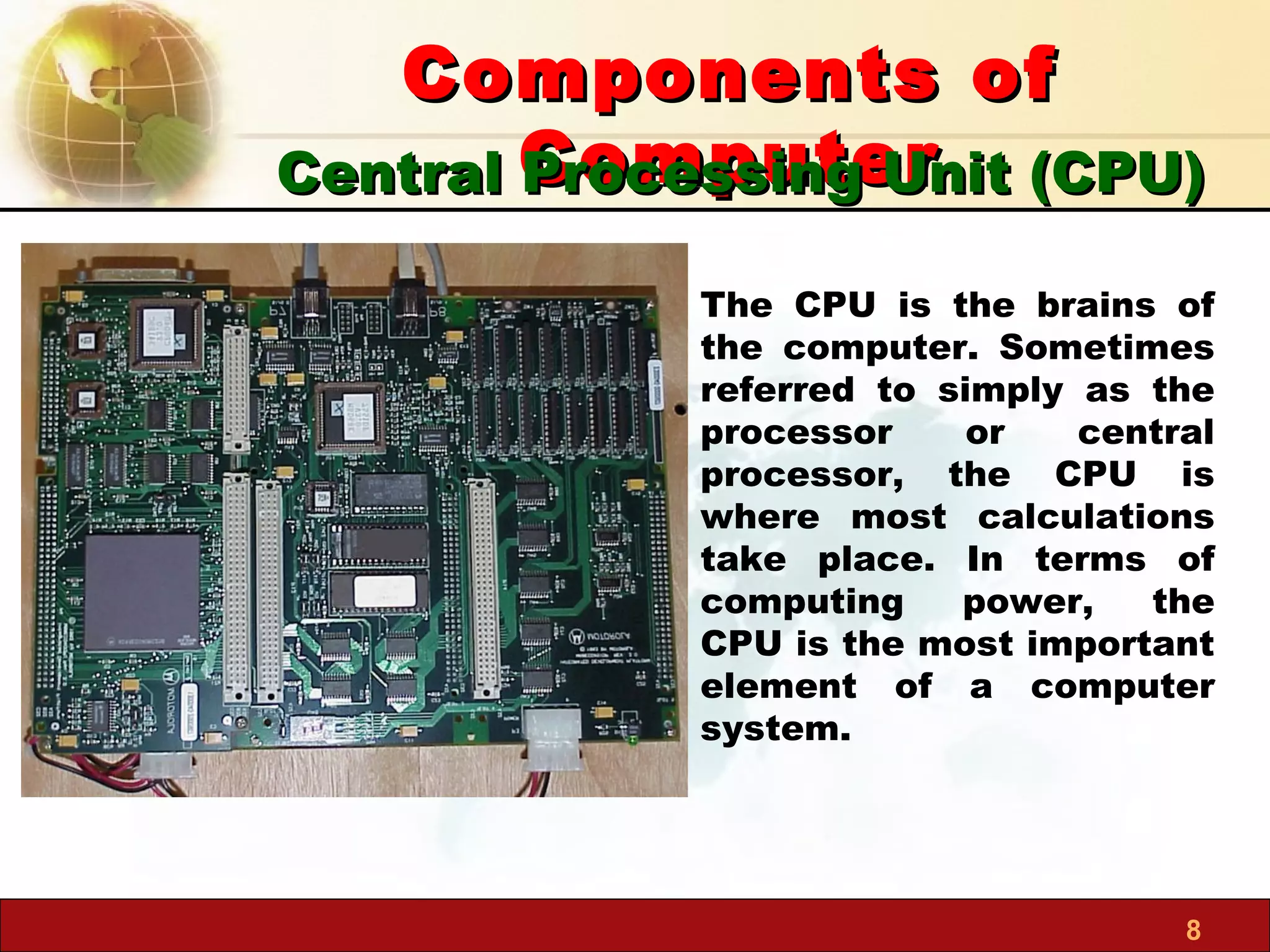
ComputerComputerCentral Processing Unit (CPU)Central Processing Unit (CPU)
The CPU is the brains of
the computer. Sometimes
referred to simply as the
processor or central
processor, the CPU is
where most calculations
take place. In terms of
computing power, the
CPU is the most important
element of a computer
system.
9
Components ofComponents of
ComputerComputerRAMRAM
Random access memory (usually known by its acronym,
RAM) is a type of computer data storage. It takes the form
of integrated circuits that allow the stored data to be
accessed in any order — that is, at random and without the
physical movement of the storage medium or a physical
reading head. RAM is a volatile memory as the information
or instructions stored in it will be lost if the power is
switched off.
10
Components ofComponents of
ComputerComputer
Key BoardKey Board
An input device similar to a
typewriter, for the entry of
text, numbers and
punctuation.
MouseMouse
A mouse is a small device
that a computer user pushes
across a desk surface in
order to point to a place on
a display screen and to
select one or more objects.
11
Components ofComponents of
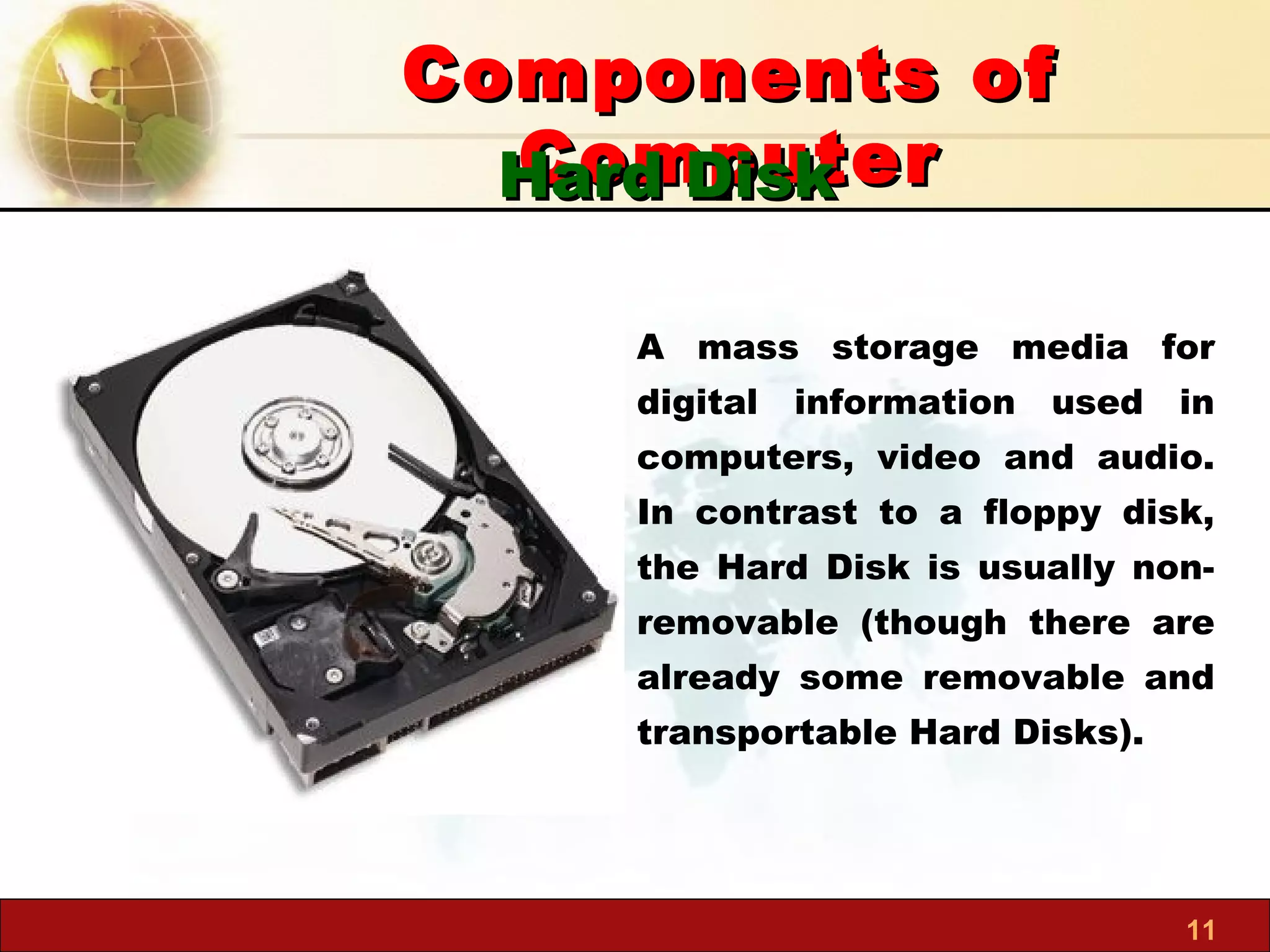
ComputerComputerHard DiskHard Disk
A mass storage media for
digital information used in
computers, video and audio.
In contrast to a floppy disk,
the Hard Disk is usually non-
removable (though there are
already some removable and
transportable Hard Disks).
12
Components ofComponents of
ComputerComputer
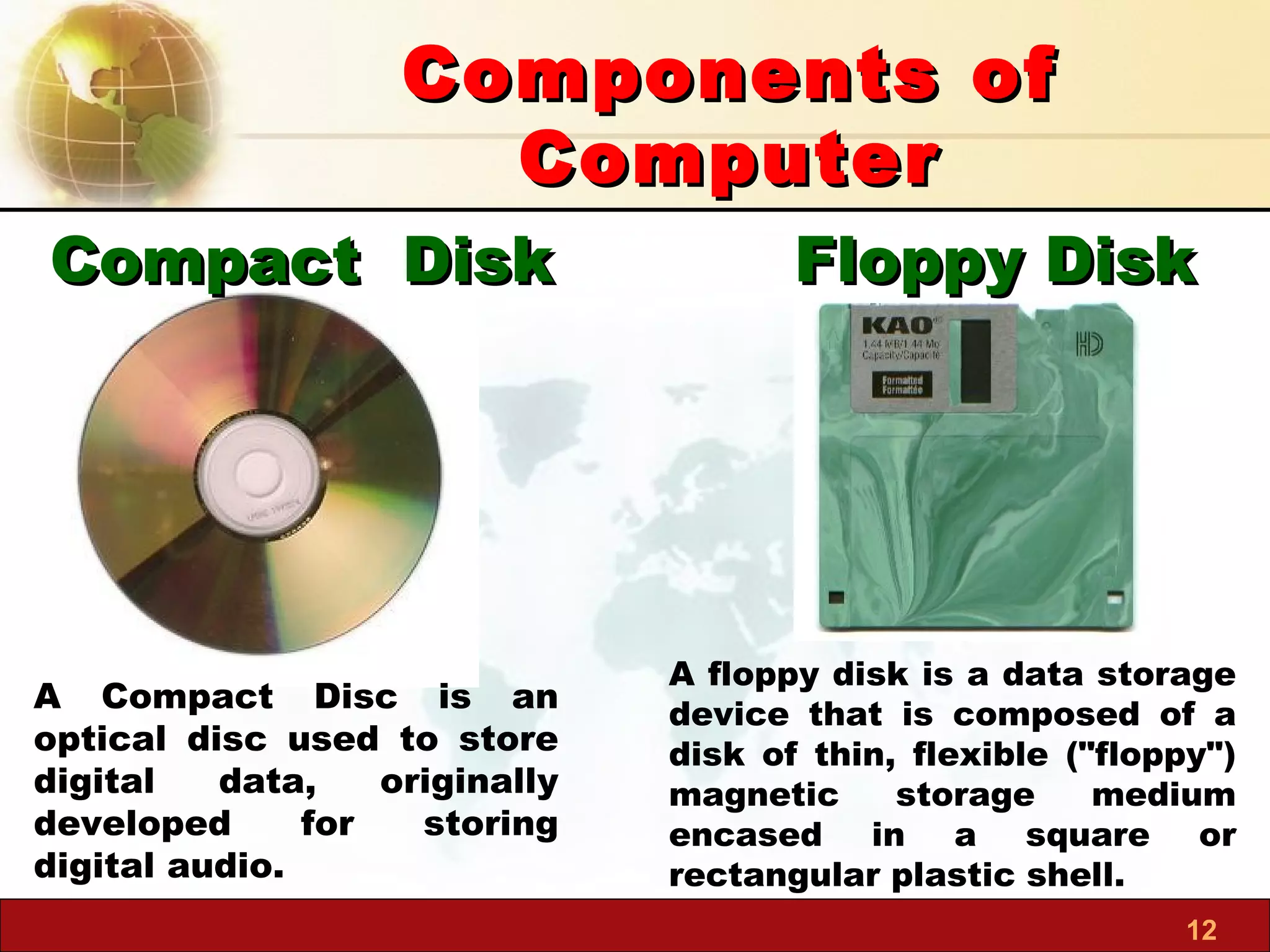
Floppy DiskFloppy DiskCompact DiskCompact Disk
A floppy disk is a data storage
device that is composed of a
disk of thin, flexible ("floppy")
magnetic storage medium
encased in a square or
rectangular plastic shell.
A Compact Disc is an
optical disc used to store
digital data, originally
developed for storing
digital audio.
13
Components ofComponents of
ComputerComputerPrinter & ScannerPrinter & Scanner
In computers, a printer is a device that
accepts text and graphic output from a
computer and transfers the information
to paper
A scanner is a device that captures
images from photographic prints,
posters, magazine pages, and similar
sources for computer editing and
display
14
Components ofComponents of
ComputerComputerJoy StickJoy Stick
Joy stick is used for playing
games on a computer
15
Components ofComponents of
ComputerComputerSpeakerSpeaker
16
How Computer WorksHow Computer Works
DataData
This is the raw input with which the
computer manipulates to produce some
result
InputInput
The data that we feed into the computer
is called the Input
ProcessingProcessing
When the computer manipulates the data
for producing some required result, it is
called processing
17
How the ComputerHow the Computer
WorksWorks
OutputOutput
Result that is obtained after processing
the data, is called output.
The data given to the computer stays in the
memory. The microprocessor processes the
data. This the output is produced. Various
devices are involved in the whole process. The
Keyboard and mouse are both input devices.
The monitor and printer are both output
devices and microprocessor acts as the brain
of the computer.
18

Computer presentation

  • 1.
  • 2.
    2 Definition ofDefinition of ComputerComputer Acomputer is a machine that accepts data (in digital form) and manipulates it for some result based on a program (sequence of instructions) which describes how data is to be manipulated or processed.
  • 3.
    3 History of ComputerHistoryof Computer Computer is normally made for calculation work. Before the invention of the computer many other devices were used for calculations. These are:  Abacus  Napier Bones  Pacaline (Pascal’s Calculator)  Arthmetical Replica  The Analytical and Differential Engine
  • 4.
    4 History of ComputerHistoryof Computer  Atanasoff and Berry invented the first ever digital computer. It is called ABC.  The first large scale electronic digital computer was named ENIAC (Electronic Numerical Integrator and Computer). It contained 13000 vacuum tubes. It became operational in 1964.  Somewhere near 1964, a Hungarian born mathematician built a more efficient computer called EDVAC (Electronic Discrete Variable Automatic Computer).
  • 5.
    5 History of ComputerHistoryof Computer  In 1985, the second generation of computers evolved by discarding the use of vacuum tubes and introducing transistors.  On 7 April, 1964 IBM announced the system 360. It consisted of six computer, all compatible with 40 different input / output and auxiliary storage devices.  Back in 80s, the first PC (Personal Computer) came on market.
  • 6.
    6 Types of ComputersTypesof Computers  Super Computers  Main Frame  Mini Computers  Micro Computers  Laptop Computers
  • 7.
    7 Components ofComponents of ComputerComputer SystemUnitSystem Unit Box-like device containing electronic components connected to motherboard. MonitorMonitor A computer display monitor, usually called simply a monitor, is a piece of electrical equipment which displays viewable images generated by a computer without producing a permanent record.
  • 8.
    8 Components ofComponents of ComputerComputerCentralProcessing Unit (CPU)Central Processing Unit (CPU) The CPU is the brains of the computer. Sometimes referred to simply as the processor or central processor, the CPU is where most calculations take place. In terms of computing power, the CPU is the most important element of a computer system.
  • 9.
    9 Components ofComponents of ComputerComputerRAMRAM Randomaccess memory (usually known by its acronym, RAM) is a type of computer data storage. It takes the form of integrated circuits that allow the stored data to be accessed in any order — that is, at random and without the physical movement of the storage medium or a physical reading head. RAM is a volatile memory as the information or instructions stored in it will be lost if the power is switched off.
  • 10.
    10 Components ofComponents of ComputerComputer KeyBoardKey Board An input device similar to a typewriter, for the entry of text, numbers and punctuation. MouseMouse A mouse is a small device that a computer user pushes across a desk surface in order to point to a place on a display screen and to select one or more objects.
  • 11.
    11 Components ofComponents of ComputerComputerHardDiskHard Disk A mass storage media for digital information used in computers, video and audio. In contrast to a floppy disk, the Hard Disk is usually non- removable (though there are already some removable and transportable Hard Disks).
  • 12.
    12 Components ofComponents of ComputerComputer FloppyDiskFloppy DiskCompact DiskCompact Disk A floppy disk is a data storage device that is composed of a disk of thin, flexible ("floppy") magnetic storage medium encased in a square or rectangular plastic shell. A Compact Disc is an optical disc used to store digital data, originally developed for storing digital audio.
  • 13.
    13 Components ofComponents of ComputerComputerPrinter& ScannerPrinter & Scanner In computers, a printer is a device that accepts text and graphic output from a computer and transfers the information to paper A scanner is a device that captures images from photographic prints, posters, magazine pages, and similar sources for computer editing and display
  • 14.
    14 Components ofComponents of ComputerComputerJoyStickJoy Stick Joy stick is used for playing games on a computer
  • 15.
  • 16.
    16 How Computer WorksHowComputer Works DataData This is the raw input with which the computer manipulates to produce some result InputInput The data that we feed into the computer is called the Input ProcessingProcessing When the computer manipulates the data for producing some required result, it is called processing
  • 17.
    17 How the ComputerHowthe Computer WorksWorks OutputOutput Result that is obtained after processing the data, is called output. The data given to the computer stays in the memory. The microprocessor processes the data. This the output is produced. Various devices are involved in the whole process. The Keyboard and mouse are both input devices. The monitor and printer are both output devices and microprocessor acts as the brain of the computer.
  • 18.