Introduction To
Computer
By:
Prabesh Shrestha
Introduction
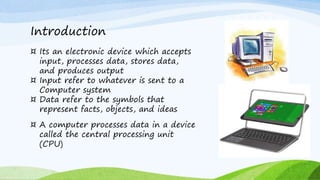
¤ Its an electronic device which accepts
input, processes data, stores data,
and produces output
¤ Input refer to whatever is sent to a
Computer system
¤ Data refer to the symbols that
represent facts, objects, and ideas
¤ A computer processes data in a device
called the central processing unit
(CPU)
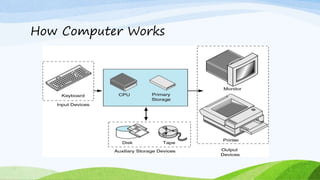
How Computer Works
Definition
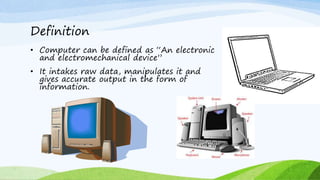
• Computer can be defined as “An electronic
and electromechanical device”
• It intakes raw data, manipulates it and
gives accurate output in the form of
information.
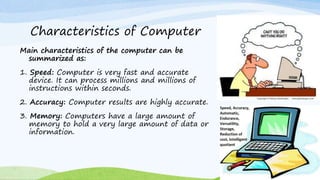
Characteristics of Computer
Main characteristics of the computer can be
summarized as:
1. Speed: Computer is very fast and accurate
device. It can process millions and millions of
instructions within seconds.
2. Accuracy: Computer results are highly accurate.
3. Memory: Computers have a large amount of
memory to hold a very large amount of data or
information.
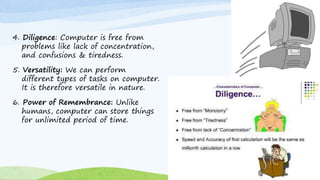
4. Diligence: Computer is free from
problems like lack of concentration,
and confusions & tiredness.
5. Versatility: We can perform
different types of tasks on computer.
It is therefore versatile in nature.
6. Power of Remembrance: Unlike
humans, computer can store things
for unlimited period of time.
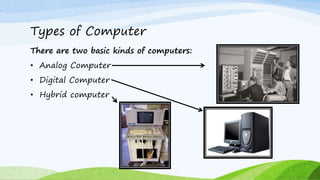
Types of Computer
There are two basic kinds of computers:
• Analog Computer
• Digital Computer
• Hybrid computer
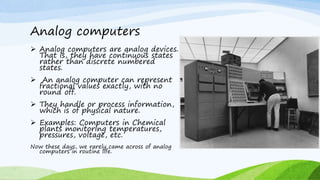
Analog computers
 Analog computers are analog devices.
That is, they have continuous states
rather than discrete numbered
states.
 An analog computer can represent
fractional values exactly, with no
round off.
 They handle or process information,
which is of physical nature.
 Examples: Computers in Chemical
plants monitoring temperatures,
pressures, voltage, etc.
Now these days, we rarely came across of analog
computers in routine life.
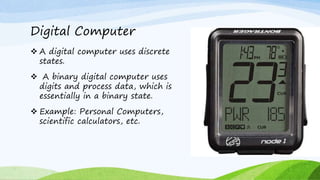
Digital Computer
 A digital computer uses discrete
states.
 A binary digital computer uses
digits and process data, which is
essentially in a binary state.
 Example: Personal Computers,
scientific calculators, etc.
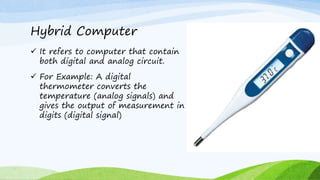
Hybrid Computer
 It refers to computer that contain
both digital and analog circuit.
 For Example: A digital
thermometer converts the
temperature (analog signals) and
gives the output of measurement in
digits (digital signal)
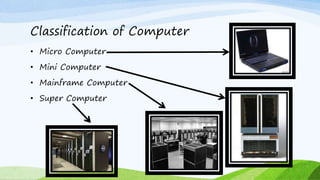
Classification of Computer
• Micro Computer
• Mini Computer
• Mainframe Computer
• Super Computer
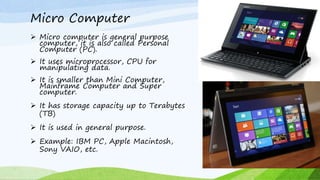
Micro Computer
 Micro computer is general purpose
computer, it is also called Personal
Computer (PC).
 It uses microprocessor, CPU for
manipulating data.
 It is smaller than Mini Computer,
Mainframe Computer and Super
computer.
 It has storage capacity up to Terabytes
(TB)
 It is used in general purpose.
 Example: IBM PC, Apple Macintosh,
Sony VAIO, etc.
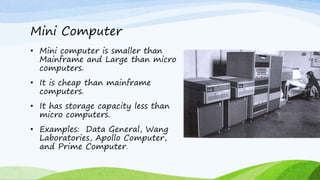
Mini Computer
• Mini computer is smaller than
Mainframe and Large than micro
computers.
• It is cheap than mainframe
computers.
• It has storage capacity less than
micro computers.
• Examples: Data General, Wang
Laboratories, Apollo Computer,
and Prime Computer.
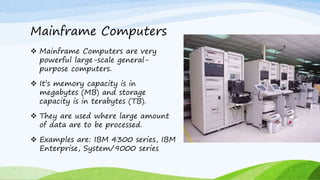
Mainframe Computers
 Mainframe Computers are very
powerful large-scale general-
purpose computers.
 It’s memory capacity is in
megabytes (MB) and storage
capacity is in terabytes (TB).
 They are used where large amount
of data are to be processed.
 Examples are: IBM 4300 series, IBM
Enterprise, System/9000 series
Super computer
 A supercomputer is a computer
which has high processing
capacity – particularly speed of
calculation.
 It has high storage capacity in
Petabyte (PB).
 It has number of CPUs to make
more speed.
 Example: IBM roadrunner, Cray
Jaguar, Cray Titan, IBM Sequoia,
etc.
Advantages & Disadvantages of Computer
Advantages
• It makes our work easier,
faster and accurate.
• It saves our cost and time
while collecting,
manipulating and storing
large amount of data
• It helps in worldwide
communication.
Disadvantages
• It is harmful to health, it
affects eyesight and
backbones if we work too
long.
• It creates unemployment.
• It makes people dumb and
dull.
The
End

Introduction to computer

  • 1.
  • 2.
    Introduction ¤ Its anelectronic device which accepts input, processes data, stores data, and produces output ¤ Input refer to whatever is sent to a Computer system ¤ Data refer to the symbols that represent facts, objects, and ideas ¤ A computer processes data in a device called the central processing unit (CPU)
  • 3.
  • 4.
    Definition • Computer canbe defined as “An electronic and electromechanical device” • It intakes raw data, manipulates it and gives accurate output in the form of information.
  • 5.
    Characteristics of Computer Maincharacteristics of the computer can be summarized as: 1. Speed: Computer is very fast and accurate device. It can process millions and millions of instructions within seconds. 2. Accuracy: Computer results are highly accurate. 3. Memory: Computers have a large amount of memory to hold a very large amount of data or information.
  • 6.
    4. Diligence: Computeris free from problems like lack of concentration, and confusions & tiredness. 5. Versatility: We can perform different types of tasks on computer. It is therefore versatile in nature. 6. Power of Remembrance: Unlike humans, computer can store things for unlimited period of time.
  • 7.
    Types of Computer Thereare two basic kinds of computers: • Analog Computer • Digital Computer • Hybrid computer
  • 8.
    Analog computers  Analogcomputers are analog devices. That is, they have continuous states rather than discrete numbered states.  An analog computer can represent fractional values exactly, with no round off.  They handle or process information, which is of physical nature.  Examples: Computers in Chemical plants monitoring temperatures, pressures, voltage, etc. Now these days, we rarely came across of analog computers in routine life.
  • 9.
    Digital Computer  Adigital computer uses discrete states.  A binary digital computer uses digits and process data, which is essentially in a binary state.  Example: Personal Computers, scientific calculators, etc.
  • 10.
    Hybrid Computer  Itrefers to computer that contain both digital and analog circuit.  For Example: A digital thermometer converts the temperature (analog signals) and gives the output of measurement in digits (digital signal)
  • 11.
    Classification of Computer •Micro Computer • Mini Computer • Mainframe Computer • Super Computer
  • 12.
    Micro Computer  Microcomputer is general purpose computer, it is also called Personal Computer (PC).  It uses microprocessor, CPU for manipulating data.  It is smaller than Mini Computer, Mainframe Computer and Super computer.  It has storage capacity up to Terabytes (TB)  It is used in general purpose.  Example: IBM PC, Apple Macintosh, Sony VAIO, etc.
  • 13.
    Mini Computer • Minicomputer is smaller than Mainframe and Large than micro computers. • It is cheap than mainframe computers. • It has storage capacity less than micro computers. • Examples: Data General, Wang Laboratories, Apollo Computer, and Prime Computer.
  • 14.
    Mainframe Computers  MainframeComputers are very powerful large-scale general- purpose computers.  It’s memory capacity is in megabytes (MB) and storage capacity is in terabytes (TB).  They are used where large amount of data are to be processed.  Examples are: IBM 4300 series, IBM Enterprise, System/9000 series
  • 15.
    Super computer  Asupercomputer is a computer which has high processing capacity – particularly speed of calculation.  It has high storage capacity in Petabyte (PB).  It has number of CPUs to make more speed.  Example: IBM roadrunner, Cray Jaguar, Cray Titan, IBM Sequoia, etc.
  • 16.
    Advantages & Disadvantagesof Computer Advantages • It makes our work easier, faster and accurate. • It saves our cost and time while collecting, manipulating and storing large amount of data • It helps in worldwide communication. Disadvantages • It is harmful to health, it affects eyesight and backbones if we work too long. • It creates unemployment. • It makes people dumb and dull.
  • 17.