ICSE
Presentation
Topic:- DIFFERENT TYPES OF
COMPUTERS AND THE
HISTORY OF
COMPUTERS
By Anadi Sharma
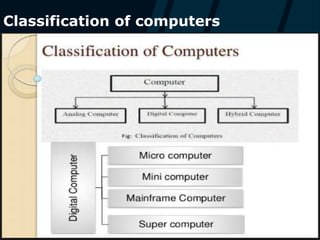
Classification of computers
Classification of Computer Systems
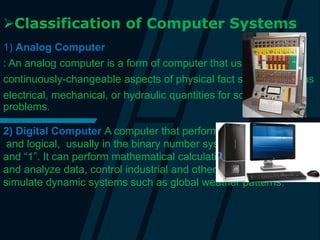
1) Analog Computer
: An analog computer is a form of computer that uses the
continuously-changeable aspects of physical fact such as such as
electrical, mechanical, or hydraulic quantities for solving the
problems.
2) Digital Computer A computer that performs calculations
and logical, usually in the binary number system of “0”
and “1”. It can perform mathematical calculations, organize
and analyze data, control industrial and other processes, and
simulate dynamic systems such as global weather patterns.
3) Hybrid Computer
A computer that processes both analog and digital data,
The digital component normally provides logical and
numerical operations, while the analog component often
serves as a solver of differential equations and other
mathematically complex equations.
Different types of Digital Computer
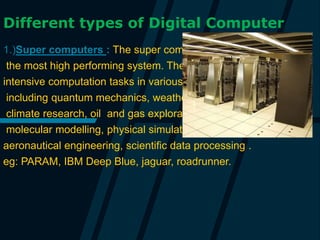
1.)Super computers : The super computers are
the most high performing system. They are used for
intensive computation tasks in various fields,
including quantum mechanics, weather forecasting,
climate research, oil and gas exploration,
molecular modelling, physical simulations,
aeronautical engineering, scientific data processing .
eg: PARAM, IBM Deep Blue, jaguar, roadrunner.
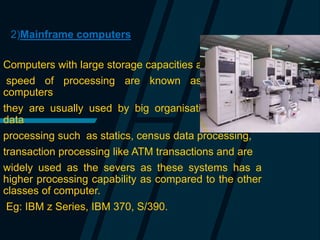
2)Mainframe computers
Computers with large storage capacities and very high
speed of processing are known as mainframe
computers
they are usually used by big organisations for bulk
data
processing such as statics, census data processing,
transaction processing like ATM transactions and are
widely used as the severs as these systems has a
higher processing capability as compared to the other
classes of computer.
Eg: IBM z Series, IBM 370, S/390.
3) Mini
computers
It is a multi processing system capable of supporting 4-200 users
simultaneously Minicomputers may contain one or more
processors, support multiprocessing and tasking, and are
generally resilient to high workloads. Minicomputers are used for
scientific and engineering computations, business-transaction
processing, and database management,
Eg IBM midrange computers, Digital Alpha, Sun Ultra.
4) Micro computers
A microcomputer have microprocessor as its CPU. It includes a
microprocessor, memory, and minimal I/O circuitry mounted on
a single printed circuit board. It is a small, relatively inexpensive
computer. They actually formed the foundation for present day
microcomputers and smart gadgets that we use in day to day
life.
Microcomputer can be classified into 2 types :
a. Desktops
b. Portables
The difference is portables can be used while travelling
whereas desktops computers cannot be carried around.
The different portable computers are: -
i) Laptop
ii) Notebooks/Palmtop/Digital Diary
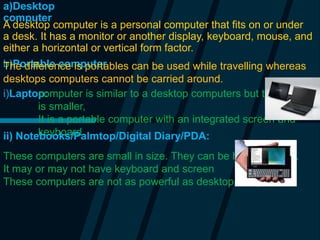
a)Desktop
computer
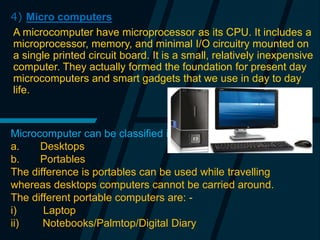
A desktop computer is a personal computer that fits on or under
a desk. It has a monitor or another display, keyboard, mouse, and
either a horizontal or vertical form factor.
b)Portable computerThe difference is portables can be used while travelling whereas
desktops computers cannot be carried around.
i)Laptop:computer is similar to a desktop computers but the size
is smaller,
It is a portable computer with an integrated screen and
keyboardii) Notebooks/Palmtop/Digital Diary/PDA:
These computers are small in size. They can be held in hands.
It may or may not have keyboard and screen
These computers are not as powerful as desktop computers.
History and
Generations Of
Computer
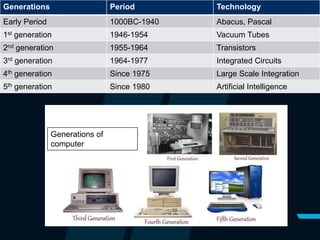
Generations Period Technology
Early Period 1000BC-1940 Abacus, Pascal
1st generation 1946-1954 Vacuum Tubes
2nd generation 1955-1964 Transistors
3rd generation 1964-1977 Integrated Circuits
4th generation Since 1975 Large Scale Integration
5th generation Since 1980 Artificial Intelligence
Generations of
computer
Thank You

Classification of Computer

  • 1.
    ICSE Presentation Topic:- DIFFERENT TYPESOF COMPUTERS AND THE HISTORY OF COMPUTERS By Anadi Sharma
  • 2.
  • 3.
    Classification of ComputerSystems 1) Analog Computer : An analog computer is a form of computer that uses the continuously-changeable aspects of physical fact such as such as electrical, mechanical, or hydraulic quantities for solving the problems. 2) Digital Computer A computer that performs calculations and logical, usually in the binary number system of “0” and “1”. It can perform mathematical calculations, organize and analyze data, control industrial and other processes, and simulate dynamic systems such as global weather patterns.
  • 4.
    3) Hybrid Computer Acomputer that processes both analog and digital data, The digital component normally provides logical and numerical operations, while the analog component often serves as a solver of differential equations and other mathematically complex equations.
  • 5.
    Different types ofDigital Computer 1.)Super computers : The super computers are the most high performing system. They are used for intensive computation tasks in various fields, including quantum mechanics, weather forecasting, climate research, oil and gas exploration, molecular modelling, physical simulations, aeronautical engineering, scientific data processing . eg: PARAM, IBM Deep Blue, jaguar, roadrunner.
  • 6.
    2)Mainframe computers Computers withlarge storage capacities and very high speed of processing are known as mainframe computers they are usually used by big organisations for bulk data processing such as statics, census data processing, transaction processing like ATM transactions and are widely used as the severs as these systems has a higher processing capability as compared to the other classes of computer. Eg: IBM z Series, IBM 370, S/390.
  • 7.
    3) Mini computers It isa multi processing system capable of supporting 4-200 users simultaneously Minicomputers may contain one or more processors, support multiprocessing and tasking, and are generally resilient to high workloads. Minicomputers are used for scientific and engineering computations, business-transaction processing, and database management, Eg IBM midrange computers, Digital Alpha, Sun Ultra.
  • 8.
    4) Micro computers Amicrocomputer have microprocessor as its CPU. It includes a microprocessor, memory, and minimal I/O circuitry mounted on a single printed circuit board. It is a small, relatively inexpensive computer. They actually formed the foundation for present day microcomputers and smart gadgets that we use in day to day life. Microcomputer can be classified into 2 types : a. Desktops b. Portables The difference is portables can be used while travelling whereas desktops computers cannot be carried around. The different portable computers are: - i) Laptop ii) Notebooks/Palmtop/Digital Diary
  • 9.
    a)Desktop computer A desktop computeris a personal computer that fits on or under a desk. It has a monitor or another display, keyboard, mouse, and either a horizontal or vertical form factor. b)Portable computerThe difference is portables can be used while travelling whereas desktops computers cannot be carried around. i)Laptop:computer is similar to a desktop computers but the size is smaller, It is a portable computer with an integrated screen and keyboardii) Notebooks/Palmtop/Digital Diary/PDA: These computers are small in size. They can be held in hands. It may or may not have keyboard and screen These computers are not as powerful as desktop computers.
  • 10.
  • 11.
    Generations Period Technology EarlyPeriod 1000BC-1940 Abacus, Pascal 1st generation 1946-1954 Vacuum Tubes 2nd generation 1955-1964 Transistors 3rd generation 1964-1977 Integrated Circuits 4th generation Since 1975 Large Scale Integration 5th generation Since 1980 Artificial Intelligence Generations of computer
  • 12.