Computer-Aided Design of Electrical
Machine
Computer-Aided Design
• Introduction to computer aided design.
• Analysis and synthesis methods -hybrid techniques.
• Introduction to Finite element method - historical background,
applications, advantages.
• Study of new computer aided machine software using Finite Element
Case study:
• Complete design of an ac machine –steps.(Assignment only)
Computer-Aided Design
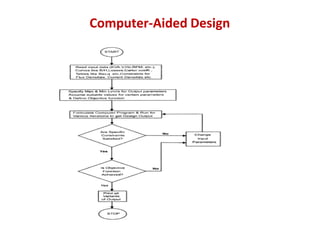
• In any practical design the number of variables is so high that hand
calculations are impossible.
• The number of constraints is also large and for these to be satisfied by
final design, a lengthy iterative approach is required.
• This is only possible with the help of computer programs (refer
Flowchart I. J).
Computer-Aided Design
A
A
B
B
Computer-Aided Design
❖ Explanation of Details of Flowchart
1. Input Data to be Fed into the Program
2. Applicable Constraints I Maximum or Minimum Permissible Limits
3. Output Data to be Printed after Execution of Program
4. Various Objective Parameters for Optimization in an Electrical Machine
• Input Data to be Fed into the Program
• a) Data
• b ) Applicable curves in array format
• c) Applicable tables in array format like
Computer-Aided Design
• Explanation of Details of Flowchart
• Input Data to be Fed into the Program
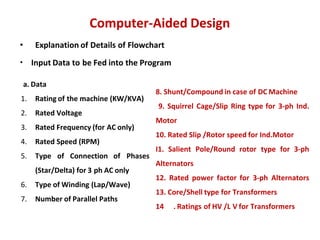
a. Data
1. Rating of the machine (KW/KVA)
2. Rated Voltage
3. Rated Frequency (for AC only)
4. Rated Speed (RPM)
5. Type of Connection of Phases
(Star/Delta) for 3 ph AC only
6. Type of Winding (Lap/Wave)
7. Number of Parallel Paths
8. Shunt/Compound in case of DC Machine
9. Squirrel Cage/Slip Ring type for 3-ph Ind.
Motor
10. Rated Slip /Rotor speed for Ind.Motor
I1. Salient Pole/Round rotor type for 3-ph
Alternators
12. Rated power factor for 3-ph Alternators
13. Core/Shell type for Transformers
14 . Ratings of HV /L V for Transformers
Computer-Aided Design
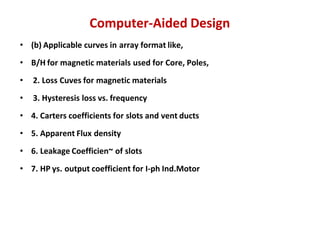
• (b) Applicable curves in array format like,
• B/H for magnetic materials used for Core, Poles,
• 2. Loss Cuves for magnetic materials
• 3. Hysteresis loss vs. frequency
• 4. Carters coefficients for slots and vent ducts
• 5. Apparent Flux density
• 6. Leakage Coefficien~ of slots
• 7. HP ys. output coefficient for I-ph Ind.Motor
Computer-Aided Design
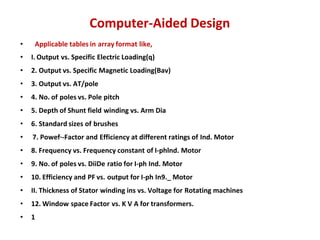
• Applicable tables in array format like,
• I. Output vs. Specific Electric Loading(q)
• 2. Output vs. Specific Magnetic Loading(Bav)
• 3. Output vs. AT/pole
• 4. No. of poles vs. Pole pitch
• 5. Depth of Shunt field winding vs. Arm Dia
• 6. Standard sizes of brushes
• 7. Powef·-Factor and Efficiency at different ratings of Ind. Motor
• 8. Frequency vs. Frequency constant of I-phlnd. Motor
• 9. No. of poles vs. DiiDe ratio for I-ph Ind. Motor
• 10. Efficiency and PF vs. output for I-ph In9._ Motor
• II. Thickness of Stator winding ins vs. Voltage for Rotating machines
• 12. Window space Factor vs. K V A for transformers.
• 1
Computer-Aided Design
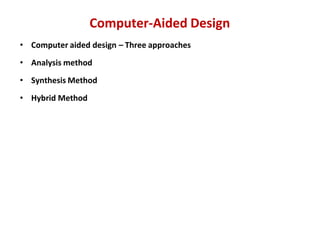
• Computer aided design – Three approaches
• Analysis method
• Synthesis Method
• Hybrid Method
Computer-Aided Design
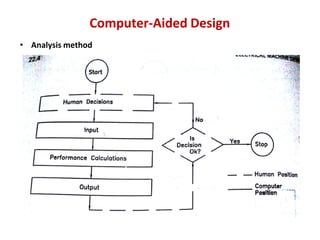
• Analysis method
• Choice of dimension , type of material and type of construction are
made by the designer and these are presented to the computer as the
input data
• The performance is calculated by the computer and is return to the
designer to analysis
• The designer analyze the performance and make another choice of
input if necessary and the performance is recalculated
• This procedure is repeated till the performance requirements are
satisfied
Computer-Aided Design
• Analysis method
Computer-Aided Design
• Analysis method – Advantages
• It is fairly easy to program to use and to understand
• Time saving
• Simple programs
• The results are highly acceptable by the designers
Computer-Aided Design
• Synthesis Method
Computer-Aided Design
B
B
A
A
Computer-Aided Design
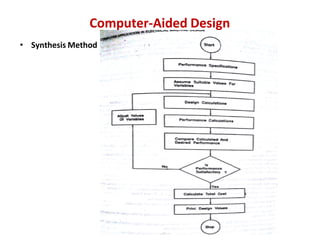
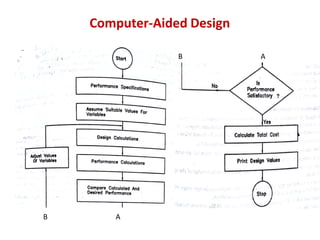
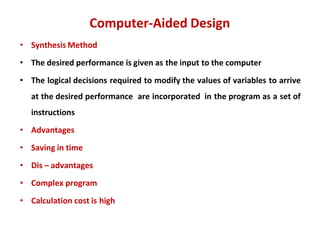
• Synthesis Method
• The desired performance is given as the input to the computer
• The logical decisions required to modify the values of variables to arrive
at the desired performance are incorporated in the program as a set of
instructions
• Advantages
• Saving in time
• Dis – advantages
• Complex program
• Calculation cost is high
Computer-Aided Design
• Hybrid Method
• This method include both analysis as well as synthesis method in the
program
Introduction to Finite Element Analysis
• Introduction to Finite Element Analysis
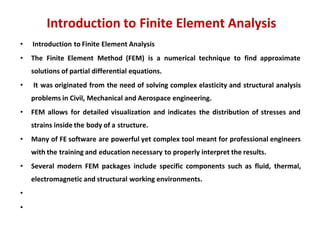
• The Finite Element Method (FEM) is a numerical technique to find approximate
solutions of partial differential equations.
• It was originated from the need of solving complex elasticity and structural analysis
problems in Civil, Mechanical and Aerospace engineering.
• FEM allows for detailed visualization and indicates the distribution of stresses and
strains inside the body of a structure.
• Many of FE software are powerful yet complex tool meant for professional engineers
with the training and education necessary to properly interpret the results.
• Several modern FEM packages include specific components such as fluid, thermal,
electromagnetic and structural working environments.
•
•
Introduction to Finite Element Analysis
• Introduction to Finite Element Analysis
• FEM allows entire designs to be constructed, refined and optimized before
the design is manufactured.
• This powerful design tool has significantly improved both the standard of
engineering designs and the methodology of the design process in many
industrial applications.
• The use of FEM has significantly decreased the time to take products from
concept to the production line.
• One must take the advantage of the advent of faster generation of personal
computers for the analysis and design of engineering product with precision
level of accuracy.
•
Introduction to Finite Element Analysis
• Background of Finite Element Analysis
• The finite element analysis can be traced back to the work by Alexander Hrennikoff
(1941)and Richard Courant(1942).
• Hrenikoff introduced the framework method, in which a plane elastic medium was
represented as collections of bars and beams.
• These pioneers share one essential characteristic: mesh discretization of a
continuous domain into a set of discrete sub-domains, usually called elements. • In
1950s, solution of large number of simultaneous equations became possible because
of the digitalcomputer. • In 1960, Ray W. Clough first published a paper using term
“Finite Element Method”. • In 1965, First conference on “finite elements” was held.
• In 1967, the first book on the “Finite Element Method” was published by
Zienkiewicz and Chung. • In the late 1960s and early 1970s, the FEM was applied to a
wide variety of engineering problems.
Computer-Aided Design

Computer-Aided Design of Electrical Machine

  • 1.
    Computer-Aided Design ofElectrical Machine
  • 2.
    Computer-Aided Design • Introductionto computer aided design. • Analysis and synthesis methods -hybrid techniques. • Introduction to Finite element method - historical background, applications, advantages. • Study of new computer aided machine software using Finite Element Case study: • Complete design of an ac machine –steps.(Assignment only)
  • 3.
    Computer-Aided Design • Inany practical design the number of variables is so high that hand calculations are impossible. • The number of constraints is also large and for these to be satisfied by final design, a lengthy iterative approach is required. • This is only possible with the help of computer programs (refer Flowchart I. J).
  • 4.
  • 5.
  • 6.
    Computer-Aided Design ❖ Explanationof Details of Flowchart 1. Input Data to be Fed into the Program 2. Applicable Constraints I Maximum or Minimum Permissible Limits 3. Output Data to be Printed after Execution of Program 4. Various Objective Parameters for Optimization in an Electrical Machine • Input Data to be Fed into the Program • a) Data • b ) Applicable curves in array format • c) Applicable tables in array format like
  • 7.
    Computer-Aided Design • Explanationof Details of Flowchart • Input Data to be Fed into the Program a. Data 1. Rating of the machine (KW/KVA) 2. Rated Voltage 3. Rated Frequency (for AC only) 4. Rated Speed (RPM) 5. Type of Connection of Phases (Star/Delta) for 3 ph AC only 6. Type of Winding (Lap/Wave) 7. Number of Parallel Paths 8. Shunt/Compound in case of DC Machine 9. Squirrel Cage/Slip Ring type for 3-ph Ind. Motor 10. Rated Slip /Rotor speed for Ind.Motor I1. Salient Pole/Round rotor type for 3-ph Alternators 12. Rated power factor for 3-ph Alternators 13. Core/Shell type for Transformers 14 . Ratings of HV /L V for Transformers
  • 8.
    Computer-Aided Design • (b)Applicable curves in array format like, • B/H for magnetic materials used for Core, Poles, • 2. Loss Cuves for magnetic materials • 3. Hysteresis loss vs. frequency • 4. Carters coefficients for slots and vent ducts • 5. Apparent Flux density • 6. Leakage Coefficien~ of slots • 7. HP ys. output coefficient for I-ph Ind.Motor
  • 9.
    Computer-Aided Design • Applicabletables in array format like, • I. Output vs. Specific Electric Loading(q) • 2. Output vs. Specific Magnetic Loading(Bav) • 3. Output vs. AT/pole • 4. No. of poles vs. Pole pitch • 5. Depth of Shunt field winding vs. Arm Dia • 6. Standard sizes of brushes • 7. Powef·-Factor and Efficiency at different ratings of Ind. Motor • 8. Frequency vs. Frequency constant of I-phlnd. Motor • 9. No. of poles vs. DiiDe ratio for I-ph Ind. Motor • 10. Efficiency and PF vs. output for I-ph In9._ Motor • II. Thickness of Stator winding ins vs. Voltage for Rotating machines • 12. Window space Factor vs. K V A for transformers. • 1
  • 10.
    Computer-Aided Design • Computeraided design – Three approaches • Analysis method • Synthesis Method • Hybrid Method
  • 11.
    Computer-Aided Design • Analysismethod • Choice of dimension , type of material and type of construction are made by the designer and these are presented to the computer as the input data • The performance is calculated by the computer and is return to the designer to analysis • The designer analyze the performance and make another choice of input if necessary and the performance is recalculated • This procedure is repeated till the performance requirements are satisfied
  • 12.
  • 13.
    Computer-Aided Design • Analysismethod – Advantages • It is fairly easy to program to use and to understand • Time saving • Simple programs • The results are highly acceptable by the designers
  • 14.
  • 15.
  • 16.
    Computer-Aided Design • SynthesisMethod • The desired performance is given as the input to the computer • The logical decisions required to modify the values of variables to arrive at the desired performance are incorporated in the program as a set of instructions • Advantages • Saving in time • Dis – advantages • Complex program • Calculation cost is high
  • 17.
    Computer-Aided Design • HybridMethod • This method include both analysis as well as synthesis method in the program
  • 18.
    Introduction to FiniteElement Analysis • Introduction to Finite Element Analysis • The Finite Element Method (FEM) is a numerical technique to find approximate solutions of partial differential equations. • It was originated from the need of solving complex elasticity and structural analysis problems in Civil, Mechanical and Aerospace engineering. • FEM allows for detailed visualization and indicates the distribution of stresses and strains inside the body of a structure. • Many of FE software are powerful yet complex tool meant for professional engineers with the training and education necessary to properly interpret the results. • Several modern FEM packages include specific components such as fluid, thermal, electromagnetic and structural working environments. • •
  • 19.
    Introduction to FiniteElement Analysis • Introduction to Finite Element Analysis • FEM allows entire designs to be constructed, refined and optimized before the design is manufactured. • This powerful design tool has significantly improved both the standard of engineering designs and the methodology of the design process in many industrial applications. • The use of FEM has significantly decreased the time to take products from concept to the production line. • One must take the advantage of the advent of faster generation of personal computers for the analysis and design of engineering product with precision level of accuracy. •
  • 20.
    Introduction to FiniteElement Analysis • Background of Finite Element Analysis • The finite element analysis can be traced back to the work by Alexander Hrennikoff (1941)and Richard Courant(1942). • Hrenikoff introduced the framework method, in which a plane elastic medium was represented as collections of bars and beams. • These pioneers share one essential characteristic: mesh discretization of a continuous domain into a set of discrete sub-domains, usually called elements. • In 1950s, solution of large number of simultaneous equations became possible because of the digitalcomputer. • In 1960, Ray W. Clough first published a paper using term “Finite Element Method”. • In 1965, First conference on “finite elements” was held. • In 1967, the first book on the “Finite Element Method” was published by Zienkiewicz and Chung. • In the late 1960s and early 1970s, the FEM was applied to a wide variety of engineering problems.
  • 21.
  • 22.
  • 23.