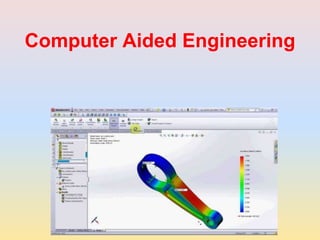
Computer Aided Engineering
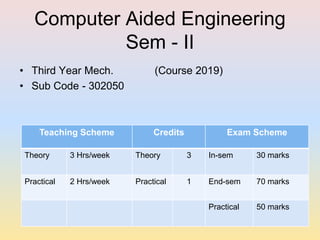
Sem - II
• Third Year Mech. (Course 2019)
• Sub Code - 302050
Teaching Scheme Credits Exam Scheme
Theory 3 Hrs/week Theory 3 In-sem 30 marks
Practical 2 Hrs/week Practical 1 End-sem 70 marks
Practical 50 marks
Course Objectives:
• 1. UNDERSTAND the basic concepts of Computer Aided Engineering
(CAE) and CHARACTERISTICS of various elements required for
analysis.
• 2. NURTURE students about the discretization process and criteria for
quality mesh.
• 3. UNDERSTAND the approaches of Finite Element Method (FEM) and to
find displacement and stresses over the body.
• 4. DEVELOP the knowledge and skills needed to effectively evaluate the
results using Finite Element Analysis (FEA).
• 5. APPLY computational technique to solve complex solid mechanics
problems and its loading states.
• 6. STUDY the applications of CAE in the various domains of the
Mechanical Engineering.
• CO1: DEFINE the use of CAE tools and DESCRIBE the significance of
shape functions in finite element formulations.
• CO2: APPLY the various meshing techniques for better evaluation of
approximate results.
• CO3: APPLY material properties and boundary condition to SOLVE 1-
D and 2-D element stiffness matrices to obtain nodal or elemental
solution.
• CO4: ANALYZE and APPLY various numerical methods for different
types of analysis.
• CO5: EVALUATE and SOLVE non-linear and dynamic analysis
problems by analyzing the results obtained from analytical and
computational method.
• CO6: GENERATE the results in the form of contour plot by the USE of
CAE tools.
Course Outcomes:
Syllabus Discussion
• Unit 1 - Elemental Properties
• Introduction to Computer Aided Engineering (CAE), Use of CAE in Product development,
Discretization methods – Finite Element Method (FEM), Finite Difference Method (FDM) and Finite
Volume Method (FVM), CAE Tools- Pre-processor, Solver and Post-Processor.
• Element Shapes – 1D, 2D and 3D elements, Nodal Unknowns and field variables, Coordinate
Systems,
• Shape Functions- linear, quadratic and cubic, Convergence Requirements of Shape Functions,
Derivation of Polynomial Shape Functions using coordinate systems for Bar, Beam, Triangular, and
rectangular elements.
• Unit 2 - Meshing Techniques
• Discretization of a Structure, 1D, 2D and 3D element Meshing, Element selection criteria, Refining
Mesh, Effect of mesh density in critical region, Use of Symmetry.
• Element Quality Criterion:-Jacobian, Aspect ratio, Warpage, Minimum and Maximum angles,
Average element size, Minimum Length, skewness, Tetra Collapse etc., Higher Order Element vs
Mesh Refinement, Geometry Associate Mesh, Mesh quality, Bolted and welded joints
representation, Mesh independent test.
Syllabus Discussion
• Unit 3 - 1D Finite Element Analysis
• Consistent Unit System, Introduction to approaches used in Finite Element Analysis (
FEA) such as direct approach and energy approach
• Bar and Truss Element - Element stiffness matrix, Assembling stiffness Equation,
Load vector, stress and reaction forces calculations.
• Temperature effect on Bar Element- Calculation due to uniform temperature change,
Stress and reaction forces calculations.
• Unit 4 - 2D Finite Element Analysis
• Plane Stress-Strain, axi-symmetric problems in 2D elasticity.
• Constant Strain Triangle (CST) - Element Stiffness matrix, Assembling stiffness
equation, Load vector, Stress and reaction forces calculations.
• Post Processing Techniques – Check and validate accuracy of results, Average and
Un-average stresses, and special tricks for Post Processing. Interpretation of results
and design modifications, CAE reports.
Syllabus Discussion
• Unit 5 - Non-Linear and Dynamic Analysis
• Non-Linear Analysis: Introduction to Nonlinear Problems, Comparison of Linear and
Nonlinear analysis, Types of Nonlinearities, Stress-strain measures for Nonlinear
analysis, Analysis of Geometric, Material Nonlinearity, Solution Techniques for Nonlinear
analysis, Newton Raphson Method, Essential steps in Nonlinear analysis.
• Dynamic Analysis: Introduction to Dynamic Analysis, Comparison of Static and Dynamic
analysis, Time domain and frequency domain, Types of loading, Simple Harmonic
motion, Free vibration, Boundary conditions of free vibration, Solution.
• Unit 6 - Applications of Computer Aided Engineering
1. Computational Fluid Dynamics (CFD): 2. Injection moulding of Plastics:
3. Simulation for Manufacturing Processes like Casting and Sheet Metal
Applications:
4. Durability Analysis: 5. Crash Analysis:
6. Noise Vibration and Harshness (NVH) Analysis:
Books and other resources
Text Books:
1. Gokhale N. S., Deshpande S. S., Bedekar S. V. and Thite A. N., Practical Finite Element Analysis, Finite
to Infinite, Pune
2. S. S. Bhavikatti, Finite Element Analysis, New Age International Publishers
3. Chandrupatla T. R. and Belegunda A. D., Introduction to Finite Elements in Engineering, Prentice Hall
India, 2002.
4. G Lakshmi Narasaiah, Finite Element Analysis, BS Publications / BSP Books, 5. J. N. Reddy, An
Introduction to the Finite Element Method, Mcgraw Hill Series in Mechanical, 2005.
5. P. Seshu, Text book of Finite Element Analysis, PHI Learning Private Limited, New Delhi
References Books:
1. K. J. Bathe, Finite Element Procedure, Prentice-Hall of India (P) Ltd., New Delhi, 1996.
2. Cook R. D., Finite Element Modeling for Stress Analysis, John Wiley and Sons Inc, 1995.
3. G.R. Liu S. S. Quek, The Finite Element Method- A Practical Course, Butterworth Heinemann, 2013.
4. Fagan M. J., Finite Element Analysis Theory and Practice, Harlow Pearson/Prentice Hall, 2012.
5. S. Moaveni, Finite element analysis, theory and application with Ansys, Pearson, Third Edition, 2011.
6. David V. Hutton, Fundamental of Finite Element Analysis, Tata McGraw-Hill, 2017.
7. Mukhopadhyay M and Sheikh A. H., Matrix and Finite Element Analyses of Structures, Ane Books Pvt.
Ltd., 2009
Books and other resources
• Web References:
https://nptel.ac.in/courses/112/104/112104116/-for Basics of Finite Element Analysis by
Prof. Nachiketa Tiwari, IIT Kanpur
https://nptel.ac.in/courses/112/106/112106130/for Advanced Finite Element Analysis by
Dr. R. Krishnakumar, Department of Mechanical Engineering, IIT Madras
https://nptel.ac.in/courses/112/103/112103299/for Finite Element Analysis for Welding
Analysis by Prof. Swarup Bag, Department of Mechanical Engineering, IIT
Guwahati.
https://sites.ualberta.ca/~wmoussa/AnsysTutorial/ for ANSYS Tutorials
Introduction.ppt

Introduction.ppt

  • 1.
  • 2.
    Computer Aided Engineering Sem- II • Third Year Mech. (Course 2019) • Sub Code - 302050 Teaching Scheme Credits Exam Scheme Theory 3 Hrs/week Theory 3 In-sem 30 marks Practical 2 Hrs/week Practical 1 End-sem 70 marks Practical 50 marks
  • 3.
    Course Objectives: • 1.UNDERSTAND the basic concepts of Computer Aided Engineering (CAE) and CHARACTERISTICS of various elements required for analysis. • 2. NURTURE students about the discretization process and criteria for quality mesh. • 3. UNDERSTAND the approaches of Finite Element Method (FEM) and to find displacement and stresses over the body. • 4. DEVELOP the knowledge and skills needed to effectively evaluate the results using Finite Element Analysis (FEA). • 5. APPLY computational technique to solve complex solid mechanics problems and its loading states. • 6. STUDY the applications of CAE in the various domains of the Mechanical Engineering.
  • 4.
    • CO1: DEFINEthe use of CAE tools and DESCRIBE the significance of shape functions in finite element formulations. • CO2: APPLY the various meshing techniques for better evaluation of approximate results. • CO3: APPLY material properties and boundary condition to SOLVE 1- D and 2-D element stiffness matrices to obtain nodal or elemental solution. • CO4: ANALYZE and APPLY various numerical methods for different types of analysis. • CO5: EVALUATE and SOLVE non-linear and dynamic analysis problems by analyzing the results obtained from analytical and computational method. • CO6: GENERATE the results in the form of contour plot by the USE of CAE tools. Course Outcomes:
  • 5.
    Syllabus Discussion • Unit1 - Elemental Properties • Introduction to Computer Aided Engineering (CAE), Use of CAE in Product development, Discretization methods – Finite Element Method (FEM), Finite Difference Method (FDM) and Finite Volume Method (FVM), CAE Tools- Pre-processor, Solver and Post-Processor. • Element Shapes – 1D, 2D and 3D elements, Nodal Unknowns and field variables, Coordinate Systems, • Shape Functions- linear, quadratic and cubic, Convergence Requirements of Shape Functions, Derivation of Polynomial Shape Functions using coordinate systems for Bar, Beam, Triangular, and rectangular elements. • Unit 2 - Meshing Techniques • Discretization of a Structure, 1D, 2D and 3D element Meshing, Element selection criteria, Refining Mesh, Effect of mesh density in critical region, Use of Symmetry. • Element Quality Criterion:-Jacobian, Aspect ratio, Warpage, Minimum and Maximum angles, Average element size, Minimum Length, skewness, Tetra Collapse etc., Higher Order Element vs Mesh Refinement, Geometry Associate Mesh, Mesh quality, Bolted and welded joints representation, Mesh independent test.
  • 6.
    Syllabus Discussion • Unit3 - 1D Finite Element Analysis • Consistent Unit System, Introduction to approaches used in Finite Element Analysis ( FEA) such as direct approach and energy approach • Bar and Truss Element - Element stiffness matrix, Assembling stiffness Equation, Load vector, stress and reaction forces calculations. • Temperature effect on Bar Element- Calculation due to uniform temperature change, Stress and reaction forces calculations. • Unit 4 - 2D Finite Element Analysis • Plane Stress-Strain, axi-symmetric problems in 2D elasticity. • Constant Strain Triangle (CST) - Element Stiffness matrix, Assembling stiffness equation, Load vector, Stress and reaction forces calculations. • Post Processing Techniques – Check and validate accuracy of results, Average and Un-average stresses, and special tricks for Post Processing. Interpretation of results and design modifications, CAE reports.
  • 7.
    Syllabus Discussion • Unit5 - Non-Linear and Dynamic Analysis • Non-Linear Analysis: Introduction to Nonlinear Problems, Comparison of Linear and Nonlinear analysis, Types of Nonlinearities, Stress-strain measures for Nonlinear analysis, Analysis of Geometric, Material Nonlinearity, Solution Techniques for Nonlinear analysis, Newton Raphson Method, Essential steps in Nonlinear analysis. • Dynamic Analysis: Introduction to Dynamic Analysis, Comparison of Static and Dynamic analysis, Time domain and frequency domain, Types of loading, Simple Harmonic motion, Free vibration, Boundary conditions of free vibration, Solution. • Unit 6 - Applications of Computer Aided Engineering 1. Computational Fluid Dynamics (CFD): 2. Injection moulding of Plastics: 3. Simulation for Manufacturing Processes like Casting and Sheet Metal Applications: 4. Durability Analysis: 5. Crash Analysis: 6. Noise Vibration and Harshness (NVH) Analysis:
  • 8.
    Books and otherresources Text Books: 1. Gokhale N. S., Deshpande S. S., Bedekar S. V. and Thite A. N., Practical Finite Element Analysis, Finite to Infinite, Pune 2. S. S. Bhavikatti, Finite Element Analysis, New Age International Publishers 3. Chandrupatla T. R. and Belegunda A. D., Introduction to Finite Elements in Engineering, Prentice Hall India, 2002. 4. G Lakshmi Narasaiah, Finite Element Analysis, BS Publications / BSP Books, 5. J. N. Reddy, An Introduction to the Finite Element Method, Mcgraw Hill Series in Mechanical, 2005. 5. P. Seshu, Text book of Finite Element Analysis, PHI Learning Private Limited, New Delhi References Books: 1. K. J. Bathe, Finite Element Procedure, Prentice-Hall of India (P) Ltd., New Delhi, 1996. 2. Cook R. D., Finite Element Modeling for Stress Analysis, John Wiley and Sons Inc, 1995. 3. G.R. Liu S. S. Quek, The Finite Element Method- A Practical Course, Butterworth Heinemann, 2013. 4. Fagan M. J., Finite Element Analysis Theory and Practice, Harlow Pearson/Prentice Hall, 2012. 5. S. Moaveni, Finite element analysis, theory and application with Ansys, Pearson, Third Edition, 2011. 6. David V. Hutton, Fundamental of Finite Element Analysis, Tata McGraw-Hill, 2017. 7. Mukhopadhyay M and Sheikh A. H., Matrix and Finite Element Analyses of Structures, Ane Books Pvt. Ltd., 2009
  • 9.
    Books and otherresources • Web References: https://nptel.ac.in/courses/112/104/112104116/-for Basics of Finite Element Analysis by Prof. Nachiketa Tiwari, IIT Kanpur https://nptel.ac.in/courses/112/106/112106130/for Advanced Finite Element Analysis by Dr. R. Krishnakumar, Department of Mechanical Engineering, IIT Madras https://nptel.ac.in/courses/112/103/112103299/for Finite Element Analysis for Welding Analysis by Prof. Swarup Bag, Department of Mechanical Engineering, IIT Guwahati. https://sites.ualberta.ca/~wmoussa/AnsysTutorial/ for ANSYS Tutorials