CONTENTS
Introduction
• RAM,ROM,PROM,EPROM
• Auxiliary Storage Devices-Magnetic
Tape, Hard Disk, Floppy Disk
• Optical Disks: CD-R Drive,CD-RW
disks,DVD,Blue ray Discs.
1
2
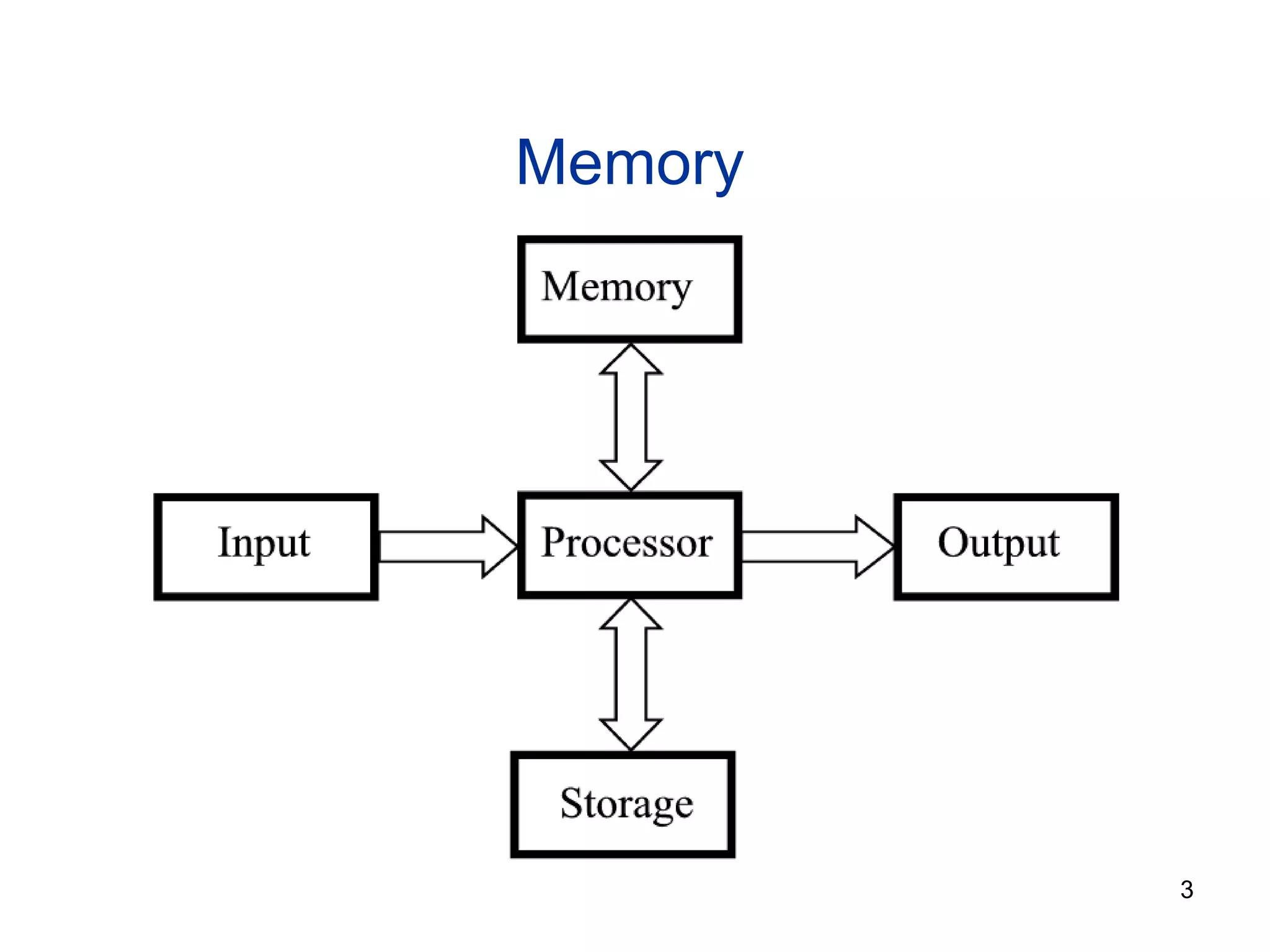
Memory

3
1. Introduction
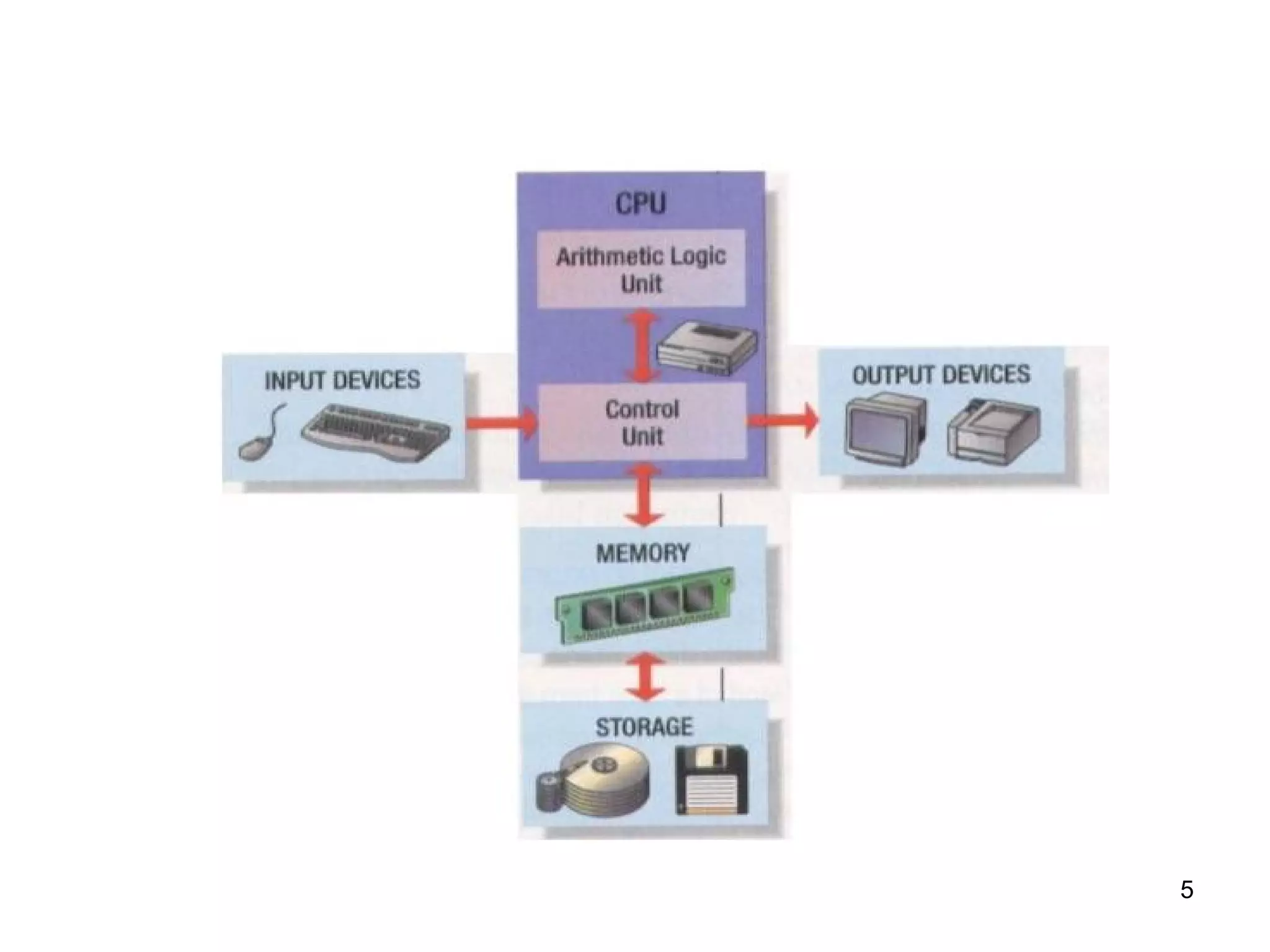
• Memory Devices
(RAM,ROM,PROM,EPROM)
• Storage Devices (Auxiliary Storage
Devices-Magnetic Tape, Hard Disk, Floppy
Disk .Optical Disks: CD-R Drive,CD-RW
disks,DVD,Blue ray Discs)
4
5
Characteristics of Storage Devices
•
•
•
•
•

Speed
Volatility
Access method
Portability
Cost and capacity
6
Basic Units Of Measurement
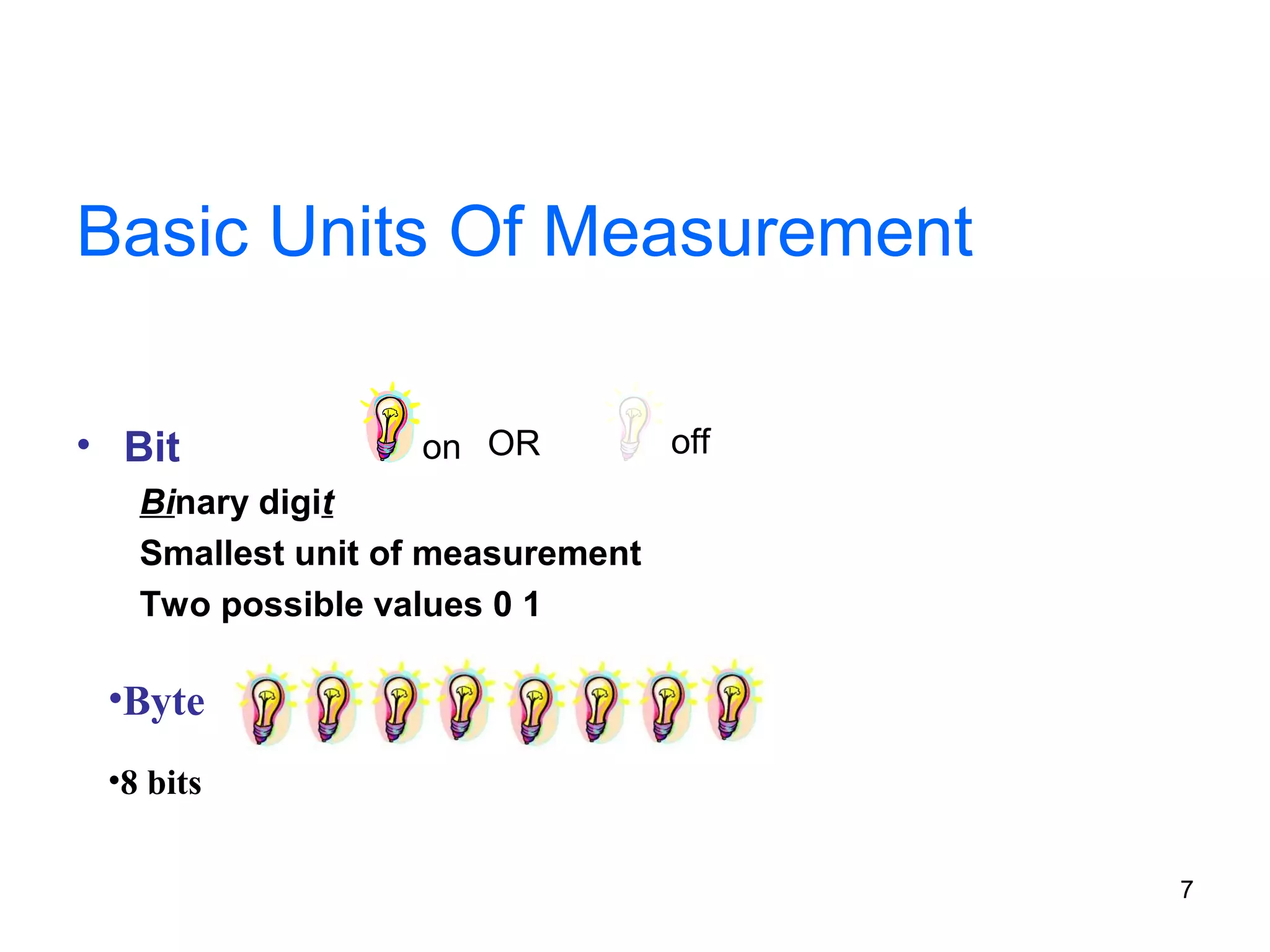
• Bit

on OR

off

Binary digit
Smallest unit of measurement
Two possible values 0 1

•Byte
•8 bits
7
Small Units Of Measurement (Processor
And Memory Speed)
Millisecond (ms) – a thousandth of a second
(1/1,000 = 10-3)
Microsecond (μs) - a millionth of a second
(1/1,000,000 = 10-6)
Nanosecond (ns) – a billionth of a second
(1/1,000,000,000 = 10-9)
8
Large Units Of Measurement
(Memory, Storage)
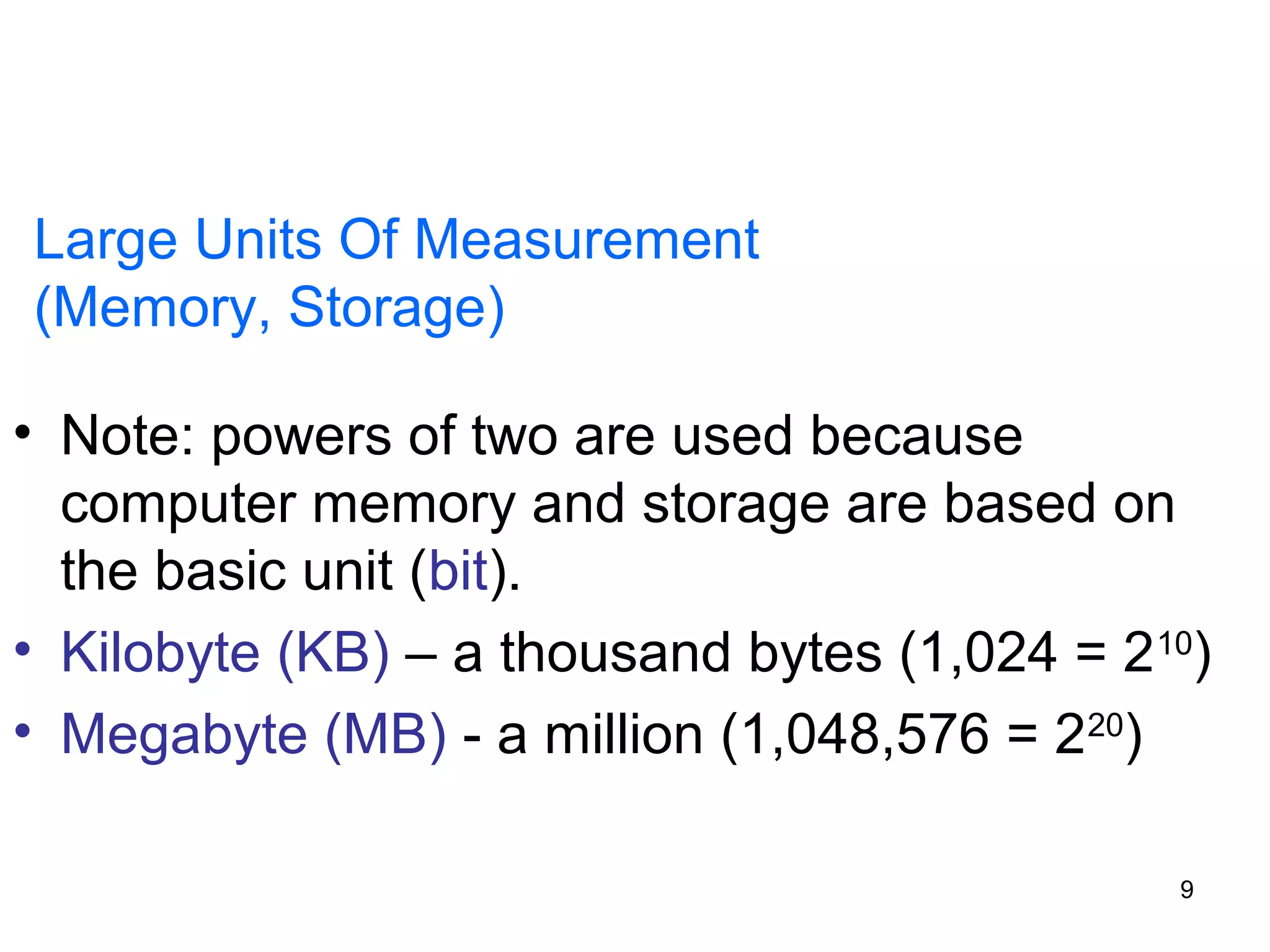
• Note: powers of two are used because
computer memory and storage are based on
the basic unit (bit).
• Kilobyte (KB) – a thousand bytes (1,024 = 2 10)
• Megabyte (MB) - a million (1,048,576 = 220)
9
Large Units Of Measurement
(Memory, Storage)
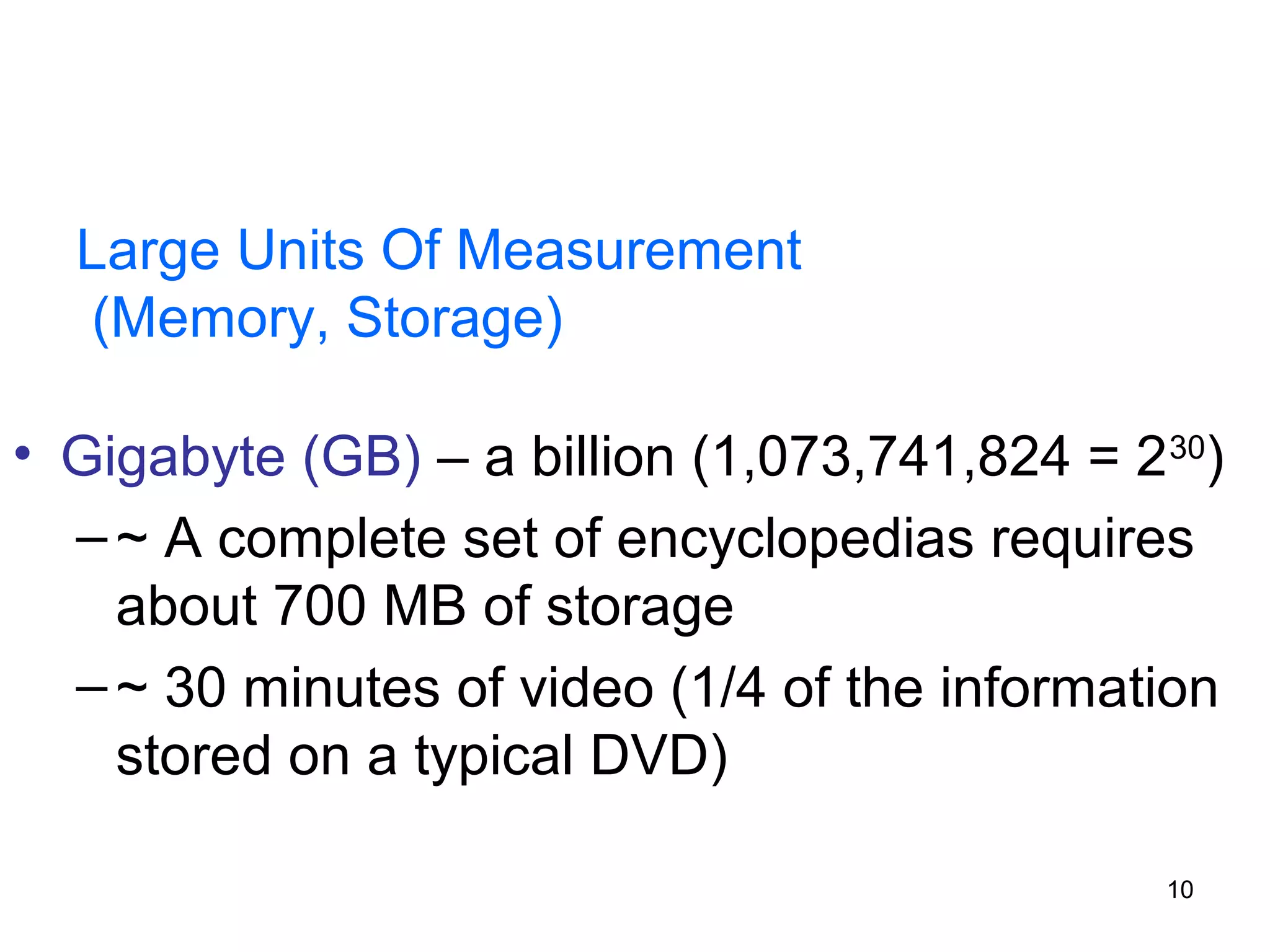
• Gigabyte (GB) – a billion (1,073,741,824 = 2 30)
– ~ A complete set of encyclopedias requires
about 700 MB of storage
– ~ 30 minutes of video (1/4 of the information
stored on a typical DVD)
10
Large Units Of Measurement
(Memory, Storage)
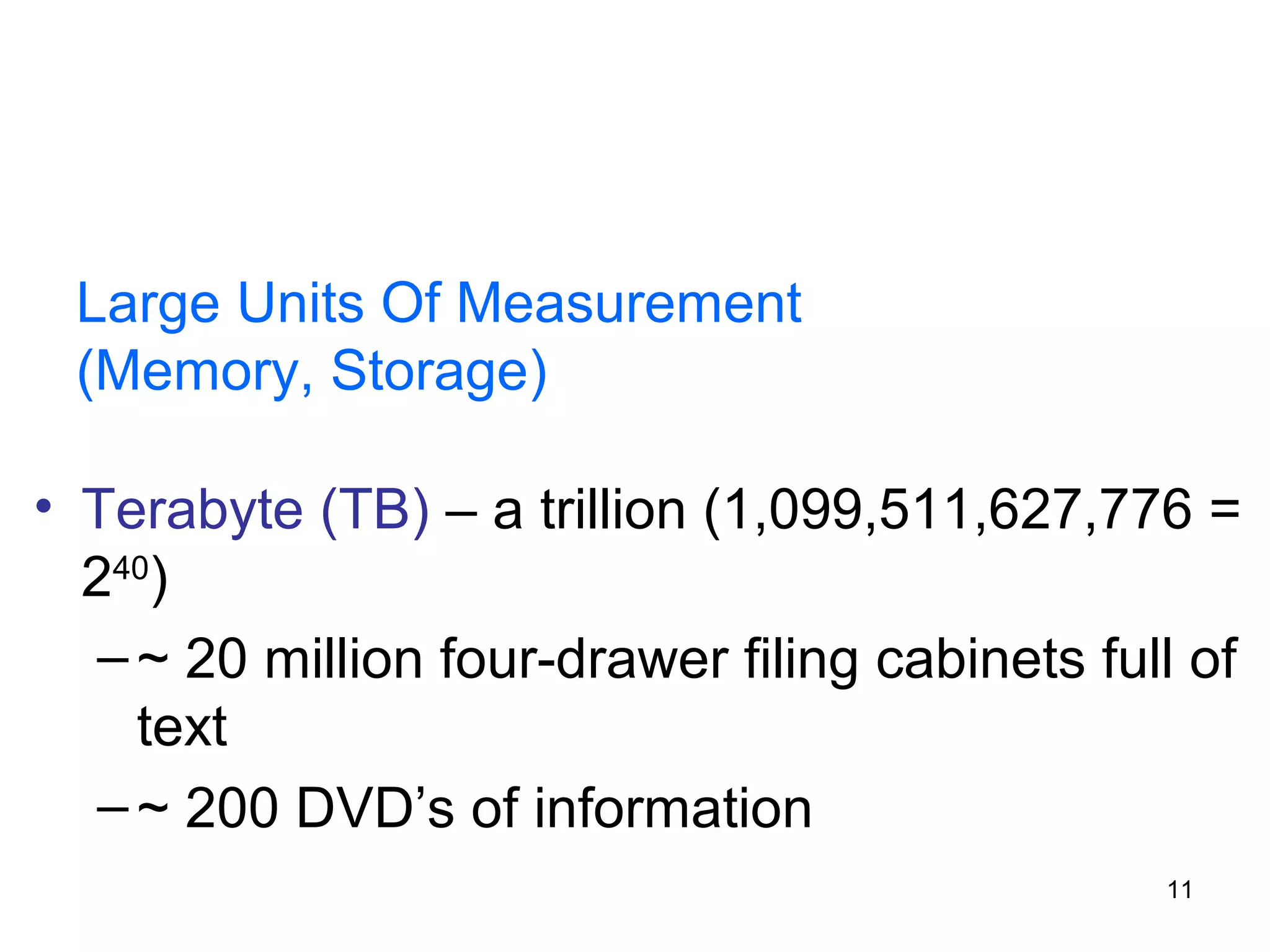
• Terabyte (TB) – a trillion (1,099,511,627,776 =
240)
– ~ 20 million four-drawer filing cabinets full of
text
– ~ 200 DVD’s of information
11
CONTENTS
• Introduction
• RAM,ROM,PROM,EPROM
• Auxiliary Storage Devices-Magnetic
Tape, Hard Disk, Floppy Disk
• Optical Disks: CD-R Drive,CD-RW
disks,DVD,Blue ray Discs.
12
2. RAM,ROM,PROM,EPROM
• Memory Devices
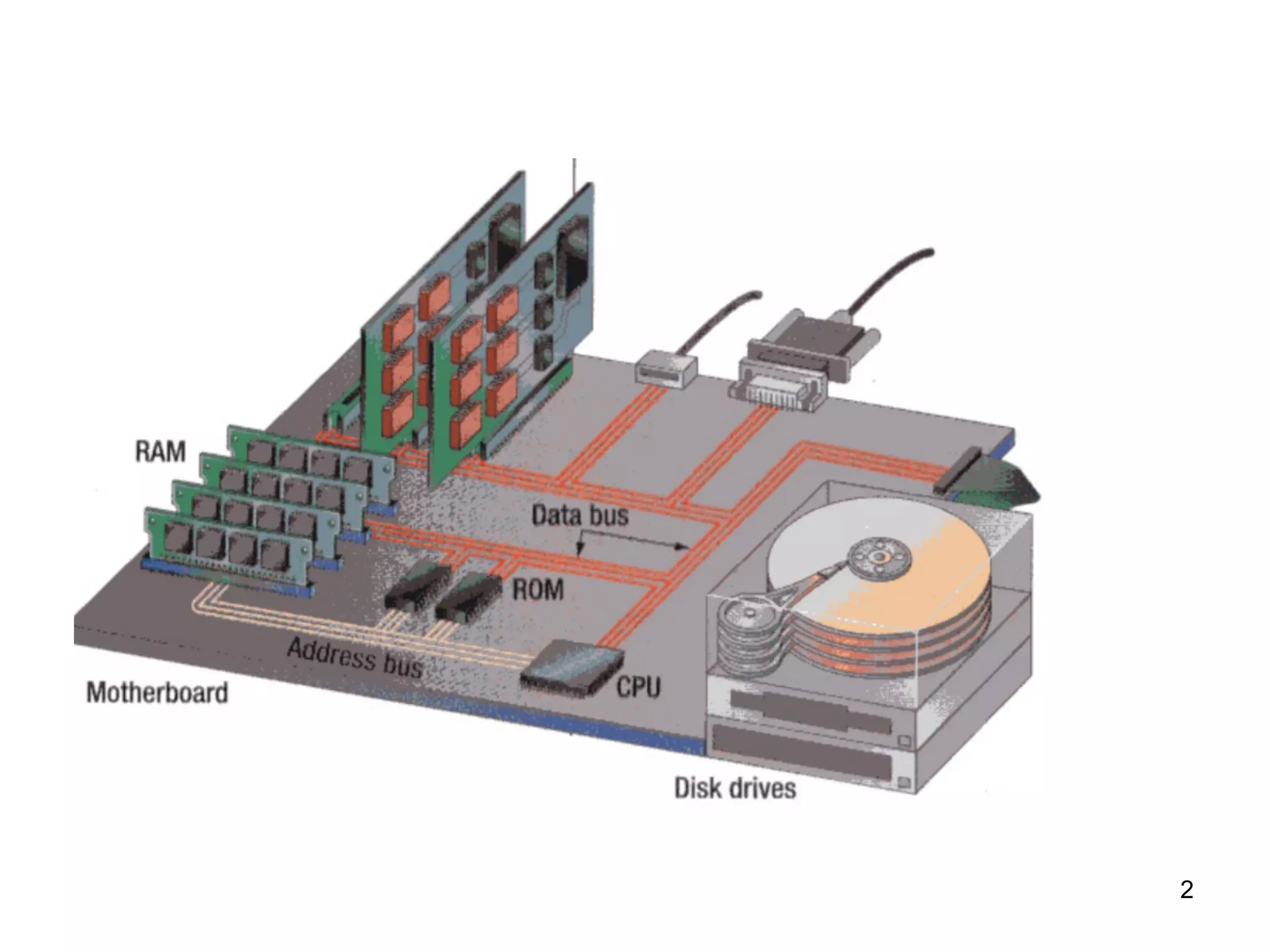
– Memory: Is one or more sets of chips
that store data/program instructions,
either temporarily or permanently .
– It is critical processing component in
any computer
– PCs use several different types

13
RAM,ROM,PROM,EPROM
• Memory Devices
– Two most important are
• RAM(Random Access Memory)
• ROM(Read-only Memory)

– They work in different ways and perform
distinct functions
– CPU Registers
– Cache Memory
14
RAM
•
•
•
•

RAM is packaged as a chip.
Basic storage unit is a cell (one bit per cell).
Multiple RAM chips form a memory.
Random Access Memory
Volatile
Used for temporary storage
Typical ranges 256 MB - 4 GB
• Random Access means direct access to any
part of memory

15
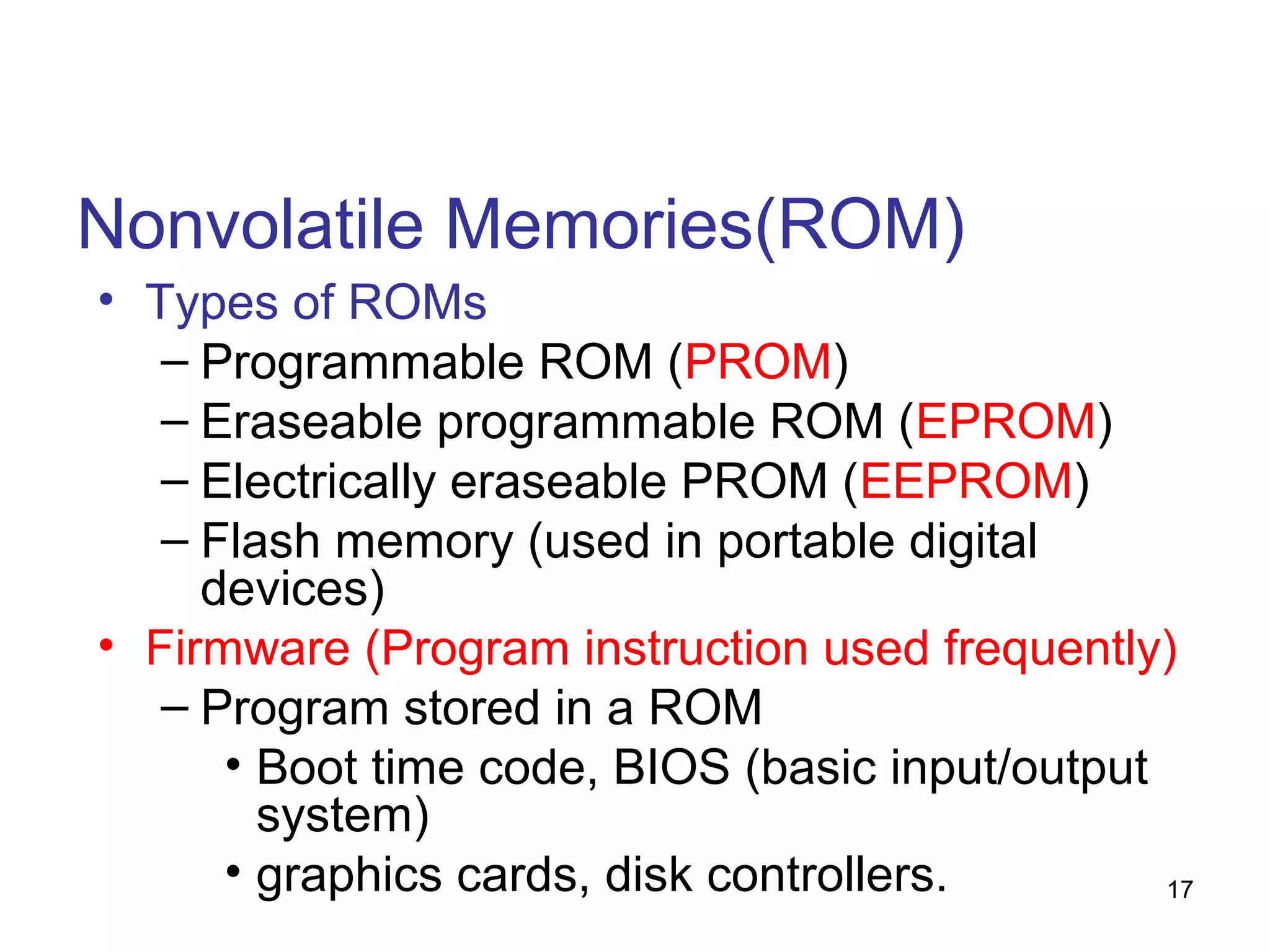
Nonvolatile Memories(ROM)
• DRAM and SRAM are volatile memories
– Lose information if powered off.
• Nonvolatile memories retain value even if
powered off.
– Generic name is read-only memory
(ROM).
– Misleading because some ROMs can
be read and modified.
16
Nonvolatile Memories(ROM)
• Types of ROMs
– Programmable ROM (PROM)
– Eraseable programmable ROM (EPROM)
– Electrically eraseable PROM (EEPROM)
– Flash memory (used in portable digital
devices)
• Firmware (Program instruction used frequently)
– Program stored in a ROM
• Boot time code, BIOS (basic input/output
system)
• graphics cards, disk controllers.
17
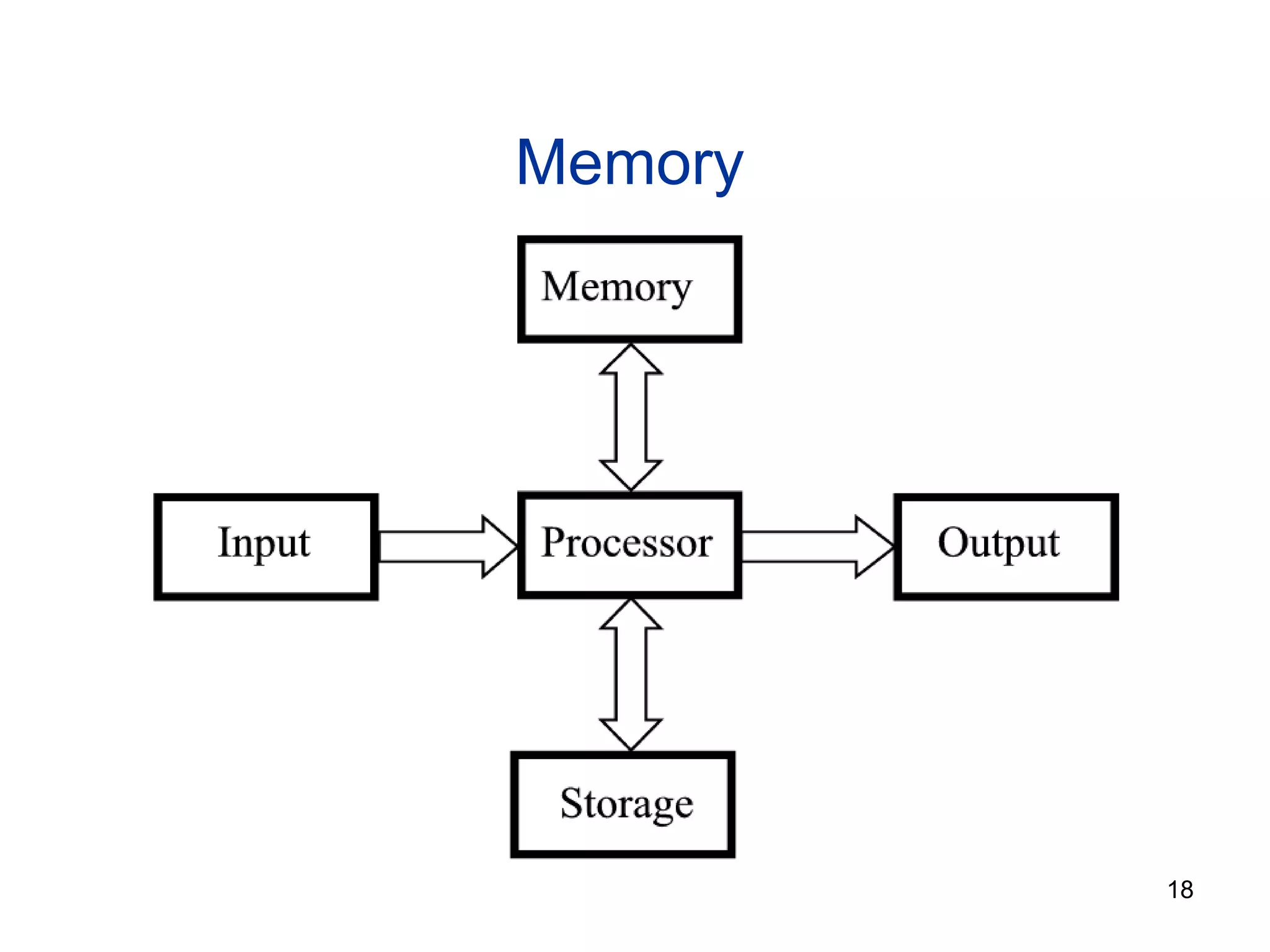
Memory

18
3. Storage Vs. Memory
Memory (e.g., RAM)
•Keep the information for a shorter period
of time (usually volatile)
•Faster
•More expensive
19
3. Storage Vs. Memory
Storage (e.g., Hard disk)
• The information is retained
longer (non-volatile)
• Slower
• Cheaper
20
CONTENTS
• Introduction
• RAM,ROM,PROM,EPROM
• Auxiliary Storage Devices-Magnetic
Tape, Hard Disk, Floppy Disk
• Optical Disks: CD-R Drive,CD-RW
disks,DVD,Blue ray Discs.
21
Categories Of Storage
• Magnetic
– Floppy disks
– Zip disks
– Hard drives
• Optical
– CD-ROM
– DVD
• Solid state storage devices
– USB Key (a very common form of solid state
storage)
22
Magnetic Storage
• Exploits duality of magnetism and
electricity
– Converts electrical signals into magnetic
charges
– Captures magnetic charge on a storage
medium
– Later regenerates electrical current from
stored magnetic charge

• Polarity of magnetic charge represents
bit values zero and one

23
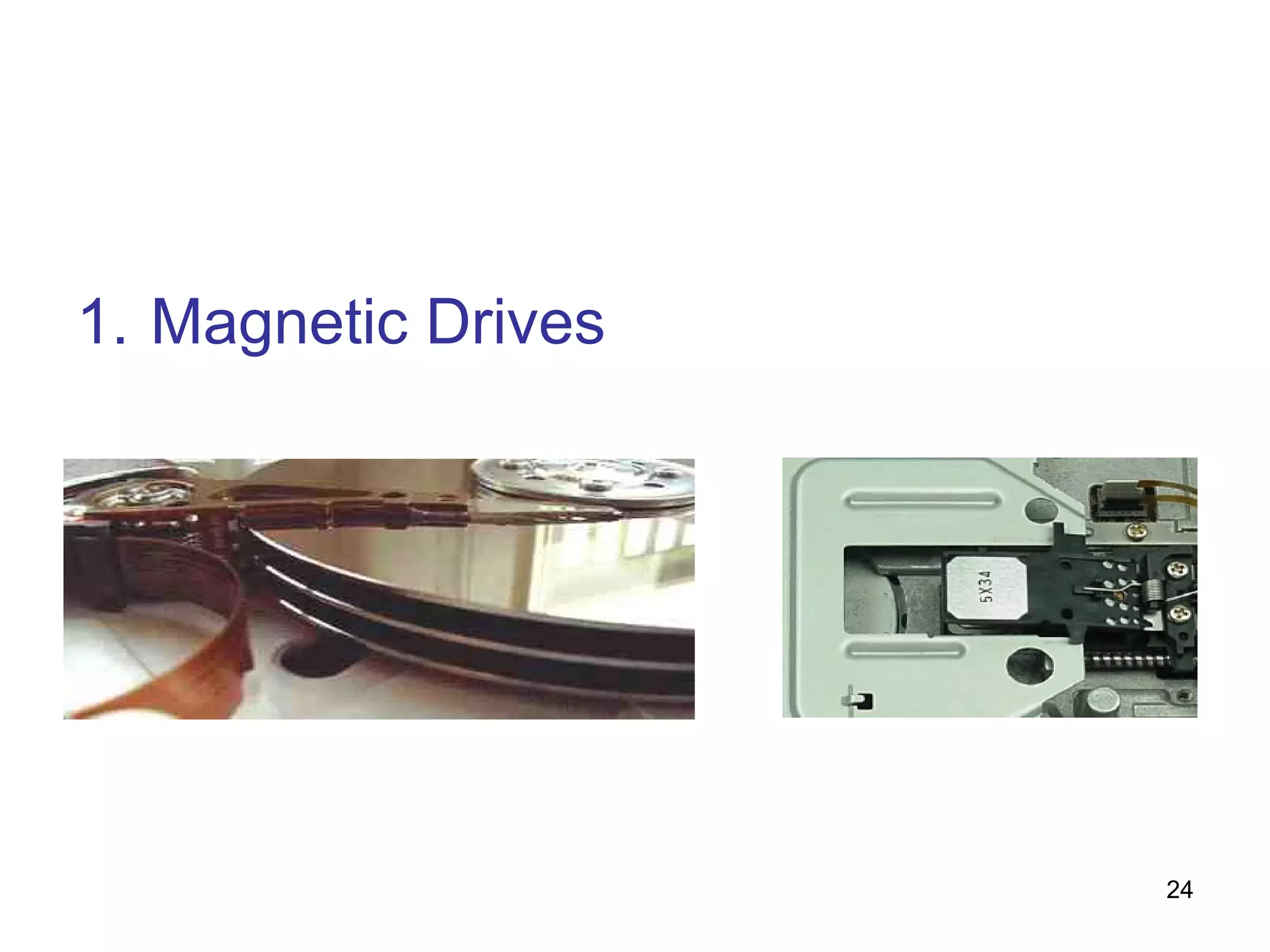
1. Magnetic Drives

24
Magnetic Disk
• Flat, circular platter with metallic coating
that is rotated beneath read/write heads
• Random access device; read/write head
can be moved to any location on the platter
• Hard disks and floppy disks
• Cost performance leader for generalpurpose
on-line secondary storage

25
1. Magnetic Drives: Storage Capacities
•Floppy disks
–~ 1 MB
•Hard drives
–~80 – 500 GB (TB is possible but very
rare)
26
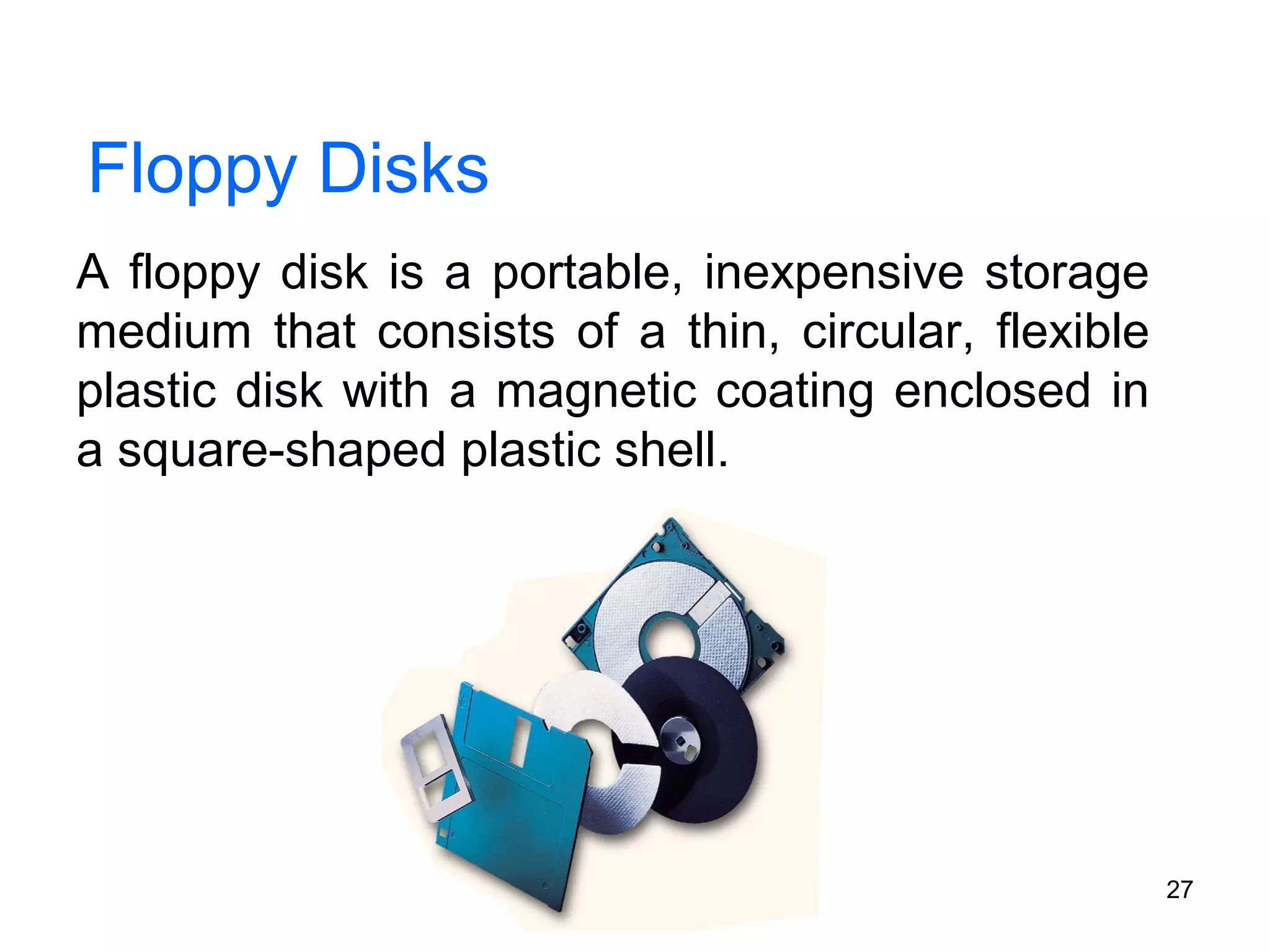
Floppy Disks
A floppy disk is a portable, inexpensive storage
medium that consists of a thin, circular, flexible
plastic disk with a magnetic coating enclosed in
a square-shaped plastic shell.

27
Structure Of Floppy Disks
• Initially Floppy disks were 8-inches wide, they
then shrank to 5.25 inches, and today the most
widely used folly disks are 3.5 inches wide and
can typically store 1.44 megabytes of data.
• A folly disk is a magnetic disk, which means that
it used magnetic patterns to store data.
• Data in floppy disks can be read from and
written to.
• Formatting is the process of preparing a disk
for reading and writing.
• A track is a narrow recording band that forms a
full circle on the surface of the disk.
28
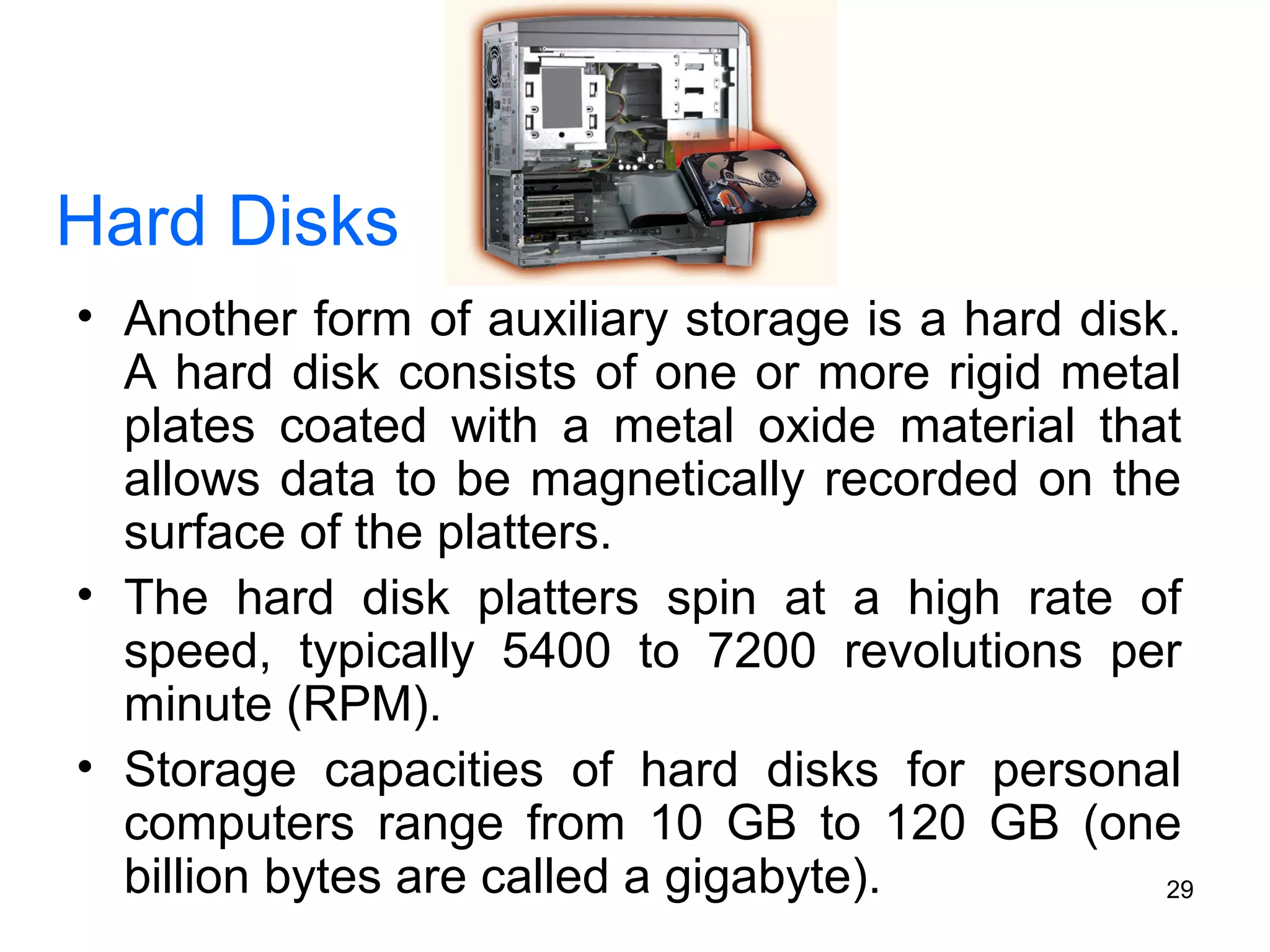
Hard Disks
• Another form of auxiliary storage is a hard disk.
A hard disk consists of one or more rigid metal
plates coated with a metal oxide material that
allows data to be magnetically recorded on the
surface of the platters.
• The hard disk platters spin at a high rate of
speed, typically 5400 to 7200 revolutions per
minute (RPM).
• Storage capacities of hard disks for personal
computers range from 10 GB to 120 GB (one
billion bytes are called a gigabyte).
29
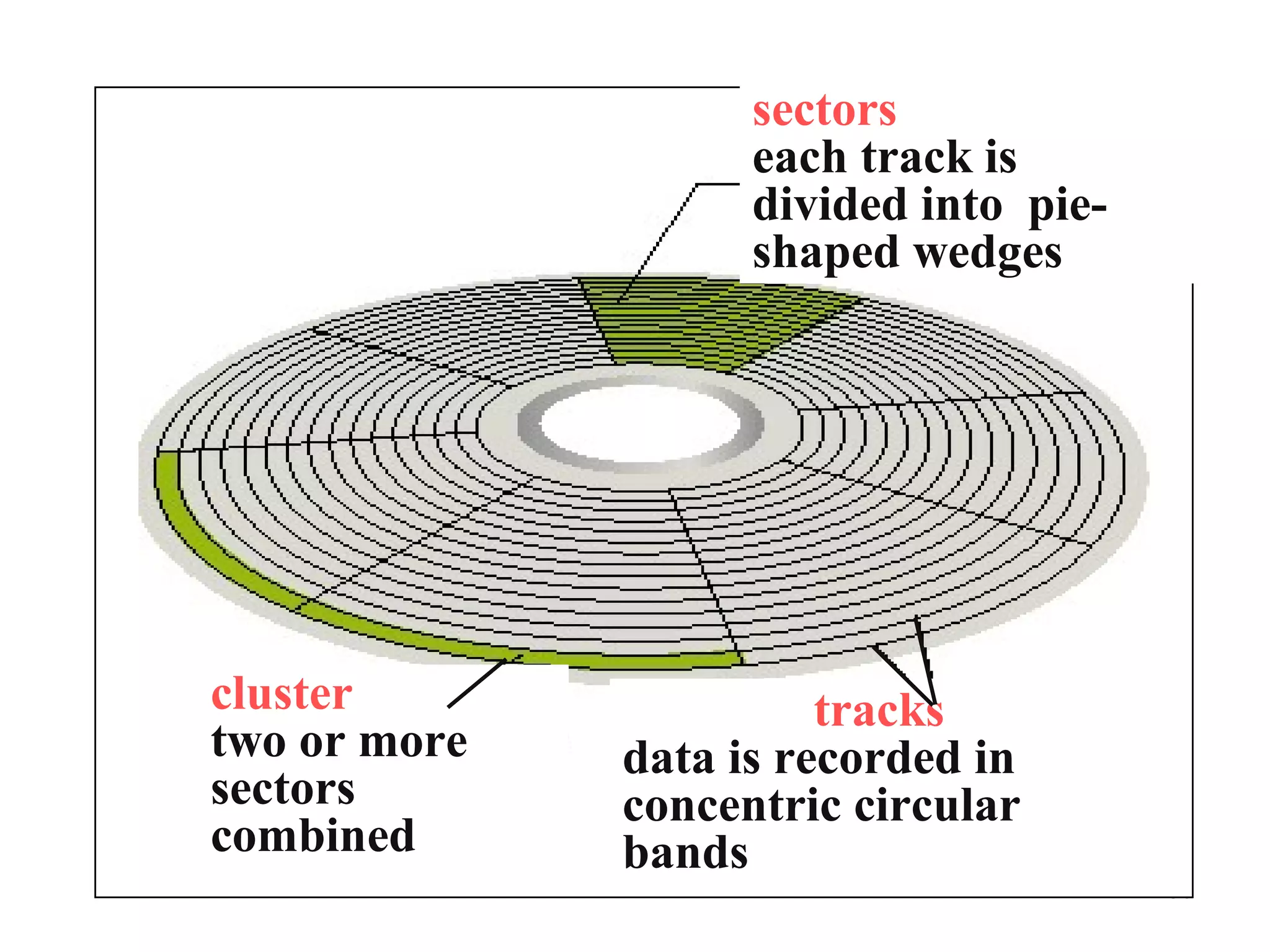
sectors
each track is
divided into pieshaped wedges

cluster
two or more
sectors
combined

tracks
data is recorded in
concentric circular
bands

30
Optical Mass Storage Devices
• Store bit values as variations in light reflection
• Higher areal density & longer data life than
magnetic storage
• Standardized and relatively inexpensive
• Uses: read-only storage with low performance
requirements, applications with high capacity
requirements & where portability in a
standardized format is needed
31
2. Optical Drives
•CD's (Compact Disk)

~ 700 MB storage
–CD-ROM (read only)
–CD-R: (record) to a CD
–CD-RW: can write and erase CD to reuse it (rewritable)
• DVD(Digital Video Disk)

32
Compact Discs (CD)
• A compact disk (CD), also called an optical disc,
is a flat round, portable storage medium that is
usually 4.75 inch in diameter.
• A CD-ROM (read only memory), is a compact
disc that used the same laser technology as
audio CDs for recording music. In addition it can
contain other types of data such as text,
graphics, and video.
• The capacity of a CD-ROM is 650 MB of data.
33
DVD (Digital Video Disk)
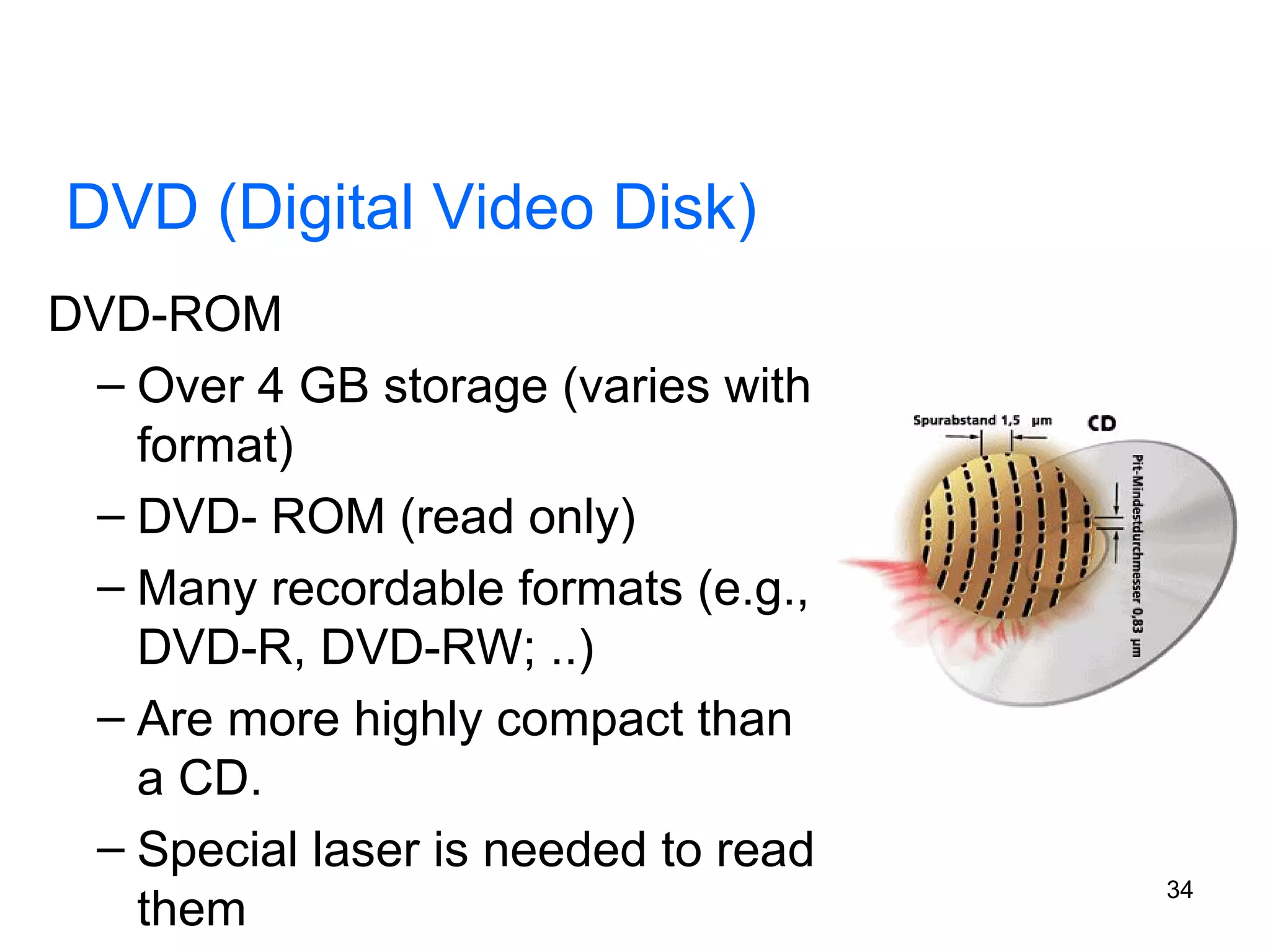
DVD-ROM
– Over 4 GB storage (varies with
format)
– DVD- ROM (read only)
– Many recordable formats (e.g.,
DVD-R, DVD-RW; ..)
– Are more highly compact than
a CD.
– Special laser is needed to read
them

34
Blu-ray Technology
• Name
Derived from the blue-violet
laser used to read and write
data.
– Developed by the Blu-ray
Disc Association with more
than 180 members.
• Dell
• Sony
• LG
35
Blu-ray Technology Cont.
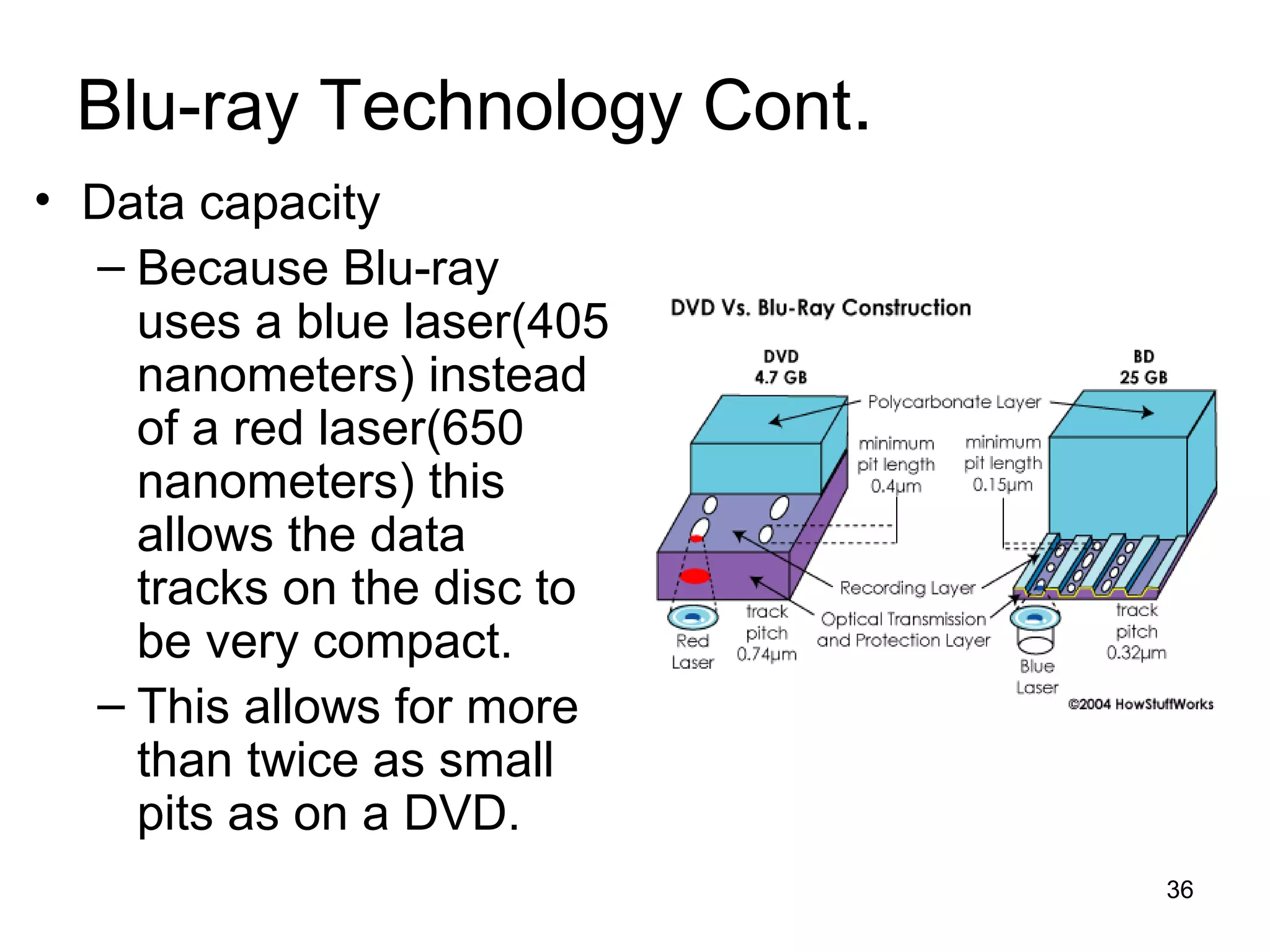
• Data capacity
– Because Blu-ray
uses a blue laser(405
nanometers) instead
of a red laser(650
nanometers) this
allows the data
tracks on the disc to
be very compact.
– This allows for more
than twice as small
pits as on a DVD.
36
Thank You
37

Compsystem2

  • 1.
    CONTENTS Introduction • RAM,ROM,PROM,EPROM • AuxiliaryStorage Devices-Magnetic Tape, Hard Disk, Floppy Disk • Optical Disks: CD-R Drive,CD-RW disks,DVD,Blue ray Discs. 1
  • 2.
  • 3.
  • 4.
    1. Introduction • MemoryDevices (RAM,ROM,PROM,EPROM) • Storage Devices (Auxiliary Storage Devices-Magnetic Tape, Hard Disk, Floppy Disk .Optical Disks: CD-R Drive,CD-RW disks,DVD,Blue ray Discs) 4
  • 5.
  • 6.
    Characteristics of StorageDevices • • • • • Speed Volatility Access method Portability Cost and capacity 6
  • 7.
    Basic Units OfMeasurement • Bit on OR off Binary digit Smallest unit of measurement Two possible values 0 1 •Byte •8 bits 7
  • 8.
    Small Units OfMeasurement (Processor And Memory Speed) Millisecond (ms) – a thousandth of a second (1/1,000 = 10-3) Microsecond (μs) - a millionth of a second (1/1,000,000 = 10-6) Nanosecond (ns) – a billionth of a second (1/1,000,000,000 = 10-9) 8
  • 9.
    Large Units OfMeasurement (Memory, Storage) • Note: powers of two are used because computer memory and storage are based on the basic unit (bit). • Kilobyte (KB) – a thousand bytes (1,024 = 2 10) • Megabyte (MB) - a million (1,048,576 = 220) 9
  • 10.
    Large Units OfMeasurement (Memory, Storage) • Gigabyte (GB) – a billion (1,073,741,824 = 2 30) – ~ A complete set of encyclopedias requires about 700 MB of storage – ~ 30 minutes of video (1/4 of the information stored on a typical DVD) 10
  • 11.
    Large Units OfMeasurement (Memory, Storage) • Terabyte (TB) – a trillion (1,099,511,627,776 = 240) – ~ 20 million four-drawer filing cabinets full of text – ~ 200 DVD’s of information 11
  • 12.
    CONTENTS • Introduction • RAM,ROM,PROM,EPROM •Auxiliary Storage Devices-Magnetic Tape, Hard Disk, Floppy Disk • Optical Disks: CD-R Drive,CD-RW disks,DVD,Blue ray Discs. 12
  • 13.
    2. RAM,ROM,PROM,EPROM • MemoryDevices – Memory: Is one or more sets of chips that store data/program instructions, either temporarily or permanently . – It is critical processing component in any computer – PCs use several different types 13
  • 14.
    RAM,ROM,PROM,EPROM • Memory Devices –Two most important are • RAM(Random Access Memory) • ROM(Read-only Memory) – They work in different ways and perform distinct functions – CPU Registers – Cache Memory 14
  • 15.
    RAM • • • • RAM is packagedas a chip. Basic storage unit is a cell (one bit per cell). Multiple RAM chips form a memory. Random Access Memory Volatile Used for temporary storage Typical ranges 256 MB - 4 GB • Random Access means direct access to any part of memory 15
  • 16.
    Nonvolatile Memories(ROM) • DRAMand SRAM are volatile memories – Lose information if powered off. • Nonvolatile memories retain value even if powered off. – Generic name is read-only memory (ROM). – Misleading because some ROMs can be read and modified. 16
  • 17.
    Nonvolatile Memories(ROM) • Typesof ROMs – Programmable ROM (PROM) – Eraseable programmable ROM (EPROM) – Electrically eraseable PROM (EEPROM) – Flash memory (used in portable digital devices) • Firmware (Program instruction used frequently) – Program stored in a ROM • Boot time code, BIOS (basic input/output system) • graphics cards, disk controllers. 17
  • 18.
  • 19.
    3. Storage Vs.Memory Memory (e.g., RAM) •Keep the information for a shorter period of time (usually volatile) •Faster •More expensive 19
  • 20.
    3. Storage Vs.Memory Storage (e.g., Hard disk) • The information is retained longer (non-volatile) • Slower • Cheaper 20
  • 21.
    CONTENTS • Introduction • RAM,ROM,PROM,EPROM •Auxiliary Storage Devices-Magnetic Tape, Hard Disk, Floppy Disk • Optical Disks: CD-R Drive,CD-RW disks,DVD,Blue ray Discs. 21
  • 22.
    Categories Of Storage •Magnetic – Floppy disks – Zip disks – Hard drives • Optical – CD-ROM – DVD • Solid state storage devices – USB Key (a very common form of solid state storage) 22
  • 23.
    Magnetic Storage • Exploitsduality of magnetism and electricity – Converts electrical signals into magnetic charges – Captures magnetic charge on a storage medium – Later regenerates electrical current from stored magnetic charge • Polarity of magnetic charge represents bit values zero and one 23
  • 24.
  • 25.
    Magnetic Disk • Flat,circular platter with metallic coating that is rotated beneath read/write heads • Random access device; read/write head can be moved to any location on the platter • Hard disks and floppy disks • Cost performance leader for generalpurpose on-line secondary storage 25
  • 26.
    1. Magnetic Drives:Storage Capacities •Floppy disks –~ 1 MB •Hard drives –~80 – 500 GB (TB is possible but very rare) 26
  • 27.
    Floppy Disks A floppydisk is a portable, inexpensive storage medium that consists of a thin, circular, flexible plastic disk with a magnetic coating enclosed in a square-shaped plastic shell. 27
  • 28.
    Structure Of FloppyDisks • Initially Floppy disks were 8-inches wide, they then shrank to 5.25 inches, and today the most widely used folly disks are 3.5 inches wide and can typically store 1.44 megabytes of data. • A folly disk is a magnetic disk, which means that it used magnetic patterns to store data. • Data in floppy disks can be read from and written to. • Formatting is the process of preparing a disk for reading and writing. • A track is a narrow recording band that forms a full circle on the surface of the disk. 28
  • 29.
    Hard Disks • Anotherform of auxiliary storage is a hard disk. A hard disk consists of one or more rigid metal plates coated with a metal oxide material that allows data to be magnetically recorded on the surface of the platters. • The hard disk platters spin at a high rate of speed, typically 5400 to 7200 revolutions per minute (RPM). • Storage capacities of hard disks for personal computers range from 10 GB to 120 GB (one billion bytes are called a gigabyte). 29
  • 30.
    sectors each track is dividedinto pieshaped wedges cluster two or more sectors combined tracks data is recorded in concentric circular bands 30
  • 31.
    Optical Mass StorageDevices • Store bit values as variations in light reflection • Higher areal density & longer data life than magnetic storage • Standardized and relatively inexpensive • Uses: read-only storage with low performance requirements, applications with high capacity requirements & where portability in a standardized format is needed 31
  • 32.
    2. Optical Drives •CD's(Compact Disk) ~ 700 MB storage –CD-ROM (read only) –CD-R: (record) to a CD –CD-RW: can write and erase CD to reuse it (rewritable) • DVD(Digital Video Disk) 32
  • 33.
    Compact Discs (CD) •A compact disk (CD), also called an optical disc, is a flat round, portable storage medium that is usually 4.75 inch in diameter. • A CD-ROM (read only memory), is a compact disc that used the same laser technology as audio CDs for recording music. In addition it can contain other types of data such as text, graphics, and video. • The capacity of a CD-ROM is 650 MB of data. 33
  • 34.
    DVD (Digital VideoDisk) DVD-ROM – Over 4 GB storage (varies with format) – DVD- ROM (read only) – Many recordable formats (e.g., DVD-R, DVD-RW; ..) – Are more highly compact than a CD. – Special laser is needed to read them 34
  • 35.
    Blu-ray Technology • Name Derivedfrom the blue-violet laser used to read and write data. – Developed by the Blu-ray Disc Association with more than 180 members. • Dell • Sony • LG 35
  • 36.
    Blu-ray Technology Cont. •Data capacity – Because Blu-ray uses a blue laser(405 nanometers) instead of a red laser(650 nanometers) this allows the data tracks on the disc to be very compact. – This allows for more than twice as small pits as on a DVD. 36
  • 37.

Editor's Notes