CONTENTS
• Introduction
• Input Devices
– Keyboard,mouse,joystick,scanners,digital
camera, bar code reader, touch
Sreeen,Speech input device (microphone)
• Output Devices
– Monitor , Speaker, Printers ( different
types)
1
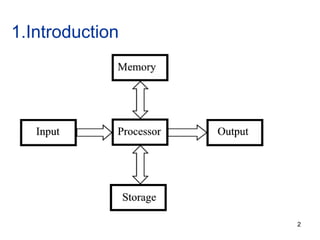
1.Introduction

2
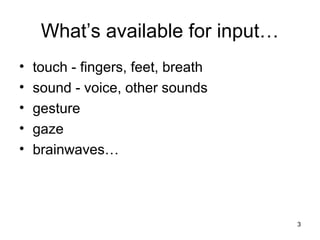
What’s available for input…
•
•
•
•
•

touch - fingers, feet, breath
sound - voice, other sounds
gesture
gaze
brainwaves…

3
and output…
•
•
•
•
•

textual information
visual images - photos, diagrams, icons
moving images
sounds - music, voice
Etc..

4
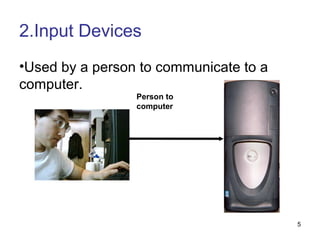
2.Input Devices
•Used by a person to communicate to a
computer.
Person to
computer

5
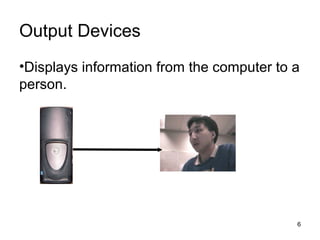
Output Devices
•Displays information from the computer to a
person.

6
Input Devices
•
•
•
•
•

Keyboard.
Mouse
Microphone
Digital Camera
Scanner

7
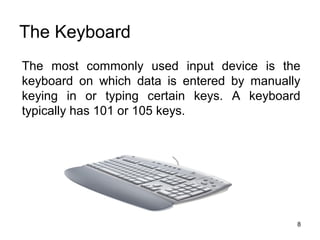
The Keyboard
The most commonly used input device is the
keyboard on which data is entered by manually
keying in or typing certain keys. A keyboard
typically has 101 or 105 keys.

8
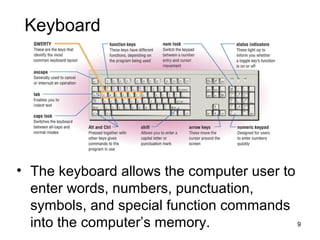
Keyboard

• The keyboard allows the computer user to
enter words, numbers, punctuation,
symbols, and special function commands
9
into the computer’s memory.
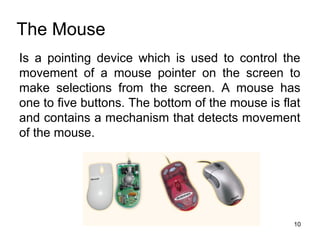
The Mouse
Is a pointing device which is used to control the
movement of a mouse pointer on the screen to
make selections from the screen. A mouse has
one to five buttons. The bottom of the mouse is flat
and contains a mechanism that detects movement
of the mouse.

10
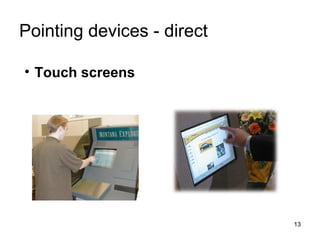
Pointing devices - direct
• Touch screens

13
Touch screens
• Often used for applications with occasional
use, for example
• Bank ATMs, Information Kiosks, etc.
• No extra hardware - used for input and for
output
• Can be precise to 1 pixel
• Good for menu choice - not so good for
other functions
• Intuitive to use
14
Touch screens
• BUT
• Tiring if at wrong angle (needs to be 30-45%
from horizontal)
• Get greasy, jammy
• Finger can obscure screen
• Alternative - use stylus to touch screen, or
lightpen
15
Indirect Pointing Devices
• Need more cognitive processing than direct
methods, but can be more efficient
•
•
•
•

mouse
tracker ball
track point
touchpad…

16
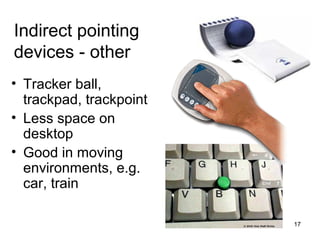
Indirect pointing
devices - other
• Tracker ball,
trackpad, trackpoint
• Less space on
desktop
• Good in moving
environments, e.g.
car, train
17
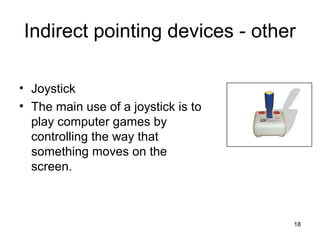
Indirect pointing devices - other
• Joystick
• The main use of a joystick is to
play computer games by
controlling the way that
something moves on the
screen.

18
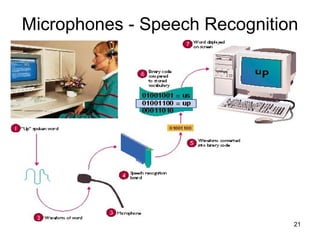
Microphones - Speech Recognition
•Use a microphone to talk to your
computer
•Add a sound card to your computer
•Sound card digitizes audio
input into 0/1s
•A speech recognition program can
process the input and convert it into
machine-recognized commands or
input
19
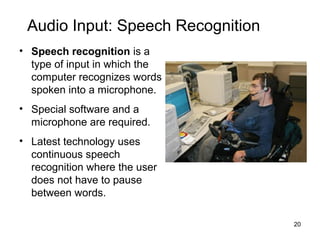
Audio Input: Speech Recognition
• Speech recognition is a
type of input in which the
computer recognizes words
spoken into a microphone.
• Special software and a
microphone are required.
• Latest technology uses
continuous speech
recognition where the user
does not have to pause
between words.
20
Microphones - Speech Recognition

21
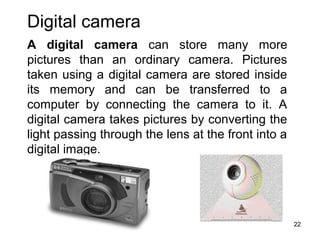
Digital camera
A digital camera can store many more
pictures than an ordinary camera. Pictures
taken using a digital camera are stored inside
its memory and can be transferred to a
computer by connecting the camera to it. A
digital camera takes pictures by converting the
light passing through the lens at the front into a
digital image.

22
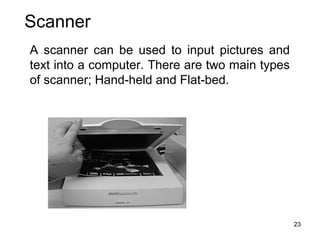
Scanner
A scanner can be used to input pictures and
text into a computer. There are two main types
of scanner; Hand-held and Flat-bed.

23
Light pen
•A light pen is a small ‘pen-shaped’ wand,
which contains light sensors.
•It is used to choose objects or commands on
the screen either by pressing it against the
surface of the screen or by pressing a small
switch on its side.
•A signal is sent to the computer, which then
works out the light pen’s exact location on the
screen.
•The advantage of a light pen is that it doesn’t
need a special screen or screen coating.
24
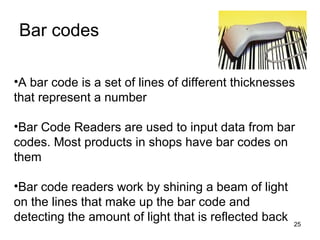
Bar codes
•A bar code is a set of lines of different thicknesses
that represent a number
•Bar Code Readers are used to input data from bar
codes. Most products in shops have bar codes on
them
•Bar code readers work by shining a beam of light
on the lines that make up the bar code and
detecting the amount of light that is reflected back

25
2. Output Types
•
•
•
•

Text output
Graphics output
Video output
Audio output

27
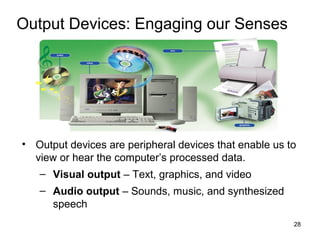
Output Devices: Engaging our Senses

• Output devices are peripheral devices that enable us to
view or hear the computer’s processed data.
– Visual output – Text, graphics, and video
– Audio output – Sounds, music, and synthesized
speech
28
Output Devices
•
•
•
•

Monitors
Printers
Speakers
Data Projectors

29
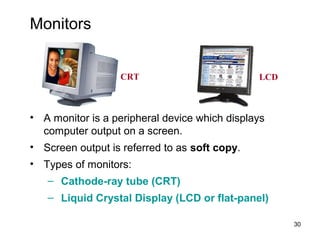
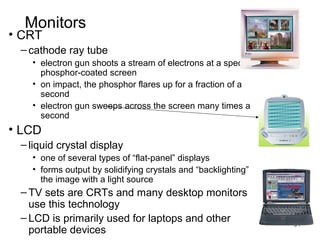
Monitors
CRT

LCD

• A monitor is a peripheral device which displays
computer output on a screen.
• Screen output is referred to as soft copy.
• Types of monitors:
– Cathode-ray tube (CRT)
– Liquid Crystal Display (LCD or flat-panel)
30
Monitors

• CRT

– cathode ray tube
• electron gun shoots a stream of electrons at a specially
phosphor-coated screen
• on impact, the phosphor flares up for a fraction of a
second
• electron gun sweeps across the screen many times a
second

• LCD
– liquid crystal display
• one of several types of “flat-panel” displays
• forms output by solidifying crystals and “backlighting”
the image with a light source

– TV sets are CRTs and many desktop monitors
use this technology
– LCD is primarily used for laptops and other
portable devices

31
Video Display Terminology
• Pixel
– picture element (smallest unit of an
image, basically a single dot on the
screen)

• Resolution
– number of pixels in the image
– Common resolution size is
1024x768
– Refresh rate
• how often a CRT’s electron gun rescans
• LCD displays do not use an electron
gun, so do not perform refreshing

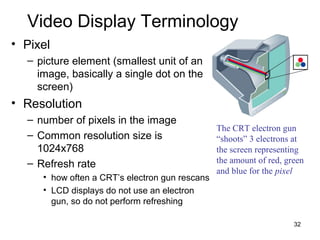
The CRT electron gun
“shoots” 3 electrons at
the screen representing
the amount of red, green
and blue for the pixel

32
Printers
• Ink Jet Printer
– least expensive, color, slower with a higher per page
cost than laser printers

• Laser Printer
– More expensive, faster, lower per page cost than ink
jet,

33
Printers
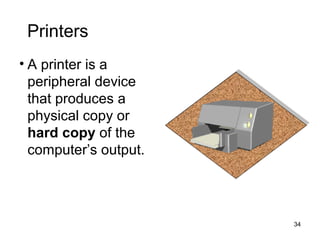
• A printer is a
peripheral device
that produces a
physical copy or
hard copy of the
computer’s output.

34
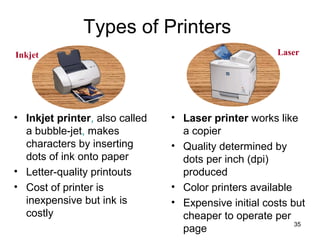
Types of Printers
Inkjet

• Inkjet printer, also called
a bubble-jet, makes
characters by inserting
dots of ink onto paper
• Letter-quality printouts
• Cost of printer is
inexpensive but ink is
costly

Laser

• Laser printer works like
a copier
• Quality determined by
dots per inch (dpi)
produced
• Color printers available
• Expensive initial costs but
cheaper to operate per
35
page
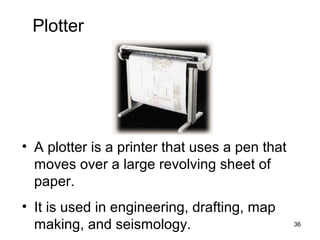
Plotter

• A plotter is a printer that uses a pen that
moves over a large revolving sheet of
paper.
• It is used in engineering, drafting, map
making, and seismology.

36
Audio Output: Sound Cards and
Speakers
• Audio output is the ability of the computer
to output sound.
• Two components are needed:
– Sound card – Plays contents of digitized
recordings
– Speakers – Attach to sound card
37
Summary
• Introduction
• Input Devices
– Keyboard,mouse,joystick,scanners,digital
camera, bar code reader, touch
Sreeen,Speech input device (microphone)
• Output Devices
– Monitor , Speaker, Printers ( different
types)
38

Input output painted

  • 1.
    CONTENTS • Introduction • InputDevices – Keyboard,mouse,joystick,scanners,digital camera, bar code reader, touch Sreeen,Speech input device (microphone) • Output Devices – Monitor , Speaker, Printers ( different types) 1
  • 2.
  • 3.
    What’s available forinput… • • • • • touch - fingers, feet, breath sound - voice, other sounds gesture gaze brainwaves… 3
  • 4.
    and output… • • • • • textual information visualimages - photos, diagrams, icons moving images sounds - music, voice Etc.. 4
  • 5.
    2.Input Devices •Used bya person to communicate to a computer. Person to computer 5
  • 6.
    Output Devices •Displays informationfrom the computer to a person. 6
  • 7.
  • 8.
    The Keyboard The mostcommonly used input device is the keyboard on which data is entered by manually keying in or typing certain keys. A keyboard typically has 101 or 105 keys. 8
  • 9.
    Keyboard • The keyboardallows the computer user to enter words, numbers, punctuation, symbols, and special function commands 9 into the computer’s memory.
  • 10.
    The Mouse Is apointing device which is used to control the movement of a mouse pointer on the screen to make selections from the screen. A mouse has one to five buttons. The bottom of the mouse is flat and contains a mechanism that detects movement of the mouse. 10
  • 11.
    Pointing devices -direct • Touch screens 13
  • 12.
    Touch screens • Oftenused for applications with occasional use, for example • Bank ATMs, Information Kiosks, etc. • No extra hardware - used for input and for output • Can be precise to 1 pixel • Good for menu choice - not so good for other functions • Intuitive to use 14
  • 13.
    Touch screens • BUT •Tiring if at wrong angle (needs to be 30-45% from horizontal) • Get greasy, jammy • Finger can obscure screen • Alternative - use stylus to touch screen, or lightpen 15
  • 14.
    Indirect Pointing Devices •Need more cognitive processing than direct methods, but can be more efficient • • • • mouse tracker ball track point touchpad… 16
  • 15.
    Indirect pointing devices -other • Tracker ball, trackpad, trackpoint • Less space on desktop • Good in moving environments, e.g. car, train 17
  • 16.
    Indirect pointing devices- other • Joystick • The main use of a joystick is to play computer games by controlling the way that something moves on the screen. 18
  • 17.
    Microphones - SpeechRecognition •Use a microphone to talk to your computer •Add a sound card to your computer •Sound card digitizes audio input into 0/1s •A speech recognition program can process the input and convert it into machine-recognized commands or input 19
  • 18.
    Audio Input: SpeechRecognition • Speech recognition is a type of input in which the computer recognizes words spoken into a microphone. • Special software and a microphone are required. • Latest technology uses continuous speech recognition where the user does not have to pause between words. 20
  • 19.
    Microphones - SpeechRecognition 21
  • 20.
    Digital camera A digitalcamera can store many more pictures than an ordinary camera. Pictures taken using a digital camera are stored inside its memory and can be transferred to a computer by connecting the camera to it. A digital camera takes pictures by converting the light passing through the lens at the front into a digital image. 22
  • 21.
    Scanner A scanner canbe used to input pictures and text into a computer. There are two main types of scanner; Hand-held and Flat-bed. 23
  • 22.
    Light pen •A lightpen is a small ‘pen-shaped’ wand, which contains light sensors. •It is used to choose objects or commands on the screen either by pressing it against the surface of the screen or by pressing a small switch on its side. •A signal is sent to the computer, which then works out the light pen’s exact location on the screen. •The advantage of a light pen is that it doesn’t need a special screen or screen coating. 24
  • 23.
    Bar codes •A barcode is a set of lines of different thicknesses that represent a number •Bar Code Readers are used to input data from bar codes. Most products in shops have bar codes on them •Bar code readers work by shining a beam of light on the lines that make up the bar code and detecting the amount of light that is reflected back 25
  • 24.
    2. Output Types • • • • Textoutput Graphics output Video output Audio output 27
  • 25.
    Output Devices: Engagingour Senses • Output devices are peripheral devices that enable us to view or hear the computer’s processed data. – Visual output – Text, graphics, and video – Audio output – Sounds, music, and synthesized speech 28
  • 26.
  • 27.
    Monitors CRT LCD • A monitoris a peripheral device which displays computer output on a screen. • Screen output is referred to as soft copy. • Types of monitors: – Cathode-ray tube (CRT) – Liquid Crystal Display (LCD or flat-panel) 30
  • 28.
    Monitors • CRT – cathoderay tube • electron gun shoots a stream of electrons at a specially phosphor-coated screen • on impact, the phosphor flares up for a fraction of a second • electron gun sweeps across the screen many times a second • LCD – liquid crystal display • one of several types of “flat-panel” displays • forms output by solidifying crystals and “backlighting” the image with a light source – TV sets are CRTs and many desktop monitors use this technology – LCD is primarily used for laptops and other portable devices 31
  • 29.
    Video Display Terminology •Pixel – picture element (smallest unit of an image, basically a single dot on the screen) • Resolution – number of pixels in the image – Common resolution size is 1024x768 – Refresh rate • how often a CRT’s electron gun rescans • LCD displays do not use an electron gun, so do not perform refreshing The CRT electron gun “shoots” 3 electrons at the screen representing the amount of red, green and blue for the pixel 32
  • 30.
    Printers • Ink JetPrinter – least expensive, color, slower with a higher per page cost than laser printers • Laser Printer – More expensive, faster, lower per page cost than ink jet, 33
  • 31.
    Printers • A printeris a peripheral device that produces a physical copy or hard copy of the computer’s output. 34
  • 32.
    Types of Printers Inkjet •Inkjet printer, also called a bubble-jet, makes characters by inserting dots of ink onto paper • Letter-quality printouts • Cost of printer is inexpensive but ink is costly Laser • Laser printer works like a copier • Quality determined by dots per inch (dpi) produced • Color printers available • Expensive initial costs but cheaper to operate per 35 page
  • 33.
    Plotter • A plotteris a printer that uses a pen that moves over a large revolving sheet of paper. • It is used in engineering, drafting, map making, and seismology. 36
  • 34.
    Audio Output: SoundCards and Speakers • Audio output is the ability of the computer to output sound. • Two components are needed: – Sound card – Plays contents of digitized recordings – Speakers – Attach to sound card 37
  • 35.
    Summary • Introduction • InputDevices – Keyboard,mouse,joystick,scanners,digital camera, bar code reader, touch Sreeen,Speech input device (microphone) • Output Devices – Monitor , Speaker, Printers ( different types) 38