Introduction to Business

MARKETING STRATEGY
Chapter # 13
Shafayet Ullah
SECTION: A3 and A4
Marketing
Marketing is the process of determining
customer needs and wants and then
providing customers with goods and
services that meet or exceed their
expectations.
Market
Market is a place where Actual Buyers
and Actual Sellers interact with each
other in order to exchange something of
value.
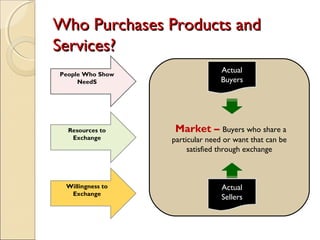
Who Purchases Products and
Services?
People Who Show
NeedS

Resources to
Exchange

Willingness to
Exchange

Actual
Buyers

Market – Buyers who share a
particular need or want that can be
satisfied through exchange

Actual
Sellers
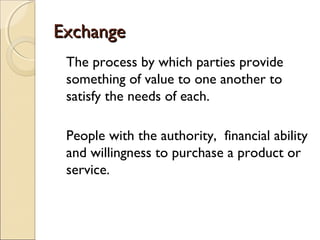
Exchange
The process by which parties provide
something of value to one another to
satisfy the needs of each.
People with the authority, financial ability
and willingness to purchase a product or
service.
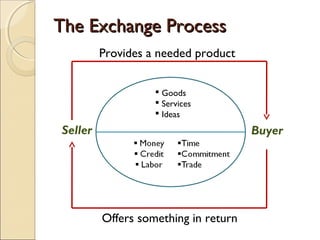
The Exchange Process
Provides a needed product
 Goods
 Services
 Ideas

Seller

Buyer

Offers something in return
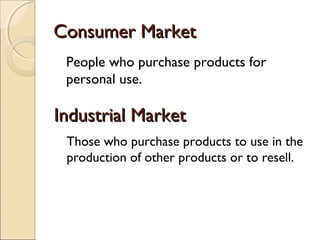
Consumer Market
People who purchase products for
personal use.

Industrial Market
Those who purchase products to use in the
production of other products or to resell.
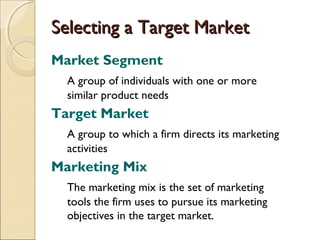
Selecting a Target Market
Market Segment
A group of individuals with one or more
similar product needs

Target Market
A group to which a firm directs its marketing
activities

Marketing Mix
The marketing mix is the set of marketing
tools the firm uses to pursue its marketing
objectives in the target market.
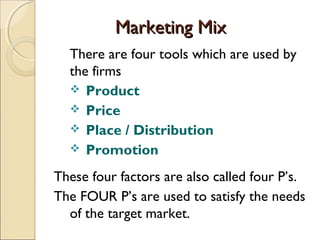
Marketing Mix
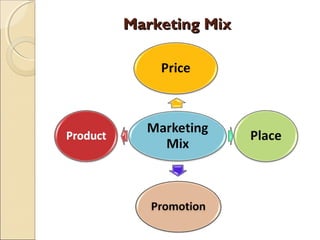
There are four tools which are used by
the firms
 Product
 Price
 Place / Distribution
 Promotion
These four factors are also called four P’s.
The FOUR P’s are used to satisfy the needs
of the target market.
Marketing Mix
Marketing Mix
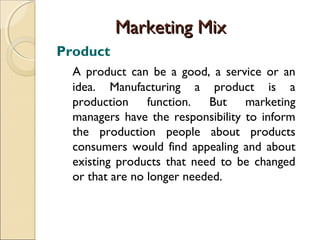
Product
A product can be a good, a service or an
idea. Manufacturing a product is a
production function. But marketing
managers have the responsibility to inform
the production people about products
consumers would find appealing and about
existing products that need to be changed
or that are no longer needed.
Marketing Mix
Price
Once a firm develops a product, it must set
a price. Pricing requires crucial decision
making because price is very visible to the
consumer and is closely tied a company
profit.
Marketing Mix
Place / Distribution
Even a terrific product, priced right, can fail
if it is not available where and when the
consumer wants it. Distribution of
products, a complex process, involves
decisions about transportation, storage and
store selection.
Marketing Mix
Promotion
Before consumer can purchase a product,
consumers must know about its availability,
its characteristics or benefits and where it
can be purchases. Promotion, consisting of
advertising,
personal
selling,
sales
promotion and publicity informs or reminds
the target market about a product and tries
to persuade consumers to buy or adopt it.
Product Life Cycle
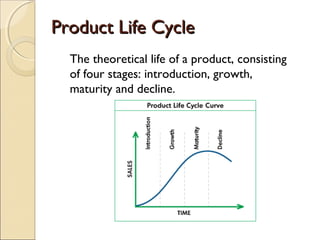
The theoretical life of a product, consisting
of four stages: introduction, growth,
maturity and decline.
Product Life Cycle
Introduction
A period of slow sales growth as product is
introduced in the market. Profits are
nonexistent because of heavy expenses
incurred with product introduction.

Growth
A period of rapid market acceptance and
substantial profit improvement.
Product Life Cycle
Maturity
A period of a slowdown in sales growth
because the product has achieved
acceptance by most potential buyers.
Profits stabilize or decline because of
increased competition.

Decline
The period when sales slow a downward
drift and loss occurs.
Product Promotion
The communication of favorable, persuasive
information about a firm or product in
order to influence potential buyers

Promotion Mix
The combination of advertising, personal
selling, sales promotion and publicity used
to promote a specific product.
Product Promotion
Advertising
A paid form of non-personal communication
to a target audience through a mass medium
such as television, newspaper or magazines

Personal Selling
Person-to-person communication with one of
more prospective customers in order to make
a sale
Product Promotion
Sales Promotion
An activities that offers customers or
marketing intermediaries direct incentives
for purchasing a product

Publicity
A non-personal form of communication
transmitted on news story form and not
paid for directly by a sponsor.
THE END

Chapter -13_-_marketing_strategy

  • 1.
    Introduction to Business MARKETINGSTRATEGY Chapter # 13 Shafayet Ullah SECTION: A3 and A4
  • 2.
    Marketing Marketing is theprocess of determining customer needs and wants and then providing customers with goods and services that meet or exceed their expectations.
  • 3.
    Market Market is aplace where Actual Buyers and Actual Sellers interact with each other in order to exchange something of value.
  • 4.
    Who Purchases Productsand Services? People Who Show NeedS Resources to Exchange Willingness to Exchange Actual Buyers Market – Buyers who share a particular need or want that can be satisfied through exchange Actual Sellers
  • 5.
    Exchange The process bywhich parties provide something of value to one another to satisfy the needs of each. People with the authority, financial ability and willingness to purchase a product or service.
  • 6.
    The Exchange Process Providesa needed product  Goods  Services  Ideas Seller Buyer Offers something in return
  • 7.
    Consumer Market People whopurchase products for personal use. Industrial Market Those who purchase products to use in the production of other products or to resell.
  • 8.
    Selecting a TargetMarket Market Segment A group of individuals with one or more similar product needs Target Market A group to which a firm directs its marketing activities Marketing Mix The marketing mix is the set of marketing tools the firm uses to pursue its marketing objectives in the target market.
  • 9.
    Marketing Mix There arefour tools which are used by the firms  Product  Price  Place / Distribution  Promotion These four factors are also called four P’s. The FOUR P’s are used to satisfy the needs of the target market.
  • 10.
  • 11.
    Marketing Mix Product A productcan be a good, a service or an idea. Manufacturing a product is a production function. But marketing managers have the responsibility to inform the production people about products consumers would find appealing and about existing products that need to be changed or that are no longer needed.
  • 12.
    Marketing Mix Price Once afirm develops a product, it must set a price. Pricing requires crucial decision making because price is very visible to the consumer and is closely tied a company profit.
  • 13.
    Marketing Mix Place /Distribution Even a terrific product, priced right, can fail if it is not available where and when the consumer wants it. Distribution of products, a complex process, involves decisions about transportation, storage and store selection.
  • 14.
    Marketing Mix Promotion Before consumercan purchase a product, consumers must know about its availability, its characteristics or benefits and where it can be purchases. Promotion, consisting of advertising, personal selling, sales promotion and publicity informs or reminds the target market about a product and tries to persuade consumers to buy or adopt it.
  • 15.
    Product Life Cycle Thetheoretical life of a product, consisting of four stages: introduction, growth, maturity and decline.
  • 16.
    Product Life Cycle Introduction Aperiod of slow sales growth as product is introduced in the market. Profits are nonexistent because of heavy expenses incurred with product introduction. Growth A period of rapid market acceptance and substantial profit improvement.
  • 17.
    Product Life Cycle Maturity Aperiod of a slowdown in sales growth because the product has achieved acceptance by most potential buyers. Profits stabilize or decline because of increased competition. Decline The period when sales slow a downward drift and loss occurs.
  • 18.
    Product Promotion The communicationof favorable, persuasive information about a firm or product in order to influence potential buyers Promotion Mix The combination of advertising, personal selling, sales promotion and publicity used to promote a specific product.
  • 19.
    Product Promotion Advertising A paidform of non-personal communication to a target audience through a mass medium such as television, newspaper or magazines Personal Selling Person-to-person communication with one of more prospective customers in order to make a sale
  • 20.
    Product Promotion Sales Promotion Anactivities that offers customers or marketing intermediaries direct incentives for purchasing a product Publicity A non-personal form of communication transmitted on news story form and not paid for directly by a sponsor.
  • 21.

Editor's Notes