Good morning
PINDBORGS
TUMOUR
SHRAVYA.M
CONTENTS
• Introduction
• Definition
• Classification
• Pathogenesis
• Clinical Features
• Radiographic Features
• Pathology –Macroscopy
- Microscopy
• IHC Findings
• Differential Diagnosis
• Treatment
• Prognosis & Prediction
• Recent Studies
• References
Introduction
Odontogenic tumours
• Odontogenic tumors are uncommon lesions that are derived
from the specialized dental tissues.
• Classification of odontogenic tumors has developed over the
last 150 years. The French physician Broca was the first to
propose a classification of tumors originating from dental
tissues.
• It was not until 1971, when a five-year collateral effort
organized by the World Health Organization [WHO], resulted
in the first consensus on taxonomy of odontogenic tumors.
• At the Editorial and Consensus Conference in Lyon, France in
July 2003, a final classification was developed based on the
REICHART revised version of the 1992 WHO classification.
• WHO Blue book -2005
(2005)
Pindborgs Tumour
• DEFINITION (WHO)
The calcifying epithelial odontogenic tumour (CEOT) is a locally
invasive epithelial odontogenic neoplasm, characterized by the
presence of amyloid material that may become calcified.
• First described by Dr Jens J Pindborg (1956)
Jens J Pindborg (left) & Robert Gorlin (right)
Pathogenesis
• Acc to pindborg et al – from Odontogenic Epithelium
• Chaudhry & associates - the cells had been derived from the
Reduced Enamel Epithelium of the closely related unerupted
tooth.
• The peripheral location strongly suggests the possibility that
the tumor arises from Rests Of The Dental Lamina or from
the Basal Cells of the oral epithelium.
•Mutations in PTCH gene
AND gene Ameloblastin
(not conclusive)
•From the cells of stratum
intermedium of the enamel
organ
EPIDEMIOLOGY
• ~1% Of all Odontogenic tumours
• Age : 20-60 .. Mean- 40yrs
• Male : female – 6:5
• Intraosseous tumours affect the mandible more often than
the maxilla with a ratio of 2:1.
• Premolar/molar region, although any site may be involved.
• Peripheral lesions usually occur in the anterior gingiva
CLINICAL FEATURES
• Painless mass, slow growth
• Associated with an impacted /unerupted tooth.
• Nasal congestion, epistaxis, headache
• The peripheral soft tissue or extraosseous, CEOT appears most
commonly as a painless, firm gingival mass
• Overlying mucosa may show ulceration due to local trauma.
• On surgical removal,an underlying bony depression or saucerization
has been reported in a few cases.
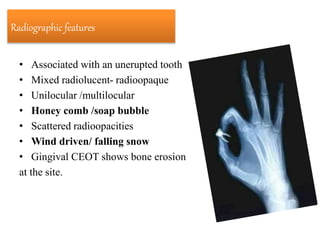
Radiographic features
• Associated with an unerupted tooth
• Mixed radiolucent- radioopaque
• Unilocular /multilocular
• Honey comb /soap bubble
• Scattered radioopacities
• Wind driven/ falling snow
• Gingival CEOT shows bone erosion
at the site.
Orthopantomograph showing
a CEOT in the left maxilla
around the roots of the third
molar with involvement of
the left sinus.
CT scan of the left maxillary
sinus containing
multiple,partly coalscent
radiopaque bodies
Transversal tomographs
showing a mixed
radiopaque/radiolucent
image
Radiograph of the left
mandibular molar region
showing an unerupted first
molar with a pericoronally
located CEOT.
Ceot case report
Macroscopy
•The intraosseously located CEOT is often
easily enucleated
• Size - 1 to 4 cm in diameter.
•Color from grayish white or yellow to
tanpink
•Bisecting the specimen usually reveals
calcified particles that makes a crunching
sound during cutting.
•The tumor may be solid
or contain minute cystic spaces.
•If associated with an
unerupted tooth, the crown
can be found embedded in
the tumour mass.
MICROSCOPY
• HISTOLOGIC DEFITION OF CEOT – (WHO 1992)
"a locally invasive epithelial neoplasm characterized by the
development of intraepithelial structures, probably of an
amyloid-like nature,which may become calcified and which
may be liberated as the cells break down."
“A locally invasive epithelial neoplasm consisting of
sheets and strands of polyhedral,pleomorphous cells
with well-defined cell borders often showing
intercellular bridges. A characteristic feature is an
amyloid-like material that may become calcified, is
formed intraepithelially and may be liberated as the
cells breakdown”.
H/P Findings
• EPITHELIAL CELLS:
are polyhedral in the form of sheets, strands or
nests. The cells are usually closely packed with few areas
showing intercellular bridges.
• They have indistinct outline, eosinophilic & homogenous
cytoplasm. The cells resemble the cells of stratum intermedium
of enamel organ.
• The nucleus is vesicular with distinct nucleoli, hyperchromatic
or pyknotic nuclei, even giant nuclei of 100nm & mitoses may
be seen rarely. If seen malignacy .
• EOSINOPHILIC MATERIAL:
is seen between the epithelial cells & in the
stroma.
• It is thought to be synthesized by the epithelial cells & is PAS
positive.
• Vickers has shown it to be amyloid as it stains positively with
Congo red, methly violet & fluorosces with thioflavine T.
• Electron microscopically the fibrillar arrangement in this
differs from that of the amyloid seen elsewhere. Therefore it
is thought to be altered amyloid or amyloid –like.
• CALCIFIC DEPOSITS:
are seen to be associated with
the amyloid deposits & can be
either calcified amyloid or
calcified collagen.
• As the amyloid gets calcified,
it looses it`s congo red
positivity.
• The calcifications can be in the form of lamellae formed by the
fusion of small calcific deposits at different foci & they are
refered to as "Liesegang rings".
• Cementum-like deposition is seen only after the amyloid is
fully calcified, probably the mesenchymal cells around the
calcified amyloid differentiates into cementoblasts. This
cementum-like substance has a basophilic appearance.
Photomicrograph showing anastomosing sheets of
epithelial,eosinophilic cells with cellular
and nuclear polymorphism (hematoxylin eosin
[H&EJ, x8O).
Higher magnification of epithelial sheet. Note
the nuclear polymorphism
and intercellular bridges (H&E, x 150).
Calcified amyloid-likebodies revealing
Liesegang rings. (H&E, x8O).
Variations In Histopathology
• Occurence of Amyloid-like material in CEOT
• Occurence of Cementum-like components of
CEOT stroma
• Occurence of Clear-Cells
• Occurence of Langerhans cells in CEOT
• Occurence of Myoepithelial Cells in CEOT
• Combined Epithelial Odontogenic Tumour
Occurence of Amyloid-like material
in CEOT
• The biologic and biochemical significance, as well as the
origin of this material, is far from being understood.
• An origin from light chain fragments of immunoglobulin
molecules has been proposed for some forms of systemic
amyloid.
• Another type is possibly associated with endocrine tumors
such as the medullary carcinoma of the thyroid derived from
the endocrine polypeptide cells of the amine precursor uptake
decarboxylation (APUD) system
• Ultrastructural studies have shown that this amyloid-like
material is composed of at least three different types of fibrils,
but that they have a smaller size than the fibers of
'conventional' amyloid.
• Some forms of amyloid are now suggested to arise from light
chain fragments of immunoglobulin molecules, called
immunamyloid, while another form is thought to originate
from cells of certain endocrine tumors (e.g. medullary
carcinoma of the thyroid) which may be derived from the
endocrine polypeptide cells of neural crest origin of the amine
precursor uptake and decarboxylation (APUD) system, called
APUD-amyloid.
• On the evidence available at present, the exact nature of the
amyloid like substance in the CEOT cannot be definitively
assessed.
Occurence of Cementum-like
components of CEOT stroma
• Mechanism is still unclear
• In the study by El-Labban- ' it was found that the outer layer of
the calcified lamellar bodies consisted of typical banded
calcified collagen with an arrangement like that seen in
cemental Sharpey fibers .
• Slootweg suggested that the amyloid-like material is an
inductive stimulus for the stroma cells to differentiate toward
production of a collagenous matrix that is destined to
mineralize and resembles cementum.
Occurence of Clear-Cells
• Sheets of classic polyhedral epithelium with abundant
eosinophilic cytoplasm may alternate with zones of epithelium
characterized by large cells with clear , foamy cytoplasm and
distinct cell borders.
• Yamaguchi et al believed that the clear tumor cells represent a
feature of cytodifferentiation rather than a simple degenerative
phenomenon.
CEOT with clear cell differentiation and scattered calcified
bodies
Occurence of Langerhans cells in
CEOT
• Only 2 cases reported
• Asano et al and Takata et al.
• In both cases the tumor cells were positive for S-100
protein,Lysozome,MT1, LN-3, and OKT6 antibodies, but not for
keratin antibody.
• Almost no calcification of homogenous eosinophilic materials was
observed.
• S-100-positive cells were identified as Langerhans cells based on the
finding of rod and tennis racket- shaped Birbeck granules
• LC in CEOT’s-antigen presentation or regression of the tumor.
Occurence of Myoepithelial Cells in
CEOT
• Ultrastructure - the tumor sheets and islands consisted of two
cell populations:- Classic polyhedral epithelial cells
Cells arranged peripherally with elongated
profiles and juxtaposed to the tumor epithelial cells. These cells
were found to extend basally around the tumor epithelium in
most of the epithelial islands
• The ultrastructural characteristics of these cells were
interpreted to be those of myoepithelial cells.
Combined Epithelial Odontogenic
Tumour
• In 1983 Damm et al first described the presence of CEOT-like
areas within two cases of adenomatoid odontogenic tumors
and named them combined epithelial odontogenic
tumors (CEOT/AOTs).
CEOT with AMELOBLASTOMA
CEOT without Calcification
-Aggressive Variant
Malignant CEOT
• Malignant CEOT shows nuclear pleomorphism with
frequent mitotic figures including tripolar figures are seen
and increased proliferative activity, as assessed by
immunostaining for Ki-67, 5times higher as compared to
typical CEOT’s, theres vascular invasion and increased
proliferating index.
• Only 2 cases reported
ULTRASTRUCTURE
• CEOT epithelial tumor cells consist of polyhedral epithelial
cells and myoepithelial-like cells, containing large numbers of
electron-dense tonofilament bundles, electron-dense bodies,
and fine lamina densa filaments.
• Amyloid-like materials compose fine filament sheets
measuring 10-12 nm in diameter and lamina densa fragment
aggregates, which are probably secreted by polyhedral
epithelial and myoepithelial-like cells.
• The fine filamentous materials are a form of amyloid, and their
formation results from lamina densa material degradation.
• Recently, the odontogenic ameloblast-associated protein
(ODAM) fibril-forming region was found in CEOT amyloid-like
materials, thus suggesting ODAM might have amyloidogenic
potential
• A number of dendritic cells, which are frequently found
among CEOT epithelial sheets, are strongly positive for S-
100 and CD-1a antisera.
• Ultrastructurally, these dendritic cells show indented nuclei
and Birbeck’s granules similar to Langerhans cells. Thus,
they are likely to be Langerhans cells, and play a role in
antigen presentation from epithelial tumor cell abortive
products
Differential diagnosis
• Ameloblastoma
• Histologically when dentine & enamel is present
- Regional
odontodysplasia
• Complete radiolucent lesions
- Dentigerous cyst,
Odontogenic keratocyst, ameloblastoma &
Odontogenic myxoma
• Mixed radiopaque & radiolucent lesions
Treatment
• From Surgical enucleation with macroscopically normal tissue
to hemimandibulectomy /hemimaxillectomy.
• Clear cell variant of ceot may prove to be a sign of increased
aggresiveness indicating more radical surgical approach.
• Maxillary CEOT requires
more aggresive resection when
compared to mandibular CEOT.
Prognosis
• Recurrence Rates -10% -15%
• Franklin and Pindborg 1976 recurrence rate of
24%
• Clear cell variant – 22%
Stains and markers
• Congo red , thioflavin T,Crystal violet,lugols iodine –
POSITIVE FOR AMYLOID but negative for COMASSIE
BLUE
• The clear polyhedral cells often exhibit stained granules after
periodic acid-Schiff staining. Therefore, these hyaline
materials are considered amyloid-like
• Epithelial cells express positivity to laminin 1 & 5 ,fibronectin
,cytokeratins and vimentin , KL1 ,TK 1, PKK1 but the
amyloid material does not. Epithelial cells are –ve to DESMIN
• In CEOT,
Amyloid +ve CD138 and amyloid A
Calcification +ve CK5, CD138, and amyloid A.
CEOT showed ↑ Ki-67 protein and minichromosome
maintenance complex component 2 (MCM-2) labeling
indices.
Calcifying epithelial odontogenic tumour.
Congo red staining shows green birefringence
when subjected to polarized light.
Recent studies
• The X-ray diffraction studies have shown the mineral phase
of CEOT to consist of apatite crystals & that the crystallinity
of the crystals to be higher than that of the bone apatite.
• The Electron Spin Resonance studies has shown a higher
crystallinity coefficient for these calcific deposits higher than
that of the the bone.
• All these imply that the calcification in CEOT has higher
crystalline structure than the cortical bone.
• Thus it is seen that the calcifications seen in CEOT is either
due to the dystrophic calcifications or due to the stromal
reaction /induction
Note:
• The use of fine-needle aspiration biopsy in
the diagnosis of CEOT was recently reported.
• 13 Cytologic smears were characterized by clusters, sheets,
and rare isolated pleomorphic cells of the squamoid type;
blocks of amorphous material encircled by fibroblasts; and
occasional calcifications.
• A cytologic diagnosis of CEOT was made, which was
confirmed by histopathologic examination.
References
• Shafers textbook of oral pathology – 7th edition
• Reichart P, Philipsen HP. Odontogenic tumours and allied
lesions.London: Quintessence Books, 2004.
• Lucas’s pathology of tumor of the oral tissue - HA Cawson
• Text Book of oral and maxillofacial pathology – Neville .
• Odontogenic tumours: a short version.
• Bouckaert MM, Raubenheimer EJ, Jacobs FJ. Calcifying epithelial
odontogenic tumor with intracranial extension: report of a case and
review of the literature. Oral Surg Oral Med Oral Pathol Oral Radiol
Endod 2000; 90: 656–62.
• Barnes L, Eveson JW, Reichart P, Sidransky D. WHO
classification of tumors. Pathology and genetics of head and
neck tumours. Lyon:IARC Press, 2005.
• Murphy CL, Kestler DP, Foster JS, et al. Odontogenic
ameloblastassociated protein nature of the amyloid found in
calcifying epithelial odontogenic tumors and unerupted tooth
follicles. Amyloid 2008; 15: 89–95
• New findings and controversies in odontogenic tumors-
Adalberto Mosqueda Taylor-Med Oral Patol Oral Cir Bucal.
2008 Sep1;13(9):E555-8.
• Bingham RA, Adrian JC. Combined epithelial odontogenic
tumor-adenomatoid odontogenic tumor and calcifying
epithelial odontogenic tumor: Report of a case. J Oral
Maxillofac Surg 1986;44:574-7
• Calcifying epithelial odontogenic tumor showing microscopic
features of potential malignant behavior April 27-May 2, 2001.
Yi-Shing Lisa Cheng,John M. Wright ,William R. Walstad,Maxwell D.
Finn
• A rare case of hybrid odontogenic tumor: Calcifying epithelial
odontogenic tumor combined with ameloblastoma, Vijay Wadhwan,
Preeti Sharma, Vishal Bansal 2015
• WHO
• Montes Ledesma C, Mosqueda Taylor A, Romero de Leon E, de la
Piedra Garza M, Goldberg Jaukin P, Portilla Robertson J.
Adenomatoid odontogenic tumour with features of calcifying
epithelial odontogenic tumour (The so-called combined epithelial
odontogenic tumour): clinico-pathological report of 12 cases. Eur J
Cancer B Oral Oncol 1993; 29B: 221-4.
….BULLETS
• Differential diagnosis (correct it)
• Metachromasia
• Principle of congo red
• Crystal violet property
• Y non-calcifying ceot recurrent ??
• Differentiate CEOT from COC
• Types of calcifications
• Areas other than oral cavity where calcifications
seen?

Pindborgs Tumour

  • 1.
  • 2.
  • 3.
    CONTENTS • Introduction • Definition •Classification • Pathogenesis • Clinical Features • Radiographic Features • Pathology –Macroscopy - Microscopy • IHC Findings • Differential Diagnosis • Treatment • Prognosis & Prediction • Recent Studies • References
  • 4.
    Introduction Odontogenic tumours • Odontogenictumors are uncommon lesions that are derived from the specialized dental tissues. • Classification of odontogenic tumors has developed over the last 150 years. The French physician Broca was the first to propose a classification of tumors originating from dental tissues. • It was not until 1971, when a five-year collateral effort organized by the World Health Organization [WHO], resulted in the first consensus on taxonomy of odontogenic tumors.
  • 5.
    • At theEditorial and Consensus Conference in Lyon, France in July 2003, a final classification was developed based on the REICHART revised version of the 1992 WHO classification. • WHO Blue book -2005
  • 6.
  • 7.
    Pindborgs Tumour • DEFINITION(WHO) The calcifying epithelial odontogenic tumour (CEOT) is a locally invasive epithelial odontogenic neoplasm, characterized by the presence of amyloid material that may become calcified. • First described by Dr Jens J Pindborg (1956)
  • 8.
    Jens J Pindborg(left) & Robert Gorlin (right)
  • 9.
    Pathogenesis • Acc topindborg et al – from Odontogenic Epithelium • Chaudhry & associates - the cells had been derived from the Reduced Enamel Epithelium of the closely related unerupted tooth. • The peripheral location strongly suggests the possibility that the tumor arises from Rests Of The Dental Lamina or from the Basal Cells of the oral epithelium.
  • 10.
    •Mutations in PTCHgene AND gene Ameloblastin (not conclusive) •From the cells of stratum intermedium of the enamel organ
  • 11.
    EPIDEMIOLOGY • ~1% Ofall Odontogenic tumours • Age : 20-60 .. Mean- 40yrs • Male : female – 6:5 • Intraosseous tumours affect the mandible more often than the maxilla with a ratio of 2:1. • Premolar/molar region, although any site may be involved. • Peripheral lesions usually occur in the anterior gingiva
  • 12.
    CLINICAL FEATURES • Painlessmass, slow growth • Associated with an impacted /unerupted tooth. • Nasal congestion, epistaxis, headache • The peripheral soft tissue or extraosseous, CEOT appears most commonly as a painless, firm gingival mass • Overlying mucosa may show ulceration due to local trauma. • On surgical removal,an underlying bony depression or saucerization has been reported in a few cases.
  • 14.
    Radiographic features • Associatedwith an unerupted tooth • Mixed radiolucent- radioopaque • Unilocular /multilocular • Honey comb /soap bubble • Scattered radioopacities • Wind driven/ falling snow • Gingival CEOT shows bone erosion at the site.
  • 15.
    Orthopantomograph showing a CEOTin the left maxilla around the roots of the third molar with involvement of the left sinus.
  • 16.
    CT scan ofthe left maxillary sinus containing multiple,partly coalscent radiopaque bodies
  • 17.
    Transversal tomographs showing amixed radiopaque/radiolucent image
  • 18.
    Radiograph of theleft mandibular molar region showing an unerupted first molar with a pericoronally located CEOT.
  • 19.
  • 21.
    Macroscopy •The intraosseously locatedCEOT is often easily enucleated • Size - 1 to 4 cm in diameter. •Color from grayish white or yellow to tanpink •Bisecting the specimen usually reveals calcified particles that makes a crunching sound during cutting. •The tumor may be solid or contain minute cystic spaces. •If associated with an unerupted tooth, the crown can be found embedded in the tumour mass.
  • 22.
    MICROSCOPY • HISTOLOGIC DEFITIONOF CEOT – (WHO 1992) "a locally invasive epithelial neoplasm characterized by the development of intraepithelial structures, probably of an amyloid-like nature,which may become calcified and which may be liberated as the cells break down."
  • 23.
    “A locally invasiveepithelial neoplasm consisting of sheets and strands of polyhedral,pleomorphous cells with well-defined cell borders often showing intercellular bridges. A characteristic feature is an amyloid-like material that may become calcified, is formed intraepithelially and may be liberated as the cells breakdown”.
  • 24.
    H/P Findings • EPITHELIALCELLS: are polyhedral in the form of sheets, strands or nests. The cells are usually closely packed with few areas showing intercellular bridges. • They have indistinct outline, eosinophilic & homogenous cytoplasm. The cells resemble the cells of stratum intermedium of enamel organ. • The nucleus is vesicular with distinct nucleoli, hyperchromatic or pyknotic nuclei, even giant nuclei of 100nm & mitoses may be seen rarely. If seen malignacy .
  • 25.
    • EOSINOPHILIC MATERIAL: isseen between the epithelial cells & in the stroma. • It is thought to be synthesized by the epithelial cells & is PAS positive. • Vickers has shown it to be amyloid as it stains positively with Congo red, methly violet & fluorosces with thioflavine T. • Electron microscopically the fibrillar arrangement in this differs from that of the amyloid seen elsewhere. Therefore it is thought to be altered amyloid or amyloid –like.
  • 26.
    • CALCIFIC DEPOSITS: areseen to be associated with the amyloid deposits & can be either calcified amyloid or calcified collagen. • As the amyloid gets calcified, it looses it`s congo red positivity.
  • 27.
    • The calcificationscan be in the form of lamellae formed by the fusion of small calcific deposits at different foci & they are refered to as "Liesegang rings". • Cementum-like deposition is seen only after the amyloid is fully calcified, probably the mesenchymal cells around the calcified amyloid differentiates into cementoblasts. This cementum-like substance has a basophilic appearance.
  • 28.
    Photomicrograph showing anastomosingsheets of epithelial,eosinophilic cells with cellular and nuclear polymorphism (hematoxylin eosin [H&EJ, x8O).
  • 29.
    Higher magnification ofepithelial sheet. Note the nuclear polymorphism and intercellular bridges (H&E, x 150).
  • 30.
  • 31.
    Variations In Histopathology •Occurence of Amyloid-like material in CEOT • Occurence of Cementum-like components of CEOT stroma • Occurence of Clear-Cells • Occurence of Langerhans cells in CEOT • Occurence of Myoepithelial Cells in CEOT • Combined Epithelial Odontogenic Tumour
  • 32.
    Occurence of Amyloid-likematerial in CEOT • The biologic and biochemical significance, as well as the origin of this material, is far from being understood. • An origin from light chain fragments of immunoglobulin molecules has been proposed for some forms of systemic amyloid. • Another type is possibly associated with endocrine tumors such as the medullary carcinoma of the thyroid derived from the endocrine polypeptide cells of the amine precursor uptake decarboxylation (APUD) system
  • 33.
    • Ultrastructural studieshave shown that this amyloid-like material is composed of at least three different types of fibrils, but that they have a smaller size than the fibers of 'conventional' amyloid. • Some forms of amyloid are now suggested to arise from light chain fragments of immunoglobulin molecules, called immunamyloid, while another form is thought to originate from cells of certain endocrine tumors (e.g. medullary carcinoma of the thyroid) which may be derived from the endocrine polypeptide cells of neural crest origin of the amine precursor uptake and decarboxylation (APUD) system, called APUD-amyloid. • On the evidence available at present, the exact nature of the amyloid like substance in the CEOT cannot be definitively assessed.
  • 34.
    Occurence of Cementum-like componentsof CEOT stroma • Mechanism is still unclear • In the study by El-Labban- ' it was found that the outer layer of the calcified lamellar bodies consisted of typical banded calcified collagen with an arrangement like that seen in cemental Sharpey fibers . • Slootweg suggested that the amyloid-like material is an inductive stimulus for the stroma cells to differentiate toward production of a collagenous matrix that is destined to mineralize and resembles cementum.
  • 35.
    Occurence of Clear-Cells •Sheets of classic polyhedral epithelium with abundant eosinophilic cytoplasm may alternate with zones of epithelium characterized by large cells with clear , foamy cytoplasm and distinct cell borders. • Yamaguchi et al believed that the clear tumor cells represent a feature of cytodifferentiation rather than a simple degenerative phenomenon.
  • 36.
    CEOT with clearcell differentiation and scattered calcified bodies
  • 37.
    Occurence of Langerhanscells in CEOT • Only 2 cases reported • Asano et al and Takata et al. • In both cases the tumor cells were positive for S-100 protein,Lysozome,MT1, LN-3, and OKT6 antibodies, but not for keratin antibody. • Almost no calcification of homogenous eosinophilic materials was observed. • S-100-positive cells were identified as Langerhans cells based on the finding of rod and tennis racket- shaped Birbeck granules • LC in CEOT’s-antigen presentation or regression of the tumor.
  • 38.
    Occurence of MyoepithelialCells in CEOT • Ultrastructure - the tumor sheets and islands consisted of two cell populations:- Classic polyhedral epithelial cells Cells arranged peripherally with elongated profiles and juxtaposed to the tumor epithelial cells. These cells were found to extend basally around the tumor epithelium in most of the epithelial islands • The ultrastructural characteristics of these cells were interpreted to be those of myoepithelial cells.
  • 39.
    Combined Epithelial Odontogenic Tumour •In 1983 Damm et al first described the presence of CEOT-like areas within two cases of adenomatoid odontogenic tumors and named them combined epithelial odontogenic tumors (CEOT/AOTs).
  • 40.
  • 41.
  • 42.
    Malignant CEOT • MalignantCEOT shows nuclear pleomorphism with frequent mitotic figures including tripolar figures are seen and increased proliferative activity, as assessed by immunostaining for Ki-67, 5times higher as compared to typical CEOT’s, theres vascular invasion and increased proliferating index. • Only 2 cases reported
  • 43.
    ULTRASTRUCTURE • CEOT epithelialtumor cells consist of polyhedral epithelial cells and myoepithelial-like cells, containing large numbers of electron-dense tonofilament bundles, electron-dense bodies, and fine lamina densa filaments. • Amyloid-like materials compose fine filament sheets measuring 10-12 nm in diameter and lamina densa fragment aggregates, which are probably secreted by polyhedral epithelial and myoepithelial-like cells.
  • 44.
    • The finefilamentous materials are a form of amyloid, and their formation results from lamina densa material degradation. • Recently, the odontogenic ameloblast-associated protein (ODAM) fibril-forming region was found in CEOT amyloid-like materials, thus suggesting ODAM might have amyloidogenic potential • A number of dendritic cells, which are frequently found among CEOT epithelial sheets, are strongly positive for S- 100 and CD-1a antisera. • Ultrastructurally, these dendritic cells show indented nuclei and Birbeck’s granules similar to Langerhans cells. Thus, they are likely to be Langerhans cells, and play a role in antigen presentation from epithelial tumor cell abortive products
  • 45.
    Differential diagnosis • Ameloblastoma •Histologically when dentine & enamel is present - Regional odontodysplasia • Complete radiolucent lesions - Dentigerous cyst, Odontogenic keratocyst, ameloblastoma & Odontogenic myxoma • Mixed radiopaque & radiolucent lesions
  • 46.
    Treatment • From Surgicalenucleation with macroscopically normal tissue to hemimandibulectomy /hemimaxillectomy. • Clear cell variant of ceot may prove to be a sign of increased aggresiveness indicating more radical surgical approach. • Maxillary CEOT requires more aggresive resection when compared to mandibular CEOT.
  • 48.
    Prognosis • Recurrence Rates-10% -15% • Franklin and Pindborg 1976 recurrence rate of 24% • Clear cell variant – 22%
  • 49.
    Stains and markers •Congo red , thioflavin T,Crystal violet,lugols iodine – POSITIVE FOR AMYLOID but negative for COMASSIE BLUE • The clear polyhedral cells often exhibit stained granules after periodic acid-Schiff staining. Therefore, these hyaline materials are considered amyloid-like • Epithelial cells express positivity to laminin 1 & 5 ,fibronectin ,cytokeratins and vimentin , KL1 ,TK 1, PKK1 but the amyloid material does not. Epithelial cells are –ve to DESMIN
  • 50.
    • In CEOT, Amyloid+ve CD138 and amyloid A Calcification +ve CK5, CD138, and amyloid A. CEOT showed ↑ Ki-67 protein and minichromosome maintenance complex component 2 (MCM-2) labeling indices.
  • 51.
    Calcifying epithelial odontogenictumour. Congo red staining shows green birefringence when subjected to polarized light.
  • 52.
    Recent studies • TheX-ray diffraction studies have shown the mineral phase of CEOT to consist of apatite crystals & that the crystallinity of the crystals to be higher than that of the bone apatite. • The Electron Spin Resonance studies has shown a higher crystallinity coefficient for these calcific deposits higher than that of the the bone. • All these imply that the calcification in CEOT has higher crystalline structure than the cortical bone. • Thus it is seen that the calcifications seen in CEOT is either due to the dystrophic calcifications or due to the stromal reaction /induction
  • 53.
    Note: • The useof fine-needle aspiration biopsy in the diagnosis of CEOT was recently reported. • 13 Cytologic smears were characterized by clusters, sheets, and rare isolated pleomorphic cells of the squamoid type; blocks of amorphous material encircled by fibroblasts; and occasional calcifications. • A cytologic diagnosis of CEOT was made, which was confirmed by histopathologic examination.
  • 54.
    References • Shafers textbookof oral pathology – 7th edition • Reichart P, Philipsen HP. Odontogenic tumours and allied lesions.London: Quintessence Books, 2004. • Lucas’s pathology of tumor of the oral tissue - HA Cawson • Text Book of oral and maxillofacial pathology – Neville . • Odontogenic tumours: a short version. • Bouckaert MM, Raubenheimer EJ, Jacobs FJ. Calcifying epithelial odontogenic tumor with intracranial extension: report of a case and review of the literature. Oral Surg Oral Med Oral Pathol Oral Radiol Endod 2000; 90: 656–62.
  • 55.
    • Barnes L,Eveson JW, Reichart P, Sidransky D. WHO classification of tumors. Pathology and genetics of head and neck tumours. Lyon:IARC Press, 2005. • Murphy CL, Kestler DP, Foster JS, et al. Odontogenic ameloblastassociated protein nature of the amyloid found in calcifying epithelial odontogenic tumors and unerupted tooth follicles. Amyloid 2008; 15: 89–95 • New findings and controversies in odontogenic tumors- Adalberto Mosqueda Taylor-Med Oral Patol Oral Cir Bucal. 2008 Sep1;13(9):E555-8. • Bingham RA, Adrian JC. Combined epithelial odontogenic tumor-adenomatoid odontogenic tumor and calcifying epithelial odontogenic tumor: Report of a case. J Oral Maxillofac Surg 1986;44:574-7
  • 56.
    • Calcifying epithelialodontogenic tumor showing microscopic features of potential malignant behavior April 27-May 2, 2001. Yi-Shing Lisa Cheng,John M. Wright ,William R. Walstad,Maxwell D. Finn • A rare case of hybrid odontogenic tumor: Calcifying epithelial odontogenic tumor combined with ameloblastoma, Vijay Wadhwan, Preeti Sharma, Vishal Bansal 2015 • WHO • Montes Ledesma C, Mosqueda Taylor A, Romero de Leon E, de la Piedra Garza M, Goldberg Jaukin P, Portilla Robertson J. Adenomatoid odontogenic tumour with features of calcifying epithelial odontogenic tumour (The so-called combined epithelial odontogenic tumour): clinico-pathological report of 12 cases. Eur J Cancer B Oral Oncol 1993; 29B: 221-4.
  • 58.
    ….BULLETS • Differential diagnosis(correct it) • Metachromasia • Principle of congo red • Crystal violet property • Y non-calcifying ceot recurrent ?? • Differentiate CEOT from COC • Types of calcifications • Areas other than oral cavity where calcifications seen?

Editor's Notes

  • #32 Clear cells of ceot r mucicarmine -ve
  • #44 REF : CURRENT CONCEPTS