Prof. Neeraj Bhargava
Mrs. Pooja Dixit
Department of Computer Science, School of Engineering & System Sciences
MDS University Ajmer, Rajasthan
 To minimize the given Boolean function,
 We draw a K Map according to the number of variables it
contains.
 We fill the K Map with 0’s and 1’s according to its function.
 Then, we minimize the function in accordance with the
following rules.
 Rule-01:
 We can either group 0’s with 0’s or 1’s with 1’s but we can not
group 0’s and 1’s together.
 X representing don’t care can be grouped with 0’s as well as 1’s.
 NOTE
 There is no need of separately grouping X’s i.e. they can be
ignored if all 0’s and 1’s are already grouped.
 Rule-02:
 Groups may overlap each other.
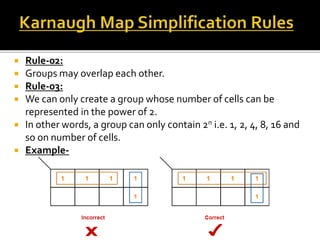
 Rule-03:
 We can only create a group whose number of cells can be
represented in the power of 2.
 In other words, a group can only contain 2n i.e. 1, 2, 4, 8, 16 and
so on number of cells.
 Example-
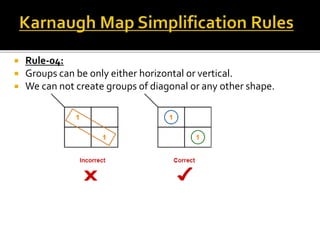
 Rule-04:
 Groups can be only either horizontal or vertical.
 We can not create groups of diagonal or any other shape.
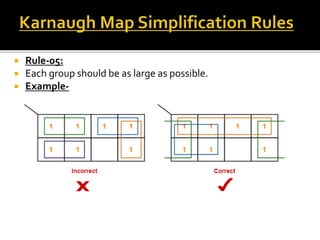
 Rule-05:
 Each group should be as large as possible.
 Example-
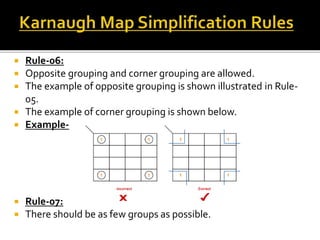
 Rule-06:
 Opposite grouping and corner grouping are allowed.
 The example of opposite grouping is shown illustrated in Rule-
05.
 The example of corner grouping is shown below.
 Example-
 Rule-07:
 There should be as few groups as possible.

Karnaugh Map Simplification Rules.pptx

  • 1.
    Prof. Neeraj Bhargava Mrs.Pooja Dixit Department of Computer Science, School of Engineering & System Sciences MDS University Ajmer, Rajasthan
  • 2.
     To minimizethe given Boolean function,  We draw a K Map according to the number of variables it contains.  We fill the K Map with 0’s and 1’s according to its function.  Then, we minimize the function in accordance with the following rules.  Rule-01:  We can either group 0’s with 0’s or 1’s with 1’s but we can not group 0’s and 1’s together.  X representing don’t care can be grouped with 0’s as well as 1’s.  NOTE  There is no need of separately grouping X’s i.e. they can be ignored if all 0’s and 1’s are already grouped.
  • 3.
     Rule-02:  Groupsmay overlap each other.  Rule-03:  We can only create a group whose number of cells can be represented in the power of 2.  In other words, a group can only contain 2n i.e. 1, 2, 4, 8, 16 and so on number of cells.  Example-
  • 4.
     Rule-04:  Groupscan be only either horizontal or vertical.  We can not create groups of diagonal or any other shape.
  • 5.
     Rule-05:  Eachgroup should be as large as possible.  Example-
  • 6.
     Rule-06:  Oppositegrouping and corner grouping are allowed.  The example of opposite grouping is shown illustrated in Rule- 05.  The example of corner grouping is shown below.  Example-  Rule-07:  There should be as few groups as possible.